The Broken Marketplace: Tackling America’s School-to-Work Crisis

Across the country, too many young people are doing everything right — working jobs, enrolling in training, and seeking advice — only to find themselves stuck. Despite their effort and ambition, the pathway to a stable, fulfilling adulthood has grown increasingly murky. New research from the Schultz Family Foundation and HarrisX puts a name to this disconnect: a broken marketplace. In this labor and education ecosystem, jobs go unfilled while talent goes underrecognized, and the traditional systems of guidance — school counselors, college degrees, even parental advice — no longer align with what the market demands. It’s a system that leaves too many behind — particularly young people from under-resourced communities, who are often navigating without a map.

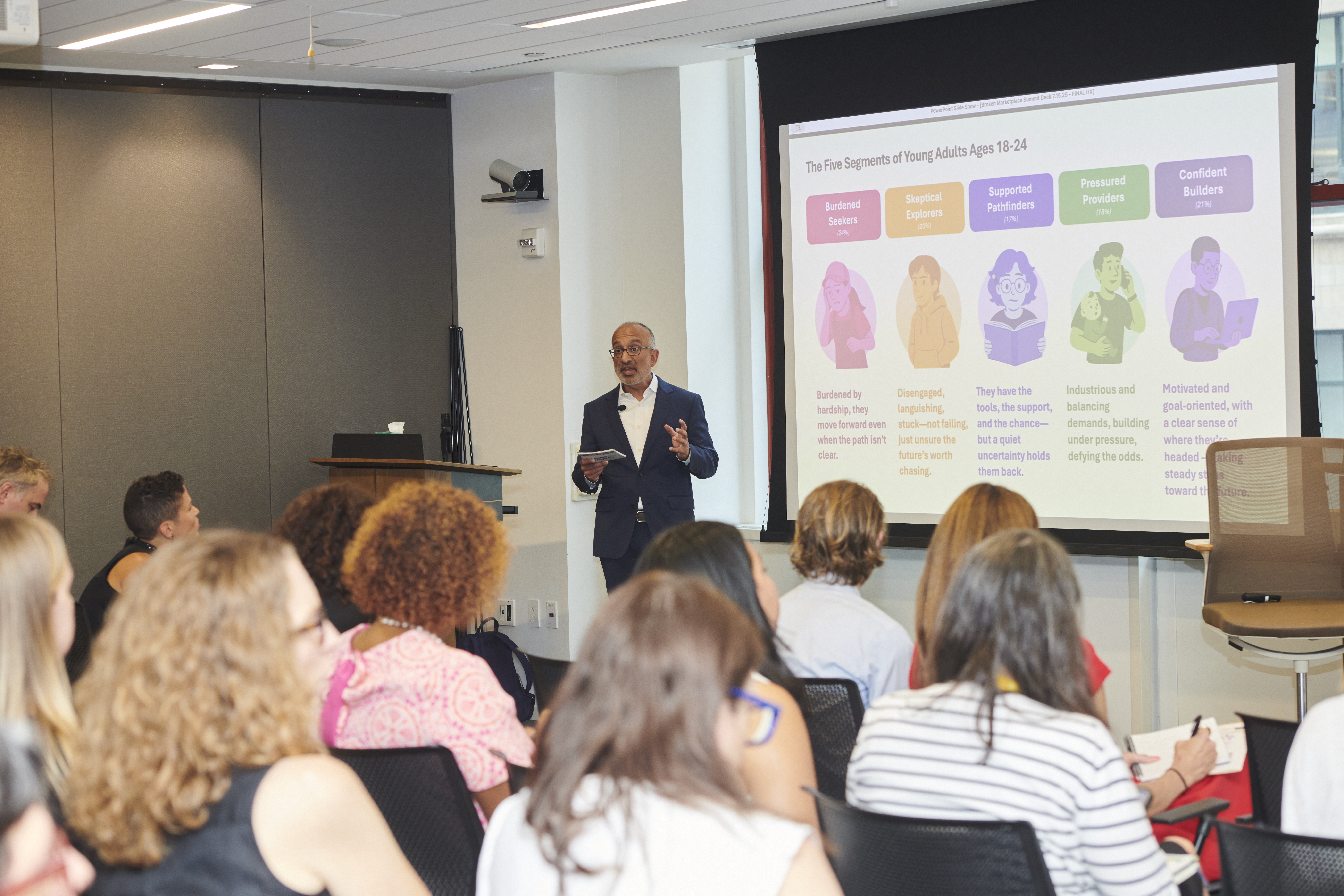
To surface solutions and spark collaboration, SFF teamed up with NationSwell and LinkedIn on July 15 to convene some of the leading thinkers, practitioners, and changemakers exploring what it will take to fix this broken marketplace. The conversation spanned everything from the promise and pitfalls of AI, to the cultural overvaluation of four-year degrees, to the structural barriers facing youth who are working hard but treading water. While the dialogue surfaced powerful models and bright spots, it also revealed a shared hunger for something deeper: a reimagined system that meets young people where they are, honors their full potential, and builds pathways that are truly navigable, equitable, and aligned with the future of work.

Below are some of the most salient insights that surfaced during the discussion — and a few questions we’re still asking.


Fast Stats:

  • 30 million young people in the U.S. are struggling, with roughly 15 million classified as underemployed or unemployed.
  • Only 8% of high schoolers feel confident about their post-graduation plans.
  • 86% of high school leaders say they recognize the importance of postsecondary planning — yet workforce readiness is still not meaningfully integrated into most school systems.
  • While 71% of employers say there are enough opportunities for job seekers, only 43% of young adults agree
  • Only 24% of parents claim to leverage school resources like guidance counselors and teachers.
  • 73% of parents see their child as having direction or purpose on their own and not needing help.
  • Only 35% of young adults report knowing exactly what drives them
  • More than half of young adults say they do not believe that college offers the guarantee of a good job.

Insights:

  • The labor market is experiencing a skills and credential mismatch. There’s a growing imbalance between the number of college-educated workers and the actual demand for degree-dependent roles. Simultaneously, there are increasing opportunities for non-degree workers — especially those with the right technical or vocational skills — which signals the need to reassess postsecondary education strategies.
  • Millions of young people — especially women — currently feel unprepared to enter the current U.S. job market. Despite performing well academically in adolescence, a growing number of young women report feeling unready for the workforce as they approach adulthood. This decline in self-confidence appears to stem from a mix of systemic and social pressures: cultural expectations around caregiving, implicit biases in hiring, and a lack of tailored support for young mothers or women from low-income households.
  • AI offers both promise and risk; it’s up to us to shape the outcomes. While artificial intelligence has the potential to revolutionize education, guidance, and workforce development, its impacts will depend entirely on how we design and deploy it. Leaders must proactively steer AI toward equitable and beneficial uses instead of passively responding to its disruptions.
  • The jobs of the future will demand radically different skills. By 2030, 70% of the skills required for many jobs are projected to shift. This rapid evolution places tremendous pressure on workers, educators, and employers to anticipate change, reskill continuously, and adapt to a moving target.
  • We must not leave vulnerable communities behind in the AI era. Historically marginalized populations — especially those without college degrees — face the greatest risk of being left out of the AI-driven economy. It’s critical to design tools, supports, and systems that center their needs from the start.
  • There is a growing mismatch between college degrees and job outcomes. Despite a rise in college attainment, many recent graduates are struggling to find roles that match their education level, particularly as AI begins to automate white-collar tasks. This disconnect suggests a deeper misalignment in how we prepare people for the labor market.
  • A surge in bachelor’s degrees hasn’t been matched by a surge in opportunity. The number of people earning college degrees has increased substantially, yet this hasn’t translated into better job placement or upward mobility for many graduates, hinting at a broken promise in the education-to-employment pipeline.
  • People without degrees are outperforming expectations. Contrary to common narratives, employment rates among non-college-educated workers have improved in recent years. This trend challenges assumptions about where economic opportunity lies and signals a need to rethink credentialism.
  • Career navigation must be reimagined for the AI era. Many young people are navigating a job market that no longer matches traditional pathways. They need updated guidance systems that reflect today’s labor market realities and help them develop adaptable, durable skills.
  • Parents are desperate for modern tools and resources. Many parents feel unprepared to help their children thrive in today’s complex world. They are seeking updated, accessible resources that reflect current realities and equip them to support their kids in meaningful, future-ready ways.
  • A place-based, community-driven parenting curriculum could be transformative. There’s an opportunity to create parenting supports that are deeply rooted in local needs, shaped by cross-sector collaboration, and tailored to the real conditions families face on the ground.
  • Young people need proximity to possibility. Exposure to mentorship, networks, and real examples of success is critical. Youth are better able to envision and pursue meaningful futures when they can see what’s possible through trusted relationships and intergenerational support.
  • Today’s guidance systems are woefully outdated. School counselors and other advisors are often overwhelmed, under-resourced, or operating from outdated assumptions. Young people need future-facing guidance tools that reflect the fast-changing world of work.
  • AI could play a role in personalizing and scaling guidance. With the right design and data, AI has the potential to provide tailored, real-time guidance that meets each learner where they are — offering suggestions, pathways, and encouragement in a scalable way.
  • The current job market is brutal for Gen Z. Some young people are submitting hundreds of AI-generated cover letters with little success, reflecting both the hyper-competitive nature of today’s labor market and a growing sense of disillusionment about career readiness. Simultaneously, AI-laden recruiting software imposes strict parameters on even the most qualified of candidates, filtering them out of the hiring pipeline unnecessarily.
  • Employers are caught in a Catch-22 of their own making: they demand experience yet offer few pathways to get it. Many employers list “prior experience” as a prerequisite for entry-level roles, even as they shrink internship programs, reduce on-the-job training, and fail to create clear earn-and-learn pathways. This paradox disproportionately affects young people — especially those without access to well-networked mentors or unpaid work experience—who find themselves locked out of opportunity before they’ve even begun. The result is a self-perpetuating loop: a talent pool deemed “unprepared” not because of lack of potential, but because the system never gave them a chance to prove it.
  • We need more bilingual talent fluent in both tech and impact. There’s a critical shortage of people who understand both advanced AI systems and the complex realities of the social sector. Building cross-functional, technically capable teams will be essential to making AI work for good.
  • The most effective nonprofits will couple tech with deep human expertise. Organizations that integrate AI into their strategy while staying grounded in pedagogy, community trust, and lived experience will be best positioned to deliver meaningful outcomes.
  • We need faster feedback loops between experience and evidence. Too often, it takes years to understand whether a policy or program has worked. Investing in data infrastructure and short-term proxies for long-term outcomes will help systems learn and improve more quickly.
  • A better future requires both urgency and imagination. It’s not enough to simply react to AI; leaders must act urgently to reshape the system — and also imagine radically different, more inclusive possibilities. Otherwise, we risk reinforcing the same inequities under new technological wrappers.

Questions we’re still asking:

1. How can we build career navigation systems that truly reflect today’s labor market realities?

There’s a clear consensus that existing guidance systems (from high school counselors to college pathways) are outdated and disconnected from the fast-moving job market. But what would a truly modernized system look like? How can it be both data-informed and deeply human, scalable and personalized, responsive to local labor conditions but aligned with broader trends like AI disruption?

2. What’s the right role for AI in supporting young people’s transitions into adulthood?

AI came up repeatedly as both a tool of promise and a source of unease. How do we ensure it amplifies human insight rather than replacing it? Can it truly offer equitable guidance without deep community input in its design? And how do we build trust in AI tools among young people who already feel the system is stacked against them?

3. How do we rebalance the perceived value of college versus non-college pathways?

The traditional “college or bust” mindset is breaking down, but what comes next is still murky. What should replace the old hierarchy of credentials? How do we create a labor market and cultural narrative that values skilled trades, apprenticeships, and alternative pathways just as much as a bachelor’s degree?

4. What does it look like to design truly place-based solutions in a national context?

Participants voiced strong belief in localized, community-rooted solutions. But questions remain: How do we balance the nuance of place with the efficiency of national models? Can we scale what’s working locally without flattening what makes it powerful? And what infrastructure is needed to make place-based innovation replicable and sustainable?

5. How do we support young people who are “doing everything right” but still stuck?

A deeply felt tension emerged around the young people who are working hard, following guidance, and still not progressing. Why aren’t their efforts yielding returns? Is it a failure of systems, expectations, or opportunity design? What does justice look like for this group — and what kinds of interventions (navigational, relational, structural) will actually help them move forward?

6. How do we square the inherent tension between the power of industry and the power of the American education system?

Calling on employers and educators to rectify a broken system exposes an uncomfortable truth — businesses have the capital; educators do not. While both employers and the education system will need to make changes in order to better serve young job seekers, the pace of change is unlikely to be equal.


NationSwell’s Workforce Innovation Collaborative:

As SFF’s research reveals, the workforce landscape is shifting rapidly — shaped by AI, automation, shifting demographics, and economic uncertainty. The labor market in the next decade will face urgent challenges and opportunities across every sector and industry. Impact leaders need a trusted space to align on what’s next.

Launching in Fall 2025, NationSwell’s Workforce Innovation Collaborative is where cross-sector leaders come together to explore trends, surface bold practices, and co-design scalable solutions. Collaborative members join a peer-driven learning and action journey — building cross-sector relationships, surfacing bold solutions, and advancing shared impact through strategy, storytelling, and collective action. 

Join the collaborative to access curated research, insights, and expert-led workshops that will help you to stay ahead of workforce trends and technologies. Alongside a trusted cohort of senior leaders across sectors, participants will move from insight to action through targeted workstreams and strategic planning designed to unlock aligned, real-world progress. 

If you are interested in learning more, please get in touch.

Cradle to Career — What’s Working Best

From early childhood to early career, every life stage presents a critical window to shape opportunity, dignity, and outcomes. And yet, too often, interventions remain fragmented, siloed, or under-resourced—especially for those most impacted by structural inequities.

At a pivotal political moment, NationSwell convened a group of experienced leaders to connect on the community-rooted solutions, place-based approaches, public-private partnerships, and system-level strategies that are demonstrably delivering results for young people and families across the country.

Some of the insights that surfaced appear below:


Insights

Neutral, community-led backbones are essential to the work. Rather than imposing top-down directives, showing up as a non-threatening backbone convener of disparate groups, including school districts and local nonprofits, fosters a neutrality that helps avoid competition and power struggles that can derail collaborative work.

Start narrow and build momentum. Trying to address the full cradle-to-career continuum at once is often overwhelming and counterproductive. Instead, start with a specific issue — like early childhood, youth opportunity, or workforce entry — where there is both community will and a clear gap. Achieving visible progress in one area helps generate trust and alignment that can then be expanded to broader outcomes, and also allows for iterative learning and increased credibility with partners and funders.

Success hinges on more than education. While many cradle-to-career efforts focus on educational benchmarks, external factors like housing instability, transportation, healthcare, and access to social services all dramatically influence a young person’s ability to succeed, and therefore must be integrated into any serious strategy aimed at improving life outcomes. Communities that only measure progress through school-based indicators risk overlooking the real barriers families face; a systems-level view that connects education to broader quality-of-life supports is essential.

Corporate partners need to engage authentically and early. It’s critical to be aware of the ways a corporate presence can spark suspicion or resentment due to lack of transparency and community engagement. By involving communities as co-designers of your programs, forging early bonds, and listening humbly, impact leaders can establish trust and credibility.

Philanthropies must balance catalytic investment with humility. While philanthropy plays a vital role in getting cradle-to-career work off the ground, overstepping or trying to “own” the work — particularly when insufficient community input or trust has been established — can unravel progress. 

Rural communities are facing unique workforce tensions. Unlike urban areas, many rural regions lack the job infrastructure to retain skilled youth, creating a disconnect between education and opportunity. This raises critical questions about whether cradle-to-career efforts should focus on helping young people thrive where they are — or prepare them to leave. For truly inclusive economic mobility, rural models must address not only education and training, but also long-term job creation and community vitality.

Policy and systems change must follow practice. While programs and partnerships can drive localized change, real, lasting impact requires policy alignment. Even amid federal dysfunction, local and state policy wins are possible — and crucial. Translating data and outcomes into legislative or regulatory reform ensures that success isn’t limited to a single program or grant cycle.

Stories of Consent: Advocating for Healthy and Safe Relationships

One in ten high school students experience dating violence before graduation, and comprehensive sexual education has been linked to prevention. Young people are leading the charge in creating more accessible and inclusive education programs and tools. Two of our NationSwell Fellows, Emily Bach and Maya Siegel, are working to scale their efforts, which focuses on bringing consent-based education to high schools and universities. Here’s a closer look at their mission — and how you can help move it forward. 


NationSwell: Tell us about your work and why it’s important.

Across the country, programs that help young people build safe, respectful relationships are under threat. Title IX, the federal statute that protects sexual violence survivors, has been significantly weakened due to the dismantling of the Department of Education. Schools are increasingly being pressured to limit how teachers and administrators discuss healthy relationships. Funding for sexual violence prevention education has been drastically reduced, with further cuts looming. 

Stories of Consent is an organization devoted to community-based consent education, particularly in states and regions where governmental policies make formal consent education inaccessible – or entirely untenable. By sharing personal stories about what affirmative consent looks and feels like, we aim to make consent education more accessible, actionable, and relatable to young people. Our goal is to fill legislative and policy gaps to ensure that young people have the tools to form safe, healthy relationships. 

NS: You both have worked alongside high school-age youth to build Stories of Consent. What are some lessons from collaborating with these young people?

Currently, if consent is taught in schools, young people typically learn about it through legal language or punchy acronyms. They learn what actions could lead to jail time. In some states, they’re taught that consent is as easy as FRIES: freely given, reversible, informed, enthusiastic, and specific. This is a great foundation – but it can’t be the end of the conversation. How many of us pause to run through a checklist before kissing someone?

We are almost always navigating consent in the context of our relationships, interpreting various forms of communication. Young people know this, even when their education doesn’t reflect it.  They often turn to friends for advice on situations our education system fails to formally address. They learn about consent through public media and the internet. These facts reveal something important about consent education: even in states without mandates, consent education is happening – but it tends to happen on an individual or interpersonal basis. 

Stories of Consent acts as a structured space for young people to have conversations about how consent looks, sounds, and feels in the context of their lives. We offer some ground rules for engagement – like defining affirmative consent – but we also encourage young people to engage with the project on their own terms. They bring the questions. We help create a safe space to explore the answers.

NS: How is implementing your education programming with college students different from students in middle school?

The best educational programs adapt to meet the people they serve. This often (but not always) means that college students are looking for guidance on navigating consent in increasingly complicated situations. For example, most of us would agree that discussing the relationship between consent and alcohol use would be inappropriate in a middle school classroom. But with college students, it’s one of the most common and relevant topics of discussions. Our project is designed to address consent in the kinds of situations students are most likely to encounter, and it naturally evolves with those situations. 

Importantly, this dynamic holds true across different identity groups. Our stories have been used in a support group for transgender students, where a facilitator focused on stories from LGBTQ+ youth. They’ve also been used by feminist groups to examine the different expectations placed on women’s sexuality. We collect stories from people of different ages, backgrounds, identities, and experiences so students can see themselves in the stories — and find language that fits their own experiences.

NS: What do you hope your work will accomplish long-term?

Long term, our goal is to contribute to a cultural shift in how the next generation understands consent. For example, 50 years ago, the culture around drunk driving was vastly different. It was frowned upon, but not widely seen as a serious safety risk. That perception changed through advocacy – largely led by mothers – who highlighted its dangers and potential long-term impacts on others. As a result, rates of drunk driving have substantially decreased. 

Our goal is to foster a similar cultural shift around consent. We want it to be widely understood as necessary for any healthy romantic or sexual activity. We believe that shift will only happen when young people understand the human impact of practicing consent. 

NS: How can people get involved?

Visit storiesofconsent.com to read or share a story, or bring Stories of Consent to your school or organization. Teachers, students, school administrators, and community organizers can also reach out to us to host Stories of Consent exhibits at their schools. We provide the materials for free. Our contact information can be found at our website or on our Instagram page, @storiesofconsent

Additionally, we partner with SafeBAE to train young people to become educators in their communities through their Peer Educator Training. If you’re interested in becoming a peer educator or supporting one, visit safebae.org to learn more. 


Learn more about the NationSwell Fellows program: https://nationswell.com/studio/nationswell-fellows/

Inside & Out: Education, Community and Opportunity for the Incarcerated

On Wednesday, May 7, NationSwell community members gathered at Mount Tamalpais College in San Quentin Prison for a guided site visit to explore how education and growth programs can foster growth, resilience, and possibility for incarcerated and formerly incarcerated individuals.

Led by Dr. Jody Lewen — founder and president of Mount Tamalpais College, the independent, tuition-free, accredited college that operates inside the prison — the experience offered a powerful look at how expanded access to quality higher education is about more than learning — it’s a bridge to community, purpose, and hope.

We’ve recapped some of the key insights from the day below.

Key Takeaways:

  • Education can be a counterculture
    In carceral systems designed to disconnect, education becomes radical. It’s not just about learning, it’s about reclaiming voice, building community, and engaging with the world in new, life-affirming ways.
  • The light of learning disrupts the system
    Mount Tamalpais College offers more than classes, it challenge the very logic of incarceration. Education is a “disturbance in the force.”
  • Healing requires space to reflect
    Access to education in prison opens the door to deeper psychological insight. It creates space to confront trauma, build resilience, and help others do the same.
  • The system is not rational
    The carceral state is not the product of coherent logic, but a patchwork of arbitrary decisions and policies. We must resist the illusion of inevitability and instead ask who benefits, who’s harmed, and what a more humane system could look like.
  • Human worth is inherent
    Regardless of our worst decisions, our pasts, or our circumstances, every person holds equal value and is worthy of dignity, respect, opportunity, and growth. Full stop. Systems can be designed to forget this. We can’t afford to.
  • Reentry is a collective responsibility
    The transition out of prison is complex. Career support and alumni services are critical and a space where deeper community partnerships can make a lasting difference. This is an area where Mount Tamalpais College could use our help!
  • Proximity is powerful—but depth is essential
    Connection starts with showing up, but it doesn’t end there. The question is: how do we move beyond observation into curiosity, action, and shared storytelling?
  • Let people tell their own stories
    Authentic storytelling fosters understanding, not just attention. How do we create space for people to speak in their own words?
  • Resist both romanticizing and othering
    Incarcerated people are often cast as either heroes or villains. The truth is more human, more complicated, and more deserving of our full attention. How do we shift society from sensationalizing the experience of incarceration to humanizing it?
  • Fair chance hiring is everyone’s work
    Every organization can audit, improve, and advocate. Whether it’s changing internal practices or supporting national reform, inclusive hiring must become standard.
  • Bridge-building means welcoming discomfort
    Can we broaden the aperture of experiences like this one? Can we invite in people with different ideologies and use shared reflection to build understanding across differences? What’s the first step? How do we take it?

Five Minutes with Alix Guerrier, CEO of DonorsChoose

For this installment of 5 Minutes With, NationSwell sat down with Alix Guerrier, CEO of DonorsChoose — a nonprofit donation platform that helps connect teachers with the resources and materials they need to create the inspiring classrooms and projects that ensure a great education.

Ahead of Teacher Appreciation Week (May 5 – 9, 2025), we asked Guerrier about how DonorsChoose is helping to address racial and socioeconomic inequities in school funding; the impact milestones he’s most excited about; and how the platform is helping to support teachers who come from HBCUs. 

Here’s what he had to say:


NationSwell: Tell us about your personal connection to education — is there anything about your background that gives you a unique perspective or emotional connection to this space?

Alix Guerrier, CEO of DonorsChoose: I became a math teacher after I did investment banking, and I found teaching to be by far the more challenging profession! It remains the toughest job I’ve had. But the thing that I loved most about teaching was witnessing students as they understood new concepts. I would feel so fortunate to be able to observe kids as they were starting to do things that, before, they were not able to do. It’s an incredible privilege to be part of a kid’s journey as they learn and develop new skills.

NationSwell: Where are the existing gaps in school funding models, and how is DonorsChoose helping to close those gaps?

Guerrier, DonorsChoose: Public schools aren’t created equal. Schools that serve mostly students of color receive $23 billion less in state and local funding each school year – a funding gap of $2,266 per student. This inequity is reflected in teacher out-of-pocket spending. Teachers working at schools in lower income communities and with more students of color reach into their own wallet more to buy classroom materials. Our DonorsChoose platform gives members of the public a transparent, accountable way to bridge that inequity.

Every time a teacher submits a project to DonorsChoose, we receive a collection of data points on that classroom: number of students, subject area, items requested, teacher demographics, and more. We integrate this national data into our platform to help donors and institutional partners target their support where it will make the biggest impact. By highlighting schools that have been historically underfunded due to racial and economic inequity, we’ve made it easy for anyone to help us move the needle towards equity — whether they have $5 or $5 million to give.

NationSwell: Are there any anecdotes or moments that stand out to you in terms of the tangible impact you’ve seen DonorsChoose create for teachers?

Guerrier, DonorsChoose: What immediately comes to mind is the preschool classroom of Dominique Foster at Friendship Blow Pierce in Washington, DC, where the majority of students are Black or Latino and qualify for free or reduced-price lunch. You won’t find a better equipped or more engaging preschool classroom, and that’s because of Dominique. In December 2024, she used DonorsChoose to fund costumes for her students to dress up as veterinarians, doctors and dentists, skeleton models, weighted stuffed animals to serve as the patients, toothbrushes, and Band-aids – among so many other resources. 

Since posting her first DonorsChoose project in 2019, Dominique has raised $120,000 for her classroom through our platform. Along the way, her colleagues, too, have discovered DonorsChoose. More than 300 projects, posted by 78 teachers, have been funded at Friendship-Blow Pierce – totaling more than $300,000 in resources. Through DonorsChoose, educators like those at Friendship-Blow Pierce are accessing materials that their students uniquely need for an enriching education.

NationSwell: What has your experience at DonorsChoose taught you about the role technology has to play in the education system — what is the potential that you’re seeing?

Guerrier, DonorsChoose: DonorsChoose has always embraced technology as a fuel for social good. In fact, crowdfunding wasn’t even a word when we launched 25 years ago. Teachers have similarly embraced tech advancements, and their resource requests over the years on DonorsChoose show that progress within education.

Right now, there are a lot of conversations about the potential benefits and harms of artificial intelligence (AI) for both education and technology overall. Wherever you stand, it’s clear that AI is a remarkably powerful tool that isn’t going away — teachers and students are already engaging with it on a daily basis. We need to listen to the educators on the frontlines of this progress and make sure they’re a part of our national conversation about AI so that we can create a just and equitable future for our children.

NationSwell: Are there any new initiatives in the works that you’re particularly excited about and would like to lift up?

Guerrier, DonorsChoose: DonorsChoose is gearing up for Teacher Appreciation Week (May 5-9, 2025), and we’re planning even more support for public school teachers across the U.S. Teachers should stay tuned that week for more opportunities to get funding for their classrooms.

A new initiative this school year that I’m very proud of is Quad to Classroom. Studies show that the graduation rate among Black students increases by 33% if they have at least one Black teacher between third and fifth grade. In 2021, DonorsChoose conducted the largest survey of male teachers of color, and the survey shows that Black male graduates of Historically Black Colleges and Universities (HBCUs) spend the most time engaging with students. The DonorsChoose Quad to Classroom program is inspired by these findings. The program helps to boost the pipeline of teachers who come from HBCUs and to provide them with funding on DonorsChoose.

NationSwell: Finally, what are some of the challenges you’re currently facing, and how can NationSwell’s community of changemakers help you with those challenges?

Guerrier, DonorsChoose: According to our annual DonorsChoose survey of our teacher community, teachers spend between $600 and $700 out of pocket on classroom supplies in a school year. We know that it’s often much higher than that. In fact, teachers on DonorsChoose told us that if it weren’t for our website, they’d be spending more than double out of pocket on classroom supplies. 

At the same time, teachers’ salaries have decreased as much as 15% between 2000 and 2017 and are decreasing much faster than those of comparable workers, yet they’re still reaching into their own pockets to get what their students need to learn. 

Anyone, from an individual to a corporation, can go to DonorsChoose to help a teacher avoid reaching into their own pockets again. DonorsChoose will not stop until every single student and teacher has the resources they need to thrive, and we’re doing everything we can to ensure that and to rally others to join us in empowering educators.

Impact Next: An interview with Western Governors University’s Scott Pulsipher

At a moment of growing inequality and division, who is advancing the vanguard of economic and social progress to bolster our most vulnerable communities? Whose work is fostering the inclusive growth that ensures every individual thrives? Who will set the ambitious standards that mobilize whole industries, challenging their peers to reach new altitudes of social impact? 

In 2024, Impact Next — a new editorial flagship series from NationSwell — will spotlight the standard-bearing corporate social responsibility and impact leaders, entrepreneurs, experts, and philanthropists whose catalytic work has the potential to shape the landscape of progress amid urgent need for social and economic action.

For this installment, NationSwell interviewed Scott Pulsipher, president of Western Governors University — an online university that utilizes a competency-based learning model to provide advanced education for working professionals.


Greg Behrman, CEO and Founder, NationSwell: What brought you to this field? Was there a moment in your life that galvanized your commitment to driving bold action on social and economic progress?

Scott Pulsipher, President, Western Governors University: I was raised by wonderful parents, and there were many tender mercies in my early development that shaped my leadership. I understood early on that one of the keys to a meaningful life is your influence on those with whom you associate. 

That understanding came into greater clarity for me in a professional context when I served as head of product for a startup, when through the process of being acquired, my seven-person product and marketing team scaled quickly to 120+ individuals across the globe in less than 12 months. There was this wonderful woman, Gloria Humes, who became my assistant. Early on, she reinforced the idea that my real value-add would be in helping these individuals realize that they mattered — showing them that I saw them for all the things that they were doing not only at work, but in life in general. 

Each week, she would give me two or three names, and I would pen a personal note to them to let them know that they were seen. I started improving my ability to observe what individuals were experiencing and taking that mindful moment to handwrite a note to them, acknowledging them, recognizing them, thanking them for their contributions, and congratulating them on a milestone in life or for another notable thing.

At WGU, I am constantly asking myself how I can increase my capacity and scope of leadership to lead a whole organization of more than 9,000 people. It has connected a professional pursuit with a purposeful mission. I want to be part of making a difference in the lives of others, and WGU’s whole business is changing lives for the better by expanding access to high-quality education so that they can pursue their opportunities. 

Behrman, NationSwell: Staying on leadership, what is it about your leadership that helps you to be effective? Is there a philosophy or approach that has really helped you to be an effective leader in this space?

Pulsipher, WGU: Baked into WGU’s core principles is a very clear sense that there’s inherent worth in every individual and that, if given the opportunity, everyone has something big to contribute. I see it as my responsibility as a leader to ask, “Am I getting the best out of this individual? Am I providing the feedback they need so that they understand where there are gaps between what they’re doing and what they actually want to achieve?” 

I’m also striving to do that in larger contexts — I’m trying to figure out how to connect with the individual, even if I’m speaking in a town hall to all 9,000 of our people. I’m continually trying to discern whether I’m influencing others toward an aspiration, whether it’s advancing innovation in our curriculum or new ways to partner and engage at a local level. 

In the past, I had a tendency to quickly jump to problem solving, but now I’m increasingly finding that the best counsel or support I can give is to let people work through their challenges themselves — without those challenges, they won’t really develop in the way they need. At WGU, we’re in a unique position where that logic extends to the business we’re in. With our students, we’re trying to figure out how they can pass a particular course or demonstrate mastery in something, or persist through all of the challenges they face while they’re trying to complete their degree. We endeavor to provide the right level of instruction, mentoring, and support to help them learn and master things for themselves.

At WGU, we’re trying to change lives for the better by acting as a unifying force in the midst of a lot of diversity — we’re striving to create a place where everyone from different backgrounds and all walks of life can come here as the glorious individuals that they are and work toward the same shared goal. And, in the process, we expect that we will also change and become better than we were before. 

Behrman, NationSwell: What else about the impact strategies, initiatives, or partnership models WGU is championing feels particularly unique or differentiated? 

Pulsipher, WGU: It starts with our core principles. In general, we’re operating outside of the specific paradigm most people think of when you say the word college or university — you’ll hear people say, “These individuals are the top talent because we’ve seen them perform in a certain way.” At WGU, our philosophy is that everyone is top talent. Everyone, if given the opportunity, has something big to contribute. 

One thing we’ve deployed in this highly personalized model of education is the notion of competency versus credit hour. Competency-based education is really important, because it basically says that mastery matters more than how long it took you to master something. We focus on what it really means to demonstrate mastery. All of us are going to progress at different rates, and when you design for that, you change the variable of time in terms of how quickly individuals complete their degrees. 

The second big thing is the highly personalized student experience. This is where technology and AI become incredibly beneficial, as most learning is inherently self-directed. We’re already utilizing machine learning, and tapping into existing AI models could make it just as easy to support very specific, personalized recommendations–suggesting the optimal next steps for achieving your objectives, demonstrating mastery in a module, or determining the ideal sequence of future courses, etc.

The third thing I’d highlight that differentiates WGU is our low cost. We have a declining number of traditionally-aged students, and the working individuals whom we serve need a means to upskill and uplevel. That long-form model of education is not manageable with all of the associated costs of traditional higher ed (e.g., living, board, athletics, student life), so that’s where we leverage the internet to reach and teach individuals where they are. If you want to talk about solving the student loan crisis and making opportunity work for everyone — especially those who’ve been historically underserved or disadvantaged — streamlining costs in this way is critically important. If education is supposed to be a great equalizer, let’s prove it to be so rather than being an engine of privilege (and an example of privilege begetting privilege).

Behrman, NationSwell: Of your peers in the social impact space, who are a few whose leadership inspires you, and whom you hold in high esteem?

Pulsipher, WGU: I recently reconnected with Joe Fuller, whom I used to work for at Monitor Group. He’s thinking very deeply about the need to diversify the workforce and how we need to think about talent pipelines. I find his research and work to be very informative and effective in shaping the challenges and opportunities we’re undertaking at WGU.

Another person that I have also come to be associated with is Ted Mitchell, who was formerly the Undersecretary of the Department of Education under President Obama. He is the type of person who stimulates the innovative thinking that’s necessary at this moment because he sees where the puck is going. It’s also been a privilege and a pleasure to work more closely with Tracy Palandjian, the co-founder and CEO of Social Finance — I think they’re also doing great work. 

Behrman, NationSwell: Could you recommend any insightful resources – maybe a book, report, podcast, or article — that has significantly influenced your thinking or inspired your leadership?

Pulsipher, WGU: Team of Rivals by Doris Kearns Goodwin has to be one of the best biographies ever written about one of our best American leaders, Abraham Lincoln. The biggest lesson I’ve taken from it is that if you want really good, productively reasoned solutions to some of your most complex challenges, you’d better staff your leadership and your organization with those who do not think the same way you do. If you create echo chambers or look only for cultural fit in your leadership, you will handicap your best efforts to solve complex challenges. 

I’m also a big fan of Peter Thiel’s Zero to One book on innovation — it resonates with us at WGU as we are motivated by the idea that what we did in the past has to be shed in favor of what’s needed for the future. I appreciate its framework of thinking about true innovation as fundamentally disruptive.

Lastly, I really like Daniel Pink’s book, WHEN: The Scientific Secrets of Perfect Timing. The idea of timing as the one resource we can’t create more of resonates deeply — it makes you think carefully about how you’re allocating your time. This has been invaluable for me as I lead WGU; I have to be very careful about how I’m committing my time because life doesn’t stop. How will you invest your scarcest resource? It’s something I reflect on often.

Impact Next: An interview with Amazon Web Services’ Maggie Carter

At a moment of growing inequality and division, who is advancing the vanguard of economic and social progress to bolster our most vulnerable communities? Whose work is fostering the inclusive growth that ensures every individual thrives? Who will set the ambitious standards that mobilize whole industries, challenging their peers to reach new altitudes of social impact? 

In 2024, Impact Next — a new editorial flagship series from NationSwell — will spotlight the standard-bearing corporate social responsibility and impact leaders, entrepreneurs, experts, and philanthropists whose catalytic work has the potential to shape the landscape of progress amid urgent need for social and economic action.

For this installment, NationSwell interviewed Maggie Carter, Director of Social Impact at Amazon Web Services (AWS).

Greg Behrman, CEO and Founder, NationSwell: Maggie, was there an early or formative experience that brought you into this work?

Maggie Carter, Director of Social Impact, Amazon Web Services (AWS): 

It all started with my mom, who always led by example. She was always giving back. Whether it was volunteering in my school library or serving hot meals and donating blankets and clothes to the homeless in the DC metro area, she was always giving her own time and bringing the family along for the journey.

When I was in college, we led our first Recycling Awareness Week to kick off recycling on campus, and that experience of building and running a grassroots campaign is where I first got the bug to do something with a purpose, and throughout my career I was fortunate to find roles that combined that passion with sports.

When I was leaving the NBA, I knew that I wanted to get closer to program delivery on the nonprofit side. I made the transition to the UN Foundation and UNICEF, which combined my focus areas: children, education, and health. And from there, I was pitching AWS and Amazon on what a partnership would look like around disasters, emergencies, and innovation. The AWS team said, would you be willing to come build this from the ground up? That’s how I got to where I am today.

Behrman, NationSwell: At AWS, the products are part of the impact — they’re at the center of things. Can you speak to the philosophy behind that model?

Carter, AWS: For us, it’s very much about how our technology has the potential to transform the ways organizations are delivering their programs or services to impact their communities and their beneficiaries. We look at our role as co-building solutions with organizations and helping them to scale their impact.

For example, in Rwanda, they are leveraging secure messaging and AI on AWS to more effectively and rapidly identify symptoms in cancer patients and connect them to oncologists when their symptoms worsen. In Rwanda there’s just one oncologist to over 3,000 cancer patients on average — there’s a huge demand and low supply of doctors, and by using this messaging app, we’re helping those cancer patients that need more critical care receive it sooner.

We also co-built a solution with a small organization called Operation Barbecue Relief, whose mandate is to feed those impacted by a disaster, as well as the first responders to disaster. So we designed a solution with them called Project Smoke — an application to help track and monitor their food supplies so they can better manage resources and deploy them where they’re needed most. 

Behrman, NationSwell: Is there anything else that feels very important and differentiated that people should know about this work?

Carter, AWS: Each of these solutions is repeatable and scalable, they’re not band-aids. For us, it’s important to stay laser focused on the unique value proposition that the AWS cloud has when we’re engaging with organizations in our key priority areas — specifically around disaster response, health equity, and environmental equity.

Behrman, NationSwell: Is there an attribute or an approach or a philosophy that guides your leadership that has helped to make you effective?

Carter, AWS: I put high expectations on myself and I lead by example, so it’s about finding that balance where there’s a high bar but also empathy for what is going on. 

It’s always been in my DNA to be the fixer, the builder, so shifting that mindset to where I’m coaching and enabling my team and my leaders to identify that path forward themselves — that’s been a big learning for me in the last two to three years. 

I’ll also add that it’s been amazing to see employees rise to the occasion. Shifting to this approach really helps them build confidence in themselves to find that path forward — it equips them to be successful critical thinkers, here and beyond.

Behrman, NationSwell: Who are some of the peer leaders you really admire that you want to shine a spotlight on?

Carter, AWS: One who really stands out is Jacqueline Fuller, formerly at Google.org — she is at the bleeding edge, and I was fortunate to work with her and her team when I was at UNICEF USA on some pretty strategic partnerships around Zika and Syrian refugees. I want to also mention Leisha Ward at Target, Paul Poman at Unilever, and Kayleen Walters, the head of impact at Minecraft. 

And finally, my mentor, Kathy Behrens at the NBA. Throughout my career, since I worked for Kathy, I’ve always thought to myself, “what would KB do?” What she’s been able to do with the NBA over time, launching NBA Cares, shifting to the social justice initiative, launching the foundation in the last few years — it’s been amazing to see.

Behrman, NationSwell: Are there any resources — books, essays, poems, quotes — that have informed your leadership that you might recommend to other leaders?

Carter, AWS: I love stories of perseverance — those human interest stories where you see what somebody was able to achieve when everybody doubted them, especially in sports.

I particularly love “The ‘99ers” — the documentary follows the U.S. women’s national soccer team that won the World Cup in 1999. I remember watching it live and crying about how this was opening up opportunities for future generations of women moving forward. I think that team gave women and young girls confidence in themselves to be able to push boundaries, to push the envelope, to go where other girls haven’t been able to before.

ESG Next: An Interview With IBM’s Justina Nixon-Saintil

At a moment of unprecedented attention, investment and opportunity for the emerging field of ESG, leaders are asking: Who is best preparing their organization for the society of the future? Who is innovating today to meet decades-long environmental and social goals? Who is setting standards that catalyze their industry’s change for the better? Who is defining what bold and aspirational look like — and how best to advance that work in practice?

Enter NationSwell’s ESG Next, an exemplary group of investors, executives, authors, philanthropists, social sector leaders, academics, and field builders who are helping to shape business as a force for social and environmental progress, advancing — and even pioneering — the most forward-thinking and effective programs, initiatives, technologies, methodologies, practices, and approaches.

For this installment, NationSwell interviewed Justina Nixon-Saintil, Vice President and Chief Impact Officer at IBM, about why passion and partnership are paramount to an ESG leader’s success, why engineering and corporate social responsibility work go hand-in-hand, and why the future of ESG might just be its “S.”

Greg Behrman, NationSwell CEO + Founder: Tell us about your personal and professional journey, and how it led you to ESG work.

Justina Nixon-Saintil, Vice President and Chief Impact Officer, IBM: If you told me 30 years ago when I was studying to be an engineer that I would be working on corporate social responsibility and ESG, I would not have connected the dots to see how that could be possible. My focus then was on getting a job in engineering that would let me take care of myself. I’m an immigrant from Dominica who came to the South Bronx, an area that has been challenged by its high crime rate. My mom is an educator, and she really pushed the idea that education is the way out of poverty — how we become successful, here and anywhere.

But when you think about it, what engineers actually do is solve some of the biggest problems in the world. I always loved taking things apart and putting them back together just to see how different pieces could fit, and how things worked on the inside. And in that sense, my education in engineering is directly connected to where I am and what I do today.

Behrman, NationSwell: How do you think about this moment in ESG?

Nixon-Saintil, IBM: There’s such a sense of urgency right now. When you think about how quickly technology is advancing, when you think about climate change and the urgency around it, when you think about the pandemic and its global impact, you realize this unprecedented urgency is driving everyone to figure out how you move from theory to scaling, and reaching the masses — because these pressures are impacting so many people.

You have marginalized populations who are being left behind. You have vulnerable communities who are being impacted by climate change. You have diverse subsets of the population who are still underrepresented in tech and other well-paying fields. And everyone is coming together now to say, this is not something any one company or any one entity can do alone. 

I remember going to meetings a long time ago where we would always start by identifying the problem we were trying to solve, and I would sit there and think, “We already know the problem.” It would frustrate me. What’s different about this current moment is you don’t have conversations like that anymore. It’s not a discussion about what the problem might be, it’s a move to determine how we scale and invest and actually solve the problems that we know exist.

Behrman, NationSwell: Where do you see the field going next, and what’s driving that shift?

Nixon-Saintil, IBM: I just read that almost half of Fortune 500 companies have made an aggressive commitment to reach carbon neutrality in the near future. And it made me think, what does a commitment like that look like for the S in ESG? 

I think you’re going to start seeing a lot more excitement and focus on social factors like human capital management. We’ll still talk about the E and the G, but when we do, we’ll approach it from a way that always straddles the S — like the just transition, or how companies are thinking about the vulnerable communities they impact as part of their net zero commitments.

But along with this excitement, there’s anxiety. So many business leaders are waiting to know more about how we’ll be regulated. A lot of ESG reporting up until this point has been voluntary — ours at IBM has. But we know mandatories are coming, and more will come, and everyone is waiting to see what will be expected of us. I don’t think anything will come as a surprise — especially if you’ve been doing work like this for a while — but I do think we all want to know more about the shape of the landscape.

And where there’s anxiety and excitement, there’s opportunity. Companies and organizations that are thinking through this are looking to us to help solve challenges with them, and we’re excited to partner. 

Behrman, NationSwell: Can you tell us about some initiatives at IBM that are exemplars of your approach?

Nixon-Saintil, IBM: When I started at IBM, there was so much goodness across the company. There were so many things we were doing in the environmental space, in the social space, in the governance space, but at the time, there wasn’t a comprehensive way of communicating this work and making sure that we brought even more awareness to it.

In 2022, we launched our ESG strategy, a framework called IBM Impact. And that was a new initiative for us as a business. I’ve been really proud of this because when you just talk — whether it’s external to investors, internal to your team or to clients — it’s really easy to talk about our framework, our ten commitments that are exemplars that we are going to continue to demonstrate progress against, and it really leads to further conversations, because it’s so much easier to understand how it all fits together. 

I also lead our IBM Sustainability Accelerator, a new initiative my team launched in 2022 that leverages the solutions, software, and expertise of our business around data, and the environmental intelligence suite around our hybrid cloud, and how we bring those solutions and software to non-profit organizations in order to support vulnerable communities that are most impacted by climate change. So we are really excited about the work that we’re doing in the sustainability space. 

The last initiative I want to highlight is the IBM SkillsBuild. Last year, we made a commitment to skill 30 million people by 2030, a huge and ambitious commitment. I felt we needed a north star as a company, because we’ve been a leader in the work that we’ve done around education, skills, badging, and credentials — 50% of our job postings do not require applicants to have a four year degree requirement, a barrier that has left so many populations struggling to find employment opportunities. 

When we looked at all of the work we’re doing across the board, I felt like we could make a significant commitment to skill 30 million people globally. And in fact, last year we we reached around 3.5 million people. It’s just something we can do only with partnerships on the ground, with non-profit organizations, with academic institutions that are closest to the people that we want to impact. So I’m just really excited about those three things.

Behrman, NationSwell: How do you approach social impact and sustainability work? What distinguishes or differentiates you from some of your peers?

Nixon-Saintil, IBM: First, there’s my passion; it’s a must in a role like mine. The most successful people who drive this work are those who are passionate about how business can solve issues like these.  The second thing is, I approach this from the point of view that these problems are solvable through your strategy, which means you have to understand how your company makes money and does business.

Behrman, NationSwell: Can you tell us about some leaders whose work you really admire?

Nixon-Saintil, IBM: I came to IBM under CEO Arvind Krishna’s leadership, and I’ve been impressed with his focused and thoughtful leadership. And that way of thinking has permeated through the whole company. I would say another person is Rose Stuckey Kirk, Chief Corporate Responsibility Officer at Verizon. I learned so much from her about how to “walk the halls” to get the alignment on the things you want to create and move forward, and how to communicate impact so people can understand what you’re doing in a clear and transparent way.


To learn more about how our ESG Next honorees are shaping business as a force for social and environmental good, visit the series hub. IBM is a NationSwell Institutional Member. To learn more about membership in NationSwell’s community of leading social impact and sustainability practitioners, visit our site.