The Intersection of Caregiving and Business: NationSwell Summit Explores the Care Crisis

As we enter a new era of workplace dynamics, the critical issue of care support for workers has become increasingly urgent. According to a survey led by AARP and S&P Global, 67% of caregivers face difficulty in balancing their employment with caregiving duties with 27% of caregivers needing to switch to part-time work or reduced hours. Furthermore, 16% of caregivers have needed to decline promotions due to their care responsibilities and 13% have been forced to change employers to meet their care needs. Between April 2022 and March 2024, the U.S. Census collected data from 1.1 million parents who said child care has kept them from working, up from 939.7K between 2018-2020. Care directly impacts the economy and both private sector solutions and public policy are needed to support the sustainability of the workforce. 

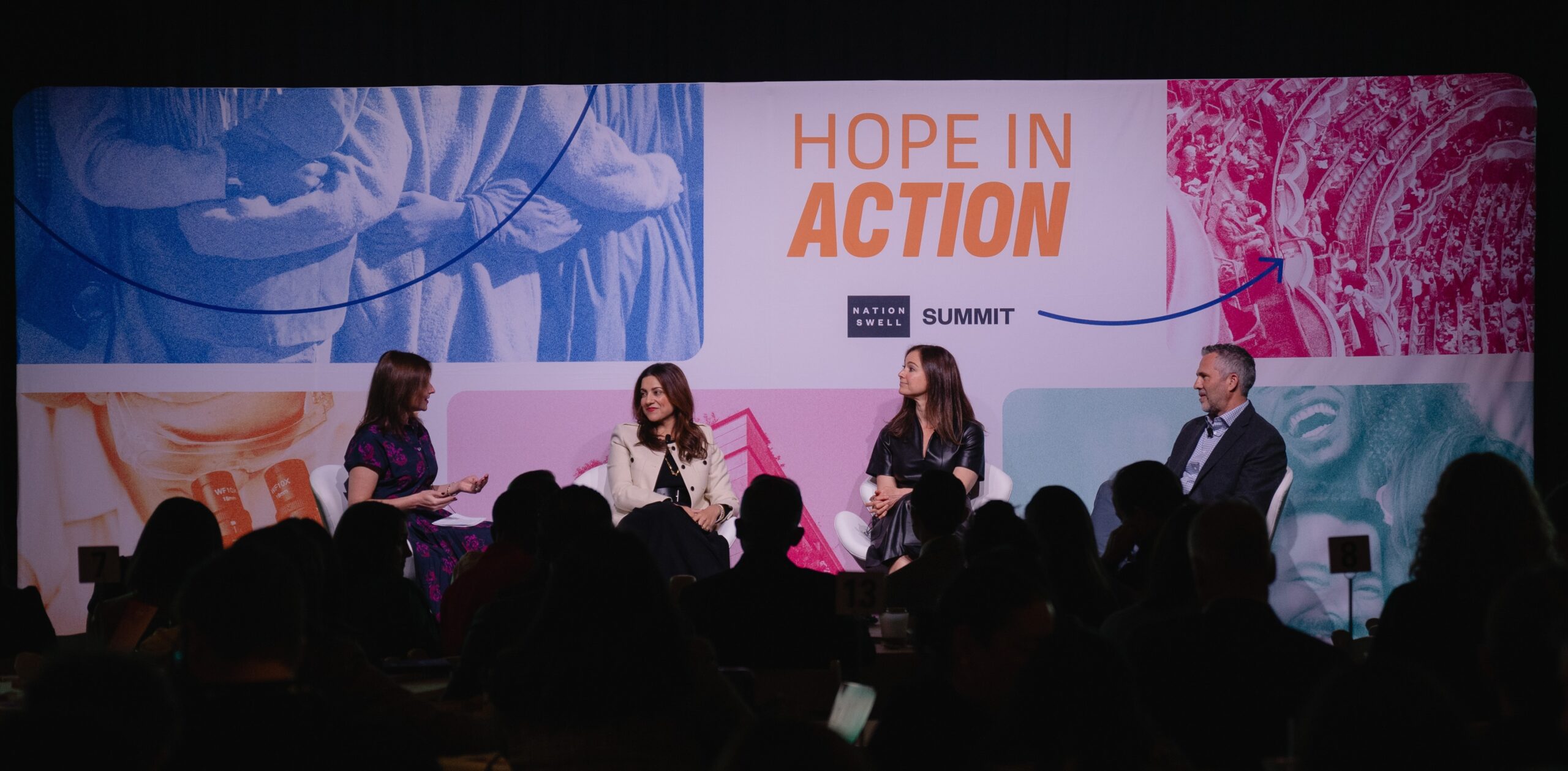
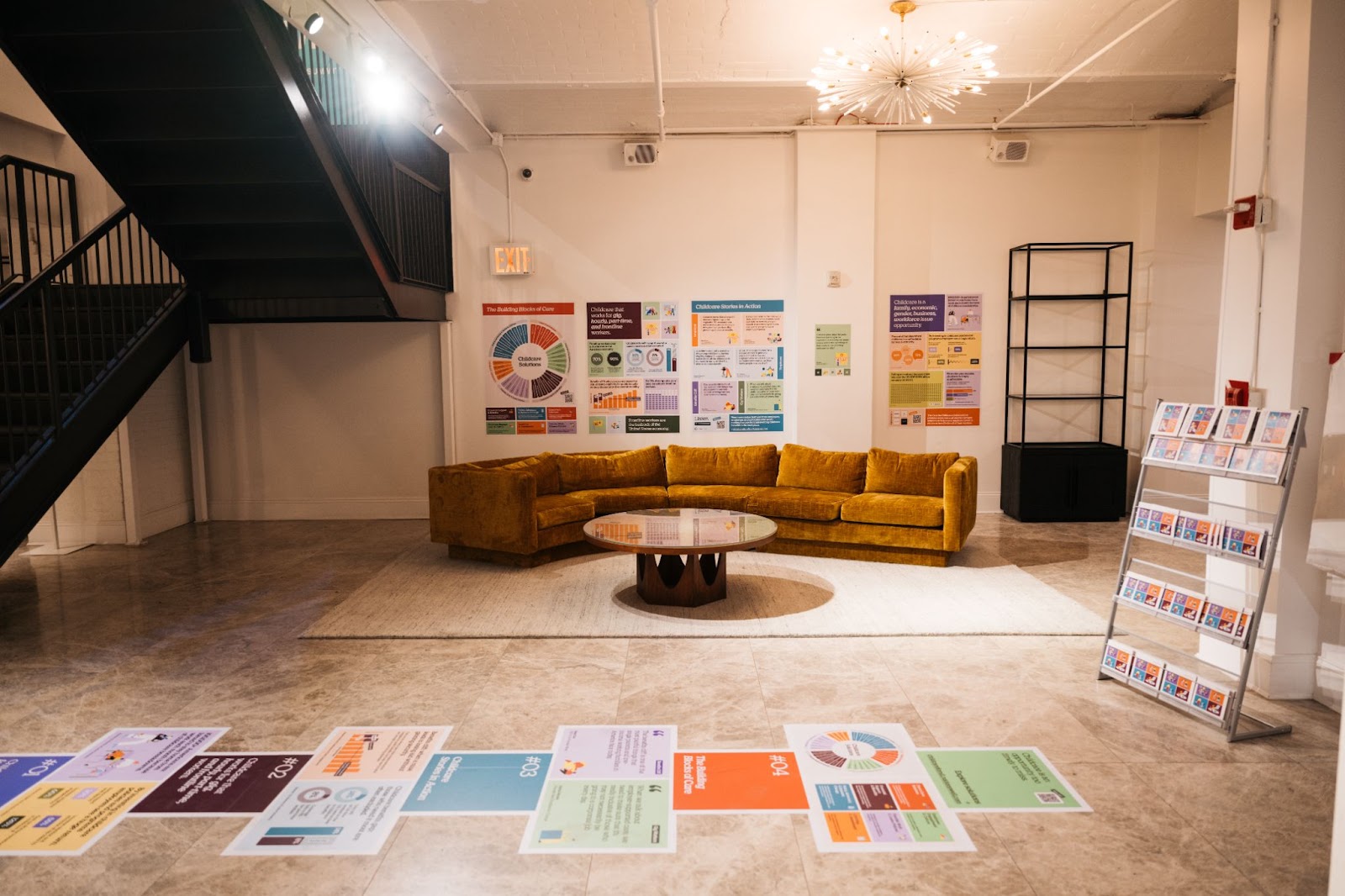
In response to this urgent need, Pivotal, the Annie E. Casey Foundation, and the American Family Insurance Dreams Foundation highlighted caregiving at the 2024 NationSwell Summit through an Impact Spotlight and a panel discussion, which was punctuated with an on-site immersive experience including a ‘Care Lounge’ that highlighted key stats, quotes and figures from  the expanded Childcare for All site created by the Case for Childcare Collaborative.

We’ve summarized key insights from this portion of the Summit below:


Public-private partnerships are key to sustainable, systemic change.

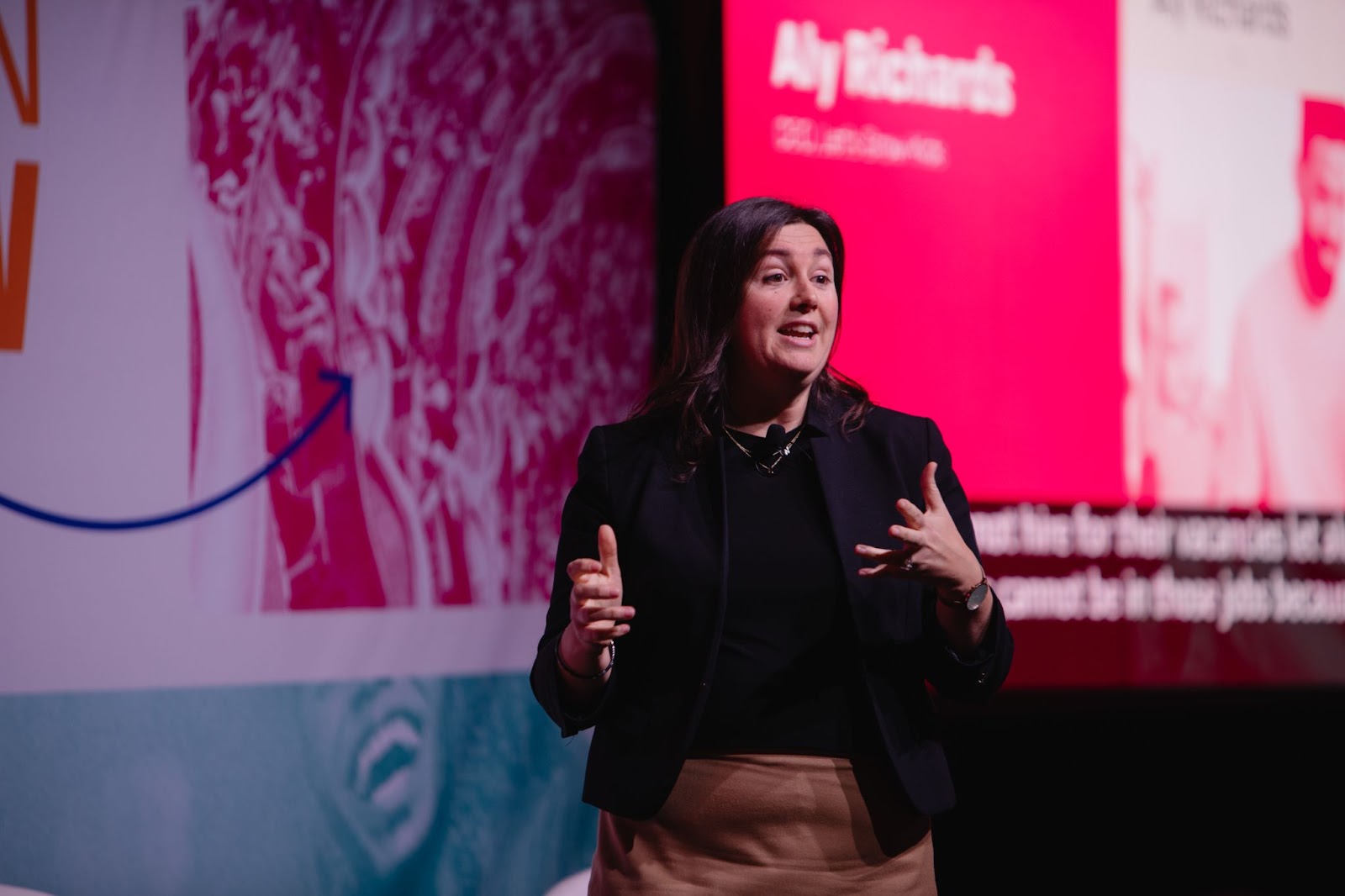
Aly Richards, CEO of Let’s Grow Kids, shared her inspiring story through an Impact Spotlight showcasing how the nonprofit revolutionized childcare in Vermont alongside the business community, ultimately passing Act 76, which committed $125 million to the childcare sector annually through a 0.44% payroll tax. During the spotlight, Richards emphasized the critical role of childcare in both economic and social development, calling the state’s care crisis a “market failure.” Through her passionate storytelling, Richards highlighted the urgency of early childhood education on workforce participation, stating, “90% of a child’s future is baked by age 5.”

As seen by Richards’ work in Vermont, public investments can fill care gaps. Through a grassroots campaign, Let’s Grow Kids mobilized 40,000 citizens and business leaders and secured bipartisan support for Act 76. Now, more families are eligible to receive financial assistance for child care than ever before, and the state is paying programs at higher weekly rates to provide that care. Since implementation, slots have surged, boosting access for many families and relieving employers of staff shortages with a more stable workforce.

Caregiving is an economic issue with investments yielding huge economic returns.

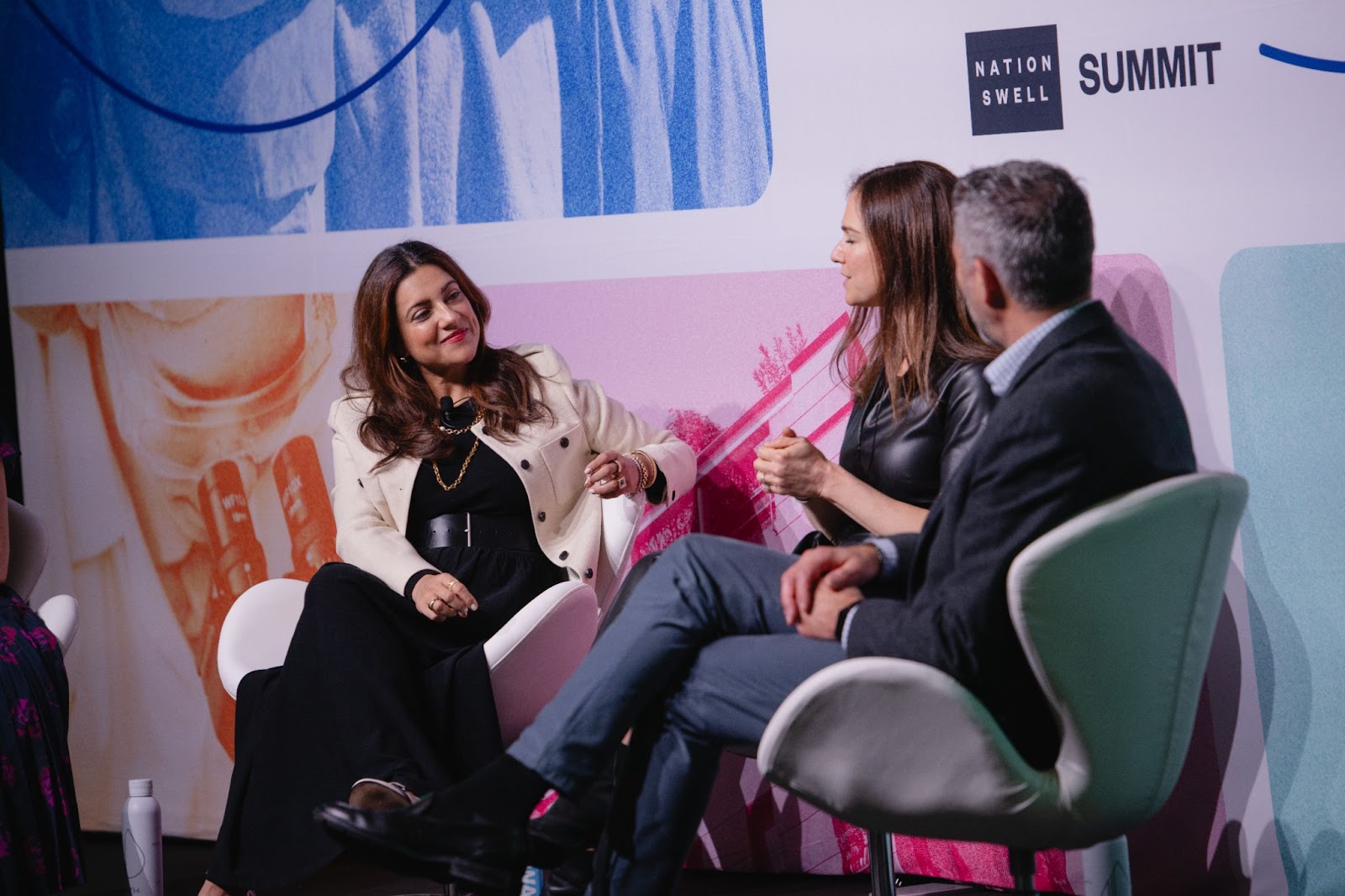
The NationSwell caregiving panel brought together visionary leaders to discuss the urgent challenges and groundbreaking solutions shaping the future of caregiving. Moderated by Jennifer Stybel of Pivotal, the panel featured Reshma Saujani, founder of Moms First; Lindsay Jurist-Rosner, CEO of Wellthy; and Stephan Dolling, Vice President at Merck, who each shared their personal and professional perspectives on the critical care issue.

Stybel set the stage by emphasizing caregiving as a universal challenge, stating, “None of us can do it alone. The solution lies here together.” Saujani underscored the transformative potential of prioritizing caregiving within policy and business frameworks. “We need to convince the nation that childcare is an economic issue,” she said. She credited the pandemic for shifting perspectives, noting, “We’ve slammed the door on whether childcare is a personal problem or an economic problem.”

Jurist-Rosner shared her personal caregiving journey and explained Wellthy’s mission to partner with families through personalized care coordinators, alleviating the complexities of a fragmented healthcare system. “Families need someone who can get things done,” she explained. Dolling highlighted Merck’s commitment to employee well-being and the ROI of caregiving benefits. “Providing caregiving support shows your people you truly care,” he said, sharing how Merck implemented Wellthy’s services during the pandemic resulting in overwhelming employee appreciation and support.

The conversation also spotlighted the significant economic case for caregiving. Saujani noted, “Investing in childcare offers a 425% return,” emphasizing that solutions must extend beyond privileged workforces to include hourly and shift workers.

The panelists concluded by exploring bold, actionable strategies for change: join national coalitions advocating for policy reform, foster open discussions about caregiving in workplaces, and leverage data to drive leadership buy-in. As Stybel aptly concluded, “Caregiving isn’t a niche issue; it’s a challenge that unites us all.”

Workers with the most to gain from employer-sponsored care support are traditionally excluded from care benefits.

Following the inspiring spotlight and panel, NationSwell announced the launch of the expanded Childcare for All site, which builds the case for gig, hourly, part-time and frontline workers to be included in employer benefits to support caregivers. Frontline workers represent about 70% of the workforce with 90% of companies relying on these workers. And yet, while only 14% of full-time workers have access to employer-sponsored childcare support, that number falls to 8% for part-time workers. This demonstrates a childcare benefits gap, revealing those with the most to gain from these benefits are traditionally excluded from qualifying. The detrimental effects of a broken childcare system are glaringly apparent, with parents forced to leave careers in order to take care of children, and businesses suffering huge workforce losses. 

The site serves as a resource for employers to better support employees who are caregivers, highlighting 35+ actionable strategies through an interactive solutions visualization. Packed with resources, firsthand stories, insights, and examples, the site empowers businesses and individuals to advocate for and implement impactful caregiving solutions. This launch reinforces the call to action for systemic change and collective responsibility in addressing the childcare crisis. Visit the Case for Childcare Collaborative’s site to publicly commit to implementing solutions and find downloadable resources to share with your team and network. Help us forge a world where childcare is no longer a barrier for workers to remain and thrive in the workforce. 


To learn more about the Case for Childcare Collaborative, click here

Pathways to Economic Opportunity: MassMutual Foundation and Opportunity Finance Network

In the Pathways to Economic Opportunity interview series, NationSwell is taking a closer look at how companies are pursuing remedies to disparities that exist in vulnerable communities that lack access to financial opportunity and prosperity. In spotlighting these partnerships, this series hopes to uncover the “secret sauce” that makes these solutions successful.

NationSwell recently sat down with Dennis Duquette, president and CEO of the MassMutual Foundation to discuss their newly-announced partnership with Opportunity Finance Network to launch the CDFI Innovation Initiative — a new effort designed to drive innovation, scale impact, and build new infrastructure for the Community Development Financial Institution (CDFI) industry.

Here’s what he had to say:


NationSwell: To start, what is the theory of change behind CDFIs — how do they work to expand economic access and provide financial stability in low-income communities?

Dennis Duquette, president and CEO of the MassMutual Foundation: CDFIs are financial institutions dedicated to delivering responsible, affordable lending to disinvested communities that are often underserved by other lenders and banks. By their very nature – certified by the Treasury Department to be prioritizing community development, serving underserved markets and providing wraparound support services – CDFIs seek to fund the needs and dreams of businesses, housing providers, schools, and community facilities that other financing providers deem to be too risky.

NationSwell: What challenges in the CDFI space is the MassMutual Foundation looking to help solve, and what positions the Foundation to do so?

Duquette, MMF: As it turns out, the biggest challenges facing the CDFI space have a lot to do with their own success – there’s been incredible growth in the visibility and recognition of CDFIs’ unique positioning in addressing community needs in the last few years.

The industry stepped into extraordinary visibility and expanded scale as it supported small businesses and economic recovery during the COVID-19 pandemic, including deploying more than $30B through the Paycheck Protection Program. The Barber of Little Rock, an Oscar-nominated short documentary that the MassMutual Foundation helped fund, highlights the work of a CDFI called People Trust and further contributes to public awareness of CDFIs as effective, community-centered providers of the financial capital and personalized support communities need to achieve financial health and resilience. And most recently, the EPA’s $27B Greenhouse Gas Reduction Fund (GGRF) includes one of the most significant new flows of capital to the CDFI space anticipated over the next six years.

This success and opportunity to scale brings many new challenges, as CDFIs often have limited internal resources and too often face major challenges in deploying capital to meet their communities’ needs due to infrastructure challenges. Solving these challenges will help both better utilize the existing capital available to CDFIs and help attract further investment in the industry by institutional investors.

NationSwell:  What made Opportunity Finance Network (OFN) stand out as an ideal partner for the MassMutual Foundation?

Duquette, MMF: We always strive to make investments that can unlock opportunities that may otherwise not be fully leveraged – as we were just discussing, CDFIs stand at a major juncture of opportunity, and we want to ensure that it’s not missed. OFN is an ideal partner for us due to a number of reasons. They are themselves a CDFI and have been the leading CDFI support network for forty years, offering the critical capacity building, relationships, and loan capital that members across the country (over 430 member CDFIs and counting) need to fulfill their missions. Their role as convener and capacity builder for such a wide swath of CDFIs means that they have an incredible view into the challenges and opportunities facing the ecosystem. They also have a proven track record of executing visionary partnerships and, perhaps most importantly, share our view that collaboration and cooperation between funders and community partners is an important attribute for maximizing impact. Together, we aim to attract additional partners to the table to help fund the many innovations that this initiative will spur over the next five years.

NationSwell: What are the goals behind the MassMutual Foundation’s partnership and $25 million investment in OFN? How does the CDFI Innovation Initiative fit into your larger impact strategy as an organization?

Duquette, MMF: OFN and the MassMutual Foundation are in alignment that building and scaling resources and capacity of financial intermediaries like CDFIs is critical to achieving key shared outcomes, including income and wealth creation, financial resilience of individuals, and new jobs and small businesses nationwide. This partnership represents a natural evolution of our giving and is an outgrowth of all the things we’ve seen and learned through our local grantmaking focused on financial resilience across our recent focus communities (Springfield, Boston, Memphis). We’ve learned that the neighborhoods with the greatest need for affordable and accessible financial products and services are the very ones that most often lack them. More specifically, pathways to homeownership for first time homebuyers, small businesses loans & support, and access to quality jobs are consistently top needs expressed by residents and nonprofit leaders. This opportunity allows us to extend those lessons nationally to other communities and potentially engage like-minded funders to join us in this work.

NationSwell: What’s the special sauce behind the initiative – the novel or innovative elements that you’re most excited by?

Duquette, MMF: This initiative is structured to ensure that a strategic mix of voices, expertise, and resources are continually at the table to identify how to best innovate and invest in the infrastructure needed to help CDFIs grow, evolve, and scale into the future; with three core pillars designed to drive new strategies and innovations:

o   Creating an Innovation Advisory Council with investments in thought leadership and data-driven insights into scalable innovations.

o   Establishing an Innovation Center, an action tank that will take insights and promising solutions and seed them with capital and support.

o   Launching an Innovation Fund, a blended capital pool that will help take innovative and promising solutions to scale each year.

NationSwell: What impact are you intending to achieve through this initiative, and what are your metrics for success? How will the initiative measure the long-term impact of innovations on underserved communities?

Duquette, MMF: The CDFI Innovation Initiative aligns with the MassMutual Foundation’s goals of building and promoting the use of critical networks, fostering financial health and resilience, fulfilling basic economic needs, and expanding employment opportunities for low-income households and communities. The initiative will help advance new systems, and develop solutions needed to support scale and impact in the following areas:  capitalization innovations, new financing products, technology platform innovations, operational efficiencies, and data analytics and research. The complexity of this overall project means that we’ll be evaluating success on multiple levels, including increased growth rates in overall assets under management, financing closed from OFN members, number of housing units developed, small business loans closed, and jobs created or retained. We’ll also track specific outcomes for each individual innovation that is piloted.

NationSwell: How do you see this initiative evolving in the future? What’s your longer-term vision for the work with CDFIs?

Duquette, MMF: We have a long-standing history of supporting CDFIs in the cities where we live and work and we’re excited to grow that investment commitment with this initiative. We, along with OFN, are confident that the structure, approach, and impact of this initiative will really lay the groundwork and make clear the case for sustaining this initiative beyond the next five years.

NationSwell:  Finally, do you have a call to action for leaders at peer organizations who have opportunities to help advance this work forward? 

Duquette, MMF: We would absolutely love to connect with anyone at any peer organization who may have a shared interest in any element of this work and initiative. We think there is a very compelling case for collaborative funding here, and as I just mentioned, we see shared investment as part of the longer-term goal of sustaining and growing the impact of the CDFI Innovation Initiative long into the future!

Impact Next: An interview with Wells Fargo Foundation’s Darlene Goins

At a moment of inequality and division, who is advancing the vanguard of economic and social progress to bolster under-served communities? Whose work is fostering the inclusive growth that ensures every individual thrives? Who will set the ambitious standards that mobilize whole industries, challenging their peers to reach new altitudes of social impact? 

In 2024, Impact Next — a new editorial flagship series from NationSwell — will spotlight the standard-bearing corporate social responsibility and impact leaders, entrepreneurs, experts, and philanthropists whose catalytic work has the potential to shape the landscape of progress amid urgent need for social and economic action.

For this installment, NationSwell interviewed Darlene Goins, President of the Wells Fargo Foundation.


Greg Behrman, CEO and founder, NationSwell: What brought you to this field? Was there a moment in your life that galvanized your commitment to driving bold action in the impact space?

Darlene Goins, President, Wells Fargo Foundation: I grew up the daughter of a minister and seeing the service to others and community that my father provided instilled in me a need to provide service to others. As I entered my adult life and career, I became fascinated by the idea of decision analysis — making decisions through data. When I was in graduate school, and then later when I was at FICO, I realized there was a ton of consumer confusion around credit scores. I knew I wanted to help demystify credit scores for people and provide financial education with it — to help people improve their scores and chart the path forward — so I created a program that allowed financial institutions to share FICO scores for free. Seeing the impact that program had unlocked passion in me to do more, beyond the credit space. I came to Wells Fargo excited to scale relationships that can be used to further financial capability, and to create lasting community impact on the lives of underserved, underestimated families and businesses. 

Behrman, NationSwell: As a leader in the space, how are you sense-making when it comes to this moment, and how are you thinking about the unique opportunities and challenges inherent to it?

Goins, Wells Fargo Foundation: It’s clear that we’ve made meaningful progress, but we still have a long way to go. We are seeing that some of society’s toughest problems are still widely prevalent — the housing crisis, an unmanageable cost of living, the difficulties so many people face in getting ahead. But at the same time, I’m encouraged by the collective effort I’m seeing from so many organizations to drive change and move us in the right direction. That’s one of the reasons I feel so blessed to be in this role, to have the ability to leverage philanthropy as a catalyst and test new and innovative ideas at scale. 

Behrman, NationSwell: Are there any trends we’re seeing in the current moment that make you feel particularly optimistic?

Goins, Wells Fargo Foundation: From a philanthropy perspective, one of the changes I’ve seen over the course of the last nine years has been the general attitude shift I’ve seen around really integrating a community’s lived experience and wisdom into investment decisions. Historically speaking, the traditionally held attitude of philanthropy was that you could come into communities and you automatically knew what would work best. These days, I’m seeking more of an orientation toward community co-design — leveraging the experience of the people you’re trying to help. This trend around community-led design gives me real optimism for the future. 

Behrman, NationSwell: What are two or three facets of the work you are leading that you think are particularly special or differentiated in the field — what feels important to lift up?

Goins, Wells Fargo Foundation: One of the things I really like to think about is how we can leverage the full breadth of our resources. As a financial institution, Wells Fargo Foundation has four primary funding priorities: affordable housing, sustainability, small business growth, and financial health. Bringing the full resources of the bank to bear is critical to the work of strengthening marginalized communities, and that intentional approach allows us to go deeper on societal issues.

One example of this multi-pronged approach can be found in Minneapolis, where we invested in the development of a mixed-use, multi-income housing development in the commercial corridor that was destroyed in wake of George Floyd’s murder. After a period of intentional and highly engaged community outreach, the finished development will feature 100 new affordable housing units, a Wells Fargo branch, and a community meeting space — the combination of commercial and corporate properties that can create a lasting impact.

I’m also very proud of the work we’re doing in the small business growth space, particularly with the Open for Business Fund. When the pandemic hit, our CEO decided to take the gross processing fees the government issued for administering the PPP loans — equivalent to around $420 million — and put that back into a fund to deliver urgent capital and expertise to racially and ethnically diverse small business owners. Fast forward four years, and we’ve been able to serve 336,000 small businesses, which has helped to generate or preserve more than 461,000 jobs. 

Behrman, NationSwell: What are some of the resources that have really inspired you as a leader? 

Goins, Wells Fargo Foundation: One resource that’s really helped shape my thinking on how to position the work is an article that McKinsey published on the business case for financial inclusion, which looked at Black and white Americans and access to financial products and the racial wealth gap. It concluded that if Black Americans had the same access to financial services that white Americans have, companies could realize up to $60 billion in additional revenue each year. That is something I’ve really come back to over and over again, and it has helped me with positioning this work on numerous occasions.

As a leader, I also love the book More than Ready by Cecilia Muñoz. I have dealt with imposter syndrome in the past, and her book helped me to recognize that I am ready for the seat that I occupy. It’s also been helpful in providing strategies for dealing with microaggressions and unconscious bias, and just generally reminding me that I’m not alone in this work.

There’s a quote I come back to often: “Never accept criticism from someone from whom you wouldn’t seek advice.” I think that pretty much speaks for itself.

Pathways to Economic Opportunity: Extern

As wealth and income inequality continue to climb in the United States, some employers are developing innovative models and catalytic partnerships designed to bring new skills, job access, and ultimately economic opportunity to financially vulnerable and historically marginalized individuals.

With our Pathways to Economic Opportunity interview series, NationSwell is taking a closer look at some of the solutions companies are pursuing in service of leveling the playing field and expanding their talent pipelines. In spotlighting these partnerships, this series hopes to uncover the “secret sauce” that makes these solutions successful for the benefit of other employers and their leaders.

NationSwell recently sat down with the team at Extern — a mission-driven organization empowering students with hands-on professional experience while creating meaningful pathways to economic mobility for historically underserved talent. Extern developed the Externship – a new form of professional experience that its students say is a more flexible and accessible alternative to internship or co-op programs. Companies like PwC, The Home Depot, AT&T, HSBC, National Geographic, and The Nature Conservancy have leveraged Extern’s tech-enabled platform to deliver Externships to tens of thousands of young people.

Here’s what they had to say:


NationSwell: In your own words, can you describe the high-level problem that Extern is solving for? 

Matt Wilkerson, Founder and CEO, Extern: The challenge is clear: employers increasingly value work experience over credentials, yet most students don’t have access to the professional opportunities they need to succeed. Internships are shrinking, and career centers aren’t equipped to meet the demand for real-world preparation.

At Extern, we create new opportunities for students to gain professional experience while helping companies broaden their talent pipelines. Our team has a mix of tech, education, and corporate DNA which allowed us to develop a platform so companies can deliver Externships at scale. Externships go beyond traditional internships by offering accessible, structured work experiences that meet the needs of both students and employers.

As of this publication, we’ve officially served 50,000 students with six to eight week externship experiences since 2020; about 25,000 of those have been year to date, and we’ve worked with about 45 companies at this point. 

Extern works by standing up programs that connect students seeking real-world experience with companies seeking to recruit from diverse, underrepresented talent pools. The companies pay us to organize and run these experiences, and in exchange we absorb much of the recruiting, training, and management work that they would have had to do in a traditional internship.

For hiring managers, the professional experience section of a resume is often the most critical factor in recruitment decisions. Yet, systemic barriers leave millions of students—especially those from underrepresented communities—without access to these resume-building opportunities. Extern’s solution is to create and deliver new experiences that wouldn’t exist otherwise, ensuring more students are equipped to step into the workforce with confidence.

NationSwell: What are the primary differences between externships and internships, and what are the unique benefits of each for companies?

Wilkerson, Extern: Externships make professional experience more scalable and accessible. Unlike internships, which are often limited in number and require significant HR resources, Externships are designed to create flexibility and minimize the logistical burden on companies. 

The number of available internships is currently about 4 million each year, compared to about 20 million college students. So there’s a supply and demand issue to begin with, and part of the reason is that internships are hard to get set up on the employer side — it’s laborious to train students, to give them feedback, to manage these programs. The really big programs require enormous amounts of employee resources — many, many hours supporting individual students. At Extern, we take most of that load off of the employers.

NationSwell: Could you tell us a bit about how the program actually works, in practice?

Wilkerson, Extern: Over six to eight weeks, students work on real-world projects remotely with company support, removing geographic and logistical barriers to gaining work experience. For companies, externships reduce training and management overhead while delivering meaningful engagement with a diverse talent pool.

Take a head of consumer insights launching a customer research project: they may not have time to recruit, train, or manage interns on frameworks like survey design or ‘Jobs to Be Done.’ With Extern, they can launch projects quickly, spending just an hour every other week mentoring students while Extern handles the rest—recruiting, training, managing, and ensuring deliverables meet professional standards.

Extern streamlines the entire process: recruiting students through a single application, preparing them with targeted training on project-specific tools and methodologies, and managing daily operations like answering questions and reviewing work. By the time deliverables are presented, students have been guided to produce high-quality, professional outputs, freeing managers to focus on high-value mentorship instead of oversight.

For companies—whether or not they aim to hire college grads at scale—this creates a rewarding way to share expertise, connect with emerging talent, and build brand recognition.

NationSwell: How does your current funding model work?

Mike Eng, Senior Director of Partnerships, Extern: We’ve been fortunate enough to find some corporates who have been paying us to run these programs; that is predominantly where our funding comes from right now. Some of our biggest partners believe from a CSR perspective that they have a commitment to society — and to different stakeholders — to invest in initiatives like education and upskilling, and have funded programs where they want to create better career outcomes for specific demographic groups. They’re not necessarily looking to hire the students, and they are happy if the students go and work at different places. 

Other corporates work with us from the perspective of a pre-internship funnel, where some strategic leaders have recognized that they need to improve and find ways to differentiate themselves in the marketplace. By launching Externships with large cohorts they expand their brand recognition in competition with peers or different companies. They’re able to engage students a little earlier on and give them exposure to different career opportunities within the organization.

For example, we created a National Geographic and the Nature Conservancy externship that’s managed by us. These organizations want to bring young people into the field of conservation as part of their mission to inspire others to protect the natural environment, and so we’re running this program where students come in and get support and guidance toward careers at all these different places doing conservation work. 

NationSwell: How would you describe your theory of change?

Wilkerson, Extern: At a societal level, we’re addressing the disconnect between education and employment. For decades, the focus has been on earning costly degrees without ensuring job readiness, disproportionately affecting underrepresented students who face greater economic barriers.

At an individual level, Externships act as a catalyst for economic mobility, embedding future-ready skills through structured, real-world experiences that enhance education and give students a competitive edge. For example, we’re investing heavily in Generative AI training—covering prompt engineering, identifying hallucinations, and building chatbots—because we see it as a key skill for helping young people leapfrog the job market over the next few years.

This has a direct impact on learners from underrepresented populations, who ultimately have gotten left behind by this big push over the last few decades to go through higher education, take on more and more student debt to do so, and come out the other end with some kind of credential that’s supposed to mean something in the marketplace. 

NationSwell: What is the call to action for other leaders at other organizations who would hope to establish their own programs to improve either educational attainment or economic mobility?

Wilkerson, Extern: If you’re a company that has been thinking of standing up some sort of impact program, but you’re struggling with how to connect it to business value, the Externship model offers a powerful solution. If you have a corporate foundation or CSR team that wants to tie into business goals around recruiting, building employer branding, and engaging your employees, that’s where this program really shines. That’s our big call to action. 

NationSwell: Tell us a little bit about your learning curve — what have been the stumbles you’ve faced, or anything you’ve learned as you’ve grown this program? 

Wilkerson, Extern: One of our biggest hurdles has been convincing companies that externships are as effective as we claim. Employers are often skeptical that students can deliver high-quality work with minimal oversight. It sort of flies in the face of your intuition about how the world works. However, once the employees and managers experience the program firsthand, they see the value—and that’s why we’ve maintained such strong retention among our partners.

Degrees alone aren’t enough anymore. Employers need to prioritize real-world skills, and students need more opportunities to build them. Extern is uniquely positioned to address both sides of this equation.

NationSwell: Is there anything else that feels really important to mention here?

Wilkerson, Extern:  An Externship becomes this ability to train young people on future-ready skills. My current thesis is that companies aren’t going to embrace Generative AI fast enough — they’re dabbling in it, but employees actually need to be able to experiment and play with those tools. We’ve started to build out modules that can be delivered within the Externship that train students on this — we’ll teach them how to do something the regular way, and we’ll teach them how to use Generative AI to do it more efficiently, at higher quality — or do something that wasn’t possible before. 

Over the next few years, you’re not going to have enough candidates in the market who have developed these skill sets in a real professional experience. We can help students from underserved and underrepresented backgrounds essentially leapfrog the talent pool with these skill sets. So I’d say companies that believe in that, that want to invest in that, that want to run experiments, this is also a way to do that with a talent pool that’s hungry, and in many cases, actually knows more about how to use technologies like Generative AI better than the average employee. 
NationSwell Launches the ‘Childcare for All’ Site from the Case for Childcare Collaborative

The Business Case for Childcare Benefits for Every Employee

Today NationSwell is proud to announce the launch of our expanded Case for Childcare Collaborative site advocating  for childcare for all workers. Employees—especially gig, hourly, part-time and frontline workers— across the country continue to face an uphill battle, punctuated by the ongoing childcare crisis in the United States. Frontline workers represent about 70% of the workforce with 90% of companies relying on these workers (BCG, Fortune). And yet, while only 14% of full-time workers have access to employer-sponsored childcare support, that number falls to 8% for part-time workers (U.S. Bureau of Labor Statistics). This demonstrates a childcare benefits gap, revealing those with the most to gain from these benefits are traditionally excluded from qualifying. The detrimental effects of a broken childcare system are glaringly apparent, with parents forced to leave careers in order to take care of children, and businesses suffering huge workforce losses. 

This was the instigation for NationSwell to launch the Case for Childcare site in February 2024, showcasing two years of research making the case for employer-supported childcare benefits, revealing the business opportunity of supporting employee childcare needs. 

Why focus on frontline workers?

But–a gap in our research remained—frontline workers have the most to gain from childcare support yet are traditionally excluded from benefits packages that are reserved for full-time, salaried employees. So we set our sights on an expansion of this site to build the case for employers to provide childcare benefits for all workers. Over the last year, we’ve focused our research on frontline workers, speaking with workers, advocates, and employers alike. This research highlighted the importance of these workers for businesses and the overall economy—leaving this demographic out of conversations around employer-based childcare support is a missed opportunity for companies to improve their retention, attraction, loyalty, and engagement of workers, ultimately boosting their bottom line. Today, we’re exposing the data that employers should support their worker’s childcare needs because it is both the right thing to do for people and the company.

Educate

With this launch, our Collaborative aims to put the spotlight on the research-backed value of supporting employer-sponsored childcare benefits for frontline workers so that more leaders can educate their colleagues and advocate for change.  If you need to make the case for childcare at your company, you can find easily downloadable materials that can serve as a pitch to leadership on why childcare benefits should be implemented or expanded for your workforce. Visit our site and request the synthesized research and solutions that you can use to pitch leaders and HR managers on the expansion of your childcare support for all workers.

Commit

You might be asking, “After I get buy-in, how can we get started? What can we offer as an employer to support caregivers?” The newly launched site includes a visualization of childcare solutions that range to fit any business, no matter where you’re starting from, whether it’s just starting to think about childcare support for the first time or adding cutting-edge policies to your already comprehensive benefits package. Explore each solution with resources and organizations to help you get started and examples of other companies who are implementing these kinds of support. Then commit to change, perhaps making a plan to reevaluate your care policies each quarter with executive leadership or starting to pilot one solution over the next six months. No matter where you start, start somewhere. Join others by committing publicly on our site—submit your story or commitment to be uploaded on our wall of examples. Together we can build a community of care. 

Share

Finally, we encourage you to share this site with your networks. Caregiving is undervalued in the United States and we’re on a mission to showcase the value of care for businesses and our economy. This site not only portrays the data on the clear business value in providing employer-supported care benefits for every employee, but it also features firsthand stories from business owners and workers who are parents. Listen to employers share how to accommodate childcare needs in the workplace for all workers—it’s not only possible, but practical. Hear from advocates on the unique barriers these workers face in regards to care. And listen to parents share their stories on the impact of employers who support the care movement. Post the site on your LinkedIn, text the link to a friend or family member, or reshare NationSwell’s social posts. Help us reframe the narrative to value care.

Conclusion

This site is a go-to hub for businesses and leaders to find information they need to not only build awareness of the business case for employer-supported childcare, but also, to provide tactical solutions that more employers can implement to grow the support for all workers to  have access to affordable, quality childcare that fits the needs of their family.

Visit the Case for Childcare Collaborative’s childcare for all expanded site to learn about the case for care for all workers, commit to implementing solutions, and share the information with your team and network. Help us forge a world where childcare is no longer a barrier for workers to remain and thrive in the workforce. Thank you to our partners at the Annie E. Casey Foundation, American Family Insurance Dreams Foundation and Pivotal Ventures for supporting this important work.


Read more about the Case for Childcare Collaborative

Impact Next: An interview with the Seattle Foundation’s Alesha Washington

At a moment of growing inequality and division, who is advancing the vanguard of economic and social progress to bolster our most vulnerable communities? Whose work is fostering the inclusive growth that ensures every individual thrives? Who will set the ambitious standards that mobilize whole industries, challenging their peers to reach new altitudes of social impact? 

In 2024, Impact Next — a new editorial flagship series from NationSwell — will spotlight the standard-bearing corporate social responsibility and impact leaders, entrepreneurs, experts, and philanthropists whose catalytic work has the potential to shape the landscape of progress amid urgent need for social and economic action.

For this installment, NationSwell interviewed Alesha Washington, President and CEO of Seattle Foundation.


Chloe Lew, Senior Vice President of Partnerships, NationSwell: How did you come to be the President and CEO of the Seattle Foundation? I’d love to hear about any key milestones, mentors, or experiences that brought you here.

Alesha Washington, President and CEO, Seattle Foundation: For me, it started with a general curiosity about nonprofit organizations because of my experiences with them growing up. I was a volunteer camp counselor at my neighborhood YMCA, and my first internship experience was with the ACLU. As I became more aware of nonprofits, I quickly learned that philanthropy played a role in funding all of these amazing experiences I was having as a kid, and I knew I wanted to do something to give back to this sector that was giving so much to me.

I also had a notable mentor in Dave Abbott, the former president of the George Gund Foundation in Ohio — he was the one who instilled in me the power of public policy and philanthropy. He taught me that if we make a grant to an organization, it will benefit a group of people, but if we change the law or the regulation that’s causing the need in the first place, we can help many more. He was always thinking about how to use philanthropy as a catalyst for public policy and systems change. I became a lobbyist because of his influence and used my position to create change in the civic sector. By the time Seattle Foundation became a possibility for me, I was impressed by how explicit the foundation was about racial equity and justice, and how clear it was about the role that a community foundation could play in systems-change work through grant making and advocacy. 

Lew, NationSwell: You have been at the Seattle Foundation for nearly three years. What has been guiding your leadership as you’ve taken the helm of the organization?

Washington, Seattle Foundation:  Three things come to mind. First, there were some operational challenges when I stepped into Seattle Foundation, and I came in eyes wide open — the opportunity I saw was: How do you unlock resources for a community while also building a stronger business, and how do you do that with purpose? Wrestling with this solidified the need for a very clear and accessible vision. When you go through big shifts as an organization, there are bound to be questions and pent-up energies — the ability to set that vision early on and give folks something to aspire to helps them know that even when it’s hard, it’s hard for a reason.

The second thing is that I genuinely believe organizations are only as strong as their people, and at the end of the day if the people aren’t well, the organization isn’t healthy either. Stepping into this role, I spent time early on with every single person who works at the Foundation so that I could hear their stories and understand their point of view. It starts to give you a real temperature check on the health of the organization as a whole when you hear how people are showing up to work every day.

Finally, the thing I hold at the very center of my work is joy. In a space where there is so much polarization and so many people coming from different lived experiences, joy is something that we all still seem to find some unity in. Holding space for joy doesn’t mean that things aren’t chaotic or difficult; it just means that we can recognize the beauty of that discord and move through it with meaning, strength, purpose, and hope.

Lew, NationSwell: How do you center joy within the Foundation — what does that look like in practice? 

Washington, Seattle Foundation: The reality is given the changing nature of community foundations – the shift towards sustainable business models that can drive real impact – we will be in a state of evolution constantly. Navigating change is hard, so a key focus for us is building trust in order to ensure that our people feel valued and heard. We put out a robust staff engagement survey in an attempt to create mechanisms for people to share thoughts and perspectives. We use our people manager meetings to offer training on change management, really focusing on how to manage through change joyfully so they feel equipped to support our team. 

We’re always thinking about how to create safe spaces for people to share thoughts, but then also how to respond to those concerns so folks have clarity and transparency around our thinking. Our team that works on learning literally put together a Jeopardy game to bring people deeper into the work and make it fun — you can make gaining knowledge and trust a really joyful experience.

At the end of the day, we’re trying to create a fun and joyful environment internally while also being intentional about transparency and trust mechanisms that help people step into more of their power in the work. My personal barometer for that is how many staff feel comfortable reaching out to me to say, “Can we grab coffee?” or “Can I talk to you?” I’m seeing an uptick in that in a way that lets me know we’re doing something to foster something good here, even if it’s hard. 

Lew, NationSwell: How are you thinking about the current moment in social impact, and the economic landscape more broadly?

Washington, Seattle Foundation: Nikole Hannah-Jones did a piece on the colorblindness trap that I think is essential reading. Especially now as I consider where we are post this election. She very skillfully and artfully tracks the impact and legacy of slavery to where we are in the present day, with a number of lawsuits and efforts to attack diversity, equity, inclusion, to turn the Civil Rights Act and the Voting Rights Act on their heads and systematically reverse a lot of the efforts to create more opportunities for Black people and other people of color.

So much has gotten lost in translation through this time that I’m not quite clear or sure how astute and clued in we all are as a society. If nothing else, it is illuminating how powerful and sometimes dangerous narrative can be. One thing I still hold onto from NationSwell’s immersive experience in Montgomery is when Bryan Stevenson shared with the group that the biggest sin of slavery wasn’t slavery itself, it was the way that we justified it — the narrative around it.

I think what it means in my work, and for philanthropy as a whole, is that we get prepared for sophisticated legal, financial, and reputational threats that are meant to make us back away from anything we are doing that would be seen as too controversial in this current environment. We need to stay focused and close to each other. We need to keep our values at the center of every move we make. And we need to keep funding narrative change, community organizing, and power building in the communities we serve. 

I want to know that we’re able to stand the test of this time, that we don’t shrink away and acquiesce to a moment and then find ourselves in a situation a decade from now where these things we fought so hard for around a more inclusive democracy, around opportunities for those that never had a fair shot to a get ahead, all of that is turned on its head.

Lew, NationSwell: What are some of the initiatives, ways of working, or projects that you feel represent the best or most differentiated work that the Seattle Foundation is doing? What would you lift up for other leaders in the field?

Washington, Seattle Foundation: We have a vision of a joyful region of shared prosperity, belonging, and justice. As a grantmaker, we’re always thinking about how we resource organizations — especially BIPOC-led and -serving organizations — in a way that helps make that vision a reality. 

We’ve always done that through this very tiny pot of money that represents our core discretionary dollars — around 5% of what we do as a whole — with the other 95% driven through our donor-advised funds. The foundation has had to get innovative to figure out how we shift from impact work happening through a tiny discretionary grantmaking pool to bringing all the resources under our control to drive toward our vision. We have to think about all of the tools in our impact toolkit and how they support traditional grantmaking, and so we’ve really started to deepen our work with impact investing.

One of our primary vehicles for this is the Evergreen Impact Housing Fund, which is our way of contributing to the production of affordable housing, something that iis sorely needed in a community like Seattle. Thinking about the creative ways that philanthropy can test, innovate, and de-risk projects around affordability, how we can come into a capital stack of a project to make it more solvable at the end — we really put a lot of energy into that, and it creates opportunities for donors to co-invest with us. We are planning to grow this impact fund over the next year and create opportunities for individual donors to co-invest with us. 

We have refreshed learning opportunities for our donors to help broaden their understanding of community issues and help them get engaged. We’re supporting peer-to-peer learning among our donor base, so while their entry point may be a conversation of interest for them with other philanthropists on environmental justice, we’re there to then help them see what we’re funding and where there are opportunities for them to invest. 

My hope is that by recognizing everybody’s humanity in this — and the fact that we are all linked together in what it takes to get to a joyful community — we’re seeing resources move in more ways that are aligned and connected to what Seattle needs to thrive.  

Lew, NationSwell: Which of your peers in the field most inspire you?

Washington, Seattle Foundation: I have a top three. Fred Blackwell with the San Francisco Foundation is the epitome of cool for me. He has a tremendous heart for social justice. Trisha Finnegan at the Oklahoma City Community Foundation — we have this shared experience of moving to communities that we are not from and stepping in as new leaders attempting to drive pretty significant change. She leads with a level of courage and strength that is beyond anything that I’ve seen, and it gives me a lot of energy and hope. 

I’m also inspired by a phenomenal community leader back home named Leah Hudnall, who runs the Legacy Perspective. Leah really understands narrative change work and is deeply committed to the success of the community that raised her. She’s been very intentional in capturing the stories and legacy of people that would otherwise not be named, and she has stayed true to that calling, even in the face of opposition to her leadership.

Lew, NationSwell: What are the resources that you’ve found have been transformational in terms of how you look at this work and at your own leadership?

Washington, Seattle Foundation: I’m reading a really great book right now called “Leading with Joy: Practices for Uncertain Times,” by Akaya Windwood and Rajasvini Bhansali. I’m big on leadership books for past time reading but it is probably the most insightful, meaningful body of work that I’ve read — it uses short vignettes and stories from both of the authors to reflect on the leadership experiences of women of color through a lens of joy.

Impact Next: An interview with Kyndryl’s Pam Hacker

At a moment of growing inequality and division, who is advancing the vanguard of economic and social progress to bolster our most vulnerable communities? Whose work is fostering the inclusive growth that ensures every individual thrives? Who will set the ambitious standards that mobilize whole industries, challenging their peers to reach new altitudes of social impact? 

In 2024, Impact Next — a new editorial flagship series from NationSwell — will spotlight the standard-bearing corporate social responsibility and impact leaders, entrepreneurs, experts, and philanthropists whose catalytic work has the potential to shape the landscape of progress amid urgent need for social and economic action.

For this installment, NationSwell interviewed Pam Hacker, Vice President of Social Impact at Kyndryl.


AiLun Ku, Senior Strategic Advisor, NationSwell: What brought you to this field? Was there a moment in your life that galvanized your commitment to driving bold action on social and economic progress?

Pam Hacker, Vice President of Social Impact at Kyndryl: I think I was born to do good in the world. I remember volunteering at the local hospital as a kid, and teaching theater to kids with special needs — I always had this passion for giving back. 

I was lucky enough to land in the PR department at Sesame Street’s nonprofit, Sesame Workshop, and I knew right away that I had found my people (and my Muppets). Slowly but surely, I found myself leading our outreach efforts — everything from creating resources for how to talk to kids about an incarcerated parent to eating healthy on a budget. Throughout it all, the essence of the work was about giving back to under-resourced communities. 

From there I was able to make a very organic transition to HBO, where I used my skills as a communicator and a storyteller to help build out their social impact work. I loved that era, and I loved creating resources and PSAs to help communities — everything from how to get access and talk about the vaccine, to Black Lives Matter, to Stop Asian Hate, and more.

Just as I was starting to ask myself what was next, a recruiter found me on LinkedIn and told me about Kyndryl. Over a year in, it has been the most incredible experience for me. I’m learning more about the space and how we can use tech for good, and how we can better allow our 80,000 employees to take time off to volunteer in the communities where we live and operate. 

Ku, NationSwell: How are you making sense of the current trends we’re seeing in social impact? What are you concerned about, what are you optimistic about, and what should we be paying more attention to?

Hacker, Kyndryl: Honestly, I’m a huge optimist — I always see hope in any scenario, in any community, in any issue we’re tackling, in any theme. If there’s one thing that still ails me, it’s the fact that diversity, equity, and inclusion is still something that we have to even have these conversations around, that there is still so much work to be done in terms of ensuring that all people have a seat at the table.

Ku, NationSwell: Looking back at the scope of your career, how have your thinking, your strategies, leadership style, or philosophies evolved? What are some attributes or approaches that make you an effective leader in this space?

Hacker, Kyndryl: I’m continuing to grow as a leader. At Kyndryl, being a global organization, this is the biggest team that I’ve led. But even when I’ve had small teams, I am a people centric leader.The work is as important, I should say, but I go back to the people. I care deeply about the next generation of humans and I care deeply about people having the opportunity to grow at a company and stay on their journey. Nothing makes me happier than mentoring people inside and outside of my team. I lead with my heart. 

Ku, NationSwell: Is there any particular initiative at Kyndryl you want to highlight that really kind of brings into focus your unique brand of leadership and what’s coming ahead in the work that you’re doing?

Hacker, Kyndryl: The beauty of a global company is that there’s so much happening on the ground that sometimes it’s hard to keep up. We are just in our first year of foundation grants, and we’ve given 11 of those grants out in seven different countries. We’re about to meet with our board and talk about the next round, so to be part of building something because the company is so young, that is something I’m grateful to be able to do.

I really see and feel the pride in working at Kyndryl: Employees wear our colors, they wear the logo — there’s a sense of pride, and it’s so exciting to have the platform to show that pride and to help build it. We’re building the culture, we’re transforming as we’re here, and you truly see them care about the people. 

Ku, NationSwell: It’s clear that you bring a very values-centered approach to leadership. How do some of those values show up — what’s the North Star of your leadership?

Hacker, Kyndryl:  Honestly, it’s people. When you have great people on your team, you end up doing great work together, and I got really lucky with the team I’ve gotten to work with. Kyndryl attracts really great people in general — smart, high performers, creative, strategic individuals. I don’t think I’ve ever worked harder in my life, and yet I simultaneously feel myself stretching and learning and growing almost every day because the work is so inspiring.

Ku, NationSwell: What does winning in social impact look like to you?

Hacker, Kyndryl: I think the more lives we could impact and change, that’s winning, right? And there’s small wins, right? For every student that walks into our office who’s never been in an office before, that’s a win for me. For being able to train almost 50,000 women in India around cybersecurity, that’s a win. And on a larger scale, being so young as a company, there’s so much opportunity to grow, to impact more. 

As the brand grows, we’re part of that brand growth. Social impact is embedded into the DNA of the company. It’s not something that is an afterthought. It’s really built from the ground up.

Ku, NationSwell: Could you recommend any insightful resources – maybe a book, report, podcast, or article that has significantly influenced your thinking?

Hacker, Kyndryl:  My relationships in the impact space are my best resources. Whether it’s other colleagues, friends, a mentor — impact leaders want each other to succeed. My peers in this space are my go-to, and it’s so comforting to know that I have experts or advisors that I could call about any issue throughout the years, no matter where I’ve been in my career.

Ku, NationSwell: Do you have any words of wisdom to share with those working in the social impact space?

Hacker, Kyndryl: For newcomers to the work, I say often that if you are at a company that you’re happy at, start a social impact team there. One of my old bosses at Sesame Street always used to say, “change is good,” and that’s been true for me — it was good for me to leave Sesame and go to HBO, and it was even better for me to leave HBO and come to Kyndryl. So I’d say the same to a more seasoned professional, or anyone experiencing a moment of uncertainty, that I would to anyone just starting out: Change is good.

Impact Next: An interview with Western Governors University’s Scott Pulsipher

At a moment of growing inequality and division, who is advancing the vanguard of economic and social progress to bolster our most vulnerable communities? Whose work is fostering the inclusive growth that ensures every individual thrives? Who will set the ambitious standards that mobilize whole industries, challenging their peers to reach new altitudes of social impact? 

In 2024, Impact Next — a new editorial flagship series from NationSwell — will spotlight the standard-bearing corporate social responsibility and impact leaders, entrepreneurs, experts, and philanthropists whose catalytic work has the potential to shape the landscape of progress amid urgent need for social and economic action.

For this installment, NationSwell interviewed Scott Pulsipher, president of Western Governors University — an online university that utilizes a competency-based learning model to provide advanced education for working professionals.


Greg Behrman, CEO and Founder, NationSwell: What brought you to this field? Was there a moment in your life that galvanized your commitment to driving bold action on social and economic progress?

Scott Pulsipher, President, Western Governors University: I was raised by wonderful parents, and there were many tender mercies in my early development that shaped my leadership. I understood early on that one of the keys to a meaningful life is your influence on those with whom you associate. 

That understanding came into greater clarity for me in a professional context when I served as head of product for a startup, when through the process of being acquired, my seven-person product and marketing team scaled quickly to 120+ individuals across the globe in less than 12 months. There was this wonderful woman, Gloria Humes, who became my assistant. Early on, she reinforced the idea that my real value-add would be in helping these individuals realize that they mattered — showing them that I saw them for all the things that they were doing not only at work, but in life in general. 

Each week, she would give me two or three names, and I would pen a personal note to them to let them know that they were seen. I started improving my ability to observe what individuals were experiencing and taking that mindful moment to handwrite a note to them, acknowledging them, recognizing them, thanking them for their contributions, and congratulating them on a milestone in life or for another notable thing.

At WGU, I am constantly asking myself how I can increase my capacity and scope of leadership to lead a whole organization of more than 9,000 people. It has connected a professional pursuit with a purposeful mission. I want to be part of making a difference in the lives of others, and WGU’s whole business is changing lives for the better by expanding access to high-quality education so that they can pursue their opportunities. 

Behrman, NationSwell: Staying on leadership, what is it about your leadership that helps you to be effective? Is there a philosophy or approach that has really helped you to be an effective leader in this space?

Pulsipher, WGU: Baked into WGU’s core principles is a very clear sense that there’s inherent worth in every individual and that, if given the opportunity, everyone has something big to contribute. I see it as my responsibility as a leader to ask, “Am I getting the best out of this individual? Am I providing the feedback they need so that they understand where there are gaps between what they’re doing and what they actually want to achieve?” 

I’m also striving to do that in larger contexts — I’m trying to figure out how to connect with the individual, even if I’m speaking in a town hall to all 9,000 of our people. I’m continually trying to discern whether I’m influencing others toward an aspiration, whether it’s advancing innovation in our curriculum or new ways to partner and engage at a local level. 

In the past, I had a tendency to quickly jump to problem solving, but now I’m increasingly finding that the best counsel or support I can give is to let people work through their challenges themselves — without those challenges, they won’t really develop in the way they need. At WGU, we’re in a unique position where that logic extends to the business we’re in. With our students, we’re trying to figure out how they can pass a particular course or demonstrate mastery in something, or persist through all of the challenges they face while they’re trying to complete their degree. We endeavor to provide the right level of instruction, mentoring, and support to help them learn and master things for themselves.

At WGU, we’re trying to change lives for the better by acting as a unifying force in the midst of a lot of diversity — we’re striving to create a place where everyone from different backgrounds and all walks of life can come here as the glorious individuals that they are and work toward the same shared goal. And, in the process, we expect that we will also change and become better than we were before. 

Behrman, NationSwell: What else about the impact strategies, initiatives, or partnership models WGU is championing feels particularly unique or differentiated? 

Pulsipher, WGU: It starts with our core principles. In general, we’re operating outside of the specific paradigm most people think of when you say the word college or university — you’ll hear people say, “These individuals are the top talent because we’ve seen them perform in a certain way.” At WGU, our philosophy is that everyone is top talent. Everyone, if given the opportunity, has something big to contribute. 

One thing we’ve deployed in this highly personalized model of education is the notion of competency versus credit hour. Competency-based education is really important, because it basically says that mastery matters more than how long it took you to master something. We focus on what it really means to demonstrate mastery. All of us are going to progress at different rates, and when you design for that, you change the variable of time in terms of how quickly individuals complete their degrees. 

The second big thing is the highly personalized student experience. This is where technology and AI become incredibly beneficial, as most learning is inherently self-directed. We’re already utilizing machine learning, and tapping into existing AI models could make it just as easy to support very specific, personalized recommendations–suggesting the optimal next steps for achieving your objectives, demonstrating mastery in a module, or determining the ideal sequence of future courses, etc.

The third thing I’d highlight that differentiates WGU is our low cost. We have a declining number of traditionally-aged students, and the working individuals whom we serve need a means to upskill and uplevel. That long-form model of education is not manageable with all of the associated costs of traditional higher ed (e.g., living, board, athletics, student life), so that’s where we leverage the internet to reach and teach individuals where they are. If you want to talk about solving the student loan crisis and making opportunity work for everyone — especially those who’ve been historically underserved or disadvantaged — streamlining costs in this way is critically important. If education is supposed to be a great equalizer, let’s prove it to be so rather than being an engine of privilege (and an example of privilege begetting privilege).

Behrman, NationSwell: Of your peers in the social impact space, who are a few whose leadership inspires you, and whom you hold in high esteem?

Pulsipher, WGU: I recently reconnected with Joe Fuller, whom I used to work for at Monitor Group. He’s thinking very deeply about the need to diversify the workforce and how we need to think about talent pipelines. I find his research and work to be very informative and effective in shaping the challenges and opportunities we’re undertaking at WGU.

Another person that I have also come to be associated with is Ted Mitchell, who was formerly the Undersecretary of the Department of Education under President Obama. He is the type of person who stimulates the innovative thinking that’s necessary at this moment because he sees where the puck is going. It’s also been a privilege and a pleasure to work more closely with Tracy Palandjian, the co-founder and CEO of Social Finance — I think they’re also doing great work. 

Behrman, NationSwell: Could you recommend any insightful resources – maybe a book, report, podcast, or article — that has significantly influenced your thinking or inspired your leadership?

Pulsipher, WGU: Team of Rivals by Doris Kearns Goodwin has to be one of the best biographies ever written about one of our best American leaders, Abraham Lincoln. The biggest lesson I’ve taken from it is that if you want really good, productively reasoned solutions to some of your most complex challenges, you’d better staff your leadership and your organization with those who do not think the same way you do. If you create echo chambers or look only for cultural fit in your leadership, you will handicap your best efforts to solve complex challenges. 

I’m also a big fan of Peter Thiel’s Zero to One book on innovation — it resonates with us at WGU as we are motivated by the idea that what we did in the past has to be shed in favor of what’s needed for the future. I appreciate its framework of thinking about true innovation as fundamentally disruptive.

Lastly, I really like Daniel Pink’s book, WHEN: The Scientific Secrets of Perfect Timing. The idea of timing as the one resource we can’t create more of resonates deeply — it makes you think carefully about how you’re allocating your time. This has been invaluable for me as I lead WGU; I have to be very careful about how I’m committing my time because life doesn’t stop. How will you invest your scarcest resource? It’s something I reflect on often.

Impact Next: An interview with LinkedIn’s Meg Garlinghouse

At a moment of growing inequality and division, who is advancing the vanguard of economic and social progress to bolster our most vulnerable communities? Whose work is fostering the inclusive growth that ensures every individual thrives? Who will set the ambitious standards that mobilize whole industries, challenging their peers to reach new altitudes of social impact? 

In 2024, Impact Next — a new editorial flagship series from NationSwell — will spotlight the standard-bearing corporate social responsibility and impact leaders, entrepreneurs, experts, and philanthropists whose catalytic work has the potential to shape the landscape of progress amid urgent need for social and economic action.

For this installment, NationSwell interviewed Meg Garlinghouse, Vice President of Social Impact at LinkedIn.


Greg Behrman, CEO and Founder, NationSwell: What brought you to this field? Was there a moment in your life that galvanized your commitment to driving bold action on social and economic progress?

Meg Garlinghouse, Vice President of Social Impact, LinkedIn: I grew up in Topeka, Kansas, in a very middle class community. I went to an average public high school, where it was very uncommon for kids to go to college out of state, but my parents were adamant that we did. They had the resources and the determination to make that happen — they drove me to Kansas City to take the SAT and they took me out of state for college visits. Their guidance and support every step of the way helped me to excel in high school and get into college.

I’ve always been hyper aware of this privilege and believe I’m ultimately a product of my circumstance because of the family I was born into. This belief and experience has fueled my motivation to help enable social and economic mobility for others.

Behrman, NationSwell: Looking back at the scope of your career, how have your thinking, your strategies, your leadership style, or your philosophies evolved over time?

Garlinghouse, LinkedIn: One of the ways my impact philosophy has evolved over the years is focusing our vision and strategy much more “up river”. This means broadening our focus to address the root causes of social issues in addition to the symptoms, and we have several initiatives underway at LinkedIn to move this work forward.  

First, we work closely with our data scientists and engineers to ensure that the technology powering our platform and products is inclusive of all members of the global workforce. Second, thanks to one of my team members, Kavell Brown, we kicked off the LinkedIn Social Impact Global Root Causes Fund, which we started in Brazil and are expanding to other countries. The Fund focuses on root causes of inequality and includes a participatory process for grant-making that supports the organizations doing the direct service work.

Today my greatest conviction is making sure that LinkedIn is truly a place for everyone to find opportunity, connect with new people with diverse perspectives and learn the skills they need to be successful in the evolving workplaces. We have a responsibility to ensure that this new world of work, powered by artificial intelligence (AI), is truly building a better world of work for everyone.  

Behrman, NationSwell: Which trends define the current societal and economic moment? Which fill you with optimism, which ones give you pause, and which aren’t getting enough attention?

Garlinghouse, LinkedIn: I think networks are overlooked as critical pillars of economic mobility. Networks are much more than how you get a job — they often determine whether or not you even know that there is a job available in the first place.

We can build a more equitable labor market based on skills. It’s equally important, though, to consider the critical role networks play and apply them in a way that unlocks their value — ensuring that they serve as avenues to connect people to other perspectives, individuals, and experiences.

One way we do this at LinkedIn is through our signature social impact program, LinkedIn Coaches, where LinkedIn employees connect with professionals overcoming barriers to review best practices for LinkedIn profiles, learn how to network and practice interviews, either in 1:1 sessions or group settings. This program helps to build networks through career conversations with mentors and LinkedIn platform training, and it ends up being really impactful — not just for the jobseekers, but also for employees to learn and get a sense of what job seekers are actually facing. We also encourage members to reach outside of their networks with LinkedIn’s Plus One Pledge to help level the playing field and close the network gap.

Finally, when we’re looking at access to economic opportunity, a conversation that’s now more urgent than ever is the one happening around generative AI. Innovation is happening so quickly, and I’m spending a lot of time thinking about how we are meeting this pace of change. It’s important to have strong data foundations so we can measure as we go and maintain a consistent focus on ensuring that our products and platform support all members of the global workforce, in partnership with our engineering teams. It’s also important to ensure we are making critical decisions based on an established set of principles. 

Behrman, NationSwell: Can you elaborate on your specific role in spearheading social or economic progress within your organizational framework? How does your role stand out from other social or economic impact leadership functions, and what is the North Star of your leadership? 

Garlinghouse, LinkedIn: By far the most important attribute in a leader is being able to identify and develop extraordinary talent. If you get the right people on the proverbial bus who have clarity on the “why?” and conviction on the “how,” then work becomes both meaningful and effective.

The other important piece of my leadership style is helping to connect people to their purpose. Linkedin’s vision is to create economic opportunity for every member of the global workforce — not just the people who were born into economic opportunity, but every member. To make this vision a reality, we really need every employee to join us on this journey to ensure that the products and features we are building are benefitting professionals of all backgrounds and experiences.   

Behrman, NationSwell: Of the social or economic leaders who perform a similar function to yours at a peer organization, whose work inspires you, and whom you hold in high esteem?

Garlinghouse, LinkedIn: I deeply admire Erin (Baudo Felter, the Vice President of Social Impact and Sustainability) at Okta. She’s one of those people who got smart on issues quickly; she is impressive and has been taking bold steps to meet the moment we are in. For example, I love the work she’s doing around investing in tech executive talent for nonprofit boards.

Behrman, NationSwell: Could you recommend any insightful resources – maybe a book, report, podcast, or article that has significantly influenced your thinking?

Garlinghouse, LinkedIn: One book that has really helped to shape my thinking is From Generosity to Justice: A New Gospel of Wealth, by Darren Walker, which really challenges the reader to think about philanthropy as a tool for achieving economic, social, and political justice – and not a bandaid to cover or address the symptoms.

One of the best podcasts I’ve listened to recently is Kelly Corrigan Wonders’ conversation with David Brooks. It really has everything — leadership, how to make sense of the craziness in the world, how to think about individual responsibility. 

I also think everyone needs to spend time learning about advancements in Generative AI. Henry Timms has an article in the Harvard Business Review that has really evolved how I’m thinking about it, and Fei Fei Li is another leading voice — she’s brilliant, clear, pragmatic, and humble. We’re in this moment where AI can become a force for good, but it won’t happen by chance — it will only happen by design. 

Impact Next: An interview with Workday’s Carrie Varoquiers

At a moment of growing inequality and division, who is advancing the vanguard of economic and social progress to bolster our most vulnerable communities? Whose work is fostering the inclusive growth that ensures every individual thrives? Who will set the ambitious standards that mobilize whole industries, challenging their peers to reach new altitudes of social impact? 

In 2024, Impact Next — a new editorial flagship series from NationSwell — will spotlight the standard-bearing corporate social responsibility and impact leaders, entrepreneurs, experts, and philanthropists whose catalytic work has the potential to shape the landscape of progress amid urgent need for social and economic action.

For this installment, NationSwell interviewed Carrie Varoquiers — Chief Philanthropy Officer at Workday.


Greg Behrman, CEO and Founder, NationSwell: What brought you to this field? Was there a moment in your life that galvanized your commitment to driving bold action on social and economic progress?

Carrie Varoquiers, Workday: My parents came from very humble beginnings, especially my Mom. After eventually reaching the middle class, she was always stressing the importance of reaching back to lift others up with her. She was (and still is) a life-long volunteer, and she brought us to lots of volunteer events as children.  As a result of those volunteer experiences from a young age, and hearing stories from my mother about her childhood, her resilience, and seeing all that she was able to achieve because of her grit and determination and — most importantly — her access to opportunity. I became focused on building a career that helped to kick open the doors of opportunity for all. 

I didn’t bounce around much after college trying to figure it out — I had a purpose. I knew early on that I worked really well in a corporate environment and firmly believed then, and still do now, that businesses can be a huge change agent for good. Business has the power, capital and influence to move quickly, innovate and advance big changes at scale to benefit society.  

Behrman, NationSwell: Looking back at the scope of your career, how have your thinking, your strategies, leadership style, or philosophies evolved?

Varoquiers, Workday: There are a few really positive changes that I have witnessed over my philanthropy career: The shift to a blend of data-driven and trust-based philanthropy; blowing up the overhead ratio myth to end the starvation cycle for nonprofits; the fact that grant applications have gotten shorter, data collection has become more automated and advanced, reporting requirements have become less cumbersome, the fact that more capital is going towards unrestricted funding….all of which frees up these talented leaders and organizations to spend more time innovating and experimenting and scaling proven solutions. This is progress!

Behrman, NationSwell: What defines this present societal and economic moment? Which trends fill you with optimism, and which ones give you pause?

Varoquiers, Workday:  We are at a true tipping point for the skills-first hiring and mobility movement globally, which is really exciting. Emerging AI technologies have the power to rapidly accelerate skills-based hiring, unlocking access to opportunity for a diverse talent pool and opening up new talent funnels for companies. Creating a skills-first movement will not only create a more equitable future for talent that has been traditionally left out due to a lack of college degree or a non-linear career path, but it will create a more robust economy that ensures people have the opportunity to use all of their skills and capabilities to the fullest. 

Of course what excites me most is also what gives me pause — the future of AI, ensuring that it is developed ethically and responsibly, and that government regulations are put in place that protect people without stifling innovation. Thankfully, Workday is leading in these areas. When AI is trustworthy and supported by smart public policy, it can improve the way we work, support informed decisions about upskilling and career mapping the workforce, and foster greater access to opportunities. 

Behrman, NationSwell: What are the current social impact trends that are not getting enough attention, in your mind?

Varoquiers, Workday: Now I am taking off my Workday hat and putting on my Cool Planet Food hat: We need to get really serious about reducing our consumption of animal products if we want to get to net zero. I didn’t say eliminate….reduce. We need to create purchasing incentives through a change in current subsidies to include fruits and veggies; we need to invest in alternative proteins and dairy; we need to help ranchers transition to plant-based crops without losing any income; we need to make plant-based options widely available in hospitals, schools, and other government institutions; we need to teach cooking in schools again! There are SO many ways for philanthropists to help influence change at scale with this issue, and it is just woefully under-funded. 

Behrman, NationSwell: What makes the impact strategies or initiatives Workday is championing unique? Can you walk us through the steps you’ve taken?

Varoquiers, Workday:  I would say that having the Workday Foundation’s mission tied so closely to the core product and expertise of the company since day one has really accelerated our impacts. In the very early days, Workday began as a human capital management software company, with deep expertise in all things HR and workforce. The Foundation’s focus on closing the opportunity gap by investing in workforce training organizations, workforce field building organizations, internal hiring programs such as Opportunity Onramps, creating and participating in all kinds of skills-first talent collaborations…this focus has allowed us to partner with the business in so many ways over the years and to tap into that institutional expertise, like with AI+work, to advance outcomes for the job seekers we are serving.  

Not only have we been able to do things like convene customers seeking to diversify their teams to discuss their talent strategies, introduce them to new talent funnels through our non-profit partners, and listen to their ideas for product features that would make skills-based hiring more effective for their orgs, we have been able to filter that information back to our training partners to help strengthen their programs. 

One current example I would call out that just launched earlier this year is our Workday training program, called Learn with Workday, which is open to anyone, anywhere. Today, there are some 60,000 openings for Workday related jobs in the U.S., but up until now, only people who work for a Workday customer or partner could access Workday product training — creating a talent gap. This is sure to lead to great new careers for job seekers, and bring new Workday-skilled talent to our customer companies. It is a perfect example of how the business and Foundation are totally aligned.

Behrman, NationSwell: Is there a signature social or economic project or initiative you’re currently overseeing that you’d like to spotlight during our discussion?

Varoquiers, Workday:  I am currently most proud of Workday’s new feature length documentary film, UNTAPPED, which will premiere on Netflix on October 16. 

Developed and executive produced by Workday, in partnership with LeBron James and Maverick Carter’s SpringHill Entertainment, and directed by Josh Kahn, UNTAPPED is a film that shines a light on all of the untapped talent that surrounds us, and asks the audience to think differently about what a “qualified” job candidate looks like. With this film, we aim to accelerate the skills-first talent movement and show viewers why a shift towards a skills-based hiring and mobility strategy benefits individual families, businesses, and our nation’s economy.

I hope everyone reading today will add UNTAPPED to their Netflix watch list — we want this film to be viewed by hiring managers everywhere!

Behrman, NationSwell: What’s the North Star of your leadership?

Varoquiers, Workday: My North Star of leadership is the same as my life philosophy: Leave the world a better place. It’s very simple. At the end of every day, I want to be able to lay my head down and believe that I did something to leave the world a bit better for people, animals, and the planet. It can be as small as listening with empathy when an employee is having a tough day, or as big as creating a new 3-year strategy to help close the opportunity gap for job seekers without a 4-year degree. I just try to have a positive impact in every interaction… like anything else in life, it takes thoughtful intention and practice. 

Behrman, NationSwell: Of the social or economic leaders who perform a similar function to yours at peer organizations, whose work inspires you, and whom you hold in high esteem?

Varoquiers, Workday: There are SO many amazing social impact leaders in tech! I am a member of a professional group of peers that has been meeting monthly for 10 years now, and we have gone through births and job changes and marriages and moves… at this point, we have moved well past peer professional relationships and into deep and authentic friendships. Many of them are also NationSwell members. 🙂 I learn so much from them — they make me better at my job, for sure. But I am mainly in awe of the nonprofit professionals I have the honor to work with every day who are actually making change happen on the ground. They are my heroes.

Behrman, NationSwell: Could you recommend any insightful resources – maybe a book, report, podcast, or article that has significantly influenced your thinking?

Varoquiers, Workday: Specifically speaking about philanthropy, I would say that Dan Palotta’s book Uncharitable was terrific. I also loved Winners Take All by Anand Giriharadas. Drawdown by Paul Hawken was so practical and digestible — it was a very optimistic climate book. 

I also love The Purpose Economy by my friend Aaron Hurst, and Change for Good by my friend Paul Klein. Both of these social impact practitioners have been leading the field and are really inspiring. But when I was in my late 20s, I read a New York Times article by philosopher Peter Singer that struck a deep chord with me titled “The Singer Solution to World Poverty.” The idea that it is our basic moral obligation to help all of our fellow humans — and the idea that we all need to be as invested in reducing the suffering of our neighbors on the other side of the world as we are with those that live right next door — touched me very deeply. 

Lastly, I would say a must-read for this moment in history is The Coming Wave, by Mustafa Suleyman, about how we have a moment — if we act right now — to truly harness the power of AI for good.