Built to Thrive: Learnings from Wells Fargo

Built to Thrive: Learnings from Wells Fargo

This report offers a look into the Open for Business Fund Asset Ownership Program’s localized models, aggregate impact, and key program takeaways.

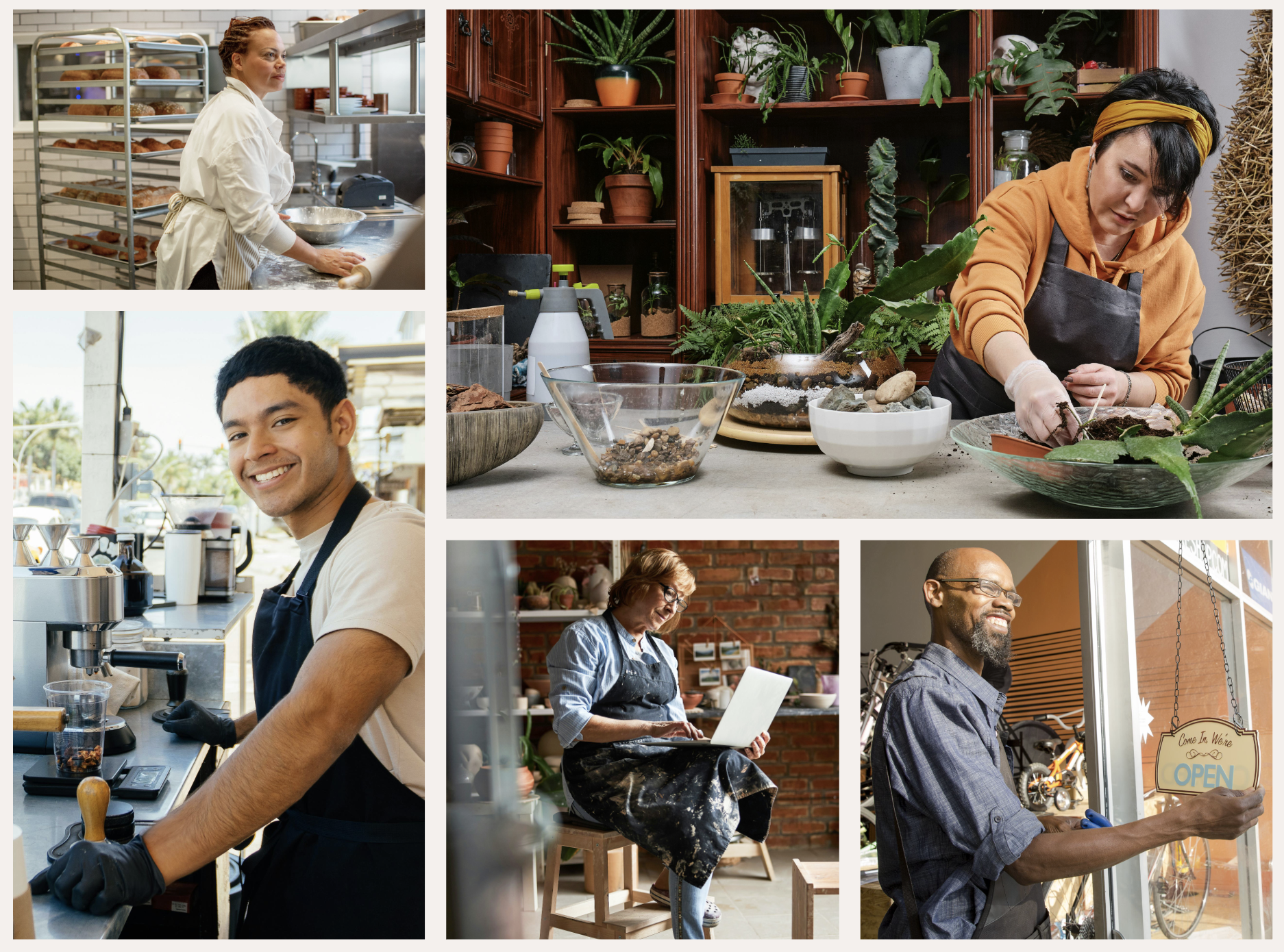
The total impact of the $100 million Open for Business Fund Asset Ownership Program demonstrates that the program did more than keep storefront lights on—it moved small businesses from chasing stability to a clear pathway for job creation, scale, and building wealth, while driving a ripple effect of impact across community partners, local small business ecosystems, and communities at large.

It did this through a targeted yet flexible overarching strategy that was laser-focused on helping business owners acquire tangible business assets like property, and equipment. In each of the five markets, local community partners designed tailored capital interventions to fit the needs of small businesses in their community, ranging from grants to acquire equipment, forgivable down payment assistance, 0% interest loans, grants for commercial property improvements, and more.

Insights across five markets describe business owners who have added production lines, hired staff, and negotiated larger contracts after securing critical assets: property, equipment, and technology. At the same time, community partners report stronger balance sheets of their own and a web of newly forged relationships that continue to pay dividends beyond any single grant.

In short, the combination of market-specific, targeted strategies, and flexible capital, plus hands-on support and ecosystem development has proven to be a scalable engine of broadly shared growth.


Share this report

The 1% Tax Floor and Innovative Approaches to Corporate Impact ROI

A new tax reality is changing the economics of corporate philanthropy: companies can now only deduct charitable contributions that exceed 1% of taxable income. That shift is forcing a more explicit conversation inside businesses about the most financially advantageous approaches to philanthropy and how—or whether—those investments generate business value alongside social outcomes.

During a May 19 virtual Leader Roundtable, senior corporate impact and philanthropy leaders from the NationSwell community kicked off a conversation on how companies are reassessing philanthropic budgets, rethinking the balance between grants, in-kind assets, and ordinary business expenses, and sharpening how they define and measure impact ROI. Some of the most salient insights from the discussion appear below:

Key Takeaways:

Collaborate cross-functionally to establish the best organizational approach for navigating the 1% tax floor. To understand the best way for your organization to navigate the 1% tax floor, it is important to align with legal, tax, and government affairs teams early and strategically. Adjustments differ depending on organizational makeup, budget cycles, and legal parameters; bunching or front-loading grants is one mechanism that organizations are considering, but other strategies include shifting the balance between corporate and foundation dollars, reclassifying some philanthropic spend as ordinary business expense, or considering the use of donor-advised funds (DAFs). 

Proactively identify and introduce opportunities for shared value inside of your organization. Social impact leaders should work toward identifying opportunities to center their work around business strategy rather than aligning community programs to a business case retroactively. Programs can be set up for success if they meet the business’s standards for rigor, are grounded in data and collaboration with business leaders, and are communicated in the language of the business. 

Lean on both quantitative and qualitative frameworks to bring a human dimension to measurement discussions. Measuring hours, dollars, and people reached is important, but these metrics alone only tell part of the story. Stories and case studies can be equally important in communicating impact, especially when discussing long-term change. 

Frame social impact initiatives as a talent development and retention driver. Some organizations are partnering with HR and L&D teams to build a more defensible, data-driven people ROI story focused on employee engagement and retention. They are analyzing the relationship between impact programs and talent outcomes – engagement, retention, skill development, and more – using existing survey data or, in some cases, developing new surveys to collect and study primary data.

Invest in human skills development as a business opportunity. With increased AI adoption, the skills that volunteerism and community engagement build — collaboration, empathy, leadership — are becoming more strategically valuable to businesses. Organizations that reframe their impact programs as a vehicle for developing these skills may be better positioned to make credible ROI cases to the business, while also providing value to employees seeking these opportunities.  

Five Minutes with… the Northern New Mexico Pathways to Opportunity Strategy Table

As funders look to move from isolated grants to systems-level impact, the need for durable, place-based models that communities can shape — not just receive — has never been clearer. In northern New Mexico, the LANL Foundation and the Annie E. Casey Foundation are collaborating with twenty other funders to pioneer the next frontier of place-based funding with the Northern New Mexico Pathways to Opportunity Strategy Table: a 15-member collaborative that brings philanthropy, public agencies, community leaders, and young people themselves together to align resources for those too often left out of education and workforce pathways.

What began as a listening process and a fund-mapping exercise has since evolved into a distinctly ambitious model that blends pooled philanthropic, corporate, and public dollars; youth-led participatory grantmaking; and capacity-building designed to help nonprofit  and tribal organizations grow stronger over time. The result is a more community-rooted way of thinking about how grant funding moves, who helps shape it, and what long-term success looks like.

For this installment of Five Minutes With…, NationSwell spoke with Alvin Warren, Vice President of Policy and Impact at the LANL Foundation, and Tomi Hiers, Vice President of Center for Civic Sites and Community Change at the Annie E. Casey Foundation, about what it took to move this work from convening to action, why the Strategy Table built youth voice into the model from the start, and what other funders around the country can learn from this effort. 


NationSwell: What is the Strategy Table, and what challenge was it built to address?

Alvin Warren, LANL Foundation: From our side, it’s important to understand that we’re a 100% place-based foundation based in Española, New Mexico, and we serve a predominantly rural and tribal region across north-central New Mexico. We were created to address a very specific geography: a seven-county, eighteen-tribe region of northern New Mexico.

One thing I knew from my time at Kellogg was that when national funders looked at New Mexico, they often focused only on Albuquerque, and there are understandable reasons for that, especially when funders are trying to meet numerical targets. But what struck me were the many opportunities to invest in good work in rural New Mexico — including work aligned with Casey’s Thrive by 25 framework — and yet that work often wasn’t visible or accessible to larger funders. Sometimes it was happening at a smaller scale; sometimes there were structural barriers that made it difficult for national funders to support smaller, rural organizations or tribes.

So we realized a mechanism might be needed to both draw attention to the opportunities and needs in Northern New Mexico and also make it logistically possible for funders, especially national funders, to invest in a way that felt informed, respectful, and shared. That’s really the blueprint for what the Strategy Table became.

Tomi Hiers, Annie E. Casey Foundation: At the Annie E. Casey Foundation, we made the decision to dedicate roughly 50% of our grantmaking to improving access to opportunity for young people ages 14 to 24 through our Thrive by 25 commitment, and we wanted to begin implementing that work in three places: our hometowns of Baltimore and Atlanta, and also Albuquerque, New Mexico — a place where the Foundation had already been active for about two decades, particularly around systems impacting justice-involved and child welfare-involved youth.

As we started thinking about a place-based strategy in Albuquerque and about working in deep partnership with nonprofits helping young people connect to education, training, employment, youth leadership, and financial stability, we knew it was important to understand the local philanthropic landscape. As a national funder, there can sometimes be tension around how national philanthropy shows up in a place, so we wanted to be a strategic co-investor; we wanted to know who the local funders were, what their priorities were, how those priorities aligned with ours, and how they wanted national philanthropy to support their work.

That’s how we began building relationships with local funders, and with Alvin, who was then at Kellogg and later transitioned to LANL Foundation. Those early conversations about what was important in the broader community, and what kinds of partnerships could help address barriers facing young people, were really the building blocks that eventually led to the Strategy Table.


NationSwell: What makes this different from a traditional workforce or economic development effort?

Warren, LANL Foundation: Northern New Mexico has one of the highest rates of disconnected, or “opportunity,” youth in the country: nearly one in four. For some populations, including Native youth and young parents, that number can be even higher. And this is happening in a region that also has real deserts of opportunity — places where access to paid internships, career training, or youth development programs are limited or uneven. So the goal isn’t simply workforce development in the conventional sense, it’s about transforming the landscape of opportunity so that young people, regardless of where they live in the region, have access to meaningful pathways.

What makes this model distinct is that it’s a pooled fund with three important differences. First, it’s designed to pool philanthropic, corporate, and public dollars, which is relatively unusual. Second, the grantmaking is done through a youth-led participatory process. And third, the model includes dedicated capacity-building support through a Regional Resource Hub, so grantees aren’t just getting one-off dollars, they’re also getting technical assistance, peer learning, and support to become more competitive for larger public and philanthropic funding over time.

Hiers, Annie E. Casey Foundation: What was attractive to us about the Strategy Table was that it offered leverage, sustainability, and scale. We rarely go it alone as a funder; we think a lot about how to use philanthropic dollars to leverage public funding or to bring other philanthropic partners into the work. We’re always asking: how do we have impact beyond a few hundred young people served directly? How do we influence policy and practice?

So part of what was exciting here was that there were already strong efforts underway, and a number of the funders at the table were supporting that work, including state agencies. The question became: how do we scale the best and most promising practices around education, training, and employment for young people, especially those who are often left behind and locked out of opportunity?


NationSwell: How have the Annie E. Casey and LANL Foundations helped move the work from convening to action?

Warren, LANL Foundation: We formally launched in 2021, and the first major step was a fiscal map. We partnered with the Children’s Funding Project and used the Thrive by 25 framework to do a five-year lookback on philanthropic investments in the region. Initially, we were only going to look at philanthropy, but the Casey Foundation pushed us to include public investments as well, and that was transformational; it would have been a huge missing piece otherwise.

At that point, the table had grown from an initial group of four funders to about ten. When the fiscal map was completed, we made what turned out to be a very important decision: instead of releasing the report publicly right away, we paused and took the findings out to our community first. We held a series of community gatherings, including a tribal-specific gathering, across the region, including in very rural communities. We also ran a survey and held focus groups, including one focused on underrepresented youth and another for policymakers and public funders. That process took about a year, and it was all about listening to how community understood the data and what they believed should happen next.

The other major shift from convening to action came when Casey helped us recognize that if we were serious about this, we needed infrastructure. Casey was the first funder to commit real resources to support the backbone and operations of the collaborative. Without that early investment, we would not have been able to grow the table or move toward implementation.

Hiers, Annie E. Casey Foundation: We think a lot about leverage. There’s power in bringing other funders to the table and in aligning philanthropic dollars with public systems. For us, this was an opportunity to support a table that was already rooted in a particular place and to help build something that could influence systems, not just fund isolated programs.

Once the fund mapping report came back, it became easier to think strategically. It helped us understand both where resources were flowing and where they weren’t. There was one county, for example, where the lack of investment was striking. That allowed the table to ask: What problem are we trying to solve, and what can a pooled set of more nimble philanthropic resources actually do?

From there, it was about planning carefully and building toward a model that could invite local partners into a meaningful, well-designed process for competing for and receiving resources.


NationSwell: What does the most helpful philanthropic support look like in a collaborative like this?

Hiers, Annie E. Casey Foundation: Flexibility is really important. In the early days, there was some willingness from other funders to include Albuquerque because Casey was doing work there. But we took the position that even though we were active in Albuquerque, this table was focused on northern New Mexico, and that was okay. We didn’t want our partners to contort themselves to make something work for us just because of how we had originally framed our priorities.

So for other funders or strategic partners joining a table, I think one of the biggest lessons is: if there are places where you can be flexible in service of the broader effort, you should seriously consider that.

Warren, LANL Foundation: I’d add that impact comes from infrastructure. Funders often want as much money as possible going directly out the door, and of course that matters. But if you under-resource the infrastructure it takes to do something complex like this, you undercut the impact. That means staffing, facilitation, evaluation, communications, support for the youth advisory members, and all the connective tissue that makes a collaborative actually function. Those investments may not always feel as exciting as direct grants, but they’re what make the grants more effective.

The other thing is: lend a hand. This doesn’t work if one organization is doing all the labor. Casey and other funders have actively helped make introductions, bring in new partners, and expand the pool, and that’s part of how we’ve grown the number of contributing funders. 

And finally: show up. It matters when national funders come in person, meet grantees, and participate face to face. That presence builds trust and changes the quality of the relationship.


NationSwell: What’s one anecdote or example of progress you’ve seen that shows the model is working?

Hiers, Annie E. Casey Foundation: One sign is simply that partners are still there, and new partners keep joining. My understanding is that this kind of table is something relatively new for northern New Mexico: funders coming together in this way with each other, with public systems, and with the broader community. The fact that the table has held together and continued to attract interest is itself a meaningful sign that the model is offering something valuable.

Warren, LANL Foundation: We’ve now been able to make 19 grants, almost all at the $100,000 level, with a couple slightly smaller based on what grantees requested. Based on grantee data, we anticipate reaching at least 800 young people by the end of the first year.

What’s especially exciting is the growth in participation in the pooled fund itself. As of the end of last week, we had 21 corporate and philanthropic funders either contributing or engaged in supporting the youth fund in some way, including 17 philanthropic funders and four corporate funders. And our largest state agency partner, the New Mexico Department of Workforce Solutions (essentially our Department of Labor), has committed a $1.5 million match for our second grantmaking round.


NationSwell: What’s been your biggest challenge in standing up this work, and what have funders needed to understand about that complexity?

Warren, LANL Foundation: One of the biggest challenges was the tension between moving thoughtfully and moving quickly. We spent what I think was an appropriate amount of time doing shared analysis and relationship building. That meant bringing funders together repeatedly, defining terms, developing guiding principles, and getting clear on what success actually meant across organizations with very different strategies and metrics.

That took time — a couple of years, really. And during that period, there were certainly people saying, “We’ve been in this space too long; we need to move to action.” That pressure is understandable. But if you don’t spend time building shared understanding, you can end up with a collaborative that looks aligned on paper but isn’t actually aligned in practice.

Hiers, Annie E. Casey Foundation: I think it also helps to have a broader definition of success. To me, the table being formed was a success. Having diverse philanthropic and public partners at the table was a success. Conducting the fund map and having honest conversations about what the data told us, and what it didn’t, was a success. Those things matter. And then, yes, the grants and the impact on young people are the “cherry on top,” but the process that led there matters too.


NationSwell: What felt important about building youth voice and participatory grantmaking into the Strategy Table’s design from the start?

Hiers, Annie E. Casey Foundation: Youth leadership is one of the pillars of Thrive by 25, and our Foundation has also been doing a lot of work around intergenerational engagement. It’s one thing to talk about youth voice or youth development. It’s another to think seriously about how adults and young people actually sit together, share decision-making, and govern together.

That was part of what made this model so intriguing to us. I’ll be honest — I didn’t know exactly how it would play out. I had questions: How would the youth advisory group be structured? Who would support them? How would adults and young people sit alongside each other in a real decision-making process? But when you’re part of a collaborative, you also have to trust the design process and the partners at the table. This was a chance to see what meaningful youth leadership and intergenerational governance could actually look like in practice.

Warren, LANL Foundation: We were very intentional about making sure the young people involved actually reflected the populations the work is designed to serve. The original members of the Regional Youth Advisory Council represented Native youth and Opportunity Youth, among others. In fact, two of the most active members are young parents.

We also didn’t just bring in young people who had never been exposed to philanthropy or leadership spaces. We recruited young people who had already participated in youth development efforts and were ready for this to be the next step in their leadership. And the reason we were able to do this well is because we had already spent so much time developing shared guiding principles that became a touchstone for the table. They made it much easier to say: if we really believe these things, then youth leadership and participatory grantmaking aren’t optional — they’re part of the model.


NationSwell: What can other funders and regional leaders take away from this model?

Hiers, Annie E. Casey Foundation:  Flexibility is one of the biggest takeaways. If you’re joining or building a collaborative, there may be places where you can loosen your grip on your own preferences in order to strengthen the broader effort, but that doesn’t mean losing your priorities, it means being willing to support something bigger than any one organization.

Also: time matters. If you want to build something durable, you have to resist the urge to rush to visible outputs before the foundation is there. Build intentionally, document what matters, and be prepared to adapt as the work evolves. The goal is not speed for its own sake — it’s sustainability.

And finally, I advise folks to define success broadly. The process of building alignment, doing the analysis, surfacing the data, and creating a real table with diverse stakeholders is not just pre-work, it is part of the impact.

Warren, LANL Foundation: If I had to put it in bullet points, I’d say:

  • Be willing to learn together. We wouldn’t have this table, or this success, without the Casey Foundation, our other Strategy Table partners, and other contributors. In particular, if Casey had gotten a year in and said, “Actually, it’s been great, see you later,” I honestly don’t know where we’d be. 
  • Stay the course. Philanthropy is often too quick to pivot just as things begin to work. When you stay the course, you begin to build capacity and move towards long-term impact. 
  • Recognize that impact comes from infrastructure. You don’t win by undercutting the resources it takes to do something this complex. Funders have to invest in the infrastructure, too — staffing, evaluation, communications, facilitation, the support it takes to manage and train the Regional Youth Advisory Council. All of that is what makes the impact possible, alongside the dollars going into the fund itself.
  • Lend a hand: Don’t assume one backbone organization should do all the labor.
  • Show up, especially in person. National funders, in particular, need to remember that their presence matters. It matters when they come to the community, meet grantees, and participate via relationships, not just transactions. That can make all the difference.

The Northern New Mexico Pathways to Opportunity Strategy Table is made possible by a collaborative of 15 members: Anchorum Health Foundation, The Annie E. Casey Foundation, Aspen Institute Forum for Community Solutions, The Cricket Island Foundation, LANL Foundation, Los Alamos National Laboratory Community Partnerships Office / Triad National Security, LLC, Las Vegas (New Mexico) Community Foundation, Marshall L. and Perrine D. McCune Charitable Foundation, New Mexico Foundation, Regional Youth Advisory Council, Santa Fe Community Foundation, Taos Community Foundation, Conrad N. Hilton Foundation, Thornburg Foundation, United Way North Central New Mexico, and W.K. Kellogg Foundation.

The Placed-based Action Map

The Placed-based Action Map

Where is effective place-based impact actually happening, and who is involved? Until now, it’s been difficult to answer that with any clarity.

The Place-Based Impact Map allows users to explore initiatives across the U.S., making it easy to explore what’s happening in your region and others, and who to reach out to for insights. And the map offers place-base leaders an opportunity to promote their work to curious funders and regional supporters. A companion to the Place-based Impact Measurement Toolkit.


Share this report

The Principled Approach: Place-based Measurement Toolkit

The Principled Approach: Place-based Measurement Toolkit

Measuring impact can be hard to do accurately and effectively. Place Based Impact Measurement in particular, because every region and neighborhood is different. That can lead to overlapping KPIs and confusion over how to chart progress, and scale good ideas.

So, NationSwell’s Place Based Collaborative have created a new resource to address this gap:‘The Principled Approach’ — A toolkit to guide thoughtful, community-led, effective
measurement of place-based impact.

Whether you are embarking on place based work, or deep into it, this toolkit illuminates the key principles that put communities at the heart of not just the programs being funded, but the way the success of those efforts is quantified. A perfect companion to NationSwell’s Place-based Action Map.


Share this report

Five Minutes with… The Greater Tacoma Community Foundation’s Kathi Littmann

What does it look like for a community foundation to meet the moment not just as a funder, but as a convener, translator, and catalyst for long-term change? As a longtime steward of community resilience across Pierce County, Washington, the Greater Tacoma Community Foundation is embracing that challenge by connecting unlikely partners across the region and creating the conditions for communities to influence and shape the systems that affect them.

For this installment of Five Minutes With…, NationSwell spoke with Kathi Littmann, president and CEO of The Greater Tacoma Community Foundation, about the evolving role of community philanthropy, the importance of building resilience alongside capacity, and what other foundations can learn from Pierce County’s collaborative model.

Here’s what she had to say:


NationSwell: How would you describe the role The Greater Tacoma Community Foundation plays in the region, and what makes your approach to community philanthropy distinct?

Kathi Littman, President and CEO, The Greater Tacoma Community Foundation: We serve Pierce County, which is in the Puget Sound region between Seattle and the state capital. It’s a gritty, deeply collaborative community that has always known how to do a lot with limited resources, and that really shapes who we are as a foundation.

GTCF has been here since 1981, and we’ve grown from about $10,000 to more than $200 million in assets, so today we’re a mid-sized community foundation. At our core, our prime directive is honoring donor intent: what do our fund advisors love about Pierce County, and what kind of legacy do they want to leave here?

At the same time, when we’re working with discretionary resources, we’re very focused on systems change. We’re always asking how we can help meet urgent needs today, but we’re thinking in parallel about how we can address those problems long-term so that we’re not responding to them forever. For us, that means removing barriers to generational wealth and well-being across Pierce County.

Our strategic framework is built around four interconnected pillars: housing, youth, civic voice and power, and access to capital and wealth. Those issues all intersect, but right now we’re especially focused on civic voice and power in that we’ve been shifting our thinking from helping nonprofits build capacity to helping communities build resilience. Capacity is about doing what you already do, better; resilience is about being able to adapt, lead, and meet a changing moment.

And while we do a lot of grantmaking, our real superpower is not just the money, but the relationships. It’s convening across sectors, connecting people, catalyzing ideas, and helping communities use their lived experience to influence the systems shaping their lives. That’s really GTCF’s sweet spot, and it’s what makes us uniquely suited to this moment.

NationSwell: What would you say GTCF’s secret sauce is as a convener? What lessons have you learned that are transferable for others hoping to build community trust

Littmann, GTCF: Pretty consistently, whether we’re working with a government agency, a national funder, or one of our own donor-advised fundholders, people come to us because they know we’ll connect them to others who care about the same issues and help them make smarter decisions about how they invest in the community. They see us as thought partners, and just as importantly, as connectors to other thought partners.

That’s why I often say some of the highest-value things we offer go well beyond the grants themselves. A good example of this is the intermediary work we’ve done with the Washington State Department of Commerce, where we’ve helped move state dollars into communities faster by serving as the contract holder and intermediary so that nonprofits receive those funds as grants rather than taking on the administrative burden and risk of a government contract.

That work led to another important role: Last fall, the state Speaker of the House and the Pierce County Executive asked us to convene nonprofits around the impact of federal budget cuts on county services. We brought in service sector and network leaders, grounded the conversation in data, and created an ongoing space to understand the ripple effects across housing, food access, Medicaid, employment, and more.

That’s really our model: community-centered philanthropy. The people closest to the issue understand the barriers, and our role is to convene them, amplify their voices, bring in research and examples, and help translate lived experience into action.

NationSwell: How are you thinking about what it means to be a community foundation in this moment? What are the unique challenges that you’re facing, and how does your work go beyond traditional grantmaking? 

Littmann, GTCF: Being a community foundation is both inspiring and a little daunting, because in theory we’re built to be here in perpetuity. That means we have to lead with hope — not just for what Pierce County needs right now, but for what we want this community to look like seven generations from now. That’s a beautiful mission, but it’s also a heavy one, especially in a moment when so many systems feel misaligned with that long view. What we’ve learned is that even when there’s trauma and scarcity, there is real power in bringing people together around possibility and helping communities imagine solutions that reduce the need for crisis response over time.

A few lessons consistently guide how we do that work. First, we’re always asking: are we in the right role? If someone else should own it, we’re not trying to hold it. One reason communities trust us is that they know we can incubate and convene, but also that we’re not trying to keep control. Second, we’re constantly asking who’s not at the table; we don’t need to convene everyone, but we do need the right voices in the room. Third, one of our unique roles is helping the community see the bigger picture — surfacing patterns, gaps, and ripple effects that individual organizations may not be able to see on their own. And finally, we believe deeply in passing the mic. Our role is not to speak for communities, but to create the conditions for people to speak for themselves through our platform and relationships.

We’re also very intentional about building relationships beyond Pierce County, because some of our best learning comes from statewide and national partnerships. Pierce County is a strong testing ground: it’s diverse, collaborative, and in many ways a microcosm of the country. That makes it a powerful place not just to serve community needs, but to learn what kinds of philanthropic approaches actually work.

NationSwell: Can you share an example of a partnership, initiative, or investment that reflects how you’re trying to meet this moment differently?

Littmann, GTCF: I’ll start with our Department of Commerce work around the Community Reinvestment Project, which was a $200 million state initiative designed to address harms caused by the war on drugs and which we stepped into as an intermediary for Pierce County. We signed the contract, negotiated the terms, provided upfront funding, and convened a local advisory team made up of leaders from the sectors most impacted. We also trained them in community-centered philanthropy, because many had been conditioned to navigate contracts and compete for funding rather than help shape how resources move. Then they helped decide how the money went out.

We were able to move funds quickly and get grant dollars into the hands of local organizations, but what became most interesting was what happened beyond Pierce County. The Department of Commerce wanted to serve the whole state, and we stayed in our lane while helping foundations in the other priority counties replicate the model. We shared our contract, encouraged them to step into the same intermediary role, and built a coalition across the state. We were asking: what does this look like in a rural county? In a place with a huge geographic footprint? In a community with fewer people but different needs? We eventually brought in a third-party evaluator, captured what we learned, and shared it back with the Department of Commerce. That’s the kind of role we can play as connectors, conveners, and catalysts: helping partners scale while learning in real time.

Another example is our work with the Pierce County Resiliency Hub, which feels especially relevant right now. As federal funding started to shrink, we heard from two longtime community leaders — the Washington State Speaker of the House and the Pierce County Executive — both of whom came up through grassroots and agency leadership. They reached out and essentially said: Pierce County has done this before; when resources get tight, the community has to come together and get ahead of it, and GTCF is in a unique position to help make that happen.

That really speaks to our role beyond grantmaking. We can convene, yes, but we also serve as a knowledge facilitator. One of the hardest questions right now is simply: how much federal money has actually been flowing into Pierce County, and where is it going? That’s incredibly difficult to answer. Funding reaches municipalities, the county, the state, and individual organizations in different ways. So one of the first things we did was secure a researcher to help us build what we’re calling reliable data. With so much federal data becoming harder to access or disappearing altogether, we wanted a shared source of truth the community could trust.

NationSwell: As you look ahead, what feels most important for community foundations to get right in the next few years if they want to build long-term resilience and opportunity?

Littmann, GTCF: First, we have to be truly client-centered in how we make philanthropy accessible. The products themselves can be confusing: donor-advised funds, designated funds, changing tax laws, qualified minimum distributions. For someone simply trying to figure out how to do good with what they have, it can be overwhelming, and our role is to make that process feel human, clear, and usable.

Second, we have to get our financial model right. Like many organizations, our organic revenue doesn’t fully cover the catalyst and convening work we know has the highest impact. So it’s our responsibility to sustain GTCF in a way that reflects a theory of abundance, not scarcity. That means being able to clearly articulate the return on investment: if you support GTCF, you’re helping ensure we can meet the moment not just now, but 10, 20, or 50 years from now. That kind of long-term stewardship matters, and so does making sure we can retain the staff who make that work possible.

Third, we need to create the time and bandwidth to influence the field. We do our best work when we’re running alongside like-minded foundations, businesses, agencies, and partners. But that kind of collaboration takes time. It requires real relationship-building and a willingness to understand not just what someone is doing, but how they’re doing it and, most importantly, why.

And that leads to the last piece: narrative. If we’re truly thinking seven generations ahead, we can’t just document what we did or how we did it; the most important thing to preserve is why. If future leaders understand the values and reasoning underneath a decision, they can adapt the tactics to meet their own moment without losing the thread.

Five Minutes with… Walton Family Foundation’s Tina Fletcher

The Arkansas-Mississippi Delta is a case study in what community-rooted investment can make possible. Too often framed through deficit and disinvestment, the Delta is also a place of deep resilience, cultural richness, and local leadership; a region where people have been building and adapting solutions for generations, often without the level of sustained support they deserve. 

Tina Fletcher, who helps lead the Walton Family Foundation’s work in the Delta, is focused on helping shift that narrative by pairing long-term commitment with a community-centered approach to partnership. Across education, economic mobility, and leadership development, Fletcher’s work centers on strengthening what’s already working in the region and connecting the people and institutions best positioned to carry that momentum forward.

For this installment of Five Minutes With…, NationSwell spoke with Tina about what makes the Delta such a distinctive and inspiring place to work and why the greatest opportunity may be less about reinventing the Delta than investing in the talent and leadership that’s already there.

Here’s what she had to say:


NationSwell: For those less familiar, how would you describe the Delta — and what makes this region both unique and inspiring to you?

Tina Fletcher, Senior Program Officer, Walton Family Foundation: When it comes to the Delta, what stands out to me is just how much determination and resilience already exists. The Delta is a region rich in culture, community, and getting things done, with deep relationships and a strong sense of place that you can feel immediately. What makes it especially inspiring is that, despite being under-funded, the Delta has never lacked the capability to thrive. The Delta is full of people who have been leading and building for generations, people who aren’t waiting for solutions; they’re generating them in real time and in and meaningful ways. What’s needed now is investment that recognizes and accelerates that momentum because when you shift from “What’s wrong?” to “What’s working?”, the Delta looks entirely different.

NationSwell: How would you describe the Walton Family Foundation’s strategy on building trust and momentum in the Delta region over time?

Fletcher, WFF: At the Walton Family Foundation, our Delta Region strategy is simple, but not easy: show up, listen, be a good partner, and stay committed. Building trust in the Delta means investing in relationships just as much as we invest in results. In my role, I focus on strengthening what’s already working across education, economic mobility, and leadership, while finding creative ways to connect the individuals driving progress. I also bring a learning mindset to every table and conversation  I join, using data to inform the work without losing sight of community voice. That combination-commitment, consistency, humility, and rigor—is what turns trust into real momentum.

NationSwell: Can you share a moment or partnership in the Delta that changed how you think about community-centered philanthropy?

Fletcher, WFF: The biggest shift for me has been seeing what happens when communities aren’t just included—they’re in the lead. Across the Delta, I’ve seen young people, educators, and local leaders design solutions that are more relevant, effective, and sustainable than anything we could prescribe from the outside. I saw this firsthand in Jonestown, Mississippi, during a conversation with Mayor Columbus Russell, Jr., the youngest mayor in the state, and again in Helena-West Helena, Arkansas, led by Mayor Joseph Whitfield. Both are young, energetic leaders working in step with residents, partners, and funders to move their communities forward. Those moments reinforced that proximity matters. Community-centered philanthropy isn’t just about engagement, it’s about shared ownership. When communities lead together, the results aren’t just impactful, they’re sustainable. And that’s when the work doesn’t just land, it takes root.

NationSwell: For funders looking to invest in the Delta, what guidance would you offer to ensure their approach is both effective and community-centered? What are some common mistakes you’d recommend they avoid?

Fletcher, WFF: First, start by listening and plan to stay longer than you initially imagined. The Delta doesn’t need more one-off investments; it needs partners willing to build over time. Fund what’s already working, invest in capacity, and trust local leaders to guide the way. A common mistake is chasing quick wins without understanding the broader system or underestimating how long trust takes to build. In the Delta, philanthropy must focus on building trust and staying committed, because that’s what ultimately drives results. Opportunities for impact are real and plentiful, but they require patience, partnership, and a deep belief in the people closest to the work.

NationSwell: As a leader, how has working in the Delta shaped your personal leadership style, or clarified what kind of leadership this work requires?

Fletcher, WFF: This work has taught me that leadership isn’t about having all the answers, it’s about creating the conditions for the right answers to emerge. In the Delta, that means listening deeply, sharing power, and being intentional about whose voices shape your decision-making around the work. It’s also reinforced the importance of staying grounded in both data and humanity, balancing the desire for accountability and rigor with the realistic challenges Delta communities face. As a result, I am much more focused on connecting dots amongst stakeholders, leverage my organizations connections to benefit the communities we serve, funding what has proven to work, and making space for others to learn and lead. The kind of leadership this work requires is steady, collaborative, and deeply rooted in trust.

NationSwell: What gives you the most optimism about the future of the Delta, and where do you see the greatest opportunities for impact in the years ahead?

Fletcher, WFF: What gives me optimism is the talent and leadership already present, especially young leaders who are stepping up to shape what comes next, alongside seasoned leaders supporting them along the way. There’s a growing ecosystem of organizations doing powerful work, and the opportunity now is to connect and scale those efforts. I see real potential in more intentionally linking education to economic mobility, creating clear, local pathways from learning to earning and investing. The Delta doesn’t need to be reinvented; it needs to be invested in. And for funders willing to lean in, this is a moment with real momentum.

When and How AI Can Improve Grantmaking

AI is moving fast, but grantmakers are rightly cautious. Funders are under pressure to move money more efficiently, learn faster, and support grantees better, all without adding risk, burden, or opacity to an already complex system. The question is no longer whether AI will touch grantmaking, but where it can actually add value—and where it shouldn’t.

On April 16, NationSwell invited philanthropic and impact leaders to take part in a conversation on the practical use of AI in grantmaking. The conversation featured ideas about when AI can meaningfully improve decisions and workflows and how to adopt it in ways that strengthen, rather than undermine, equity, accountability, and relationships with grantees. Some of the most salient takeaways from the discussion appear below:


Key takeaways:

Assess where AI meaningfully adds value across the grantmaking process. Rather than applying AI indiscriminately, organizations should take a step back and evaluate workflows end-to-end to determine where these tools can be most effective. A thoughtful, system-level approach can promote AI application in ways that enhance, rather than complicate, existing processes.

Use AI to streamline manual and error-prone grantmaking workflows. Financial due diligence can be a highly manual, time-intensive, and error-prone process, often involving spreadsheet-based analysis or visual review of financial statements. AI tools like Grant Guardian were developed to improve accuracy and efficiency in this specific workflow. 

Reinvest time savings from AI into deeper grantee engagement. Small grantmaking teams often face hundreds of applications, creating capacity constraints. AI can be used to support summarization, rubric-based pre-review, and prioritization to help manage this volume. The reduction in processing time, from hours to minutes, can allow staff to spend more time having meaningful conversations with grantees and improving the quality of their work. 

Recognize and normalize AI use among applicants and grantees. There is growing recognition that applicants and grantees are using AI to improve efficiency, particularly in drafting and responding to applications. When used thoughtfully, this can help reduce administrative burden, though differentiation still relies on the substance of proposals and outcomes.

Consider supporting grantees’ capacity to adopt AI tools and infrastructure. As AI becomes more embedded in workflows, there is an opportunity for funders to think about how grantees can access and use these tools effectively. Supporting this capacity, particularly through flexible, operational funding, can help organizations integrate AI in ways that enhance their work, rather than treating it as a one-off programmatic expense.

Develop and deploy AI systems with responsible AI principles. Specific principles should guide all AI adoption work in grantmaking, including safety and transparency, community-centered design, bias mitigation, human-in-the-loop validation, enterprise-grade security, and sustainability considerations. Start AI adoption through structured experimentation with clear guardrails, and consider empowering early adopters to test tools within defined parameters (e.g., “stoplight” approaches to acceptable use). These frameworks can also support clearer communication and transparency about how AI is being used.

Consider AI disclosure as contextual and relational: Whether and how to disclose AI use in grantmaking processes depends on organizational policies and levels of AI involvement. While practices may vary between organizations, especially as technology grows and with wider experimentation, keep a relational and trust-based mindset.

Maintain human oversight as a core requirement in AI-assisted workflows. AI is never a substitute for human judgment, and validation and verification by users must be built into the process. Being explicit about this, both internally and externally, can help reinforce trust, particularly in a field like philanthropy that is deeply relationship-driven and values human expertise.

Design for customization of AI tools to reflect different evaluation contexts. Grantmaking organizations assess financial health and programmatic fit differently, and AI tools can be configured with varying metrics, thresholds, and profiles to match those needs. This flexibility can also support more context-sensitive and equitable evaluation approaches; for example, assessing early-stage organizations differently than more established ones. 

Impact Next: An interview with the Caterpillar Foundation’s Asha Varghese

At a moment of unevenness and division, who is advancing the vanguard of economic and social progress to bolster under-served communities? Whose work is fostering the shared growth that ensures every individual thrives? Who will set the ambitious standards that mobilize whole industries, challenging their peers to reach new altitudes of social impact? 

In 2025, Impact Next — an editorial flagship series from NationSwell — will spotlight the standard-bearing corporate social responsibility and impact leaders, entrepreneurs, experts, and philanthropists whose catalytic work has the potential to shape the landscape of progress amid urgent need for social and economic action.

For this installment, NationSwell interviewed Asha Varghese, Head of Corporate Social Responsibility at Caterpillar and President of the Caterpillar Foundation.


Greg Behrman, founder and CEO, NationSwell: What brought you to the field that you’re in right now? Was there an early moment, a relationship, or an experience that galvanized your commitment to driving bold action?

Asha Varghese, Head of Corporate Social Responsibility at Caterpillar and President of the Caterpillar Foundation: What brought me into this work wasn’t a single defining moment but really a series of experiences that shaped how I see opportunity, equity, and the role the private sector can play in expanding both.

A big part of that goes back to growing up between two very different worlds. I spent my early childhood in Kerala, India, and my family didn’t move to rural Kentucky until I was 12. On the surface, those places couldn’t have looked more different, but what connected them for me was how deeply access to opportunity shaped people’s lives. I was fortunate to grow up in a family that believed fiercely in education and pushed us toward careers, especially in STEM. But many people in both of those communities didn’t have the same access. Living between those two worlds taught me resilience, but also a lasting awareness of how much opportunity — or the lack of it — can define a person’s path.

The other set of worlds I’ve learned to navigate is more professional: I’m a computer engineer by training, and I now work in corporate philanthropy and social impact. Those fields may seem far apart, but for me they’re deeply connected: Engineering taught me how to break down complex problems, innovate with limited resources, and build thoughtful, durable solutions, and I bring that same mindset to social impact work.

That’s really how I think about this role: bridging the discipline and problem-solving orientation of the private sector with the urgency and complexity of social development. It’s the combination of those personal and professional experiences that led me here.

Behrman, NationSwell: What is the “North Star” of your leadership style? What are some of the attributes that make you an effective leader in the space?

Varghese, Caterpillar: I’d say my North Star as a leader is creating stable pathways for people to thrive, no matter where they’re starting from. That’s true for how I lead as an individual, and also for how I show up representing our brand.

I actually got a lot of clarity on that through the Presidential Leadership Scholars program, which brings together leaders to study the leadership styles of past U.S. presidents. One of the most powerful exercises they put us through was identifying your single core value — the one you’d choose if you could only pick one. For me, that value was stability.

That really clicked for me because it ties so directly to my own journey. Stable environments created opportunity in my life, and that’s shaped how I think about leadership ever since. Any solution I’m building, any initiative I’m helping lead, I want to make sure I’m leaving behind something that outlasts me: a system that is durable, intentional, and built to support people over time.

The other value that has become increasingly important to me over the last decade is empathy. And I don’t think of empathy as a soft skill but as strategic clarity. It’s about listening deeply to communities, to teams, to emerging leaders, and making sure their voices shape the systems we’re building. At the core of all of it, I believe in expanding access to opportunity. That’s what guides the work I do.

Behrman, NationSwell: What is helping you or anchoring you to a sense of stability in the current moment?

Varghese, Caterpillar: A good example of that is the work we’ve been doing at Caterpillar around the future of work. Last year, as we celebrated the company’s centennial, we used that milestone not just to reflect on our legacy, but to sharpen our focus on people.

In a moment defined by AI and rapid technological change, the question for us is not whether technology matters; of course it does. The question is: how do we make sure people and technology can coexist and thrive together? That’s where a lot of my work is centered right now.

It connects directly to our broader commitment around workforce development and the future of work. For the next generation entering the workforce, the path forward can feel increasingly unclear. At the same time, there are many workers, especially in manufacturing and adjacent sectors, who understandably worry about being left behind. So the challenge for us is how to help create stable pathways for both groups: pathways that help young people navigate what’s next, and pathways that help current workers adapt with confidence.

That’s the work in front of us right now: taking a massive, complex problem and breaking it down into scalable solutions that help people feel more prepared, more included, and more secure in the future.

Behrman, NationSwell: What is unique or differentiated about the approach that you’re taking? Can you walk us through what excites you most about the work that you’re leading?

Varghese, Caterpillar: It’s hard to pick a single initiative, but the work I’m most energized by right now is our growing enterprise-wide commitment to workforce development. We’ve supported that work in different ways for years, but this deeper focus across the company gives me a lot of optimism because it’s so clearly centered on people.

More broadly, one approach I’m especially proud of is how we think about shared-value philanthropy: designing strategies that create real social impact while also aligning with the unique role a company like Caterpillar can play. Over the last six years, through a pandemic, humanitarian crises, and all kinds of global volatility, we’ve stayed committed to showing up consistently in communities. And what I’m proudest of is that we’ve done it by keeping community at the center — not by assuming we know the answers, but by listening, collaborating, and building solutions that can outlast us.

A good example in the U.S. is the Caterpillar Foundation’s work with Learning Undefeated, which uses game-based experiences to get K–12 students, especially middle schoolers, excited about STEM and modern manufacturing. It’s a creative way to tackle perception and interest early, and it brings in not just students, but teachers and other adults who influence their choices.

Globally, the Foundation is also focused on partnerships that treat jobs as the outcome, not just training. That’s what I appreciate about partners like IYF and Generation: the goal isn’t simply to hand someone a certification. It’s to ask, did this person get a job, and are they still in it six months later? That’s the kind of economic progress that matters. 

Behrman, NationSwell: Are there any particularly cool or illustrative examples of how Caterpillar is showing up in communities?

Varghese, Caterpillar: One longstanding area of work I’d point to is our disaster relief and humanitarian response portfolio through the Foundation. What I find especially meaningful about it is that we don’t think about disaster response as just the immediate relief effort (though that’s obviously critical). We also focus on how communities can be better prepared before disaster strikes, so local organizations are ready to respond quickly rather than starting from scratch in the middle of a crisis.

And just as importantly, we stay engaged after the headlines fade. Once the cameras are gone and the community is still recovering, we look at long-term mitigation and resilience, which is where this work connects directly to our sustainable infrastructure portfolio. That means asking: what kinds of nature-based or infrastructure solutions can actually reduce the impact of future floods, fires, droughts, and other climate-related events?

To me, that portfolio really reflects the consistency of how we try to show up as a company. Whether it was COVID, wildfires in California, or flooding in parts of Africa, the goal is the same: respond in the moment, but also invest in the systems that help communities recover and withstand what comes next. That’s a strong example of what shared-value philanthropy looks like for us.

Behrman, NationSwell: Are there any resources you’d recommend — books, podcasts, Ted talks — that have influenced your thinking that might influence others as well?

Varghese, Caterpillar:  On the resource side, a couple of things come to mind right away. Podcast-wise, I really like the TED Radio Hour episode on “Networks.” It resonates deeply with how I think about leadership and impact — that solutions grow at the speed of trust, and that ecosystems and relationships really matter.

I also really enjoy Fortune’s Leadership Next. It’s a great look at how CEOs and corporate leaders are thinking about leadership today, especially when it comes to integrating social responsibility into business strategy. That intersection feels very relevant to the work I do, so I always find something useful there.

Book-wise, one that has really stayed with me is Atomic Habits by James Clear. It’s helped me stay disciplined and intentional about how I want to show up, both personally and professionally. I also subscribe to his weekly newsletter, which I find grounding and consistently useful.

Behrman, NationSwell: Of the socially motivated leaders you consider your peers, who are 2-3 whose work inspired you and whom you hold in high esteem?

Varghese, Caterpillar: The person who most inspires me is my father, Dr. Roy Varghese. He came to the U.S. in the 1970s and ultimately chose to spend more than 30 years of his career in rural Kentucky, helping revive a struggling hospital in a small town where he was, for a long time, the only physician. He could have chosen to practice anywhere, but he chose to stay there; that says so much to me about resilience, purpose, and intentionality. The way he showed up in medicine, and the way he stayed rooted in service, has had a profound impact on how I think about leadership.

Beyond that, I’m inspired by so many leaders across the social development space — especially those who lead with steadiness, creativity, and a commitment to building systems that outlast them. It’s a tough and often chaotic world, and I have a lot of admiration for the way so many nonprofit and corporate leaders continue to show up with consistency and conviction for the greater good.

Solution Spotlight: Rethinking homeownership models to build generational wealth

In many cities, the homeownership gap reflects not a shortage of aspiring buyers, but the long erosion of affordable homes for sale. In communities shaped by redlining, population loss, and decades of systemic neglect, the problem is often twofold: homeownership remains financially out of reach for many families, and the supply of high-quality, affordable homes has been hollowed out. In some neighborhoods, that dysfunction is compounded by hypervacancy, where abandoned or uninhabitable properties sit empty for years, dragging down surrounding values even as would-be buyers struggle to find homes they can realistically purchase.

NationSwell’s Solution Spotlight series is designed to surface the most innovative and promising (or proven!) initiatives and approaches that are creating results. Each installment offers a closer look at a unique, impact-driven model — how it works in practice, how it was brought to bear, and what it reveals about building durable change. Sourced from within the NationSwell community, the series aims to surface what’s working, why it matters, and how it can be adapted or scaled.

This feature spotlights two models that both show how reinvestment in overlooked areas can unlock exciting new opportunities for homeownership (and avoid the displacement of communities who have lived in those neighborhoods for decades.) 

Parity Homes — created and run by Bree Jones in West Baltimore — has stepped in to fill that gap by rebuilding not just individual homes, but also by rethinking the conditions that make ownership possible in the first place. 

And in Springfield, Massachusetts, the City of Homes Initiative — led by Way Finders and supported by MassMutual Foundation — is advancing a policy-driven pathway that transforms long-blighted properties into affordable homeownership opportunities for working families. 

More on both below…


Parity Homes: Rebuilding homes and markets in West Baltimore

“What we do in simple terms is we create both the supply and the demand to jumpstart housing activity in collapsed markets through social capital.— Bree Jones, Founder & CEO, Parity Homes

The Problem: Dysfunctional housing markets
In historically Black neighborhoods like those in West Baltimore, homeownership barriers aren’t driven by overheated demand, but by long-term market disinvestment. Thousands of homes sit vacant or uninhabitable due to decades of redlining, urban renewal, and predatory lending that displaced residents and restricted the flow of capital into Black neighborhoods. Legacy residents are often left with devalued homes and overdue maintenance, while new buyers have few affordable and livable options. Traditional housing markets — and financing systems — struggle to operate effectively in this context.

For individual buyers, the perceived risk of being “first” — moving onto a block without confidence that neighbors, services, or investment will follow — further suppresses demand, even where interest in homeownership exists.

The Solution: Community building for market revival
Founded in 2020, Parity is a development company and community-building model designed to address both sides of this problem at once. The organization acquires clusters of vacant properties, renovates them to a high standard, and pre-sells homes to cohorts of buyers — often friends, family members, or existing social networks — who move onto a block together.

By anchoring demand in trusted relationships rather than isolated individual buyers, Parity reduces the social and financial risk of moving into disinvested neighborhoods, helping buyers feel confident that they are not entering a block — or market — alone. Rather than treating homeownership as an individual leap of faith, Parity treats it as a coordinated act of collective entry which contributes to stronger community relations and richer social capital.

On the buyer side, Parity guides participants through a readiness program that prepares them financially, emotionally, and mentally for homeownership. On the community side, it supports legacy residents through key partnerships with organizations like the SOS Fund which connects residents with anti-displacement resources that help them address deferred maintenance and lock in property taxes as values rise.

Why it’s Different: Parity treats social capital as the primary catalyst for market revival. Rather than marketing homes to individual buyers in isolation, the organization intentionally assembles cohorts of prospective homeowners from existing social networks, guiding them through the buying process together. 

Parity recruits buyers through referrals, community outreach, and trusted relationships, then moves cohorts through a shared readiness process that builds financial preparedness alongside mutual commitment. And by pre-selling homes before construction and anchoring demand in groups that already trust one another, Parity reduces uncertainty for buyers, lenders, and the surrounding market. Parity’s core process of repurposing vacant houses also contributes to more sustainable construction, because it creates a much smaller ecological footprint than a new construction site would.

“We pre-sell all of our homes. The buyer goes through the entire construction process — they choose finishes, they’re invested. It’s not ‘build it and list it on Zillow.”

— Bree Jones, Founder & CEO, Parity Homes

Impact Highlights: In just a few years, Parity has moved from proof of concept to measurable, neighborhood-level impact, accelerating renovation timelines while demonstrating that coordinated reinvestment can revive disinvested blocks.

What began as a vision to cluster buyers and rebuild vacant homes has translated into measurable production and faster delivery, signaling that the model can scale:

  • 60+ properties acquired
  • 13 units completed on the first block; 20 more under development
  • Renovation timelines reduced from ~12 months to ~6 months

Key Enabler: Catalytic capital that de-risks early stage innovation

“Without JPMorgan Chase’s catalytic funding, I wouldn’t have been able to do any of this.”

— Bree Jones, Founder & CEO, Parity Homes

Parity launched with a $2M catalytic grant from JPMorgan Chase, enabling early proof of concept at a moment when traditional lenders were unlikely to back a market-revitalization model. That early capital helped to demonstrate viability, which in turn helped to attract additional partners.

The organization has since expanded through blended capital, including a $1M, 1% program-related investment (PRI) from the Nathan Cummings Foundation, and a $2M revolving construction loan from Baltimore Community Lending – increasingly leveraging debt to scale production.

Future Plans: Parity’s model is uniquely designed for housing markets experiencing hypervacancy like Detroit, Cleveland, St. Louis, East Cleveland, and Kansas City.  Parity has proven the ability to convert the most entrenched dilapidation and vacancy into ownership, rebuilding intergenerational wealth, and strengthening civic power at the block, neighborhood, and city level.

Lessons & applications for other leaders:

  • Design for community building, not just individual sales. Pre-selling homes to buyer cohorts before construction reduces risk for purchasers and lenders alike. By leveraging existing relationships to assemble and support buyers, Parity demonstrates that social capital can function as a form of investable capital when intentionally organized.
  • Build ownership pathways for a range of buyer profiles. Designing financing and readiness processes around actual lived circumstances expands access while strengthening long-term stability.
  • Fix underlying structural misalignment, not just the symptoms. Markets don’t fail accidentally — they fail when systems are misaligned. Pairing social driven demand with institutional lending, national philanthropy, policy, and construction innovation restores market function (rather than temporarily masking dysfunction).

“Our long-term theory of change is about building power—neighbors who know how to advocate for themselves and shape the systems that serve them.”

— Bree Jones, Founder & CEO, Parity Homes


City of Homes: Turning blight into pathways to ownership in Springfield

“We’re creating a new pathway for properties to go from being blighted to being assets for the community — and for families that didn’t have that opportunity before.”

— Keith Fairey, President & CEO, Way Finders

The Problem: Blight, disinvestment, and lost ownership opportunities
Springfield, Massachusetts is historically known as the “City of Homes,” but decades of disinvestment have left many single- and two-family properties abandoned or in severe disrepair. In turn, those properties depress surrounding home values, destabilize neighborhoods, and often cycle through the court-appointed receivership process where they are rehabilitated and often converted into rental units rather than preserved as ownership opportunities.

At the same time, hundreds of local residents complete first-time homebuyer education programs each year. Upon graduation, and with access to down payment assistance programs, they still struggle to uncover adequate, affordable inventory to purchase. This imbalance results in a glut of blighted homes creating liabilities for neighborhoods while scores of aspiring homeowners remain locked out.

The Solution: Connecting policy reform, redevelopment, and first-time buyers
Observing this disconnect, Way Finders created its “City of Homes” initiative (named for the city it serves), which relies on three coinciding solutions in order to create a new, equity-focused pathway for prospective homeowners: 

First, Way Finders works effectively within recent reforms to Massachusetts’ Affordable Homes Act — shaped by Way Finders’ own on-the-ground innovation in both process and partnerships — to appoint what are known as “special attorney receivers” to interrupt the automatic conversion of distressed properties into permanent rental stock. Traditionally, when properties entered into receivership proceedings, the assigned court-appointed receivers were private contractors or developers. But thanks to recent reforms, the law now allows for the appointment of “special attorney receivers,” who transfer the properties specifically to nonprofit developers like Way Finders for rehabilitation and resale as an affordable homeownership opportunity.

In addition to strengthening ownership pipelines, Way Finders simultaneously leverages its developmental capacity by working to acquire, rehabilitate, or rebuild the blighted homes themselves — often using local, BIPOC-owned contractors to do so. 

Finally, Way Finders taps into an extant first-time homebuyer education pipeline that it already uses to train 700–800 prospective buyers annually in order to connect that demand directly to newly restored inventory. Homes are then sold affordably to buyers earning roughly 80–100% of area median income, with mechanisms such as lotteries used when city-owned funding is involved.

Why it’s Different: By recognizing and slightly modifying how receivership works under Massachusetts state law, the model creates a durable pathway for blighted properties to return to community ownership rather than speculative rental properties. 

“This is such a slight tweak to an existing process that has such strong ripple effects… reminding us that innovation doesn’t always have to mean looking for a big flashy unicorn. It can be as simple as a shift in the way that we think about something that already exists.”
– Dennis Duquette, President & CEO, MassMutual Foundation

Impact Highlights: While still early in its implementation (the Massachusetts Affordable Homes Act was signed into law in August of 2024), properties are currently being rehabilitated in concentrated clusters, creating a multiplier stabilization effect within targeted neighborhoods. The special attorney receiver pathway is now codified statewide through Massachusetts’ Affordable Homes Act, expanding the model beyond Springfield, and early implementation demonstrates that long-blighted ownership properties can return to productive, affordable homeownership rather than converting to rental stock.

Keith Fairey, President & CEO, Way Finders, shared one recent anecdote from a blighted home’s former owner upon learning that it would be rehabilitated into a family home:

“We had a public event at a two-family home that had seen much better days… it was boarded up. The special attorney who helped convey that property brought the owner — someone who grew up in the home but couldn’t keep up with it.

I didn’t know how that would go… but he felt really bad that it was pulling down the neighborhood. He was glad to see that it was going to be somebody’s home again rather than sitting there in a very blighted and abandoned state.” 

— Keith Fairey, President & CEO, Way Finders

Key Enabler: Patient, flexible capital and systems-oriented philanthropy

“We don’t hold the solutions… we are a connector. We use our resources to bring folks together, to experiment, and advance ideas into action.”

– Dennis Duquette, President & CEO, MassMutual Foundation

MassMutual Foundation has played a catalytic role in bringing the City of Homes model to life. Over several years, the Foundation funded research by a retired housing court judge to prove viability, pressure-tested the concept with stakeholders across the city, and provided early, flexible capital to de-risk the pilot before other funders joined.

Beyond funding, MassMutual also convened stakeholder groups, supported statewide policy adoption, and aligned complimentary investments — including down payment assistance resources for Western Massachusetts — to strengthen existing ownership pipelines.

Future Plans: Scalable pathways for gateway cities
The legislative framework that underpins the City of Homes Initiative is now active statewide, with interest emerging from other “gateway cities” across Massachusetts — former industrial centers facing similar cycles of abandonment and disinvestment.

If scaled, the model offers:

  • A durable mechanism for transforming blight into ownership
  • Expanded pathways to household wealth-building
  • Stabilized neighborhoods where property value growth benefits working families rather than external investors

For MassMutual Foundation, the long-term goal aligns with its broader mission of strengthening financial resilience:

“Homeownership is such a key lever in building financial resilience and capability. It’s also foundational to establishing generational wealth over time.”

– Dennis Duquette, President & CEO, MassMutual Foundation

Lessons & applications for other leaders:

  • Slight policy shifts can unlock outsized impact. A targeted change to receivership rules created a new pathway without having to dismantle the entire system.
  • Pair systems change with tactical investment. Supporting first-time homebuyer programs and down payment assistance in tandem with reforms to structural barriers accelerates impact.
  • Patient capital matters. The City of Homes Initiative required years of dialogue, research, and early stage risk tolerance before it could be implemented.
  • Innovation doesn’t have to be “disruptive” to be transformative. Sometimes the most durable change comes from adjusting existing infrastructure rather than inventing something new.