 "
"
In many cities, the homeownership gap reflects not a shortage of aspiring buyers, but the long erosion of affordable homes for sale. In communities shaped by redlining, population loss, and decades of systemic neglect, the problem is often twofold: homeownership remains financially out of reach for many families, and the supply of high-quality, affordable homes has been hollowed out. In some neighborhoods, that dysfunction is compounded by hypervacancy, where abandoned or uninhabitable properties sit empty for years, dragging down surrounding values even as would-be buyers struggle to find homes they can realistically purchase.
NationSwell’s Solution Spotlight series is designed to surface the most innovative and promising (or proven!) initiatives and approaches that are creating results. Each installment offers a closer look at a unique, impact-driven model — how it works in practice, how it was brought to bear, and what it reveals about building durable change. Sourced from within the NationSwell community, the series aims to surface what’s working, why it matters, and how it can be adapted or scaled.
This feature spotlights two models that both show how reinvestment in overlooked areas can unlock exciting new opportunities for homeownership (and avoid the displacement of communities who have lived in those neighborhoods for decades.)
Parity Homes — created and run by Bree Jones in West Baltimore — has stepped in to fill that gap by rebuilding not just individual homes, but also by rethinking the conditions that make ownership possible in the first place.
And in Springfield, Massachusetts, the City of Homes Initiative — led by Way Finders and supported by MassMutual Foundation — is advancing a policy-driven pathway that transforms long-blighted properties into affordable homeownership opportunities for working families.
More on both below…
Parity Homes: Rebuilding homes and markets in West Baltimore
“What we do in simple terms is we create both the supply and the demand to jumpstart housing activity in collapsed markets through social capital.— Bree Jones, Founder & CEO, Parity Homes
The Problem: Dysfunctional housing markets
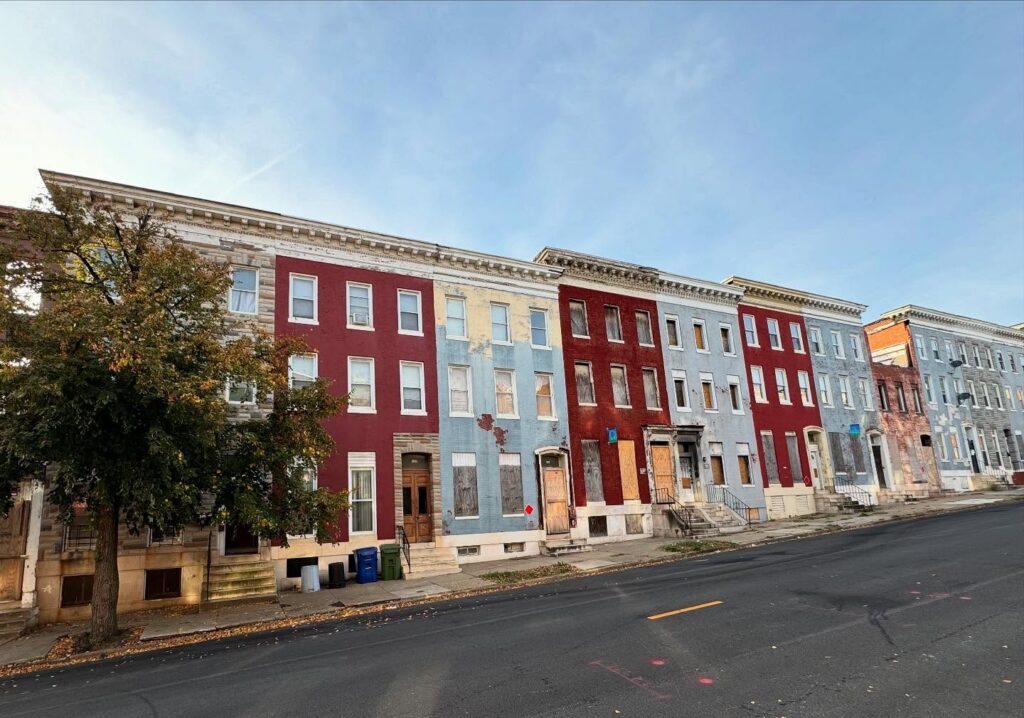
In historically Black neighborhoods like those in West Baltimore, homeownership barriers aren’t driven by overheated demand, but by long-term market disinvestment. Thousands of homes sit vacant or uninhabitable due to decades of redlining, urban renewal, and predatory lending that displaced residents and restricted the flow of capital into Black neighborhoods. Legacy residents are often left with devalued homes and overdue maintenance, while new buyers have few affordable and livable options. Traditional housing markets — and financing systems — struggle to operate effectively in this context.
For individual buyers, the perceived risk of being “first” — moving onto a block without confidence that neighbors, services, or investment will follow — further suppresses demand, even where interest in homeownership exists.
The Solution: Community building for market revival
Founded in 2020, Parity is a development company and community-building model designed to address both sides of this problem at once. The organization acquires clusters of vacant properties, renovates them to a high standard, and pre-sells homes to cohorts of buyers — often friends, family members, or existing social networks — who move onto a block together.
By anchoring demand in trusted relationships rather than isolated individual buyers, Parity reduces the social and financial risk of moving into disinvested neighborhoods, helping buyers feel confident that they are not entering a block — or market — alone. Rather than treating homeownership as an individual leap of faith, Parity treats it as a coordinated act of collective entry which contributes to stronger community relations and richer social capital.
On the buyer side, Parity guides participants through a readiness program that prepares them financially, emotionally, and mentally for homeownership. On the community side, it supports legacy residents through key partnerships with organizations like the SOS Fund which connects residents with anti-displacement resources that help them address deferred maintenance and lock in property taxes as values rise.
Why it’s Different: Parity treats social capital as the primary catalyst for market revival. Rather than marketing homes to individual buyers in isolation, the organization intentionally assembles cohorts of prospective homeowners from existing social networks, guiding them through the buying process together.
Parity recruits buyers through referrals, community outreach, and trusted relationships, then moves cohorts through a shared readiness process that builds financial preparedness alongside mutual commitment. And by pre-selling homes before construction and anchoring demand in groups that already trust one another, Parity reduces uncertainty for buyers, lenders, and the surrounding market. Parity’s core process of repurposing vacant houses also contributes to more sustainable construction, because it creates a much smaller ecological footprint than a new construction site would.
“We pre-sell all of our homes. The buyer goes through the entire construction process — they choose finishes, they’re invested. It’s not ‘build it and list it on Zillow.”
— Bree Jones, Founder & CEO, Parity Homes
Impact Highlights: In just a few years, Parity has moved from proof of concept to measurable, neighborhood-level impact, accelerating renovation timelines while demonstrating that coordinated reinvestment can revive disinvested blocks.
What began as a vision to cluster buyers and rebuild vacant homes has translated into measurable production and faster delivery, signaling that the model can scale:
- 60+ properties acquired
- 13 units completed on the first block; 20 more under development
- Renovation timelines reduced from ~12 months to ~6 months
Key Enabler: Catalytic capital that de-risks early stage innovation
“Without JPMorgan Chase’s catalytic funding, I wouldn’t have been able to do any of this.”
— Bree Jones, Founder & CEO, Parity Homes
Parity launched with a $2M catalytic grant from JPMorgan Chase, enabling early proof of concept at a moment when traditional lenders were unlikely to back a market-revitalization model. That early capital helped to demonstrate viability, which in turn helped to attract additional partners.
The organization has since expanded through blended capital, including a $1M, 1% program-related investment (PRI) from the Nathan Cummings Foundation, and a $2M revolving construction loan from Baltimore Community Lending – increasingly leveraging debt to scale production.
Future Plans: Parity’s model is uniquely designed for housing markets experiencing hypervacancy like Detroit, Cleveland, St. Louis, East Cleveland, and Kansas City. Parity has proven the ability to convert the most entrenched dilapidation and vacancy into ownership, rebuilding intergenerational wealth, and strengthening civic power at the block, neighborhood, and city level.
Lessons & applications for other leaders:
- Design for community building, not just individual sales. Pre-selling homes to buyer cohorts before construction reduces risk for purchasers and lenders alike. By leveraging existing relationships to assemble and support buyers, Parity demonstrates that social capital can function as a form of investable capital when intentionally organized.
- Build ownership pathways for a range of buyer profiles. Designing financing and readiness processes around actual lived circumstances expands access while strengthening long-term stability.
- Fix underlying structural misalignment, not just the symptoms. Markets don’t fail accidentally — they fail when systems are misaligned. Pairing social driven demand with institutional lending, national philanthropy, policy, and construction innovation restores market function (rather than temporarily masking dysfunction).
“Our long-term theory of change is about building power—neighbors who know how to advocate for themselves and shape the systems that serve them.”
— Bree Jones, Founder & CEO, Parity Homes
City of Homes: Turning blight into pathways to ownership in Springfield
“We’re creating a new pathway for properties to go from being blighted to being assets for the community — and for families that didn’t have that opportunity before.”
— Keith Fairey, President & CEO, Way Finders
The Problem: Blight, disinvestment, and lost ownership opportunities
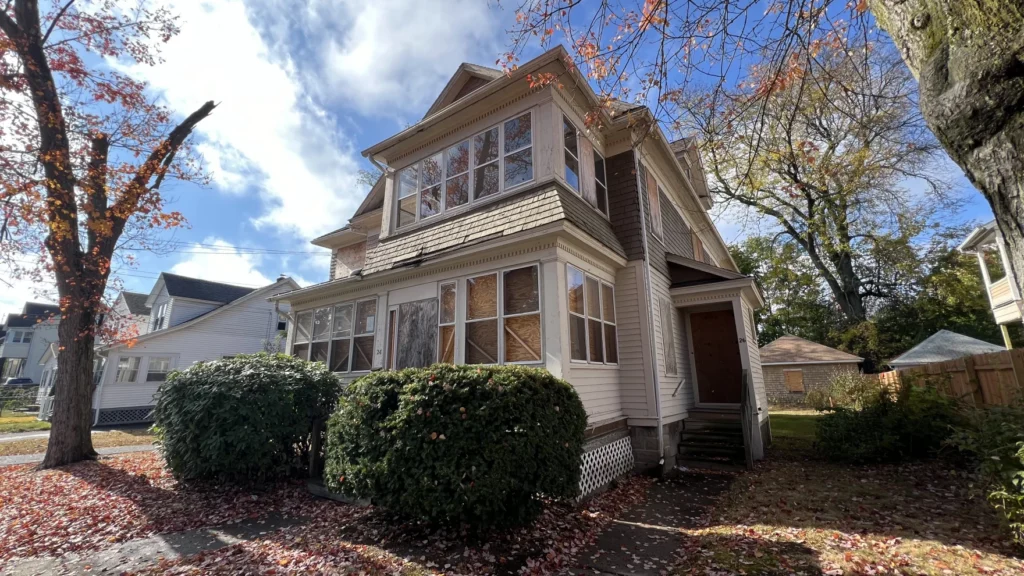
Springfield, Massachusetts is historically known as the “City of Homes,” but decades of disinvestment have left many single- and two-family properties abandoned or in severe disrepair. In turn, those properties depress surrounding home values, destabilize neighborhoods, and often cycle through the court-appointed receivership process where they are rehabilitated and often converted into rental units rather than preserved as ownership opportunities.
At the same time, hundreds of local residents complete first-time homebuyer education programs each year. Upon graduation, and with access to down payment assistance programs, they still struggle to uncover adequate, affordable inventory to purchase. This imbalance results in a glut of blighted homes creating liabilities for neighborhoods while scores of aspiring homeowners remain locked out.
The Solution: Connecting policy reform, redevelopment, and first-time buyers
Observing this disconnect, Way Finders created its “City of Homes” initiative (named for the city it serves), which relies on three coinciding solutions in order to create a new, equity-focused pathway for prospective homeowners:
First, Way Finders works effectively within recent reforms to Massachusetts’ Affordable Homes Act — shaped by Way Finders’ own on-the-ground innovation in both process and partnerships — to appoint what are known as “special attorney receivers” to interrupt the automatic conversion of distressed properties into permanent rental stock. Traditionally, when properties entered into receivership proceedings, the assigned court-appointed receivers were private contractors or developers. But thanks to recent reforms, the law now allows for the appointment of “special attorney receivers,” who transfer the properties specifically to nonprofit developers like Way Finders for rehabilitation and resale as an affordable homeownership opportunity.
In addition to strengthening ownership pipelines, Way Finders simultaneously leverages its developmental capacity by working to acquire, rehabilitate, or rebuild the blighted homes themselves — often using local, BIPOC-owned contractors to do so.
Finally, Way Finders taps into an extant first-time homebuyer education pipeline that it already uses to train 700–800 prospective buyers annually in order to connect that demand directly to newly restored inventory. Homes are then sold affordably to buyers earning roughly 80–100% of area median income, with mechanisms such as lotteries used when city-owned funding is involved.
Why it’s Different: By recognizing and slightly modifying how receivership works under Massachusetts state law, the model creates a durable pathway for blighted properties to return to community ownership rather than speculative rental properties.
“This is such a slight tweak to an existing process that has such strong ripple effects… reminding us that innovation doesn’t always have to mean looking for a big flashy unicorn. It can be as simple as a shift in the way that we think about something that already exists.”
– Dennis Duquette, President & CEO, MassMutual Foundation
Impact Highlights: While still early in its implementation (the Massachusetts Affordable Homes Act was signed into law in August of 2024), properties are currently being rehabilitated in concentrated clusters, creating a multiplier stabilization effect within targeted neighborhoods. The special attorney receiver pathway is now codified statewide through Massachusetts’ Affordable Homes Act, expanding the model beyond Springfield, and early implementation demonstrates that long-blighted ownership properties can return to productive, affordable homeownership rather than converting to rental stock.
Keith Fairey, President & CEO, Way Finders, shared one recent anecdote from a blighted home’s former owner upon learning that it would be rehabilitated into a family home:
“We had a public event at a two-family home that had seen much better days… it was boarded up. The special attorney who helped convey that property brought the owner — someone who grew up in the home but couldn’t keep up with it.
I didn’t know how that would go… but he felt really bad that it was pulling down the neighborhood. He was glad to see that it was going to be somebody’s home again rather than sitting there in a very blighted and abandoned state.”
— Keith Fairey, President & CEO, Way Finders
Key Enabler: Patient, flexible capital and systems-oriented philanthropy
“We don’t hold the solutions… we are a connector. We use our resources to bring folks together, to experiment, and advance ideas into action.”
– Dennis Duquette, President & CEO, MassMutual Foundation
MassMutual Foundation has played a catalytic role in bringing the City of Homes model to life. Over several years, the Foundation funded research by a retired housing court judge to prove viability, pressure-tested the concept with stakeholders across the city, and provided early, flexible capital to de-risk the pilot before other funders joined.
Beyond funding, MassMutual also convened stakeholder groups, supported statewide policy adoption, and aligned complimentary investments — including down payment assistance resources for Western Massachusetts — to strengthen existing ownership pipelines.
Future Plans: Scalable pathways for gateway cities
The legislative framework that underpins the City of Homes Initiative is now active statewide, with interest emerging from other “gateway cities” across Massachusetts — former industrial centers facing similar cycles of abandonment and disinvestment.
If scaled, the model offers:
- A durable mechanism for transforming blight into ownership
- Expanded pathways to household wealth-building
- Stabilized neighborhoods where property value growth benefits working families rather than external investors
For MassMutual Foundation, the long-term goal aligns with its broader mission of strengthening financial resilience:
“Homeownership is such a key lever in building financial resilience and capability. It’s also foundational to establishing generational wealth over time.”
– Dennis Duquette, President & CEO, MassMutual Foundation
Lessons & applications for other leaders:
- Slight policy shifts can unlock outsized impact. A targeted change to receivership rules created a new pathway without having to dismantle the entire system.
- Pair systems change with tactical investment. Supporting first-time homebuyer programs and down payment assistance in tandem with reforms to structural barriers accelerates impact.
- Patient capital matters. The City of Homes Initiative required years of dialogue, research, and early stage risk tolerance before it could be implemented.
- Innovation doesn’t have to be “disruptive” to be transformative. Sometimes the most durable change comes from adjusting existing infrastructure rather than inventing something new.