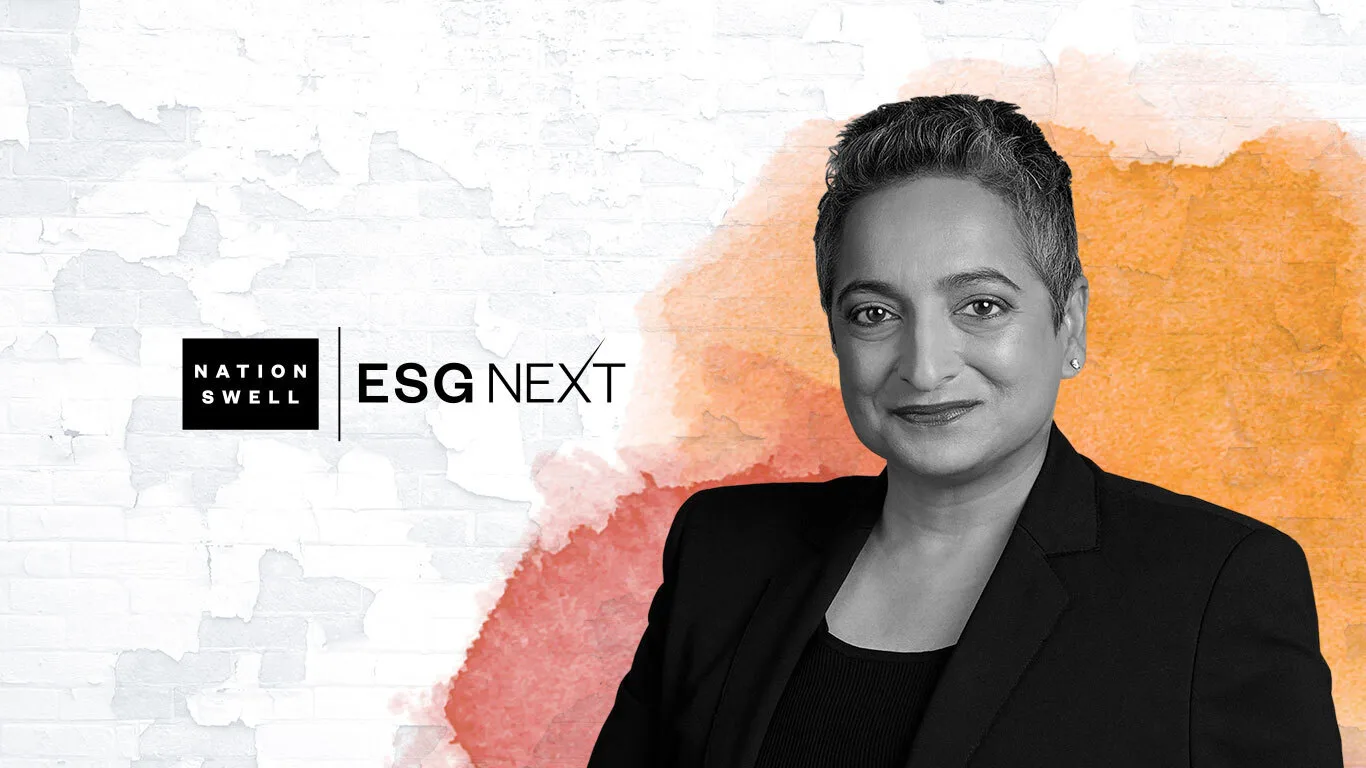
ESG Next: An Interview With Mastercard’s Shamina Singh

At a moment of unprecedented attention, investment, and opportunity for the emerging field of ESG, leaders are asking: Who is best preparing their organization for the society of the future? Who is innovating today to meet decades-long environmental and social goals? Who is setting standards that catalyze their industry’s change for the better? Who is defining what bold and aspirational look like — and how best to advance that work in practice?

Enter NationSwell’s ESG Next, an exemplary group of investors, executives, authors, philanthropists, social sector leaders, academics, and field builders who are helping to shape business as a force for social and environmental progress, advancing — and even pioneering — the most forward-thinking and effective programs, initiatives, technologies, methodologies, practices, and approaches.

For this installment, NationSwell interviewed Shamina Singh, Founder and President of the Mastercard Center for Inclusive Growth and Executive Vice President of Sustainability at Mastercard. We spoke with Singh about the “S” in ESG, her commitment to continued learning and service, and the power of leaning into the urgency of the moment.

Greg Behrman, CEO + Founder, NationSwell: How would you make sense of this moment in ESG? 

Singh, Mastercard: It’s an exciting time for sure, but it’s a time that’s born out of crisis. We face monumental climate issues and rampant income inequality on a global scale. This moment demands that practitioners maintain focus on what we’re genuinely aiming to solve.

It’s encouraging to see everyone across the spectrum trying to figure out how to get it right; but as investors, companies, politicians, and governments are all grappling with what ESG means for them, we have to remember that each group has its own unique incentives and roles. The task at hand is balancing these different perspectives, creating a unified approach, and maintaining urgency among lots of different stakeholders. 

Behrman, NationSwell: How is the field of ESG evolving? What’s next?

Singh, Mastercard: What comes next is the private sector continuing to navigate an increasingly dynamic regulatory environment. Between the EU and the US, requirements for measuring corporate climate impact will require greater resourcing and administrative attention. At the same time, more communities are experiencing climate change directly and in real time, managing mitigation and adaptation simultaneously. It’s that intersection of climate change and the related economic impact that’s on the agenda now.

There’s broad agreement about how we measure an organization’s environmental factors and impact, but we’re still in the sense-making stage when it comes to social factors. Current measures don’t capture the impact of private sector initiatives like financial inclusion, relief and aid tied to the war in Ukraine, and the development of COVID-19 vaccines. The thinking about how to measure what businesses do in the social impact space keeps changing, so even companies that have been doing this work for a while face the shifting challenge of how to capture and report their impact. 

Looking forward, there’s an opportunity to embrace standardization around the ‘S.” If we don’t, and if it continues to shift, there’s a chance that practitioners might deprioritize these efforts, particularly as the regulatory focus on environmental factors continues.

We can apply the best practices that have been used to standardize environmental factors to communicate social impact measure — and that’s one of the things we’re proposing at the Center for Inclusive Growth: a framework for the social factors that mirrors the environmental, which might help companies and other stakeholders to tell their story around the ‘S’ as clearly as they do around the ‘E.’  

The Greenhouse Gas Protocol Corporate Standard offers a model. In this protocol, Scope 1 covers the emissions that companies directly control, Scope 2 covers emissions associated with a company’s energy consumption, and Scope 3 covers the indirect emissions generated through the company’s supply chain.  We could use a parallel structure for social impact standards. Scope 1 could include the direct social impact of a company’s policies on its own employees. Scope 2 could account for how a company’s core competencies – like products, services, and work within supply chains — address societal challenges. And Scope 3 could encompass philanthropic giving, grants, and other community investments. 

This is a conceptual starting point, but the idea is to create a framework that quantifies the work companies are doing that provide a positive benefit to society.

Behrman, NationSwell: What’s unique about the work you’re leading? What are some approaches, strategies, or practices you’re deploying that other field builders should have visibility into?

Singh, Mastercard: There are three aspects of our work I’d like to call out. 

First is the unique framework we’ve established around creating impact. Though the Center is housed within Mastercard, we conduct independent research. It’s important to build our programs on an independent evidence base. The goal is to understand and utilize the assets of the company for social and environmental benefit, and to share that approach with the world. For us, this involves identifying and using Mastercard’s resources to progress toward these ends, and then ensuring our corporate activities are informed by these crucial issues. It’s the recognition that our business success depends on a healthy planet with an inclusive economy, and that we do well by doing good.

Secondly, as a company with extensive data assets, we recognize that data science can be harnessed for better decision-making—but unfortunately, social sector organizations are not building data capacity at a rate that will allow them to capitalize on a new data economy. 

In 2019, we established a program dedicated to building the field of data science for social impact. This initiative aims to enhance the social sector’s capacity to harness the power of their data. In partnership with the Rockefeller Foundation, we created data.org—an organization dedicated to building data science capacity around the world. Our aim is to close the information inequality gap, the growing divide between those who have data and those who don’t.

The third highlight is our focus on small businesses through a global initiative called Strive. We know that small businesses are the engines of the economy, and we are putting our assets to work to support their success. Strive supports businesses with a propensity for growth, and we focus our support in three areas: capital, digital transition, and market access. 

Behrman, NationSwell: Tell us about the Center for Inclusive Growth. How has it evolved?

Singh, Mastercard:  In modern corporate America, social impact isn’t always treated as a central business strategy. The Center for Inclusive Growth seeks to change that narrative by harnessing our company’s resources to generate meaningful change, primarily through a focus on financial inclusion. 

We founded the Center with clear principles for our work, all of which is rooted in evidence-based methods for applying the insights, impact, influence, and investments we have at our disposal.

Thinking about ESG, the Center’s role grows more critical. Many companies have a c3 foundation or an impact fund along with their primary business. The Center brings together these elements and helps determine the most effective application for philanthropic capital and business assets. 

Behrman, NationSwell: What leadership practices have helped you operate effectively?

Singh, Mastercard: I act upon the deep sense of urgency that I feel. It’s simply not acceptable to me that people are suffering, particularly in a world that’s rich with technology, medical advancements, and information. Yet, these resources aren’t being shared widely enough.

You see this sense of urgency reflected in the Center’s philosophy of creating networks. The premise is simple: One’s place of birth shouldn’t dictate their life’s trajectory. This concept of mobility resonates deeply with me. I believe everyone should have the opportunity to fulfill their potential.

Behrman, NationSwell: Is there anything you’ve read, watched, or listened to that has inspired your leadership?

Singh, Mastercard: There’s a book by Sendhil Mullainathan called Scarcity that has profoundly influenced my thinking. The book offers a nuanced and illuminating view on poverty, showing that people with limited resources are often excellent decision-makers because, from necessity, they’ve learned to operate in an environment of scarcity, not abundance. The goal then should not be to instruct them on what they should do, but to help them expand their bandwidth and time.


To learn more about how our ESG Next honorees are shaping business as a force for social and environmental good, visit the series hub. Mastercard is a NationSwell Institutional Member. To learn more about membership in NationSwell’s community of leading social impact and sustainability practitioners, visit our site.
Seven critical design choices for corporate impact investors

Seven critical design choices for corporate impact investors

EXECUTIVE BRIEFING

As the global impact investing market surpasses $1 trillion USD, a small yet growing number of companies are adopting the strategy.

Corporate impact investors are motivated by the limitations of traditional philanthropy to fundamentally alter the structural disadvantages of capital markets, the desire to diversify their social impact strategies, the proven possibility of competitive financial returns, and intensifying pressure on the private sector to help finance the UN Sustainable Development Goals (SDGs).

Regardless of their motivation, what these enterprising companies are discovering is a world of opportunity and constraint, one that requires intentionality and conviction when designing an impact investing approach that best serves the organization and its goals.

To support the aspirations of would-be and nascent corporate impact investors, NationSwell went behind the curtain with four successful and well-established leaders in the space. We dug deep into their investment philosophies, models, and mechanics with the intent to pinpoint the most fundamental design choices that determine a program’s shape and direction.

This report summarizes our learnings from these four investors, organized around a short but load-bearing list of questions that any new corporate impact investor will need to resolve with clarity. Each question is followed by further explanation of its significance, illustrations of how the four model organizations answered it for their own purposes, and additional guidance from NationSwell on how to approach the choices at hand.

The seven fundamental design choices:

  • What is your impact investment thesis and how does it align with company priorities?
  • Where do your investments originate within the enterprise?
  • Are you investing directly in companies or indirectly through funds and intermediaries?
  • How are you reaching beyond traditional networks to source investment leads?
  • Who should be at the table when making investment decisions in order to optimize for efficacy and efficiency?
  • What will be your level of involvement with investments after cutting a check?
  • How will you measure and report the impact made through your investments?

Share this report

Key learnings on the theme of economic mobility

Key learnings on the theme of economic mobility

NationSwell’s 2023 Summit brought together the most cutting-edge and committed leaders in ESG, social impact, philanthropy, and other select fields. Across a full day of programming, participants elevated exciting and promising ideas and initiatives, reflected and revitalized, and gleaned actionable insights, practices, and collaboration opportunities to propel their leadership forward.

One of the main themes of the day was economic mobility, through which presenters and guests explored how to better center their values, prioritize human connection, and bring forward a “Better + Bolder” version of themselves.

Below are key learnings from the NationSwell Summit on the theme of economic mobility.

Note: Key learnings are also available on the Summit themes of purpose-driven leadership and business for good. A panel discussion on the fourth theme of sustainability was off the record.

Key Learnings

We have a collective responsibility to overcome the fallacy that decision-making, rather than circumstance, is responsible for an individual’s poor financial health.

Professor Darrick Hamilton (Henry Cohen Professor of Economics and Urban Policy and founding director of the Institute on Race, Power and Political Economy, The New School), in his opening remarks at the NationSwell Summit, reminded us that the tendency to blame poor decision-making over environmental factors like weak systems and structures is a common cognitive bias called fundamental attribution error. To move past this error, Professor Hamilton urged us to dismantle the policies that deny people opportunities to make the right choices and redirect resources to communities in order to provide the enabling conditions for marginalized groups to become self-determining and overcome poverty. Professor Hamilton spoke of baby bonds as one particularly bold and promising solution, describing the appreciating asset as “economic birthright to capital” available to all regardless of circumstances at birth.

Through strategies like employee ownership, business has the capacity to de-stratify our society where other institutions have failed.

On a Practitioners’ Panel on Economic Mobility, Pete Stavros (Head of Global Private Equity, KKR) offered that solutions like employee ownership models are effective at improving financial outcomes for workers. Stavros emphasized that the average American does not have enough assets to invest, in turn limiting their opportunity to develop financial management skills. Through KKR and his nonprofit Ownership Works, Stavros advocates for and has implemented a model in which businesses issue stock as a free benefit to employees, pairing ownership with financial literacy programs, as a mechanism to create a true win-win for the company, its investors, and its workers. Results to date have shown that employee ownership can lead to better employee retention, increased productivity, a higher ROI for the business, and significant wealth creation for workers. But, Stavros emphasized, the work of employee ownership programs is not as elegant and simple as it may first appear, requiring significant commitment and hands-on involvement from company leadership.

Employers are determinative of economic mobility for their workers; it’s time for businesses to better understand their impact and to take charge of that responsibility.

In presenting the American Opportunity Index Corporate Scorecard, Rajiv Chandrasekaran (Head of Policy + Strategy, The Emes Project) presented evidence that a company’s practices are determinative in lower-income workers’ ability to escape poverty. Chandrasekaran highlighted three dimensions of a company’s opportunity to impact workers’ economic mobility, particularly for those without college degrees: (1) the access they offer to employment opportunity, (2) the pay they offer in low- and middle-skill roles, and (3) the level of mobility experienced by employees both within and beyond the firm. The American Opportunity Index Corporate Scorecard offers a first-of-its-kind look into the actual performance of the United States’ largest 250 companies on worker economic mobility and provides an evidentiary basis for employers to look inward at the practices and behaviors that do or do not facilitate that mobility.

  1. Good data is essential for improving economic mobility, but its efficacy is significantly constrained without the right narrative and storytelling.

  2. In a Practitioners’ Panel on Economic Mobility, Michael Tubbs (Special Adviser for Economic Mobility and Opportunity, Gov. Gavin Newsom) asserted that “data is interesting and important, but if data actually drove decision-making, our work would be the opposite of what it is today.” Tubbs’ point is that we already have compelling data to support work on climate action, economic mobility, and more, but the decisions of policy-makers and others in power often defy the conclusions of that data. Tubbs called upon leaders to focus on shifting the narrative and storytelling around how the economy works in order to provide cultural and social momentum behind solutions like baby bonds and universal basic income.
  1. Funders can advance racial equity by making large, unrestricted, multi-year grants to BIPOC-led organizations.

  2. Given that historical and intergenerational effects of systemic inequity are central to the complexities of solving for economic mobility, Terri Ludwig (President, Ballmer Group) highlighted the need for the trust-based philanthropy principles of long-term solutions, multi-year unrestricted funding, and shifting decision-making power to BIPOC leaders proximate to the problem. For its part, Ballmer Group makes 10 year investments in its grantees, and also funds organizations like New Profit and Echoing Green to ensure that capital makes it into the hands of leaders who have traditionally been starved of that access.
Explore

Commercial products deployed for social good

Commercial products deployed for social good

CURATED COLLECTION

This Curated Collection explores a range of ways that companies are creating or repurposing products in service to their social impact strategies. It includes a non-exhaustive selection of representative and innovative examples of impact-oriented products, organized in categories based on how they are used.

The collection includes the following categories: 

  • Products used for fundraising 
  • Product grant programs 
  • Sustainable product; 
  • Special initiative products

Share this report

ESG Next: An Interview with Wells Fargo’s Jenny Flores

At a moment of unprecedented attention, investment and opportunity for the emerging field of ESG, leaders are asking: Who is best preparing their organization for the society of the future? Who is innovating today to meet decades-long environmental and social goals? Who is setting standards that catalyze their industry’s change for the better? Who is defining what bold and aspirational look like — and how best to advance that work in practice?

Enter NationSwell’s ESG Next, an exemplary group of investors, executives, authors, philanthropists, social sector leaders, academics, and field builders who are helping to shape business as a force for social and environmental progress, advancing — and even pioneering — the most forward-thinking and effective programs, initiatives, technologies, methodologies, practices, and approaches.

For this installment, NationSwell interviewed Jenny Flores, Head of Small Business Growth Philanthropy at Wells Fargo, about how her experience as an immigrant in America informed her journey to human-centered banking, the unique impact of flexible capital, the importance of fearless philanthropy, and the not-so-secret powers of her approach to collaboration.

Greg Behrman, CEO + Founder, NationSwell: How did your personal and professional journey to the field of ESG begin?

Jenny Flores, Head of Small Business Growth Philanthropy, Wells Fargo: I’m an immigrant to this country; we moved to San Francisco from El Salvador when I was almost three years old. Coming to America was the promise of a better life. We were leaving a country that was war-torn and my parents knew that in America, dreams come true.

But my journey has been defined by questioning what that actually means in practice. There’s this sentiment that in America, you can do anything. But then there’s what it actually takes — that grit — to navigate an unfamiliar system and actually make something big happen.

For me, that means navigating the systems of this beautiful country alongside the people whom I ultimately want to help and serve. I went into banking wanting to learn to underwrite affordable housing because I knew housing was such an important goal for my community; having a home that is affordable and accessible is the number one priority for so many.

That’s what fuels my drive, and that’s what brought me to the industry. And in my time working within it, I’ve learned just how powerful the banking industry really is. It allows you to buy a home or go to college or start a business, so it’s at the core of enabling the American dream.  I made a very deliberate choice to stay in this industry and help influence it to better serve people like me, who have to work that much harder to become executives.

That’s the question at the core of my mission: How do I get banking to see the world through the eyes of people like me — people who may not have that natural runway?

Behrman, NationSwell: How do you make sense of this moment in ESG?

Flores, Wells Fargo: The momentum in ESG right now is going to make it extremely difficult to go backwards. The leaders of the future will need to balance profit and purpose in ways that in the past hadn’t been needed. This is no longer just about compliance — it’s about how leaders can show they’re ready to navigate the opportunities that are still nascent or evolving in a complex society.

We had a recent conversation at a town hall with our employees. We asked ourselves the question, “Are we willing to continue to double down on ESG in the face of opposition from some segments of the population?”

From my personal perspective and taking into account all of the data and the science, we need to take these factors seriously. Yes, we have our traditional oil and gas industries; and yes, they are filling a need. But we also need to transition to a way of doing things that will help a sustainable future to exist. We’re in the position to finance that, and to figure out how to scale that. And that is not something I personally think we should back down from. The banking industry is in a position to help figure out the solutions for our economy today but also for our future needs, and we’re going to do it. Our survival depends on it.

But put aside the politics and just think about it from the reality of the moment, and from the business opportunity. Any company would be foolish not to understand there is a real commercial opportunity present. ESG professionals have the ability to really influence how our understanding of this moment evolves in authentic ways that map into the business priorities that we foresee for our prospective industries: How we bring our employee expertise, how we elevate it, how we connect the dots between our business impact and our impact in the world around the issues we choose to stand by.

Behrman, NationSwell: Can you talk about some of the unique programs or initiatives that you think other ESG practitioners should know about?

Flores. Wells Fargo: Before I embark on a new initiative at any of the companies where I’ve had the privilege of working, I find that there’s this moment when I can center solutions on building equity in the system, and help executives with decision-making power to see a new or different path forward.

Speaking truth to that power is very important. About 60 days after I started at Wells Fargo, Covid came to America. I had to make a choice about how I wanted to frame the work, and I wanted to make sure that we had a shared understanding, without mincing words — not leaving anything up to assumption.

And what I said was, “The financial system as it currently exists does not serve people of color or people from diverse backgrounds well. Period.” I laid out all the reasons I’d seen in my 20-year career in banking that have made that happen, and I told my organization that though I haven’t been at Wells Fargo for very long, I would imagine that some of these reasons play out here, too. And if that’s the case, I reasoned that our response had to be very different than what we would traditionally do — because the urgent need here will grow exponentially, and it’ll grow very quickly.

Within 30 days, businesses were shutting down. The majority of those 41% were Black businesses, 36% Latino Hispanic businesses. It was very clear who was most negatively impacted.

Because of the conversations we started around driving impact for the most vulnerable and under-served , our CEO made a courageous decision: That we were going to give away all of our processing fees from participating in the first round of the Paycheck Protection Program, not even knowing what the final sum total would be.

And that’s how the Open For Business Fund started — with intention built in, and with the understanding that we should build in flexibility where, in the past, we would avoid taking quick, bold action because it was perceived as too risky. Now, we could move forward with our assumptions based in the realities of the communities we served. That’s how we designed it, and it’s been a pride point for the company ever since.

Through our roughly $420 million Open for Business Fund, we’ve reached over 178,000 businesses. 73% of those business owners are low-to-moderate income, 79% are racially or ethnically diverse, over 53% are women business owners. And you could just see the impact happening in those populations that we really sought to reach.

Behrman, NationSwell: What was the impact of those investments?

Flores. Wells Fargo: Of that money, the first $250 million was deployed as very flexible capital, which took a lot of different forms: In one example we made a grant so that the nonprofits we supported could make grants directly to small businesses; In another instance, the investment could have helped a community lender bring down the interest rate for a small business owner’s existing loan; it took a myriad of forms. Impact will be tracked through early 2025, but as of September 2022 organizations funded through the program have raised $1.7 billion dollars in grants and debt to support communities across the country — so essentially we’ve generated six times the initial investment — just based on being flexible and responsive.

The Wells Fargo dollars were catalytic because we were really fast to get into the community. The money went out as grants to nonprofits, as equity on the balance sheets of nonprofits so they could lever that money up. We focused on strengthening the balance sheet of our non-profit grantees so they were able to then absorb additional capital that they raised so that they wouldn’t be in a risky situation themselves. We also utilized loan loss reserves so that if any of those loans went sideways, they could have that on their balance sheet to protect them.

The design was really purposeful and intentional. It helped create and amplify impact. We did a lot of little things that were meaningful to support the strategies and successes of small businesses across the country.

Behrman, NationSwell: What are some other examples of unique initiatives you’re helping to lead at Wells Fargo that are yielding tangible impact?

Flores, Wells Fargo: We’re also lifting up some incredible ideas that I think have the potential to change how small businesses raise money. For example, we are funding the Small Business Exchange, or SMBX, which is a FINRA-registered funding portal and public marketplace for issuing and buying U.S. small business bonds.  The SMBX team has figured out how to help small businesses be able to issue bonds so they can raise capital. And in Washington D.C., we are testing this with the mayor, providing technical assistance to small businesses who can then go on to raise $400,000 or $500,000 as part of a bond offer.

Very often, this support will go to the ideas and leaders that have so many naysayers who challenge them and say, “How are you going to do that? It’s never going to happen.” Those are the people I love to get behind. The future holds so much promise for resilient leaders like them, but we have to think differently about how we assess risk and finance innovation.

The SMBX is just a completely different way of financing businesses, and it has the power to really engage the community. So if I want to invest, get a financial return and drive social impact, I know where to go. The due diligence is completed, and I can invest in businesses in my neighborhood that are going to create jobs and build the economic base of my city.

Behrman, NationSwell: What is it about your approach to this work that has helped you to be an effective leader?

Flores, Wells Fargo: Once something gets approved, I love going full speed on it, and I love helping others reach that velocity — even if it means sitting back and letting them take the wheel. It brings me a lot of joy to see the people around me actively in pursuit of impact, and I like to empower them to take a piece of the initiative and really lead it internally, creating visibility around it. I’m not driven by getting the credit — and not being credit-driven helps bring people to the table with me because they feel like they can collaborate more authentically and freely, and it also empowers them to step up, become advocates and changemakers, and make things happen.

Getting the credit or getting acknowledged isn’t nearly as important as getting someone else in an organization to care about the problem that you’re working on, and getting them moving to work on it in their own way. That’s how change happens in organizations. It’s not one person. It is kind of a movement that happens and then you have people everywhere marching towards a bigger goal. It makes companies better. It makes the culture come to life in a different way. I can’t begin to tell you how happy that makes me.

Basically, my secret power is that I’m a huge collaborator, and I try to do so courageously. I’ll be the first to step up and try to sell something internally, and I might get kicked in the face, but it’s okay.

Behrman, NationSwell: Who are some leaders that inspire your leadership?

Flores, Wells Fargo: My dear friend Lorena Hernandez who previously headed up community impact for Comcast in California. She’s an incredible leader, and a true champion at understanding how to ingrain ESG into the core of your business. I admire the fact that she’s always collaborating with community, and doesn’t just design from her corporate office – she’s always really out there, learning and giving back.

Another person whose wisdom I often seek is Tracy Gray, who is the Founder and Managing Partner at a venture firm called The 22Fund.  Tracy is recognized widely as a multifaceted leader in social and economic equity in finance.  She is brilliant (she is also a rocket scientist) and I have her on speed dial because she is able to break down business models like no one else. I love that Tracy can see the world for what it is and also for the potential we all have to do and be better.  . She’s always thinking about what the present needs of communities are to date, and thinking ahead to how those needs will evolve in the future. I just love talking to her because I feel like she grounds me in the short term, and then inspires me for long-term thinking.

Last but not least is Jacqueline Martinez Garcel over at the Latino Community Foundation. She’s incredible. She’s such a heart-centered leader. Anytime I have the opportunity to be near her, I feel like I leave just spiritually in a different place because she is so grounded in the work, and in how people are feeling.

Behrman, NationSwell: What are some resources that inspire your leadership?

Flores, Wells Fargo: I get inspired by people who are on their A Game, it doesn’t matter what industry they’re in. But I would say I am a big Beyoncé fan. She is heart, mind, soul, everything’s aligned to give you this experience where you feel like, when she’s performing in front of you, she’s singing just to you. Everyone leaves her concerts feeling that way. I’m inspired by how ferocious she is. I want to be that ferocious at impact. I want to be the Beyoncé of social impact.


To learn more about how our ESG Next honorees are shaping business as a force for social and environmental good, visit the series hub. Wells Fargo is a NationSwell Institutional Member. To learn more about membership in NationSwell’s community of leading social impact and sustainability practitioners, visit our site.

NationSwell Collaboratives: Making the Case for Childcare

NationSwell Collaboratives are a vehicle for bringing together committed actors to push towards collective action on a specific issue. Anthony Smith, NationSwell V.P. of Editorial, spoke to Uyen Tieu, NationSwell President, Amy Lee, NationSwell Chief Strategy Officer, Allie Mahler, NationSwell Senior Strategy Director, and Austen Zoutewelle, NationSwell Associate Director of Strategy, about the Case for Childcare Collaborative, a cross-sector coalition working to solve our nation’s crisis of childcare and help 1.1 million women return to a better workplace than the one they left at the outset of the pandemic.

Anthony Smith, NationSwell V.P. of Editorial: Why should leaders make the case for childcare?

Uyen Tieu, NationSwell President: The moment for leaders to make the case for childcare has been such a long time coming. This isn’t a new conversation in America, but it’s one that till this point had been led largely by women, experts, and activists. It took the wide scale disruption of the pandemic to get us to where we are now, where it’s now as clear for men — especially fathers — as it has been for us. We have to take advantage of this moment.

NationSwell: How did the work begin?

Amy Lee, NationSwell Chief Strategy Officer: Our first step was to recognize the mass exodus of women that left the workplace during the pandemic. At the beginning of the Covid era, 2 million women left the workforce; 1.1 million still have not returned. Their reasons aren’t just because of the tangible realities of school shutdowns and the lack of childcare — they’re about societal norms around which parent is chiefly responsible for caregiving.

One of our Studio partners told us, “We really want to work with you to tackle the problems that working womxn* and caregiving womxn are facing,” and that’s really how our Collaborative was born — out of the idea that we didn’t just want to help these women get back to work, we want to build the structures that allow women to actually thrive at work once they return.

Allie Mahler, NationSwell Senior Strategy Director: Collaboratives are all about building coalitions of committed actors for scaled, collective action. We have an incredible group of partners that have coalesced around this Collaborative initiative: American Family Insurance, Annie E. Casey Foundation, Caring Across Generations, National Domestic Workers Alliance, Working for Women, and others. It’s a powerhouse group who each bring unique expertise, funding, programming, organizing capabilities, and community to the table. I have no doubt this group will move mountains when it comes to helping businesses support low wage workers and the caregiving economy.

NationSwell: What are some of the challenges facing working caregivers in this country?

Austen Zoutewelle, NationSwell Associate Director, Strategy: Given what we know about economic disruption, it’s unsurprising that the women who are most affected by the lack of childcare in this country are women without a college degree, women of color, and small business owners. 

But one big learning for us is that the care industry — not only for early childhood education, but also for eldercare — is predominantly run by women. So not only are working mothers being affected by this disruption, but working mothers within the industry of care are also affected — even as we expect them to be at the frontlines of this crisis. Not only does that lead to fewer workers, it leads to fewer options for daycare and childcare. 

NationSwell: What advantages does the Collaborative model provide in tackling this challenge?

Lee: Philanthropy and corporate social responsibility functions are evolving at a rapid pace. Legacy models have been focused on a personal or organization-specific mission, but the new generation of leaders in this space have embraced the idea that these issues — whether it’s climate change or childcare — are too large to be solved by one person, or one family foundation, or one organization alone. We have to work together. And at the same time, we need to provide funders with a way to see what their peers are doing so that we don’t support redundant work.  

Collaboratives allow us to do exactly that — we bring funders and committed actors together to deepen and broaden their impact. We allow them to look across the space and really identify where there are unmet needs. And it also allows them to work together with partners that may not organically be at the same table without our support. 

Tieu: One of our partners said it the best: This time can be different because the table is different. NationSwell approaches this work with the nuanced understanding that the players need to work towards something that can last.

NationSwell: How is the case for childcare personal to you?

Tieu:  I’m a mom, I’m a daughter, I’m a woman, and I’m a business leader. If we’re to compete without actually addressing the urgent need for childcare, there’s going to be a knock-on effect across every aspect of society. The problem is too urgent to rely only on federal policy change. If committed actors come together now to co-create the roadmap, we can turn the case for childcare into a reality.

Zoutewelle: I watched my mom balance raising three kids and working full-time when I was in high school. She still manages caring for my brother with Down syndrome while working full-time. I’ve seen first hand the urgency of this issue, the importance of flexible working arrangements, the necessity of public policy to support parents, and the need for collaborative, systemic strategies for making an impact. The urgency is even greater for women of color in low-wage industries. It’s important to me to elevate this work so that more women can participate in the economy and feel supported as a parent. It’s critical for our moms and the future generations.

Mahler: This work is incredibly personal to me. I just returned back to work at NationSwell as a mom of two young babies under two years old while also leading our Strategy team. I love what I get to do at work, and I love my daughters, but it is not only mentally and physically taxing on a daily basis but also financially taxing to coordinate care for my children. During my maternity leave, I thought daily about how fortunate I was to have the time to connect with my daughters, and how so many women and their families are taken too soon from their babies as they go back to work at 6 or 8 weeks post-delivery. That’s why this work inspires me and lights a fire for me.

Lee: I am a privileged white woman, but nonetheless the pandemic showed me how hard it is to be a working parent. My children were one and three years old when the pandemic started, and my husband and I were suddenly thrust into full-time childcare and a full-time job at a time of huge uncertainty and fear. We were only just able to make it work and that was with the benefit of being able to work remotely and having a flexible, empathetic employer. I can’t even imagine how hard it must have been for people working shifts, or people from single parent families.


For more information on Collaboratives, visit our site.

Editor’s Note: To exercise intersectionality and inclusion, one member of our collaborative uses the spelling “womxn” whereas other members use the traditional spelling, “women.” You can learn more about “womxn” and other forms of intentional, lexical inclusion at the Womxn’s Center for Success. 

Datasets for economic mobility

Datasets for economic mobility

CURATED COLLECTION

Wealth inequality and income inequality in the United States are significantly higher than in other OECD countries. And economic mobility is rigid. The likelihood of an individual moving from low wealth status to high wealth status over the course of their lifetime is low. Income disparity and wealth inequality are rooted in an array of social and economic factors, including race and geography. These factors create what is known as the economic opportunity gap.

This Curated Collection provides social impact leaders in the public and private sectors with a roundup of data-driven tools to strengthen their decision-making processes in addressing the economic opportunity gap. The resources provide specific consideration for indicators of racial equity and social justice and factors that promote mobility for disadvantaged groups across neighborhoods, communities, and states.

Resources include (but are not limited to) the following: 

  • Tools that allow companies to benchmark themselves against others on strategy and progress; 
  • Datasets that support deciding which communities would benefit most from company investments to increase equity;
  • Resources that encourage companies to prioritize racial and social factors that affect indicators of wealth (e.g., access to education and employment, and asset ownership).

Share this report

The Takeaway | The Future of the Workforce

On January 25, members of the nationswell council gathered for an in-person salon in New York City to discuss the future of work — the solutions and programs being considered at all levels of learning to better prepare students for successful careers; what organizations can do to build untraditional pipelines to the middle class and beyond; how to navigate a new hybrid work landscape in a way that balances individual flexibility and seamless collaboration while simultaneously mitigating burnout; and much, much more.

The conversation was warm, inviting, and generative, and sparked a flurry of great ideas and new chances for collaboration. Below are just a few key highlights from the discussion:


  • The future of work starts with students — and with how we ensure that they’re being prepared not just for the careers of today, but also to make family-sustaining wages. By partnering with large companies, community colleges in particular have an opportunity to be more thoughtful about designing curriculums that equip students with the real-world skills and connections they’ll need to land in-demand jobs. Micro-credentialing, upskilling, and financial literacy conversations — happening not just with students, but with corporate executives as well — can also help to create a climate of preparedness that will give applicants a competitive advantage.
  • Building a more equitable workforce will require us to take a more realistic look at the current set of challenges facing marginalized applicants. Taking into account the realities of violence and trauma that disproportionately impact some communities, companies looking to increasingly onboard new hires from nontraditional backgrounds will increasingly need to reevaluate their cultural competency training and provide more mental health, wellness, and wraparound support systems for future employees. 
  • To get more economically diverse applicants in the door, we will first need to “tear the paper ceiling.” Far too often, internships, fellowships, and other entry level opportunities require levels of experience or credentials, like a four-year college degree, that exploit and exacerbate existing societal inequities. In order to combat this and level the playing field, leaders will need to put out a clarion call to executives and hiring managers challenging them to reimagine their selection systems and hiring practices.
  • For those struggling under unreasonable credential requirements and barriers to entry, credential stacking could be a helpful pathway towards success. One way around this is through the stacking of credentials: building transferable skills through extracurricular experiences that count as elective credits, which can be immediately added to a resume in real time.
  • The pandemic has permanently reshaped our understanding of what counts as a “good job.” While there will always be a premium on the ability to earn a living wage, millennial and Gen Z workers have expectations of their employers that differ significantly from their predecessors. Interest in policies like unlimited paid time off and an increasing demand for health policies that respond to concerns about Roe v. Wade signal that, more and more often, people are choosing jobs and employers that align with their values.
  • Anticipating the challenges of the next 25 years will be critical in training the next generation of leaders. The challenges that young people will inevitably be forced to reckon with in the coming years are nothing short of enormous — not just in the world of work, but also involving climate change, globalization, wars, and growing social stratification. The question of how to develop and train young people as leaders in a more holistic way will be critical to anyone working with the next generation, and a particular premium will need to be placed on the “3 Cs”: connectedness, creativity and curiosity.
  • The interconnectedness of all people will continue to emerge as an important theme in the near future. Acknowledging those global challenges that young people will undoubtedly be facing will also require us to develop the deeper mindset that ‘my fate is interconnected with yours’ — not just in the U.S., but globally. Preparing young people for work will, increasingly, require us to grapple with an even bigger set of global challenges.

The NationSwell Council community brings together a diverse, curated community of bold individuals and organizations leading the way in social, economic, and environmental problem-solving. Learn more about the Council here.

ESG Next: An Interview With Pete Stavros, KKR’s Co-Head of Global Private Equity

At a moment of unprecedented attention, investment, and opportunity for the emerging field of ESG, leaders are asking: Who is best preparing their organization for the society of the future? Who is innovating today to meet decades-long environmental and social goals? Who is setting standards that catalyze their industry’s change for the better? Who is defining what bold and aspirational work looks like — and how best to advance that work in practice?

Enter NationSwell’s ESG Next, an exemplary group of social impact and sustainability leaders who are shaping business as a force for social and environmental progress, advancing — and even pioneering — the most forward-thinking and effective programs, initiatives, technologies, methodologies, practices, and approaches.

For this installment, Greg Behrman, CEO + Founder of NationSwell, sat down with Pete Stavros, co-head of Global Private Equity at KKR , to talk about his journey to the field of ESG, the leaders and books that inspire him, and why the movement for broad worker ownership is good for just about everyone — even if its myriad of implementational challenges can be daunting.

Greg Behrman, CEO + Founder, NationSwell: Tell us about your personal and professional journey.

Peter Stavros, Co-Head of Global Private Equity, KKR: My dad operated a road grader for a small construction company in Chicago for about 45 years, and I saw firsthand what it was like to earn an hourly wage. My dad liked his job. If you were to talk with him, he’d never begrudge being a construction worker. But there are two things about it he didn’t like: First, the inability to build wealth on an hourly wage of 15 bucks an hour; and second, the lack of alignment of incentives. 

There were so many moments in my childhood that really centered on the hourly wage and the lack of incentive alignment, like a big fight my dad’s union had with the company over whether workers would get paid for the drive to and from the job site, whether they get paid for the lunch hour. And my dad would say, “Isn’t this crazy? It’s not about how much we get done, or the quality of what we do. It’s all about the hours.”

My dad always really dreamt of profit sharing, or worker ownership, or some way for his union to be aligned with the company. Neither of my folks went to college, so I didn’t have much of an embedded career path. I happened to find myself at an investment bank right after I graduated, and then I got recruited away to be an investor. The first thing they had me work on was an Employee Stock Ownership Plan (ESOP), a fascinating experiment from 1974 wherein Congress tried to provide tax incentives for broad worker ownership. 

It was almost like the universe was saying, “You should learn about employee ownership.” And so when I went to business school, every spare chance I worked ownership into the curriculum that I was studying.

Behrman, NationSwell: Can you tell us about Ownership Works, the nonprofit you founded?

Stavros, KKR: Ownership Works is a nonprofit organization that partners with companies and investors to provide all employees with the opportunity to build wealth at work. If worker ownership is done well, it’s good for all stakeholders. We’ve seen broad-based employee ownership create meaningful wealth-building opportunities for employees, uplift families, reinvigorate corporate cultures, and improve business performance. 

From everything I’ve seen in all the work I’ve done on this — and I’ve been working on this since I was in business school — if it’s done well, it’s good for all stakeholders. Now the challenge is that it’s hard to do: it takes a ton of time and effort. That’s really a lot of what Ownership Works is trying to unravel: How can we help companies do this more efficiently and more effectively?

So, to start, let’s say your goal is to extend ownership to Ingersoll Rand’s 16,000 workers in 80 countries — how do you actually do that? How do you administer a huge plan like that mechanically, structurally, and from a tax regulatory compliance legal perspective? And then, importantly, how do you get people to understand and value it across all these different jurisdictions, facilities, languages, time zones — and then how do you use it to build culture? 

You have to start from a place where you acknowledge that there’s low trust. Look at the data: 70% of Americans don’t like their jobs. 15% to 20%, depending on the company, actually hate their jobs. They’re literally throwing wrenches in the machines trying to hurt their employer. And then you look at the Treasury Department saying two-thirds of Americans are not financially competent. So this isn’t just a lower income person’s problem, it’s an epidemic in the country.

As we grapple with these challenges, we’re also trying to do enough storytelling that we build a broader movement around this to build trust and buy-in. Now that Ingersoll Rand’s 16,000 workers across 80 countries have all become owners, the hourly workers have earned well over a half a billion of wealth for themselves. This took nine and a half years, but the quit rate went from over 20% per year to about two and a half percent — so we went from one in five walking out the door to one in 50. And the engagement scores went from the 19th percentile to the 91st. 

When you see something like that, you have to ask yourself, “Who could that not be good for?” Workers aren’t quitting because they’re happier. Companies have a more stable workforce. The company doesn’t have to hire 3,000 new people every year, which means less recruiting costs, less training costs, and smaller losses in productivity and knowledge since every year, the thousands of people who would be walking out of the door are staying put.

From an investor perspective, that was one of the better deals we’ve done — it was a multi, multi-billion dollar gain for our investors. It’s been great in the public markets. The stock at one point had tripled, and it’s still more than doubled despite a bad market. 

We’ve been working on Ownership Works internally for about 12 years. We’re currently working with over 60 partners to expand shared ownership, including banks like Goldman Sachs, Morgan Stanley; investors like KKR, TPG, Warburg Pincus and Leonard Green; labor leaders like Wilma Liebman, President Obama’s head of the National Labor Relations Board; nonprofit leaders like Ford Foundation and Rockefeller Foundation; and some of the biggest pension funds in the country.

By the end of Q1 2023, I imagine we’ll have close to 100 organizations around the table trying to make a real step forward in how ownership and upside is shared and how that’s used to build stronger cultures. 

My estimate is the top 20 private equity firms, if they were all to do this, you’d be talking about 5 million people impacted. The potential for scale impact is massive. 

Behrman, NationSwell: How would you define this present moment in ESG? Where do we find ourselves, and where is the field going?

Stavros, KKR: It’s become politicized, and I’m concerned. But I try to approach some of the factors that I’m most passionate about as good business. If you take employee ownership, it’s hard to make an argument against it. It’s good for workers, good for corporate cultures, good for communities, and good for investors. But I think if you come at some of it from my perspective, where I frame it as good business, then it would be a shame if people aren’t also looking at this as a risk mitigation tool, a culture enhancer.

Behrman, NationSwell: Who are some leaders in the space whose work inspires you?

Stavros, KKR: I would mention Vicente Reynal at Ingersoll Rand, Kathy Bolhous of Charter Next Generation, Dave Bangert at C.H.I. Overhead Doors, and Bert Bean at Insight Global.

Behrman, NationSwell: Can you tell us about some books that have informed your approach to leadership?

Stavros, KKR: The End of Loyalty” by Rick Wartzman is a great book, and it basically chronicles what happened in the labor market: how we went from where we were 50 years ago — when workers had a defined benefit pension, gold-plated healthcare, and a myriad of worker benefits that basically amounted to lifetime employment — to where workers are now, where they’re on their own for retirement, health care, and job security. 

Alongside the Wartzman book, I’d also raise up “The Great Risk Shift” by Jacob S. Hacker, and “The Fissured Workplace” by David Weil as great, related books on what’s happened to the economy that’s made it so hard on working class folks.


To learn more about how our ESG Next honorees are shaping business as a force for social and environmental good, visit the series hub. KKR is a NationSwell Institutional Member. To learn more about membership in NationSwell’s community of leading social impact and sustainability practitioners, visit our site.

This story has been updated to reflect Pete Stavros’ recent promotion.