Collaboration in Action: Supporting Communities Amid LA Wildfires

As we take stock of the urgent needs on the ground in Los Angeles following the devastating wildfires earlier this month, a group of NationSwell members convened to discuss how to best allocate energy and resources in response to the near and long-term impacts of the disaster.

Below are some of the key takeaways that were surfaced:

Think in phases to align support with evolving needs during disaster recovery. As you build your response and recovery strategies, consider the distinct needs at different stages of recovery. Focus on immediate relief and first responder support in the near term, stabilizing communities with housing and essential services in the mid term, and rebuilding homes, mental health, and economic resilience in the long term. Phased grantmaking and collaborating with trusted community organizations during each phase ensures aid meets actual needs, preventing overwhelm or misallocation of resources. 

Invest in disaster mitigation and prevention to improve preparedness. Proactive efforts in disaster prevention, including for wildfires, can significantly reduce the impact of future disasters. For example, initiatives like clearing fuel sources, creating defensible space around homes, and providing home protection training can help communities better withstand wildfires. Find opportunities to invest in mitigation strategies during blue-sky periods to enhance resilience and reduce the strain on recovery resources after disasters occur. Consider encouraging employees to take wildfire prevention training (e.g. home ignition zone training). 

Work with credible partners to ensure product donations are targeted and effective. Collaborate with organizations that specialize in timely and efficient product distribution to increase the likelihood that in-kind donations reach the right people at the right time. Leveraging established relationships with grassroots organizations or well vetted partners can prevent product donations going to waste or the creation of logistical challenges for impacted communities. 

Prioritize cash assistance to meet diverse and immediate needs. Direct cash assistance is one of the most effective ways to help individuals and small businesses address their unique needs following a disaster. Cash assistance is particularly critical for underbanked populations and undocumented workers, who often face barriers to accessing traditional financial support. Supporting communities at risk of being left behind, such as day laborers and micro-businesses, can lessen lost livelihood from the fires. Flexible cash-based approaches empower recipients to make decisions that best suit their circumstances, from securing housing to rebuilding businesses.

Leverage platforms and create opportunities for employee giving. Activating employees as contributors to disaster relief efforts can amplify an organization’s impact while increasing a sense of purpose and community within the workplace. Companies are using platforms for employees to donate directly to vetted organizations, matched by corporate contributions. Companies can also create point-of-sale donation opportunities, raising funding through QR codes and round-up campaigns and increasing public awareness about disasters. 

Use informal networks and communication channels to improve collaboration during crises. Creating private and informal communication channels can be a valuable tool for leaders to coordinate and exchange ideas during times of crisis. For example, being part of a group of LA-based leaders or organizations for off-the-record exchanges of strategies and lessons learned can provide a safe space to troubleshoot challenges, share real-time updates, and identify opportunities for collaboration. 

Invest in narrative work to sustain attention on disaster recovery. Shifting the public and media narrative toward systemic issues like inequality and generational wealth loss can promote better understanding of community needs. Getting innovative with your funding choices, such as investing in photography projects or local storytelling initiatives, can help highlight underrepresented voices in public forums and the full scope of post-disaster challenges.

Augment and Evolve: Empowering Workers in an AI Driven World

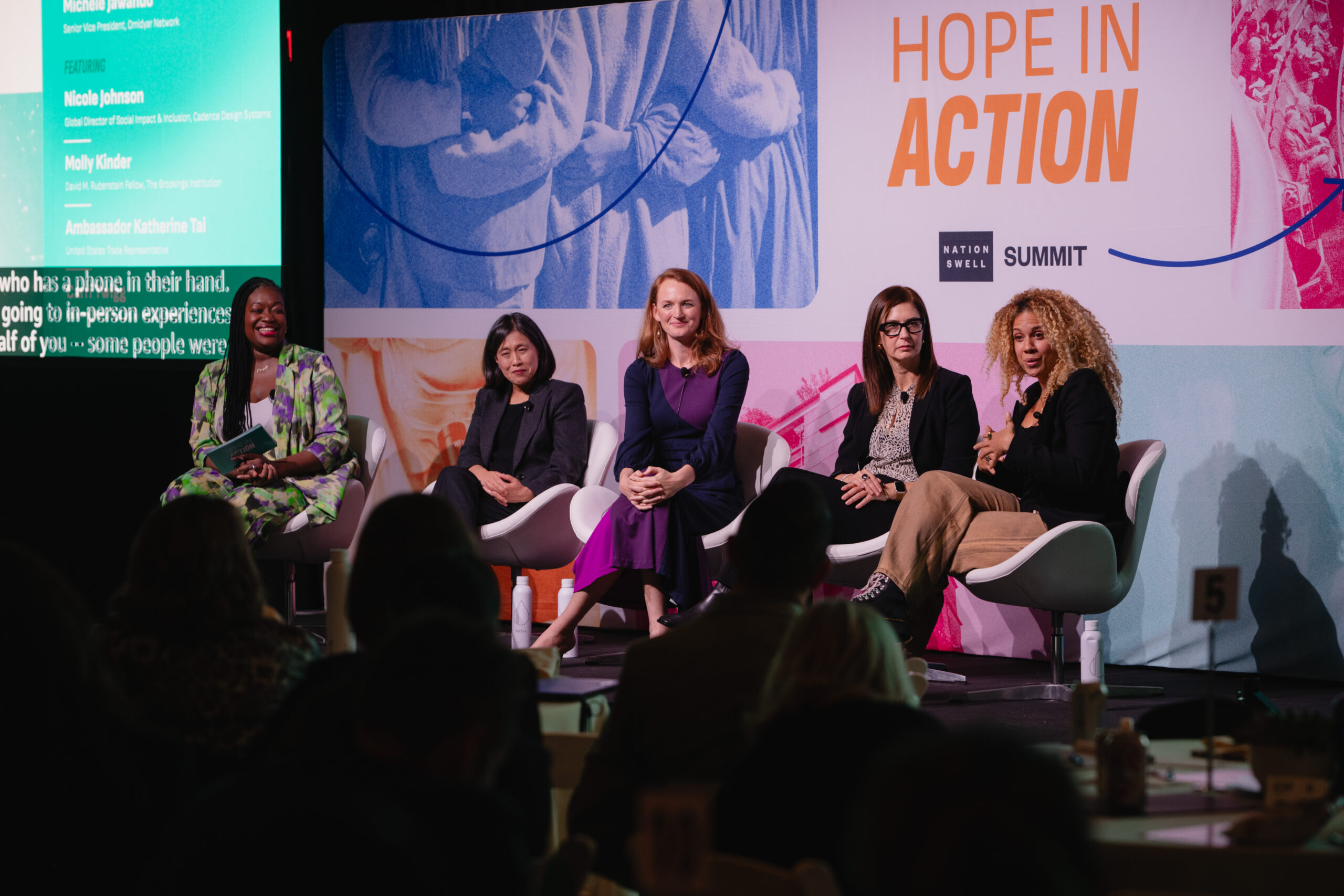
At a moment of unprecedented technological evolution, we stand at the crossroads of digital transformation and human potential. NationSwell Summits’ thought-provoking panel, “Augment and Evolve: Empowering Workers in an AI-Driven World” — presented by Omidyar Network — explored just this. Featuring an all-women lineup, moderated by Michele Jawando, Omidyar Network, joined by Nicole Johnson, Cadence Design Systems, Molly Kinder, The Brookings Institution, Carri Twigg, Culture House Media, and Ambassador Katherine Tai, United States Trade Representative, the panel illuminated a critical pathway forward: focusing not just on how AI will shape the future, but how we in turn can shape the future of AI. 

As moderator and Senior Vice-President at the Omidyar Network, Michele Jawando pointed out, AI has dominated the public conversation since Chat GPT first launched, but that conversation has been baked in fear as much as possibility. The panel situated their conversation at the intersection between the two as they discussed who will be most impacted by this new technology and how we can ensure that we all have a voice in shaping its advancement. 

Here are some key takeaways from the discussion: 


Workers must play a role in the development and implementation of AI technology and policy.

Jawando first turned to Molly Kinder, David M. Rubenstein Fellow at The Brookings Institution, to lay the groundwork for the conversation with her research into the impact of AI on workers. 

“The reason this is capturing our anxiety and our imagination,” she said, “is that generative AI is upending a lot of experts’ advice about how to stay ahead of technology.” She went on to elaborate that in the past, that advice focused on developing expertise, creativity, and empathy. But AI is advancing so quickly that its ability to mimic those qualities is putting white collar workers and creative industries on the frontline of technological disruption. 

U.S. Trade Ambassador Katherine Tai also noted that we have seen disruption like this before, particularly in trade. We are still reaping the consequences of the development of globalization and free trade, which left workers behind as it reshaped the economy. 

“Trade and technology actually have very similar impacts on the economy and on the workforce,” she stated. “They both have displacing effects, and they both go to this capitalistic pursuit of efficiency and cost minimization.” 

But both Kinder and Tai reminded us that who gets to participate in conversations around AI is critical in ensuring that AI can be a force for good. And the NationSwell audience is uniquely suited to that goal. “You are the people who are focused on figuring out how that power is used, and how that power can be used for good,” Tai said, addressing the room. 

“A lever that this room in particular can be so impactful on,” Kinder said, “is at the workplace, and as employers… making sure that employees and workers have a real seat at the table.”

Women are on the frontline of AI as a disruptive technology. 

Kinder highlighted that her research also shows that women are more exposed to the impacts of generative AI, for two reasons. First, because the jobs most likely to face automation by this technology are predominantly held by women – clerical and customer service work, as well as positions like bank tellers and paralegals. And second, because women are underusing this technology compared to men. 

But fellow panelist Nicole Johnson, Global Director of Social Impact at Cadence Design Systems, is on the case. Johnson shared that at Cadence Design Systems, they’ve seen a 50% increase in women in technical positions over the last ten years and they are taking that playbook into the world with the launch of Fem.AI and a $20 million commitment to close the gender gap in AI. 

“We looked at this AI development, this AI economy, the AI revolution that’s happening and we looked at it as an opportunity space. How can we ensure that unlike the development of the internet that happened 30 plus years ago there’s intentionality about the workforce that is behind this technology?” she said. 

As creative industries face challenging shifts in technology and the attention economy, how can we protect art’s breadth as well as its depth? 

“[Artists] have the most to gain, and we have the most to lose,” said Carrie Twigg, Co-founder and Head of Development for Culture House media. “But that’s also true for audiences, and people who consume art.” 

Creatives, particularly in media, face significant pressure. Not only does AI already have a foothold in how we edit movies and TV, but consumers frequently split their attention between several screens at once. As Twigg noted, we’re always half looking at our phones, and that creates a downward pressure on creatives to make content that doesn’t require as much of our attention or discernment. And she added that while there has always and will always be high art, it’s that middle class of media, the shows that everyone watches but that don’t usually win awards that are most vulnerable. 

“That medium tier where people really spend their time has this awesome power to shape who we are and who we become and that is the most threatened by the AI landscape…and what we’re really going to miss if we don’t build in protections for it. It may not make immediate obvious economic sense but we have to think about it in a longer term way.” 

The panel provided critical insight on the challenges AI presents, and the importance of intentionality throughout the process of developing technology and integrating AI into our lives – not just in how we use it, but in who is in the room, and what we should preserve from AI’s influence. But how the panel channeled the theme of Hope in Action can best be summed up by Michele Jawando’s last words. She got into tech policy because of Star Trek and left us with the image of Captain Picard using technology to boldly go where no man has gone before to save civilizations all over the galaxy.

“Humans first, technology second,” she said. “Let’s do it together.”


For more moments from NationSwell Summit 2024, click here. 

Impact Next: An interview with Chobani’s Nishant Roy

At a moment of growing inequality and division, who is advancing the vanguard of economic and social progress to bolster our most vulnerable communities? Whose work is fostering the inclusive growth that ensures every individual thrives? Who will set the ambitious standards that mobilize whole industries, challenging their peers to reach new altitudes of social impact? 

In 2024, Impact Next — a new editorial flagship series from NationSwell — will spotlight the standard-bearing corporate social responsibility and impact leaders, entrepreneurs, experts, and philanthropists whose catalytic work has the potential to shape the landscape of progress amid urgent need for social and economic action.

For this installment, NationSwell interviewed Nishant Roy — Chief Impact Officer at Chobani.


Greg Behrman, CEO and Founder, NationSwell: Tell us a little bit about your leadership journey — was there a formative experience that helped you to arrive at this space and this position of leadership?

Roy, Chobani: I started my professional life in the United States Air Force, and had the privilege to deploy to both Afghanistan and Iraq. That experience got me thinking far more about overall civil society, economic empowerment, and the things that could have potentially prevented those conflicts from happening. I started to really think about the role the government and the private sector can play in addressing some of the systemic issues that are happening in countries and places all over the world. 

After leaving the military, I took a job working for former President Clinton at his foundation in New York, and he actually recommended that I go to law school or get an engineering degree. He said that I had more lived experience than most of my peers because of my time in the military, and he saw that what I needed was a framework with which to identify the root causes of problems and come up with creative and thoughtful solutions to solve them. 

In 2006, he ended up connecting me to a friend of his, Bob Harrison, who happened to be a former partner at Goldman Sachs, and he said that it was an easy decision — that I should go work at Goldman Sachs. He suggested that I go somewhere to deepen my understanding of what the private sector is all about, to understand how business operates and apply that into the public sector, and so that’s what eventually sparked the interest of marrying business and social impact together back in 2006.

Behrman, NationSwell: What makes your approach to your work at Chobani differentiated — are there any programs, initiatives, or partnerships that feel particularly exciting?

Roy, Chobani: To start macro, Chobani is trying to prove that businesses can be both purposeful and profitable at the same time. As Hamdi says, a cup of yogurt won’t change the world, but how we make it can — especially in terms of how we’re using the dollars we get in profits and investing them back into the community. If you look at the yogurt category in this country, it’s gone from 43 grams of sugar in a single serving on average to around 15 grams of sugar in a single serving. That’s truly disruptive in a category that’s been run by some of the biggest food companies in the entire country, and we’re doing that next with creamers, and with coffee. 

So impact and the work that we’re doing starts with the product, and then our people are the next pillar of how we’re making this food. At one point in time, 30% of our workforce was immigrants and refugees, and we’re focused on paying folks in the 75th percentile and getting folks equity in the business. We’re getting childcare, we’re getting elder care, we’re focused on upskilling — there are a lot of unique things that we’re doing to support our people. 

The third pillar of how we’re making our food is the sustainability side of things, and we’re always looking upstream to see how we can impact and empower our suppliers and find new ways in which we can use our purchasing power to influence better standards on farms.

The final pillar is how we’re spending our profits, and here we have this big ambition to get to zero hunger in the communities in which we operate, which is in central New York and in Twin Falls, Idaho. We’ve seen food insecurity rise in this country by more than 30 plus percent, and unfortunately 13 million children are food insecure. Our thesis is that we as Chobani can partner with a number of different retailers to help improve overall food accessibility, which also allows other NGOs to come and join us in our journey to start to look at the other social determinants of health, such as access to housing, access to transportation, access to healthcare. These are all things that are critical in order to truly address hunger, but it’s got to start with one of the social determinants that’s being solved for least, which is food accessibility.

Behrman, NationSwell: As you look at this moment for CSR and corporate philanthropy, how do you make sense of where we are, and where do you think we’re headed?

Roy, Chobani: The acronyms have changed so much, but the bottom line that I’m seeing behaviorally is that from a purchasing perspective, people want to see that the brands that they’re buying are actually doing something to really move the needle on issues.

There’s been this big focus from the citizens of this country to want to see that their government is delivering for them at the federal and state level, and in the absence of that, they’re deferring to businesses. 

I think the fascinating thing we’re learning is that you can be profitable and purposeful at the same time: If you are operating your plants with a high level of efficiency, you’re going to be using less electricity, less water, and you’re going to be spending less money on overtime because you have a pretty efficient operation, which leads to better profitability in the long run. That profitability, in turn, enables us to then invest in our employees and our community.

And at the end of the day, we also make a great product that people love — it’s not just operational efficiency alone that makes us profitable.

Behrman, NationSwell: What are some of the resources that you might showcase or lift up that have helped to inform your leadership? 

Roy, Chobani: Hamdi, of course, has been my biggest shepherd in all of this. As the founder and CEO of the business, he took a chance on me, and a hallmark of his leadership is the way he believes in everyone that works at Chobani; he sees something in everyone that we may not see in ourselves. He asked me to step in on projects and responsibilities not because I had experience in them, but because I did not have that experience and my perspectives would challenge conventional wisdom and the “regular/traditional” way of doing business. 

As of late I would also say Rajiv Shah — his book, Big Bets was pretty inspirational because as we’re in this work thinking about food insecurity, we want to make a big ambitious bet by getting to zero hunger, and it can seem a pretty lofty goal at times. To address the naysayers and the skeptics and bring people along with you is probably one of the biggest challenges, and I think the book does a great job of addressing how coalition-building is a superpower. 

The third person I would mention has been our COO, Kevin Burns. Kevin is a world class operator — he takes businesses when they’re at this level of efficiency and brings them up to another level that they probably never thought that they could ever achieve. As I talk to him about the work that we’re doing to address hunger, he’s constantly pushing me harder and harder about thinking even bigger. 

Behrman, NationSwell: Who are some of the peer leaders you really admire — folks more or less in your role at other companies or organizations who you think are really great leaders doing great work?

Roy, Chobani: Jake Wood comes to mind right away — not only did he found Team Rubicon, but he’s also involved with a new venture called Groundswell. He’s always thinking about disruptive ways to be innovative and deliver on what’s needed at the moment in time, and it’s always done in such a way where it democratizes people’s ability to go and contribute towards solving a problem. 

The other person that comes to mind is C.D. Glin over at PepsiCo. When I think about what he’s done with the PepsiCo Foundation, in terms of bringing in a level of focus, energy, and innovative programming, I just admire his work so much and his commitment to doing it in a way that feels long-term and sustainable. 
Fresh Perspectives Unlock Creative Wealth-Building Solutions in Cities Across America

Most Americans live in cities; in fact, almost 90% of us will be city residents by 2050. Yet, every community is different and requires locally relevant solutions to the challenges and opportunities they face due to geography, history, industry, and many other place-based factors. City leaders with a local focus and lived experience in the communities they serve have never been more vital and influential in helping communities thrive across the U.S. 

Mayor Quinton Lucas of Kansas City, for example, has led the way on free public transportation and the creation of a Housing Trust Fund that has so far allocated about $19 million to support affordable housing projects and create nearly 1,000 affordable units, in a city where he grew up and experienced homelessness. But, resources in these public sector teams are stretched, capacity is limited, and space for creativity to solve systemic issues is hard to come by. 

The danger of never making space for creative thinking in local government or empowering city leaders to try new approaches is that inertia is inevitable. If neighborhoods in cities across America are to break out of cycles of inequality and build resiliency and generational wealth, we must embrace new ideas that challenge the status quo. 

In that vein, innovative impact leaders are creating ways to overcome capacity hurdles and support the important role that city government plays as a change agent. FUSE is a national nonprofit with a mission to increase the effectiveness of local governments in building more equitable communities. They have a unique method of empowering public sector teams to be the source of creative, community-led solutions for wealth-building among underserved populations. 

The FUSE Executive Fellowship Program hires diverse private-sector professionals and embeds them in government agencies on a full-time basis. These fellows bring new ideas, research, and action, all in service of advancing racial equity and addressing pressing challenges facing city communities. This allows FUSE to pursue creative approaches and public-private partnerships. Many fellows continue working in the public sector after their projects are complete, creating a unique pathway for private-sector professionals to make career moves and fulfill their desire to achieve greater impact in the communities where they work and live. 

The interventions by the FUSE Executive Fellows always begin with deep community listening, which is the genesis of fresh ideas: from the community, for the community. They integrate insights with data and human-centered design to help address seemingly intractable problems. For example: How can you preserve affordable housing and promote climate resilience in Durham, NC? How can you ensure everyone has access to fresh food in Birmingham, AL? How can local government use data and analytics to reduce reliance on incarceration and drive criminal justice reforms throughout LA County? How can county leadership help bridge the digital equity divide in Central Texas? And — in many places — how do you shift a workforce into a new era of needs and opportunities, post-pandemic?

Washington, D.C., witnessed a tremendous loss of jobs during the pandemic, particularly within the hospitality and leisure industries. The District’s Workforce Investment Council partnered with Karla Yoder, FUSE Executive Fellow to create a strategic plan to create a more resilient local ecosystem, for workers and employers. Yoder’s work not only highlighted how workers earning low wages were bearing the brunt of job losses but also noted accelerated shifts in the workforce landscape, with demand surging for workers in healthcare and technology. These factors underscored the need for employers to embrace skills-based hiring in order to service new and growing needs. In response, Yoder designed recovery initiatives tailored to D.C.’s workforce, including career coaching for unemployed residents and fostering partnerships between employers and skill-training providers.

FUSE Executive Fellow Daniel Han’s work with the City of Long Beach is another great example of innovative solutions supporting those at the highest risk of economic disruption. He helped the City connect nontraditional, community-based lenders to small business owners of color who were struggling to access capital. “The one thing that remains consistent is the critical leadership role that local government has in being a social innovator, change agent, and advocate for creating an inclusive platform for small businesses to thrive in the community,” said Han.

Just recently, FUSE Executive Fellow Kay West embedded with the City of Fort Worth to help revitalize their Economic Development Department’s “Business Assistance Center” to better support small businesses and entrepreneurs. West’s engagement with the community led to changes that made the Center more accessible, responsive, and fortified — including streamlined processes, more flexible opening hours, a more user-friendly “one-stop shop” web experience; and community convenings to foster inclusivity. “It brings me much joy to serve as a community quarterback to propel impact and bring national resources to my city,” said West, who continues to help communities and economic development organizations advance small enterprise initiatives and build capacity for equitable entrepreneurship programs.

The FUSE Executive Fellowship is one of a variety of exciting new localized wealth-building and social innovation models that are emerging. These programs show how fresh perspectives and an injection of creative capacity can make significant changes in large systems. Other models include building strength through networks that share insights and support between cities, like the Strong Cities Network that exists to help leaders address all forms of hate and polarization; or lifting up the voices of the unheard across a state in order to drive policy change, as demonstrated by End Poverty In California, which was founded by the Michael Tubbs, former Mayor of Stockton, California. 

We need this variety of solutions and an upswell of energy behind local government action to address a holistic issue like wealth building in underserved communities. Housing, education, workforce development, financial inclusion, small business support, digital equity, social cohesion, place-making, culture building — all of these elements and more are part of empowering a community to define its own future and build economic and social resilience. Funders and impact partners often struggle with how to help drive this type of cohesive community impact, when they are focused on one or two issues. 

The FUSE Executive Fellow model offers inspiration for one way forward: harnessing the power of creative individuals to integrate local knowledge, skills from the private sector, and collaborative coalition-building to turn the vision of community wealth-building into concrete policies and initiatives. From helping the City of Houston to create a comprehensive digital inclusion strategy that prioritizes those marginalized households that lack broadband access, to partnering with Cincinnati to help create 4,000 quality green jobs as part of a just transition to the green economy, to empowering Mayor Dickens in Atlanta to launch the Faith Based Development Initiative to create thousands of affordable housing units, the FUSE approach is effectively fast-tracking local government innovation across America. 

In a year when national elections will be held in at least 64 countries around the world, it is vital to remember that change starts at home—and local leaders are the ones whose decisions will have the greatest impact on daily lives. In this context, it’s energizing to see impact leaders like FUSE rally behind local government teams and innovate to allow creative, community-driven approaches to wealth building to flourish in cities across the U.S.


Visit fuse.org to learn more about their Executive Fellowship program.

Impact Next: An interview with Indeed’s Abbey Carlton and Maggie Hulce

At a moment of growing inequality and division, who is advancing the vanguard of economic and social progress to bolster our most vulnerable communities? Whose work is fostering the inclusive growth that ensures every individual thrives? Who will set the ambitious standards that mobilize whole industries, challenging their peers to reach new altitudes of social impact? 

In 2024, Impact Next — a new editorial flagship series from NationSwell — will spotlight the standard-bearing corporate social responsibility and impact leaders, entrepreneurs, experts, and philanthropists whose catalytic work has the potential to shape the landscape of progress amid urgent need for social and economic action.

For this installment, NationSwell interviewed Indeed’s Abbey Carlton, Vice President of Social Impact and Sustainability, and Maggie Hulce, Chief Revenue Officer.

Greg Behrman, CEO and Founder, NationSwell: How was it that you arrived in social impact work — could you each tell us a little bit about your journey to get to where you are now? 

Maggie Hulce, Chief Revenue Officer, Indeed: I spent most of my early career struggling with the question of where I could do the most good in the world — “Is it better to be part of a corporation, or to be in government? Where can you actually drive the most change?” 

I found myself gravitating to drivers of economic opportunity: workforce development, access to education, and the challenge of finding meaningful work that also pays well. Indeed is unique in how deeply the mission to help people get jobs is embedded in the culture.  At the same time, Indeed is a tech company, with the ambition to disrupt a huge industry and the potential to improve the lives of billions of people. That combination has been pretty magical, honestly. 

Abbey Carlton, Vice President of Social Impact and Sustainability, Indeed: Growing up in the rural Midwest at a time when a lot of factory jobs were going away and seeing the impact that had on people, families, and communities made an early impact on me — I saw firsthand all of the ripple effects that come when people don’t have jobs and opportunities. 

Economic opportunity has really been the animating theme of my whole career, and I couldn’t pass up the opportunity to come to Indeed, where hundreds of millions of people go to find jobs every month; I believe we are changing how hiring happens. 

It’s been really exciting to get to work alongside business leaders like Maggie, who see that social impact doesn’t have to be this niche thing to do off to the side — it really is core to our mission and our business.

Behrman, NationSwell: You’ve mentioned how embedded and connected to the core of the business social impact is; what else is different, special, or exemplary about the work you’re doing at Indeed? 

Hulce, Indeed: In our space, there is a very natural synergy between what is good for both sides of our ecosystem — job seekers and employers — and the social value that comes from making hiring faster, more effective, and more fair. 

To make hiring more effective, you first have to understanding skills and occupations deeply. You have to collect a lot of data about job seekers and jobs, and then you have to use that data to make recommendations that are nuanced, because people are nuanced in what they solve for when choosing where to work.  

We can also use all the information we collect to make data-driven arguments to employers about how to optimize their jobs or hiring processes.  This coalesces with what we’re trying to do to make hiring more fair and to help people connect with opportunities that they might be overlooked for. 

Carlton, Indeed: We’ve set four really ambitious ESG commitments for 2030, two of which Maggie and I work together very closely on: First, to help 30 million job seekers facing barriers get hired by 2030, and second, to shorten the duration of job search by half. Those are goals that will have a huge impact on people who struggle to find work, and, if we do it right, will really improve economic opportunity for lots of people. They will make our business better, they will make hiring better, they will make it easier for our clients to connect with a broader and more diverse talent pool. 

Behrman, NationSwell: Could you give an example of what that work might look like in practice?

Carlton, Indeed: Let’s say I’m someone who has gone through a cybersecurity boot camp at Year Up, and now it’s time for me to go out and look for a job: What is it like for me to look for a job on Indeed? If we can put a spotlight on where that on-ramp works really well, and where there are opportunities to help somebody who’s gone through a non-traditional educational program to explain what that is and what they learned and what skills they’ve built, we can build that into how we think about our job seeker profiles going forward.

Hulce, Indeed: Abbey’s team has played a big role in helping our product and engineering teams understand the challenges that people face when they don’t have a bachelor’s degree.  Our teams are asking: How do we help job seekers represent their skills in our ecosystem?  How do we help them present their skills in a way that’s compelling to employers?  And how do we influence employers to remove college degree requirements? 

At a certain level, inertia is the biggest barrier we face.  But, we’ve seen data-driven conversations with employers can actually change things.  For example, we can help employers realize that for certain roles, removing college degree requirements is a good business decision, as it helps them reach a much broader pool of talent.  It’s a unique role we can play, as we see both sides of the market. 

Behrman, NationSwell: What would your advice be to other leaders in the space who are similarly hoping to drive impact outcomes while making the business case for this work internally? 

Carlton, Indeed: I’ve learned that if you see your role as a social impact leader as being the counterbalance to the business strategy or being off to the side, then you might not invest in understanding the problems other teams are trying to solve across different areas of the business. Opportunities arise when you can connect those dots, whatever they may be. 

Hulce, Indeed: Our mentality internally is always, “We should be customer #1.” We care a lot about equity in our practices, so it makes sense that we should be practicing on ourselves first. If we have an idea, we want to know how well it will work.  So we try it out, and see what we learn.  This approach also helps us build more empathy for our customers.

Carlton, Indeed: What Maggie and I have done together recently is think about whether there is a single galvanizing focus that we could bring to the company so that all of these good things don’t get diluted, and we really think about skills-first hiring as being that focus. 

If we think about promoting economic mobility, that is a way that Indeed is uniquely positioned to drive change. So we’re going to pull that lever and focus on centering skills in the hiring process, because that’s how we believe we can make hiring more equitable for all job seekers.

Behrman, NationSwell: What is it about your personal leadership that you think has helped you to be effective?

Hulce, Indeed: I think a lot about the importance of optimism – believing that change is possible — and the idea that you need to triangulate with different types of brains to actually solve some of your hardest problems. 

As a leader, I also reflect on how to get people excited about what we’re trying to do. How do you get them to believe in what is possible? And how do you get them to work together to challenge and change the status quo? 

The last part of leadership I think about a lot is the importance of time spent developing and investing in people, in giving them opportunities to grow.  

Carlton, Indeed: When I was leaving the Rockefeller Foundation, my then-boss gave a toast where he described me as firm in my principles and flexible in my methods — that is the way that I try to work.

When you are in this work, you come to realize how deep, entrenched, systemic, and long-term it is. I have tried to navigate the space of doing work on jobs and economic opportunity with some pretty firm principles and beliefs, but with a lot of flexibility on how we get there, trying new things in the process. 

Behrman, NationSwell: Who are some of the peer leaders you really admire that you want to shine a spotlight on?

Carlton, Indeed: Hamdi Ulukaya, who founded Chobani and then the Tent Partnership for Refugees, is a leader whose work I have been following and admiring for some time now — I am in awe of some of the ripple effects his work has had. Last year, Indeed had the opportunity to be a part of the coalition that Tent has brought together and to sponsor a number of large-scale hiring events focused on refugees in Europe. I think his leadership is such an inspiring example of the role that business can play in galvanizing real deep change around social issues.

Hulce, Indeed: I’ll call out our CEO, Chris Hyams, as someone who has been so incredibly thoughtful about how he weaves together what we’re trying to do as a company and the importance that it can have on society. From his advocacy for responsible AI to our ambitious goals with ESG, he is definitely leading from the front.

Behrman, NationSwell: Are there any resources — books, essays, poems, quotes — that have informed your leadership that you might recommend to other leaders?

Hulce, Indeed: I am halfway through Big Bets by Rajiv Shah, which discusses how to bring people together to drive bold change. I’d also recommend a book by Deanna Mulligan called Hire Purpose.  She was the CEO of an insurance company, and her book discusses reskilling, upskilling, and long term talent strategy. 

Impact Next: An interview with Amazon Web Services’ Maggie Carter

At a moment of growing inequality and division, who is advancing the vanguard of economic and social progress to bolster our most vulnerable communities? Whose work is fostering the inclusive growth that ensures every individual thrives? Who will set the ambitious standards that mobilize whole industries, challenging their peers to reach new altitudes of social impact? 

In 2024, Impact Next — a new editorial flagship series from NationSwell — will spotlight the standard-bearing corporate social responsibility and impact leaders, entrepreneurs, experts, and philanthropists whose catalytic work has the potential to shape the landscape of progress amid urgent need for social and economic action.

For this installment, NationSwell interviewed Maggie Carter, Director of Social Impact at Amazon Web Services (AWS).

Greg Behrman, CEO and Founder, NationSwell: Maggie, was there an early or formative experience that brought you into this work?

Maggie Carter, Director of Social Impact, Amazon Web Services (AWS): 

It all started with my mom, who always led by example. She was always giving back. Whether it was volunteering in my school library or serving hot meals and donating blankets and clothes to the homeless in the DC metro area, she was always giving her own time and bringing the family along for the journey.

When I was in college, we led our first Recycling Awareness Week to kick off recycling on campus, and that experience of building and running a grassroots campaign is where I first got the bug to do something with a purpose, and throughout my career I was fortunate to find roles that combined that passion with sports.

When I was leaving the NBA, I knew that I wanted to get closer to program delivery on the nonprofit side. I made the transition to the UN Foundation and UNICEF, which combined my focus areas: children, education, and health. And from there, I was pitching AWS and Amazon on what a partnership would look like around disasters, emergencies, and innovation. The AWS team said, would you be willing to come build this from the ground up? That’s how I got to where I am today.

Behrman, NationSwell: At AWS, the products are part of the impact — they’re at the center of things. Can you speak to the philosophy behind that model?

Carter, AWS: For us, it’s very much about how our technology has the potential to transform the ways organizations are delivering their programs or services to impact their communities and their beneficiaries. We look at our role as co-building solutions with organizations and helping them to scale their impact.

For example, in Rwanda, they are leveraging secure messaging and AI on AWS to more effectively and rapidly identify symptoms in cancer patients and connect them to oncologists when their symptoms worsen. In Rwanda there’s just one oncologist to over 3,000 cancer patients on average — there’s a huge demand and low supply of doctors, and by using this messaging app, we’re helping those cancer patients that need more critical care receive it sooner.

We also co-built a solution with a small organization called Operation Barbecue Relief, whose mandate is to feed those impacted by a disaster, as well as the first responders to disaster. So we designed a solution with them called Project Smoke — an application to help track and monitor their food supplies so they can better manage resources and deploy them where they’re needed most. 

Behrman, NationSwell: Is there anything else that feels very important and differentiated that people should know about this work?

Carter, AWS: Each of these solutions is repeatable and scalable, they’re not band-aids. For us, it’s important to stay laser focused on the unique value proposition that the AWS cloud has when we’re engaging with organizations in our key priority areas — specifically around disaster response, health equity, and environmental equity.

Behrman, NationSwell: Is there an attribute or an approach or a philosophy that guides your leadership that has helped to make you effective?

Carter, AWS: I put high expectations on myself and I lead by example, so it’s about finding that balance where there’s a high bar but also empathy for what is going on. 

It’s always been in my DNA to be the fixer, the builder, so shifting that mindset to where I’m coaching and enabling my team and my leaders to identify that path forward themselves — that’s been a big learning for me in the last two to three years. 

I’ll also add that it’s been amazing to see employees rise to the occasion. Shifting to this approach really helps them build confidence in themselves to find that path forward — it equips them to be successful critical thinkers, here and beyond.

Behrman, NationSwell: Who are some of the peer leaders you really admire that you want to shine a spotlight on?

Carter, AWS: One who really stands out is Jacqueline Fuller, formerly at Google.org — she is at the bleeding edge, and I was fortunate to work with her and her team when I was at UNICEF USA on some pretty strategic partnerships around Zika and Syrian refugees. I want to also mention Leisha Ward at Target, Paul Poman at Unilever, and Kayleen Walters, the head of impact at Minecraft. 

And finally, my mentor, Kathy Behrens at the NBA. Throughout my career, since I worked for Kathy, I’ve always thought to myself, “what would KB do?” What she’s been able to do with the NBA over time, launching NBA Cares, shifting to the social justice initiative, launching the foundation in the last few years — it’s been amazing to see.

Behrman, NationSwell: Are there any resources — books, essays, poems, quotes — that have informed your leadership that you might recommend to other leaders?

Carter, AWS: I love stories of perseverance — those human interest stories where you see what somebody was able to achieve when everybody doubted them, especially in sports.

I particularly love “The ‘99ers” — the documentary follows the U.S. women’s national soccer team that won the World Cup in 1999. I remember watching it live and crying about how this was opening up opportunities for future generations of women moving forward. I think that team gave women and young girls confidence in themselves to be able to push boundaries, to push the envelope, to go where other girls haven’t been able to before.

2023 Private Sector Social Impact and Sustainability Leadership Survey

2023 Private Sector Social Impact and Sustainability Leadership Survey

SURVEY FINDINGS

2023 brought social impact and sustainability work further into the social, political, and organizational spotlight, and presented leaders with distinct, long-term considerations for their work. Leaders encountered large-scale, composite challenges: the escalation of the anti-ESG movement; the Supreme Court’s ruling against affirmative action and its subsequent implications for diversity, equity, inclusion, and belonging (DEIB); the effects of an increasingly restrictive macroeconomic environment on teams and priorities; and the intensification of regulatory requirements. At the same time, social impact work has matured and deepened, with leaders investing heavily in employee engagement, leaning in on sustainability strategies, cautiously adopting AI, and empowering communities through trust-based and place-based work.

Against this backdrop, NationSwell set out to investigate what forces were most significant in changing the way leaders approached their priorities and decision-making over the past year, and what leaders anticipate about the environment, their organizations, and their jobs in the year to come. Between July and August 2023 we surveyed 74 corporate social impact and sustainability leaders across NationSwell’s membership community and beyond. The resulting report explores the direct opinions and experiences of those leaders, in service to advancing collective knowledge about their essential roles.

Below is a summary of the key findings discussed in greater detail in the report:

Theme 1: Leaders’ confidence takes a hit among a difficult year for impact work

  • Leaders’ satisfaction with their organizations’ social impact is waning marginally amid an increasingly challenging environment.
  • With trepidation about the year ahead, leaders’ confidence in their own work is also dwindling.

Theme 2: Economic and regulatory activity assert their dominance above other forces 

  • Two of 2023’s trending issues – the politicization of ESG and the emergence of generative AI – have not transformed social impact and sustainability strategies. 
  • Instead, macroeconomic conditions had widespread and deep impacts highlighted by layoffs, budget cuts, and new barriers to collaboration.
  • Over the next year, leaders predict that economic conditions and regulatory/legislative activity will be key factors in their prioritization and decision-making.
  • In recognition of their growing need, and in spite of economic uncertainty, leaders will advocate for more funding for social impact and sustainability work in the year ahead.

Theme 3: Influence is leaders’ most sought-after and valued currency 

  • Leaders respond most to the influence of their executive team, and want to wield their own influence in return.
  • Leaders are intent on improving their strategies and capabilities to engage with internal stakeholders.

Share this report

Making the case for investment in corporate social impact and sustainability

Making the case for investment in corporate social impact and sustainability

This resource is intended to support corporate social impact and sustainability leaders in securing and growing their organization’s investment in their work.

The guidance contained herein is based on an online survey of 74 private sector social impact leaders conducted during July 2023, phone interviews with 8 private sector social impact leaders conducted during July and August 2023, and a literature review.

Skip to PDF content

ESG Next: An Interview With American Express’ Jennifer Skyler

At a moment of unprecedented attention, investment, and opportunity for the emerging field of Environmental, Social, and Governance (ESG), leaders are asking: Who is best preparing their organization for the society of the future? Who is innovating today to meet decades-long environmental and social goals? Who is setting standards that catalyze their industry’s change for the better? Who is defining what bold and aspirational look like — and how best to advance that work in practice?

Enter NationSwell’s ESG Next, an exemplary group of investors, executives, authors, philanthropists, social sector leaders, academics, and field builders who are helping to shape business as a force for social and environmental progress, advancing — and even pioneering — the most forward-thinking and effective programs, initiatives, technologies, methodologies, practices, and approaches.

For this installment, NationSwell interviewed Jennifer Skyler, Chief Corporate Affairs Officer at American Express, about the importance of leveraging your core values in times of disruption, drawing new strength from embracing discomfort, and the timeless, underappreciated value of resilience.

Greg Behrman, CEO + Founder, NationSwell: Can you walk us through what’s unique about how you and your team have approached ESG?

Jennifer Skyler, Chief Corporate Affairs Officer, American Express: When I first joined in 2020, my team undertook a comprehensive process to refresh the ESG strategy and framework based on a materiality analysis of key stakeholder issues. That was an important first step — those first efforts culminated in the launch of our ESG Strategy and Framework which encompasses three core pillars: financial confidence; climate solutions; diversity, equity, and inclusion.

That framework guides us to drive action in alignment with our values and address the top issues that matter the most for our company and stakeholders. It provides the guiding principles, operational structure, and resources to be able to make meaningful, positive impact in people’s lives and the world we live in. 

By having a foundational framework in place to address those issues, we can set tangible goals, build action plans to achieve those goals and hold ourselves accountable for progress, and provide transparency into our efforts for our internal and external stakeholders. 

Behrman, NationSwell: How is the work you’re leading at American Express unique?

Skyler, American Express: We have a very special, values-driven culture. As Chief Corporate Affairs Officer, I carry the responsibility of championing the Blue Box values that our company and brand stand for, making sure all our actions and communications are tightly aligned to those values.

I joined the company in 2020 — and as you can imagine, that meant that my arrival was met with the unprecedented challenges associated with the COVID-19 pandemic. Before we even began to address those challenges, we committed to one core principle as our north star: that we would back our colleagues, customers, and communities above all else.

That commitment has since proven critical to how we managed to emerge as an even stronger company. From the early days of the pandemic, we doubled down on our backing of our stakeholders. We invested in the health, safety, and holistic well-being of our colleagues through expanded benefits and support programs. For our customers, we offered financial relief to those experiencing economic challenges and evolved our product benefits and services to meet their changing needs in the face of the pandemic. We also provided philanthropic support to economically vulnerable communities to help them address their challenges and support their recovery.

Those investments have paid off a great deal and put us in a strong position today, where we’re seeing great momentum across our business. Our customers and colleagues are sticking with us, and we are attracting many more to our workforce and card member base – all enabling us to deliver record growth rates that we’ve been seeing for several quarters now.      

Having gone through such a pivotal moment at American Express, I have an even greater appreciation now for working at a company with sound and consistent values that you can lean on during good times and bad times.

Behrman, NationSwell: Is there a significant program or initiative you’re leading into which other field builders should have visibility? 

Skyler, American Express: As Chair of the American Express Foundation, which facilitates the company’s philanthropic and community impact efforts and am deeply inspired by the work our nonprofit partners do to improve their communities. In December, we relaunched the American Express Leadership Academy, transforming the curriculum to help enhance the business and leadership skills of high-potential nonprofit leaders to meet the unique challenges of today. Since its launch in 2007, the Academy helped more than 165,000 social purpose leaders reach their potential.

This year, the theme of our Leadership Academy was resilient changemakers, and I think my overall thinking as a communications and corporate sustainability leader over the past few years has really embodied this idea. If the pandemic has taught us one thing, it’s that we can’t foresee the future and the challenges we will face tomorrow. What’s most important is developing the right skills and having the tools to be able to effectively tackle life’s challenges– whatever they might be – and remain resilient.

More personally, I love to support small businesses, whether shopping in my own neighborhood or at local shops wherever I travel. I have now had the opportunity to turn this personal passion of mine into even greater real impact given American Express’ continued commitment to backing small businesses, like through our Backing Historic Small Restaurants grant program in partnership with the National Trust for Historic Preservation, which has awarded $2 million to 50 historically significant restaurants in the U.S. over the past two years and will provide another $1 million to 25 new recipients this year.

Behrman, NationSwell: To which leadership practices do you most attribute your success and efficacy?

Skyler, American Express: One of the behaviors that we’re expected to demonstrate as leaders is courageous and transparent leadership, which has been something I always believed in. Being courageous and embracing discomfort is necessary to be able to achieve growth and realize your full potential.

You cannot grow in your career without discomfort. You must be receptive to feedback and not be afraid to fail to make progress. That’s why I am always focused on challenging myself and my team to think differently, aim higher, and learn from both successes and failures to grow with each experience.

Behrman, NationSwell: What’s inspiring your leadership right now? 

Skyler, American Express: I’m a voracious consumer of so many different podcasts and media – often multiple screens at a time – so if I made a list, it would be ridiculously long. I like to hear all sides of an issue and stay on top of the fast-paced, ever-evolving environment that we operate in.

Of course, every now and then we need a break from the news cycle. Right now, I’m loving Daisy Jones and the Six on Amazon Prime as my respite.


To learn more about how our ESG Next honorees are shaping business as a force for social and environmental good, visit the series hub. American Express is a NationSwell Institutional Member. To learn more about membership in NationSwell’s community of leading social impact and sustainability practitioners, visit our site.