
NationSwell surveyed 60 impact leaders between February 26 and March 5 to better understand employee sentiment and engagement trends in early 2025. Participants ranged across organization types, including corporations, non-profit organizations, corporate foundations, and private philanthropies. This resource provides key learnings from the research, as well as four ways impact leaders can boost engagement.
Key learnings and results from that survey include:
Employee engagement is trending lower in 2025
Leadership communication is inconsistent
Most engagement initiatives remain, but flexible work is being reduced
Burnout is the top engagement challenge
Employees need more transparency leadership
Most organizations use engagement data to support their business case
Four ways impact leaders can boost engagement:
Make the case for internal transparency between leadership and employees
Are you a leader navigating DEI backlash and looking for clarity you can act on? This resource distills the political, cultural, and economic forces shaping corporate DEI, and unpacks how companies are responding to mounting threats. In this report, you’ll find actionable archetypes and strategic considerations to inform your organization’s path forward.
Q1 2025 marked one of the most turbulent periods for the social impact sector since the COVID-19 pandemic. What emerged was a mix of reactive, proactive, and strategic responses: creating shared value, evolving DEI approaches, strengthening supports and deepening engagement, and advancing collective action.
On November 20 and 21, NationSwell convened changemakers, innovators, and thought leaders in New York City for our Summit 2024. This year’s theme was Hope in Action — a nod to both the radical optimism this moment requires and the intentionality needed to create a more equitable and prosperous world.
Throughout the event, we heard from some of the nation’s leading social impact, sustainability, and philanthropic leaders on the innovative solutions and game-changing partnerships they’re pioneering. Below are a few of the moments that left us feeling hopeful and inspired to be standing shoulder to shoulder with this community of changemakers for all the work still to come:
Fireside Chat with Julián Castro
“We have an opportunity in this moment to model what we want the world to look like and to do that as leaders in our own organizations; to recommit ourselves to that vision and to breathe more energy into the values that we want to prevail.” – Julián Castro, CEO of the Latino Community Foundation and former United States Secretary of Housing and Urban Development
Impact Spotlight by Maria Kim
“What I’ve learned through my work and my life over the years is that lived experience is not what you’ve done or what’s been done with you; it’s sometimes this catalyst that makes you most beautifully, gloriously, affirmatively who you are. So in a way, my lived experience is more aptly described as my lived expertise.” – Maria Kim, President and CEO, REDF
“I know we can do this if we put our back into it. And if we do it, we end up shifting from a generational transfer of poverty to a generational transfer of joy.” – Maria Kim, President and CEO, REDF
NationSwell founder and CEO Greg Behrman
Impact Spotlight by Scott Pulsipher
“To me, Hope in Action is about changing one life for the better and doing that hundreds of thousands of times, if not millions of times. And it’s incredible to actually imagine a different world in which we rethink education, we imagine how it can actually operate. Not just for the good of the few, but for the good of the many.” – Scott Pulsipher, President, Western Governors University
“The U.S. higher education system is, in fact, failing those that it was designed to serve.” – Scott Pulsipher, President, Western Governors University
NationSwell’s Books of the Year panel, moderated by Alesha Washington and featuring Nicholas Kristof and Dr. Ayana Elizabeth Johnson
NationSwell’s Books of the Year
“Hope is a muscle.” – Nicholas Kristof, Journalist, The New York Times
“Find the way to connect the dots to your work. I offer a simple diagram: what are you good at, what needs doing, and what brings you joy? The joy part is what keeps you going and will welcome other people into the work. Pick one and roll up your sleeves and see how far we can get.” – Dr. Ayana Elizabeth Johnson, Co-founder, Urban Ocean Lab
Impact Spotlight by Vilas Dhar
“Leadership in this moment is no longer about just individual courage; it’s no longer about many conversations that happen across society, but a world where we make decisions together.” – Vilas Dhar, President, Patrick J. McGovern Foundation
“We can be architects, we can build blueprints for tools and technologies in the future that incorporate our morals, our values, our norms, our beliefs, and the voices of the people around us.” – Vilas Dhar, President, Patrick J. McGovern Foundation
Impact Spotlight by Aly Richards
“[Affordable and accessible childcare] is a market failure – it is a broken business model. Early educators can’t afford to make less, parents can’t afford to pay more. The sooner we can understand that we need help from local, state, and federal, the sooner we can fix it.” – Aly Richards, CEO, Let’s Grow Kids
The Stonewall Chorale Chamber Choir
The Case for Care: The Business Imperative of Investing in Care
“In many ways, motherhood is the unfinished business of gender equality.” – Reshma Saujani, Founder and CEO, Moms First; Founder, Girls Who Code
“You can make a very strong business case for [child care], to do the right thing to help your people.” – Stephan Dolling, AVP, Global Benefits and Well-Being, Merck
“Let’s talk about the challenges more. Talk to me, or talk to your employers, about the caregiving challenges that we’re all experiencing.” – Lindsay Jurist-Rosner, Founder and CEO of Wellthy
The Care Lounge, presented by the Case for Childcare Collaborative
Creative Forces for Social Change: The Power of Art in Action
“There’s a war on the storytelling of our authentic selves and truth and history.” – Renée Elise Goldsberry, Tony- and Grammy Award-Winning Actress and Singer
“I put all my hope in art. For one, art never cared who was in power.” – Rahsaan Thomas, Documentary Filmmaker, Podcaster, and Producer
“There’s a lot of misunderstandings going on in our country right now, so we need art more than ever to translate the truth.” – Rahsaan Thomas, Documentary Filmmaker, Podcaster, and Producer
“I think my greatest resource as an artist is my most authentic self.” – Renée Elise Goldsberry, Tony- and Grammy Award-Winning Actress and Singer
Impact Spotlight by Dr. Carmen Rojas and Tara Raghuveer
“Our country faces an unprecedented housing crisis. Not only are more than 3 million people homeless, housing insecure, or living in shelters, but rents have gone up more than 30% since 2020. This is in a context in which we have 16 million vacant homes in the United States. So this means that we have made a choice not to house our brothers and sisters, our cousins, people that we might fall in love with, slow dance with, sing karaoke with – it’s a decision that our political leaders have made.” – Dr. Carmen Rojas, President and CEO, Marguerite Casey Foundation
“The rent is the biggest bill in most working people’s budgets. When people need to cut back on living expenses, making cuts to housing is not an option – the alternative is homelessness. The rent is too damn high.” – Tara Raghuveer, Founding Director of Kansas City Tenants
“Derek is one of the tenants who will strike another month. He said, ‘My rent is my power. And I will use my power with my neighbors until we win what we’re owed.’” – Tara Raghuveer, Founding Director of Kansas City Tenants
Impact Spotlight by Jay Bailey
“You want to talk about innovation? Show me someone more innovative than a single mother with two kids making $17,000 a year. She problem-solves, she makes sure there are gifts under the Christmas tree – send her to business school and she’ll run circles around everybody.” – Jay Bailey, President and CEO, Russell Innovation Center for Entrepreneurs (RICE)
“Hope in action is black prosperity through ownership.” – Jay Bailey, President and CEO, Russell Innovation Center for Entrepreneurs (RICE)
The Augment and Involve panel, featuring Molly Kinder, Nicole Johnson, and Carri Twigg
Augment and Involve: Empowering Workers in an AI-driven World
“We look at the AI development and economy that’s happening as an opportunity space. How can we ensure – unlike the internet – that there’s intentionality to the workforce that’s behind this technology?” – Nicole Johnson, Global Director of Social Impact & Inclusion, Cadence Design Systems
“Tech is all of us – each of us has the ability to engage and change for the tech future we want.” – Michele Jawando, Senior Vice President, Omidyar Network
“The human spirit is indomitable, and art is a fundamental part of that. We will figure out how to fulfill the promise of increasing representation, increasing stories using AI, and we will see more people fight for the art that gives their lives texture.” – Carri Twigg, Founding Partner, Culture House Media
“What gives me hope is that when workers are at the heart of our design of this technology and the decisions around deployment, this is not only good for society and workers, but there’s a lot of evidence that it’s good for employers, too. Workers are assets. They’re experts. They often know their space the best. AI is not something that’s top-down.” – Molly Kinder, David M. Rubenstein Fellow, The Brookings Institution
“Just as we celebrate innovation and we’re awed by it, it creates opportunities for creation and destruction. We need innovation in our policies, badly – we’re at an intersection of technology where it impacts workers, and there’s a role for the government in all of this.” – Ambassador Katherine Tai, United States Trade Representative
Impact Spotlight by Dreama Gentry
“The hope I’m holding – the hope that I’d ask you to join me in – is hope that this great nation can be a place where all of our children and young people are supported and have a choice-filled life.” – Dreama Gentry, President and CEO, Partners for Rural Impact
“We know what will create upward mobility from cradle to career – we just need to invest in that, and we can’t do this work alone.” – Dreama Gentry, President and CEO, Partners for Rural Impact
Impact Spotlight withSurgeon General Dr. Vivek Murthy
“When your friend is in a crisis, showing up doesn’t mean coming up with a ten-point plan to solve all problems. The truth is, people derive tremendous comfort from knowing that they’re not alone.” – Surgeon General Dr. Vivek Murthy
NationSwell’s 3rd annual Private sector social impact and sustainability leadership survey coincided with a period of significant turmoil in the U.S. political arena, and occurred against a backdrop of ongoing backlash to corporate social impact, diversity, equity, inclusion, and belonging (DEIB), and environmental initiatives.
The survey sought to better understand the sentiments, experiences, and priorities of senior leaders overseeing environment, social, and governance (ESG), corporate social impact, sustainability, DEIB, and related functions. Through those leaders, the survey also sought to better understand organizational priorities and behaviors.
The 2024 survey explored three themes in particular depth: perceptions of – and attitudes toward – the overall environment for corporate impact and sustainability initiatives, the amount of influence wielded by social impact and sustainability leaders within their own organizations, and the role of political and cultural forces on their work.
Summary of top findings
Leaders continue to face down a difficult environment for their work, but growing optimism is there if you squint
Despite ongoing backlash to ESG, impact and sustainability leaders are strengthening their positions within their organizations
U.S. politics loom large over corporate impact and sustainability programs, with most leaders expecting their organizations to remain on the sidelines during the 2024 election
Methodology and sample
NationSwell fielded this survey from early July through early August 2024. Participants included vice presidents (VPs) and above at public companies, private companies, and company-sponsored foundations. The survey garnered responses from 49 individuals, representing 47 unique institutions.
When NationSwell surveyed corporate social impact and sustainability executives in July 2023, nearly 7 out of 10 said they’re anticipating a challenging year in 2024. Since then, we’ve witnessed an intensifying wave of anti-DEIB activism, read the dire warnings conveyed in the UNFCCC’s first Global Stocktake, and felt the surge of collective anxiety around the coming elections in the U.S. and around the world. At the same time, powerful examples of collective action, new and transformational technologies, and the continued resolve of purpose-driven leaders demand our attention and urge optimism into the picture.
At NationSwell, we too are resolved. We are resolved to support our membership community, partners, and concerned public in advancing progress on the issues that we believe matter most in the year ahead.
To ground our collective efforts, we have prepared this 2024 look ahead with four goals in mind:
To orient organizations, leaders, and their teams to the issues and trends that we see mattering most in 2024, supported by detailed evidence
To provide line of sight into the predictions and forecasts of experts steeped in those issues
To support scenario planning around a range of inevitabilities and possibilities
To voice our calls to action for the field and for ourselves
Our look ahead focuses on 6 major topics that NationSwell anticipates being central to the work of purpose-driven leaders and organizations in 2024:
Artificial intelligence
Climate progress
Democracy and civic engagement
Diversity, Equity, Inclusion, Belonging (DEIB) and economic opportunity
2023 brought social impact and sustainability work further into the social, political, and organizational spotlight, and presented leaders with distinct, long-term considerations for their work. Leaders encountered large-scale, composite challenges: the escalation of the anti-ESG movement; the Supreme Court’s ruling against affirmative action and its subsequent implications for diversity, equity, inclusion, and belonging (DEIB); the effects of an increasingly restrictive macroeconomic environment on teams and priorities; and the intensification of regulatory requirements. At the same time, social impact work has matured and deepened, with leaders investing heavily in employee engagement, leaning in on sustainability strategies, cautiously adopting AI, and empowering communities through trust-based and place-based work.
Against this backdrop, NationSwell set out to investigate what forces were most significant in changing the way leaders approached their priorities and decision-making over the past year, and what leaders anticipate about the environment, their organizations, and their jobs in the year to come. Between July and August 2023 we surveyed 74 corporate social impact and sustainability leaders across NationSwell’s membership community and beyond. The resulting report explores the direct opinions and experiences of those leaders, in service to advancing collective knowledge about their essential roles.
Below is a summary of the key findings discussed in greater detail in the report:
Theme 1: Leaders’ confidence takes a hit among a difficult year for impact work
Leaders’ satisfaction with their organizations’ social impact is waning marginally amid an increasingly challenging environment.
With trepidation about the year ahead, leaders’ confidence in their own work is also dwindling.
Theme 2: Economic and regulatory activity assert their dominance above other forces
Two of 2023’s trending issues – the politicization of ESG and the emergence of generative AI – have not transformed social impact and sustainability strategies.
Instead, macroeconomic conditions had widespread and deep impacts highlighted by layoffs, budget cuts, and new barriers to collaboration.
Over the next year, leaders predict that economic conditions and regulatory/legislative activity will be key factors in their prioritization and decision-making.
In recognition of their growing need, and in spite of economic uncertainty, leaders will advocate for more funding for social impact and sustainability work in the year ahead.
Theme 3: Influence is leaders’ most sought-after and valued currency
Leaders respond most to the influence of their executive team, and want to wield their own influence in return.
Leaders are intent on improving their strategies and capabilities to engage with internal stakeholders.
As climate change creates a growing risk to companies’ financial stability, sustainability programs offer a competitive advantage for businesses across size and sector. Those who are ahead of the curve are making bold commitments, deepening expertise, collaborating effectively, and greening their workforces. The most resolute business leaders will continue to push forward their strategies against political backlash. For them, it is a moment of opportunity not hesitancy.
In this report, we help leaders get up to speed and check their progress against the latest macro trends, policy and regulatory developments (U.S. and E.U.), and pace-setting organizations.
The trends:
Corporate climate commitments and leadership accountability are on the rise. But the rate of progress remains well behind what’s needed to achieve 2050 goals.
Political and legislative activity are creating cross-pressures on sustainability work. But stakeholder activism remains a strong tailwind.
New innovations and collaborations reflect a growing supply chain playbook. Companies know that Scope 3 impact cannot be ignored.
Jobs–both existing and new–are becoming greener. Employers and workers are both driving the transition.
Water and biodiversity are making big moves toward the center of corporate interest. Pending emissions disclosure rules remain top of mind.
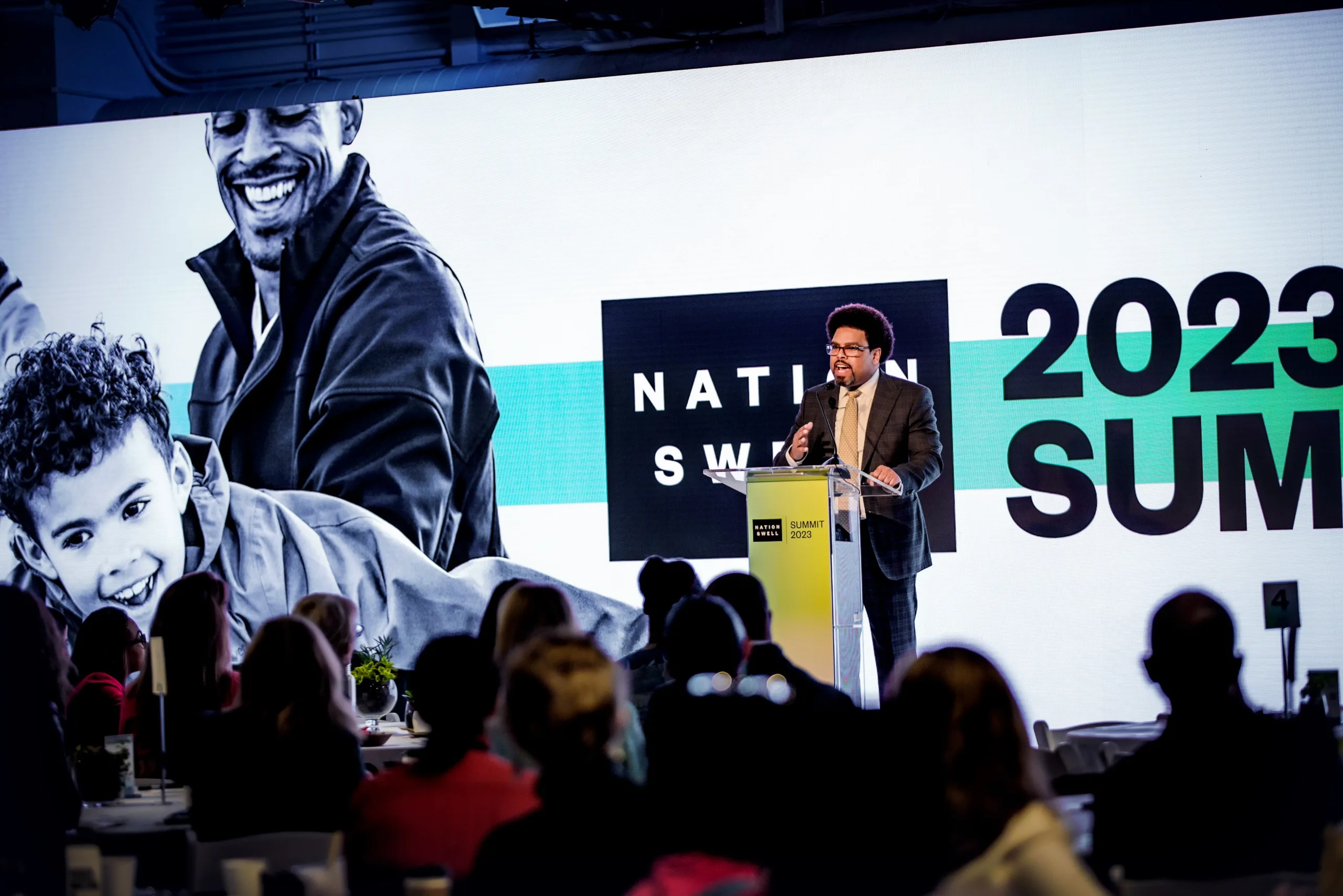
Once a year, the most cutting-edge and committed leaders in ESG, social impact, philanthropy and other select fields gather at the NationSwell Summit to foster invaluable cross-sector connections, to hear about the most exciting and promising ideas and initiatives, to reflect and revitalize, and to glean actionable insights, practices and collaboration opportunities to propel their leadership forward.
NationSwell held its Summit on Thursday in New York; the theme for 2023 was “Better + Bolder.”
Here are the better and bolder quotes and moments throughout the day that will be on our minds, in our hearts, and close to the core of our personal and professional practices of impact.
“The challenges we are working on are difficult, multi-layered and urgent. There is no time to waste, and none of us will be at our best if we’re doing it alone. At a moment that needs our best, how might we stretch further in the direction of the impact we seek?” — Greg Behrman, NationSwell CEO + Founder
“My call to action is a call to arms: Commit to justice as a matter of faith simply because it is the right thing to do.” — Darrick Hamilton, economist, Henry Cohen Professor of Economics and Urban Policy, and the founding director of the Institute on Race, Power and Political Economy at The New School.
“On every single barometer we know what works — yet, it’s not being done.It’s not that people don’t know how to manage their money, it’s that people don’t have money to manage. One’s income is not correlated to one’s intelligence. Your kids & their kids deserve just as much as my kids.” — former Stockton Mayor Michael Tubbs, special advisor on economic mobility to California Governor Gavin Newsom.
“Broad-based employee ownership and engagement, while difficult to execute, is wildly promising — it can lead to a radical increase in economic mobility, financial fluency, workforce stability and productivity.” — Pete Stavros, co-head of Global Private Equity, KKR; Founder and Chairman, Ownership Works
“Regarding social media, it’s important to remember that 80% of tweets come from 10% of users. And that 10% tends to be much more extreme than the average American. We naturally interpret these frequent, loud voices as being mainstream but if you look at surveys of what matters most to Americans across political lines, you actually find broad agreement. So let’s take the time to talk to each other, particularly folks you wouldn’t normally talk to, because that’s the only way we’re going to understand each other and make progress.” — Pete Stavros,
“We’re in a burning building. We all have to get out. I might hit the ground before you, but you are right behind me. It’s not about being an ally because it affects you too… that’s why the term ‘allyship’ doesn’t quite capture it. You’re not doing this to help me. Your own life is at stake. Injustice makes everyone sick. If your proverbial boot is on my neck, your humanity is at stake too.” — Ruha Benjamin, author of “Viral Justice,” Princeton Professor of African-American Studies, NationSwell Book of the Year Award recipient.
“Be better and bolder by investing in the microscopic. People may not see it, but they will feel it.” — Ruha Benjamin
“Better and Bolder means not limiting ourselves in any way possible. It means constantly innovating, exploring, and creating new radical solutions by incorporating diverse perspectives. In this moment, we have to take that first step into the unknown. We have to ask ourselves “What would a world without a climate crisis look like?” And then we also have to consider these three questions: what does that mean to me? what does that mean for those most impacted by the crisis? And how can we make that future a reality?” — Thea Gay, NationSwell Fellow, youth climate activist
“Social impact at scale rarely happens overnight. Years of everyday decisions made by organizational leaders operating incrementally and independently reach a certain threshold — and can get stuck, often due to lack of capacity and broader insight. Our Collaboratives take the baton at that point of impasse, help identify shared opportunities and create the space for collective action to break through.” — Amy Lee, Chief Strategy Officer, NationSwell
“Refugees aren’t looking for a handout. These are the people fighting to stay alive, fighting for the futures of their families… these are the people you want working at your organizations.” — Hamdi Ulukaya, CEO + Founder, Chobani; Founder, the Tent Partnership for Refugees
“We all remember where we were when we heard something, watched something, or experienced something that changed our lives. The arts — and the extraordinary artists behind them — are the beating heart of our culture. They make us better, and they make us bolder. The catalytic inspiration and perspective they provide are essential for any leader.” — Anjali Ramasunder, NationSwell Vice President of Programming and Events
In the days to come, we will share more insights, reflections, photographs, and video from the NationSwell Summit. For more information, visit our digital hub.
Wealth inequality and income inequality in the United States are significantly higher than in other OECD countries. And economic mobility is rigid. The likelihood of an individual moving from low wealth status to high wealth status over the course of their lifetime is low. Income disparity and wealth inequality are rooted in an array of social and economic factors, including race and geography. These factors create what is known as the economic opportunity gap.
This Curated Collection provides social impact leaders in the public and private sectors with a roundup of data-driven tools to strengthen their decision-making processes in addressing the economic opportunity gap. The resources provide specific consideration for indicators of racial equity and social justice and factors that promote mobility for disadvantaged groups across neighborhoods, communities, and states.
Resources include (but are not limited to) the following:
Tools that allow companies to benchmark themselves against others on strategy and progress;
Datasets that support deciding which communities would benefit most from company investments to increase equity;
Resources that encourage companies to prioritize racial and social factors that affect indicators of wealth (e.g., access to education and employment, and asset ownership).