
Place-Based Impact in Practice: 36 hours in Tulsa with NationSwell and George Kaiser Family Foundation

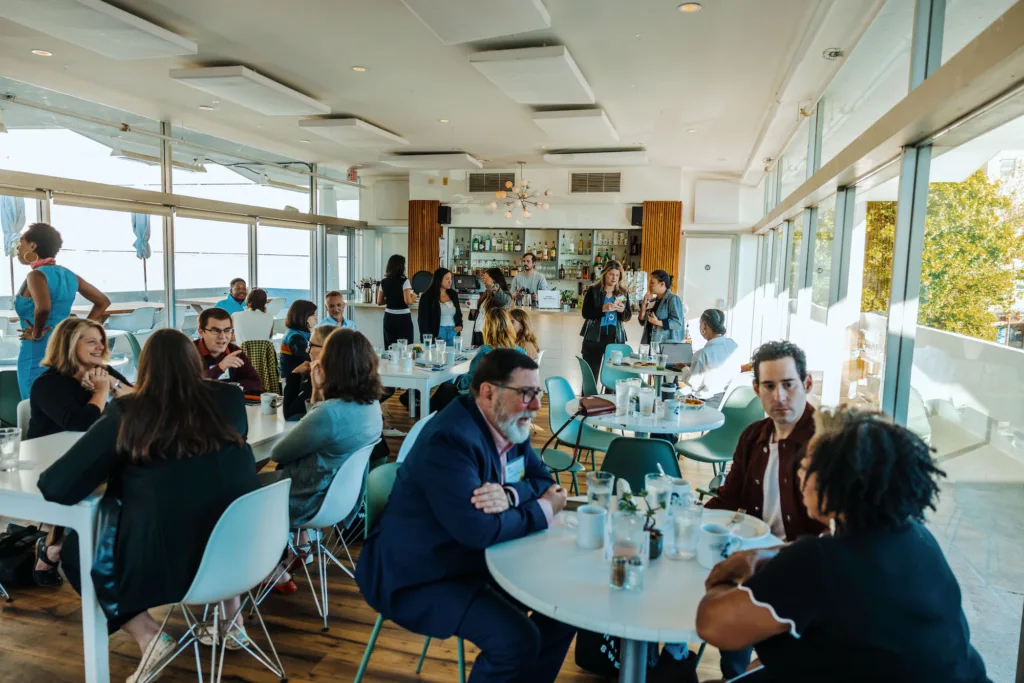
On the evening of October 18th, black clouds of starlings wheeled overhead as the NationSwell team made its way to meet a group of partners and leaders in downtown Tulsa. The group had gathered as part of our Place-Based Impact Collaborative for an immersive, 1.5-day experience designed to explore how community-centered investment and strategic partnerships are working in concert to give new strength to Tulsa. 

The insights and best practices we gathered from GKFF’s approach — and from the experts in attendance — were many, and can better enable communities nationwide to thrive. Although it’s impossible to accurately capture and convey the profound experience of being on the ground in Tulsa, our hope is that this piece can shed some light on what it was like to come together and learn with an incredible group of leaders and inspire you as you strengthen your own community-centered, place-based work.

Day One

The day began with a tour at Greenwood Rising to hear the vital stories at the core of Tulsa’s history and identity: the impact the Trail of Tears, the systems of anti-Blackness that fomented the Race Massacre of 1921, and the cultural reverberations of both eras that are still being felt throughout the city. Despite the violence dotting its past, Tulsa and its residents have persisted — deepening their sense of community and establishing a rich sense of place and culture that makes the city vibrant and unique.

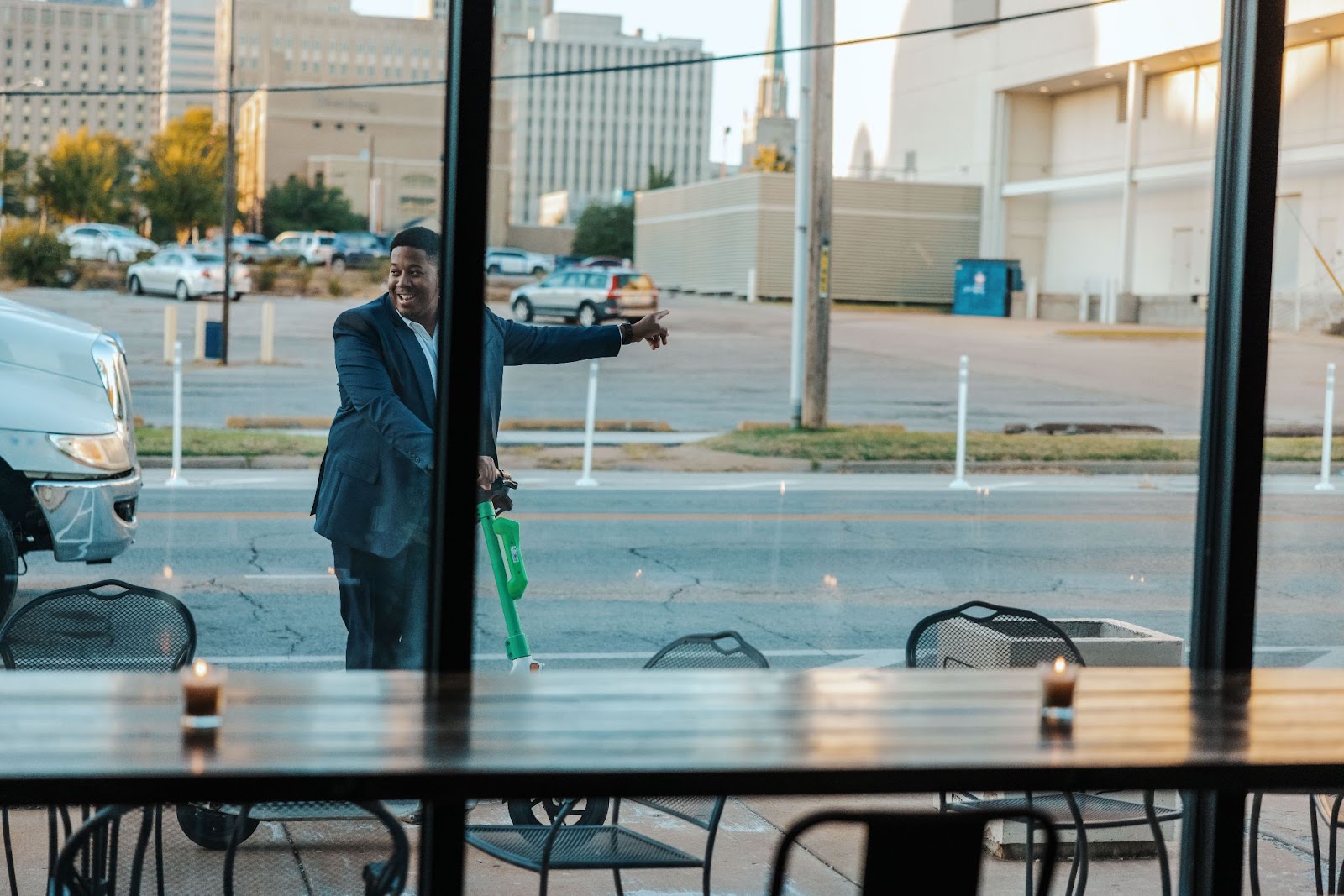
That night, we joined our hosts from George Kaiser Family Foundation for a welcome reception at a speakeasy in the city’s Deco District. After an evening of warm conversation, introductions, and getting to know one another better as we prepared for the next day, Aaron Miller — head of partnerships at inTulsa — announced that he would lead a group by bus to celebrate the city’s popular Oktoberfest, currently in its 44th year. Jonathan Pride, executive director at NPower, announced that he planned to lead a competing group to the same location via the city’s widely-available Lime scooters.

Day Two

East Tulsa

After a quick pit stop for breakfast on Thursday morning, our group set out by bus for East Tulsa, where white flight and the attendant infrastructural divestment have created unlikely opportunities for the city’s growing immigrant population. 

Cynthia Jasso — a program officer on the Vibrant and Inclusive Tulsa team — explained that East Tulsa has become a community hub, learning center, and worker community for newly-arrived immigrants, more than 1,100 of whom arrive at the Plaza Santa Cecilia from Mexico by bus each week. While organizations like Growing Together have done grassroots outreach to meet residents where they are — helping to expand access to vaccines and make PPP loan applications easier for local businesses owners — they ultimately found that there was an overwhelming need for a centralized community hub where people could get the help that they needed. Plaza Santa Cecilia has become that epicenter — a place for the community to gather, relax, take classes, shop, or even acquire permits.
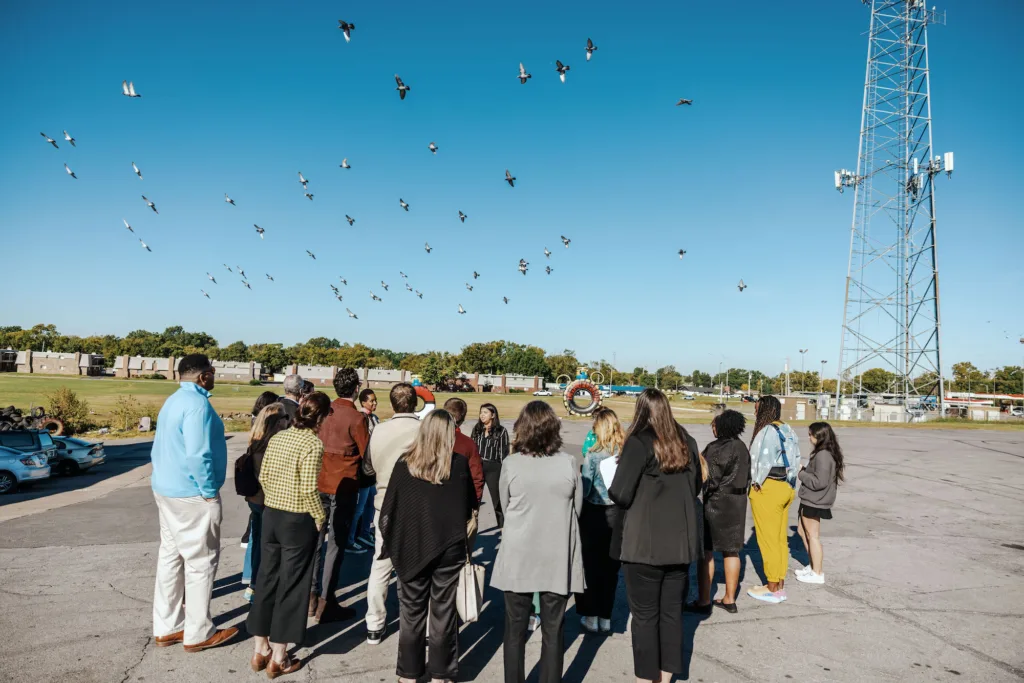

The plaza features beautiful murals, restaurants, and a nightclub, and has become a major source of community pride and belonging — a critical metric of success for place-based investment. 

North Tulsa
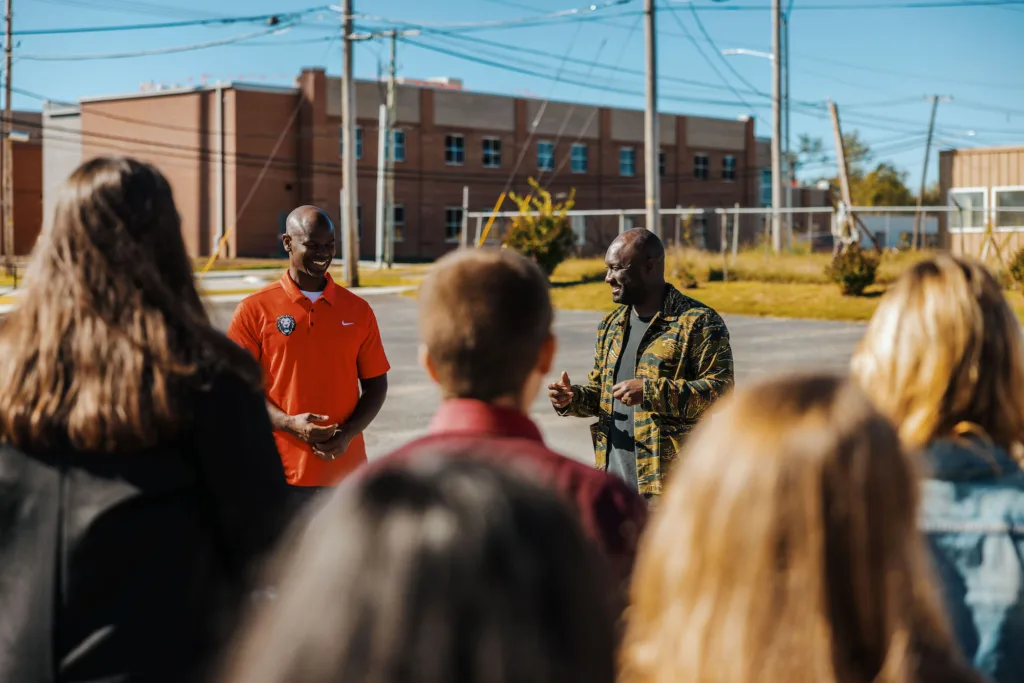

Our next stop was in North Tulsa, where attendees heard from Pastor Philip Abode of Crossover Community Impact and Crossover Bible Church. A former University of Tulsa football player and current high school football coach, Abode’s passion for coaching youth eventually catalyzed an even deeper relationship to mentorship in the city: he now serves as executive director of Crossover Preparatory Academy, which oversees several private middle schools throughout the city.

A majority-Black neighborhood, Tulsa’s north corridor is currently the site of major community development efforts, including a planned 500-unit, mixed-income housing project and new contracts with high-quality, high-paying manufacturing jobs at companies that agree to recruit from within the neighborhood (and nearby Tulsa Technology Center). 

Kendall Whittier


As the bright sun continued to warm up the day, we visited Kendall Whittier Park — located in Tulsa’s historic Kendall Whittier neighborhood — where we learned more about how a mixed-income neighborhood trust has helped  provide stable, affordable housing, and how partners like Growing Together and Tulsa Educare have created educational opportunities and green spaces where children and families can grow and thrive. 

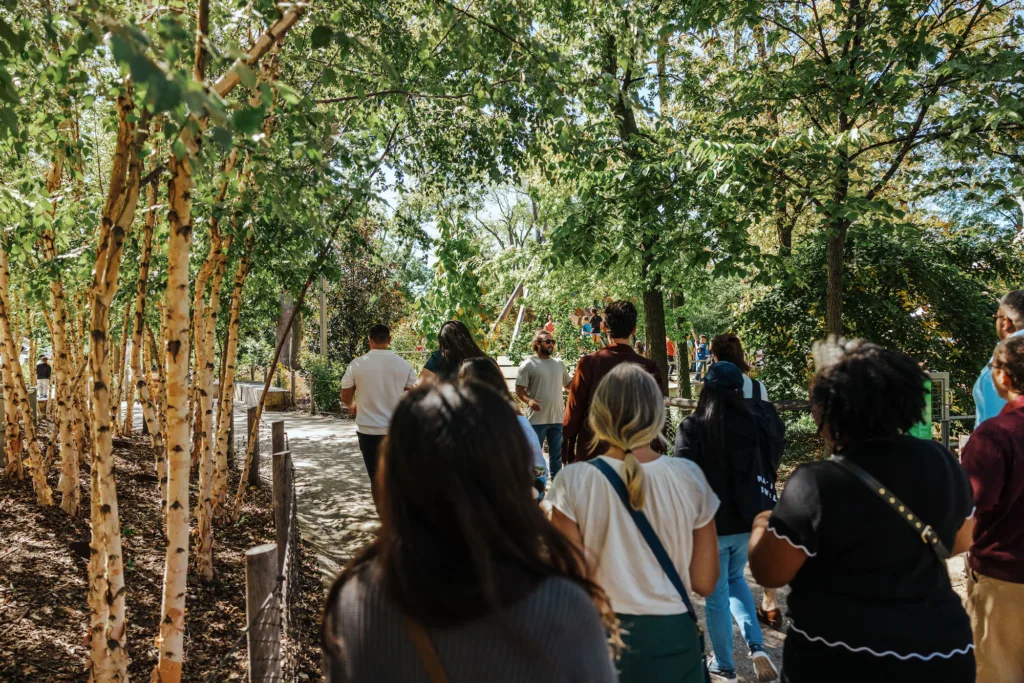
We also had the opportunity to tour The Gathering Place, which words alone don’t really do justice. A sprawling 66.5-acre green space nestled against the Arkansas River, The Gathering Place’s pathways were dotted with pumpkins and its playgrounds had names like “Land of the River Giants,” “Fairyland Forest,” and “Volcanoville.” All park activities are free, and guests can help themselves to kayaks and paddle boats, attend concerts on the lawn, and engage with the park’s many educational programs. 

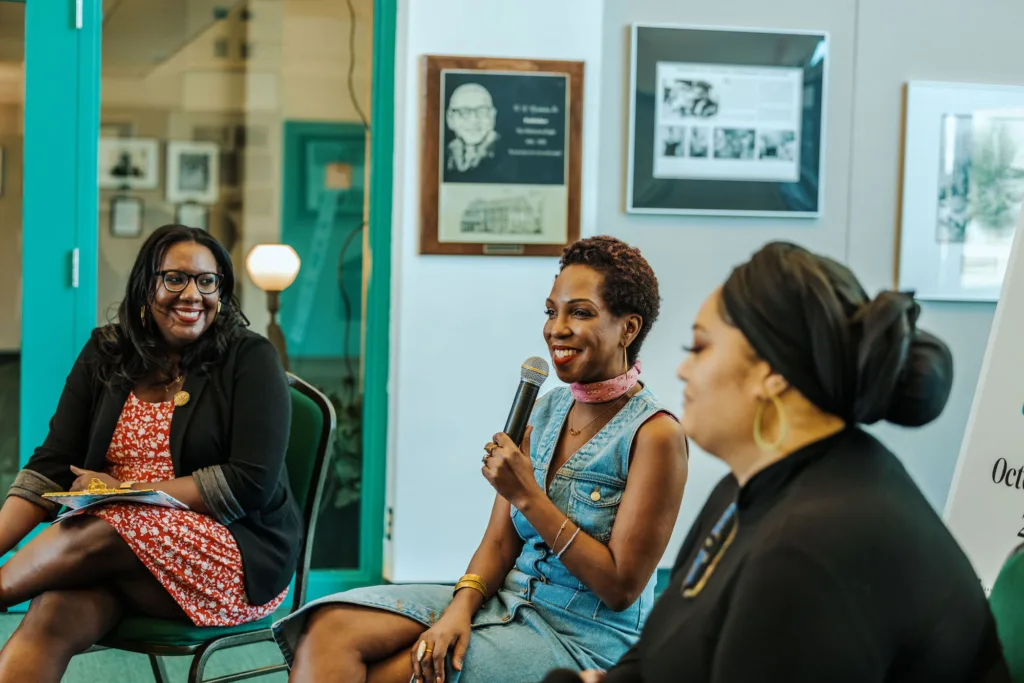
After lunch, we reconvened at Greenwood Cultural Center for a series of panel discussions — first on how to leverage the power of storytelling, and then on how new models of collaboration across the public, private, and philanthropic sectors can help to foster opportunity from the ground up.

During the first panel, Jasmine Dellafosse — Director of Organizing and Community Engagement at EPIC — spoke about the value of telling the stories that run counter to our assumptions. 

“What are the stories we don’t know, and in whose interest is it that we don’t know them?” she asked. 

Panelist Vanessa Garrison — Co-founder and COO of GirlTrek — further emphasized the power storytelling holds in developing a community: deconstructing myths, challenging assumptions and enabling community members to lead change. 

In the second panel, a key insight that surfaced was the recognition that change doesn’t just take a longer grant cycle but can take generations to actualize. The question that emerges, then, is how do we integrate intergenerational change as a metric when measuring impact? 

At the intersection of both of these panels is the emerging understanding that how we measure impact in place-based philanthropy needs to evolve to incorporate more qualitative data, compelling us to reimagine what a thriving community really means.

After a visit to Archer Studios to learn about the Tulsa Artist Fellowship — and a ceramics activity with fellow Raphael Corzo — participants had a few minutes to rest and recharge before coming together for a NationSwell Signature Dinner to reflect on the events and learnings of the day. 

Hosting us for the evening was the team at et al., a collective of chefs working collaboratively to “build a more delicious and equitable future for the food and beverage industry in Tulsa.” Aptly named to reflect the important but often overlooked or unknown people who help to make an ambitious vision into a reality, the symbolism behind et al.’s name and mission had a beautiful symmetry with the focus of our visit to Tulsa — and the patchwork of organizations and solutions we’d witnessed firsthand on the ground there. 
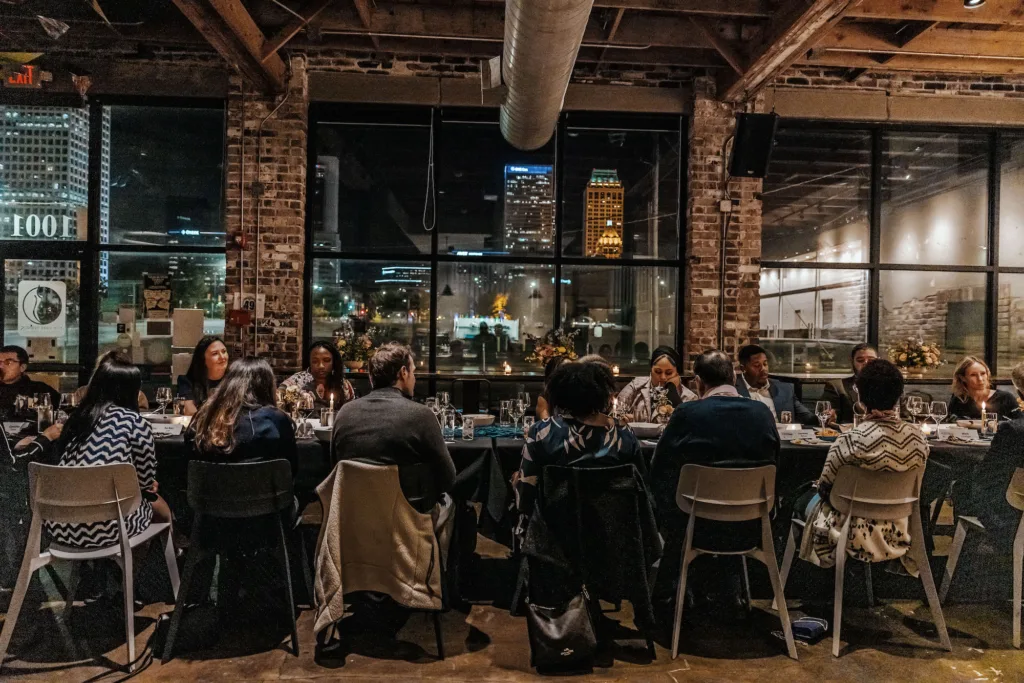

Attendees dove deep into what had inspired and moved them during the course of the meal, which was themed around the idea of breaking bread (as chef Colin Sato explained, “You have now broken bread with Tulsa, and now it’s a part of you”). There was a discussion of some of the central challenges to their own place-based work, with members laying out the approaches, tools, and new opportunities for partnership they were excited to bring back to their own communities. 

Like the chefs in et al.’s culinary collective, our time in Tulsa was distinguished by the patchwork of seemingly disparate, often undersung voices we heard from joining together to create a beautiful and undeniable chorus of solutions. While partners on the ground maintain different focuses in the work that they do and the neighborhoods they serve, everything in Tulsa has a certain harmony to it; the work comes together to hum like a well-oiled machine. As we packed up to leave on Friday, we couldn’t help but think about how this model of community impact — where every voice, program, and initiative happening on the ground is truly greater than the sum of its parts — has the potential to transform not only communities, but the world.

We’re so excited to have plans for more in-person, immersive experiences in the works for the near future. This incredible experience was part of our Place-Based Impact Collaborative. Our Collaborative model is based on the idea that the challenges we face call for collaboration and shared action to achieve the impact we seek on a variety of issue areas. Together, with cross-sector leaders, we illuminate challenges and opportunities in the space and align on action to advance each other’s work, and the field as a whole.

We encourage you to read more about our different Collaboratives and to contact us to get involved if you see one that resonates with you and your work. 

NationSwell Collaboratives are a new initiative convening cross-sector leaders to work in new ways on major issues affecting our lives, our nation, and our world. Learn more about our current offerings here.


What we can learn from George Kaiser Family Foundation’s place-based work in Tulsa, Oklahoma

This fall, NationSwell launches its first immersive experience on October 18 and 19 in Tulsa, Oklahoma for Place-Based Impact in Practice: An Immersive Experience to Explore Community-Centered Funding and Action. Hosted by George Kaiser Family Foundation (GKFF) as part of our recently launched Place-Based Impact Collaborative, this hands-on event will take place over the course of one and a half days and will allow attendees to explore on-the-ground examples and innovative strategies to foster thriving and inclusive communities, particularly in fast-growing cities and rural areas. We’d love for you to join us.

But, you may be thinking, why Tulsa?

Since its establishment in 1999, George Kaiser Family Foundation has held, as its primary philanthropic goal, cementing Tulsa, Oklahoma, as a vibrant, inclusive, and prosperous environment where children and families can flourish. 

As the primary supporting organization of the Tulsa Community Foundation, GKFF funds organizations and efforts that directly service the greater Tulsa area, all while adhering to its guiding principle, “no child is responsible for the circumstances of [their] own birth.” Foundation investments include robust early childhood education initiatives that serve approximately 2,000 children in year-round education and care; over $100 million earmarked for the arts; economic development initiatives to attract and retain local businesses and talent as well as transform 100 acres of Tulsa’s iconic riverfront into a dynamic and world-class centralized park; neighborhood programs to foster a strong sense of community; and a work stipend program that has welcomed more than 2,500 diverse professionals to the city. 

GKFF harnesses a nimble, entrepreneurial spirit, which has helped to adeptly address community needs. Their approach is holistic and community-centered and driven–designed to lead with the community’s needs so that children and families in Tulsa can thrive. What sets their investment strategy apart from other philanthropic models is that it’s not only nuanced, but multi-pronged–touching almost every part of the Tulsa ecosystem. Parent engagement and early childhood education, health and family well-being, civic enhancement, and breaking the cycle of intergenerational poverty are all vital pillars of community prosperity.

George Kaiser Family Foundation’s holistic approach

In order to create and maintain the conditions for a thriving local community, GKFF has taken a holistic, all-encompassing approach to funding that sees early childhood education; health and wellbeing; neighborhood development; thriving public spaces; criminal justice; housing; and arts & culture as vital pillars of economic prosperity. During an onsite visit in March 2023, NationSwell got a firsthand look at how these key initiatives operate on the ground in Tulsa; below are some of the highlights we observed.

  • Parent Engagement and Early Childhood Education

GKFF provides support and resources to young Tulsa families to encourage parent‐child engagement and interaction. Through initiatives like Tulsa Educare and Early Learning Works, families and children are encouraged to pursue skill-building opportunities and early learning workshops, and are given the chance to connect with community and faith-based organizations that help to promote literacy and learning.

  • Civic Enhancement

Robust public spaces provide abundant natural spaces for residents to relax, convene and unplug. Tulsa’s 100-acre riverfront park, Gathering Place, now boasts a skate park, a picnic grove, cultural events and festivals for all ages, and free educational programming to support early childhood development. A $465 million transformation of more than 66 acres in central Tulsa, the park is one of the largest and most ambitious public parks ever created with private funds. The Foundation undertook a similarly ambitious project with Guthrie Green — a former truck loading facility that has now been converted into a 2.6-acre urban park, located in the heart of the Tulsa Arts District and a true living room for cultural programming in downtown Tulsa. 

Investments in a thriving arts scene and strong cultural values are integral to GKFF’s community approach. Both the Bob Dylan Center and the Woody Guthrie Center operate under auspices of the American Song Archives, a project of George Kaiser Family Foundation, and dedicated artist residencies, fellowships, and programming helps to further stimulate Tulsa’s growing arts community. 

In the same Tulsa Arts District as Guthrie Green sits the GKFF-funded Holberton School–a credentialing school for software developers. In addition to training career-ready developers, Holberton provides living stipends to students and tuition incentives to stay in Tulsa both pre- and post-graduation. 

Partnership is at GKFF’s core. GKFF takes a program-forward approach — meaning the Foundation serves as co- or sole owner of many of the LLCs that operate the aforementioned initiatives in Tulsa. When visiting the city, you can explore parks, cafes, bakeries, restaurants, food trucks, and programming initiatives that provide Tulsa residents with meaningful ways to stay engaged in their communities. 

  • Workforce Development

GKFF’s dedication to developing Tulsa’s tech-led inclusive economy is something to aspire to. Tulsa Innovation Labs (TIL) was founded with support from GKFF to establish a city-wide strategy for inclusive, tech-led growth. TIL designs and launches economic and workforce development initiatives in Tulsa’s four emerging tech clusters: virtual health, energy tech, advanced air mobility and cyber, and aims to support the growth of startups, train diverse talent, expand job opportunities, and spur academic innovation. And through the network of local workforce programs in Tulsa, businesses can more easily connect with key hires and launch operations in Tulsa via inTulsa’s talent, relocation, and growth solutions.

36 Degrees North — Tulsa’s basecamp for entrepreneurs, innovators, and startups — works to provide the high-quality workspace, resources, and spirited community that entrepreneurs need to build growing companies and drive economic impact in Tulsa. Workforce development programs like Tulsa Remote — which offers participants a $10,000 grant in addition to a membership at a local co-working space, support in identifying housing, and regular community-building opportunities — have helped draw new workers into Tulsa and boost retention rates for local populations.

  • Health and Family Well-Being

To address the longstanding problem of high recidivism rates in Tulsa County, GKFF has partnered with the Justice and Mobility Fund to launch JusticeLink — a compendium of resources designed to help those navigating the criminal legal system in Tulsa to access a full spectrum of community-based services. JusticeLink primarily focuses on providing court and resource navigation, while also helping individuals to access wraparound supports like phones, IDs, or benefits enrollment services.

And through neighborhood development initiatives like ElevateEast — which works collaboratively with residents, community-based organizations, and public and private entities to invest and support immigrant families living in East Tulsa — residents can further access the wraparound support they need to thrive.

Affordable housing also has a huge role to play in ensuring family wellbeing, and neighborhood development initiatives like Growing Together and Kendall Whittier West Park have been intentionally designed to create vibrant, mixed-income communities and an intense focus on the birth-to-college-to-career pipeline.

  • The Tulsa Artist Fellowship
    Dedicated artist residencies, fellowships, and programming helps to further stimulate Tulsa’s growing arts community. Established in 2015, Tulsa Artist Fellowship was created to address and mitigate the challenges facing artists and arts workers living in and joining the city. Through intentionally crafted programming, the Fellowship celebrates and supports artists across all mediums by providing them with $150,000 over three years in addition to a $12,000 yearly housing stipend. 

Stronger together

GKFF’s approach has necessitated a rethinking of scale and impact as being simultaneously micro and macro. Seemingly hyperlocal initiatives — like the neighborhood development in Kendall Whittier, or the transformation of public spaces into vibrant parks — can scale to an overall transformation that impacts community members’ wellbeing and livelihood. For GKFF, scale is ultimately not about reaching hundreds of millions of people to solve for one issue; it’s about making meaningful and impactful investments that tackle root causes, identify and address social determinants, and take into account the specific moments that come together to make up a well-lived life.

All of us invested in place-based work can learn from GKFF’s approach, bring insights back to our communities, and integrate them into our own strategies — all uniquely tailored to each place. Place-based strategies are inherently collaborative and rely on strong partnerships: together, we can learn from each other, lean on each other’s strengths, and propel strategies that have a community’s best interest at its core.  

This is why we can’t wait to share in the Tulsa experience and the work of GKFF with the broader NationSwell Community this Fall! If you are interested in joining us you can register here or learn more about GKFF’s work or the Immersive Experience on October 18-19 by emailing Joy Gregory at [email protected].

NationSwell Collaboratives: Making the Case for Childcare

NationSwell Collaboratives are a vehicle for bringing together committed actors to push towards collective action on a specific issue. Anthony Smith, NationSwell V.P. of Editorial, spoke to Uyen Tieu, NationSwell President, Amy Lee, NationSwell Chief Strategy Officer, Allie Mahler, NationSwell Senior Strategy Director, and Austen Zoutewelle, NationSwell Associate Director of Strategy, about the Case for Childcare Collaborative, a cross-sector coalition working to solve our nation’s crisis of childcare and help 1.1 million women return to a better workplace than the one they left at the outset of the pandemic.

Anthony Smith, NationSwell V.P. of Editorial: Why should leaders make the case for childcare?

Uyen Tieu, NationSwell President: The moment for leaders to make the case for childcare has been such a long time coming. This isn’t a new conversation in America, but it’s one that till this point had been led largely by women, experts, and activists. It took the wide scale disruption of the pandemic to get us to where we are now, where it’s now as clear for men — especially fathers — as it has been for us. We have to take advantage of this moment.

NationSwell: How did the work begin?

Amy Lee, NationSwell Chief Strategy Officer: Our first step was to recognize the mass exodus of women that left the workplace during the pandemic. At the beginning of the Covid era, 2 million women left the workforce; 1.1 million still have not returned. Their reasons aren’t just because of the tangible realities of school shutdowns and the lack of childcare — they’re about societal norms around which parent is chiefly responsible for caregiving.

One of our Studio partners told us, “We really want to work with you to tackle the problems that working womxn* and caregiving womxn are facing,” and that’s really how our Collaborative was born — out of the idea that we didn’t just want to help these women get back to work, we want to build the structures that allow women to actually thrive at work once they return.

Allie Mahler, NationSwell Senior Strategy Director: Collaboratives are all about building coalitions of committed actors for scaled, collective action. We have an incredible group of partners that have coalesced around this Collaborative initiative: American Family Insurance, Annie E. Casey Foundation, Caring Across Generations, National Domestic Workers Alliance, Working for Women, and others. It’s a powerhouse group who each bring unique expertise, funding, programming, organizing capabilities, and community to the table. I have no doubt this group will move mountains when it comes to helping businesses support low wage workers and the caregiving economy.

NationSwell: What are some of the challenges facing working caregivers in this country?

Austen Zoutewelle, NationSwell Associate Director, Strategy: Given what we know about economic disruption, it’s unsurprising that the women who are most affected by the lack of childcare in this country are women without a college degree, women of color, and small business owners. 

But one big learning for us is that the care industry — not only for early childhood education, but also for eldercare — is predominantly run by women. So not only are working mothers being affected by this disruption, but working mothers within the industry of care are also affected — even as we expect them to be at the frontlines of this crisis. Not only does that lead to fewer workers, it leads to fewer options for daycare and childcare. 

NationSwell: What advantages does the Collaborative model provide in tackling this challenge?

Lee: Philanthropy and corporate social responsibility functions are evolving at a rapid pace. Legacy models have been focused on a personal or organization-specific mission, but the new generation of leaders in this space have embraced the idea that these issues — whether it’s climate change or childcare — are too large to be solved by one person, or one family foundation, or one organization alone. We have to work together. And at the same time, we need to provide funders with a way to see what their peers are doing so that we don’t support redundant work.  

Collaboratives allow us to do exactly that — we bring funders and committed actors together to deepen and broaden their impact. We allow them to look across the space and really identify where there are unmet needs. And it also allows them to work together with partners that may not organically be at the same table without our support. 

Tieu: One of our partners said it the best: This time can be different because the table is different. NationSwell approaches this work with the nuanced understanding that the players need to work towards something that can last.

NationSwell: How is the case for childcare personal to you?

Tieu:  I’m a mom, I’m a daughter, I’m a woman, and I’m a business leader. If we’re to compete without actually addressing the urgent need for childcare, there’s going to be a knock-on effect across every aspect of society. The problem is too urgent to rely only on federal policy change. If committed actors come together now to co-create the roadmap, we can turn the case for childcare into a reality.

Zoutewelle: I watched my mom balance raising three kids and working full-time when I was in high school. She still manages caring for my brother with Down syndrome while working full-time. I’ve seen first hand the urgency of this issue, the importance of flexible working arrangements, the necessity of public policy to support parents, and the need for collaborative, systemic strategies for making an impact. The urgency is even greater for women of color in low-wage industries. It’s important to me to elevate this work so that more women can participate in the economy and feel supported as a parent. It’s critical for our moms and the future generations.

Mahler: This work is incredibly personal to me. I just returned back to work at NationSwell as a mom of two young babies under two years old while also leading our Strategy team. I love what I get to do at work, and I love my daughters, but it is not only mentally and physically taxing on a daily basis but also financially taxing to coordinate care for my children. During my maternity leave, I thought daily about how fortunate I was to have the time to connect with my daughters, and how so many women and their families are taken too soon from their babies as they go back to work at 6 or 8 weeks post-delivery. That’s why this work inspires me and lights a fire for me.

Lee: I am a privileged white woman, but nonetheless the pandemic showed me how hard it is to be a working parent. My children were one and three years old when the pandemic started, and my husband and I were suddenly thrust into full-time childcare and a full-time job at a time of huge uncertainty and fear. We were only just able to make it work and that was with the benefit of being able to work remotely and having a flexible, empathetic employer. I can’t even imagine how hard it must have been for people working shifts, or people from single parent families.


For more information on Collaboratives, visit our site.

Editor’s Note: To exercise intersectionality and inclusion, one member of our collaborative uses the spelling “womxn” whereas other members use the traditional spelling, “women.” You can learn more about “womxn” and other forms of intentional, lexical inclusion at the Womxn’s Center for Success. 

NationSwell Leaders on the Biden Administration’s Student Debt Forgiveness Plan

On August 24, President Joe Biden’s White House announced intentions to ease student debt obligations by up to $20,000 for millions of Americans. Early details of the plan included a commitment to forgive up to $10,000 in federal student loan debt from the U.S. Department of Education for any borrower who earned less than an adjusted gross income of $125,000 ($250,000 for married couple filing jointly or head of household) in either 2020 or 2021, with Pell Grant recipients reportedly eligible to receive an additional $10,000 in relief on top of that.

While the finer points of the new debt forgiveness plan are still being hammered out, the measure is already set to have sweeping implications for those who qualify. To help make sense of the policy, NationSwell reached out to our community of experts for their reactions, and to ask if the plan goes far enough towards ensuring a more equitable playing field for millions of debt-saddled Americans.

Here are some of their responses:

NationSwell: What does the student loan forgiveness news mean in practical terms, for both workers and students? 

David Shapiro, CEO of MENTOR
Similar to the enactment, further guidance, and activation of the Public Service Loan Forgiveness over the last year, this is another opportunity for economic relief and increased stability for folks who work for non-profits and anyone looking to start a career in the sector. It is also important to note that it will affect people of all ages, not just the person who is receiving loan relief. Economic relief for parents and spouses can affect whole families and communities. Student debt burden has also often been intergenerational as well. Awareness is crucial so that folks get the full benefit of this opportunity, and that’s where community-based organizations, mentors, and others need to spread the word and help folks access this.

Mohan Sivaloganathan, CEO of Our Turn:
We need a future-facing lens with respect to student debt. President Biden’s announcement provides current day relief for past issues, but the structural issues that perpetuate racial inequity still exist — such as students of color lacking financial, college, and career planning resources in middle/high school (a stark contrast to white and/or affluent students).

Zeeshan Ali, a former Our Turn student leader who recently wrote a piece on student debt:
For both workers and students, such forgiveness provides a great opportunity for upward mobility and financial sustainability. Whether it be $10,000 or $20,000, those amounts mean the difference between eating three meals a day or going hungry, being able to pay rent or becoming homeless, buying a car or walking miles to work . For current and prospective students, I believe it generates ambition within them to continue their pursuit of higher-education, knowing that attending a college is within their reach .With hope that such a culture of affordable education is prolonged, I foresee an increase in minority enrollment in educational institutions, thus closing the wealth inequality gap. Workers will feel that relief as well: I know of many friends who are working jobs that do not interest them, however, the pay of such jobs helps with their student debt. With this forgiveness, workers can have more flexibility in their career paths, and it can enable them to work in a field they want to, vs. one that they have to.

Martin Kurzweil, Vice President of Educational Transformation at Ithaka S+R:
While there are some open questions about when it will take place (as it will likely be challenged in court) and how it will operate, once in effect, President Biden’s loan forgiveness order would completely wipe out debt for millions of borrowers, many of whom have not completed their degree, are not recognizing the value of their investment, and have been shut out of ineffective existing options for reducing or cancelling their debt. Getting out from under that burden will allow those individuals to make family, financial, and educational plans that their debt has put on hold. I do worry that the forgiveness program, as seemingly simple as its criteria are, may prove administratively complicated — the process will need to be carefully designed to ensure that it does not put bureaucratic barriers in the way of individuals who would otherwise be eligible. The more the Education Department can process the forgiveness automatically, using information it (or other branches of the federal government) already has, the better. Although debt forgiveness doesn’t address the ongoing accumulation of new debt, it does put greater pressure on the administration and Congress to address problems of college affordability, wasted individual expenditures by those who don’t complete or get a credential of value, and ongoing processes for ensuring repayment and interest accumulation aren’t overwhelming. The administration’s announcement included some indications of how it plans to address income-based repayment, public service loan forgiveness, and institutional accountability, but a lot more detail is needed on those plans.

Jean-Claude Brizard, President and CEO of Digital Promise:
In many countries around the world, students don’t exit formal education saddled with debt. In practical terms, students can spend more time building the foundation for economic security and not worrying about repaying a loan that often greatly exceeds their annual income. It also allows some to enter graduate school and further their education. 

NationSwell: What are some of the next steps we’ll need to take in order to advance educational and workforce equity?

David Shapiro, CEO of MENTOR:
Driving equity is about culture, structure, and systemic examination and change. We have to look at the barriers and biases that drive access, engagement, and retention. These could be economic, process driven, geographic, representative, along with other factors. And it requires deep listening, action orientation, benchmarking, communication, and marking progress and setbacks. It is a consistent pursuit and while there may be milestones, there is not an endpoint.

Dr. Noel Harmon, President and Executive Director of APIA Scholars:
We are grateful for the Biden administration’s recognition of the crippling effects of student loan debt, especially for the relief that will be directed towards the most under-represented and disadvantaged students in the educational process. While we appreciate that this is progress in providing aid to those who are most in need, we also feel that there are core problems that remain unsolved and must stay in the forefront. We need to continue to address systemic issues impacting educational equity, including financial barriers, access, and support.

Zeeshan Ali, former Our Turn student leader:
Outside of the student debt crisis that still remains, we must provide resources to marginalized communities in the form of community building, career guidance, and most of all, financial investments. I have seen it in my hometown of Palm Beach, Florida: There are mansions on one block of the street, but if you drive a block or two away, there are houses with broken windows, rundown schools, and mold-ridden recreational centers. We must allocate money towards such poverty-ridden areas to build better institutions that encourage personal development — in areas of both education and career, we need to reaffirm to the younger generation that they are not forgotten, nor do they mean any less than a student who lives in the wealthier part of town. And above everything else, we must make progressive change together, on every level. From the grassroots organizer to the President of the United States, there cannot be change if we are not unified in our efforts to make the world a better place, a place that promotes inclusion, offers opportunities of growth, and relentlessly fights for equity, for this generation and those to come. 

Mohan Sivaloganathan, CEO of Our Turn:
We need to invest in reframing the narrative around education and race. Too often, education is viewed as a critical lever for upward mobility and success — UNLESS — it is a Black, Indigenous, or Student of Color, and suddenly they are viewed as asking for a handout. The elimination of predatory higher education practices — while addressing an unjust playing field leading up to higher education — can actually forge a more prosperous, inclusive, and healthy country.

Jean-Claude Brizard, President and CEO of Digital Promise:
We need to make college more affordable and create better pathways from education to a meaningful career — one that puts young people on a path to economic security, well-being and personal agency. The Education Secretary’s push to greatly increase PELL is one good step in that direction. 

Martin Kurzweil, Vice President of Educational Transformation at Ithaka S+R::
There’s so much to do! Focusing on the federal and state level, the federal government and states ought to orient their spending and policies toward providing value with their investments in education — improving affordability as well as attainment of credentials that have labor market value. An important step is providing adequate resources to public institutions, especially those that serve large populations of students of color and lower-income students (which currently are less resourced than those serving wealthier, whiter student populations). An important issue that affects attainment is that the majority of students will earn college credit and other forms of validated postsecondary learning from more than one source, and we are terrible at reconciling all that evidence of learning and enabling seamless transfer — it results in a huge waste of time, money, and effort, and it disproportionately harms people of color and those from lower-income backgrounds. Streamlining transfer by aligning policies, providing better access to information and guidance, and reducing administrative barriers will benefit millions of individuals.

Madeline Kerner, CEO and Co-Founder of Matriculate, On the Promise of Equitable College Access

In the United States, less than half of high-achieving students from low-income backgrounds who graduate from high school apply to colleges that scan as a good academic fit for them.

While structural issues, including a lack of resources or institutional knowledge, can play a huge role in perpetuating this inequity, for many students, applying to the nation’s top universities can pose a crisis of confidence. Although attending a leading college or university can be a critical step in charting a path towards a brighter future — and despite the fact that generous financial aid packages can, counterintuitively, often mean that highly selective schools are a cheaper alternative than less competitive options — many students lack exposure to peers or teachers who have themselves applied to top colleges.

In the fall of 2014, Madeline Kerner founded the national nonprofit Matriculate in the hopes of giving students the hope, support, and models for success they need to thrive in and beyond their education careers. The organization began working to train college students from top universities like Columbia, Princeton, and Yale as Advising Fellows, who would then in turn work with high-achieving, low-income high school students in order to create pipelines to excellence. Today, Matriculate partners with Advising Fellows across 16 partner colleges and universities in an effort to guide students through their applications process and provide a model for the success they can achieve.

NationSwell spoke with Madeline about Matriculate’s impact and how creating new educational opportunities can have a transformative impact on talented students across the U.S.


NationSwell: Tell us a little bit about the inspiration behind your work — what was the impetus for founding Matriculate? How would you explain your mission statement?

Every year, thousands of students from low-income families and diverse communities have done everything we could expect of a high school student and excelled, yet too few of these students land at a college commensurate with their track record and with enough funding to make it through. As a result, talented students across the country are not able to access the opportunities they deserve and have earned. My interest in co-founding Matriculate came in part from my own values — I was in college at the same time my 85 year-old grandparents were working on getting their degrees. Education unlocked opportunity for me and my family. But more than that, I believe all students should have the support they need to thrive. At Matriculate, we serve as allies to talented students from rural, suburban, and urban communities from coast to coast as they navigate the college application and decision-making process and encourage students to attend colleges where they will have the support they need to succeed and pursue their dreams. We hope our work can contribute to forging a higher ed system that is truly representative of the talent in our country.

NationSwell: For a lot of reasons, it must be a tough time to be working in the education space. Is there anything about these last two years of pandemic that has informed or influenced your work in a way that’s surprised you?

It really has been tough. On the one hand, I am so ready for human connection in person. At the same time, we’ve learned how powerful, flexible, and effective virtual connection can be. Matriculate provides (and always has provided) virtual advising to support talented high school students from low-income families, which enables us to support students in hard-to-reach communities. Matriculate recently received the results of a gold-standard, randomized control trial in partnership with Bloomberg Philanthropies and CollegePoint and we’ve learned that the model is highly effective. Through virtual relationships, student are building meaningful, empathic connections with advisors. Matriculate students are going on to attend the top 80 colleges at a rate 24% higher than a pure control group. Our students also persist at statistically significant higher rates. So I am persuaded that while we all need in person human connection to break out of the challenges of the past two years, virtual connection can be very powerful.

NationSwell: Are there any initiatives coming up that you’re particularly excited about?

Yes! We’re exploring social capital—how deep connections formed between highly trained undergraduate advisors and high school students can prepare students for the college experience, help them know they belong, and help them anticipate the challenges they may face and how to navigate those issues. We are also developing new strategies to identify and connect with rural, first gen, and underrepresented students of color across the country, in part by leveraging our networks of thousands of students and advisors.

NationSwell: Do you have any helpful advice for people trying to understand how to lead or do impactful work in these uncertain times?

It has been very meaningful to be able to make a contribution during a time of great stress and uncertainty for young people and, at the same time, I have found it to be a very challenging time to lead. I have, not surprisingly, learned to hold plans very loosely and be more firmly guided by values and to reach out to connect and listen for what I don’t know.

Council member Lauren Baer on stepping into the ‘Arena’ to protect abortion rights

In 2018, NationSwell inspired Council member Lauren Baer, a former senior policy advisor to the U.S. Ambassador to the United Nations, to run for U.S. Congress in her home state of Florida. Her victory would have made history: Baer would’ve served as the first openly queer person to represent Florida in Washington. Following a narrow defeat, she’s now Managing Partner for Arena, focusing on supporting the next generation of women, BIPOC, and queer politicians on how to organize across the political spectrum and win seats on the federal and state level.

Following the news that the Supreme Court will likely overturn Roe v. Wade’s decades-spanning federal abortion rights protections in June, and that other civil liberties like same-sex marriage might be in jeopardy, I spoke with Baer to get her unique perspective on this unprecedented moment in our nation’s history.

This is what she had to say.


NationSwell: Thank you so much for speaking with us, Lauren. Please tell us about your professional journey.

Lauren Baer: My personal journey over the last five years is one of political activation and civic engagement. Earlier in my career, I had been a practicing lawyer, and then a foreign policy official in the Obama administration for six years. But in October of 2016, I gave birth to a baby girl, and two weeks later, Donald Trump was elected president. For me, that led to a very deep questioning of how I could have the most impact in our world — how I could create the kind of world I wanted my daughter to live in at a time where I saw our own democracy in the United States very much under threat.

And so what grew out of that for me was a move from the world of policy to politics. I returned to my home state of Florida and ran for office there — in 2018, I was the democratic nominee for US Congress in Florida’s 18th District. And although I narrowly lost that race, I knew afterwards that I needed to stay on the front lines in the fight to preserve and protect our democracy and all of the rights that we hold so dear.

So for the last 14 months, I have been managing partner at an organization called Arena. Our mission is to convene, train, and support the next generation of Democratic candidates and campaign staff. And what we see our job as is essentially building and diversifying the talent pipeline into politics, so that it is more representative of our party as a whole, more representative of the country as a whole, and therefore more effective at waging these battles that we’re fighting today — not only on the federal level, but in all 50 states.

NationSwell: How does Arena do that?

Baer: There are four key components of our work, and the first component is training. Our flagship program is called Arena Academy and we’ve trained more than 6,200 campaign staffers and volunteers since 2019 — the majority of them women, the majority of them people of color, and more than 30% LGBTQ+.

We train these individuals on all of the different types of work that are necessary to run Democratic campaigns and work in movement organizations. But we don’t stop there. We have a team, our Arena Careers team, that works to place these individuals on Democratic campaigns and with Democratic and progressive organizations so that they can be carrying on the fight in all 50 states. 

We also have a suite of free downloadable campaign tools that can be accessed by campaign staff and candidates alike in order to help them build effective operations. Those tools have been downloaded more than 40,000 times at this point.

Lastly, we support the next generation of new and diverse candidates running for office by taking individuals we’ve trained, placing them on what we consider to be the most critical races around the country, and fully funding their salaries and healthcare. This ensures that these individuals who are running for office have the capacity that they need in order to run good races and win.

And here I want to emphasize that our focus since the 2020 election cycle has been on state legislative races because we recognize that state legislatures control some of the most important things that touch individuals’ day to day lives. You look across the country at legislation from Florida’s, “Don’t Say Gay” bill, to SB-8 restricting abortion in Texas, to the dozens upon dozens of laws that have been proposed and enacted limiting voting rights. We know that control of state legislatures is absolutely critical to preserving our democratic freedoms. And so we’re placing a real emphasis on supporting those down ballot candidates who are ultimately going to determine who has control at the state level and therefore the rights that most Americans enjoy.

NationSwell: As you train organizers, what messaging have you found works in building bridges to talk about abortion rights? How do you bring more conservative voices to the table here?

On abortion rights, we actually know from polling that the overwhelming majority of Americans believe that abortion is a constitutional right and that individuals should have safe and legal access to abortion. So that does not need to be a partisan issue. In fact, there is overwhelming bipartisan support. And so what I find effective to do there is actually to point out ways in which the Supreme Court and the Republican party are being anti-democratic in their actions. Even in so-called red states, there is support for abortion rights from both Democrats and Republicans.

More broadly, on issues where Americans do agree, we need to put aside the partisan labels and talk about these issues as issues. And we need to question our leaders as to why, when there’s such agreement, there isn’t action in the direction that the majority of Americans want.

NationSwell: The Supreme Court confirmed yesterday that the document was authentic. If the draft opinion holds, what does this mean for women? What does this mean for queer people? And what does this mean for people of color in this country?

Baer: So this is nothing less than an all-out assault on fundamental reproductive freedoms that are enshrined in the United States constitution. If that draft opinion holds, or if anything close to that draft opinion holds, what we know is that tens of millions of individuals in our country will be denied access to abortions, that this will disproportionately affect women of color, and that our daughters will be growing up with fewer rights than we were raised with. It’s a very scary time.

What we also know is that the writing was on the wall for this. Arena recognized prior to when Texas passed the SB-8 law, which at the time was the most restrictive abortion ban in the country, that this was going to be a huge issue this election year, and that even if the Supreme Court didn’t take action, that in states around the country, there was going to be an emphasis on trying to restrict reproductive freedoms.

This is precisely the reason that we are so heavily invested in Texas this cycle, including our upcoming Arena Summit in Austin, Texas, which is taking place June 11th and 12th. There, we will be convening reproductive rights leaders from across the state, along with other activists, elected officials, and change-makers to strategize about the path forward.

Our work we see as absolutely integral to protecting civil liberties because we know that they can be restricted in so many ways by state legislatures. And so our work to ensure that we have Democratic and progressive majorities at the state level is at its core work to ensure that we are protecting reproductive freedoms, that we are protecting voting rights, that we are protecting the rights of LGBTQ+ individuals, that we’re paying actual attention to climate change and gun safety and the like. Because we know as we’ve seen in the legislative record this year, that when Republicans have the majority, they have no qualms about taking these things away.

So the first component of our work, working to elect the right people in the right places, is our number one safeguard in terms of protecting rights. But beyond that, Arena organizes large convenings like the Arena Summit in Austin, Texas, that I mentioned, to provide a space for individuals who are working on the front lines to protect our civil liberties to gather together, to share ideas, to strategize, to chart a path forward. Because we know that if we are going to win these battles, if we are going to effectively fight back, we have to be working effectively together. And we need spaces where people can come together and do that work.

NationSwell: As a queer person, did Alito’s draft opinion trouble you about what other civil liberties might be in peril?

Baer: I think the draft opinion is an incredibly troubling harbinger of numerous negative decisions that could be handed down by the Supreme Court. We are fooling ourselves if we do not think right now that LGBTQ+ rights are on the line, that our right to contraception, our right to privacy, our right to consensual sexual relations are all on the line.

Justice Alito made very clear that he had in his sight decisions like Obergefell, which guaranteed a constitutional right to same sex marriage decisions; like Lawrence v. Texas, which protected same-sex relationships; decisions like Griswold — going back decades — which ensured access to contraception. So this is no longer hypothetical. This is about a very clear path that the court is charting to roll back constitutional rights that have been taken as sacrosanct for decades. And we therefore, as a country, have to treat this moment with the urgency that it requires. At Arena, we are not sitting back. We know that this is a moment to train people, to organize, to fight all over this country, because it is not a given at this point that our rights will endure or that our democracy will endure. So we all have to be in it together.


The NationSwell Council is a non-partisan community bringing together a diverse, curated community of bold individuals and organizations leading the way in social, economic, and environmental problem-solving. Learn more about the Council here.

Learnings from NationSwell’s ‘Unexpected Alliances in the Fight for Abortion’ event

The national discourse over abortion access is often polarized along partisan or religious lines — but the diversity of people at the heart of the movement to protect reproductive rights tells a different story.

Despite the politicization of abortion access in mainstream discourse, studies have shown that a majority of Americans believe that abortion should be legal in all or most cases. In fact, although we might expect opinions about reproductive rights to fall along partisan lines, the truth is that there are allies working on both sides of the aisle to support a pregnant person’s right to determine their own future without being hindered by the U.S. government. 

During a NationSwell Council event, the Reverend Jacqui Lewis, a prominent faith leader and pro-choice advocate, Nancy Northup, President and CEO of the Center for Reproductive Rights, JaTaune Bosby, executive director of the ACLU of Alabama, and Charlie Dent, and Charlie Dent, a Republican former member of the United States House of Representatives for Pennsylvania, took a look at how the movement for reproductive rights is a wider tent than many imagine it to be, and how unification across perceived divides is central to the work ahead. 

Here are some of the key takeaways from the event:

We’re at the edge of a precipice that underscores the dire need to protect abortion from state to state

Recent abortion restrictions enacted at the state level in Texas and Mississippi have purposefully escalated the threat to abortion access up to the Supreme Court. As we await the Court’s decision, it’s important to remember the possibility that Roe vs. Wade — the decision that upholds a pregnant person’s right to abortion — could be overturned at any moment. 

Love is at the center of most religious doctrines 

Most religions advocate for a kind of “fierce community love,” as Rev. Lewis puts it — a mandate to love one’s neighbor as one loves themselves. Although those who traffic in splitting humankind around economic justice, race, gender, education, and so on have thought to use religion as the cudgel to froth up an anti-abortion community, there is no official religious teaching that condemns reproductive freedom.

“To me as a theologian, the very best way to love our neighbor is to acknowledge their autonomy and freedoms,” Rev. Lewis said.

Abortion access is more broadly supported than its detractors would have you believe

Many people, politicians in particular, frequently use abortion as a wedge issue to advocate for organizations like Planned Parenthood to be stripped of resources of federal funding. But while reproductive rights have been heavily politicized, there are voices on both sides of the aisle who support a woman’s right to choose. 

“While many Americans are conflicted on abortion… most want abortion to remain legal under most circumstances,” Dent said.

Use your voice to advocate for reproductive rights

One of the most powerful ways to lend your support to the fight for reproductive justice is to make your support visible in your spheres of influence. A whopping 70% of Americans support abortion access, and the more visible that support is, the better. Whether you’re advocating for abortion access amongst your family members, in your workplace, or at your place of worship, you may be able to have a transformative impact just by sharing your abortion story (if you’ve had one) or cementing your support.

Educate, collaborate, and advocate

If we can do those three things effectively as a collective, we’ll really be able to move forward with imagining a country that’s more inclusive and safe for all. You are a citizen and neighbor, and your neighbor’s life affects your own. Try to do the research necessary to have a well-informed position on abortion, and work to identify and elect politicians who might be sympathetic to your cause.

We don’t live in a Christian nation — we live in a nation

The democracy we want to enjoy is made up of a cacophony of diverse voices. Although Christian activists have become one of the loudest factions advocating against abortion access, there are still some who believe that we can rally around what unites us, including a shared desire for a healthy planet, having enough food on the table, racial equity, and more… striving to be a “world that delights in difference,” rather than a world divided. 

The NationSwell Council community brings together a diverse, curated community of bold individuals and organizations leading the way in social, economic, and environmental problem-solving. Learn more about the Council here.

Learnings from NationSwell’s event on immigration with Ali Noorani

We often hear that the United States is a “nation of immigrants,” but this notion doesn’t reflect the realities of either our national discourse or federal immigration policy.

In his new book, “Crossing Borders: The Reconciliation of a Nation of Immigrants,” Ali Noorani, president and CEO of the National Immigration Forum, explores the recent history and current landscape of U.S. immigration policy through the stories of immigrants themselves.

In a recent Council event with NationSwell, Ali joined us to discuss his book, the rise of certain anti-immigration narratives — particularly on the far-right — what can be done to change these narratives, and what steps must be taken on a federal and local policy level to truly make it possible for immigrants and refugees to flourish.

Here are some of the key takeaways from the event.


Change is most effective when it comes from within

It’s extremely difficult to change somebody’s social and political views as an outsider. This can be especially true of issues, such as immigration, that large media companies like Fox News have a vested interest in shaping. But there are groups of conservatives who have broken from the narratives around immigration that are being pushed, and they have the best chance of affecting change in their own circles.

This is not to say that liberals and progressives are powerless to move the needle. The key, however, is for them to focus their energy on smaller scale outreach, as fact checking and scolding far-right media narratives has little practical effect.

We must make an effort to understand the fears of those who hold anti-immigrant views

Those who oppose immigration typically have a common set of fears: Culture, security, and economy. However wrongheaded or inaccurate these fears may be, if an attempt isn’t made to understand them, then the work of changing the minds of those who hold them becomes exponentially more difficult. When people feel their concerns are being dismissed outright, they are much less likely to want to be part of a dialogue.

What can we take away from the situation in Ukraine?

Russia’s invasion of Ukraine has resulted in one of the largest and fastest mass migrations since World War II. Attitudes towards Ukrainians fleeing their country are generally positive, but rather than dwell on the disparity between how they are looked upon favorably while, for example, Central and South American migrants have often been demonized, we should use this opportunity to reshape our national immigration policy. The United States can use both the war in Ukraine and the recent influx of Afghan refugees to make permanent changes to its immigration policy and restore its gutted resettlement infrastructure.

What are some steps that still need to be taken to help immigrants and their children succeed in the U.S.?

Education is a key tool in this effort. Our schools must do better at even the basics of teaching about immigration so that non-immigrant students can better understand what their classmates or possibly classmates’ parents have gone through. Educators must also be provided with access to professional development so that they can better teach immigrant students. Immigrant families must also be provided with the basic infrastructure to succeed in the U.S. economy, such as access to the naturalization process through their employers, English classes if needed, and assistance obtaining necessary licenses to open businesses.


The NationSwell Council community brings together a diverse, curated community of bold individuals and organizations leading the way in social, economic, and environmental problem-solving. Learn more about the Council here.

Alejandro Gibes de Gac, CEO of Springboard Collaborative, on reimagining the education system

The son of Chilean and Puerto Rican immigrant parents who had escaped political persecution in coming to the U.S., Alejandro quickly realized that the American dream of a quality education was not necessarily as accessible to low-income children of color in the same way it was for their white peers. It was this epiphany that helped to ignite Alejandro’s lifelong mission to rehabilitate the educational system, and a major part of the reason he founded Springboard Collaborative.

A data-driven and community based immersive experience, Springboard works to provide parents, guardians and family members with the training and resources they need in order to support children in learning outside of the classroom. NationSwell spoke to Alejandro about how developing schools’ leadership pipelines and delivering one-on-one literacy support can help support communities and how Springboard is endeavoring to close the literacy gap and make schools a more equitable place for low-income children.


NationSwell: What inspired you to form Springboard, and what is it about reforming the educational system that feels personal to you?

Springboard Collaborative CEO and founder Alejandro Gibes de Gac: The school system was constantly putting barriers in our way and constantly trying to keep our parents shut out of the process, even all the way up through senior year of high school. When I was applying to Harvard, the guidance counselor tried to talk me out of it so that I could avoid the disappointment of rejection, and then seemed pretty disappointed to see my acceptance letter. 

I share all of that because growing up in a home with little money but lots of love taught me firsthand that parents’ love for their children is the single greatest, and also the most underutilized natural resource in education. I took that perspective with me into teaching: I was a first grade teacher in North Philadelphia, teaching in a Puerto Rican neighborhood where I saw myself and my kids, I saw my parents, and pretty quickly I became frustrated that the same scenario from my childhood was playing out. 

Our school system approached black and brown parents like mine as liabilities, rather than as the assets that they are. Kids spend 75 percent of their waking hours outside of the classroom, and I realized that if we don’t find a way to help parents and teachers work together to give kids access to learning across the continuum of home and school, then we’re never going to close the achievement gap, let alone the opportunity gap. 

So, long story short, that’s why I started Springboard a decade ago: To close the literacy gap by closing the gap between home and school. And the way that we do that is by coaching parents and teachers to team up to work together to accelerate student learning.

NS: What are some of the methods you utilize in order to improve literacy in communities, and has that strategy changed at all during the pandemic?

Gibes de Gac: Our work has evolved pretty significantly during the pandemic, but the easiest way to think about it is three concentric spheres, the smallest of which is our direct impact. That’s springboard delivering intensive programs, which we’ve done since Day 1, and what they look like are 5-10 week summer and after school programs that combine personalized reading instruction for K-third graders with weekly workshops that equip parents to support learning at home and professional development so that they can help to sustain that habit over the long run. 

The problem that we’re trying to solve affects millions and millions of kids, and about two years ago we challenged ourselves to make the shift from direct to widespread impact, which is the second sphere. It’s really about codifying our playbook and training others to run programs much more independently much more affordably. You can think of it like a train-the-trainer model; it basically took out two thirds of the cost, but we’re still getting seventy five percent of the impact of the original model, and it’s been invaluable for us to scale our impact more quickly and more nimbly. 

As I mentioned, the problem affects millions of kids, and you don’t get to that order of magnitude without changing the system more broadly. So that third sphere of systemic impact is really where we’re innovating, and our focus is on widespread impact right now. But what we’re trying to figure out is how you change the education sector broadly so that parent-teacher collaboration is the rule, not the exception. 

Thanks to Covid, a few things have seismically shifted the education sector, and one of them is just a greater appreciation for the essential role that parents play in their childrens’ learning. School closures really kind of made it plain to see how important learning at home is. When it comes to educating kids, there’s no going around parents. Schools have to work with them in order to ensure that kids are learning. That was true long before the pandemic happened, but when you combine that with the fact that school closures have disproportionately affected children of color and children from low income families, with this massive influx of federal funding to help kids recover, that’s led to surging demand for our programs. So that for us is the name of the game right now – helping to meet that demand and support districts across the country in their efforts to help marginalized kids recover, especially as it relates to literacy. 

The most exciting recent update is that just last week we got a three-year, $17 million contract with the Los Angeles Unified School District to help 23,000 kids accelerate their literacy gains and get back on track. We’re having conversations like that across the country, which is both exciting, because it’s so important for the marginalized kids and families that make up our target population, and a little daunting to keep up with that demand and raise sufficient growth capital so that we can keep our foot on the accelerator rather than tap the breaks.

NS: What advice do you have for others on how they can better act with a clear sense of purpose?

Gibes de Gac: I think at least for me, it’s finding a problem that you care so deeply about that you can’t help but to solve it. Something that, come hell or high water, you will continue to stick with that problem. 

Finding that problem, though, is sometimes easier said than done. It’s hard to find the problem that you care most deeply about from the 52nd floor of your office building, so also just immersing yourself in circumstances where you’re likely to encounter problems until you meet the problem that you want to commit to. 

Once you find the problem, you roll your sleeves up and the challenge becomes, how do I understand this problem more deeply than anyone before me. Intractable problems require solutions, and you’re unlikely to come up with a better idea than the zillion people who’ve come before you. You can try to reach some new and nuanced understanding of the root cause, and if you do that, then and only then can you get to a solution that’s worth growing.

How to center equity in measurement, learning, and evaluation

In an ideal situation, MLE can help to drive social impact and question deeply-held, outmoded foundational beliefs, helping organizations to stay agile and adapt to new challenges so that they can align around key outcomes that serve their mission statements. But the practices on their own have limitations: Without viewing evaluative work through the lens of equity, we run the risk of using the insights we glean to accidentally strengthen the systemic and structural barriers that already exist and limit possibilities for marginalized communities.

In the aftermath of the event, NationSwell asked the three panelists — Dr. Albertina Lopez of the Center for Evaluation Innovation, Dr. Daniela Pineda of Informed Insight, and Dr. Amber Banks of the Center for Trust and Transformation — to go deeper on how organizations can meaningfully track change at the systemic level and build trust within their communities through compassionate, equitable MLE practices.

Below are some key insights from the panelists:

NationSwell: Why do you think MLE is important for change-making work?

Dr. Albertina Lopez, senior associate the the Center for Evaluation Innovation: Evaluation is a problem-solving tool, and problem solving is necessary for change-making work. Evaluation — with the quantitative and qualitative measuring that goes with it — helps us learn in a systematic and intentional way rather than defaulting to the natural, biased way our brain works, which is generally to bring in information that is aligned with our existing beliefs and to reject that which is not — things like confirmation bias. Evaluation can help us to see a more expansive set of strategies so that we can select those that meet the demands of justice. We can use evaluation to unpack answers to questions like, “To what extent does our work align with how the community defines the problems and solutions?” in order to help us plan for forward-facing, strategic questions like, “How can we devote more resources in 2022 to the racial and gender justice work that communities are leading in the places we touch?”

Dr. Amber Banks, founder and CEO of the Center for Trust and Transformation: Reflective practices are critical for social change. The essence of measurement, learning, and evaluation activities is to create space to understand whether we are making progress toward our goals. Learning and evaluation can help change-makers determine if their efforts are having the desired impact and adjust course to either accelerate or enhance impact. Justice requires an evolution of the field/practice of evaluation as well. Evaluation must also shift toward asset based frames that honor the truth and abundance of who are most impacted by injustices not centered around those already in power. Accountability that centers on the responsibility of institutions to evolve toward more liberatory practices is critical.

Dr. Daniela Pineda, founder of Informed Insight and Lead for the Social and Economic Justice Research Collaborative: Whether you are working on a data dashboard, facilitating a learning session, or conducting an evaluation, MLE tools and practices are  powerful resources for helping us all to keep each other accountable. They clarify problems and help to define what success looks like.

When we are in the midst of “doing the work,” taking time to collect data or participating in an evaluation can feel like a luxury we don’t have. But I urge you to think again. MLE tools can be used to tell our stories, quantify and describe systemic inequities, and describe success. We cannot afford to skip out on these activities. Being able to name the changes we seek is powerful because it helps to focus on what matters.

NS: What does it look like to practice MLE in a way that serves equity and justice?

LOPEZ: At the Center for Evaluation Innovation, we partner with philanthropy on strategy, learning, and evaluation efforts to advance racial equity and justice. We largely work with people who are advancing policy and system changes, and so are practicing the use of evaluation to contest power and to help move it to those who have been historically oppressed by structural racism. What this looks like in practice is applying the Equitable Evaluation Framework™ principles in how we plan and implement the work and using the power-building framework to narrow in on what we evaluate.

BANKS: When we think of MLE we think about processes and methodologies but the most important part of learning and evaluation is relationships. Centering relationships can provide a foundation for listening, co-creation, shared ownership, and trust building. It is also important to honor the negative experiences many communities/individuals have had with evaluation being an extractive, punitive process. Intentionally designing and implementing humanizing approaches that are rooted in asset based frames and create opportunities for multiple voices and perspectives are critical for equity and justice. Ultimately, generative learning is grounded in trust and an ability to be vulnerable with what is working and not working. It also requires acknowledging that evaluation/data has been used historically to harm communities of color and communities impacted by poverty. Serving equity and justice means upending the power imbalances in evaluation and expanding the invitation to co-creation, multiple truths, and a re-orientation around the purpose and value of learning for impact.

PINEDA: The good news here is that there is not a manual or a single toolkit that will tell you how to ‘do’ equitable MLE. And the even better news is that there are so many entry points for any of us to use MEL tools and practices to serve equity and justice.

In my practice I have had the privilege of working with organizations that are taking steps to make their evaluation practice  more equitable.  Centering equity and justice is about our values as practitioners, the way in which we partner with others, and what we want to accomplish with those partnerships. I have partnered with organizations that have gone back to the drawing board to discuss what they mean by community engagement. Serving equity in those conversations was as much about being realistic about what type of input they were seeking from community partners as much as it was about facing their internal barriers to sharing control with community members. As a learning partner, I’ve designed processes that account for power dynamics, build input from different types of experts, and shine a light on how the myth of objectivity can privilege research methods that at worst reify structural inequities. All of this work is ongoing because serving equity is not like flipping a switch; it is a practice.

NS: What is your vision for the future of MLE?

LOPEZ: My vision is justice. Justice is why we measure, evaluate, and learn, and how we work. What does it look like to have justice as both principle and standard? First, we need to know what justice is. The Oxford Dictionary states that it is the “maintenance of what is just or right by the exercise of authority or power; assignment of deserved reward or punishment; giving of due deserts.” So, if we are to serve justice, then we must know what power we have to exercise so we can meet its demands. We can look at our power positionally (e.g., what influence does your organizational role give you?) and personally (e.g., what skills and relationships do you have?). Once we have an idea of what our power is, we may wonder when to use it and how to do so in the complex, unique situations we encounter daily as change-makers. Love is the way. Justice requires love, as I learned from the influential moral philosopher Paul Tillich in his book, “Love, Power and Justice.” This means we are using our positional and personal power lovingly by, as bell hooks proclaims in her book “All About Love: New Visions”: “… mix[ing] various ingredients—care, affection, recognition, respect, commitment, and trust, as well as honest and open communication.” In our future, MLE is serving justice and we are loving in our power.

BANKS: My vision is that we will center learning over evaluation. This learning will value narratives and not just quantitative data. Numbers only tell part of the story and transformative change requires embracing stories, complexity, and tension. We will honor that the narratives included in evaluations belong to the communities being served and that deficit based narratives are a form of violence against communities of color and those impacted by poverty that perpetuate inequities. We will center how evaluators and others in positions of power are in relationship with community partners and we are clear about why we are collecting data, what data will be used for, and who gets to define success. Ultimately, “evaluation” as we know it will be driven by those who are closest to the work and centered around learning, reflection, and asset based frames.

PINEDA: The future is bright. Just in the last few years we have seen a huge shift in the field as more change-makers are calling for and expecting their MLE partners to center equity in their work. I also see more colleagues working to rethink how they work. I want to take for granted that all researchers own their biases and have abandoned the myth of objectivity. In the near future, I want MLE practitioners to redefine what it means to conduct rigorous research and evaluation; to privilege  marginalized voices; and to value the knowledge of those who are most acutely affected by structural inequality over those who have more privilege and hold power.