AI for Nonprofit Empowerment

AI for Nonprofit Empowerment

Nonprofits face unique challenges when it comes to incorporating AI in their work.

NationSwell’s latest report, AI for Nonprofit Empowerment, funded by Annie E. Casey Foundation, provides knowledge on how nonprofit organizations can use AI to streamline processes and improve day-to-day functions, while maintaining focus on the work that truly matters.


Share this report

Strengthening Public Health with Community Health Workers

Strengthening Public Health with Community Health Workers

In virtually every community in our country, it is often the work of a Community Health Worker (CHW) that unlocks the potential for a child, a family, a senior, a farmworker, and millions of others, to access a healthy life. This study isn’t meant to be another generalized, awareness-raising gesture for CHWs. It’s meant to spotlight where CHWs are effectively integrated into their communities while being paid in sustainable ways so these models can continue to be funded and expanded.

Our teams at SanofiNationSwellAtlas Clarity, and NACHW saw a gap, a story to tell. We embarked on a collaborative journey to seek these models of CHW partnership and integration, with our differing perspectives and burning questions.

We asked: What works in communities? What works for CHWs? How might funders, partners, and governments—each of us—better support CHWs while also honoring the self-determination of this unique workforce? And we curated our findings, with replicable examples and insights to build on.

In this report, we’ve laid out what we heard and what we believe are some of the best actions you can take for improved community health powered by CHWs who are sustainably paid for their work, and we’re looking forward to using this tool as a springboard for discussion across sectors. Appreciation to all CHW and non-CHW contributors for sharing their knowledge and stories.


Share this report

Corporate Social Impact Models and Approaches

Corporate Social Impact Models and Approaches

EXECUTIVE BRIEFING

This practical guide is designed to help leaders and organizations orient their existing social impact strategies within a larger context, and identify opportunities to progress.

The guide includes four models of corporate social impact in practice today, ranging from CSR to business-integrated strategies. Each model includes definitions, actionable recommendations, and real-world case examples. The goal is to help leaders determine the best way to deepen impact within your organization, which may mean advancing from one model to the next or further developing your current model.

The models covered in this guide include:

  • Traditional CSR
  • Asset-driven impact
  • Shared value initiatives
  • Systems change leadership

Share this report

Place-based Impact Funders Guide

Place-based Impact Funders Guide

Place-Based Impact in Practice is an interactive guide designed to help funders and changemakers better understand, assess, and implement place-based strategies that create long-term community impact. Through practical frameworks, real-world case studies, interactive assessments, and a national action map, the platform explores how community-centered investment can help address challenges ranging from economic mobility to housing, workforce development, and climate resilience.

Built for philanthropy leaders, nonprofits, and cross-sector partners, the resource helps organizations move from theory to action by highlighting what effective place-based work looks like in practice and what it takes to build lasting, locally driven change


Share this report

How Johnson & Johnson is Accelerating a Health Equity Mindset: the Business Match Fund

How Johnson & Johnson is Accelerating a Health Equity Mindset: the Business Match Fund

In the U.S., health disparities for people of color relative to White individuals include higher rates of illness and death and less access to quality care. In response to longstanding and systemic healthcare inequities, Johnson & Johnson (“J&J”) launched its “Our Race to Health Equity” initiative (“ORTHE”) in November 2020. The bold under-taking “aspires to help eradicate racial and social injustice as a public health threat by eliminating health inequities for people of color” with a $100 million commitment over five years.

The company will invest half of ORTHE’s $100 million through external grants, programs, and initiatives by 2025. To embed a health equity mindset into J&J’s everyday business practice and strategy, J&J has also committed to driving change from within their large enterprise, allocating $50 million over five years to a Business Match Fund (“BMF”). The BMF is an incubator and catalyst for alignment at all levels of J&J by providing dollar-for-dollar co-investment alongside business units seeking to advance a health equity-oriented initiative in the United States. 

This case study details how Johnson & Johnson designed and executed the Business Match Fund to accelerate the adoption of a health equity focus across its divisions and, consequently, to seed large-scale organizational change. Their approach includes five core elements, explored further in the report:

  1. Design a funding approach that promotes innovation, long-term thinking, and engagement
  2. Use a varied toolkit to invite applications from across the enterprise
  3. Administer a layered and inclusive review process to select fund recipients
  4. Track impact centrally and regularly, leaving room for flexibility
  5. Tell the story of catalyzed impact internally and externally

Share this report

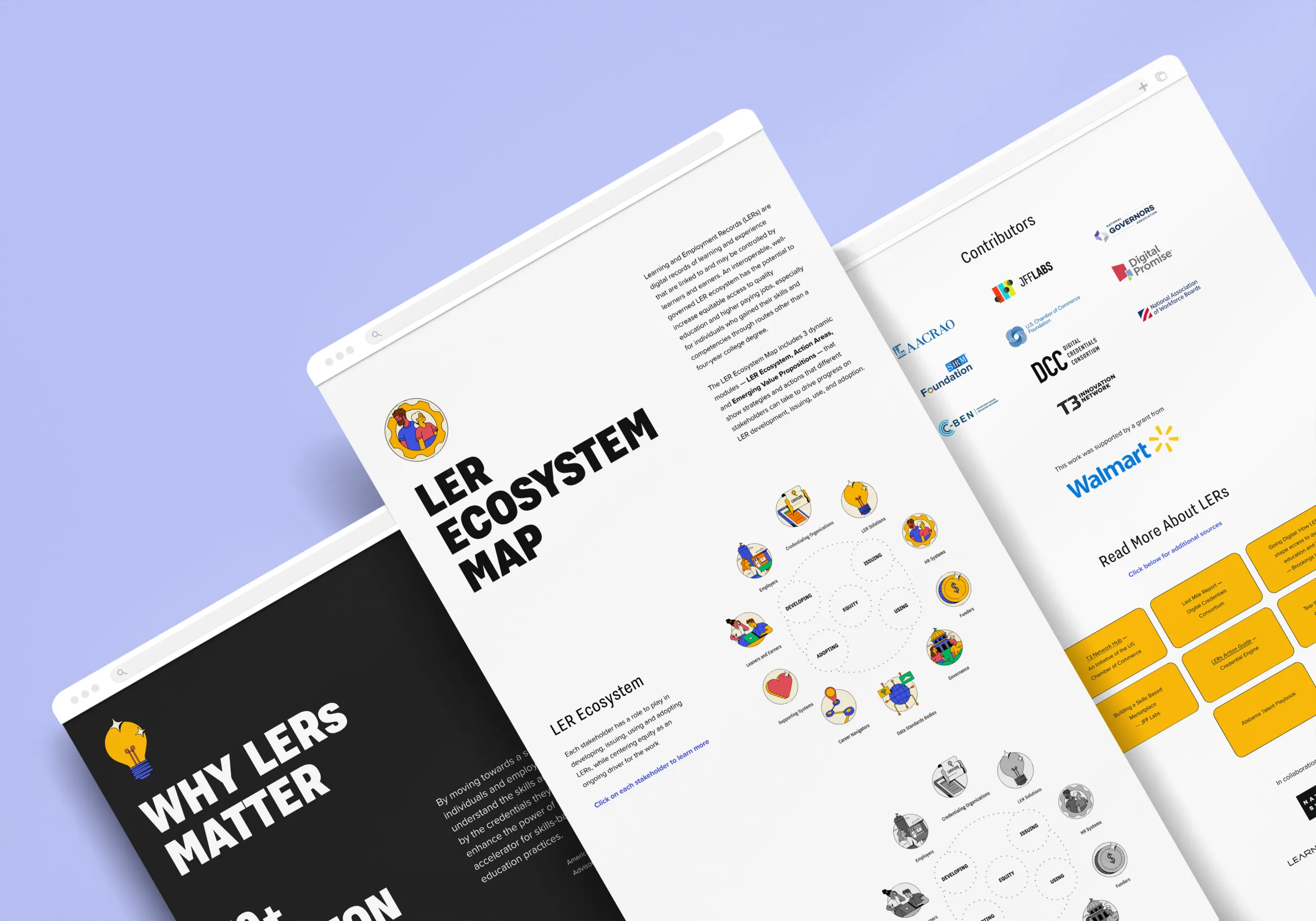
Mapping the LER Ecosystem to Drive Equity

Mapping the LER Ecosystem to Drive Equity

CASE STUDIES

Learning and employment records (LERs) are a vital solution to accelerating the uptake of skills-based hiring while empowering learners and earners to be recognized for their full set of skills from work, education, credentialing, service and life experiences. However, widespread use of LERs is often hindered by a lack of clarity and collaboration amongst the many necessary stakeholders, including employers, credential providers, learners and earners, and policy makers.

Therefore, Walmart brought NationSwell on to work with a Steering Committee of experts in the education, credentialing, equity and hiring space, to create an LER Ecosystem Map that would help people connect the dots across the ecosystem and more easily see how they can take action to drive equity through LERs.

Organizations in the LER Ecosystem Map Steering Committee:

  • AACRAO
  • Competency-Based Education Network
  • Digital Credentials Consortium
  • Digital Promise
  • JFFLabs
  • National Association of Workforce Boards
  • National Governors Association
  • SHRM Foundation
  • T3 Innovation Network
  • U.S. Chamber of Commerce Foundation

NationSwell worked closely with the Steering Committee to undertake thorough research to establish the goals and needs for the LER Ecosystem Map.

Through desk research, in-depth interviews, a diverse focus group, workshops, and months of cross-team collaboration, content drafting, design work and data visualization, our teams engaged 50+ individuals to help develop an interactive digital experience, accessible to stakeholders across the ecosystem, that clearly demonstrates opportunities for engagement, collaboration and action.

Through our three workstreams — establishing a hypothesis, research and development — the team discovered learnings, opportunities to drive adoption, and insights gaps that informed how the LER Ecosystem Map should come to life. The map launched at a pivotal point in LER development, providing many large and small players in the space with vital clarity on how to take action.
Share this report

How the Bush Foundation’s $100 million community trust funds are decolonizing philanthropy

How the Bush Foundation’s $100 million community trust funds are decolonizing philanthropy

Spurred by the global resurgence of the movement to demand bolder action against structural racism, the Bush Foundation designed an innovative approach to redistribute wealth to Black and Native American communities. Called community trust funds, the model disburses $100 million dollars through two steward organizations from these communities. Those steward organizations will use the trust funds to support educational attainment, home ownership, and entrepreneurial opportunities for individuals. The full report describes the Bush Foundation’s Community Trust Fund approach in five steps:

  • Issue a social impact bond to dramatically increase funding capacity.

By relying on debt financing to fund new grants, the foundation was able to urgently increase its support to the Native American and Black communities while still investing in other projects using their endowed assets.

  • Engage directly with community members to design a funding strategy.

The Bush Foundation structured a deep engagement process with 28 community members including leaders, elders, and experts on reparations and philanthropy. Their guidance helped the organization arrive at a community trust fund model for investing the $100M bond proceeds in Native American and Black individuals.

  • Invite expressions of interest from potential steward organizations.

The Bush Foundation cast a wide and inclusive net to invite interest from potential steward organizations. Their request for proposals focused on organizations’ capacity to credibly steward the funds and their demonstrated ability to engage deeply with community members in informing their work.

  • Select two steward organizations with guidance from community members.

The Bush Foundation recruited a representative community panel with understanding of the lived experiences and needs of the Black and Native American community to advise their selection process by interviewing finalist organizations. They helped identify NDN Collective and Nexus Community Partners as the two steward organizations for $50M community trust funds.

  • Provide initial funding and guidelines to steward organizations for their program design phase.

The Bush Foundation provided an up front $500,000 to each steward organization to support their work designing a grantmaking program for each community trust fund, as well as support around grant management, evaluation, and legal issues. The design phase funding is in addition to the $50M each steward organization will receive to seed their community trust fund.


Share this report

How Verizon engaged 89,000 employee volunteers in the middle of a global pandemic

How Verizon engaged 89,000 employee volunteers in the middle of a global pandemic

Between 2020 and 2021, Verizon mobilized 89,000 of its employees to volunteer over 1,000,000 hours, at an average of over 7 hours per employee. Far exceeding the industry average of 1.4 hours per employee per year and the average annual volunteer participation rate of 17%, Verizon’s success demonstrates how taking a human-centered and empathetic approach can tap into employees’ diverse motivations for Volunteering. This case study describes six elements of Citizen Verizon Volunteers that are critical to its success: 

  • Cascade volunteerism strategy from the organization’s broader societal purpose.

Verizon linked goals to the time and talents of its employees.

  • Develop a volunteerism-oriented RFP that’s empathetic and transparent toward applicants.

Verizon designed a partner selection process that mitigates legacy deficiencies.

  • Over-index to existing employee skills and organizational capabilities.

Verizon harnessed features intrinsic to the organization and its people.

  • Use metrics to elevate the strategic importance of volunteerism.

Verizon actively promoted the strategic value of volunteerism to the business, its employees, and the communities they serve.

  • Plan to tap diverse motivations among employees.

Verizon used a varied toolkit as opposed to relying on a single engagement lever to bring employees forward.

  • Make participation as easy as possible for employees and partners.

Verizon lifted barriers to entry for participants and created opportunities for engagement that were highly responsive to the current environment.


Share this report