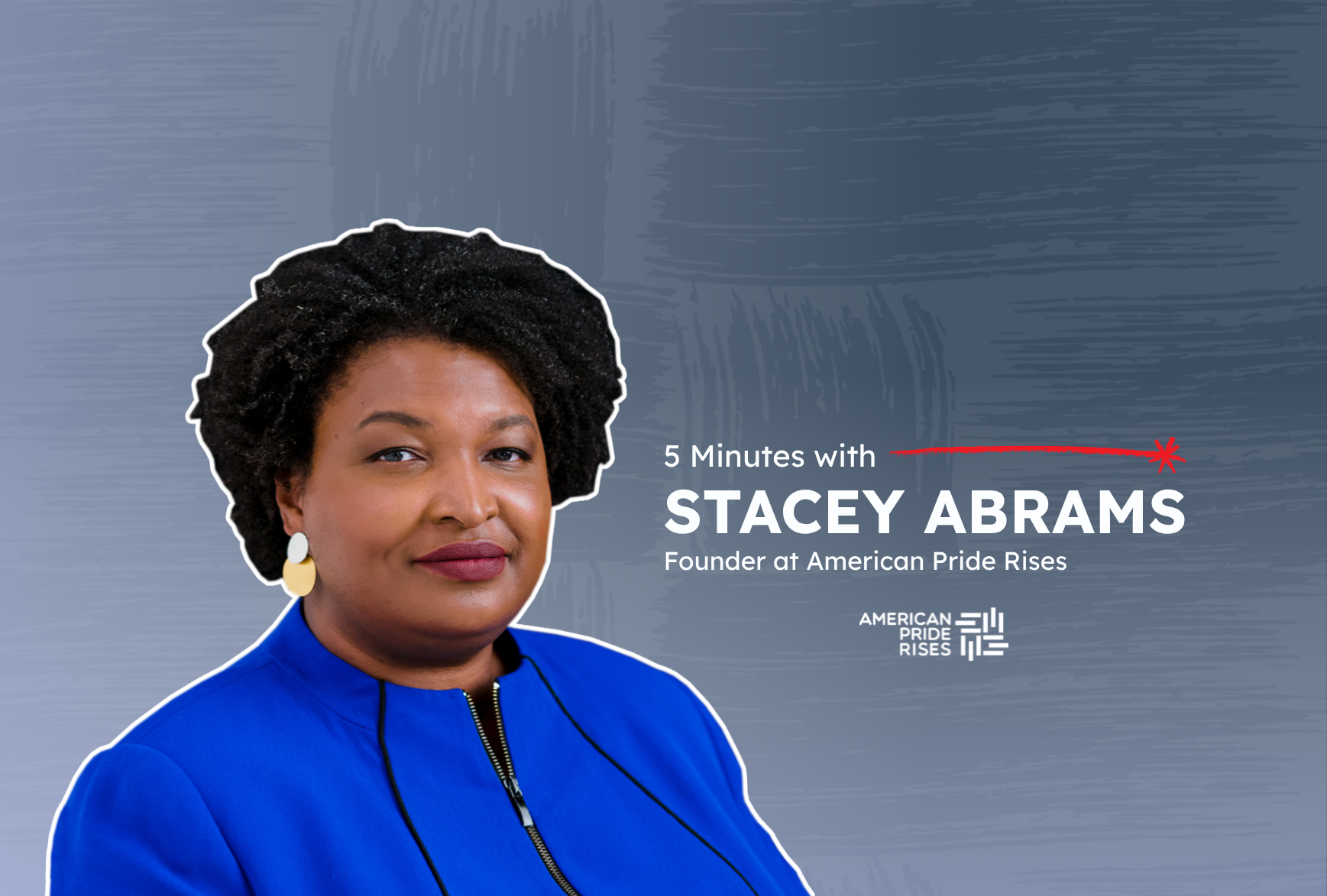
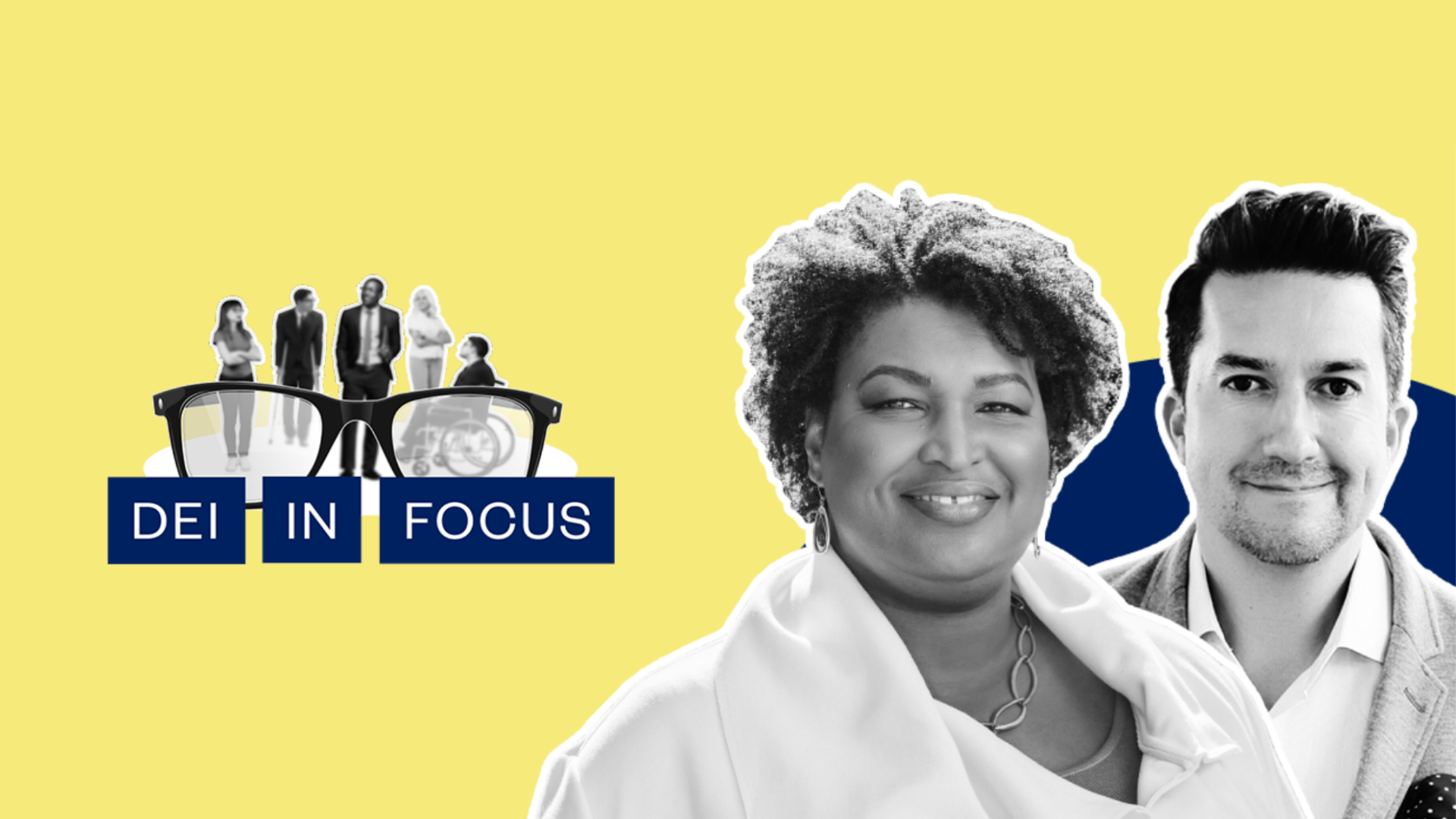
For years, Stacey Abrams has been one of America’s most recognizable champions for expanding access to the ballot box, to economic opportunity, and to the systems that shape who gets to thrive. A former Georgia House minority leader, two-time gubernatorial candidate, bestselling author, and founder of organizations including Fair Fight and American Pride Rises, Abrams has built a national profile by connecting the dots between structural inequities and the everyday lives they shape.
That same desire to expand access is what animates Close to Home: a new health equity initiative from American Pride Rises designed to help people better understand how wellness is shaped by policy, place, and the everyday pressures we all face. Alongside a public education campaign, the initiative also pairs storytelling and resource-sharing with a 2026 health equity microgrant program designed to surface community-driven solutions.
In this installment of Five Minutes With…, NationSwell asked Abrams to reflect on why health equity belongs in the same conversation as democracy and economic mobility; what makes such an initiative remarkable in a moment when even the language of equity is under attack; and what she hopes funders, business leaders, and civic institutions will do to bring this work close to their own homes.
NationSwell: In the simplest terms, what is “Close to Home,” and why did American Pride Rises want to make health equity one of its flagship fights right now?
Stacey Abrams, founder of American Pride Rises: American Pride Rises focuses on DEI in our everyday lives, and one of the most important and high impact places where DEI has been critical is in the healthcare space. The Close to Home campaign is focused on how we can best surface, understand, and invest in community-driven solutions that reflect the lived healthcare experiences of the most impacted communities.
Put more simply, the Close to Home campaign is a place to understand how health connects to our daily lives and to one another through the lens of DEI.
NationSwell: The name “Close to Home” is significant. What does that phrase mean to you, and how does it help people understand how inequity actually shows up in everyday life?
Abrams, APR: We know that health equity is a fairly misunderstood issue. It often feels like something that’s being done to you; as if your access to healthcare is shaped by Washington, D.C., that your access to a hospital is being changed by your state, or that your access to a fair chance at good health is being determined by your background or your zip code. What we want to do is say that it is close to home, it is your community, it is your family, but if the problems are there, so are the solutions.
At the same time, we also want folks to understand that these health outcomes, these challenges, are not personal: It’s close to home, but it’s not you. So many of us are made to believe that a poor health outcome is a personal failure, and Close to Home is designed to help us understand the gaps that exist in access, and between people and opportunities, and that the solutions are close to home.
NationSwell: Close to Home seems designed to do three things at once: public education, community-based microgrants, and policy advocacy. How do those pieces work together, and why was it important to build an initiative that operates across all three?
Abrams, APR: First and foremost, we have to understand the systemic failure that has led to the healthcare crisis. We’re talking about communities that face barriers to preventive care, higher rates of chronic illness, environmental hazards, and rising healthcare costs, and all of that can be traced back to what you know, who you know, how much things cost, and who’s in charge. That’s why we always say it comes back to education, economics, and elections.
On the education side, we are stronger when we understand what we’re facing. Too many Americans of all backgrounds are experiencing persistent health challenges because of gaps in access to care. And that’s part of the onus of DEI: understanding that diversity means all people, equity means fair access to opportunity, and inclusion means respect for belonging — especially when it comes to healthcare.
So the education piece is about making sure people know what they’re entitled to and understand the barriers they face. The microgrants are the economic piece. We know that, at scale, it’s going to take public policy to solve these problems — but close to home, we are already incubating and ideating solutions. One of the most important things we want to lift up is that wherever you live, you probably have a neighbor, a friend, or a community member who’s thinking about how to make life better and improve access to healthcare.
The intention of the microgrants is to invest in those ideas. Because of the attacks on DEI and the attacks on the Affordable Care Act, resources that could make us stronger are instead making us sicker, more divided, and more vulnerable. So the microgrants are really about investing in communities to surface extraordinary ideas, test those experiments, and then say: based on what we now know, let’s build systems that can scale them.
And that leads to the third piece: policy. It is a political decision to undermine public health infrastructure. It is a political decision to use executive orders to attack equity in healthcare. It is a policy decision to roll back protections for women’s bodily autonomy, and to undermine care for communities facing the AIDS and HIV epidemic.
These are policy decisions, and therefore it is our responsibility to advocate for the policies that can make us healthier, help unite us, and strengthen not only those most directly impacted, but the communities they’re part of. We all win, regardless of where we start, when we solve healthcare inequity.
NationSwell: What feels differentiated about the approach American Pride Rises is taking here, particularly in a moment when even the language of equity is under attack?
Abrams, APR: We begin with the belief that we have to understand what we face. And to your very first question about what “Close to Home” means, we know that the language we hear helps shape what we believe we’re entitled to. That’s why we’re focusing on the language of “Close to Home”: because we want people to understand that this is an everyday issue. It’s not remote. It’s about you, your loved ones, and your community. For us, it’s about helping people understand how the values of DEI improve health outcomes for all communities.
We’re talking about providers who are trained to deliver competent care based on your cultural needs. For example, we know that men can experience PSA levels differently in ways that affect whether prostate cancer is detected. That’s culturally competent care. And that doesn’t care about who you are; it cares about what biology tells us about your health needs. We know that women, especially women going through menopause, have very specific needs, and that policies should be designed around the people most impacted. We know that rural communities often have less access to healthcare simply because of geography.
So part of our intention is to use language that helps people understand that diversity isn’t a curse. It is one of the superpowers of our society, but it can only work if we understand how it can be used for us, or weaponized against us.
NationSwell: When you look at the communities this initiative is meant to serve, what do you see as the most overlooked drivers of health inequity — the forces upstream from the doctor’s office that too many leaders still treat as separate from “health”?
Abrams, APR: Well, let’s just start with the current administration’s decisions: We began with the slashing of federal funding for healthcare, and we saw this administration double healthcare premiums for 20 million Americans and kick 14 million people off their coverage in order to fund a permanent tax handout for the top 1%.
That has real consequences, because those are still people who are going to show up in our hospitals. They’re still going to show up in urgent care, but they’re not going to have the care they need. And there’s a cost to every American. We don’t often think about this, but when someone goes to the hospital and can’t afford care, the hospital absorbs that as uncompensated care and then passes those costs along to everyone else. One of the realities is that our affordability crisis is caused, in part, by our broken healthcare system.
You can’t afford to get what you need because when you do get support, you’re being charged more than you should. Number two: this administration also cut environmental justice investments. That may sound esoteric, until you realize what it actually means: they cut efforts to address the health burdens facing vulnerable communities, including communities living with high levels of pollution. When you roll back environmental protections, you create an environmental hazard that becomes a healthcare cost.
And then there’s something very close to me, and to where I live in Georgia: we have one of the worst maternal mortality rates in the nation. But this is not endemic to Georgia, and it’s not endemic to the South. When maternal mortality rises, it’s not just healthcare costs that go up, the economic costs to the entire community go up as well. There are real economic harms that come with persistent health challenges.
We are all made stronger when we have a public health infrastructure that goes beyond the medicine we’re given and extends into the communities we live in.
NationSwell: At a time when many institutions are retreating from equity language or narrowing their ambitions, what does it look like to make the case for health equity in a way that is both morally clear and broadly resonant?
Abrams, APR: I was having a conversation with someone earlier today who asked me, “Why do you talk about DEI and equity so brazenly?” And I said it comes down to two things. First, when we adapt our language, we change our minds. That’s not always a bad thing; sometimes we change our language because we’ve learned something new. New language can help us evolve our thinking, but that same dynamic can also be used against us.
So when it comes to the attacks on DEI, my question is always: Which letter don’t you agree with? Do you oppose diversity? Are you offended by equity? Are you afraid of inclusion? What part is problematic? Equity simply means fair access to opportunity. And in healthcare, equity means understanding that when one person is healthier — when a system is healthier — we all benefit.
That goes back to a fundamental recognition: too many of us have been trained to believe that broken healthcare is a personal failing, that our needs are simply the result of individual choices. But health is shaped by the places we call home. It’s shaped by the work we do. It’s shaped by the pressures we face. It’s shaped by what we can afford.
That’s why it’s so important to talk about health equity and to talk about DEI. Because when we internalize that language, we also internalize the power to know that things can be made better. The attacks on DEI are not happening because DEI has failed. They’re happening because DEI has been working — because Americans of all backgrounds were getting better access and a fairer shot at living healthy, thriving lives.
Those who oppose it demonized the language. So for me, it is a power move to keep using it, because when we own the language, we own the narrative. And the narrative should be that everyone in this country deserves a fair shot at living a healthy and thriving life, no matter where they are — but especially close to home.
NationSwell: You’ve spent so much of your career expanding access to power in democracy, in the economy, in public life. Why does health equity belong in that same conversation?
Abrams, APR: I grew up in southern Mississippi. I used to be on the debate team when I was young, and when we’d pass through Louisiana, we would drive through what was known as “Cancer Alley.” The fact that there was a nationally recognized name for an entire community defined by environmental harm was devastating. What it said was that, in pursuit of revenue, it was acceptable for industry to poison a whole community. And that community was predominantly Black and predominantly poor.
My family did not have health insurance. When we got sick, prayer was our best option — and then Tylenol. Those should not be the choices we have to make. My dad fell off scaffolding and broke his back in an on-the-job accident, but his employer refused to pay for it. So my parents had to figure out how to cover extraordinary medical bills while also fighting a legal system that ignored my father because of his race.
Now my parents are older, and they’re grappling with healthcare issues again. But the difference is: now they have health insurance, and now they have a daughter who knows who to call and has the ability to open doors. What I can do on an individual level for my parents today should be available to every person, for every member of their family, every day.
Equity is about fair access. I should not have more access simply because more people know my name. This comes close to home for me because I cannot believe in a democracy that is real if it does not include all people.
NationSwell: If you could leave corporate leaders, funders, and civic institutions with one challenge as they think about their own role in health equity, what would you want them to do differently? How could they start the work close to home?
Abrams, APR: A healthy workforce is the least expensive form of labor. At the most basic economic level, it is better for industry and better for companies to have a healthy workforce. People work faster, they work better, and they’re not stressed about the next accident or the next mistake. So at a very basic level, it’s in the interest of business leaders to want a healthcare system that works for all of us.
At the societal level, we know that DEI helps ensure the healthcare system reflects real communities — that we have providers trained to deliver culturally competent care, and that policies are designed around the people most impacted. When we invest in DEI and healthcare, we build systems that work better for everyone. When we solve healthcare problems for the most vulnerable or the most complex cases, there’s a follow-on benefit for everyone else.
And ultimately, in a democracy, business does better when people can afford to invest, afford to come to work, and afford to value your products. “Close to Home” is about connecting those dots and making sure we are building healthier, more equitable communities everywhere we go, and supporting the ideas that actually lift us up.
Companies already know from the data that when people do better, they are more productive, more engaged, and stronger community members. So at the individual, corporate, and societal level, health equity makes us all richer.