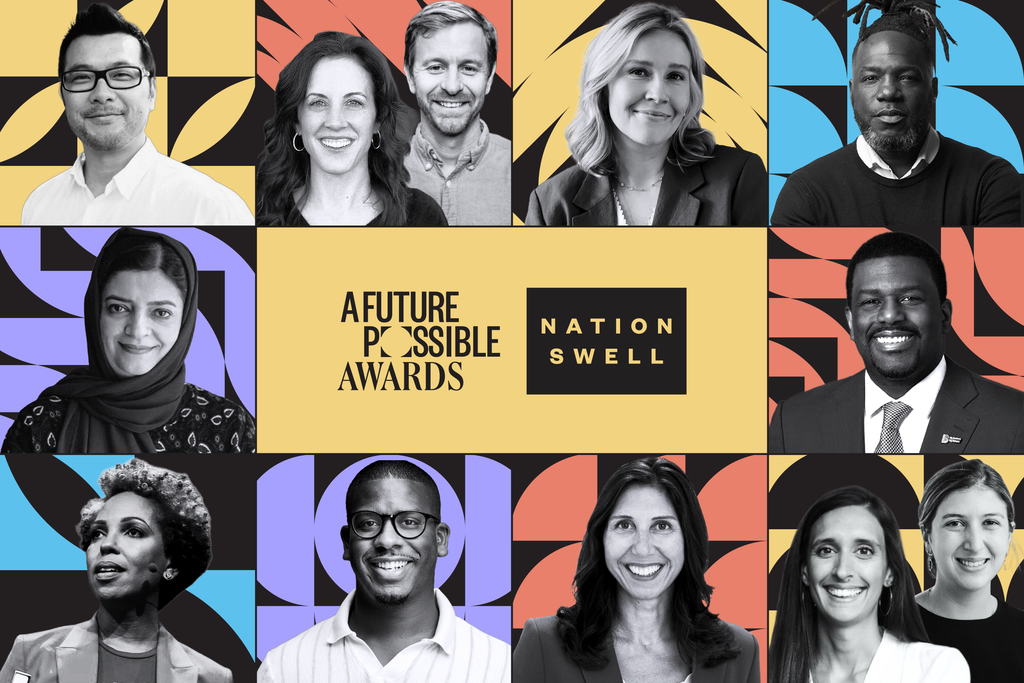
NationSwell Announces Inaugural ‘A Future Possible’ Awards

12 groundbreaking leaders recognized for the roles they play in making meaningful social impact

NationSwell today announced the inaugural A Future Possible Awards, recognizing twelve leaders whose vision, skill and commitment are driving breakthroughs in social impact.

A Future Possible Awards celebrate the roles that make lasting change possible: from the Catalyst to the Builder to the Sustainer. Rather than focus on a single initiative, NationSwell shines a light on the bold leadership, relationship building, organizational systems, and dedicated work required to move progress forward.

The inaugural class represents ten essential roles that leaders can play in creating change, from inventing new tools and building sustainable organizations to mobilizing communities, redesigning systems and changing how people understand the challenges they face.

“NationSwell created A Future Possible Awards to recognize something we don’t always see in traditional awards: the work behind the work,” said Amy Lee, Chief Strategy Officer and Managing Director, Studio, NationSwell. “The leaders we’re celebrating are not all solving problems in the same way. They’re bringing different strengths, approaches and forms of leadership to the challenges that matter most, and together they offer a powerful picture of what it takes to move change forward.”

The honorees were nominated and endorsed through a curated process informed by expert advisors and mentors with rich personal contributions to social impact. The expert advisors and mentors included luminaries from across the field, including Nobel Peace Prize Laureate Malala Yousafzai, international bestselling author Jonathan Haidt, and CEO of Echoing Green, Cheryl Dorsey.

“Creating a better future isn’t the work of a single leader executing a single campaign or initiative,” said Greg Behrman, Founder and CEO of NationSwell. “It takes visionaries and teams who invent, build, mobilize, connect, collaborate, redesign and tell new stories about what is possible. A Future Possible is our way of recognizing the people and organizations doing that work and making visible the different roles that allow progress to take hold.”

The 2026 honorees will be celebrated through a beautiful web experience that includes exclusive editorial content, plus ongoing social promotion and celebration on stage at the NationSwell Summit 2026 in Philadelphia, PA., the impact sector’s most engaging and inspiring gathering for cutting edge impact leaders.

The 2026 A Future Possible Honorees

THE INVENTOR deploys new tools and models — AI, science, technology and economic systems — in ways that open groundbreaking and powerful new paths forward.
Winner: Ken Ikeda, CEO, Community Arts Stabilization Trust (CAST)

THE SUSTAINER operationalizes progress by creating sustainable, efficient and effective teams and processes.
Winner: Artis Stevens, CEO, Big Brothers Big Sisters of America

THE ADVOCATE raises awareness and urgency around an issue, fearlessly activating the levers needed to drive change.
Winner: Zarqa Yaftali, Founder and Chairperson, Women and Children Research and Advocacy Network

THE CATALYST directs capital, influence or institutional power toward promising ideas and leaders that might otherwise be overlooked or undervalued.
Winners: Catherine Casey Nanda & Amon Anderson, Co-Founders and Managing Partners, Acumen America

THE INNOVATOR meets needs and creates new opportunities with fresh approaches that challenge the status quo.
Winners: Sarah Alexander & Olivia Rosenthal, Co-Founders and Co-CEOs, Patch Caregiving

THE BUILDER does the long, often unglamorous work of making meaningful change possible in a specific place or community.
Winner: Adair Mosley, CEO, GroundBreak Coalition

THE MOBILIZER grows a movement by shifting public will, activating new constituencies and channeling collective energy toward bold solutions.
Winner: Alexa Arnold, CEO & Cofounder, The TAG Movement

THE INTEGRATOR bridges sectors, ideologies or geographies to forge unlikely coalitions capable of addressing challenges in ambitious and durable ways.
Winner: Sixto Cancel, Founder and CEO, Think of Us

THE ARCHITECT redesigns systems, policies and conditions that keep problems entrenched, working at root causes rather than symptoms.
Winner: Jennifer Blatz, CEO, StriveTogether

THE STORYTELLER changes what is possible by changing how people understand and relate to a problem through journalism, documentary, fiction, visual art, music or cultural movements.
Winner: Vanessa Renae, Co-Founder and President, GirlTREK

Meet the Honorees: https://afp.nationswell.com/

Impact Next: An interview with Merck’s Allison Goldberg

At a time of rapid change and evolving community needs, who is advancing the vanguard of economic and social progress to bolster under-served communities? Whose work is fostering the inclusive growth that ensures every individual thrives? Who will set the ambitious standards that mobilize whole industries, challenging their peers to reach new altitudes of social impact? 

In 2026, Impact Next — an editorial flagship series from NationSwell — will spotlight the standard-bearing corporate social responsibility and impact leaders, entrepreneurs, experts, and philanthropists whose catalytic work has the potential to shape the landscape of progress amid urgent need for social and economic action.

For this installment, NationSwell interviewed Allison Goldberg — President of the Merck Foundation and Executive Director of Social Impact & Sustainability at Merck (known as MSD outside of the United States and Canada) — on the experiences that shaped her approach to leadership, the power of long-term partnership to expand access to health, and how corporate philanthropy can adapt without losing sight of its purpose.. Here’s what she had to say:


Greg Behrman, founder and CEO of NationSwell: What brought you to the field that you’re in right now? Was there an early moment, a relationship, or an experience that galvanized your commitment to driving bold action?

Allison Goldberg, president, the Merck Foundation: I grew up in Ohio’s Rust Belt, where the collapse of the steel industry upended families and communities. That experience shaped my purpose – to help ease suffering and take on hard problems.

As an undergraduate at the University of Michigan, I experienced an “aha” moment in a public health course that set me on the path I follow today. I realized that pursuing a PhD that combined my passion for political science with public health could be a framework for how to close inequities and improve lives. That path took me from consulting to academia to the private sector, where I worked at Anheuser-Busch InBev at the intersection of public policy and social impact. Along the way I learned that companies can be powerful forces for good. That’s what drew me to Merck — a company with a deep legacy of social responsibility and a real commitment to making a difference.

Behrman, NationSwell: What is the “North Star” of your leadership style? What is it about the way that you lead in the space that makes you an effective leader?

Goldberg, Merck: Early in my career, I thought leadership meant taking charge and seeking out every opportunity. At Merck, I have learned that some of the best leaders create space for others to lead. My role is to set direction and to support my team to bring forward their own leadership and ideas and to drive impact.

I like to ask people about their own goals and marry that with the potential they may not yet see in themselves. I believe in stretch assignments, shared decision-making, asking hard questions, and bringing different perspectives into the room. When people feel valued and heard, trust grows, and that’s when greater impact is made possible.

Behrman, NationSwell: When did you know you wanted to be a leader? Was it something you always aspired to, or did it emerge naturally as your career progressed?

Goldberg, Merck: Leadership was instilled in me early. Starting at age eight, I attended a peer-led summer camp rooted in leadership, strong values, and social action. I also grew up in a family deeply committed to service and showing up when it counted. The message was clear: if you want to create change, step in and do your part.

I am sending my sons to this same summer camp because I believe in the value of challenging young people to think critically, solve problems, and lead. This is what helps to build confidence, character, and a sense of purpose.

This shaped how I think about leadership today. The most complex challenges won’t change unless we all find a role in the solution.  Everyone on my team is a leader and real progress happens when each of us uses that leadership to drive change.

Behrman, NationSwell: Is there a particular program, signature initiative, or some facet of the work that you would like to spotlight for us that is driving outcomes for the work?

Goldberg, Merck: When I joined Merck’s Social Impact & Sustainability team, we asked a simple question: what is our North Star and how can we move toward it? Our answer was clear: unlocking sustainable access to health. 

Lasting progress takes more than innovation. It takes understanding the persistent barriers people face, building trust, and making partnerships. These insights shaped the way we invest, putting communities at the center.

A strong example is the Merck Foundation’s recent launch of the Community Collaborative for Reimagining HIV Care, a new national initiative designed to advance access to holistic, person-centered care for people living with HIV in underserved U.S. communities. This five-year, $20 million initiative will pair systems-level change with lasting community partnerships to help overcome barriers to care.

I am also incredibly proud of the Mectizan Donation Program. Almost 40 years ago, Merck made a commitment to donate Mectizan as much as needed, for as long as needed to eliminate river blindness. Today, this program reaches more than 300 million people each year across 64 countries and expanded to include the elimination of lymphatic filariasis.  Last year, we marked the delivery of the five-billionth treatment – a powerful reminder of what we can achieve when we work together towards a shared goal.

Behrman, NationSwell: I’d love to invite you to reflect on former Merck CEO Ken Frazier a little bit. He’s one of my heroes, and I know he’s had a massive impact on the company. What are some enduring lessons you learned from him as this CEO?

Goldberg, Merck: Our former and current CEOs have consistently reminded us to keep Merck’s purpose at the center, even as the world changes around us. Our purpose is to use leading edge science to save and improve lives around the world. The work we do through the company’s Social Impact & Sustainability team is fully aligned with this. 

CEO-led initiatives like the Mectizan Donation Program and Merck for Mothers are powerful examples of what happens when purpose guides action.  I tell my team that we must always lead with purpose. I am proud to work for a company where this principle is firmly embedded.

Behrman, NationSwell: Merck has a long history of pioneering programs and sustained commitments, but this is also an evolving field shaped by external forces. How do you stay rooted in the company’s purpose while helping yourself and your team remain adaptable?

Goldberg, Merck: Change is constant, and this moment is marked by especially rapid transition — from technological growth and economic pressure to more fragmented geopolitical and social environments. 

Yet moments like these can also spark creativity, resilience, collaboration, and the courage to rethink long-held assumptions. We have an opportunity to ask ourselves how we can adapt in ways that sustain and even expand our impact.

We begin by listening closely to our partners – understanding how they are being affected and what they need. In response, we are evolving the ways we invest so we can continue to make a meaningful difference.

We are also listening to our employees, who are making a difference in their local communities. We are helping them transform their passion and energy into action by offering meaningful opportunities to make a difference

In the end, adaptability begins with listening, and progress is proven by the actions that follow.

Behrman, NationSwell: Are there any resources you’d recommend — books, podcasts, Ted talks — that have influenced your thinking that might influence others as well?

Goldberg, Merck: One is Tom Frieden’s The Formula for Better Health. His central argument — that the greatest health gains come from changing systems so individuals can make healthier choices within them — reflects the way I think about community-led systems change.

Another is Dr. Frank Luntz’s Words That Work. Its premise is, “It’s not what you say, it’s what people hear.” In any effort to drive change, how we frame an idea can shape whether it resonates and inspires action.

Finally, Nelson Mandela’s Long Walk to Freedom remains a North Star. For those of us in global public health, it is a powerful reminder that determination is key to moving forward, even when progress is hard-won.

Impact Next: An interview with Best Buy’s Olivia Jefferson

At a moment of inequality and division, who is advancing the vanguard of economic and social progress to bolster under-served communities? Whose work is fostering the inclusive growth that ensures every individual thrives? Who will set the ambitious standards that mobilize whole industries, challenging their peers to reach new altitudes of social impact? 

In 2026, Impact Next — an editorial flagship series from NationSwell — will spotlight the standard-bearing corporate social responsibility and impact leaders, entrepreneurs, experts, and philanthropists whose catalytic work has the potential to shape the landscape of progress amid urgent need for social and economic action.

For this installment, NationSwell interviewed Olivia Jefferson — the Vice President of Social Impact at Best Buy and Executive Director of the Best Buy Foundation. Our conversation focused on creating skills-first pathways into tech-enabled careers for young people and what it takes for corporate leaders to move from presence to power. 

Here’s what she had to say:


Greg Behrman, founder and CEO, NationSwell: What brought you to the field that you’re in right now? Was there an early moment, a relationship, or an experience that galvanized your commitment to driving bold action?

Olivia Jefferson, Vice President of Social Impact at Best Buy: A year and a half ago, this wouldn’t have been my answer, but while preparing for the Best Buy Foundation’s annual Charity Classic, I worked with a speech coach. The process became almost like therapy: He asked about how I grew up and helped me recognize an experience I had never connected to my career.

On my fifth birthday, my birth mother was in a car accident that left her paralyzed from the neck down. Growing up, I watched her navigate systems that, particularly in the 1980s, were not designed for people with disabilities. When I was a college freshman, she told me she was applying for a Habitat for Humanity grant to build an accessible home, and I remember thinking, “This lady is something else — who does this?” Sure enough, she secured the grant, and Habitat built her a fully accessible home.

That was when I first understood the power of standing in the gap between resources and changing someone’s life. I didn’t yet know to call it philanthropy, but I knew I wanted to be part of it. For years, I saw that period only as a difficult part of my childhood; my speech coach helped me understand that it was also my introduction to this field — and that it had been guiding me throughout my career, even before I had the words for it.

Behrman, NationSwell: What is your approach to leadership or leadership philosophy? What makes you an effective leader in the space?

Jefferson, Best Buy: I was fortunate to see leadership done well very early in my career. At 22, fresh out of college and trying to break into public health, I was hired by Audrey Smith, general manager of the Detroit Department of Health and Wellness Promotion. She gave me the opportunity to lead two school-based health clinics, where I managed a physician, a nurse practitioner, and a health educator — all of whom were old enough to be my parents.

I quickly began to feel like an imposter, but Audrey pulled me into her office and said, “Don’t let your youth keep you from leaning into your potential. Draw on their wisdom, but recognize that you also have something to give.” She reminded me that my energy and excitement were exactly what the young people in those clinics needed to see in a professional who felt more like a peer.

Audrey gave me direct feedback without sugarcoating it, but it always came from a place of care and a desire to see me grow. She taught me that clear, critical feedback is something we give to people we believe in. Throughout my career, I’ve learned from strong women leaders and from people willing to challenge me; if everyone tells you you’re the best thing since sliced bread, you cannot see where you need to grow. My own leadership style is deeply empathetic: I listen, ask thoughtful questions, champion people, and seek to understand, but I also believe clarity helps us become better versions of ourselves. Those are the cornerstones of how I lead.

Behrman, NationSwell: Can you tell us a little about what you’re trying to do by bringing folks together? What are some of the things that are helping you to get traction?

Jefferson, Best Buy: At Best Buy social impact, we’ve partnered with America Achieves, which brings together government leaders focused on skills and creating good-paying jobs that offer real opportunity, not dead ends. That vision closely aligns with what we want for young people, and we joined in part to ensure r the voices of young people were represented.

Through our network of Best Buy Teen Tech Centers across four regions, we have direct relationships with young people and trusted local partners in those communities. We recently held an informal focus group about AI because so many people are telling us what young people think when in reality, we should really just be asking them. Hearing their fears, their excitement, and where they want organizations like ours to play a role has been incredibly valuable.

America Achieves also serves as a bipartisan, neutral convener, bringing government, business, and philanthropy together. Through the partnership, we’ve been able to engage organizations including JPMorgan Chase and Salesforce in conversations that might not otherwise have happened. The work is still in its early stages, but we see tremendous potential. Companies that may be competitors elsewhere are not competing here; this is a space where we need to work together.

Behrman, NationSwell: With all the dynamics at play as the backdrop for doing impact work right now, how are you sense-making this moment? How do you anchor and ground yourself amidst it all?

Jefferson, Best Buy: Something Tonya Allen said recently has stayed with me: “We need to act more like a constellation, and less like a North Star.” There is a role for everyone to play in shaping a world being transformed by AI and economic change, but we have to work in concert. We also have to accept some risk and be vulnerable enough to say, “This will be difficult, but we’re willing to step forward.”

At Best Buy, one part we can play is advocating for skills-first hiring. Young people are telling us they don’t necessarily see college as the right next step, and they aren’t convinced it will prepare them for jobs that are still being defined. If employers don’t begin valuing skills alongside credentials, we risk becoming irrelevant to the very people we will need as our future workforce.

What excites me is that Best Buy isn’t waiting for every answer before taking meaningful action. We’re willing to say, “We may not get it right every time, but we’re going to step forward now and invite others to join us.” Tonya’s language helped me see that more clearly: Do your part, do it well, and be willing to take a risk. That is how we begin linking the constellation.

Behrman, NationSwell: Is there a particular program, signature initiative, or some facet of the work that you would like to spotlight for us that is driving outcomes for the work?

Jefferson, Best Buy: Our Teen Tech Centers have built a strong foundation by giving young people access to technology, helping them develop skills, and listening to what they need, but what excites me now is the Best Buy Foundation’s commitment to create even more pathways to economic opportunity. Through hub networks in the Twin Cities, New York, Los Angeles, and Atlanta, we’re braiding together partnerships that can move young people beyond a physical tech center and toward tech-enabled careers.

Technology underpins nearly every industry. A young person may want to be a singer or songwriter, but they could also become an engineer in the music industry or work in technology for the Grammys and still be close to what they love. We want to help young people see those possibilities and gain real-world experience through internships and apprenticeships. Skills like critical thinking, defending an idea, and navigating disagreement are often learned in a first job, not a classroom. Our goal is to create a connected ecosystem that builds both skills and confidence so young people can chart their own paths from education to employment.

Another important part of the strategy is connecting Best Buy employees to this work. One way we’ve done that is through Geek Squad Academy. Best Buy employee volunteers  from across the company to teach young people coding, Photoshop, digital design, and other technical skills. We’ve also created a portable version called Geek Squad Academy in a Box that our stores can tailor to the needs of their own communities. Young people develop both technical and interpersonal skills, while employees engage directly in places where they live and work. It has been powerful to take something we already had, scale it differently, and help employees feel that their company truly understands what they care about.

Behrman, NationSwell: Are there any resources you’d recommend — books, podcasts, Ted talks — that have influenced your thinking that might influence others as well?

Jefferson, Best Buy: I recently heard Rashad Robinson discuss his book, From Presence to Power, and his central argument is that we often mistake presence for power. You can be highly visible — invited to speak everywhere and asked to comment on every issue — without actually moving the needle in a meaningful way. That distinction stayed with me.

Corporate spaces can sometimes feel lonely because companies often believe they have a great deal to lose by taking a clear position. At this moment, we see many people doing a lot of talking without a long record of impact behind their names or their work. I never want to be that person. I want to understand the power I have, wield it responsibly, help shape the narrative, and use it to create real change.

I admire Rashad’s willingness to be brutally honest about that distinction. It is also meaningful to see a Black author writing explicitly about power and strategy — an area where far too few Black voices have been elevated.

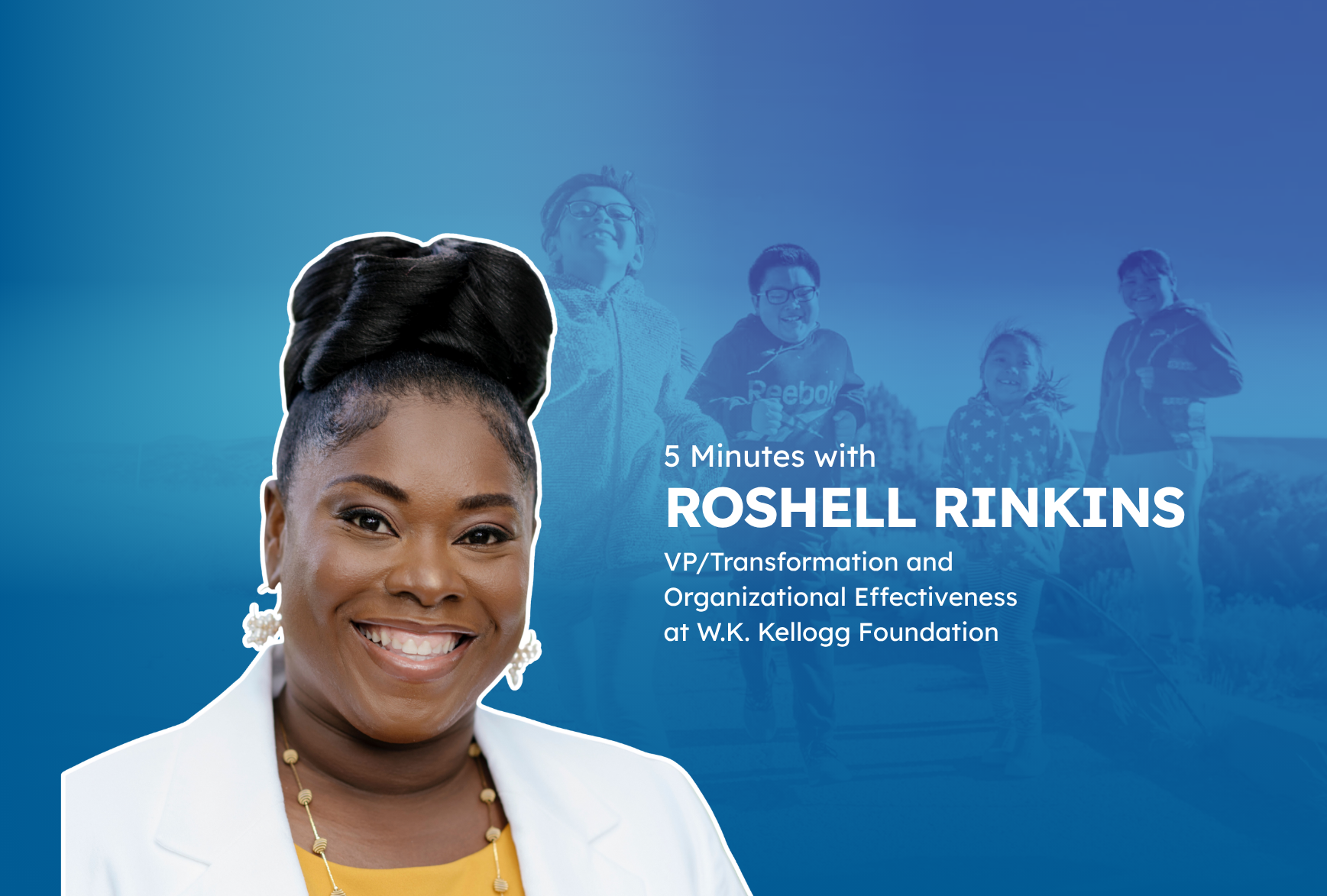
Five Minutes with… W.K. Kellogg Foundation’s Roshell Rinkins

Long before foundations and formal grantmaking institutions became synonymous with philanthropy, Black communities were building their own systems of care. Mutual aid networks, church-based giving, civic organizations, and families pooling their own resources together have helped communities meet their needs and pursue their dreams across generations. 

In celebration of Black Philanthropy Month this year, Roshell Rinkins — vice president for transformation and organizational effectiveness at the W.K. Kellogg Foundation — brought that expansive view to her moderation of a conversation on “Rewriting History: The Promise and Power of Narrative Equity” at the Martha’s Vineyard African American Film Festival. The discussion explored an idea with significant implications for philanthropy: The stories institutions tell about communities can shape whose expertise they value, which problems they see, and ultimately where resources flow.

NationSwell spoke with Rinkins about what the panel surfaced, the state of Black philanthropy, the relationship between narrative and systems change, and what it means to shift power toward communities themselves. 

Here’s what she said:


NationSwell: When we talk about “the state of Black philanthropy,” what are we actually referring to — traditions of giving? Institutional investment in Black communities? The influence Black philanthropic leaders have? Some combination of these? What tends to get overlooked in the way the field usually frames the conversation?

Roshell Rinkins, vice president for transformation and organizational effectiveness, WKKF: Our understanding of Black philanthropy has to include all of the above — and that breadth and depth is itself often overlooked. 

Black communities have long had to look beyond institutions to survive, meet our needs, advance our priorities, and have created traditions that help sustain us across shifting political landscapes. These include mutual aid, church-based giving, civic organizations, and families simply pooling resources and taking care of one another. I also think about the traditional practice of susu, or giving circles, which help communities flourish even without formalized support. All of these traditions have evolved with the times, as Black communities face new political challenges, new means of organizing, and new ways to expand their reach.

And so casting philanthropy as solely about institutional generosity — or implying that big-dollar giving is the only way to meaningfully improve lives — leaves out important context. And that’s at our own peril. Understanding the rich history of community care, and celebrating the grassroots traditions that inform and complement our current practices, can also help us navigate this political moment. I am so proud that one of the areas we support in our racial equity and community engagement grantmaking is around catalyzing community giving

Another important point, often overlooked, is that supporting Black philanthropy helps us address other systemic issues. Essentially, it’s the curb cut effect: The first curb ramps, which were introduced in California in the 1970s, were intended to support people with accessibility needs. But it turned out that not only wheelchair users benefited from curb cutting — people on crutches, pregnant mothers, parents pushing strollers, and pedestrians generally all enjoyed a better experience thanks to the curb cuts. We see the same effect today with closed captioning. Originally developed for people who are deaf or hard of hearing, captions are now widely used by people who simply have difficulty following dialogue, particularly as sound mixing in movies and television has changed. That’s how I think about Black philanthropy: By focusing on the issues affecting the Black community, you can create systems improvements that affect everyone.

NationSwell: Tell us a bit about the conversation you recently moderated on Martha’s Vineyard. What surfaced, and what changed or sharpened your own understanding of what Black philanthropy needs from the broader sector right now?

Rinkins, WKKF: During this year’s Black Philanthropy Week on Martha’s Vineyard, I moderated a discussion called “Rewriting History: The Promise and Power of Narrative Equity” at the 24th annual Martha’s Vineyard African American Film Festival. We had an incredible panel of speakers: the legendary actor Glynn Turman, producer and strategist Keisha Senter, and Brookings Senior Fellow Dr. Andre Perry. 

Glynn, who’s part of the cast of A Different World, and Keisha, who leads social impact at Jordan Peele’s Monkeypaw Productions, presented their work on the recent documentary High Horse: The Black Cowboy. The miniseries examines the Black contributions to Western culture, which have long been overlooked. For most of us, if we close our eyes and picture a cowboy, the image that comes to mind is that of a white, cisgender man—when in reality, one in four cowboys were Black. The film broadens the aperture and expands our minds, with Glynn, a rancher and rodeo cowboy, speaking from his lived experience. 

Stories like this — narratives of joy and adventure — aren’t the stories we usually hear about Black communities. And for me, the conversation reinforced that philanthropy can’t treat narrative as tangential to systems change — a kind of PR exercise that comes after the so-called real work. Philanthropy can help us change what we can see, and the stories we tell shape the future we can imagine. 

NationSwell: How do the stories philanthropy tells us about Black communities influence what gets funded? How does narrative in general continue to shape whose expertise is valued and which forms of progress are considered possible?

Rinkins, WKKF: Long before funding decisions are made, familiar stories about communities inform our interactions with them. If the dominant narrative focuses on deficiency—poverty, violence, educational gaps, poor health outcomes—then philanthropy can easily design its response around fixing people rather than addressing the systems around them.

But when we engage with narratives of Black success and joy, we create a more complete picture, one that highlights our communities as stewards of knowledge and creators of solutions. It’s the difference between raising the floor and raising the ceiling and broadening our horizon of the possible. I’ve seen how narrative transformation can reshape institutions, expanding our understanding of what kinds of people and communities are valuable, investable, and capable of creating sustained change. 

A key part of that is also challenging the stories we tell when Black philanthropy falls short, or doesn’t immediately produce transformation. Failures are analyzed in dozens of post-mortems, but successes are rarely awarded similar scrutiny. This can spark a cycle of negativity and fear: People say, “We did that once and it didn’t work as well as we hoped, so we can’t do it again.” That shapes the funding future efforts receive. We see it in the numbers. Black-led nonprofits are less likely to receive foundation funding, and when they do, they are more likely to receive funding that is restricted rather than flexible. That matters because flexibility gives organizations the ability to respond to what their communities need, invest in their infrastructure, and sustain the work over time.

The successes happening in Black philanthropic spaces deserve far more attention, both to celebrate the great work so many folks are doing, and to inform future grantmaking. 

NationSwell: WKKF emphasizes community leadership and the importance of people closest to inequity shaping solutions. Where do you still see a gap between that principle and how philanthropy actually distributes money and decision-making power?

Rinkins, WKKF: Philanthropy has certainly come a long way in embracing community voice and community leadership. The turn towards trust-based philanthropy, with its focus on openness and mutual accountability, is particularly indicative of the field going in the right direction.

I worked at Procter & Gamble and Apple, so I come from very consumer-driven industries. Those businesses don’t stay in business unless the consumer is happy. And I think “Big-P” Philanthropy sometimes loses sight of the fact that our position isn’t entirely different: We don’t have a business without our grantee partners. They are the reason we exist.

That’s why I love the Kellogg Foundation’s approach, which holds that those closest to the problem are best equipped to solve it. It dates back to our founder, Will Keith Kellogg, who sought to provide communities with “practical assistance in solving their own problems,” as one of our earliest foundation reports put it. 

Empowering people to address the issues closest to home requires collaboration, trust, and respect, and we take every opportunity to reduce the power imbalances that can exist in our field. For example, as we plan investments with our grantees, we ask them which KPIs they think will matter, rather than imposing our own. Yes, we have a board, and yes, there are metrics we need to collect from a governance perspective, but it’s important to acknowledge that grantees are on the ground, they’re the experts, and their knowledge drives the work. 

There’s also the fact that over 90% of our grantmaking is done in 60 business days or less, which is another way we build trust with our grant seekers and respect the urgency of their efforts. That timeline is a top-down commitment, and we monitor ourselves against it — a weekly dashboard is shared across the organization, including with our CEO, La June Montgomery Tabron. This timeline is critically important to us, because a “yes” that arrives nine months or a year after the ask may very well come too late: organizations shutter, people move on. 

NationSwell: WKKF oversees both racial equity grantmaking and organizational transformation, which means you have a unique insight into how external commitments intersect with internal practice. What systems or habits should philanthropic institutions examine if they want equity to shape how decisions are made, vs. simply what they say or fund?

Rinkins, WKKF: At the Kellogg Foundation, I sit at a very interesting intersection, because few roles in philanthropy that bring operations and programs together as much as mine does. I manage the operational side, with grants and contracts and org effectiveness, and I also have the racial equity and community engagement side, too.

This role has taught me that you can’t separate external strategy from internal practice, because an organization can have a strong public commitment to equity and still operate through systems steeped in hierarchy that hamper collaboration. 


One example of an investment we’ve made to ensure our operations reflect our values is creating our Concierge Desk. It’s an omnichannel service designed to meet grantseekers and grantees where they are, whether by phone, email, or other forms of direct support. And importantly, we still maintain a public phone number where someone can speak directly with a live person—which is increasingly rare today.

We track the concierge desk’s performance and are always exploring new ways to help people access the information they need, whether they’re existing grantees or grant seekers. And that’s notable, as many foundations only hear the voices of those they’ve funded. But we want to create a transparent and accessible experience for everyone we touch, whether or not we end up working with them.

We also held a convening for our Racial Equity and Community Engagement team this spring, and one of the things that was really important to me and our team was making sure we included grantee voices. So we created a grantee advisory council, and we’re used this community to help co-create the grantee convening experience. What emerged went beyond a traditional advisory body. It existed as a strategy for impact and a model for how insight sharing, when practiced with intention, can accelerate strategy, build a culture that deepens reciprocal trust and through amplification can elevate learning across an organization and its partners.

NationSwell: What is one lesson from this conversation on Martha’s Vineyard that you hope fellow philanthropic leaders will carry into their own work, and what would acting on it look like in practice?

Rinkins, WKKF: As we closed the conversation in Martha’s Vineyard, I told the audience that we tell stories because they help identify what has hurt our communities and what needs to change. But both harms and solutions look very different depending on your vantage point — and transformation is only possible when we take a 360-degree perspective. 

One illustration of this broader point of view came through the work of Dr. Andre Perry, who was among the panelists that day, and who’s also a Kellogg Foundation grantee partner. He’s producing the upcoming documentary The Most Equal Place in America. It’s about Paulding County, Georgia, where the quality-of-life gap between Black and white people is smaller than almost anywhere else in the nation. 

This asset-first framing is so often left out of conversations about marginalized communities. We usually talk about underrepresented groups as lagging behind, but the film instead spotlights a community that’s proving that equity is attainable, even given all of the challenges our nation currently faces. 

That’s the lesson I’ll carry forward: Your story and your strategy are one and the same. Sharing the “who” and the “why” behind the “what” and the “how” is how we prove that better worlds are possible. 

Acting on that lesson requires investment — funding Black storytellers and Black-owned media, and supporting the platforms, researchers, and archives that help stories reach audiences. And it also requires us to examine the stories embedded in existing grantmaking strategies. Imagine the opportunities we can unlock if we shift our perspective toward communities’ strengths rather than their deficits. 

Five Minutes with… New York Life Foundation’s Heather Nesle

Although grief touches nearly every family at some point, the systems people rely on most — schools, workplaces, healthcare settings — often remain unprepared to offer meaningful support. This year, the New York Life Foundation is hitting a major milestone in its effort to change that: $100 million invested in bereavement support since it began funding the field nearly two decades ago.

The Foundation’s 2025 State of Grief Report zeroes in on three places where support gaps run deepest: the youngest grievers under age five, who are often the most overlooked; schools, where most parents want grief education and better systems for identifying bereaved students; and workplaces, where two in three employees say they’ve experienced the death of a loved one while on the job. Taken together, the findings are clear: people want grief acknowledged and supported, not sidestepped, and most institutions still don’t know how.

For this installment of Five Minutes With…, NationSwell spoke with Heather Nesle, President of the New York Life Foundation, about the $100 million milestone, what the report reveals, and where the Foundation’s work goes next.


NationSwell: Congratulations on New York Life Foundation reaching $100 million invested in bereavement support. What does that milestone mean to you? What story does it tell about the role philanthropy can play in building a more grief-literate society?

Heather Nesle, President, New York Life Foundation: I think $100 million is very significant in the history of our foundation. Since we started in 1979, we’ve given roughly half a billion dollars total, so 20% of that in just the last 17 to 18 years, all focused on this one issue.

We started with a few grants for camps and bereavement centers. But once we understood the depth of the need, it became clear this was a place where we could really have an impact — the kind of niche every funder hopes to find.

Early on, we realized we couldn’t even answer a basic question: How many children are actually affected? Grief is universal, yet in the U.S. it’s swept under the rug; there’s a stigma around even bringing it up. So we helped fund the Childhood Bereavement Estimation Model out of Judi’s House, which let bereavement organizations back up their work with real numbers instead of just stories. Today we know 1 in 11 children will lose a parent or sibling before age 18 in the U.S., and that’s an undercount of the pervasiveness of grief, since it doesn’t include grandparents, friends or other significant relationships. Nearly every grant application we receive now cites that statistic.

We’ve also focused on schools. Over a decade ago, our survey with the American Federation of Teachers found that roughly 93% of teachers had a grieving student in their classroom, but only 7% had ever received training on how to help. So, we built the Coalition to Support Grieving Students and launched our own Grief-Sensitive Schools Initiative, training our employees and agents to run presentations about bereavement resources at local schools, each of which gets a $500 grant and joins a support network now nearly 8,000 strong. When we redid the survey years later, teacher training had risen to 15% — still lower than we’d like, but marking real progress.

This work is deeply mission-driven for us. Our company’s mission is financial security and peace of mind, and this is the peace-of-mind half of that, because our agents and claims staff are often among the first people bereaved families talk to. It’s genuinely a labor of love: our Grief-Sensitive Schools program is our most popular volunteer effort, with over 3,600 agents and employees trained to lead it. As a corporate funder, it’s rare to find an issue that resonates so deeply that you never have to convince your people to engage — and this work makes us better as an organization, too.

NationSwell: The latest State of Grief report does a good job highlighting that while grief is universal, support for grief is still pretty uneven. Where do you see the biggest gaps right now, especially for children, families, schools, and workplaces?

Nesle, New York Life Foundation: I think one of the biggest gaps — and it’s not just about schools, though schools play a big part — is identifying bereaved youth. Right now, there’s no real way to know where a grieving child is or who they’ve lost.

In our State of Grief Report, we’ve asked about this the past few years, and parents are clear: 83% believe grief education has a place in school, and around 75% believe a death in the family should be documented on a child’s school record. We can train teachers and administrators all we want, but if they don’t know which children are grieving, it’s much harder to help. We see the effects of this: children acting out because of a loss and being treated punitively because no one at school knows what’s actually going on.

Identification also matters because of the benefits many of these children are owed. Most children in the U.S. who lose a parent or guardian qualify for Social Security survivor benefits, but less than half actually receive them, largely due to lack of awareness. Schools, as the hub of social support for most families, could play a huge role here: if they could identify and understand what a child is going through, they’d be positioned to offer real support, not just academically. 

Government has a major role to play as well. We’re already seeing what’s possible through our partnership with the Children’s Collaborative, where we worked with state agencies in Utah to match death records with school enrollment data. That work has surfaced more than 3,000 children so far who are eligible for support but have never been identified by any system. That’s a proof of concept for what proactive, government-enabled identification can look like at scale. 

So that’s an issue very much on our radar, and one we’re working on from multiple angles.

NationSwell: The latest report spends meaningful time on very young children. Why was it important to focus on the youngest grievers, and what do adults often get wrong about how young children experience loss?

Nesle, New York Life Foundation: We want to focus on everybody, not just children — our interest is in supporting all people as they grieve. That said, we’re putting particular attention on the youngest grievers right now, because very few people pay attention to that cohort. There’s a general belief that if you’re very young, you don’t really understand these concepts, so you’re not affected in the same way. But we like to say: if you’re old enough to love, you’re old enough to grieve. Young children need attention, too.

Our findings back that up. Nearly 90% of people wanted more resources to help them talk to young children about grief. Most parents and caregivers want to do the right thing, but often aren’t sure what that is, so they end up doing nothing, which is actually the wrong approach.

We’ve worked with several partners to address this age group appropriately, Sesame Street being one great example. While a three-year-old can’t have the same conversation as a 12-year-old, that doesn’t mean they aren’t feeling things or don’t need ways to express themselves. We’ve also worked with children’s museums across the country to find the right ways, often through play, to engage the youngest grievers.

NationSwell: So much of this work seems to come down to helping people know what to do in moments when they might otherwise freeze, avoid the topic, or say nothing. What have you learned about what actually helps people show up well for someone who is grieving?

Nesle, New York Life Foundation: A few things stick with me from conversations with many colleagues and bereavement experts over the years.

Saying nothing is the worst thing you can do. People, children and adults alike, need to feel supported and safe, and able to communicate in whatever way feels comfortable to them. Even something as simple as “I’m here for you, talk to me” can be enough.

Our most popular resource is a tip card on what to say and what not to say. People worry a lot about saying the wrong thing. Those tips help, but I’d also say there isn’t really a wrong thing to say. Someone might take it the wrong way, but I think it comes down to intent. If you’re authentic, honest, and willing to listen on the other person’s terms, that’s the best thing you can do.

We also tell people not to put the burden on the grieving person. Instead of asking “What can I do for you?”, be specific: “Can I bring you dinner tonight?” or “Can I help with your laundry?” That way it’s not one more thing they have to figure out.

But beyond the ideal conversations and tips, I think it’s really about showing up and checking in, not just the first week or month, but three months in, six months in. People often respond right away and then disappear. Grief doesn’t follow a linear timetable, especially when you lose someone close, and the first year can get harder, not easier, as it goes on. Just letting someone know you’re still thinking of them can be enough.

NationSwell: How has having proprietary data benefitted the initiative holistically?

Nesle, New York Life Foundation: Data is so important. Many funders, governments included, won’t grant money to an organization unless there’s data to back up its claims. Storytelling can bring out emotion and help convey what you’re trying to say, but hard data can do the same thing.

I don’t like comparing one cause to another, but when you look at the fact that 1 in 11 children in the U.S. will lose a parent or sibling before age 18, that prevalence rate is far higher than many other issues receiving attention. Having that contrast, that benchmark against other causes, helps push this to the forefront as something that needs to be addressed. And that 1-in-11 figure is a national average. Some states are at 1 in 7, and some cities are even higher. Being able to point to real numbers like that, to show this is a genuine issue area, gets people’s attention.

Data also matters for us in benchmarking our own impact. We want to understand where we’re starting from and where we want to get to. With the American Federation of Teachers survey, starting from such a low percentage was tough to see, but it also motivated us to find real interventions, ones that would actually move that number and have a measurable effect. The work is cut out for you, but at least you know where you stand.

NationSwell: New York Life Foundation has invested in a wide ecosystem of grief supports, from schools and employers to public awareness campaigns and partnerships with organizations like Sesame Workshop, Judi’s House, and the National Alliance for Children’s Grief. How do you think about knitting those efforts together so they add up to something bigger than a set of individual programs?

Nesle, New York Life Foundation: We’re focused on the ecosystem. Schools were a good example: we found the gap and tackled it from multiple angles. Our workplace grief initiative follows the same model. School makes sense for children since that’s where they spend most of their time; for adults, it’s the workplace.

So we built a free, voluntary program for companies, starting with training, but expanding to policy templates, manager guidance and resources for HR teams. The first goal is just getting companies to acknowledge that grief affects productivity, emotional health, and culture. From there, we want them to build that acknowledgment into how their support model is structured — not just a one-time training, but policies and practices that reflect the reality of how grief actually works.

We’re taking the same approach elsewhere: a healthcare initiative with Yale training frontline workers on how to talk about death, deeper school partnerships through the PTA, and work with children’s museums, another place parents learn how to support their kids. We want to meet people where they are and raise awareness.

One way I explain this: I recently spoke at SHRM, a major HR conference, and asked the room how many had gotten married while working. Most hands went up, and I reminded them how colleagues threw showers, asked about the honeymoon, remembered anniversaries. Then I asked who’d had kids while working. Same story: gifts, excitement, people still asking years later.

Then I asked them to think about losing someone while working. People give condolences at first, maybe come to the funeral. But very quickly, no one asks about it anymore. Few check in on the anniversary of a loss, or know you’re buried in probate paperwork months later.

The point is simple: having a child changes your life and how you show up at work, and so does losing someone close to you. Yet the workplace does almost nothing to acknowledge it. It doesn’t take much: a word, a note, a casserole. In our workplace research, we hear it constantly: people who felt supported at work say they’ll never leave; people who didn’t say they couldn’t imagine staying.

That’s the goal: look at the whole ecosystem, fill the gaps, and get more people thinking about how to be more sensitive to this.

NationSwell: For other social impact leaders who may see grief as important but hard to act on, what would you say is the first step? Where can institutions begin?

Nesle, New York Life Foundation: There’s been a lot of talk about mental health, wellness, and culture in companies, and this is a huge part of that. All these moments in the life cycle matter. We talk a lot about bringing your whole self to work: that can’t just mean the fun parts, it has to mean all of it.

On the flip side, talking about death and about those we’ve lost doesn’t have to be sad. Grief is love, and that means you likely have great memories of the people you’ve lost. They’re still with you in many ways, still motivating you. About a decade ago, we ran the Shared Grief Project, asking athletes and other prominent people who’d lost parents young about how it affected them. Almost all talked about how it built resilience, how that adversity fueled them and made them better at what they do. None of them would have chosen it, but they found strength and resiliency.

This November, to mark the $100 million milestone, we’re launching an initiative we’re excited about, centered on hope and positivity, the brightness that comes from talking about the people we’ve loved and doing it in community. I always tell people considering an investment in this space: spend a night at a bereavement camp with kids. People assume it’ll be sad. It’s the opposite. It’s camp, it’s fun, and these kids relax because they realize they’re not the only one carrying this. For a weekend, that burden is shared, and they can just enjoy being together. There are tears, yes, but it can also be joyous: celebrating those people and everything you carry forward from them.

Launching in mid-November, our new initiative, the Golden Sweater Project, will be about raising a national conversation and bringing out positivity where society typically limits us to sadness. We want to bring in everyday people and public figures alike to show the humanity in grief. It affects all of us. Nobody’s immune.

Impact Next: Schultz Family Foundation’s Rajiv Chandrasekaran

At a moment of inequality and division, who is advancing the vanguard of economic and social progress to bolster under-served communities? Whose work is fostering the inclusive growth that ensures every individual thrives? Who will set the ambitious standards that mobilize whole industries, challenging their peers to reach new altitudes of social impact? 

In 2026, Impact Next — an editorial flagship series from NationSwell — will spotlight the standard-bearing corporate social responsibility and impact leaders, entrepreneurs, experts, and philanthropists whose catalytic work has the potential to shape the landscape of progress amid urgent need for social and economic action.

For this installment, NationSwell interviewed Rajiv Chandrasekaran, Managing Director of The Schultz Family Foundation. Here’s what he had to say:


NationSwell: Where would you situate Schultz Family Foundation in terms of strategy and influence in the broader realm of social impact?

Rajiv Chandrasekaran, Schultz Family Foundation: We bring a real focus on America’s next generation and helping them build better lives of purpose and prosperity, and we do that in ways that go beyond passive grant writing. We believe in multi-sector solutions, forging partnerships among funders, and co-creating with many of our grantees. 

We’re ultimately looking for catalytic opportunities. If initiatives can’t achieve scaled, sustainable impact, they’re much less appealing to us. Take the Youth Mental Health Corps: We’ve long had a real belief in the power of civilian national service. When COVID rolled around, we developed a response corps in Washington state, building on the infrastructure of the federal AmeriCorps program, that deployed young people throughout the food network, helping move millions of pounds of food during a critical moment. Then we kept innovating. Instead of leaving corps members to figure out their post-service life on their own, we provided support to help them move into jobs, education or continued service.   

A couple of years later, our co-founder, Sheri Schultz, asked our team if there was a way national service would help address the youth mental health crisis in America. 

Thus was born the Youth Mental Health Corps. We developed it in partnership with Pinterest, and we have implemented it in partnership with states. The Corps trains and places young adults as near-peer mental health navigators in schools and community organizations. Communities gain additional capacity to serve more youth, while Corps members build pathways into behavioral health careers, helping address a national workforce shortage.

Today, the Youth Mental Health Corps is deployed — or in the process of deploying — in 27 states, Republican and Democratic, and its more than 1,000 members have reached nearly 100,000 young people and community members through their service. It draws on federal AmeriCorps dollars, philanthropic and private-sector support, and state-level support.

The design is intentionally based on an apprenticeship model: Young people gain experience while earning credentials, enabling them to move into professions with a clear mobility pathway. The result is a Corps made up of young people from a wide range of economic and educational backgrounds, from high school graduates to college students and recent graduates.

That, to me, is the classic Schultz approach: taking something that’s been out there, thinking through it in different ways and bringing in partners to create impact at scale and putting it on a pathway to sustainability.

NationSwell: Youth Mental Health Corps draws on a mix of federal, state, and philanthropic dollars. Are there other examples where the Schultz Family Foundation helped prove a model that public funding then took to scale?

Chandrasekaran, Schultz Family Foundation: Yes, let me throw one other example into the mix: diversion. In 2019, we saw some early data from Seattle that suggested that it was possible to “divert” someone from the homeless system by providing resources to resolve their immediate housing crisis. Building on that early evidence, we began working with partners in smaller communities across Washington to identify young people at the moment they were at risk and intervene before they ever entered the homelessness system.

From the beginning, our partners worked alongside the state, using public dollars to test the approach in communities across Washington. As the evidence grew, so did the state’s investment. What began as a small set of pilots has now expanded with public funding to reach young people in nearly every county in Washington. And the results are compelling: 87% of young people remain stably housed a year later, at an average cost of about $1,700 per household, roughly 80% less than the cost of emergency shelter.

Now, the model is being used in a range of communities across the country with similar results. The genius of it is that it provides cash assistance through trusted community intermediaries. 

There’s a military concept called “left of boom.” Can you get there before the explosion? How do we find those leverage points that are far more economical and impactful? Then how do we work with partners to scale it and show the ROI so it becomes a good use of public dollars?

That’s a throughline across our work, including our support for post-9/11 veterans. We believe philanthropic capital has a critical role to play as R&D funding for big social problems. It gives us the ability to test new approaches, learn what works and what doesn’t, and build evidence around the ideas that show promise. 

Some of those ideas won’t work. We don’t spend a lot of time talking about everything we’ve invested in that never got altitude, but that is part of R&D. When something does work, our job is to prove the model, assess the ROI, and bring on partners who can help take it to scale. 

NationSwell: What inspired Where You Work Matters, and how does it help workers find jobs that offer real opportunities for advancement?

Chandrasekaran, Schultz Family Foundation: This goes back about 10 years, when Howard and Sheri, through the Schultz Family Foundation, partnered with Starbucks, other large companies, and foundations to host hiring fairs for opportunity youth: young people between 16 and 24 who were not in school or working. Thousands would come, and hundreds would get job offers in one day.

But along the way, Sheri asked an important question: How are these young people doing?

With the Burning Glass, we studied what happened to young people’s careers among participating employers. About half were seeing some mobility, moving on from their first job. But half were still churning in entry-level jobs, often for something like seven years.

So we asked: Why do some move up and some don’t? A growing body of research showed that, for many low- and mid-skilled jobs, it may have less to do with someone’s work ethic or intelligence and much more to do with their employer’s practices. Does the employer see that people in entry-level jobs can move up with the right training and pathways? Or is everybody expendable?

We wondered which companies were doing this well and discovered nobody had really assessed it objectively. So, we set out to do just that with the Burning Glass Institute. It became the American Opportunity Index, now called Where You Work Matters. This year, we assessed 12 million workers across 1,750 major U.S. employers, with data on 55,000 unique occupations within those employers.

We’re assessing actual jobs, because not every job at Google, Apple, or Microsoft is a great job. And employers that aren’t the coolest on the block may have great jobs where people can get ahead.

My favorite mental image is two clothing stores in a shopping mall. In both, people are folding shirts and talking to customers. But someone at one store may have twice the chance of getting promoted and three times the likelihood of staying for three-plus years. The difference isn’t because of the job — it’s because of an employer’s practices. As a job seeker, this hasn’t been transparent — until now.

We’re working to make this data available for free to tools and platforms that help people find first jobs and better jobs. We want people to understand where a job can take them, based on real empirical data rather than a company’s puffery. What are the odds of moving up? How might their pay grow? Which occupations will be disrupted by AI?

We think making that widely known can create greater economic opportunity at scale and pressure on companies to create better jobs.

NationSwell: How does the foundation’s involvement in these initiatives extend beyond funding them?

Chandrasekaran, Schultz Family Foundation: One through-line across all three is that we’re not a passive check writer. We’re in the mud. We co-developed the methodology for Where You Work Matters with Burning Glass. My colleague Marie Groark and I have spent dozens of hours in windowless conference rooms with their team building this out. The Youth Mental Health Corps was co-developed by our foundation and is being built in close partnership with an extraordinary group of organizations and leaders across the country.

There’s a bias toward speed and scale, and toward partnership. It’s more than money. We’re trying to lead with ideas and identify points of greatest leverage given the problem we’re looking at. In some ways, it’s tackling societal challenges like investors would: Where can we get the greatest impact for the dollar?

These are different ways we try to create what we call pathways to prosperity for the next generation. All of them involve partners and aim to create impact at scale.

With Where You Work Matters, we want this data to be put to good use. Part of the reason I’m coming to Philadelphia is to plant that seed. It’s an open invitation.

NationSwell: How do you know an initiative is ready to scale, and what role do other funders play before public funding comes in?

Chandrasekaran, Schultz Family Foundation: One important proof point for us is: Can we bring along other funders before we get to seeking public funding? Is what we have compelling, impactful, and creative enough that others want to co-fund?

The Youth Mental Health Corps is a perfect example of how partnership has been essential from the beginning. Pinterest was at the table from the beginning, sketching out the model with us and helping shape what the Corps could become. Other funders have joined because they see the potential of the model and the impact it can have for both young people and communities. Their partnership brings more than funding. It brings expertise, relationships, and perspectives that make the work stronger and helps us build something that can ultimately reach far more young people than any one organization could on its own.

Five Minutes with… Vanguard’s Rashanda Perryman

The benefits of investing in children early can compound over a lifetime. For nearly a decade, Vanguard’s Strong Start for Kids program has put that idea into practice, supporting early childhood development, literacy, and access to high-quality care in communities across the country. Through grants, partnerships, and employee volunteerism, the program has reached more than one million children, families, and caregivers while helping strengthen the systems that surround them.

As Strong Start approaches the end of its planned ten-year arc, Vanguard is carrying its lessons into a broader focus on financial well-being. Its new flagship philanthropic program, Foundations and Futures, builds on years of community relationships and a growing understanding that lasting economic mobility depends not only on knowledge and confidence, but on meaningful access to the tools and opportunities that help families build wealth.

NationSwell spoke with Rashanda Perryman —Senior Manager of Philanthropy and Community Stewardship at Vanguard — about what Strong Start has taught the company, why investing in children means investing in the stability of their families, and how those lessons are shaping Vanguard’s next chapter of community investment.


NationSwell: What need was the Strong Start for Kids program originally created to address, and how has that strategy evolved over the years?

Rashanda Perryman, Senior Manager of Philanthropy and Community Stewardship, Vanguard: Vanguard’s Strong Start for Kids program started with the identification of a simple but urgent need. Too many young children, especially in underserved communities, were starting school without access to the early literacy experiences, high-quality pre-K, and nurturing learning environments that help them thrive. 

At Vanguard, we often talk about the power of compounding — the outsized gains you get when you make investments early. Investment in early childhood is one of the most human examples of that idea. When children are supported early, the benefits build over a lifetime, shaping their confidence, health, education, and future opportunity.

Over time, Strong Start became much more than a grantmaking program. It became a way for Vanguard to show up as a long-term partner, bringing together philanthropy, community relationships, our subject matter expertise, and crew volunteerism (we call our employees “crew members”). One of the biggest lessons for me is that lasting change happens when you listen first, stay close to the work, and help strengthen the systems families count on every day.

NationSwell: Which results or contributions from Strong Start feel most significant? What has Vanguard learned over the years about measuring the long-term effects of early childhood investments?

Perryman: There are many results we’re proud of, but I’d highlight the number of lives touched and the strength of the partnerships behind that impact. Strong Start for Kids has reached more than one million children, families, and caregivers. It has helped expand access to quality childcare, supported individualized coaching for families, provided early literacy resources, and strengthened the early childhood ecosystem in communities where our crew live and work.

We’ve learned to measure this work with patience and humility. Some outcomes are visible relatively quickly, like more books in homes, more families receiving coaching, or more children gaining access to quality care. But the deeper effects unfold over years. That is why we look at both immediate signs of progress and system-level change: Whether organizations are stronger, whether public and private dollars are being unlocked, whether families are better connected to resources, and whether communities are building the capacity to sustain that progress long after a grant period ends.

NationSwell: What did Strong Start reveal about the conditions children and families need to achieve lasting stability and economic mobility?

Perryman: One of the clearest lessons is something our community partners have always known: Children do best when the adults around them are supported too. A child’s readiness for school is connected to the stability of their family, the confidence of their caregivers, the quality of their early learning environment, and the broader conditions in their neighborhood.

That became clearer as we looked at the connection between early childhood development and financial well-being. Families need trusted resources, coaching, childcare, education, and economic opportunity. When those supports come together, caregivers have more room to make choices, plan ahead, and create stability for the children in their lives. So, when I think about Strong Start’s legacy, I think it reminded us that investing in children also means investing in the conditions that help families feel secure and hopeful about the future.

NationSwell: How are the lessons and relationships developed through Strong Start informing the next phase of Vanguard’s work? What prompted the organization to broaden or evolve its focus at this moment?

Perryman: The relationships built through Strong Start are very much informing what comes next. Using those relationships as our foundation, we are broadening our focus to financial well-being through a new flagship philanthropic program called Foundations and Futures. It will bring Vanguard’s mission, expertise, and community relationships together in a way that can support people across more stages of life.

Over nearly a decade, our partners have taught us the power of trust, humility, and staying connected to what communities are experiencing day to day. I think one of the most important lessons we learned is that the answers often lie with those most proximate to the challenges and opportunities we hope to address. The best strategies are built with communities, not for them.

The timing feels meaningful to me. Strong Start was designed with a ten-year arc, and as we approach the end of the arc, we have a chance to honor its legacy by building on the relationships, lessons, and systems work developed and responding to what families and communities need now. Financial insecurity, gaps in access, and barriers to wealth building are still very real for many people.

NationSwell: How do you define financial well-being beyond financial literacy? And how does your theory of change account for both the choices people can make and the structural barriers that shape their ability to build security and wealth?

Perryman: When we talk about financial well-being, we mean something broader and more personal than financial literacy. While literacy matters because it helps people understand concepts and make informed decisions, well-being is also about confidence, resilience, access, and the ability to make choices that support long-term security. 

Our theory of change related to financial well-being holds two priorities at the same time: investor readiness and investor access. At Vanguard, we have long believed that investing should not be reserved for a select few. For decades, we have worked to make investing more accessible to more people, helping millions build wealth and work toward their financial goals.

Foundations and Futures offers a vision of what’s possible when we bring that same commitment deeper into communities that have historically lacked readiness as well as access to investing opportunities. Our goal is simple: we want more people to become investors. We know the good that can happen through incremental steps over time. First, people need knowledge, confidence, coaching, and support to help them see investing as something that is available to them. But readiness alone is not enough. People also need access to meaningful on-ramps and opportunities to begin investing, whether through family wealth-building vehicles, first-time investment opportunities, children’s savings and investment accounts, or other pathways that make participation possible.

That is why our approach is twofold. We want to help people to feel confident in taking the first step while also expanding access to the tools, opportunities, and systems that make investing possible over the long term. Ultimately, we want to create the conditions for more individuals and families to become investors, grow wealth, and move toward greater financial freedom on their own terms.

NationSwell: What will this next phase of Vanguard’s financial-well-being work look like? Who do you hope to reach, what outcomes will signal meaningful progress, and how will Vanguard’s philanthropy, research, employee engagement, and financial expertise contribute?

Perryman: Foundations and Futures is about helping more people build financial stability, confidence, and long-term opportunity, particularly in under-resourced communities and among families who have faced persistent barriers to economic mobility. We know people and communities possess strengths, ideas, and aspirations.

Our role is to invest in that potential and help expand access to the opportunities, resources, and pathways that enable it to grow over time. Practically speaking, that means supporting community partners that provide evidence-based programs, financial coaching, access to benefits, job training, early financial education, and pathways to wealth building.

For me, meaningful progress will look like people feeling more confident, families becoming more financially resilient, nonprofit partners growing stronger, and communities building more durable pathways to opportunity. Through Foundations and Futures, Vanguard can contribute in a distinctive way as we bring together philanthropy, research, crew engagement, and financial expertise. But just as important, we bring a long-term mindset and a willingness to learn alongside our partners. We are not coming in with answers. Many of the answers already exist within communities. We are coming in as partners, to listen, learn, invest, and work alongside communities to help create conditions where financial well-being is within reach for more people, in more lasting ways.

Five Minutes with… Autodesk Foundation’s Kate Buchanan

As technology reshapes the way people design, build, and maintain the world around us, the workforce development conversation is becoming correspondingly more complex. How do we help people navigate careers in industries that are changing almost as quickly as the technologies workers are being asked to use?

The Autodesk Foundation is focused on a specific version of that challenge: helping people build careers in industries that are also central to the climate transition. Through grants, partnerships, and impact investments, the Foundation is helping to build more adaptive pathways into fields like construction, manufacturing, architecture, and engineering — industries with enormous reach, rapidly evolving skill needs, and growing demand for talent capable of advancing lower-carbon, more resilient infrastructure.

For this installment of Five Minutes With…, NationSwell spoke with Kate Buchanan — Workforce Innovation & Investment Lead at the Autodesk Foundation — about why skills training alone is no longer enough to meet the scale of today’s workforce challenge and what it will actually take to prepare workers for not only the jobs that exist today, but for the ones still taking shape.

NationSwell: Can you start by telling us how the Autodesk Foundation approaches its work, and what makes its role inside of Autodesk distinct?

Kate Buchanan, Workforce Innovation & Investment Lead, Autodesk Foundation: The Foundation is a unique vehicle for Autodesk because it allows us to think longer term and lead with an impact-first lens. Our broader focus is on workforce and climate — both mitigation and adaptation — and those areas often intersect, especially around climate-oriented jobs. 

What’s exciting is that the Foundation can act almost like the tip of the spear. Autodesk is a fast-moving, innovative company, and we get to think around corners: Where is the intersection between the economy, the business, our industries, and impact? 

That shows up in our investment philosophy, too. We’re one of the few corporate foundations that makes impact investments, especially on the climate tech side, but we always start with the problem: What are we trying to solve, and what is the best structure or vehicle to solve it? 

We don’t start by saying, “We have a grant,” or “We have an investment,” and then try to find something that fits. We start with the thesis — here’s what we care about, here’s what we want to advance — and then use the tool that makes the most sense. That might be a grant, a venture investment, a pooled fund, or something else. It makes the work more complex, but it also lets us operate in a much more flexible and strategic way.

NationSwell: In your response to a recent NationSwell prompt on the future of work, you noted that it’s no longer enough to “train people on tools in isolation”. Why is funding alone often insufficient for workforce innovation, and what becomes possible when organizations also have access to tools, technical expertise, employee talent, and industry knowledge?

Buchanan, Autodesk Foundation: Skills training alone is not going to achieve the impact or scale we need. We have to think about workforce development as a system — one shaped by both the supply of and demand for labor, and one that is increasingly dynamic.

One stat that really resonates for me is the half-life of a skill, which essentially refers to how long a skill remains useful. That half-life is now about two and a half to five years — it used to be 10 to 20. That means all of us are having to learn new things faster, and at shorter intervals, which requires more adaptability and more support.

So the responsibility can’t just sit with the learner. We also have to understand which jobs are in demand, what underlying competencies those jobs require, and how technology is changing the tools people use every day. As a technology company, Autodesk sees that change across industries. The specific tools may look different in manufacturing, construction, or design, but the larger pattern is the same: the tools are changing quickly. Our role is to help people understand what’s coming, how to prepare for it, and how to apply new skills in context. That is useful to workers, and it’s useful to employers.

We originally framed our work around foresight and mindset, skills and learning, and access and inclusion. Those principles still matter, but our experience has pushed us to ask how the systems around workers need to change so those capabilities and opportunities can reach far more people. 

NationSwell: What changes, spiritually or emotionally, in that environment where folks have to be in that continuous learner posture, with the half-life of skills turning over so quickly? 

Buchanan, Autodesk Foundation: Some recent studies have really looked at the cognitive pressure workers are under right now, including the amount of context-switching, time management, energy management, and adaptation people are being asked to do. Unsurprisingly, the findings suggest that workers are stretched thin — not just by the amount of work they’re doing, but by the constant mental effort required to keep shifting, learning, and adapting.

I’ve been at Autodesk for ten years, so my work is rooted in technology. And in that environment, the question becomes: How do you manage your energy? How do you manage your output? How do you structure your day in a way that helps you be effective as a person?

We’re not robots. We can’t work at 100% all day, every day. So a lot of effective leadership training is really about helping people manage their time, energy, and attention in ways that allow them to do their best work.

That’s why ideas like growth mindset and adaptability come up so often in today’s business environment. They can sound like buzzwords, but there’s a reason they’re trending. New technologies are constantly coming forward, and people have to be able to say, “Okay, this is a challenge, but it’s also an opportunity. How do I learn this? How do I leverage it?”

Without the ability to manage your time, energy, and cognitive load, you can end up putting your effort toward things that are not the most effective or useful — either for you or for the job. At the same time, these are fundamentally human capabilities: showing up, communicating effectively, inspiring people, setting a vision, understanding what motivates you. Those are not things people are necessarily going to turn to AI or robots to do.

So I think the opportunity is to lean into those uniquely human components while also asking: How do I keep up with the pace of learning without burning out? When that’s done well, you see people lean into what they’re passionate about and what they’re good at. In the skilled trades, for example, a lot of people say, “I was never great at working at a desk. This gives me something I’m good at, something I enjoy, and a way to be successful.”

If you’re clear on what motivates you, what gets you excited, what you’re good at, and what the market needs, there will always be a place to navigate within that, but it does require more self-awareness and discernment than maybe it did before.

NationSwell: Autodesk has a close view into the industries that literally make the physical world, from infrastructure and construction to manufacturing, energy, and climate resilience. What are these industries revealing about where workforce systems need to evolve next?

Buchanan, Autodesk Foundation: Manufacturing makes up about 14% of the global workforce, and construction is about 7%. That doesn’t even include architecture and engineering, which represent millions of jobs around the world. So the scale of the opportunity is huge. Across these industries, we can help people understand what roles are changing, what skills they need, what pathways are opening up, what is being automated, and how technology can help them do more analytical, problem-solving work.

What’s exciting is that we’re investing in foundational training pathways, and then layering in tools like data for carbon reduction, predictive analytics, and digital twins. When you think about the evolution of construction and manufacturing, so much of it is connected to energy, climate resilience, and using technology to solve problems in ways we couldn’t before.

One of our foundation partners works in building maintenance, which may not sound especially exciting to young people at first. But then they realize, “Oh, I can use digital twins and predictive analytics to identify problems before something breaks?” Suddenly, that becomes a tech-enabled career in a way it wasn’t before.

That’s the big picture: we can build lower-carbon infrastructure more quickly and effectively, but we need people who know how to do that, know how to analyze it, and are excited by the problem. A lot of young people want to put their skills to purposeful use, and industries like manufacturing, construction, architecture, and engineering offer real opportunities to do that.

Many of these are also entirely new jobs. You can’t necessarily go to school and get a degree in all of them yet. But they’re inspiring roles, and we know young people are especially interested in climate-oriented and carbon-focused careers.

NationSwell: With industry evolving as quickly as it is, how should we be thinking about not only getting folks the skills they need to adapt and thrive in the job market, but also about scaling and future-proofing those skills? 

Buchanan, Autodesk Foundation: We’ve been talking a lot about the move toward skills-based hiring, but the real question is: How do you prove someone has acquired a skill in a way an employer will trust?

There’s growing focus on specific skills within specific contexts, but also on skills that can move across industries. Part of the work is helping workers understand what their skills actually are: What can you do? How does that ladder up to a role? How does it ladder up to a longer-term pathway? That’s getting more and more granular. There are technologies emerging that can look at a resume, identify underlying competencies, and help workers validate those skills so an employer can understand what they’re capable of.

We’re doing that across Autodesk, too. If you’re a mechanical engineer, what skills do you need at the entry level? What do you need at the mid-tier? How do you move laterally, or move up and down a pathway?

That flexibility matters because traditional, linear pathways are no longer suitable for every job or career. It’s not always school, advanced degree, job; increasingly, people are adding certificates, stackable credentials, transferable skills, and other signals throughout their careers. The challenge is that the system is still catching up. A lot of skills-based hiring began with employers removing degree requirements, but without a clear substitute. So in some cases, they still hired based on degrees because they didn’t yet have another trusted signal.

The strongest models are the ones where industry and employers help define and verify the credential themselves. Google has done that well with some certifications. FAME, one of the partners we’ve worked with, is another good example. It spun out of Toyota because they needed manufacturing technicians with a specific set of skills, and it has been successful because employers helped define those skills and verified that they would hire people who completed the program.

That de-risks the hire in the same way a college degree traditionally has. There are a lot of credentials in the market, but not all of them are proven to give employers what they need. The real shift is toward credentials that are validated by industry and trusted by employers.

NationSwell: Autodesk Foundation reports that in 2025 438,000 people obtained quality jobs through the organizations it supports. When you look beyond the number itself, what have you learned about what makes a job outcome meaningful for workers, employers, and communities?

Buchanan, Autodesk: I’m really proud of the work we’ve done with our portfolio. At the same time, it still doesn’t meet the full scale of the problem. Helping 438,000 people is a strong start, but there are millions of people who need to enter new careers, move into better-paying jobs, access quality jobs, and then continue navigating those careers over time. That’s an important shift: It’s no longer just about helping people get into a job, it’s about helping them navigate a career.

For me, that points to the importance of improving workforce coordination and systems that support people long-term — creating better on-ramps, helping people navigate across pathways, and anchoring all of it in job quality. That is what can really help us reach the scale and breadth of impact we’re aiming for. 

I think that’s one of the next frontiers for workforce development, because the nature of a quality job is changing quickly. And I don’t think that’s only a blue-collar or white-collar issue. Wage and employment data are helpful signals, but so are things like well-being, stability, predictable scheduling, adequate pay, and benefits.

Some of our partners have done really important work to codify job quality, including JFF, the Aspen Institute, and the Families and Workers Fund. That includes looking at questions like: Do workers understand their schedules? Can they plan for childcare? Do they have the pay and benefits they need? Do they experience stability?

The workforce itself is more dynamic now, with the growth of gig work, full-time work, contract work, and everything in between. So it’s important to understand not just whether someone has a job, or what that job pays, but whether they believe it is a good job — and what “good” actually means to them.

So yes, it’s meaningful that in 2025 our portfolio helped more than 438,000 people obtain quality jobs. But we also have to keep paying attention to what job quality means in a modern workforce, and how that changes across different economies and contexts.

NationSwell: As the tools of work continue to evolve, what kinds of human skills or durable capabilities do you think will become even more valuable?

Buchanan, Autodesk: There’s a lot of data on this, and it’s relatively consistent. The three human skills that stand out to me are problem-solving, communication, and empathy.

Problem-solving is especially important in our industries. Whether you’re redesigning a manufacturing process, improving safety in a factory or on a construction site, or figuring out how to deliver faster, on time, and under budget, every project is different. 

There’s a lot of creativity in that, but to do that well, you have to communicate clearly and often. And empathy matters because people are under a lot of pressure to keep learning and adapting, while also managing everything happening in their lives outside of work. Being able to show up meaningfully with colleagues, solve problems together, and communicate with care is huge. Those are the fundamentally human capabilities that become more important as technology changes.

One example I think about is Autodesk’s sabbatical program. Full-time employees get six weeks off every four years, and people can use that time however they need to. What’s interesting is that we cover for each other while people are out. That creates a real sense of reciprocity: when someone else goes on leave, you step in for them; when it’s your turn, others step in for you.

It also gives people opportunities to grow. When I was newer at Autodesk, two of my managers went out around the same time, and I suddenly had the chance to take on work I probably wouldn’t have otherwise done. I grew because of that opportunity, and then I felt really taken care of when it was my turn to go out. To me, that’s empathy and care in action. It says: everyone needs a break, and we’re going to support each other in making that possible.
Impact Next: An interview with The Campbell’s Foundation’s Kate Barrett

At a moment of inequality and division, who is advancing the vanguard of economic and social progress to bolster under-served communities? Whose work is fostering the inclusive growth that ensures every individual thrives? Who will set the ambitious standards that mobilize whole industries, challenging their peers to reach new altitudes of social impact? 

In 2026, Impact Next — an editorial flagship series from NationSwell — will spotlight the standard-bearing corporate social responsibility and impact leaders, entrepreneurs, experts, and philanthropists whose catalytic work has the potential to shape the landscape of progress amid urgent need for social and economic action.

For this installment, NationSwell interviewed Kate Barrett, President of The Campbell’s Foundation. Here’s what she had to say:


Chloe Lew, Senior Vice President of Strategic Partnerships and Innovation, NationSwell: What brought you to the field that you’re in right now? Was there an early moment, a relationship, or an experience that galvanized your commitment to driving bold action?

Kate Barrett, President, The Campbell’s Foundation: It has definitely been a circuitous route. I talk about the career jungle gym rather than the career ladder because there have been a lot of twists and turns, but social impact has been a consistent through line.

For as long as I can remember, I’ve wanted to do work with purpose. I grew up surrounded by teachers, psychologists, and immigrants — people who came to this country and made lives for themselves. I was the beneficiary of tremendous stability, and I learned early how important it is to recognize your own privilege and use it to lift others up.

I majored in public health, and initially thought I would become a doctor. Then I took neuroscience and realized, first, that it was really hard, and second, that I was much more interested in systems than in the granular mechanics of the brain. I wanted to understand why people make the decisions they make, especially when we know what’s healthy, but don’t necessarily act in the best interest of our health (I also don’t love blood, so I’m not entirely sure what I was thinking).

After a summer spent injecting rats in a basement lab, I knew research wasn’t the right fit either. My dad suggested consulting as a way to see different parts of the healthcare system, so I joined McKinsey right out of undergrad, having never heard of McKinsey before. That probably worked to my benefit because it lowered the intimidation factor. My first project was with the Gates Foundation, and I also discovered that I loved organizational work — everything from leadership development and talent structures to culture and employee engagement.

Since then, I’ve worked at a tech startup, gone to business school, done workforce strategy and product development, and spent several years at the Center for High Impact Philanthropy. In a way, I tried each element of what interested me separately. Corporate social impact is where they all come together: business and corporate purpose, organizational strategy and employee engagement, and social impact. I love the employee side of the work, I love building external partnerships, and I love being able to tie it all back to the business.

Lew, NationSwell: How has your perspective on leadership changed or evolved over the years?

Barrett, The Campbell’s Company: Before I came to Campbell’s, the longest I had stayed anywhere was about two and a half years, so the fact that I’ll have been here nine years in June is kind of wild to me.

I first interned in marketing at Campbell’s during business school. That’s when I realized, “I don’t think marketing is for me, but I love this company — and I want to be on that team over there.” I stayed in touch with my predecessor until a role opened on her team five years later. I was lucky to learn from her; she was a former lawyer and nonprofit leader, so we brought very different but complementary perspectives to the work.

When she left, I was nervous about filling her shoes because she had established such a strong reputation externally. But I eventually realized that I didn’t have to fill her shoes. I could build on the great work she had done while finding my own way of leading — not better or worse, just different. Over time, I also had to move beyond my own imposter syndrome and recognize: I know my stuff. I’m now seen within the organization as the expert on social impact and community-focused employee engagement, which is a really interesting place to be.

Before focusing on my external profile, though, I wanted to establish my internal brand: Who am I as a leader here? How do I build the right team, develop champions, and strengthen my credibility and influence across the organization?

At first, I worried I might hire people who were too similar to me. Instead, I found people whose backgrounds and strengths complement both mine and one another’s. A year or two in, my boss told me, “You hired an incredible team. Your team is so high-performing.” That was one of the best compliments I could have received because building and leading a strong team is deeply important to me.

Lew, NationSwell: How have you cultivated your internal brand, and what are you known for within the organization? 

Barrett, The Campbell’s Company: I think about internal brand at both the individual and team levels. I wanted our team to be seen almost as a center of excellence — not as a “nice to have” function off doing its own thing, but as a visible and valuable partner across the organization.

We’re culture builders and culture champions, but we’re also business partners. If a sales team is looking for a meaningful way to engage a customer, for example, we can be a thought partner on nonprofit partnerships and help create something valuable. Building that reputation — as a team people can turn to for expertise and resources — has been important to both my personal brand and the identity of the team.

Lew, NationSwell: What is the “North Star” of your leadership style? What is it about the way that you lead in the space that makes you an effective leader?

Barrett, The Campbell’s Company: It’s about authenticity and integrity. I’ve always been unapologetically myself — I don’t really know how to lead any other way. “Fake it till you make it” has never worked for me; I’d rather lean into my strengths than pretend to be something I’m not. For me, that means being approachable and accessible. I can be a leader while also being a peer, mentor, and partner. I’ve also worked intentionally to become more visible internally, joining teams’ all-hands meetings to explain what we do and how we can be a resource.

When it comes to building a high-performing team, I think hiring is as much art as science. I’m open to nontraditional backgrounds, and I look for people whose experiences and strengths complement mine rather than replicate them. Two of the three people I ultimately hired had initially been screened out by our recruiting team, but I found their backgrounds interesting and asked to bring them back in.

I also pay close attention to candidates’ curiosity and the questions they ask. Once you’ve hired great people and established trust, the key is giving them challenge, autonomy, and room to lead. My job is to bring their work together and tell the larger story — not to stay in the weeds. As someone who has always been hyper-organized, I wondered whether I could let go. But when you hire great people, the answer is absolutely yes.

Lew, NationSwell: What challenges have you had to overcome in your role, and what strategies have you used to overcome them? 

Barrett, The Campbell’s Company: Campbell’s has been based in Camden, New Jersey for 158 years, which is a relatively small city, and I take seriously our responsibility to maintain the community’s trust and be a good neighbor. Camden has often had a bad reputation, and I’ve made it my personal mission to show people what a fantastic place it is.

Another one of the more challenging parts of the work is making our programs equitable and accessible across our employee footprint. Most of our employees work in manufacturing and distribution, and engaging them is very different from engaging office-based employees. At one point, we moved our employee matching and giving programs from paper forms to an entirely online system and saw participation from our plants drop off. Some facilities had been major contributors to their local United Ways, and the change made it harder for them to participate. It showed us that a seemingly efficient organizational decision could exclude much of our manufacturing workforce.

Since then, we’ve worked closely with our supply-chain partners, particularly the HR business partners supporting our plants, to listen and meet employees where they are. It can’t be a one-size-fits-all approach.

That listening has also helped us build stronger partnerships with HR. When collaborations have failed, it’s often because we were asking another team to take on additional work without advancing its priorities. We’ve had the most success when we find the win-win. When we launched a high school internship program, for example, we aligned it with both the early-careers team’s strategy and a new leadership-development program. Graduates of that program could practice managing by supervising a high school intern, while we created opportunities for students.

Lew, NationSwell: What defines the present societal and economic moment? Which trends are filling you with optimism, and which ones give you pause?

Barrett, The Campbell’s Company: What gives me optimism is the collaboration I’m seeing, both in Camden and among funders more broadly. There’s greater acknowledgement that the problems facing us are too big and complex for any one organization — let alone one sector — to solve; we’re moving away from the idea that one signature program will provide the answer and toward more intentional collaboration among funders and nonprofits. 

What gives me pause is the level of division and extremism in the country. We seem to have moved away from compromise and moderate solutions, while the loudest voices are often at the extremes. We have to remember that many people are still willing to listen to multiple perspectives, collaborate, and find solutions that work for different communities.

Even food access and food security — issues you might assume everyone could support — have become politicized through debates over SNAP and whether assistance is a “handout.” It’s startling that we’ve found a way to make food political, too.

Lew, NationSwell: You are a well-connected and thoughtful leader among your peers. Are there any leaders or organizations doing especially strong work whose praises you’d like to sing?

Barrett, The Campbell’s Company: Ali Mathias, who recently moved to a new organization, is someone I immediately connected with both personally and professionally — I believe she introduced me to NationSwell. We would get together every few months to compare notes, and I’ve learned a great deal from her.

I’ve also always admired Chobani. They’ve integrated purpose into who they are as a company, and I love how they treat their products as part of their social-impact strategy.

Walmart is another interesting example. They operate at an entirely different scale, so I look to them to understand how a company with that level of resources can move the needle. Their workforce-development work helped inspire ours: How can a company strengthen its talent pipeline while also creating jobs in communities? They also use their size and influence to bring suppliers into programs addressing issues like hunger and the environment. They’re an organization I continue to watch.

Lew, NationSwell: Are there any resources you’d recommend — books, podcasts, Ted talks — that have influenced your thinking that might influence others as well?

Barrett, The Campbell’s Company: My reading lately has fallen into two categories: pure fun and, frankly, self-help books about parenting my 10-year-old daughter. I’ve been reading Jonathan Haidt, whose earlier work on positive psychology also resonated with me. I really subscribe to that strength-based approach: How do you identify and build on your strengths?

Another major influence was a women’s leadership project I worked on during my last nine months at McKinsey. It began as internal training for women at the firm and eventually became a book, How Remarkable Women Lead, and an external training program. A senior partner interviewed around 100 successful female leaders to understand what had enabled them to succeed and whether women lead differently from men. I contributed to the book and spent my final few months at McKinsey teaching the resulting courses around the world, which was incredibly meaningful.

Two themes have stayed with me. One was “energizing”: consciously recognizing what gives you energy and what depletes it, then managing that throughout your day, week, and year. The other was “framing,” including the idea of learned optimism — that anyone can become more optimistic, although you may have to train your brain to think that way. 

Poppy MacDonald Joins NationSwell as President

NationSwell is delighted to announce that Poppy MacDonald has joined the organization as President.

As President, MacDonald will lead NationSwell’s next chapter of growth and impact, working across the organization to deepen its membership community, expand its award-winning Studio, and build the partnerships and capabilities needed to serve an evolving ecosystem of leaders.

“As we look toward NationSwell’s next chapter, we knew we wanted an experienced operator who could help us scale what makes NationSwell special,” said Greg Behrman, NationSwell’s founder and CEO. “Poppy brings an exceptional track record of building and growing membership-driven organizations, developing high-performing teams, and translating ambitious ideas into results. I’m thrilled to welcome her as President.” 

MacDonald brings more than 20 years of experience building and scaling mission-driven membership, information, and data organizations. Most recently, she served as President of USAFacts, the nonpartisan civic initiative founded by Steve Ballmer to make government data more accessible and understandable. During her tenure, MacDonald helped grow USAFacts from an early-stage startup into a leading public data platform reaching more than one million monthly users, while overseeing product, engineering, marketing, research and operations. 

“I was incredibly purposeful about finding my next chapter, and NationSwell brought together everything I was looking for: a mission I deeply believe in, an extraordinary community of leaders, a culture and team I immediately respected, and an ambitious opportunity for growth and impact,” MacDonald said. 

Previously, MacDonald served as President and Chief Operating Officer of POLITICO, where she launched a premium B2B subscription offering, and as President and Publisher of National Journal, where she helped transform a traditional media company into a membership business serving leaders and organizations navigating Washington. Earlier in her career, she held senior leadership roles at Gallup and began her work in membership at The Advisory Board Company, where bringing executives together around shared challenges helped shape her approach to building high-value member communities.

Throughout her career, MacDonald has focused on expanding the reach of mission-driven organizations, strengthening the value they deliver to members and customers, and building sustainable growth and impact. Her experience spans membership, media, data, research and civic information, with a focus on helping leaders and organizations navigate complex challenges and turn ideas into action.

MacDonald also serves on the Board of Public Media Company and advises mission-driven and technology companies on strategy, positioning, partnerships and growth.