 "
"
At a moment of inequality and division, who is advancing the vanguard of economic and social progress to bolster under-served communities? Whose work is fostering the inclusive growth that ensures every individual thrives? Who will set the ambitious standards that mobilize whole industries, challenging their peers to reach new altitudes of social impact?
In 2026, Impact Next — an editorial flagship series from NationSwell — will spotlight the standard-bearing corporate social responsibility and impact leaders, entrepreneurs, experts, and philanthropists whose catalytic work has the potential to shape the landscape of progress amid urgent need for social and economic action.
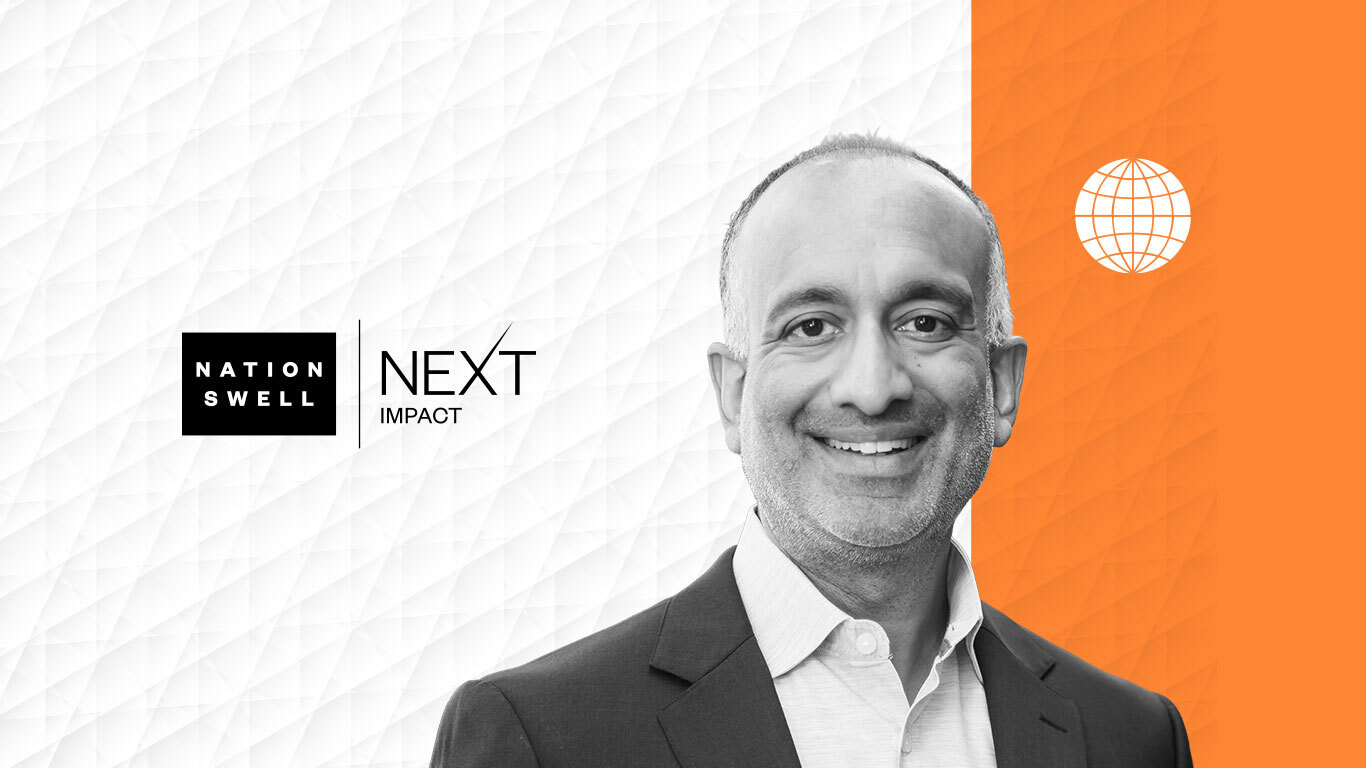
For this installment, NationSwell interviewed Rajiv Chandrasekaran, Managing Director of The Schultz Family Foundation. Here’s what he had to say:
NationSwell: Where would you situate Schultz Family Foundation in terms of strategy and influence in the broader realm of social impact?
Rajiv Chandrasekaran, Schultz Family Foundation: We bring a real focus on America’s next generation and helping them build better lives of purpose and prosperity, and we do that in ways that go beyond passive grant writing. We believe in multi-sector solutions, forging partnerships among funders, and co-creating with many of our grantees.
We’re ultimately looking for catalytic opportunities. If initiatives can’t achieve scaled, sustainable impact, they’re much less appealing to us. Take the Youth Mental Health Corps: We’ve long had a real belief in the power of civilian national service. When COVID rolled around, we developed a response corps in Washington state, building on the infrastructure of the federal AmeriCorps program, that deployed young people throughout the food network, helping move millions of pounds of food during a critical moment. Then we kept innovating. Instead of leaving corps members to figure out their post-service life on their own, we provided support to help them move into jobs, education or continued service.
A couple of years later, our co-founder, Sheri Schultz, asked our team if there was a way national service would help address the youth mental health crisis in America.
Thus was born the Youth Mental Health Corps. We developed it in partnership with Pinterest, and we have implemented it in partnership with states. The Corps trains and places young adults as near-peer mental health navigators in schools and community organizations. Communities gain additional capacity to serve more youth, while Corps members build pathways into behavioral health careers, helping address a national workforce shortage.
Today, the Youth Mental Health Corps is deployed — or in the process of deploying — in 26 states, Republican and Democratic, and its more than 1,000 members have reached nearly 100,000 young people and community members through their service. It draws on federal AmeriCorps dollars, philanthropic and private-sector support, and state-level support.
The design is intentionally based on an apprenticeship model: Young people gain experience while earning credentials, enabling them to move into professions with a clear mobility pathway. The result is a Corps made up of young people from a wide range of economic and educational backgrounds, from high school graduates to college students and recent graduates.
That, to me, is the classic Schultz approach: taking something that’s been out there, thinking through it in different ways and bringing in partners to create impact at scale and putting it on a pathway to sustainability.
NationSwell: Youth Mental Health Corps draws on a mix of federal, state, and philanthropic dollars. Are there other examples where the Schultz Family Foundation helped prove a model that public funding then took to scale?
Chandrasekaran, Schultz Family Foundation: Yes, let me throw one other example into the mix: diversion. In 2019, we saw some early data from Seattle that suggested that it was possible to “divert” someone from the homeless system by providing resources to resolve their immediate housing crisis. Building on that early evidence, we began working with partners in smaller communities across Washington to identify young people at the moment they were at risk and intervene before they ever entered the homelessness system.
From the beginning, our partners worked alongside the state, using public dollars to test the approach in communities across Washington. As the evidence grew, so did the state’s investment. What began as a small set of pilots has now expanded with public funding to reach young people in nearly every county in Washington. And the results are compelling: 87% of young people remain stably housed a year later, at an average cost of about $1,700 per household, roughly 80% less than the cost of emergency shelter.
Now, the model is being used in a range of communities across the country with similar results. The genius of it is that it provides cash assistance through trusted community intermediaries.
There’s a military concept called “left of boom.” Can you get there before the explosion? How do we find those leverage points that are far more economical and impactful? Then how do we work with partners to scale it and show the ROI so it becomes a good use of public dollars?
That’s a throughline across our work, including our support for post-9/11 veterans. We believe philanthropic capital has a critical role to play as R&D funding for big social problems. It gives us the ability to test new approaches, learn what works and what doesn’t, and build evidence around the ideas that show promise.
Some of those ideas won’t work. We don’t spend a lot of time talking about everything we’ve invested in that never got altitude, but that is part of R&D. When something does work, our job is to prove the model, assess the ROI, and bring on partners who can help take it to scale.
NationSwell: What inspired Where You Work Matters, and how does it help workers find jobs that offer real opportunities for advancement?
Chandrasekaran, Schultz Family Foundation: This goes back about 10 years, when Howard and Sheri, through the Schultz Family Foundation, partnered with Starbucks, other large companies, and foundations to host hiring fairs for opportunity youth: young people between 16 and 24 who were not in school or working. Thousands would come, and hundreds would get job offers in one day.
But along the way, Sheri asked an important question: How are these young people doing?
With the Burning Glass, we studied what happened to young people’s careers among participating employers. About half were seeing some mobility, moving on from their first job. But half were still churning in entry-level jobs, often for something like seven years.
So we asked: Why do some move up and some don’t? A growing body of research showed that, for many low- and mid-skilled jobs, it may have less to do with someone’s work ethic or intelligence and much more to do with their employer’s practices. Does the employer see that people in entry-level jobs can move up with the right training and pathways? Or is everybody expendable?
We wondered which companies were doing this well and discovered nobody had really assessed it objectively. So, we set out to do just that with the Burning Glass Institute. It became the American Opportunity Index, now called Where You Work Matters. This year, we assessed 12 million workers across 1,750 major U.S. employers, with data on 55,000 unique occupations within those employers.
We’re assessing actual jobs, because not every job at Google, Apple, or Microsoft is a great job. And employers that aren’t the coolest on the block may have great jobs where people can get ahead.
My favorite mental image is two clothing stores in a shopping mall. In both, people are folding shirts and talking to customers. But someone at one store may have twice the chance of getting promoted and three times the likelihood of staying for three-plus years. The difference isn’t because of the job — it’s because of an employer’s practices. As a job seeker, this hasn’t been transparent — until now.
We’re working to make this data available for free to tools and platforms that help people find first jobs and better jobs. We want people to understand where a job can take them, based on real empirical data rather than a company’s puffery. What are the odds of moving up? How might their pay grow? Which occupations will be disrupted by AI?
We think making that widely known can create greater economic opportunity at scale and pressure on companies to create better jobs.
NationSwell: How does the foundation’s involvement in these initiatives extend beyond funding them?
Chandrasekaran, Schultz Family Foundation: One through-line across all three is that we’re not a passive check writer. We’re in the mud. We co-developed the methodology for Where You Work Matters with Burning Glass. My colleague Marie Groark and I have spent dozens of hours in windowless conference rooms with their team building this out. The Youth Mental Health Corps was co-developed by our foundation and is being built in close partnership with an extraordinary group of organizations and leaders across the country.
There’s a bias toward speed and scale, and toward partnership. It’s more than money. We’re trying to lead with ideas and identify points of greatest leverage given the problem we’re looking at. In some ways, it’s tackling societal challenges like investors would: Where can we get the greatest impact for the dollar?
These are different ways we try to create what we call pathways to prosperity for the next generation. All of them involve partners and aim to create impact at scale.
With Where You Work Matters, we want this data to be put to good use. Part of the reason I’m coming to Philadelphia is to plant that seed. It’s an open invitation.
NationSwell: How do you know an initiative is ready to scale, and what role do other funders play before public funding comes in?
Chandrasekaran, Schultz Family Foundation: One important proof point for us is: Can we bring along other funders before we get to seeking public funding? Is what we have compelling, impactful, and creative enough that others want to co-fund?
The Youth Mental Health Corps is a perfect example of how partnership has been essential from the beginning. Pinterest was at the table from the beginning, sketching out the model with us and helping shape what the Corps could become. Other funders have joined because they see the potential of the model and the impact it can have for both young people and communities. Their partnership brings more than funding. It brings expertise, relationships, and perspectives that make the work stronger and helps us build something that can ultimately reach far more young people than any one organization could on its own.