 "
"
As technology reshapes the way people design, build, and maintain the world around us, the workforce development conversation is becoming correspondingly more complex. How do we help people navigate careers in industries that are changing almost as quickly as the technologies workers are being asked to use?
The Autodesk Foundation is focused on a specific version of that challenge: helping people build careers in industries that are also central to the climate transition. Through grants, partnerships, and impact investments, the Foundation is helping to build more adaptive pathways into fields like construction, manufacturing, architecture, and engineering — industries with enormous reach, rapidly evolving skill needs, and growing demand for talent capable of advancing lower-carbon, more resilient infrastructure.
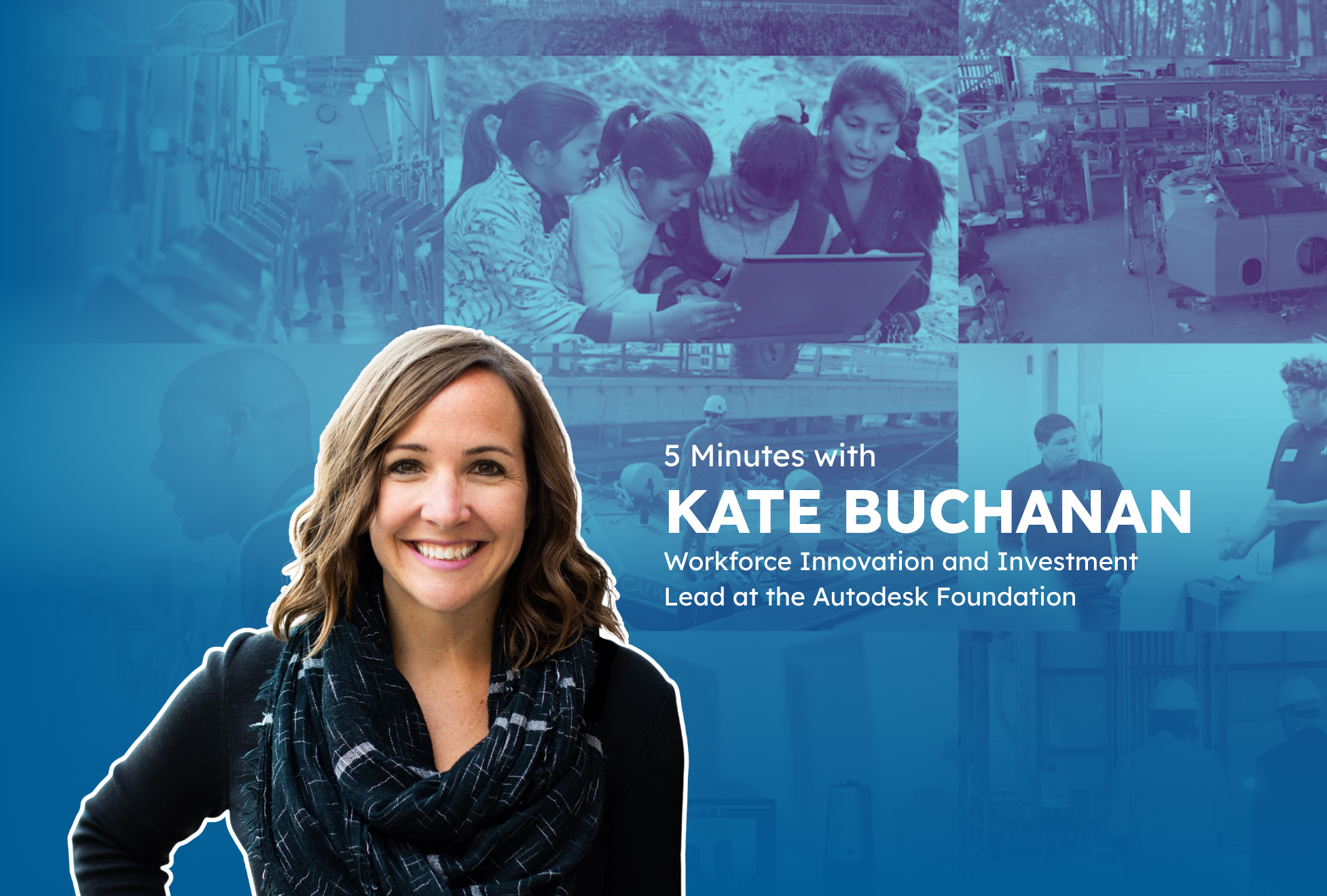
For this installment of Five Minutes With…, NationSwell spoke with Kate Buchanan — Workforce Innovation & Investment Lead at the Autodesk Foundation — about why skills training alone is no longer enough to meet the scale of today’s workforce challenge and what it will actually take to prepare workers for not only the jobs that exist today, but for the ones still taking shape.
NationSwell: Can you start by telling us how the Autodesk Foundation approaches its work, and what makes its role inside of Autodesk distinct?
Kate Buchanan, Workforce Innovation & Investment Lead, Autodesk Foundation: The Foundation is a unique vehicle for Autodesk because it allows us to think longer term and lead with an impact-first lens. Our broader focus is on workforce and climate — both mitigation and adaptation — and those areas often intersect, especially around climate-oriented jobs.
What’s exciting is that the Foundation can act almost like the tip of the spear. Autodesk is a fast-moving, innovative company, and we get to think around corners: Where is the intersection between the economy, the business, our industries, and impact?
That shows up in our investment philosophy, too. We’re one of the few corporate foundations that makes impact investments, especially on the climate tech side, but we always start with the problem: What are we trying to solve, and what is the best structure or vehicle to solve it?
We don’t start by saying, “We have a grant,” or “We have an investment,” and then try to find something that fits. We start with the thesis — here’s what we care about, here’s what we want to advance — and then use the tool that makes the most sense. That might be a grant, a venture investment, a pooled fund, or something else. It makes the work more complex, but it also lets us operate in a much more flexible and strategic way.
NationSwell: In your response to a recent NationSwell prompt on the future of work, you noted that it’s no longer enough to “train people on tools in isolation”. Why is funding alone often insufficient for workforce innovation, and what becomes possible when organizations also have access to tools, technical expertise, employee talent, and industry knowledge?
Buchanan, Autodesk Foundation: Skills training alone is not going to achieve the impact or scale we need. We have to think about workforce development as a system — one shaped by both the supply of and demand for labor, and one that is increasingly dynamic.
One stat that really resonates for me is the half-life of a skill, which essentially refers to how long a skill remains useful. That half-life is now about two and a half to five years — it used to be 10 to 20. That means all of us are having to learn new things faster, and at shorter intervals, which requires more adaptability and more support.
So the responsibility can’t just sit with the learner. We also have to understand which jobs are in demand, what underlying competencies those jobs require, and how technology is changing the tools people use every day. As a technology company, Autodesk sees that change across industries. The specific tools may look different in manufacturing, construction, or design, but the larger pattern is the same: the tools are changing quickly. Our role is to help people understand what’s coming, how to prepare for it, and how to apply new skills in context. That is useful to workers, and it’s useful to employers.
We originally framed our work around foresight and mindset, skills and learning, and access and inclusion. Those principles still matter, but our experience has pushed us to ask how the systems around workers need to change so those capabilities and opportunities can reach far more people.
NationSwell: What changes, spiritually or emotionally, in that environment where folks have to be in that continuous learner posture, with the half-life of skills turning over so quickly?
Buchanan, Autodesk Foundation: Some recent studies have really looked at the cognitive pressure workers are under right now, including the amount of context-switching, time management, energy management, and adaptation people are being asked to do. Unsurprisingly, the findings suggest that workers are stretched thin — not just by the amount of work they’re doing, but by the constant mental effort required to keep shifting, learning, and adapting.
I’ve been at Autodesk for ten years, so my work is rooted in technology. And in that environment, the question becomes: How do you manage your energy? How do you manage your output? How do you structure your day in a way that helps you be effective as a person?
We’re not robots. We can’t work at 100% all day, every day. So a lot of effective leadership training is really about helping people manage their time, energy, and attention in ways that allow them to do their best work.
That’s why ideas like growth mindset and adaptability come up so often in today’s business environment. They can sound like buzzwords, but there’s a reason they’re trending. New technologies are constantly coming forward, and people have to be able to say, “Okay, this is a challenge, but it’s also an opportunity. How do I learn this? How do I leverage it?”
Without the ability to manage your time, energy, and cognitive load, you can end up putting your effort toward things that are not the most effective or useful — either for you or for the job. At the same time, these are fundamentally human capabilities: showing up, communicating effectively, inspiring people, setting a vision, understanding what motivates you. Those are not things people are necessarily going to turn to AI or robots to do.
So I think the opportunity is to lean into those uniquely human components while also asking: How do I keep up with the pace of learning without burning out? When that’s done well, you see people lean into what they’re passionate about and what they’re good at. In the skilled trades, for example, a lot of people say, “I was never great at working at a desk. This gives me something I’m good at, something I enjoy, and a way to be successful.”
If you’re clear on what motivates you, what gets you excited, what you’re good at, and what the market needs, there will always be a place to navigate within that, but it does require more self-awareness and discernment than maybe it did before.
NationSwell: Autodesk has a close view into the industries that literally make the physical world, from infrastructure and construction to manufacturing, energy, and climate resilience. What are these industries revealing about where workforce systems need to evolve next?
Buchanan, Autodesk Foundation: Manufacturing makes up about 14% of the global workforce, and construction is about 7%. That doesn’t even include architecture and engineering, which represent millions of jobs around the world. So the scale of the opportunity is huge. Across these industries, we can help people understand what roles are changing, what skills they need, what pathways are opening up, what is being automated, and how technology can help them do more analytical, problem-solving work.
What’s exciting is that we’re investing in foundational training pathways, and then layering in tools like data for carbon reduction, predictive analytics, and digital twins. When you think about the evolution of construction and manufacturing, so much of it is connected to energy, climate resilience, and using technology to solve problems in ways we couldn’t before.
One of our foundation partners works in building maintenance, which may not sound especially exciting to young people at first. But then they realize, “Oh, I can use digital twins and predictive analytics to identify problems before something breaks?” Suddenly, that becomes a tech-enabled career in a way it wasn’t before.
That’s the big picture: we can build lower-carbon infrastructure more quickly and effectively, but we need people who know how to do that, know how to analyze it, and are excited by the problem. A lot of young people want to put their skills to purposeful use, and industries like manufacturing, construction, architecture, and engineering offer real opportunities to do that.
Many of these are also entirely new jobs. You can’t necessarily go to school and get a degree in all of them yet. But they’re inspiring roles, and we know young people are especially interested in climate-oriented and carbon-focused careers.
NationSwell: With industry evolving as quickly as it is, how should we be thinking about not only getting folks the skills they need to adapt and thrive in the job market, but also about scaling and future-proofing those skills?
Buchanan, Autodesk Foundation: We’ve been talking a lot about the move toward skills-based hiring, but the real question is: How do you prove someone has acquired a skill in a way an employer will trust?
There’s growing focus on specific skills within specific contexts, but also on skills that can move across industries. Part of the work is helping workers understand what their skills actually are: What can you do? How does that ladder up to a role? How does it ladder up to a longer-term pathway? That’s getting more and more granular. There are technologies emerging that can look at a resume, identify underlying competencies, and help workers validate those skills so an employer can understand what they’re capable of.
We’re doing that across Autodesk, too. If you’re a mechanical engineer, what skills do you need at the entry level? What do you need at the mid-tier? How do you move laterally, or move up and down a pathway?
That flexibility matters because traditional, linear pathways are no longer suitable for every job or career. It’s not always school, advanced degree, job; increasingly, people are adding certificates, stackable credentials, transferable skills, and other signals throughout their careers. The challenge is that the system is still catching up. A lot of skills-based hiring began with employers removing degree requirements, but without a clear substitute. So in some cases, they still hired based on degrees because they didn’t yet have another trusted signal.
The strongest models are the ones where industry and employers help define and verify the credential themselves. Google has done that well with some certifications. FAME, one of the partners we’ve worked with, is another good example. It spun out of Toyota because they needed manufacturing technicians with a specific set of skills, and it has been successful because employers helped define those skills and verified that they would hire people who completed the program.
That de-risks the hire in the same way a college degree traditionally has. There are a lot of credentials in the market, but not all of them are proven to give employers what they need. The real shift is toward credentials that are validated by industry and trusted by employers.
NationSwell: Autodesk Foundation reports that in 2025 438,000 people obtained quality jobs through the organizations it supports. When you look beyond the number itself, what have you learned about what makes a job outcome meaningful for workers, employers, and communities?
Buchanan, Autodesk: I’m really proud of the work we’ve done with our portfolio. At the same time, it still doesn’t meet the full scale of the problem. Helping 438,000 people is a strong start, but there are millions of people who need to enter new careers, move into better-paying jobs, access quality jobs, and then continue navigating those careers over time. That’s an important shift: It’s no longer just about helping people get into a job, it’s about helping them navigate a career.
For me, that points to the importance of improving workforce coordination and systems that support people long-term — creating better on-ramps, helping people navigate across pathways, and anchoring all of it in job quality. That is what can really help us reach the scale and breadth of impact we’re aiming for.
I think that’s one of the next frontiers for workforce development, because the nature of a quality job is changing quickly. And I don’t think that’s only a blue-collar or white-collar issue. Wage and employment data are helpful signals, but so are things like well-being, stability, predictable scheduling, adequate pay, and benefits.
Some of our partners have done really important work to codify job quality, including JFF, the Aspen Institute, and the Families and Workers Fund. That includes looking at questions like: Do workers understand their schedules? Can they plan for childcare? Do they have the pay and benefits they need? Do they experience stability?
The workforce itself is more dynamic now, with the growth of gig work, full-time work, contract work, and everything in between. So it’s important to understand not just whether someone has a job, or what that job pays, but whether they believe it is a good job — and what “good” actually means to them.
So yes, it’s meaningful that in 2025 our portfolio helped more than 438,000 people obtain quality jobs. But we also have to keep paying attention to what job quality means in a modern workforce, and how that changes across different economies and contexts.
NationSwell: As the tools of work continue to evolve, what kinds of human skills or durable capabilities do you think will become even more valuable?
Buchanan, Autodesk: There’s a lot of data on this, and it’s relatively consistent. The three human skills that stand out to me are problem-solving, communication, and empathy.
Problem-solving is especially important in our industries. Whether you’re redesigning a manufacturing process, improving safety in a factory or on a construction site, or figuring out how to deliver faster, on time, and under budget, every project is different.
There’s a lot of creativity in that, but to do that well, you have to communicate clearly and often. And empathy matters because people are under a lot of pressure to keep learning and adapting, while also managing everything happening in their lives outside of work. Being able to show up meaningfully with colleagues, solve problems together, and communicate with care is huge. Those are the fundamentally human capabilities that become more important as technology changes.
One example I think about is Autodesk’s sabbatical program. Full-time employees get six weeks off every four years, and people can use that time however they need to. What’s interesting is that we cover for each other while people are out. That creates a real sense of reciprocity: when someone else goes on leave, you step in for them; when it’s your turn, others step in for you.
It also gives people opportunities to grow. When I was newer at Autodesk, two of my managers went out around the same time, and I suddenly had the chance to take on work I probably wouldn’t have otherwise done. I grew because of that opportunity, and then I felt really taken care of when it was my turn to go out. To me, that’s empathy and care in action. It says: everyone needs a break, and we’re going to support each other in making that possible.