 "
"
At a moment of inequality and division, who is advancing the vanguard of economic and social progress to bolster under-served communities? Whose work is fostering the inclusive growth that ensures every individual thrives? Who will set the ambitious standards that mobilize whole industries, challenging their peers to reach new altitudes of social impact?
In 2026, Impact Next — an editorial flagship series from NationSwell — will spotlight the standard-bearing corporate social responsibility and impact leaders, entrepreneurs, experts, and philanthropists whose catalytic work has the potential to shape the landscape of progress amid urgent need for social and economic action.
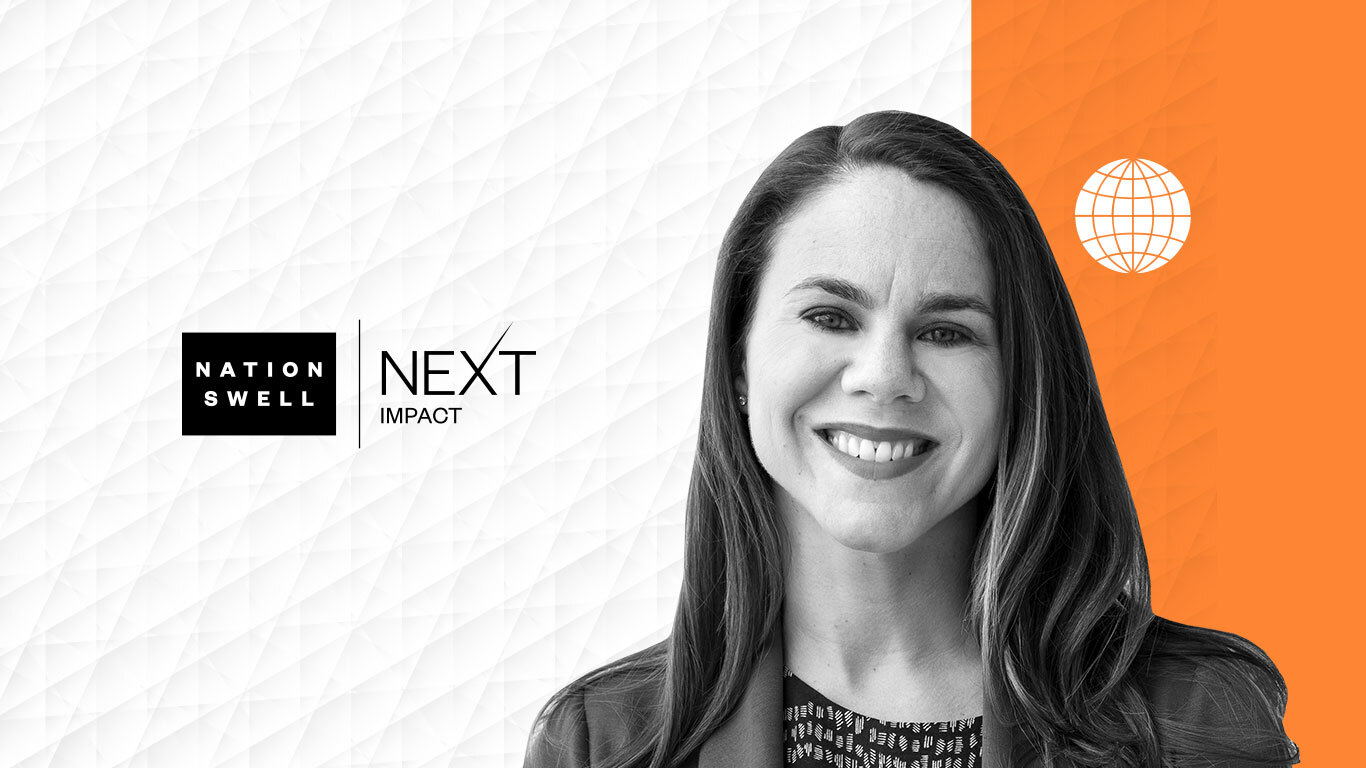
For this installment, NationSwell interviewed Kate Barrett, President of The Campbell’s Foundation. Here’s what she had to say:
Chloe Lew, Senior Vice President of Strategic Partnerships and Innovation, NationSwell: What brought you to the field that you’re in right now? Was there an early moment, a relationship, or an experience that galvanized your commitment to driving bold action?
Kate Barrett, President, The Campbell’s Foundation: It has definitely been a circuitous route. I talk about the career jungle gym rather than the career ladder because there have been a lot of twists and turns, but social impact has been a consistent through line.
For as long as I can remember, I’ve wanted to do work with purpose. I grew up surrounded by teachers, psychologists, and immigrants — people who came to this country and made lives for themselves. I was the beneficiary of tremendous stability, and I learned early how important it is to recognize your own privilege and use it to lift others up.
I majored in public health, and initially thought I would become a doctor. Then I took neuroscience and realized, first, that it was really hard, and second, that I was much more interested in systems than in the granular mechanics of the brain. I wanted to understand why people make the decisions they make, especially when we know what’s healthy, but don’t necessarily act in the best interest of our health (I also don’t love blood, so I’m not entirely sure what I was thinking).
After a summer spent injecting rats in a basement lab, I knew research wasn’t the right fit either. My dad suggested consulting as a way to see different parts of the healthcare system, so I joined McKinsey right out of undergrad, having never heard of McKinsey before. That probably worked to my benefit because it lowered the intimidation factor. My first project was with the Gates Foundation, and I also discovered that I loved organizational work — everything from leadership development and talent structures to culture and employee engagement.
Since then, I’ve worked at a tech startup, gone to business school, done workforce strategy and product development, and spent several years at the Center for High Impact Philanthropy. In a way, I tried each element of what interested me separately. Corporate social impact is where they all come together: business and corporate purpose, organizational strategy and employee engagement, and social impact. I love the employee side of the work, I love building external partnerships, and I love being able to tie it all back to the business.
Lew, NationSwell: How has your perspective on leadership changed or evolved over the years?
Barrett, The Campbell’s Company: Before I came to Campbell’s, the longest I had stayed anywhere was about two and a half years, so the fact that I’ll have been here nine years in June is kind of wild to me.
I first interned in marketing at Campbell’s during business school. That’s when I realized, “I don’t think marketing is for me, but I love this company — and I want to be on that team over there.” I stayed in touch with my predecessor until a role opened on her team five years later. I was lucky to learn from her; she was a former lawyer and nonprofit leader, so we brought very different but complementary perspectives to the work.
When she left, I was nervous about filling her shoes because she had established such a strong reputation externally. But I eventually realized that I didn’t have to fill her shoes. I could build on the great work she had done while finding my own way of leading — not better or worse, just different. Over time, I also had to move beyond my own imposter syndrome and recognize: I know my stuff. I’m now seen within the organization as the expert on social impact and community-focused employee engagement, which is a really interesting place to be.
Before focusing on my external profile, though, I wanted to establish my internal brand: Who am I as a leader here? How do I build the right team, develop champions, and strengthen my credibility and influence across the organization?
At first, I worried I might hire people who were too similar to me. Instead, I found people whose backgrounds and strengths complement both mine and one another’s. A year or two in, my boss told me, “You hired an incredible team. Your team is so high-performing.” That was one of the best compliments I could have received because building and leading a strong team is deeply important to me.
Lew, NationSwell: How have you cultivated your internal brand, and what are you known for within the organization?
Barrett, The Campbell’s Company: I think about internal brand at both the individual and team levels. I wanted our team to be seen almost as a center of excellence — not as a “nice to have” function off doing its own thing, but as a visible and valuable partner across the organization.
We’re culture builders and culture champions, but we’re also business partners. If a sales team is looking for a meaningful way to engage a customer, for example, we can be a thought partner on nonprofit partnerships and help create something valuable. Building that reputation — as a team people can turn to for expertise and resources — has been important to both my personal brand and the identity of the team.
Lew, NationSwell: What is the “North Star” of your leadership style? What is it about the way that you lead in the space that makes you an effective leader?
Barrett, The Campbell’s Company: It’s about authenticity and integrity. I’ve always been unapologetically myself — I don’t really know how to lead any other way. “Fake it till you make it” has never worked for me; I’d rather lean into my strengths than pretend to be something I’m not. For me, that means being approachable and accessible. I can be a leader while also being a peer, mentor, and partner. I’ve also worked intentionally to become more visible internally, joining teams’ all-hands meetings to explain what we do and how we can be a resource.
When it comes to building a high-performing team, I think hiring is as much art as science. I’m open to nontraditional backgrounds, and I look for people whose experiences and strengths complement mine rather than replicate them. Two of the three people I ultimately hired had initially been screened out by our recruiting team, but I found their backgrounds interesting and asked to bring them back in.
I also pay close attention to candidates’ curiosity and the questions they ask. Once you’ve hired great people and established trust, the key is giving them challenge, autonomy, and room to lead. My job is to bring their work together and tell the larger story — not to stay in the weeds. As someone who has always been hyper-organized, I wondered whether I could let go. But when you hire great people, the answer is absolutely yes.
Lew, NationSwell: What challenges have you had to overcome in your role, and what strategies have you used to overcome them?
Barrett, The Campbell’s Company: Campbell’s has been based in Camden, New Jersey for 158 years, which is a relatively small city, and I take seriously our responsibility to maintain the community’s trust and be a good neighbor. Camden has often had a bad reputation, and I’ve made it my personal mission to show people what a fantastic place it is.
Another one of the more challenging parts of the work is making our programs equitable and accessible across our employee footprint. Most of our employees work in manufacturing and distribution, and engaging them is very different from engaging office-based employees. At one point, we moved our employee matching and giving programs from paper forms to an entirely online system and saw participation from our plants drop off. Some facilities had been major contributors to their local United Ways, and the change made it harder for them to participate. It showed us that a seemingly efficient organizational decision could exclude much of our manufacturing workforce.
Since then, we’ve worked closely with our supply-chain partners, particularly the HR business partners supporting our plants, to listen and meet employees where they are. It can’t be a one-size-fits-all approach.
That listening has also helped us build stronger partnerships with HR. When collaborations have failed, it’s often because we were asking another team to take on additional work without advancing its priorities. We’ve had the most success when we find the win-win. When we launched a high school internship program, for example, we aligned it with both the early-careers team’s strategy and a new leadership-development program. Graduates of that program could practice managing by supervising a high school intern, while we created opportunities for students.
Lew, NationSwell: What defines the present societal and economic moment? Which trends are filling you with optimism, and which ones give you pause?
Barrett, The Campbell’s Company: What gives me optimism is the collaboration I’m seeing, both in Camden and among funders more broadly. There’s greater acknowledgement that the problems facing us are too big and complex for any one organization — let alone one sector — to solve; we’re moving away from the idea that one signature program will provide the answer and toward more intentional collaboration among funders and nonprofits.
What gives me pause is the level of division and extremism in the country. We seem to have moved away from compromise and moderate solutions, while the loudest voices are often at the extremes. We have to remember that many people are still willing to listen to multiple perspectives, collaborate, and find solutions that work for different communities.
Even food access and food security — issues you might assume everyone could support — have become politicized through debates over SNAP and whether assistance is a “handout.” It’s startling that we’ve found a way to make food political, too.
Lew, NationSwell: You are a well-connected and thoughtful leader among your peers. Are there any leaders or organizations doing especially strong work whose praises you’d like to sing?
Barrett, The Campbell’s Company: Ali Mathias, who recently moved to a new organization, is someone I immediately connected with both personally and professionally — I believe she introduced me to NationSwell. We would get together every few months to compare notes, and I’ve learned a great deal from her.
I’ve also always admired Chobani. They’ve integrated purpose into who they are as a company, and I love how they treat their products as part of their social-impact strategy.
Walmart is another interesting example. They operate at an entirely different scale, so I look to them to understand how a company with that level of resources can move the needle. Their workforce-development work helped inspire ours: How can a company strengthen its talent pipeline while also creating jobs in communities? They also use their size and influence to bring suppliers into programs addressing issues like hunger and the environment. They’re an organization I continue to watch.
Lew, NationSwell: Are there any resources you’d recommend — books, podcasts, Ted talks — that have influenced your thinking that might influence others as well?
Barrett, The Campbell’s Company: My reading lately has fallen into two categories: pure fun and, frankly, self-help books about parenting my 10-year-old daughter. I’ve been reading Jonathan Haidt, whose earlier work on positive psychology also resonated with me. I really subscribe to that strength-based approach: How do you identify and build on your strengths?
Another major influence was a women’s leadership project I worked on during my last nine months at McKinsey. It began as internal training for women at the firm and eventually became a book, How Remarkable Women Lead, and an external training program. A senior partner interviewed around 100 successful female leaders to understand what had enabled them to succeed and whether women lead differently from men. I contributed to the book and spent my final few months at McKinsey teaching the resulting courses around the world, which was incredibly meaningful.
Two themes have stayed with me. One was “energizing”: consciously recognizing what gives you energy and what depletes it, then managing that throughout your day, week, and year. The other was “framing,” including the idea of learned optimism — that anyone can become more optimistic, although you may have to train your brain to think that way.