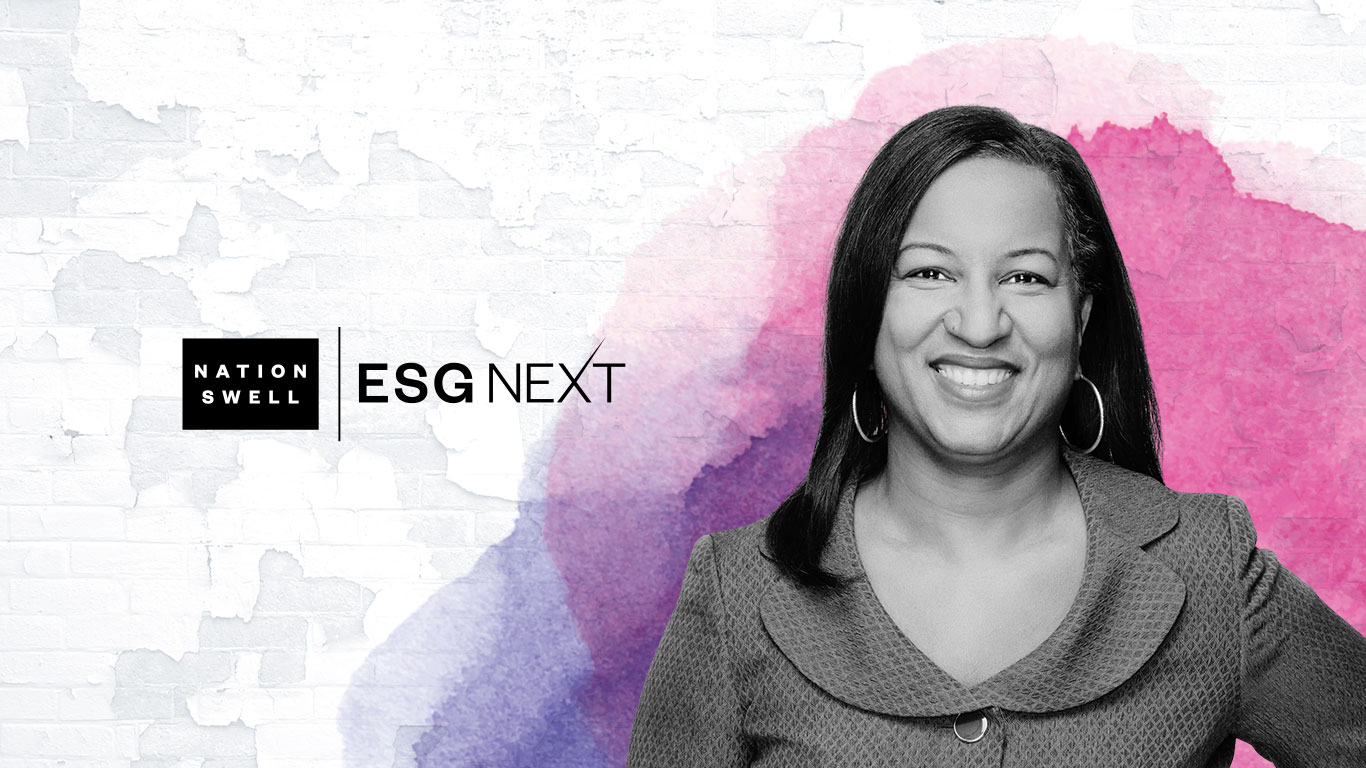
ESG Next: An Interview With Nike’s Caitlin Morris

At a moment of unprecedented attention, investment, and opportunity for the emerging field of ESG, leaders are asking: Who is best preparing their organization for the society of the future? Who is innovating today to meet decades-long environmental and social goals? Who is setting standards that catalyze their industry’s change for the better? Who is defining what bold and aspirational look like — and how best to advance that work in practice? 

Enter NationSwell’s ESG Next, an exemplary group of investors, executives, authors, philanthropists, social sector leaders, academics, and field builders who are helping to shape business as a force for social and environmental progress, advancing — and even pioneering — the most forward-thinking and effective programs, initiatives, technologies, methodologies, practices, and approaches. 

For this installment, NationSwell interviewed Caitlin Morris, Vice President of Social + Community Impact at Nike, about this moment in ESG, the intertwining of people and planet, and the unique power of measurement not to gauge impact,  but actually facilitate it. 

Greg Behrman, CEO + Founder, NationSwell: How did your personal and professional journey to the field of ESG begin? 

Caitlin Morris, Vice President, Social + Community Impact, Nike: My journey to this field began almost by accident. I graduated from the University of Virginia during a recession, and I didn’t really know what I wanted to do next. I went to Hungary to teach English my first year out of school. 

My second year there, I worked for a consulting firm as the only native English speaker in the office, where I had some high-profile accounts. I specifically recall my secretary saving all her money to buy a pair of Levi’s, highlighting the power of American business as a force for good. But like any situation where you think you’re giving something, you get more than you give. I learned a lot from Hungarians about a diversity of worldviews, and about not taking things for granted.

After returning to the U.S. from Hungary, I worked at a consulting firm focused on capital markets development. I was drawn to the idea that we could make a difference by changing government structures to be more open and democratic through capitalism. My path was set early on, and it would eventually lead me to Nike. 

I joined Nike because of their first Community Impact report — it wasn’t because of Michael Jordan or any great sports moments, but because of the innovation they were driving around corporate responsibility. 

Behrman, NationSwell: How do you define this moment in ESG? 

Morris, Nike: I don’t really think ESG is a framework. It’s more of a collection of letters that roll nicely off the tongue. But the environmental piece of ESG is critically important, and at the same time, it often gets elevated over social without people recognizing the strong intersectionality between the two. 

I don’t disagree that we need sharp measurement on environmental factors, but people and the planet are two intertwined issues. If you don’t solve poverty and other challenges that communities are facing in their daily lives, we’re going to continue to make decisions that aren’t good for the planet. My team sits in social and community impact, so we lead with the people piece. That doesn’t mean we don’t see the intersectionality with the environment. It’s part of why we launched the Community Climate Resilience Fund, where we’re directly investing in intersectionality with the Trust for Public Land

My team has never been in more demand from the brand. Community used to be a “nice to have”; now it’s “table stakes” for companies. As you look at the Edelman Trust Barometer, consumers expect companies to solve problems more than they expect governments to. So, we have to have a clear point of view on which issues we take a stand on and how we’re addressing them. I feel proud that we have a team that can stick with long-term change around physical activity and supporting leaders who are working to address social justice issues. 

This moment in ESG brings so much excitement, but that excitement also brings challenges. Everyone grew up in a community, so the passion for thinking about the community component of social factors can feel quite outsized. That passion comes from an authentic and honest place, but it can be noisy, and the noise makes it difficult to maintain focus on the strategy, all while giving it enough space to

constantly evolve and emerge. The challenge is to balance the desire to keep people focused and to be flexible and responsive to current issues. 

Behrman, NationSwell: What are some initiatives you and your team are driving at Nike that you think are noteworthy, or that show promising signs of advancing the field? 

Morris, Nike: Nike has a mission, vision, and purpose — and the purpose part is relatively new for the company. This guiding principle has made our work central to the company’s operations, which is exciting. 

One of our most important initiatives began with a big framework: believing the world needed to understand the global cost of inactivity. We created Designed to Move, an advocacy play that we hoped would catalyze a movement around physical activity. For Designed to Move, the theory of change is supported by science. We collaborated with scientists to understand the various benefits that come from sports, and we learned that it’s a uniquely efficient investment — it pretty singularly combines physical literacy, emotional intelligence, and cognitive function. As the nexus of all of those things, it has been undervalued. 

So, for Designed to Move, our theory of change had two key focuses: one is integrating physical activity back into everyday life, the second is providing kids with early positive experiences in sports and play. 

At an individual level, it’s crucial to give children the ability, confidence, and desire to be active, as this sets them up for a lifetime of activity. The cycle is intergenerational — inactive adults are two times more likely to have inactive children. When we provide kids with positive early experiences in sports and play, they continue engaging in these activities. We began with a high-level macro approach, and then shifted to more programmatic work, testing innovations on the ground to gather proof points and inspirational stories. 

Another initiative I’d like to spotlight is the Nike Community Ambassador Program. This initiative excites me because it demonstrates the power of measurement and using the company’s full resources. The program involves training retail athletes to be coaches in local community organizations. What I love about this is that it was driven by insight. For instance, in Seattle, a group of Nike retailers were volunteering

at a school when the PE teacher left them in charge of 50 kids, assuming they could handle a PE class since they were associated with Nike. 

This experience highlighted the need for our teams to be better equipped as coaches in the field. The program began as a way to rally teams around the cause of getting kids active and walking our talk. We believe that quality trained coaches are critical to a child’s experience, so we can’t have untrained employees volunteering. What we didn’t expect was the incredible impact this program had on the employees and their connection to the brand. Some Nike employees may have grown up in the local Boys and Girls Club and now are returning to volunteer at a place that was meaningful to them. Others might have a master’s degree in sports science and are working retail because it was the available job. 

These employees didn’t necessarily see a future for themselves in retail, but now they’re able to use their knowledge and apply it in the community. This has unlocked a different reaction regarding their longevity with the brand. The program allows us to test our coaching materials, authentically engage with communities on a larger scale, and drive an employee engagement strategy that delivers returns to the brand. 

Behrman, NationSwell: How are you measuring and evaluating the success of your initiatives? 

Morris, Nike: Nike’s power lies in innovation and inspiration, and when we are at our best, we utilize the full power of the brand along with my team’s work on the ground. About seven years ago, we transitioned from a separate mission-based team to the company’s philanthropy center. As the company’s budget grew, so did ours, allowing us to do some exciting things. 

We’ve invested in digital tools for scaling our reach, providing resources such as coaching guides and inclusive coaching tools. We adopted a collective impact approach, focusing on local partnerships and place-based investment. This enables us to align our efforts on a city or neighborhood level and measure the impact of our work. I do think that this power of partnership at a local level is absolutely profound: You can’t get scale without first making a hyperlocal impact and measuring it properly.

Speaking of measurement, our increased budget gives us more tools to better measure our efficacy, ensuring our work is genuinely effective. With a smaller budget, you want to spend all your money doing good work. As your budget grows, you can be more honest about assessing your performance and asking, “Well, we’re doing it, but is it really working?” 

Effectively measuring our progress is new territory for us. We’ve been good at selling inspirational concepts and catalyzing movements, and now we’re prioritizing holding ourselves accountable by leveraging both internal and external tools to measure our reach. 

We’re also getting granular with measurement, even measuring the effectiveness of our tools. We’ve historically built things in partnership with experts and gained insights from users, and now we have experts examining how well our tools are being used. 

Behrman, NationSwell: To which leadership practices do you most attribute your success? 

Morris, Nike: Stakeholder engagement has been the connecting thread of my career. I make a dedicated effort to actively listen. Great leaders are excellent communicators, and communication starts with listening. That, for me, is probably my connecting thread and belief. People often ask why I stay at Nike. I stay because of our commitment to innovation and the people. I am fortunate to lead and partner with a team of 70 incredibly intelligent individuals, and my job as a leader is to be a multiplier for them, helping them do their best work. 

Behrman, NationSwell: Who are some leaders who inspire your work? 

Morris, Nike: My first choice is Shelly Omilade Bell, founder of Black Girl Ventures. Shelly is entrepreneurial, creative, and authentic in everything she does. She radiates energy and possesses the wisdom to lead her organization forward while recognizing that her role may need to change over time. It is not easy for founders to do this, and she is doing it brilliantly. 

Charlie Brown, CEO of Context Partners, also comes to mind. I’ve known Charlie for a long time and admire his work, starting at Ashoka, where the power lies in believing in individual game-changers. Charlie’s philosophy centers on the idea that no one achieves success on their own — we always do it in a community. I have learned a lot from Charlie, who has not been afraid to reinvent himself. As someone who has been consistent in my career, I am always impressed by people who take risks and change things up. 

Last but not least, there’s Maria Bobenrieth, CEO of Women Win. What I love about Maria is her constant joy. She has a saying, “Don’t get angry, get curious.” She leads with joy and innovation, changing how we support women and girls through sport. We have collaborated on our first participatory grant-making initiative outside of our employees: the ONSIDE Fund, funded by us and Puma. While there has been good collaboration on the labor rights side, there has been less collaboration on community impact. The Onside Fund and the participatory grant-making initiative, as well as the ability to co-fund with others in the industry, are fascinating. 

Alongside those leaders, I’ve also become a big podcast fan. I keep going back to “No Off Season,” a Nike podcast that features Megan Bartlett from the Center for Healing and Justice through Sport. I highly recommend it. 


To learn more about how our ESG Next honorees are shaping business as a force for social and environmental good, visit the series hub. Nike is a NationSwell Institutional Member. To learn more about membership in NationSwell’s community of leading social impact and sustainability practitioners, visit our site.

ESG Next: An Interview With Microsoft’s Kate Behncken

At a moment of unprecedented attention, investment and opportunity for the emerging field of ESG, leaders are asking: Who is best preparing their organization for the society of the future? Who is innovating today to meet decades-long environmental and social goals? Who is setting standards that catalyze their industry’s change for the better? Who is defining what bold and aspirational look like — and how best to advance that work in practice?

Enter NationSwell’s ESG Next, an exemplary group of investors, executives, authors, philanthropists, social sector leaders, academics, and field builders who are helping to shape business as a force for social and environmental progress, advancing — and even pioneering — the most forward-thinking and effective programs, initiatives, technologies, methodologies, practices and approaches.

For this installment, NationSwell interviewed Kate Behncken, Corporate Vice President of Microsoft Philanthropies, about the importance of tying together purpose and profit, the power of capacity-building leadership, and this moment of tremendous opportunity for social impact and sustainability leaders.

Greg Behrman, NationSwell CEO + Founder: Tell us about how your personal and professional journey led you to ESG work.

Kate Behncken, Microsoft Philanthropies Corporate Vice President: While I was a lawyer for many years working in Australia and Europe, I was presented with the opportunity to come on board as Chief of Staff for Brad Smith, Microsoft President, Vice Chairman, and General Counsel. That post gave me an opportunity to be exposed to the broader work of the company, and it was in that role that I learned about all of Microsoft’s social impact work. 

I had the opportunity to work on a number of initiatives like Kids in Need of Defense, and I think that exposure is what really lit the fire for me to get passionate about the work we were leading, the opportunity to make a difference, and most importantly, about the responsibility the private sector has to all communities.

Behrman, NationSwell: How do you think about what defines this moment in ESG?

Behncken, Microsoft: As a tech company, we see the tremendous opportunity that technology brings — the huge benefits and great potential for technology to address some of society’s biggest challenges — but we also see the pace of change, the rapid transformation that was only accelerated in the Covid era, and how this pace raises new challenges and also intensifies existing inequities in our communities.

Because of that, at this moment, there’s greater expectation on private sector leaders from everybody — employees, stakeholders, and ourselves. I would say from what I’ve seen at Microsoft, the level of energy across the company for the work we do is at an all-time high. That’s a fantastic opportunity for someone like me in my role, so the question is, how do you tap into it in the best possible way?

We view our goals through four key lenses: supporting economic growth, sustainability, trust and protecting fundamental rights, but ESG is also so broad. I think a lot of us are thinking about what this framework means, and what it’s going to do. There’s going to be more that companies will have to report on in more ways; and there are going to be more things that we want to continue to report on.

Behrman, NationSwell: What is it about your approach to ESG, social impact, and sustainability work that yields the most success?

Behncken, Microsoft: In the private sector, there’s been a historical sense that profit happens at the core of an organization, but the purpose-driven functions take place in this small department that’s separate from it. But I don’t think that’s the case. The more that companies can bring together profit and purpose, the more they’re going to be successful.  

That’s certainly not the case at Microsoft. From a people perspective, we have a multidisciplinary team thinking about how we bring together our purpose and our profit. That’s no easy task. To do that, you really need a diverse skill set. We have people from so many different backgrounds, and as with any team, that diversity makes you stronger, and makes the work better.  

One of the really unique things about Microsoft Philanthropies is a group called Tech for Social Impact, where we focus on how we help nonprofits get access to affordable technology to be able to leverage that tech to grow, scale, and reach more of the beneficiaries that they’re trying to reach. But it’s not just the affordable technology we provide — it’s often that we’re working really closely with them to help them drive their own digital transformation. We’re meeting them where they are. Some nonprofits have great mastery of their technology tools, others not as much. So we, and our partners, listen to the organizations’ specific needs, that’s what makes our model so different from a one-size-fits-all approach to helping nonprofits.

In this arrangement, we reinvest incremental profits generated from the TSI model into philanthropy, into innovation for the nonprofit sector, and into a wide range of social good initiatives. That gives us a tremendous opportunity to do more; the better TSI does, the more that we can reinvest back into the sector.

A lot of people originally thought that a non-profit sales channel in philanthropies is oil and water; they thought, “How can that possibly work?” Well, I see it work. And it’s fantastic. Last year alone, we provided $3.2 billion in donated and discounted technology – up 29% from the previous year – to 302,000 nonprofits that deliver critical services to over 1.2 billion people around the world. Over the next five years, we will double the number of nonprofits we reach with technology discounts and grants to help amplify their impact.

We’re also focused heavily on multi-sector partnerships, like our partnership with U.S. Vice President Kamala Harris’s office to deepen investments in local economies in Central America, bolstering quality of life, increasing access to work, and helping to stem the tide of migration to the United States. For this initiative, the partners worked together to map out the different “swim lanes,” and then we each focused on the one where we could have the most unique impact. 

We lead the swim lane around digital inclusion: Microsoft is focused on expanding Broadband internet access to 3 million Central American  people and providing access to digital skills learning paths to upskill workers and make them more competitive in the job market. We’re training over 100,000 Central American workers in the next three years, helping them to learn the soft, technical, and digital skills that will enable them to gain access to  higher-paying local jobs.

The partners were very thoughtful, not only about which of us could lean in to each of the swim lanes, but about how each lane supported all the others,  and then how all involved collaborated more closely with government. I think it’s a model that we might start seeing in other countries around the world. You can learn more about our work, and the other partners involved on the White House website.

Behrman, NationSwell To which of your leadership practices or approaches do you attribute your success leading the sustainability function of an organization like Microsoft?

Behncken, Microsoft: One of my core beliefs about being a leader is that leadership is about building capacity and not dependency. Of course, I’m very focused on making sure Microsoft Philanthropies is a great place to work, but I’m also really invested in how we’re helping to grow people’s careers in the space. 

I’m also a firm believer in the power of partnerships. We partner a lot with governments around the world. It’s the only way to really achieve scale with some of the work we do, like our global initiative to upskill workers in an effort to support local economies and talent pipelines around the world.

Lastly, I am a firm believer in focus, and I steer my team towards only being at the tables where we can add really unique value. If you do less, you’ll drive greater impact. That’s a journey we’re all still on.

Behrman, NationSwell: Who are some leaders in this space whose leadership inspires your own?

Behncken, Microsoft: I’m inspired by Wendy Young of Kids in Need of Defense, a great organization working to help unaccompanied minors migrating to the US. Wendy is an amazingly generous leader, and Microsoft has worked closely with KIND over many years. I’ve had the opportunity to see how she thinks about addressing systemic issues, and she’s just very on top of it. An absolutely wonderful person.

My team and I look at the work that Shamina Singh is leading at Mastercard, not just on inclusive growth but also more broadly across the whole organization, thinking about how they bring together their purpose and their profit. (Editor’s Note: Shamina Singh is a future ESG Next honoree, and will be profiled in this series at a later date.)

Behrman, NationSwell: What are some resources you recommend that have helped to fuel your leadership, professionally and personally?

Behncken, Microsoft: Caste, an exploration of how America has been — and still is — shaped by a not-so-hidden caste system, is essential reading. The author, Isabel Wilkerson, links our social system to India’s and Nazi Germany’s, and her analysis has shaped my view of the world today.

Brad Smith, who’s the president of Microsoft, recently wrote a book called Tools and Weapons, and also recently released a podcast where he speaks to leaders in business and government to look at the world’s most critical challenges, the intersection of technology and society, rural broadband, and digital inclusion. I think they’re both essential.


To learn more about how our ESG Next honorees are shaping business as a force for social and environmental good, visit the series hub. Microsoft Philanthropies is a NationSwell Institutional Member. To learn more about membership in NationSwell’s community of leading social impact and sustainability practitioners, visit our site.

ESG Next: An Interview With Bain Capital’s Tricia Winton

At a moment of unprecedented attention, investment and opportunity for the emerging field of ESG, leaders are asking: Who is best preparing their organization for the society of the future? Who is innovating today to meet decades-long environmental and social goals?

Who is setting standards that catalyze their industry’s change for the better? Who is defining what bold and aspirational look like — and how best to advance that work in practice?

Enter NationSwell’s ESG Next, an exemplary group of investors, executives, authors, philanthropists, social sector leaders, academics, and field builders who are helping to shape business as a force for social and environmental progress, advancing — and even pioneering — the most forward-thinking and effective programs, initiatives, technologies, methodologies, practices, and approaches.

For this installment, NationSwell interviewed Tricia Winton, Partner and Global Head of ESG at Bain Capital, about why she thinks ESG isn’t going away anytime soon, the power of a private partnership model in advancing ESG work, and the importance of focusing on the upside while you navigate the risks and pitfalls.

Greg Behrman, Founder + CEO, NationSwell: Was there a defining experience or moment that drew you to this field?

Tricia Winton, Partner and Global Head of ESG, Bain Capital: It wasn’t just one moment. I’ve had the opportunity to be surrounded by leaders in our field and a firm like Bain Capital that believed that thriving businesses across a number of dimensions including governance, sustainability, organizational performance and culture generate higher returns as well as positive societal and environmental outcomes. I’m proud to say that Bain Capital has held this belief since its inception and before the term ESG came to fruition.  

I joined Bain Capital in the midst of the pandemic and saw firsthand the power of an organization that is sincere and engages and collaborates with a wide range of important stakeholders. I also saw our ambition to lead in this space. The goal was not to make flashy proclamations, but to drive genuine impact. You can feel that in the culture and in the work, which is very different from what I’ve seen anywhere else.

Behrman, NationSwell: What do you make of this moment in ESG? Where are we in its evolution, and how do you assess this moment?

Winton, Bain Capital: I have a long-term perspective on the evolution of the space, and I think broader socio-economic factors have only heightened the awareness of what’s expected of companies and individuals in facing some of society’s largest problems. The reality is we’re going to need more collective effort, not less.

Here’s the good news: We’re seeing progress every day. We’re seeing more and more employees who want to work at firms and companies that think long-term and holistically about their impact.  We know employees want it and we know investors want it. Ultimately, it’s a focus that is going to reward our industry and the broader business community. 

The more I see this progress, the more my conviction grows around the importance of this work. Of course, we need to address the risks our companies are facing — but it’s equally important to concertedly lean into the upside of ESG work and the lasting, positive impact that businesses can deliver. We can and must do so much more.

Behrman, NationSwell: Can you share how you and your team at Bain Capital approach ESG work in ways that are unique or exemplary?

Winton, Bain Capital:  Our full team really wanted to develop an ESG approach that has our fingerprint on it — distinctive, generative and ultimately our own. 

We’ve had four decades built on a consulting business transformation model that’s really unique in this space — and that really gives us a head start on producing authentic, exemplary work. Our goal is to invest and grow great companies, but also to do that in the right way with a very high integrity, respect for people and enthusiasm to create these businesses that thrive. Because of our consulting roots, we have the desire to work through tough problems. We’re trying to apply that same rigor and intensity to our ESG efforts, endeavoring to build out what we think is a distinctive approach to where our culture is in alignment with our values. 

That manifests throughout the five core ESG commitments we established, where we believe we can have meaningful, measurable impact over the long-term. It also manifests in the practical application of those commitments in our investments and portfolio companies, through examples like building our ESG leadership team with leaders from across our business units, organizing global teams to spot ESG trends and share learnings, and focusing on building good governance in our investments and portfolio companies because we believe that good governance is the umbrella through which ESG efforts get the right traction. We have an intentional approach there with a consistent set of practices that centers around ensuring that we are thinking about ESG outcomes with the same intensity that we have every other part of our investment thesis. 

Other examples include the convening of portfolio company leaders like our Chief Human Resources and Talent Officer monthly forums and annual summit to advance our approaches to human capital management.  In these forums, leaders review the latest strategies and tools to enhance diversity, equity and inclusion and share approaches to boost employee engagement and organizational health.

Finally, we prioritize broader stakeholder engagement with thought partners like NationSwell, Focusing Capital on Long Term (FCLT Global), Business for Social Responsibility and the Sustainable Markets Initiative to advance our sustainable investment practices, and Management Leaders for Tomorrow and the Directors Academy to really expand the pipeline of diverse talent coming to our firm and to our portfolio companies.

Those are the kinds of things we’re building out across our businesses. Soup to nuts, we think this is distinctive and differentiating.

Behrman, NationSwell: What are some key opportunities you see for Bain Capital? 

Winton, Bain Capital:  There’s so much that’s been said about how we need alignment, uniform actions, and clarity as an industry. All of that would be great. But for us, here and now, we’re really focused on how we can measure and drive year-on-year improvements. We continue to build out our measurement and reporting capabilities, centering the tangible outputs that help drive our progress. And when you hear people talk about the confusion and the challenges around data measurement, the momentum of what’s possible and those tangible outcomes get lost from the discussion.

We believe that a focus on tangible outcomes helps us act on priority topics, such as our efforts to reduce our environmental footprint and engage our portfolio companies to reduce carbon. We leverage our deeply collaborative approach, and support from expert advisors to ensure decarbonization efforts are practical and relevant for our companies.  

Behrman, NationSwell: To which of your leadership practices do you attribute your success?

Winton, Bain Capital: I embrace a deeply collaborative process and I’m fortunate that our firm and our ESG team really pride itself on that.  We work to understand different points of view. We believe firmly that more perspectives on a problem will yield a better outcome. I think we are trying to be bold and we have an ambitious vision, but we have this highly collaborative approach that I feel will help us build more effective programs and drive impact over time.

Behrman, NationSwell: Who are the leaders that inspire you in personal and professional ways?

Winton, Bain Capital:  I think one of the most inspiring people to me is Paul Farmer. I had the opportunity to meet Paul on many occasions and learn more about his fundamental belief about global health equity and how important it is to advocate for human health and justice globally. With his passing, the world really lost an incredible visionary.Bryan Stevenson’s work on racial justice in America has been a constant source of inspiration for me, and he is an incredible example of how you build lasting partnerships.


To learn more about how our ESG Next honorees are shaping business as a force for social and environmental good, visit the series hub. Bain Capital is a NationSwell Institutional Member. To learn more about membership in NationSwell’s community of leading social impact and sustainability practitioners, visit our site.

ESG Next: An Interview with Wells Fargo’s Jenny Flores

At a moment of unprecedented attention, investment and opportunity for the emerging field of ESG, leaders are asking: Who is best preparing their organization for the society of the future? Who is innovating today to meet decades-long environmental and social goals? Who is setting standards that catalyze their industry’s change for the better? Who is defining what bold and aspirational look like — and how best to advance that work in practice?

Enter NationSwell’s ESG Next, an exemplary group of investors, executives, authors, philanthropists, social sector leaders, academics, and field builders who are helping to shape business as a force for social and environmental progress, advancing — and even pioneering — the most forward-thinking and effective programs, initiatives, technologies, methodologies, practices, and approaches.

For this installment, NationSwell interviewed Jenny Flores, Head of Small Business Growth Philanthropy at Wells Fargo, about how her experience as an immigrant in America informed her journey to human-centered banking, the unique impact of flexible capital, the importance of fearless philanthropy, and the not-so-secret powers of her approach to collaboration.

Greg Behrman, CEO + Founder, NationSwell: How did your personal and professional journey to the field of ESG begin?

Jenny Flores, Head of Small Business Growth Philanthropy, Wells Fargo: I’m an immigrant to this country; we moved to San Francisco from El Salvador when I was almost three years old. Coming to America was the promise of a better life. We were leaving a country that was war-torn and my parents knew that in America, dreams come true.

But my journey has been defined by questioning what that actually means in practice. There’s this sentiment that in America, you can do anything. But then there’s what it actually takes — that grit — to navigate an unfamiliar system and actually make something big happen.

For me, that means navigating the systems of this beautiful country alongside the people whom I ultimately want to help and serve. I went into banking wanting to learn to underwrite affordable housing because I knew housing was such an important goal for my community; having a home that is affordable and accessible is the number one priority for so many.

That’s what fuels my drive, and that’s what brought me to the industry. And in my time working within it, I’ve learned just how powerful the banking industry really is. It allows you to buy a home or go to college or start a business, so it’s at the core of enabling the American dream.  I made a very deliberate choice to stay in this industry and help influence it to better serve people like me, who have to work that much harder to become executives.

That’s the question at the core of my mission: How do I get banking to see the world through the eyes of people like me — people who may not have that natural runway?

Behrman, NationSwell: How do you make sense of this moment in ESG?

Flores, Wells Fargo: The momentum in ESG right now is going to make it extremely difficult to go backwards. The leaders of the future will need to balance profit and purpose in ways that in the past hadn’t been needed. This is no longer just about compliance — it’s about how leaders can show they’re ready to navigate the opportunities that are still nascent or evolving in a complex society.

We had a recent conversation at a town hall with our employees. We asked ourselves the question, “Are we willing to continue to double down on ESG in the face of opposition from some segments of the population?”

From my personal perspective and taking into account all of the data and the science, we need to take these factors seriously. Yes, we have our traditional oil and gas industries; and yes, they are filling a need. But we also need to transition to a way of doing things that will help a sustainable future to exist. We’re in the position to finance that, and to figure out how to scale that. And that is not something I personally think we should back down from. The banking industry is in a position to help figure out the solutions for our economy today but also for our future needs, and we’re going to do it. Our survival depends on it.

But put aside the politics and just think about it from the reality of the moment, and from the business opportunity. Any company would be foolish not to understand there is a real commercial opportunity present. ESG professionals have the ability to really influence how our understanding of this moment evolves in authentic ways that map into the business priorities that we foresee for our prospective industries: How we bring our employee expertise, how we elevate it, how we connect the dots between our business impact and our impact in the world around the issues we choose to stand by.

Behrman, NationSwell: Can you talk about some of the unique programs or initiatives that you think other ESG practitioners should know about?

Flores. Wells Fargo: Before I embark on a new initiative at any of the companies where I’ve had the privilege of working, I find that there’s this moment when I can center solutions on building equity in the system, and help executives with decision-making power to see a new or different path forward.

Speaking truth to that power is very important. About 60 days after I started at Wells Fargo, Covid came to America. I had to make a choice about how I wanted to frame the work, and I wanted to make sure that we had a shared understanding, without mincing words — not leaving anything up to assumption.

And what I said was, “The financial system as it currently exists does not serve people of color or people from diverse backgrounds well. Period.” I laid out all the reasons I’d seen in my 20-year career in banking that have made that happen, and I told my organization that though I haven’t been at Wells Fargo for very long, I would imagine that some of these reasons play out here, too. And if that’s the case, I reasoned that our response had to be very different than what we would traditionally do — because the urgent need here will grow exponentially, and it’ll grow very quickly.

Within 30 days, businesses were shutting down. The majority of those 41% were Black businesses, 36% Latino Hispanic businesses. It was very clear who was most negatively impacted.

Because of the conversations we started around driving impact for the most vulnerable and under-served , our CEO made a courageous decision: That we were going to give away all of our processing fees from participating in the first round of the Paycheck Protection Program, not even knowing what the final sum total would be.

And that’s how the Open For Business Fund started — with intention built in, and with the understanding that we should build in flexibility where, in the past, we would avoid taking quick, bold action because it was perceived as too risky. Now, we could move forward with our assumptions based in the realities of the communities we served. That’s how we designed it, and it’s been a pride point for the company ever since.

Through our roughly $420 million Open for Business Fund, we’ve reached over 178,000 businesses. 73% of those business owners are low-to-moderate income, 79% are racially or ethnically diverse, over 53% are women business owners. And you could just see the impact happening in those populations that we really sought to reach.

Behrman, NationSwell: What was the impact of those investments?

Flores. Wells Fargo: Of that money, the first $250 million was deployed as very flexible capital, which took a lot of different forms: In one example we made a grant so that the nonprofits we supported could make grants directly to small businesses; In another instance, the investment could have helped a community lender bring down the interest rate for a small business owner’s existing loan; it took a myriad of forms. Impact will be tracked through early 2025, but as of September 2022 organizations funded through the program have raised $1.7 billion dollars in grants and debt to support communities across the country — so essentially we’ve generated six times the initial investment — just based on being flexible and responsive.

The Wells Fargo dollars were catalytic because we were really fast to get into the community. The money went out as grants to nonprofits, as equity on the balance sheets of nonprofits so they could lever that money up. We focused on strengthening the balance sheet of our non-profit grantees so they were able to then absorb additional capital that they raised so that they wouldn’t be in a risky situation themselves. We also utilized loan loss reserves so that if any of those loans went sideways, they could have that on their balance sheet to protect them.

The design was really purposeful and intentional. It helped create and amplify impact. We did a lot of little things that were meaningful to support the strategies and successes of small businesses across the country.

Behrman, NationSwell: What are some other examples of unique initiatives you’re helping to lead at Wells Fargo that are yielding tangible impact?

Flores, Wells Fargo: We’re also lifting up some incredible ideas that I think have the potential to change how small businesses raise money. For example, we are funding the Small Business Exchange, or SMBX, which is a FINRA-registered funding portal and public marketplace for issuing and buying U.S. small business bonds.  The SMBX team has figured out how to help small businesses be able to issue bonds so they can raise capital. And in Washington D.C., we are testing this with the mayor, providing technical assistance to small businesses who can then go on to raise $400,000 or $500,000 as part of a bond offer.

Very often, this support will go to the ideas and leaders that have so many naysayers who challenge them and say, “How are you going to do that? It’s never going to happen.” Those are the people I love to get behind. The future holds so much promise for resilient leaders like them, but we have to think differently about how we assess risk and finance innovation.

The SMBX is just a completely different way of financing businesses, and it has the power to really engage the community. So if I want to invest, get a financial return and drive social impact, I know where to go. The due diligence is completed, and I can invest in businesses in my neighborhood that are going to create jobs and build the economic base of my city.

Behrman, NationSwell: What is it about your approach to this work that has helped you to be an effective leader?

Flores, Wells Fargo: Once something gets approved, I love going full speed on it, and I love helping others reach that velocity — even if it means sitting back and letting them take the wheel. It brings me a lot of joy to see the people around me actively in pursuit of impact, and I like to empower them to take a piece of the initiative and really lead it internally, creating visibility around it. I’m not driven by getting the credit — and not being credit-driven helps bring people to the table with me because they feel like they can collaborate more authentically and freely, and it also empowers them to step up, become advocates and changemakers, and make things happen.

Getting the credit or getting acknowledged isn’t nearly as important as getting someone else in an organization to care about the problem that you’re working on, and getting them moving to work on it in their own way. That’s how change happens in organizations. It’s not one person. It is kind of a movement that happens and then you have people everywhere marching towards a bigger goal. It makes companies better. It makes the culture come to life in a different way. I can’t begin to tell you how happy that makes me.

Basically, my secret power is that I’m a huge collaborator, and I try to do so courageously. I’ll be the first to step up and try to sell something internally, and I might get kicked in the face, but it’s okay.

Behrman, NationSwell: Who are some leaders that inspire your leadership?

Flores, Wells Fargo: My dear friend Lorena Hernandez who previously headed up community impact for Comcast in California. She’s an incredible leader, and a true champion at understanding how to ingrain ESG into the core of your business. I admire the fact that she’s always collaborating with community, and doesn’t just design from her corporate office – she’s always really out there, learning and giving back.

Another person whose wisdom I often seek is Tracy Gray, who is the Founder and Managing Partner at a venture firm called The 22Fund.  Tracy is recognized widely as a multifaceted leader in social and economic equity in finance.  She is brilliant (she is also a rocket scientist) and I have her on speed dial because she is able to break down business models like no one else. I love that Tracy can see the world for what it is and also for the potential we all have to do and be better.  . She’s always thinking about what the present needs of communities are to date, and thinking ahead to how those needs will evolve in the future. I just love talking to her because I feel like she grounds me in the short term, and then inspires me for long-term thinking.

Last but not least is Jacqueline Martinez Garcel over at the Latino Community Foundation. She’s incredible. She’s such a heart-centered leader. Anytime I have the opportunity to be near her, I feel like I leave just spiritually in a different place because she is so grounded in the work, and in how people are feeling.

Behrman, NationSwell: What are some resources that inspire your leadership?

Flores, Wells Fargo: I get inspired by people who are on their A Game, it doesn’t matter what industry they’re in. But I would say I am a big Beyoncé fan. She is heart, mind, soul, everything’s aligned to give you this experience where you feel like, when she’s performing in front of you, she’s singing just to you. Everyone leaves her concerts feeling that way. I’m inspired by how ferocious she is. I want to be that ferocious at impact. I want to be the Beyoncé of social impact.


To learn more about how our ESG Next honorees are shaping business as a force for social and environmental good, visit the series hub. Wells Fargo is a NationSwell Institutional Member. To learn more about membership in NationSwell’s community of leading social impact and sustainability practitioners, visit our site.

ESG Next: An Interview With Prudential’s Lata Reddy

At a moment of unprecedented attention, investment and opportunity for the emerging field of ESG, leaders are asking: Who is best preparing their organization for the society of the future? Who is innovating today to meet decades-long environmental and social goals? Who is setting standards that catalyze their industry’s change for the better? Who is defining what bold and aspirational look like — and how best to advance that work in practice?

Enter NationSwell’s ESG Next, an exemplary group of investors, executives, authors, philanthropists, social sector leaders, academics, and field builders who are helping to shape business as a force for social and environmental progress, advancing — and even pioneering — the most forward-thinking and effective programs, initiatives, technologies, methodologies, practices, and approaches.

For this installment, NationSwell interviewed Lata Reddy, Senior Vice President, Prudential Financial Chair, The Prudential Foundation, about the importance of place-based impact, the power of anchor institutions, the next frontier for ESG measurement, and the importance of tried-and-true approaches alongside newer, more disruptive technologies.

Greg Behrman, NationSwell CEO + Founder: Tell us about how your personal and professional journey led you to ESG work.

Lata Reddy, Senior Vice President, Prudential Financial Chair, The Prudential Foundation: While I was finishing my first year of law school, I had the life-changing opportunity to work and intern with Bryan Stevenson, who is now Executive Director of the Equal Justice Initiative. I was in Atlanta at the time, and Bryan was a young lawyer right out of law school. I spent the next couple of years working with the organization he was working with, which represented people on death row and people who had been incarcerated. 

During the experience, I had the opportunity to speak with those on death row and learned how their experiences were so indicative of structural racism. It raised my consciousness and helped me understand, even as a law student, how the legal realm played a role in perpetuating these inequities, and that one day I could use my experience to address these historic and systemic injustices.

Behrman, NationSwell: How is the work you’ve been leading unique in the social impact and the sustainability field? What distinguishes you from others working in ESG?

Reddy, Prudential: Prudential started this work early, we take more risks with our capital than others do, and we stay in the work longer.

Our organization has been ahead of the curve in that we’ve thought about the work we do from an impact lens for over 50 years. Our ethos was formed in Newark, New Jersey. It’s where we were founded almost 150 years ago, and it’s where we’ve stayed, where our headquarters are to this day. 

We’ve learned so much while operating in a community that has ridden so many waves of this country’s history — and that includes the good, the bad, and the ugly. We’ve had the opportunity to engage in the community of Newark, which is our front yard, backyard, all around. 

Early on, the company bundled our resources together. It started with philanthropy, other cash giving and corporate contributions, employee volunteerism, and impact investing — long before anyone was calling it impact investing. We were spending the capital anyway, so we wanted to make sure we did it in a way that maximized impact. It morphed over the years, and we grew exponentially: about two years back, we had reached a billion dollars in impact assets under management on the impact investing side. And that, by the way, was all Prudential balance sheet money, so our own capital that we had invested in that way. We had doubled the size of our philanthropy, which for us is $35 million annually, and our total cash giving is more than that.

We do it in a place-based way in Newark, and we continue to be deeply engaged in a broader set of issues because we know that these systems are interacting with each other; through Prudential’s deep history and commitment to Newark residents, we’ve helped redefine the place of an anchor institution in its community. That effort has been transformative. We now have a larger set of institutions working together in a very concerted way, and so I think there’s a lot of stickiness to that and people are really taking to that, which is exciting to see.

It is a function of being the kind of corporation we are. We’re in the business of managing risk and pooling risk, and thinking about it over the long term. I think we all need to be taking more risks, and I would argue that it’s imperative for us as businesses to engage a broader set of stakeholders, and the only way we’re going to do that is through nontraditional stakeholders, and that inherently will involve a little bit of risk. It’s informed risk, or it can be, and you can mitigate the risk. So there’s the business imperative which is clearly a moral imperative for us to do more with our capital.

Behrman, NationSwell: What initiatives are you leading that exemplify your approach?

Reddy, Prudential: Somebody once said to me, and I love this phrase, people live their lives horizontally, not vertically. Systems interact, and you have to think holistically about a place.

Years ago, Prudential wanted to redefine what it means to be an anchor institution in Newark. So we did that by casting a wider net: We brought in cultural organizations, other corporations, universities; really, all facets of the community writ large. It was a core group of about six, and it’s grown since then. We commissioned some research to look at opportunities for us as anchors, to do some fact-finding around small businesses, like what would a procurement initiative look like, and the realization that if we just allocate an additional percentage of our spend to Newark businesses, we can exponentially impact the local economy.  

And then it grew to a hiring initiative around hiring local Newark residents, and then living initiatives — meaning, how do we get more of our employees to live in the city and have that take hold? That approach is what we’re still managing today. It started about five years ago or so, and we’ve had some great success working with Mayor Ras Baraka; we’ve actually helped him achieve some of his goals around making sure that 2,020 Newark residents had jobs at anchor institutions by 2020, which we did — and we well surpassed that number. 

That success also impacted Gov. Phil Murphy and his work with the CEO collective that our CEO is part of, especially as we looked at post-Covid recovery strategies for the state of New Jersey. So some of what we did in Newark is now a part of the state’s strategy, so we were able to grow it there.

Berhman, NationSwell: What’s your take on ESG as a framework, what’s your read on this moment? How do you make sense of the field, where are we, and where we’re going?

Reddy, Prudential: This all began with negative screening. Many of us remember the time when the prevailing sentiment was, “First, do no harm.” We avoided investing in programs, initiatives, or really anything that had the potential to cause harm. 

Now, it’s moved more into a conversation where we’re mitigating risk against Environmental, Social, and Governance factors. That’s an important shift, but I’ve still yet to hear very many conversations about impact — especially around proactively and affirmatively trying to create impact in whatever we do. 

I’m hoping the shifts that brought us to this current moment will accelerate us towards that. We’ve certainly talked about it in the impact investing space, where there’s an intention to create impact alongside financial returns, so I’m hoping that other players in the social impact and sustainability field will think about it as well.

Behrman, NationSwell: What are your aspirations for the field? Where do you think it’s going, and what will drive its progress, its evolution?

Reddy, Prudential: For me, the next frontier is tying it to business value, like how do we measure the impact we’re creating in a way that’s also demonstrating business value? I believe deeply you can create business value by going after societal impact, but it’s on us to prove that out. And the more we can prove it, the more baked in to our business strategy it will be. Our field will evolve when businesses make it core to what they do, rather than something they keep on the sidelines.

Behrman: How has your leadership evolved?

Reddy, Prudential: One lesson I’ve learned, which I think every leader learns, is that you can never overcommunicate. Try to communicate the same message in different ways because it will resonate with different people at different times in different ways. It’s an obvious but important one. The other thing is, leaders look around corners — that’s our job, and we get paid for it. But doubling back to bring people along is usually necessary in helping people to move forward. Helping people to see it on their own so that they have the buy-in and taking the necessary time to do that is really important as well.

I’ve found that having a “true north” for what you’re trying to get to is what has helped cut through the noise, this audience today, the messaging, so that at the core, it’s the same, and it’s based on what you believe and what you’re trying to execute against. And then on the margins you can modulate to the particular audience.

My true north is about leveling the playing field. That’s what I think about when I think about my personal purpose.

Behrman, NationSwell: What is one thing you think folks are really missing? Anything you would move people a couple degrees over on?

Reddy, Prudential: I think in some ways people are often looking for the next shiny object, the next innovation, the next disruption. That’s very intellectually exciting, but when you talk about a specific place, it’s quite often the tried and true. It’s building authentic relationships. It’s engaging the very people who know best about what’s needed, it’s about an asset framing — so not talking about the problems, but framing it all through what a community has, and the opportunities to make that even better.

Behrman, NationSwell: Who are some leaders you really admire in the space?

Reddy, Prudential: Paul Polman, author of “Net Positive” and former CEO of Unilever. I think he’s done so much for this notion of purpose, and really having purpose as a core part of your business as your brand. Under Ajay Banga’s leadership, Mastercard did some really great work, and they were very clear about the purpose, clear about the fact that change needs to be brought about through business. When you have the vision and the clarity, everything else just falls into place.


To learn more about how our ESG Next honorees are shaping business as a force for social and environmental good, visit the series hub.

ESG Next: An Interview With IBM’s Justina Nixon-Saintil

At a moment of unprecedented attention, investment and opportunity for the emerging field of ESG, leaders are asking: Who is best preparing their organization for the society of the future? Who is innovating today to meet decades-long environmental and social goals? Who is setting standards that catalyze their industry’s change for the better? Who is defining what bold and aspirational look like — and how best to advance that work in practice?

Enter NationSwell’s ESG Next, an exemplary group of investors, executives, authors, philanthropists, social sector leaders, academics, and field builders who are helping to shape business as a force for social and environmental progress, advancing — and even pioneering — the most forward-thinking and effective programs, initiatives, technologies, methodologies, practices, and approaches.

For this installment, NationSwell interviewed Justina Nixon-Saintil, Vice President and Chief Impact Officer at IBM, about why passion and partnership are paramount to an ESG leader’s success, why engineering and corporate social responsibility work go hand-in-hand, and why the future of ESG might just be its “S.”

Greg Behrman, NationSwell CEO + Founder: Tell us about your personal and professional journey, and how it led you to ESG work.

Justina Nixon-Saintil, Vice President and Chief Impact Officer, IBM: If you told me 30 years ago when I was studying to be an engineer that I would be working on corporate social responsibility and ESG, I would not have connected the dots to see how that could be possible. My focus then was on getting a job in engineering that would let me take care of myself. I’m an immigrant from Dominica who came to the South Bronx, an area that has been challenged by its high crime rate. My mom is an educator, and she really pushed the idea that education is the way out of poverty — how we become successful, here and anywhere.

But when you think about it, what engineers actually do is solve some of the biggest problems in the world. I always loved taking things apart and putting them back together just to see how different pieces could fit, and how things worked on the inside. And in that sense, my education in engineering is directly connected to where I am and what I do today.

Behrman, NationSwell: How do you think about this moment in ESG?

Nixon-Saintil, IBM: There’s such a sense of urgency right now. When you think about how quickly technology is advancing, when you think about climate change and the urgency around it, when you think about the pandemic and its global impact, you realize this unprecedented urgency is driving everyone to figure out how you move from theory to scaling, and reaching the masses — because these pressures are impacting so many people.

You have marginalized populations who are being left behind. You have vulnerable communities who are being impacted by climate change. You have diverse subsets of the population who are still underrepresented in tech and other well-paying fields. And everyone is coming together now to say, this is not something any one company or any one entity can do alone. 

I remember going to meetings a long time ago where we would always start by identifying the problem we were trying to solve, and I would sit there and think, “We already know the problem.” It would frustrate me. What’s different about this current moment is you don’t have conversations like that anymore. It’s not a discussion about what the problem might be, it’s a move to determine how we scale and invest and actually solve the problems that we know exist.

Behrman, NationSwell: Where do you see the field going next, and what’s driving that shift?

Nixon-Saintil, IBM: I just read that almost half of Fortune 500 companies have made an aggressive commitment to reach carbon neutrality in the near future. And it made me think, what does a commitment like that look like for the S in ESG? 

I think you’re going to start seeing a lot more excitement and focus on social factors like human capital management. We’ll still talk about the E and the G, but when we do, we’ll approach it from a way that always straddles the S — like the just transition, or how companies are thinking about the vulnerable communities they impact as part of their net zero commitments.

But along with this excitement, there’s anxiety. So many business leaders are waiting to know more about how we’ll be regulated. A lot of ESG reporting up until this point has been voluntary — ours at IBM has. But we know mandatories are coming, and more will come, and everyone is waiting to see what will be expected of us. I don’t think anything will come as a surprise — especially if you’ve been doing work like this for a while — but I do think we all want to know more about the shape of the landscape.

And where there’s anxiety and excitement, there’s opportunity. Companies and organizations that are thinking through this are looking to us to help solve challenges with them, and we’re excited to partner. 

Behrman, NationSwell: Can you tell us about some initiatives at IBM that are exemplars of your approach?

Nixon-Saintil, IBM: When I started at IBM, there was so much goodness across the company. There were so many things we were doing in the environmental space, in the social space, in the governance space, but at the time, there wasn’t a comprehensive way of communicating this work and making sure that we brought even more awareness to it.

In 2022, we launched our ESG strategy, a framework called IBM Impact. And that was a new initiative for us as a business. I’ve been really proud of this because when you just talk — whether it’s external to investors, internal to your team or to clients — it’s really easy to talk about our framework, our ten commitments that are exemplars that we are going to continue to demonstrate progress against, and it really leads to further conversations, because it’s so much easier to understand how it all fits together. 

I also lead our IBM Sustainability Accelerator, a new initiative my team launched in 2022 that leverages the solutions, software, and expertise of our business around data, and the environmental intelligence suite around our hybrid cloud, and how we bring those solutions and software to non-profit organizations in order to support vulnerable communities that are most impacted by climate change. So we are really excited about the work that we’re doing in the sustainability space. 

The last initiative I want to highlight is the IBM SkillsBuild. Last year, we made a commitment to skill 30 million people by 2030, a huge and ambitious commitment. I felt we needed a north star as a company, because we’ve been a leader in the work that we’ve done around education, skills, badging, and credentials — 50% of our job postings do not require applicants to have a four year degree requirement, a barrier that has left so many populations struggling to find employment opportunities. 

When we looked at all of the work we’re doing across the board, I felt like we could make a significant commitment to skill 30 million people globally. And in fact, last year we we reached around 3.5 million people. It’s just something we can do only with partnerships on the ground, with non-profit organizations, with academic institutions that are closest to the people that we want to impact. So I’m just really excited about those three things.

Behrman, NationSwell: How do you approach social impact and sustainability work? What distinguishes or differentiates you from some of your peers?

Nixon-Saintil, IBM: First, there’s my passion; it’s a must in a role like mine. The most successful people who drive this work are those who are passionate about how business can solve issues like these.  The second thing is, I approach this from the point of view that these problems are solvable through your strategy, which means you have to understand how your company makes money and does business.

Behrman, NationSwell: Can you tell us about some leaders whose work you really admire?

Nixon-Saintil, IBM: I came to IBM under CEO Arvind Krishna’s leadership, and I’ve been impressed with his focused and thoughtful leadership. And that way of thinking has permeated through the whole company. I would say another person is Rose Stuckey Kirk, Chief Corporate Responsibility Officer at Verizon. I learned so much from her about how to “walk the halls” to get the alignment on the things you want to create and move forward, and how to communicate impact so people can understand what you’re doing in a clear and transparent way.


To learn more about how our ESG Next honorees are shaping business as a force for social and environmental good, visit the series hub. IBM is a NationSwell Institutional Member. To learn more about membership in NationSwell’s community of leading social impact and sustainability practitioners, visit our site.

ESG Next: An Interview with Goldman Sachs’ Letitia Webster

At a moment of unprecedented attention, investment and opportunity for the emerging field of ESG, leaders are asking: Who is best preparing their organization for the society of the future? Who is innovating today to meet decades-long environmental and social goals? Who is setting standards that catalyze their industry’s change for the better? Who is defining what bold and aspirational look like — and how best to advance that work in practice?

Enter NationSwell’s ESG Next, an exemplary group of investors, executives, authors, philanthropists, social sector leaders, academics, and field builders who are helping to shape business as a force for social and environmental progress, advancing — and even pioneering — the most forward-thinking and effective programs, initiatives, technologies, methodologies, practices, and approaches.

For this installment, NationSwell interviewed Letitia Webster, Managing Director + Chief Sustainability Officer, Merchant Banking Division, Goldman Sachs, about what the precipice of this moment in ESG means for sustainability leaders, the importance of integrating corporate social responsibility across your entire business, and the leaders that inspire her. 

Greg Behrman, CEO + Founder, NationSwell: How did your professional and personal journey lead you to the field of ESG, social impact, and sustainability?

Letitia Webster, Managing Director + Chief Sustainability Officer, Merchant Banking Division, Goldman Sachs: When I lived in Telluride, there was a film festival they held called the Telluride Mountainfilm that celebrates important stories that need to be told within mountain communities — by and large, stories that celebrate a vibrant mountain culture with a focus on the environment and and on how it affects our most vulnerable populations. 

It helped to open my eyes to global injustice. I was very young — just out of college, and it informed my perspective. I was running a small non-profit in the region focused on the environment, and it became clear to me that I needed to make this more of my career path. I moved to the Bay Area, worked at The North Face, and while that was fun, I realized that what we were marketing — these big, pristine, wild places — was actually not what was happening in our supply chain, not just at The North Face, but in general across all products and sectors outsourcing to Asia. So I started the sustainability program at The North Face and it’s been my journey ever since.

Honestly, I’ve been passionate about this work since I was a child. It’s in my blood, and it’s so intuitive to me. It always pained me when I saw trees being chopped down for developments — I’d always wonder who was speaking up on behalf of the environment? Where are the birds going to go, the deer, everything that depends on them being there? 

But as I became more sophisticated and understanding of all of the unintended consequences and the ramifications of this work, it became crystal clear to me that there actually was no one speaking up, there was no voice in so many places for communities and the environment that were being impacted by decisions like that.

Behrman, NationSwell: How do you make sense of what this moment means for ESG and its field builders?

Webster, Goldman Sachs: We’ve made a remarkable amount of progress in 25 years,  but there’s highs and lows through all of this. Obviously, the publishing of Silent Spring was a significant milestone in turning the tide and raising awareness on these issues, and designating Earth Day was a big high. But there are big lows that come out of it as people lose focus and competing interests take over.

Sustainability has always been based in the science of what is actually happening to human and environmental health. Unfortunately, the science argument was not always understood from an economic perspective — but the science does impact the economy. And so it’s only been a recent development that we’ve started to see the sustainability argument become rooted in the business argument. You start to understand the cost of these externalities, how they impact your business, and how you approach embedding those material risks in your financial considerations.

When Covid hit, people were worried sustainability would take a backseat, and in fact it only heightened awareness of it. As our country has grown more divided in recent years, sustainability leaders have had to navigate an even more complex environment. Despite this, the reality of the increasing intensity of the impacts taking place are actually motivating investors and businesses to go even faster.

Behrman, NationSwell: What are some other factors driving movement in the field?

Webster, Goldman Sachs: Organizations like SASB have helped to evolve this work, making it more sophisticated, accountable, and transparent; while social media and NGOs helped amplify a broader sense of what’s happening in the world, from who makes our clothes to the carbon intensity of our beef, and now there’s a groundswell of consumer support for sustainability — and pressure on organizations to be more sustainable as their awareness grows more heightened.

ESG is maturing as a practice.  Companies have come along with it as have consumers.  Investors are at this precipice where they now understand the issue and their role in it. This heightened focus from investors is creating a tsunami of effort and impact as firms organize around this to integrate it into their investment approach and practices.

Behrman, NationSwell: What are some of the challenges?

Webster, Goldman Sachs: Sustainability work and the knowledge around it were very isolated at first. Now, it’s opened wide up and there is a deep desire to understand it, integrate it, and do something about it.  However there is a proliferation of frameworks, reporting requirements, and regulations. These are not always aligned; they can cause a great deal of inefficiency and be unproductive, which is causing a bit of chaos in the system.  

We need a more focused and targeted approach globally. We need clarity on expectations and reporting, just as there is guidance on general accounting principles and SEC reporting. Otherwise we fill out spreadsheets and questionnaires all day long, and don’t have time to do the real work to improve on our impact.

We have to get to that point because we’ll be able to consolidate the most material issues, and we just have to be able to focus. Really clear, crisp policy is the most important thing, and I think that includes a carbon tax.

In this moment, we are seeing these macro forces underscore the importance of integrating even deeper. We just need to stay focused on the task at hand. 

Behrman, NationSwell: What is it about your approach that differentiates you from your peers in sustainability?

Webster, Goldman Sachs: My approach, which has been refined over years of coaching and mentorship, tries to bring people to make this work inclusive and welcoming. I think that’s a really important piece of success in this field.  At the end of the day, sustainability has to be embedded into every single business function. It cannot be a standalone, isolated leadership activity where we are taking ownership or control of all of the work. It has to be dispersed, and it has to come from servant leadership — a leadership that is humbled by everything that must be done, a leadership that is visionary about where we need to go and how we get there, and a leadership that understands the goals of all key stakeholders and how this work benefits the business.

And so, it has to play this careful balance of bringing people in to that shared vision that we have and inviting people in to join us and then supporting those people in that journey and making sure everyone is part of it and understands their role in doing so.

My passion and commitment have been my fuel — this is really hard work, there’s no doubt about it. Especially 15 years ago, when doors were slammed in your face and no one wanted to hear from you. We had to literally kick the door down, but now people are more prepared. The challenge is making sure they’re listening to it in a way that they can absorb, in a way that they can engage with. You can’t lecture them, you can’t shame them, you can’t fear them.

For me, it’s all about letting your personal purpose guide your approach to your work. And personal purpose is all about three concentric circles. One is, what are you best at in the world? The second is, what are you passionate about — for me, that’s sustainability and giving people a voice. And then the third is, what does the world need from you?

Behrman, NationSwell: Who are some leaders whose work inspires you?

Webster, Goldman Sachs: I had the opportunity to see David Brower, the founder of the Sierra Club, speak right before he passed away. Listening to his stories — and the perseverance and grit that he had — it was just phenomenal.  For those earliest of environmental leaders to have that level of vision and commitment, is something I am in awe of and so grateful for.

Bill McDonough is a profound thinker whose work, specifically Cradle to cradle when it came out in 2004, transformed the way I thought about Sustainability and  how we can approach the opportunity for systemic change.  It was pretty revolutionary of him to go back to these ancient concepts of turning waste streams into nutrients for new products- he modernized the concept of a circular economy.  And, what he did to completely green the Ford River Rouge Truck Plant was fairly revolutionary  – it set the new standard.  He’s fantastic.

And a bit closer to home, I’d also have to say Hannah Jones. When she became the chief sustainability officer at Nike, it showed me that  I could do this work as my full time career, it didn’t have to something I pursued on the side.


To learn more about how our ESG Next honorees are shaping business as a force for social and environmental good, visit the series hub. Goldman Sachs is a NationSwell Institutional Member. To learn more about membership in NationSwell’s community of leading social impact and sustainability practitioners, visit our site.

ESG Next: An Interview With Target’s Amanda Nusz

At a moment of unprecedented attention, investment and opportunity for the emerging field of ESG, leaders are asking: Who is best preparing their organization for the society of the future? Who is innovating today to meet decades-long environmental and social goals? Who is setting standards that catalyze their industry’s change for the better? Who is defining what bold and aspirational look like — and how best to advance that work in practice?

Enter NationSwell’s ESG Next, an exemplary group of investors, executives, authors, philanthropists, social sector leaders, academics, and field builders who are helping to shape business as a force for social and environmental progress, advancing — and even pioneering — the most forward-thinking and effective programs, initiatives, technologies, methodologies, practices, and approaches.

For this installment, Greg Behrman, CEO + Founder of NationSwell, sat down with Amanda Nusz, Target Senior Vice President of Corporate Responsibility, to talk about the connectivity between ESG and business growth, and the importance of co-creating within your business and across your stakeholders.

Behrman, NationSwell: What is some of the work you’re leading that you’d hold up as a real exemplar of unique and effective approaches to the field of ESG?

Nusz, Target: We have undertaken several initiatives that are advancing our Target Forward sustainability ambitions. One that I’m particularly proud of is our work with Bridgeforth Farms, a fifth-generation, Black-owned family farm. By using cotton sustainably sourced from Bridgeforth Farms, we developed a selection of exclusive tee-shirts sold during Black History Month.

This alliance is unlocking growth opportunities for both of our businesses. It also inspired us to pursue new ways of working across our teams and the ways we operate with all of our external partners to enhance traceability and transparency throughout the sourcing journey.  

Our partnership and work with Bridgeforth Farms illustrates how important it is to not treat environmental and social issues as silos. They can and should work hand in hand to drive progress on all facets of sustainability and sustainable business practices. 

Behrman, NationSwell: Internally, it sounds like there’s an effort to socialize folks around some of these best practices. How do you do that in practice ?

Nusz, Target: The idea of co-creation is the central component to our process and our progress at Target. It’s a principle to which we’ve anchored our new sustainability strategy, Target Forward, which sets a vision to co-create an equitable and regenerative future with our guests, partners and communities. This means it’s a strategy built for collaboration across our business and with our partners, and for upskilling in sustainability for every member of the Target team. At every step, our principles of listening and collaboration shape our decisions and our ability to execute on our ambitions to design and elevate sustainable brands, innovate to eliminate waste, and accelerate opportunity and equity.

We know the work will be better if we do it together.

And that’s not just true of our work at Target headquarters — it’s true in our stores. For the majority of the stores we open, we’re in the community for months, if not years, before the store opening to build community relationships and understand how our stores can have meaningful presence and create meaningful impact for the community. 

It’s just one example of how we are enabling sustainable practices, decision making, and co-creation in every corner of our business, recognizing that impact and progress will be driven from every part of our organization. 

Greg Behrman, CEO + Founder, NationSwell: What’s driving you to carry out this work?

Amanda Nusz, Target: The bold sustainability ambitions being set in the business community are truly remarkable, as is the growing recognition that sustainability strategies are business strategies. The potential to drive positive impact and growth has never been more apparent, and demand for action has never been higher.

It’s energizing to see so many working to meaningfully answer that call, and it’s energizing for me personally as I reflect on the opportunity in front of us to accelerate growth through sustainable practices. 

Behrman, NationSwell: As you look at the field of sustainability and ESG and its growing prominence in the business dialogue, how do you make sense of the current moment?

Nusz, Target: I can’t help but always think about this moment — and what it means for business — in terms of growth. If you look at everything a business is trying to do, and you ask yourself, “Out of all of these goals, what really matters? What’s the role of business?” I strongly believe the role of business is to show sustainable growth — a phrase that has two meanings. 

At Target, we are mindful of the fact that business growth must be grounded in environmental and social sustainability practices; and, that the decisions we make and direction we take as a business must be built to last. Understanding the critical issues in your business model, and then relentlessly focusing on what happens in your model, can really unlock what it means to grow, and to have a brand that people love, need, and celebrate.

Behrman, NationSwell: Who are some leaders in the space who you really admire?

Nusz, Target: With co-creation at the core of our sustainability commitments, we have the opportunity to work alongside so many organizations that are advancing and accelerating sustainable growth.

Partners like the United Negro College Fund with which we’ve created the Target Scholars program to provide 1,000 students at HBCUs with scholarships, mentoring, internship and networking opportunities. And the PENSOLE Lewis College of Business & Design in Detroit, which offers free tuition to aspiring Black designers, engineers and leaders. 

Closed Loop Partners is activating meaningful work to advance circularity across the business community — and we’re grateful for our partnership with them and other retailers in The Consortium to Reinvent the Retail Bag. 

And we continue to be energized by the innovation we’re seeing across brand partners to advance sustainability with our guests. Our Target Zero initiative has seen brand partners like Burt’s Bees, PLUS, Grove Co. and more developing products and packaging designed to be refillable, reusable or compostable, made from recycled content, or made from materials that reduce the use of plastic.

Behrman, NationSwell: And what are some books or resources that have been really formative or influential for you in this space?

Nusz, Target: I’m always on the lookout for books that help me inspire our team to uncover their strengths and ideas that can advance our sustainability strategy — in particular our longstanding commitments to diversity, equity and inclusion. 

The Overstory by Richard Powers is a book that opened up a great sense of connection and understanding of the complex relationship between nature and humans as well as the importance of family, bio- and cultural diversity. And I found James D White and Krista White’s Anti-Racist Leadership to be an important resource for leaders working on designing and creating great places and cultures for all. 

I also find many podcasts a source of inspiration, including How to Save a Planet, especially the 2021 episodes with Dr. Ayana Elizabeth Johnson.


To learn more about how our ESG Next honorees are shaping business as a force for social and environmental good, visit the series hub. To learn more about NationSwell’s community of our country’s leading social impact and sustainability practitioners, visit our site.

Introducing ESG Next, the Innovators Shaping the Future of Sustainability and Social Impact

At a moment of unprecedented attention, investment, and opportunity for the emerging field of ESG, leaders are asking: Who is best preparing their organization for the society of the future? Who is innovating today to meet decades-long environmental and social goals? Who is setting standards that catalyze their industry’s change for the better? Who is defining what bold and aspirational look like — and how best to advance that work in practice? 

Over the course of the year, our executive team is profiling the investors, executives, authors, philanthropists, social sector leaders, academics, and innovators who are helping to shape business as a force for social and environmental progress. No one leader has all the answers about what the future will bring — and none of these practitioners claim to. They will be the first to speak to the difficult, complex, and ever-shifting nature of this work; of the steep challenges and hard questions they grapple with day-in and day-out. 

Yet all of these leaders are operating at the highest level of our field — and, as such, helping to shape it. They are advancing — and even pioneering — the most forward-thinking and effective programs, initiatives, technologies, methodologies, practices, and approaches. All are pushing the intellectual envelope to create the positive outcomes that our communities, our economic system, our planet, and our future need. 

That is why you should know them — and why we think you will enjoy learning and engaging with them as much as we did. 

Introducing the ESG Next, NationSwell’s new series designed to give you a glimpse of what’s ahead within this emerging and fast-evolving field. 

ESG Next will explore key issues that social impact and sustainability practitioners have surfaced to us through the years: issues like how leaders can do the most with what they have, whether it’s better to go deep on one key focus area or wide across many, how best to align strategy and programs within the business, the models that best achieve impact, the frameworks to deploy when reporting out progress and challenges, the keys to success, the best practices for partnerships, effective ways to use data to inform decision making and outcomes, the best ways to tell your ESG story to a myriad of important stakeholders, and how to navigate boards and C-suite for alignment, buy-in, and impact.

At the beginning of each month, we’ll give NationSwell members an exclusive sneak peek of our upcoming issue of the ESG Next in our newsletter products. Then, we’ll publish new installments on our public platform. If you are a practitioner, we hope the series — and the diverse insights and practices contained herein – will help you to take your ESG efforts to the next level of efficacy and impact

To learn more about how our ESG Next honorees are shaping business as a force for social and environmental good, visit the series hub.

ESG Next: An Interview With Nili Gilbert, Vice Chairwoman of Carbon Direct

At a moment of unprecedented attention, investment, and opportunity for the emerging field of ESG, leaders are asking: Who is best preparing their organization for the society of the future? Who is innovating today to meet decades-long environmental and social goals? Who is setting standards that catalyze their industry’s change for the better? Who is defining what bold and aspirational work looks like — and how best to advance that work in practice?

Enter NationSwell’s ESG Next, an exemplary group of social impact and sustainability leaders who are shaping business as a force for social and environmental progress, advancing — and even pioneering — the most forward-thinking and effective programs, initiatives, technologies, methodologies, practices, and approaches.

For this installment, Greg Behrman, CEO + Founder of NationSwell, sat down with Nili Gilbert, Vice Chairwoman of Carbon Direct, to talk about her personal journey to sustainable finance, why equitable solutions are only possible with cross-sector collaboration, and why she thinks ESG won’t be enough to get us to where we need to be.

Greg Behrman, CEO + Founder, NationSwell: How did your personal journey lead you to ESG? Is there a defining life experience or circumstance that drew you to social impact work?

Nili Gilbert, Vice Chairwoman, Carbon Direct: When I was in college at Harvard, I had the opportunity to design my own major, and studied the interplay between social movements and economic progress over time — of course, economics and finance also affect society and culture, creating a kind of cycle where neither ultimately exists in a vacuum.

After I graduated, I went to work for an international development organization, which was guided by the belief that if we could build strong local financing vehicles in low-income countries, we could beneficially support communities’ visions for social progress as well.

A lot of what we were helping to create was intangible value, societal value, which it’s hard to put a price on. I eventually became obsessed with the question of how we put prices on the things that we care about in the world. I thought about it all the time; I started a dedicated journal so I could write through it. And what I realized is that, somewhere out there, there are certain people who have an outsized voice in shaping the conversation of what we value as a society.

And around the time that I turned 22 years old, I said to myself, “I’m going to become one of those people.”

Behrman, NationSwell: How do you make sense of this moment in ESG? What is promising, and what are the pitfalls?

Gilbert, Carbon Direct: I think we’re actually in a moment where we’re advancing ESG. When I first started in this field, the phrase was “mission-driven investing.” That phrase grew out of the centuries-old “socially responsible investing.” In about 2005, this all evolved into ESG.

I don’t consider myself a leader just in the ESG space anymore. After years of working hard on ESG, I came to feel that it’s not going to be enough to really get us all the way to where we need to be. Because when you look at ESG, it’s a way of taking traditional business models and reframing them. Reframing isn’t going to get us to net zero. Reframing hasn’t proven successful in addressing social inequity. As a matter of fact, we’re reaching peak global inequity, and peak greenhouse gas emissions — all after almost two decades of ESG.

Behrman, NationSwell: Does this mean you’ve started to reject ESG?

Gilbert, Carbon Direct: I’m definitely not speaking from the point of view of the anti-woke capitalism movement, and I wouldn’t say this is a rejection of ESG — although there are some strategies which are classified as ESG, which could merit more scrutiny. But if you look at many ESG factors and approaches, it’s often about the measuring and the metrics of inputs. And now, I think we’re moving towards thinking more about the outputs from the process: the implementation and the impact.

I believe this is one of the reasons the net zero movement took on so much momentum before COP26: it’s measurable against a targeted outcome on the ground — reducing carbon emissions. We can ask: Have we limited global warming to one and a half degrees or not? This is the carbon budget, how much emissions are we putting out, and how do we get that number down to zero? And I hope that we’re starting to ask clear, direct questions about social goals and outcomes as well. I would say that we just need a more goal-oriented way of thinking about actual impact instead of just counting up inputs like whether there’s a sustainability report, or how many are on the board of a company.

Behrman, NationSwell: What caused this shift in thinking?

Gilbert, Carbon Direct: It happened back during the deepest part of the pandemic, before we had a vaccine. We were all sitting at home. We didn’t know what the future held for us. The social inequities that we’ve always faced were laid so bare in how different people were affected by the COVID crisis. We had people protesting in the streets after the murder of George Floyd. The climate community was originally worried that we would fall behind on our environmental ambitions because the social concerns became so overwhelming. But that didn’t end up happening. The opposite happened.

I was sitting there thinking, how are we going to get out of this? I’d felt like I’d been doing something good and useful for the world, but had this helped? Is this helping? Where is this going? How are we going to get to where we need to go?

The Rockefeller Family institutions where I chair the Investment Committees made our net zero pledges simultaneously during the pandemic. At the David Rockefeller Fund, we were more than 90% ESG aligned, and we “took the temperature” of our portfolio, as if our investments were the whole global economy, and found that we were still in line for global warming by 2050 of nearly 4 degrees — when we know that we need to limit this to 1.5 degrees. And I was like all this ESG, all this counting up the inputs, it hasn’t resulted in the outcomes that we need.

Last month, we just reached peak greenhouse gas emissions again. We reached peak coal use. That’s what I mean when I talk about this march of progress from SRI to ESG, and how I hope we’re moving more into a focus on outcomes and impact. We have to, because the idea of what happens if we don’t get this right is unimaginable.

Behrman, NationSwell: And what’s changed for you since this shift in your thinking on ESG?

Gilbert, Carbon Direct: I took the tough decision to resign from the firm that I had co-founded a decade prior because I was so worried about the world being off course. It was so very hard to say goodbye to my team, to put down something that we built. But I thought that what would be even harder is if we all end up living in a “four degree world” with extreme inequality. And so I said, “I have to try.”

That journey brought me to Carbon Direct, a company that has two separate businesses under one umbrella. One of the businesses is Carbon Direct Capital Management, which is focused on climate solutions and investing in technologies to decarbonize industry and build the new green economy. The other business, Carbon Direct Inc., supports clients on their decarbonization journeys — from carbon reductions to carbon removals.

The way I see it is, we have this high-emitting old economy, and we know that we need to get to zero emissions by 2050 in a way that also meets our longstanding social goals. We need to rebalance out of the old economy into the new one, on time. But one thing that we don’t talk about enough is that in order to get to that new portfolio, it’s not just that we need to stop doing a lot of things, we also need to build up a whole bunch of new things which will underpin the economy of the future.

So at COP26, it was amazing to be able to represent the leadership of the Glasgow Financial Alliance for Net Zero (GFANZ), in which the finance sector had come forward with over 400 net zero pledges. GFANZ now represents over $150 trillion in capital, and almost 50% of all private finance capital in the world. The private sector, in general, came forward with thousands of net zero pledges in Glasgow, and since then we have been marching from pledges to implementation. What this looks like is moving from the top-down frameworks that we have — for example, we know we need to get global emissions to net zero, which is very top down — into real bottom-up work. It’s understanding each sector’s transition plan, which is unique based upon business models, and the technical solutions that are available to them. It’s also about understanding what regional pathways and contributions will be, which is unique based upon their starting points and natural attributes.

And at the end of the day, it’s bottom-up work, asset by asset, ton by ton of greenhouse gas emissions, that will take us down to zero.

Behrman, NationSwell: What’s something about your work at Carbon Direct that other social impact leaders should know?

Gilbert: Beyond my passion for implementation and impact, I have a strong appreciation for the fact that we can’t solve big problems like climate change in isolation. We really need to emphasize a just transition, which appreciates the deep connection between our social goals and the environmental ones. It’s not really possible to separate them, partially because of the way that the fossil economy has been built on the backs of specific communities here at home and around the world.

And so, if we want to be able to solve the climate problem, we have to go to where the emissions are, which means place-based solutions and justice. We need to understand the labor transition for workers in high emitting sectors. We need to understand the intersection of climate with gender and race.

We need to think about global justice across the north and south, where two-thirds of the remaining investments that need to be made to limit global warming to 1.5 degrees need to be made outside of North America and Europe. The Justice 40 provisions in the U.S. climate bill, the Inflation Reduction Act, call for 40% of the benefits to accrue to previously underinvested communities, and to those which will be most affected by the transition. These groups are, of course, overlapping.

One of the things that I’m most proud of in 2022 is that Carbon Direct has hired Dr. Christian Braneon as our full-time Head of Climate Justice to lead us in this work.

Behrman: Who are some leaders that you admire, and whose work and accomplishments inspire your leadership?

Gilbert, Carbon Direct: I admire Christiana Figueres, the Costa Rican diplomat and former Executive Secretary of the United Nations Framework Convention on Climate Change, for her leadership in negotiating the Paris Agreement and well beyond.

Frederick Douglass is also deeply inspiring to me. He’s known for his work in abolition here in the US and was also a leader in foreign affairs. He reminds me of what it means to “make a way out of no way.”

Lastly, the mentorship of Peggy Dulany, Chair of Synergos, and the leadership lessons of her late father, David Rockefeller, are very moving and impactful to me.

Behrman, NationSwell: What works are you reading that are inspiring you right now?

Gilbert, Carbon Direct: There’s a book of poems by Aja Monet called “My Mother Was a Freedom Fighter” that immediately comes to mind. I would also mention “The Alchemy of Finance” by George Soros and “The Structure of Scientific Revolutions” by Thomas S. Kuhn as directly informing and inspiring my perspectives on transformative leadership.


To learn more about how our ESG Next honorees are shaping business as a force for social and environmental good, visit the series hub. To learn more about NationSwell’s community of our country’s leading social impact and sustainability practitioners, visit our site.