NationSwell Library

NationSwell Library


Share this report

Strengthening Public Health with Community Health Workers

Strengthening Public Health with Community Health Workers

In virtually every community in our country, it is often the work of a Community Health Worker (CHW) that unlocks the potential for a child, a family, a senior, a farmworker, and millions of others, to access a healthy life. This study isn’t meant to be another generalized, awareness-raising gesture for CHWs. It’s meant to spotlight where CHWs are effectively integrated into their communities while being paid in sustainable ways so these models can continue to be funded and expanded.

Our teams at SanofiNationSwellAtlas Clarity, and NACHW saw a gap, a story to tell. We embarked on a collaborative journey to seek these models of CHW partnership and integration, with our differing perspectives and burning questions.

We asked: What works in communities? What works for CHWs? How might funders, partners, and governments—each of us—better support CHWs while also honoring the self-determination of this unique workforce? And we curated our findings, with replicable examples and insights to build on.

In this report, we’ve laid out what we heard and what we believe are some of the best actions you can take for improved community health powered by CHWs who are sustainably paid for their work, and we’re looking forward to using this tool as a springboard for discussion across sectors. Appreciation to all CHW and non-CHW contributors for sharing their knowledge and stories.


Share this report

Getting Started with Gen AI

Getting Started with Gen AI

Generative AI is rapidly reshaping how work gets done, including social impact functions. Getting Started with Gen AI is a practical guide designed for purpose-driven professionals who want to harness AI’s potential without getting overwhelmed.

Inside, you’ll find suggested use cases, sample prompts, real-world examples, and other actionable guidance to help you boost efficiency, create capacity, improve communication, and more. Whether you’re synthesizing information for decision makers, summarizing grantee or partner reports, or tailoring messages for key audiences, this guide offers a grounded, accessible path to building confidence and capacity with AI in your day-to-day work.


Share this report

Cash-based Levers for Economic Mobility

Cash-based Levers for Economic Mobility

CURATED COLLECTION

Additional income is not a cure-all for poverty; health, housing, food security, and many other factors also play critical roles in an individual’s stability and well-being. However, the role of cash and savings is receiving growing attention and showing positive impact, as organizations test approaches like guaranteed income programs, changes to tax credits, and more. This resource provides an overview of various cash-based levers that drive economic mobility. 

Levers include: 

  • Universal Basic Income (UBI)
  • Guaranteed Income
  • Increasing the minimum wage
  • Baby bonds
  • Individual Development Account (IDA)
  • Financial reparations

Share this report

Corporate Social Impact Models and Approaches

Corporate Social Impact Models and Approaches

EXECUTIVE BRIEFING

This practical guide is designed to help leaders and organizations orient their existing social impact strategies within a larger context, and identify opportunities to progress.

The guide includes four models of corporate social impact in practice today, ranging from CSR to business-integrated strategies. Each model includes definitions, actionable recommendations, and real-world case examples. The goal is to help leaders determine the best way to deepen impact within your organization, which may mean advancing from one model to the next or further developing your current model.

The models covered in this guide include:

  • Traditional CSR
  • Asset-driven impact
  • Shared value initiatives
  • Systems change leadership

Share this report

Funding Response Navigator

Funding Response Navigator

This resource serves as a decision-making tool to support philanthropy leaders within private foundations and companies respond to nonprofit funding gaps. It outlines four steps designed to help leaders determine the most appropriate adjustments to a philanthropic strategy. The tool also explains the potential benefits and risks involved in taking specific strategic approaches, and provides adoptable tactics to support strategic changes.  

Four steps included in the tool: 

    1. Assess your foundation’s strategic priorities
    2. Identify risks and benefits of action
    3. Explore your funding response options
    4. Take action

Share this report

Place-based Impact Funders Guide

Place-based Impact Funders Guide

Place-Based Impact in Practice is an interactive guide designed to help funders and changemakers better understand, assess, and implement place-based strategies that create long-term community impact. Through practical frameworks, real-world case studies, interactive assessments, and a national action map, the platform explores how community-centered investment can help address challenges ranging from economic mobility to housing, workforce development, and climate resilience.

Built for philanthropy leaders, nonprofits, and cross-sector partners, the resource helps organizations move from theory to action by highlighting what effective place-based work looks like in practice and what it takes to build lasting, locally driven change


Share this report

Making corporate DEIB more durable

Making corporate DEIB more durable

EXECUTIVE BRIEFING

Diversity, equity, inclusion, and belonging (DEIB) professionals are facing heightened political and legal opposition to their day-to-day work. At times, it’s challenging to truly know if and how companies, and DEIB leaders themselves, are shifting their commitments or approaches. 

The reality is that some businesses are pausing or re-evaluating their DEIB strategies. A number of companies are reducing investments in DEIB or choosing to proceed more quietly. But the pendulum is swinging in both directions. There is evidence that the material work of DEIB has endured and will continue to endure. 

Based on interviews with chief diversity officers and other DEIB executives, this report is intended to support leaders and organizations in confidently charting a path forward at a moment of heightened scrutiny.

The resource teaches the four components of a resilient approach to corporate DEIB and includes tactical guidance, real-world examples, and implementation tools.

The four components:

  • Leverage data as the backbone of your commitment
  • Cultivate and activate accountable champions at all levels of the organization
  • Center transparency, honor progress, and strive for continuous improvement
  • Get intentional about future-proofing DEIB

Share this report

Investing in employee well-being: innovative policies and benefits

Investing in employee well-being: innovative policies and benefits

CURATED COLLECTION

The COVID-19 pandemic served as catalyst for employers to invest more deeply and creatively in employee wellbeing, driven by fundamental changes to workplaces (e.g. remote work), implications for healthcare, family and childcare support, financial outlook, and more. Simultaneously, increased focus on racial justice and equity has heightened private sector commitments to inclusive workplace policies for marginalized communities. More recently, policy changes in the U.S. –  including the overturn of Roe v. Wade and the childcare cliff – have escalated the need for employers to increase benefits that supplement lack of government supports. 

Employees and companies alike are placing workplace wellbeing higher on their priority lists. 91% of employees find that their job plays a role in determining their wellbeing, and 57% report seriously considering quitting for a more supportive workplace. 76% of U.S. executives feel that expectations about workforce wellbeing are higher than in previous years, and 87% say that workforce wellbeing gives their company a competitive advantage. In addition to productivity and retention advantages, companies with higher employee wellbeing scores fare better financially, showing a superior return on assets, higher profits, and higher valuations.

When balanced with other core aspects of employee experience (including leadership behaviors and job design), inclusive employee policies and benefits can play a significant role in supporting holistic wellbeing. This Curated Collection provides the business rationale for and innovative examples of private sector wellbeing policies and benefits across five key areas: reproductive health, family care, paid leave, financial wellbeing, and mental health.


Share this report

Mapping the LER Ecosystem to Drive Equity

Mapping the LER Ecosystem to Drive Equity

CASE STUDIES

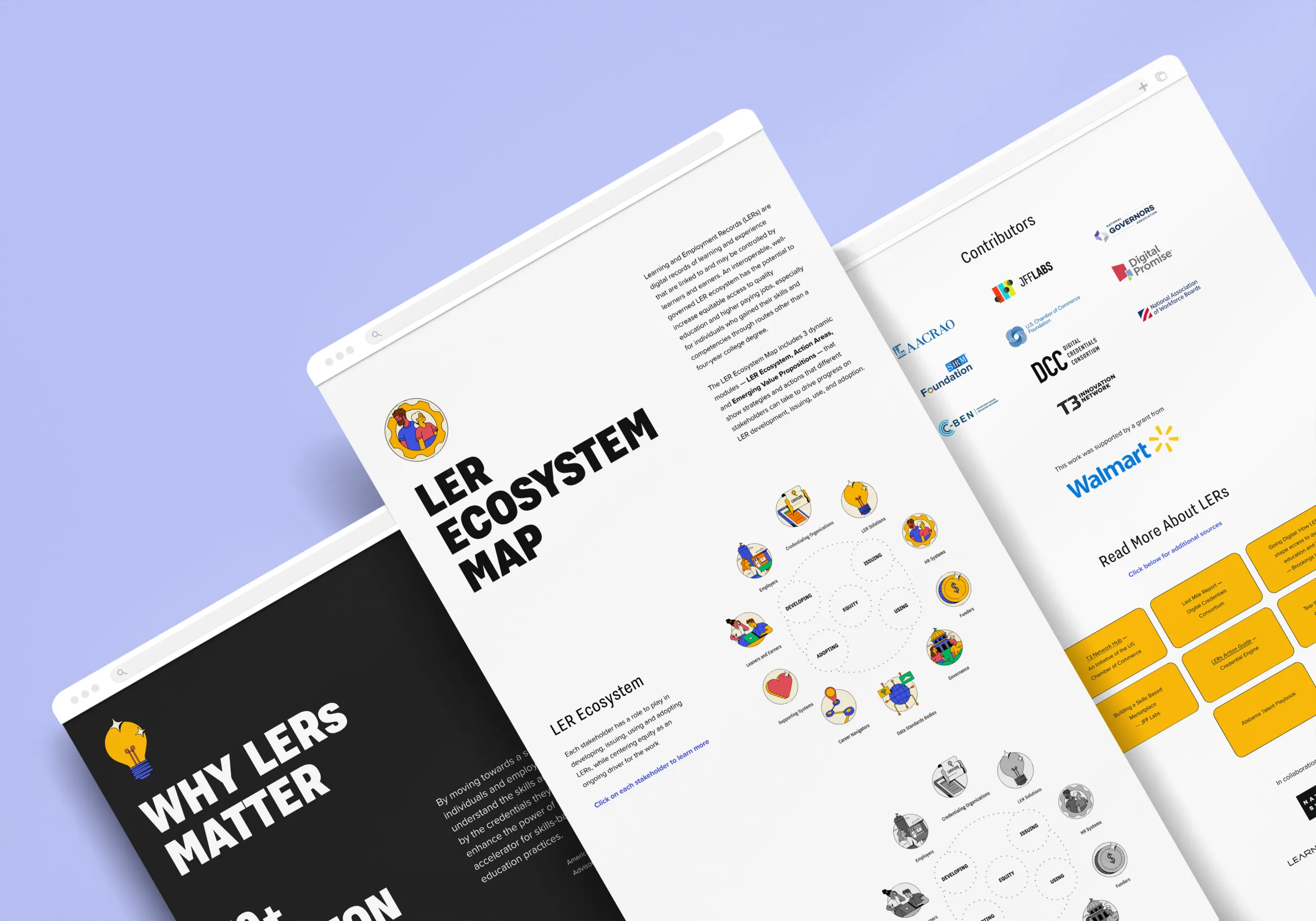
Learning and employment records (LERs) are a vital solution to accelerating the uptake of skills-based hiring while empowering learners and earners to be recognized for their full set of skills from work, education, credentialing, service and life experiences. However, widespread use of LERs is often hindered by a lack of clarity and collaboration amongst the many necessary stakeholders, including employers, credential providers, learners and earners, and policy makers.

Therefore, Walmart brought NationSwell on to work with a Steering Committee of experts in the education, credentialing, equity and hiring space, to create an LER Ecosystem Map that would help people connect the dots across the ecosystem and more easily see how they can take action to drive equity through LERs.

Organizations in the LER Ecosystem Map Steering Committee:

  • AACRAO
  • Competency-Based Education Network
  • Digital Credentials Consortium
  • Digital Promise
  • JFFLabs
  • National Association of Workforce Boards
  • National Governors Association
  • SHRM Foundation
  • T3 Innovation Network
  • U.S. Chamber of Commerce Foundation

NationSwell worked closely with the Steering Committee to undertake thorough research to establish the goals and needs for the LER Ecosystem Map.

Through desk research, in-depth interviews, a diverse focus group, workshops, and months of cross-team collaboration, content drafting, design work and data visualization, our teams engaged 50+ individuals to help develop an interactive digital experience, accessible to stakeholders across the ecosystem, that clearly demonstrates opportunities for engagement, collaboration and action.

Through our three workstreams — establishing a hypothesis, research and development — the team discovered learnings, opportunities to drive adoption, and insights gaps that informed how the LER Ecosystem Map should come to life. The map launched at a pivotal point in LER development, providing many large and small players in the space with vital clarity on how to take action.


Share this report