Closing the technology gap: Why it’s a critical time to train more women

Projections of the future dominate the global technology conversation, with business leaders, politicians, and pundits fueling headlines about how a new era of innovation will transform our world. What’s missing from this discourse, however, is a focus on how we will ensure we have a sufficient pool of professionals with required skills in the industry behind this transformation.

The workforce responsible for forging our digital future should not exclude broad swaths of the population. Yet women continue to be significantly underrepresented in fast-growing technology fields that urgently need more talent.

Consider artificial intelligence (AI). New AI technologies are playing a growing role in enterprises around the world and in our daily lives. Yet there’s concern that half of all needed AI positions may not be filled as this technology rapidly evolves. Training more women, who only comprise one quarter of the current AI workforce, could close this gap.

This imbalance — and acute need for more experts — also extends to cybersecurity, where women represent about 20% of the field. The cybersecurity workforce is growing, but not fast enough: it still needs to increase by nearly 75% to address skill shortages. This estimate comes as cyber threats are becoming more frequent and complex, meaning more cybersecurity professionals with critical skills will be needed to navigate the tremendous challenges ahead.

A sudden reversal in these trends is unlikely. Technology-related roles are the fastest- growing jobs, according to the World Economic Forum’s Future of Jobs report, and the most in-demand skills include those in AI, cybersecurity, and technological literacy. At the same time, skill gaps are perceived as a primary obstacle to business transformation, a key finding also highlighted in the Kyndryl Readiness Report, a global survey of 3,200 business and technology leaders exploring how ready businesses are for the future.

We’ve reached a critical moment to close these gaps. But just as technological advancement depends on the efforts of many, no single organization can do so alone.

Clearing the first hurdle

Czechitas, a non-profit organization committed to enabling women to thrive in technology careers, has a 10-year track record of training women with advanced digital skills in numerous IT domains. Founded by three young women in IT, Czechitas has since trained 76,000 women in areas like data analytics and UX design. The organization continues to advance its mission of removing the financial and other barriers that make it difficult for more women to embark on IT careers by providing full scholarships that make learning accessible to all.

With a grant from the Kyndryl Foundation and support from other partners, Czechitas is expanding its education offerings to meet the rising market demand for skills in cybersecurity, AI, and digital transformation. Our organizations have experienced firsthand how cross-sector partnerships can help more women join, advance, and succeed in fields like cybersecurity and AI, where they’ve been traditionally underrepresented.

We also believe that teams with a breadth of experience and perspectives can be a business strength. The ability to problem-solve from multiple angles can drive innovation and help solve emerging challenges — addressing bias in AI models, for instance, or identifying a broader range of cyber vulnerabilities as attacks become more sophisticated.

The greatest impediment to more women pursuing careers in technology, however, is often getting them to walk through the classroom door. Women are less likely to enroll in AI training courses, for example, and they’re even less likely to use AI tools like ChatGPT.

In the Czech Republic, women represent about 9% of IT specialists — one of the lowest rates in the European Union. We find that women struggle to imagine themselves pursuing technology careers due to persistent stereotypes and perceived barriers to professional advancement, like the “motherhood penalty.” Falling behind in skills development in any field can be difficult; that’s doubly true in technology, where change is so constant that a few years away can mean starting over.

These stereotypes fade as women connect with other intelligent, ambitious peers and mentors, and as they recognize the economic benefits of honing competitive skills or the work-life balance that a career in IT can offer. But encouraging that first step toward technology depends on representation. When you’re a minority in any field, it’s only human to ask, is this space really for me? We want the response to be a resounding “yes.”

Building inclusive programs

To build inclusive training programs, lead with empathy. Organizations can encourage more women to begin and succeed in training by creating peer-to-peer learning communities where women are mentors and leaders. Flexible course options that welcome women from all walks of life and provide scholarship support can also help students overcome pervasive financial and social barriers.

Because everyone brings their own experience and learning style to the classroom, Czechitas designs courses that include both in-person training and self-study opportunities, enabling each student to find the right balance. The curriculum is constantly updated to reflect the rapid pace of technological development with a focus on practical knowledge. Partnerships with technology companies can enhance this hands-on experience: students can learn from senior experts in the field and companies can benefit from new hiring pipelines.

For markers of success beyond important metrics like program completion and career progression, look for signs of infectious passion. At Czechitas, many teachers and mentors work on a volunteer basis. You know you’re on the right track when alums return to volunteer because training changed their lives. Or when cohorts of students stay connected years after training ends, supporting each other as their careers advance.

We’re excited to see the contributions students like these will continue to make in technology and the role they’ll play in encouraging more women to join their ranks. But we also recognize that bridging these divides — whether related to gender, skills, or opportunity — requires a global effort. We encourage organizations to join us in our efforts to shape a better future.


The views and opinions expressed in this article are those of the authors and do not necessarily reflect the views and opinions of NationSwell.

What’s Ahead in Social Impact and AI

As we step into 2025, AI technologies are primed to drive even greater innovation around societal challenges, from fostering inclusive growth to expanding educational pathways and beyond. But AI is also going to continue raising important ethical questions while carrying the potential to drive new inequities.

At NationSwell’s recent roundtable discussion, What’s Ahead in Social Impact and AI, leaders and innovators across sectors joined featured panelists Vilas Dhar of The Patrick J. McGovern Foundation, Nathan Froelich of Blackbaud, and Stephen Plank of The Annie E. Casey Foundation to share strategies on how AI is currently being leveraged to meet societal challenges and surface ethical considerations and best practices for responsible AI implementation moving forward.

Here are some of the key takeaways from the event:


Insights:

Philanthropic funders have a key role to play in ensuring nonprofit partners get the AI  tools they need at scale. New technologies have the potential to serve vulnerable communities, including by organizing decades of longitudinal research and creating predictive engines that can improve community wellbeing. But given the corporate power dynamics surrounding how tech is built and deployed, we need philanthropies and companies to step forward and advocate for the technology solutions their partners need on the ground, in order for them to be created at scale. Funders have a unique opportunity to come together to build shared capacity, new institutions, and resources in order to ensure that future investments in AI go toward honing its potential to create new pathways to dignity and justice in the world.

A good intelligence strategy will require us to be extremely intentional about governance. One of the most pressing challenges posed by AI will be how we can leverage and deploy it in a way that doesn’t harm people and the planet. We need to set up effective systems of governance, paying attention to how we’re deploying generative AI both within our own organizations and in the marketplace. The development of a set of guiding principles will be instrumental in determining which technologies your organization ultimately adopts, ensuring that the tools you’re using meet your ethical standards.

The creation of empowerment councils can help you tap into the most salient use cases for AI. Convening grantees and employees and giving them the access and latitude to experiment with AI can be one way to fuel unfettered iteration and innovation. Providing the tools and encouraging experimentation and exploration can help to surface the most salient examples of how they’re using new technologies to be more productive and support goals effectively, which can ultimately be helpful in deciding when and how to scale solutions appropriately.

Private-public partnerships hold great potential in shaping AI decisions and adoption. Engaging directly with tech funders through roundtable discussions can help to surface innovative ways to leverage private sector partnerships for tool licensing and technical assistance. Similarly, building peer learning communities where government leaders can access AI expertise and collectively develop approaches to service delivery and technology procurement can be powerful ways to shape policy decisions. 

AI’s potential to displace or disrupt jobs depends on which workforce you’re talking about. While there is good research to suggest that corporate leaders do not expect AI to contribute to significant disruption in white collar jobs, those outside of traditional 9-5 roles still face challenges to upskilling, and in many cases AI is being developed with goals that run counter to the interests and livelihoods of low income and nontraditional workers. At the same time, new technologies also hold the potential to help workers maintain and build power by facilitating organization among union members, helping workers to file wage theft claims, visualize data, and influencing state policy decisions. Let’s explore that potential.

Augment and Evolve: Empowering Workers in an AI Driven World

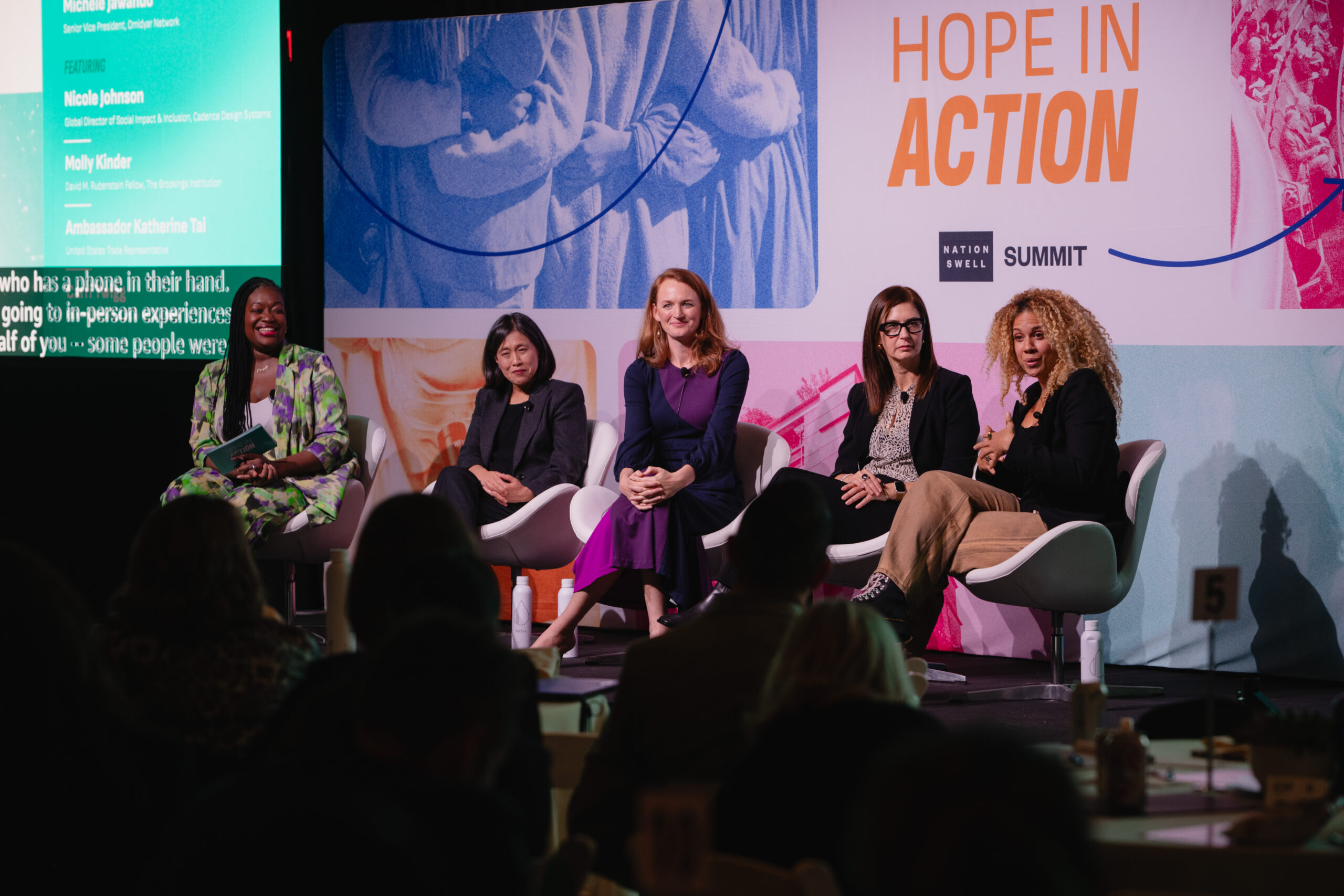
At a moment of unprecedented technological evolution, we stand at the crossroads of digital transformation and human potential. NationSwell Summits’ thought-provoking panel, “Augment and Evolve: Empowering Workers in an AI-Driven World” — presented by Omidyar Network — explored just this. Featuring an all-women lineup, moderated by Michele Jawando, Omidyar Network, joined by Nicole Johnson, Cadence Design Systems, Molly Kinder, The Brookings Institution, Carri Twigg, Culture House Media, and Ambassador Katherine Tai, United States Trade Representative, the panel illuminated a critical pathway forward: focusing not just on how AI will shape the future, but how we in turn can shape the future of AI. 

As moderator and Senior Vice-President at the Omidyar Network, Michele Jawando pointed out, AI has dominated the public conversation since Chat GPT first launched, but that conversation has been baked in fear as much as possibility. The panel situated their conversation at the intersection between the two as they discussed who will be most impacted by this new technology and how we can ensure that we all have a voice in shaping its advancement. 

Here are some key takeaways from the discussion: 


Workers must play a role in the development and implementation of AI technology and policy.

Jawando first turned to Molly Kinder, David M. Rubenstein Fellow at The Brookings Institution, to lay the groundwork for the conversation with her research into the impact of AI on workers. 

“The reason this is capturing our anxiety and our imagination,” she said, “is that generative AI is upending a lot of experts’ advice about how to stay ahead of technology.” She went on to elaborate that in the past, that advice focused on developing expertise, creativity, and empathy. But AI is advancing so quickly that its ability to mimic those qualities is putting white collar workers and creative industries on the frontline of technological disruption. 

U.S. Trade Ambassador Katherine Tai also noted that we have seen disruption like this before, particularly in trade. We are still reaping the consequences of the development of globalization and free trade, which left workers behind as it reshaped the economy. 

“Trade and technology actually have very similar impacts on the economy and on the workforce,” she stated. “They both have displacing effects, and they both go to this capitalistic pursuit of efficiency and cost minimization.” 

But both Kinder and Tai reminded us that who gets to participate in conversations around AI is critical in ensuring that AI can be a force for good. And the NationSwell audience is uniquely suited to that goal. “You are the people who are focused on figuring out how that power is used, and how that power can be used for good,” Tai said, addressing the room. 

“A lever that this room in particular can be so impactful on,” Kinder said, “is at the workplace, and as employers… making sure that employees and workers have a real seat at the table.”

Women are on the frontline of AI as a disruptive technology. 

Kinder highlighted that her research also shows that women are more exposed to the impacts of generative AI, for two reasons. First, because the jobs most likely to face automation by this technology are predominantly held by women – clerical and customer service work, as well as positions like bank tellers and paralegals. And second, because women are underusing this technology compared to men. 

But fellow panelist Nicole Johnson, Global Director of Social Impact at Cadence Design Systems, is on the case. Johnson shared that at Cadence Design Systems, they’ve seen a 50% increase in women in technical positions over the last ten years and they are taking that playbook into the world with the launch of Fem.AI and a $20 million commitment to close the gender gap in AI. 

“We looked at this AI development, this AI economy, the AI revolution that’s happening and we looked at it as an opportunity space. How can we ensure that unlike the development of the internet that happened 30 plus years ago there’s intentionality about the workforce that is behind this technology?” she said. 

As creative industries face challenging shifts in technology and the attention economy, how can we protect art’s breadth as well as its depth? 

“[Artists] have the most to gain, and we have the most to lose,” said Carrie Twigg, Co-founder and Head of Development for Culture House media. “But that’s also true for audiences, and people who consume art.” 

Creatives, particularly in media, face significant pressure. Not only does AI already have a foothold in how we edit movies and TV, but consumers frequently split their attention between several screens at once. As Twigg noted, we’re always half looking at our phones, and that creates a downward pressure on creatives to make content that doesn’t require as much of our attention or discernment. And she added that while there has always and will always be high art, it’s that middle class of media, the shows that everyone watches but that don’t usually win awards that are most vulnerable. 

“That medium tier where people really spend their time has this awesome power to shape who we are and who we become and that is the most threatened by the AI landscape…and what we’re really going to miss if we don’t build in protections for it. It may not make immediate obvious economic sense but we have to think about it in a longer term way.” 

The panel provided critical insight on the challenges AI presents, and the importance of intentionality throughout the process of developing technology and integrating AI into our lives – not just in how we use it, but in who is in the room, and what we should preserve from AI’s influence. But how the panel channeled the theme of Hope in Action can best be summed up by Michele Jawando’s last words. She got into tech policy because of Star Trek and left us with the image of Captain Picard using technology to boldly go where no man has gone before to save civilizations all over the galaxy.

“Humans first, technology second,” she said. “Let’s do it together.”


For more moments from NationSwell Summit 2024, click here. 

Impact Next: An interview with LinkedIn’s Meg Garlinghouse

At a moment of growing inequality and division, who is advancing the vanguard of economic and social progress to bolster our most vulnerable communities? Whose work is fostering the inclusive growth that ensures every individual thrives? Who will set the ambitious standards that mobilize whole industries, challenging their peers to reach new altitudes of social impact? 

In 2024, Impact Next — a new editorial flagship series from NationSwell — will spotlight the standard-bearing corporate social responsibility and impact leaders, entrepreneurs, experts, and philanthropists whose catalytic work has the potential to shape the landscape of progress amid urgent need for social and economic action.

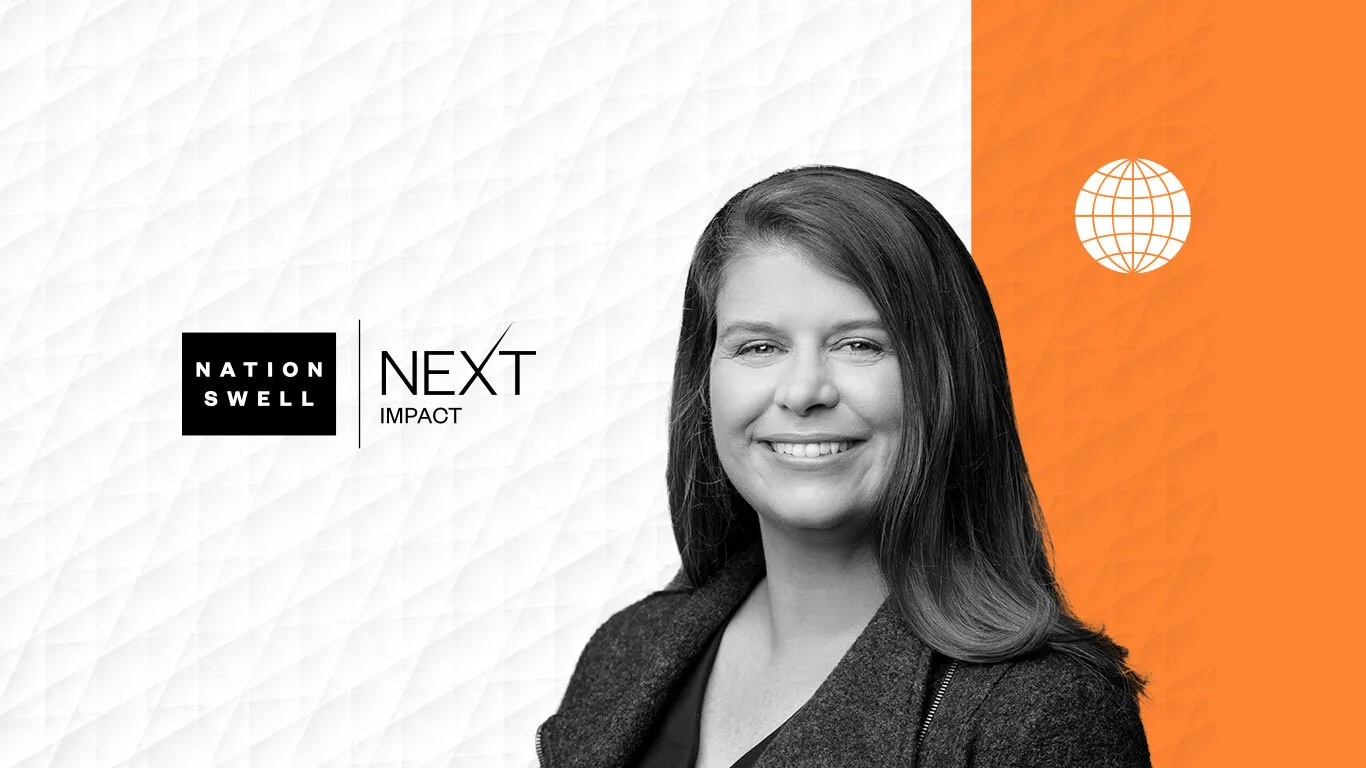
For this installment, NationSwell interviewed Meg Garlinghouse, Vice President of Social Impact at LinkedIn.


Greg Behrman, CEO and Founder, NationSwell: What brought you to this field? Was there a moment in your life that galvanized your commitment to driving bold action on social and economic progress?

Meg Garlinghouse, Vice President of Social Impact, LinkedIn: I grew up in Topeka, Kansas, in a very middle class community. I went to an average public high school, where it was very uncommon for kids to go to college out of state, but my parents were adamant that we did. They had the resources and the determination to make that happen — they drove me to Kansas City to take the SAT and they took me out of state for college visits. Their guidance and support every step of the way helped me to excel in high school and get into college.

I’ve always been hyper aware of this privilege and believe I’m ultimately a product of my circumstance because of the family I was born into. This belief and experience has fueled my motivation to help enable social and economic mobility for others.

Behrman, NationSwell: Looking back at the scope of your career, how have your thinking, your strategies, your leadership style, or your philosophies evolved over time?

Garlinghouse, LinkedIn: One of the ways my impact philosophy has evolved over the years is focusing our vision and strategy much more “up river”. This means broadening our focus to address the root causes of social issues in addition to the symptoms, and we have several initiatives underway at LinkedIn to move this work forward.  

First, we work closely with our data scientists and engineers to ensure that the technology powering our platform and products is inclusive of all members of the global workforce. Second, thanks to one of my team members, Kavell Brown, we kicked off the LinkedIn Social Impact Global Root Causes Fund, which we started in Brazil and are expanding to other countries. The Fund focuses on root causes of inequality and includes a participatory process for grant-making that supports the organizations doing the direct service work.

Today my greatest conviction is making sure that LinkedIn is truly a place for everyone to find opportunity, connect with new people with diverse perspectives and learn the skills they need to be successful in the evolving workplaces. We have a responsibility to ensure that this new world of work, powered by artificial intelligence (AI), is truly building a better world of work for everyone.  

Behrman, NationSwell: Which trends define the current societal and economic moment? Which fill you with optimism, which ones give you pause, and which aren’t getting enough attention?

Garlinghouse, LinkedIn: I think networks are overlooked as critical pillars of economic mobility. Networks are much more than how you get a job — they often determine whether or not you even know that there is a job available in the first place.

We can build a more equitable labor market based on skills. It’s equally important, though, to consider the critical role networks play and apply them in a way that unlocks their value — ensuring that they serve as avenues to connect people to other perspectives, individuals, and experiences.

One way we do this at LinkedIn is through our signature social impact program, LinkedIn Coaches, where LinkedIn employees connect with professionals overcoming barriers to review best practices for LinkedIn profiles, learn how to network and practice interviews, either in 1:1 sessions or group settings. This program helps to build networks through career conversations with mentors and LinkedIn platform training, and it ends up being really impactful — not just for the jobseekers, but also for employees to learn and get a sense of what job seekers are actually facing. We also encourage members to reach outside of their networks with LinkedIn’s Plus One Pledge to help level the playing field and close the network gap.

Finally, when we’re looking at access to economic opportunity, a conversation that’s now more urgent than ever is the one happening around generative AI. Innovation is happening so quickly, and I’m spending a lot of time thinking about how we are meeting this pace of change. It’s important to have strong data foundations so we can measure as we go and maintain a consistent focus on ensuring that our products and platform support all members of the global workforce, in partnership with our engineering teams. It’s also important to ensure we are making critical decisions based on an established set of principles. 

Behrman, NationSwell: Can you elaborate on your specific role in spearheading social or economic progress within your organizational framework? How does your role stand out from other social or economic impact leadership functions, and what is the North Star of your leadership? 

Garlinghouse, LinkedIn: By far the most important attribute in a leader is being able to identify and develop extraordinary talent. If you get the right people on the proverbial bus who have clarity on the “why?” and conviction on the “how,” then work becomes both meaningful and effective.

The other important piece of my leadership style is helping to connect people to their purpose. Linkedin’s vision is to create economic opportunity for every member of the global workforce — not just the people who were born into economic opportunity, but every member. To make this vision a reality, we really need every employee to join us on this journey to ensure that the products and features we are building are benefitting professionals of all backgrounds and experiences.   

Behrman, NationSwell: Of the social or economic leaders who perform a similar function to yours at a peer organization, whose work inspires you, and whom you hold in high esteem?

Garlinghouse, LinkedIn: I deeply admire Erin (Baudo Felter, the Vice President of Social Impact and Sustainability) at Okta. She’s one of those people who got smart on issues quickly; she is impressive and has been taking bold steps to meet the moment we are in. For example, I love the work she’s doing around investing in tech executive talent for nonprofit boards.

Behrman, NationSwell: Could you recommend any insightful resources – maybe a book, report, podcast, or article that has significantly influenced your thinking?

Garlinghouse, LinkedIn: One book that has really helped to shape my thinking is From Generosity to Justice: A New Gospel of Wealth, by Darren Walker, which really challenges the reader to think about philanthropy as a tool for achieving economic, social, and political justice – and not a bandaid to cover or address the symptoms.

One of the best podcasts I’ve listened to recently is Kelly Corrigan Wonders’ conversation with David Brooks. It really has everything — leadership, how to make sense of the craziness in the world, how to think about individual responsibility. 

I also think everyone needs to spend time learning about advancements in Generative AI. Henry Timms has an article in the Harvard Business Review that has really evolved how I’m thinking about it, and Fei Fei Li is another leading voice — she’s brilliant, clear, pragmatic, and humble. We’re in this moment where AI can become a force for good, but it won’t happen by chance — it will only happen by design. 

Impact Next: An interview with Amazon Web Services’ Maggie Carter

At a moment of growing inequality and division, who is advancing the vanguard of economic and social progress to bolster our most vulnerable communities? Whose work is fostering the inclusive growth that ensures every individual thrives? Who will set the ambitious standards that mobilize whole industries, challenging their peers to reach new altitudes of social impact? 

In 2024, Impact Next — a new editorial flagship series from NationSwell — will spotlight the standard-bearing corporate social responsibility and impact leaders, entrepreneurs, experts, and philanthropists whose catalytic work has the potential to shape the landscape of progress amid urgent need for social and economic action.

For this installment, NationSwell interviewed Maggie Carter, Director of Social Impact at Amazon Web Services (AWS).

Greg Behrman, CEO and Founder, NationSwell: Maggie, was there an early or formative experience that brought you into this work?

Maggie Carter, Director of Social Impact, Amazon Web Services (AWS): 

It all started with my mom, who always led by example. She was always giving back. Whether it was volunteering in my school library or serving hot meals and donating blankets and clothes to the homeless in the DC metro area, she was always giving her own time and bringing the family along for the journey.

When I was in college, we led our first Recycling Awareness Week to kick off recycling on campus, and that experience of building and running a grassroots campaign is where I first got the bug to do something with a purpose, and throughout my career I was fortunate to find roles that combined that passion with sports.

When I was leaving the NBA, I knew that I wanted to get closer to program delivery on the nonprofit side. I made the transition to the UN Foundation and UNICEF, which combined my focus areas: children, education, and health. And from there, I was pitching AWS and Amazon on what a partnership would look like around disasters, emergencies, and innovation. The AWS team said, would you be willing to come build this from the ground up? That’s how I got to where I am today.

Behrman, NationSwell: At AWS, the products are part of the impact — they’re at the center of things. Can you speak to the philosophy behind that model?

Carter, AWS: For us, it’s very much about how our technology has the potential to transform the ways organizations are delivering their programs or services to impact their communities and their beneficiaries. We look at our role as co-building solutions with organizations and helping them to scale their impact.

For example, in Rwanda, they are leveraging secure messaging and AI on AWS to more effectively and rapidly identify symptoms in cancer patients and connect them to oncologists when their symptoms worsen. In Rwanda there’s just one oncologist to over 3,000 cancer patients on average — there’s a huge demand and low supply of doctors, and by using this messaging app, we’re helping those cancer patients that need more critical care receive it sooner.

We also co-built a solution with a small organization called Operation Barbecue Relief, whose mandate is to feed those impacted by a disaster, as well as the first responders to disaster. So we designed a solution with them called Project Smoke — an application to help track and monitor their food supplies so they can better manage resources and deploy them where they’re needed most. 

Behrman, NationSwell: Is there anything else that feels very important and differentiated that people should know about this work?

Carter, AWS: Each of these solutions is repeatable and scalable, they’re not band-aids. For us, it’s important to stay laser focused on the unique value proposition that the AWS cloud has when we’re engaging with organizations in our key priority areas — specifically around disaster response, health equity, and environmental equity.

Behrman, NationSwell: Is there an attribute or an approach or a philosophy that guides your leadership that has helped to make you effective?

Carter, AWS: I put high expectations on myself and I lead by example, so it’s about finding that balance where there’s a high bar but also empathy for what is going on. 

It’s always been in my DNA to be the fixer, the builder, so shifting that mindset to where I’m coaching and enabling my team and my leaders to identify that path forward themselves — that’s been a big learning for me in the last two to three years. 

I’ll also add that it’s been amazing to see employees rise to the occasion. Shifting to this approach really helps them build confidence in themselves to find that path forward — it equips them to be successful critical thinkers, here and beyond.

Behrman, NationSwell: Who are some of the peer leaders you really admire that you want to shine a spotlight on?

Carter, AWS: One who really stands out is Jacqueline Fuller, formerly at Google.org — she is at the bleeding edge, and I was fortunate to work with her and her team when I was at UNICEF USA on some pretty strategic partnerships around Zika and Syrian refugees. I want to also mention Leisha Ward at Target, Paul Poman at Unilever, and Kayleen Walters, the head of impact at Minecraft. 

And finally, my mentor, Kathy Behrens at the NBA. Throughout my career, since I worked for Kathy, I’ve always thought to myself, “what would KB do?” What she’s been able to do with the NBA over time, launching NBA Cares, shifting to the social justice initiative, launching the foundation in the last few years — it’s been amazing to see.

Behrman, NationSwell: Are there any resources — books, essays, poems, quotes — that have informed your leadership that you might recommend to other leaders?

Carter, AWS: I love stories of perseverance — those human interest stories where you see what somebody was able to achieve when everybody doubted them, especially in sports.

I particularly love “The ‘99ers” — the documentary follows the U.S. women’s national soccer team that won the World Cup in 1999. I remember watching it live and crying about how this was opening up opportunities for future generations of women moving forward. I think that team gave women and young girls confidence in themselves to be able to push boundaries, to push the envelope, to go where other girls haven’t been able to before.

ESG Next: An Interview With PJMF’s Vilas Dhar

At a moment of unprecedented attention, investment, and opportunity for the emerging field of Environmental, Social, and Governance (ESG), leaders are asking: Who is best preparing their organization for the society of the future? Who is innovating today to meet decades-long environmental and social goals? Who is setting standards that catalyze their industry’s change for the better? Who is defining what bold and aspirational look like — and how best to advance that work in practice?

Enter NationSwell’s ESG Next, an exemplary group of investors, executives, authors, philanthropists, social sector leaders, academics, and field builders who are helping to shape business as a force for social and environmental progress, advancing — and even pioneering — the most forward-thinking and effective programs, initiatives, technologies, methodologies, practices, and approaches.

For this installment, NationSwell interviewed Vilas Dhar, President of the Patrick J. McGovern Foundation (PJMF), about what this moment in artificial intelligence (AI) means for ESG practitioners, the importance of pushing past digital literacy and towards digital agency, and the big questions that leaders should ask as we build an equitable and human-centered future enabled by technological innovation.

Greg Behrman, CEO + Founder, NationSwell: Tell us how your professional and personal journey led to this work.

Vilas Dhar, President, PJMF: My life’s journey has been defined by an insatiable curiosity and a commitment to accelerating innovation that sustains human aspirations, creativity, and joy. This socially minded curiosity was shaped by the time I spent with my grandfather in India.  At the start of each visit, I would proudly show him the new tools or gadgets I was developing and he’d always respond in the same way, “Now that I’ve seen how much joy and creativity these tools bring you, how can they also uplift the people in your community, in your family, in the world around you?” 

That question defines so much of my journey and is one I continue to ask myself today. I’m an incredible optimist about the world that we can build together, and that optimism started at a very young age. I had early exposure to amazing technologies: from exploring firsthand the technical innovation behind my favorite video games to hearing my mother describe how a computer was changing her job as an administrator at a university. I saw all the incredible ways these tools helped us spend more of our time doing the things that actually mattered — like connecting to each other — and helped us move away from rote mechanical tasks. Because of these technologies, we were able to use our creativity and inspiration to build cool things that, in a way, improved our lives. 

But at the same time that I was growing up and seeing all the transformative potential of technology, I also spent a lot of time with my family in rural India — in a world where technology hadn’t yet entered the picture. We’re not talking about computers here; we’re talking about basic things like power and running water. I remember these movements of contradiction so clearly because they highlight the frustrating tension that shapes so much of my professional journey: on one side, I have an unshakeable optimism about what we accomplish through ingenuity and shared action; and on the other, I can’t fathom why we are okay with a world where only a few get to enjoy the benefits of that innovation – simply because of who they are or where they grew up. 

We have to change that. 

Behrman, NationSwell: You’re an expert on artificial intelligence. What can you share to help moor ESG practitioners around what this current moment means? How can we lean in?

Dhar, PJMF: When I look out at the world, it feels like there’s actual potential for a transformation of power. These technologies are creating new agency for people across the planet, and we’ve been given — right here, right now — a chance to make decisions that include technology, but aren’t just about technology. They’re about who gets to participate, who gets to decide, and who gets to inform those decision makers. They’re about the uniquely human element of this transformation – one that will affect us all.

The big question isn’t about asking how to better understand these technologies and map their potential to the social justice work we do. We’ve already seen these new technologies do amazing things, from empowering frontline earth defenders to predict and stop illegal logging and poaching, to revolutionizing the efficiency of humanitarian aid delivery after a natural disaster. Now the big questions we need to ask are around our values and what we hold dear; how we’d reshape our very society; how we’d think about democratic and inclusive political processes to amplify marginalized voices; how we’d measure the value of our time and our labor; and how we’d re-design our governance structures and mechanisms of participatory decisionmaking.

We built an entire class of institutions after World War II that did amazing work in creating new economic opportunity and uplifting people across the battered postwar world — but that was almost 75 years ago. And while the private sector has moved forward and civil society has moved forward, we have to ask whether these institutions are ready for the challenges of the 21st century. Are these institutions fit to tackle the enormous scale of global hunger, injustice, climate change, pandemics, and beyond? Our positive frame is to ask, how do we convene all the different stakeholders in society to uplift global majority voices — and not just the Global North? How do we build new multilateral institutions that are fit-for-purpose, community-driven, and resourced to proactively address the major global challenges that we will face over the next 100 years?

Behrman, NationSwell: What are some activations that might enable leaders to better meet this moment?

Dhar, PJMF: Two categories come to mind: intention and action. We have to name and hold a set of intentions around building more inclusive and participatory decision-making infrastructure. That requires those who hold power to open the doors for those who aren’t traditionally included in those rooms, and it requires them to build trust with underrepresented or marginalized individuals so that they are willing to engage with us. 

I have deep trust in communities to define and shape their own destiny. So often, we’ve assumed that those who hold the power, privilege, and tools we are speaking about can make decisions for everyone else. But the truth is, communities are great at defining their own course. If we don’t intentionally engage them as the architects of their own future and proactively equip them with the right tools, opportunities, and support to succeed, then we’re missing the point.

Then, we have to understand that every person on the planet needs to experience not just digital literacy, but digital agency. It’s so easy to say that AI is this new thing on the horizon that’ll affect us in some profound way, but we actually need to understand these tools well enough to determine what their consequences might be on our lives. We need to create and nurture a shared and accessible language to discuss these tools and advocate for equity, justice, and human rights as they proliferate around us. That’s both an individual and collective intention we have to set. 

And then there’s the action. We need a new social conversation about what economic and moral structures we want to build. And we need to include voices across civil society, across government, across business, and across communities. We need conveners who will step forward to bring those groups together. And we need a bold willingness to act, to begin implementing what comes out of these conversations. I believe deeply in honoring human inspiration; what I mean by that is if someone has an amazing proposal, we can talk about it for months or we cantry it within just weeks. It’s the latter approach that will inspire and cement positive change.

Behrman, NationSwell: What are some unique programs or initiatives you’re leading at PJMF that other leaders may benefit from knowing?

Dhar, PJMF: We are re-envisioningwhat it means to be a philanthropy in the 21st century – where  grant making is now just one of the many tools we have to build public trust. We’ve restructured how we think about strategic intervention in civil society, moving from an idea where people apply for a grant and we make a decision — which just feels so disconnected from the outcomes we’re looking for — to a process in which we first strategize with civil society around what an ideal future would look like, and then collaborate with them to build programs to advance that future. That means, while we still make a lot of grants, we also partner directly with nonprofits to build capacity around data and AI, and we partner with governments and academic institutions to build entirely new frames of reference for human-centered AI.

To this end, we’ve recently built and deployed a new initiative called the Centre for Trustworthy Technology in partnership with Deloitte and the World Economic Forum. Together, we’re creating an entirely new convening space to think about policy for the AI-enabled age. We work directly with communities across the United States to support the idea that those who have traditionally been left out should be key architects of not only our technologies, but also of the societies we live in — groups like CodePath, Per Scholas, and The Hidden Genius Project.

We also work with AI scientists from Indigenous communities, and our work with the International Wakashan AI Consortium is emblematic of our approach. We support AI code camps on Indigenous sovereign lands to train young people to harness the power of these technologies and to give them a pathway to educational and professional opportunities. We also support their efforts to build new AI tools and models to preserve Indigenous languages, capturing thousands of years of ancient wisdom and applying that wisdom to a world that uses AI to translate and help young people connect to their own stories. 

Behrman, NationSwell: To which leadership practices do you most attribute your effectiveness?

Dhar, PJMF: My leadership style stems from a core belief that leaders have to be willing to call out what’s wrong in the world today; to call out inequity, injustice, and systemic exclusion as antithetical to the world we want to create. One key part of how I practice leadership is that I question the way things are done, and whether what we’re doing today is actually helping to build a better world. There are two benefits to asking that question. The first is more straightforward: if what you’re doing isn’t actually helping, you can ask the hard questions about what it will take to change the course of your actions; and the second is that by taking this first step as a leader, you enable and empower the community of people who work with you and around you to be able to do the same. 

This is a shared journey. If those of us on the journey can say we don’t like what we do, and if we can say we know there’s a better way, then the question you’re left with becomes a very human one: How do we come together to do better? And the answer to that question contains the real work of leadership, which is all about building trust; about becoming more humble and more curious so that others can make their voices heard; about making sure that our outcomes and our visions are aligned. As leaders, we need to demonstrate that we are truly accountable to each other; and we need to find and build spaces of shared joy to actually incentivize us to do more and do better.

When it comes to some of the issues that we focus on, we’ve become comfortable with the idea that there are technologists who make technology decisions and policymakers who make policy decisions. But for us, leadership is about empowering communities to know that technologists and policymakers should act as representatives of community interests, and that communities, too, have a right to participate in these decisions. At the end of the day, we want to affirm and show that we are here to support and serve communities along their own journeys of self-advocacy and self-actualization. And that also implies a responsibility for us to take shared ownership over the decisions.

Behrman, NationSwell: Who and what are inspiring your leadership right now?

Dhar, PJMF: At a foundation like ours, I come into contact with so many inspiring trailblazers, movement builders, and bold disruptors every day – that I couldn’t possibly name every one. But I’ll name a few here. Brandon Nicholson  runs The Hidden Genius Project, an amazing intervention that gives young Black men a full suite of support and engagement to help them find professions in technology. The Project started in Oakland, but Brandon scaled his work to multiple cities around the country; he’s just an amazing, incredible emerging leader. Gabriela Ramos, the Assistant Director-General of UNESCO, has taken this very deep international, global majority approach to thinking about how AI and technology are transforming all of our political structures. She’s a great writer, an inspiring leader, and a trusted colleague and friend. Michael Running Wolf is an Indigenous AI scientist who has committed his entire life to using these tools to connect people to the stories and wisdom of Indigenous culture. Through his leadership, we have begun to foster the next generation of young Indigenous coders, scientists, and changemakers. 

I also want to highlight the work of our partner: Tara Chklovski at Technovation — an organization that teaches girls technology and leadership skills to catalyze climate action across the globe. PJMF is proud to support and partner with civil society leaders like Tara, who are revolutionizing the application of technology to further social impact, gender equity, and empowerment. I’m sharing a recent quote of hers from THE Journal: “At Technovation, we want to champion the equitable adoption of new technologies and acknowledge as an opportunity that our students must learn how to engage with ChatGPT and use it to develop solutions to the world’s most pressing problems.” Tara and I recently hosted a LinkedIn live on “AI and Leadership: A Pathway to Girls’ Empowerment and Climate Resilience,” to dive into some of these problems and how our two organizations are partnering to address them.

In addition to the transformative changemakers I work with, I also derive inspiration from reading. One book that made a unique impression on me and my work was Tomorrow, and Tomorrow, and Tomorrow by Gabrielle Zevin – a story that reminds us of just how important it is to find joy and fulfillment in our lives and the work we do. The second is a tract that I’ve read many, many times in my life: Siddhartha by Hermann Hesse. It’s an inspiring work that shapes acceptance of the many, many paths to our own internal truth.

I also feel fortunate to work in a field that contains such rich discourse from a broad range of sources. For example, Politico’s Digital Future Daily is a tech newsletter that regularly features different experts in the digital space, ranging from Microsoft’s Chief Responsible AI Officer Natasha Crampson, to DAIR’s Timnit Gebru, to the Future of Life Institute’s Mark Brakel. These are critical resources to not only inform communities about how AI and other technologies might affect their lives, but to also foster democratic dialogue around forging an equitable and rights-based approach to AI development and use.


To learn more about how our ESG Next honorees are shaping business as a force for social and environmental good, visit the series hub. PJMF is a NationSwell Institutional Member. To learn more about membership in NationSwell’s community of leading social impact and sustainability practitioners, visit our site.

The Takeaway | Ethical Tech and the Future of Social Impact

Whether it’s a future of work powered by software that supports workers and businesses alike, technology infrastructure to manage sustainable supply chains, improving digital access and safeguards for our democratic process, or removing bias in data and AI platforms that impact marginalized communities, the actions we take in the present to invest in equitable digital platforms will determine whether our collective grasp will ever extend outwards to our collective reach.

During a NationSwell virtual roundtable on May 25th, a group of cross-sector leaders gathered to discuss the role of emergent technologies like generative AI have to play in advancing that impact and what leaders can do to implement ethical digital and technical solutions in order to scale solutions and provide equitable access.

Here are some of the key takeaways:

Organizations must stay disciplined when it comes to asking larger questions about who they’re using AI to serve and what they hope to accomplish. In order to bridge gaps between intent, strategy, and the actual digital products and services that end up being built, companies must establish clear mandates and decision matrices about how to best serve the populations they’re working for. One of the first steps to guaranteeing alignment should be to make sure that clear lines of transparency and clear moral imperatives are present throughout the entire organization. 

The adoption of an “ethical ombudsman” can help to ensure a shared ethical responsibility. Rather than adopting “shiny new tech” just for the sake of doing so and then allowing the ethical buck to get passed on to the tools themselves, companies and individuals should take a more active role in assuming the ethical burden by creating a new position designed specifically to oversee projects at the organizational level and evaluate the potential risks and harm that new technologies can pose to individuals and communities.

Train new systems with humanitarian concerns, not just technological ones. The tech we use broadly everyday (internet, social media, etc.) was created by a relatively small group of people, technologists who are good at making things, but not necessarily experts at holistically considering the ecosystems and people that will use that tech in everyday life. To solve for this gap, we’ll need to build better and more intentional methods to ensure that public interest is baked into design — potentially by hiring folks with humanitarian backgrounds to serve as model trainers and by ensuring more cross-sectionality in design phases.

Drawing distinctions between the types of potential harm that new technologies can cause will be critical to mitigating the damage. We need to think about potential technological harm as falling into two distinct categories: acute harms and institutional harms. The former includes harms done to the individual, while the latter includes harms to communities and populations. These different types of harm will require unique interventions, and getting clear on which is which will be the first step to any mitigation strategy. 

Pathways to widespread adoption of potentially transformative new technologies must be established in order for underserved populations to thrive. In addition to ensuring pathways to adoption, it’s also imperative to bring in the people who stand to be most affected by the digital divide during the design process and incorporate their feedback into the build. Bringing boots on the ground into the regulation process and having the right people around the table to help in the decision making can also be a way to reduce inherent bias.

ESG Next: An Interview With IBM’s Justina Nixon-Saintil

At a moment of unprecedented attention, investment and opportunity for the emerging field of ESG, leaders are asking: Who is best preparing their organization for the society of the future? Who is innovating today to meet decades-long environmental and social goals? Who is setting standards that catalyze their industry’s change for the better? Who is defining what bold and aspirational look like — and how best to advance that work in practice?

Enter NationSwell’s ESG Next, an exemplary group of investors, executives, authors, philanthropists, social sector leaders, academics, and field builders who are helping to shape business as a force for social and environmental progress, advancing — and even pioneering — the most forward-thinking and effective programs, initiatives, technologies, methodologies, practices, and approaches.

For this installment, NationSwell interviewed Justina Nixon-Saintil, Vice President and Chief Impact Officer at IBM, about why passion and partnership are paramount to an ESG leader’s success, why engineering and corporate social responsibility work go hand-in-hand, and why the future of ESG might just be its “S.”

Greg Behrman, NationSwell CEO + Founder: Tell us about your personal and professional journey, and how it led you to ESG work.

Justina Nixon-Saintil, Vice President and Chief Impact Officer, IBM: If you told me 30 years ago when I was studying to be an engineer that I would be working on corporate social responsibility and ESG, I would not have connected the dots to see how that could be possible. My focus then was on getting a job in engineering that would let me take care of myself. I’m an immigrant from Dominica who came to the South Bronx, an area that has been challenged by its high crime rate. My mom is an educator, and she really pushed the idea that education is the way out of poverty — how we become successful, here and anywhere.

But when you think about it, what engineers actually do is solve some of the biggest problems in the world. I always loved taking things apart and putting them back together just to see how different pieces could fit, and how things worked on the inside. And in that sense, my education in engineering is directly connected to where I am and what I do today.

Behrman, NationSwell: How do you think about this moment in ESG?

Nixon-Saintil, IBM: There’s such a sense of urgency right now. When you think about how quickly technology is advancing, when you think about climate change and the urgency around it, when you think about the pandemic and its global impact, you realize this unprecedented urgency is driving everyone to figure out how you move from theory to scaling, and reaching the masses — because these pressures are impacting so many people.

You have marginalized populations who are being left behind. You have vulnerable communities who are being impacted by climate change. You have diverse subsets of the population who are still underrepresented in tech and other well-paying fields. And everyone is coming together now to say, this is not something any one company or any one entity can do alone. 

I remember going to meetings a long time ago where we would always start by identifying the problem we were trying to solve, and I would sit there and think, “We already know the problem.” It would frustrate me. What’s different about this current moment is you don’t have conversations like that anymore. It’s not a discussion about what the problem might be, it’s a move to determine how we scale and invest and actually solve the problems that we know exist.

Behrman, NationSwell: Where do you see the field going next, and what’s driving that shift?

Nixon-Saintil, IBM: I just read that almost half of Fortune 500 companies have made an aggressive commitment to reach carbon neutrality in the near future. And it made me think, what does a commitment like that look like for the S in ESG? 

I think you’re going to start seeing a lot more excitement and focus on social factors like human capital management. We’ll still talk about the E and the G, but when we do, we’ll approach it from a way that always straddles the S — like the just transition, or how companies are thinking about the vulnerable communities they impact as part of their net zero commitments.

But along with this excitement, there’s anxiety. So many business leaders are waiting to know more about how we’ll be regulated. A lot of ESG reporting up until this point has been voluntary — ours at IBM has. But we know mandatories are coming, and more will come, and everyone is waiting to see what will be expected of us. I don’t think anything will come as a surprise — especially if you’ve been doing work like this for a while — but I do think we all want to know more about the shape of the landscape.

And where there’s anxiety and excitement, there’s opportunity. Companies and organizations that are thinking through this are looking to us to help solve challenges with them, and we’re excited to partner. 

Behrman, NationSwell: Can you tell us about some initiatives at IBM that are exemplars of your approach?

Nixon-Saintil, IBM: When I started at IBM, there was so much goodness across the company. There were so many things we were doing in the environmental space, in the social space, in the governance space, but at the time, there wasn’t a comprehensive way of communicating this work and making sure that we brought even more awareness to it.

In 2022, we launched our ESG strategy, a framework called IBM Impact. And that was a new initiative for us as a business. I’ve been really proud of this because when you just talk — whether it’s external to investors, internal to your team or to clients — it’s really easy to talk about our framework, our ten commitments that are exemplars that we are going to continue to demonstrate progress against, and it really leads to further conversations, because it’s so much easier to understand how it all fits together. 

I also lead our IBM Sustainability Accelerator, a new initiative my team launched in 2022 that leverages the solutions, software, and expertise of our business around data, and the environmental intelligence suite around our hybrid cloud, and how we bring those solutions and software to non-profit organizations in order to support vulnerable communities that are most impacted by climate change. So we are really excited about the work that we’re doing in the sustainability space. 

The last initiative I want to highlight is the IBM SkillsBuild. Last year, we made a commitment to skill 30 million people by 2030, a huge and ambitious commitment. I felt we needed a north star as a company, because we’ve been a leader in the work that we’ve done around education, skills, badging, and credentials — 50% of our job postings do not require applicants to have a four year degree requirement, a barrier that has left so many populations struggling to find employment opportunities. 

When we looked at all of the work we’re doing across the board, I felt like we could make a significant commitment to skill 30 million people globally. And in fact, last year we we reached around 3.5 million people. It’s just something we can do only with partnerships on the ground, with non-profit organizations, with academic institutions that are closest to the people that we want to impact. So I’m just really excited about those three things.

Behrman, NationSwell: How do you approach social impact and sustainability work? What distinguishes or differentiates you from some of your peers?

Nixon-Saintil, IBM: First, there’s my passion; it’s a must in a role like mine. The most successful people who drive this work are those who are passionate about how business can solve issues like these.  The second thing is, I approach this from the point of view that these problems are solvable through your strategy, which means you have to understand how your company makes money and does business.

Behrman, NationSwell: Can you tell us about some leaders whose work you really admire?

Nixon-Saintil, IBM: I came to IBM under CEO Arvind Krishna’s leadership, and I’ve been impressed with his focused and thoughtful leadership. And that way of thinking has permeated through the whole company. I would say another person is Rose Stuckey Kirk, Chief Corporate Responsibility Officer at Verizon. I learned so much from her about how to “walk the halls” to get the alignment on the things you want to create and move forward, and how to communicate impact so people can understand what you’re doing in a clear and transparent way.


To learn more about how our ESG Next honorees are shaping business as a force for social and environmental good, visit the series hub. IBM is a NationSwell Institutional Member. To learn more about membership in NationSwell’s community of leading social impact and sustainability practitioners, visit our site.