NationSwell op-ed: Predicting the Future of Work

We are currently living through one of the most profound shifts in the history of work. As AI, automation, and other emerging technologies redefine jobs, skills, and career pathways wholesale, leaders across sectors are being called to meet these industry-wide undulations head-on and help shape what comes next.

That imperative is at the heart of NationSwell’s new Workforce Innovation Collaborative — a cross-sector effort designed to help leaders explore emerging workforce trends and co-design scalable solutions for a more future-ready and inclusive economy. Through shared learning, strategic dialogue, and collective action, the Collaborative aims to create the kind of trusted space leaders need to navigate uncertainty and create a future-ready workforce where every person has the skills, opportunities, and support to succeed.

To mark the launch of that work, NationSwell invited leaders from the Collaborative to respond to a shared prompt:

Which emerging signals are giving you the most optimism about the future of work right now? And where do you currently see the greatest opportunity to build a system that is more responsive to where work is headed next?

Although their responses reflect different vantage points, they converge around the common belief that the future of work will be shaped by how well leaders connect learning to real opportunity, pair innovation with inclusion, and design workforce systems that can adapt as quickly as the world around them changes.


Prompt: Which emerging signals are giving you the most optimism about the future of work right now? Where do you currently see the greatest opportunity to build a workforce system that is more responsive to where work is headed next?

“We are at an inflection point in the future of work, and I believe the greatest source of optimism and opportunity is in mastering the art and science of building truly responsive workforce systems.

The science is the strategic leveraging of predictive labor market intelligence. By shifting away from reactive measures, we can now leverage data and insights to anticipate skill demands driven by global trends. Our data provides the scientific rigor needed to pinpoint future talent shortages, standardize risk indicators, and replace guesswork with reliable, real-time insights, allowing us to accelerate our workforce investments across the globe.

However, the true opportunity — the art — lies in translating those insights and data into hyper-local execution that allows us to co-create with the communities we work in. This essential human-centered approach ensures our work doesn’t just fill a business gap, but actively builds equitable, transparent systems that deliver a net-positive impact in local communities. We achieve this by cultivating bespoke, long-term partnerships with community leaders, educational institutions, and nonprofits. 

Linking our global data-driven approach to local trust and co-creation is the systemic approach necessary to ensure our interventions foster equity and accessibility, building the sustainable, resilient workforce the future demands.”

Courtney Williams, Global Workforce Development & Labor Market Intelligence, Google


Across the Design and Make industries, I’m seeing promising workforce solutions that connect access, applied skills, and real hiring pathways. It’s no longer enough to train people on tools in isolation — what’s emerging now are integrated models that build capability in real workflows, validate those skills through industry recognized credentials, and link learners directly to opportunity. That’s how we ensure both students and experienced professionals can adapt and thrive as technology reshapes the future of work.”

Kate Buchanan, Workforce Innovation & Investment Lead, Autodesk Foundation


“Right now, what gives me the most optimism about the future of work is the growing consensus that, as AI reshapes roles, human-centric skills — critical thinking, communication, and creativity — matter more, not less. It’s really important that optimism is matched with action in this moment, and through Barclays LifeSkills, our programs are helping people to develop these skills in order to differentiate themselves for current and future roles.

As we look at the workforce development sector, the greatest opportunity is to build a system that keeps pace with change by connecting learning to work earlier and more often, and by updating training as employer needs evolve faster. That means scaling employer-aligned earn-and-learn pathways — apprenticeships, fellowships, internships and project-based work — so learners graduate with an increased level of experience. It also means widening access to growth sectors, including AI-enabled roles and the skilled trades, where we continue to see strong demand. Through Barclays LifeSkills, we’re working across our partnerships to turn demand into clear routes to good jobs.”

Deborah Goldfarb, Global Head of Citizenship, Barclays


“What gives me optimism is how clearly manufacturing and industrial skills are being redefined as both high-tech and people-driven. Advances in automation, digital tools and connected systems are changing work on the factory floor and at job sites. Realizing the full value of those advances depends on sustained investment in our people through skills-building, learning and clear career pathways. I’m also encouraged by how employers are engaging more intentionally with collaborators beyond their organizations. We’re witnessing stronger coordination among educators, workforce systems and local communities to ensure training keeps pace with technological advancement. This alignment — of innovation, skills and purpose — is a compelling signal that manufacturing can provide meaningful, fulfilling careers in a dynamic industry.

One of the greatest opportunities lies in modernizing workforce systems to evolve alongside the technologies shaping manufacturing. High schools, community colleges and regional training providers are critical anchors in this system, and we need to align more closely and dynamically with them, given that roles and skill requirements are changing faster than traditional training cycles can keep pace.

That means co‑designing training pathways that blend hands‑on experience with digital and technology‑enabled learning. It also means creating opportunities for continuous upskilling throughout a career. When workforce systems are built to adapt — rather than react — they not only prepare people for today’s manufacturing roles, but also for the future. They also help ensure the industry can remain innovative, competitive, and resilient over the long term.”

Asha Varghese, Head of Corporate Social Responsibility, Caterpillar Inc. and President of the Caterpillar Foundation


“We are seeing a historic surge in systems readiness work at the local, state, and national levels. Stakeholders in the workforce ecosystem sometimes work in silos, but I’m seeing sustained interest in collaboration, especially across sectors. We are collectively examining what worked in the past to determine what must evolve for the future. 

There’s also growing consensus that career journeys of the future will be less linear. We know upskilling isn’t one-dimensional. It might mean deepening expertise to grow within an existing career trajectory, diversifying skills to transition into an adjacent role, or pivoting into an entirely new profession. A big opportunity right now is to reimagine our support systems to recognize this full spectrum of movement, ensuring that our infrastructure is as flexible as the workers it serves.”

Diana Fischer, Senior Director, Workday Foundation

Health in Action: Care Needs and Innovations in Rural Communities

Rural communities face some of the most persistent health challenges in the country—provider shortages, long travel distances for care, limited broadband, higher rates of chronic illness, and underfunded local health systems. Yet, across these same regions, practitioners, employers, health systems, nonprofits, and local leaders are piloting innovative approaches: mobile and telehealth models, community health workers, cross-sector care networks, and employer-backed wellness programs that meet people where they are.

During a March 24 virtual Leader Roundtable, leaders from the NationSwell community came together to discuss the real-world models working on the ground, the operational and financial barriers to scaling them, and the opportunities for multi-sector collaboration that can create more reliable, equitable access to care. Some of the most salient takeaways from that discussion appear below:


Key takeaways

Recognize Community Health Workers as the connective tissue. CHWs are most effective when embedded within communities and linked to broader care systems, bridging social services, clinical care, and local resources. Sustaining and expanding this impact requires flexible funding that meets CHWs where they are by unlocking early-stage innovation, reducing unnecessary restrictions, and resourcing the work already happening on the ground. 

Anchor care in community infrastructure to expand access at scale. Care is most effective when it flows through familiar structures, such as churches and local organizations that have long served as anchors in their communities, rather than relying solely on traditional clinical settings. From faith-based health navigation to in-home support for high-risk populations, training and deploying workers from within these networks strengthens engagement and increases the likelihood that care is sustained.

Leverage technology to unlock reimbursement and coordination. Purpose-built platforms, hub models, and shared infrastructure are enabling community-based organizations to track outcomes, meet compliance requirements, and access reimbursement. When paired with technical support, these tools reduce administrative burden and make it possible to scale impact while maintaining quality.

Use data to prove value and secure sustainable funding. Demonstrating outcomes like increased primary care engagement, reduced emergency utilization, and cost savings is critical to making the case for continued investment. Data not only validates the impact of community-based models but also translates that impact into language that funders and policymakers act on.

Invest in training that is locally relevant and role-specific. Expanding the workforce requires equipping CHWs with training that reflects the populations they serve, from maternal health to behavioral health to chronic disease. Tailored, community-informed curricula ensure that workers are prepared to meet the specific needs of their communities.

Close the gap by aligning systems, funding, and community needs. Persistent barriers like fragmented data systems, limited interoperability, and short-term funding continue to slow progress. Closing the rural health access gap requires deeper coordination, sustained investment in community-based infrastructure, and policies that reflect how care is actually delivered on the ground.

Impact Next: An interview with Results for America’s Michele Jolin

At a moment of inequality and division, who is advancing the vanguard of economic and social progress to bolster under-served communities? Whose work is fostering the inclusive growth that ensures every individual thrives? Who will set the ambitious standards that mobilize whole industries, challenging their peers to reach new altitudes of social impact? 

In 2025, Impact Next — an editorial flagship series from NationSwell — will spotlight the standard-bearing corporate social responsibility and impact leaders, entrepreneurs, experts, and philanthropists whose catalytic work has the potential to shape the landscape of progress amid urgent need for social and economic action.

For this installment, NationSwell interviewed Michele Jolin, CEO and Co-Founder of Results for America


NationSwell: What brought you to the field that you’re in right now? Was there an early moment, a relationship, or an experience that galvanized your commitment to driving bold action?

Michele Jolin, CEO and Co-Founder of Results for America: I grew up in a small town in Wisconsin that was really battered in the 1980s by the decline of manufacturing. A lot of people were losing their jobs, families were out of work — it was a hard time. At the same time, I came from a family of Irish immigrants who deeply loved America, and that shaped me just as much.

There was this incredible optimism in my upbringing about the promise of the American dream. My grandmother met my grandfather on the Fourth of July, married him a year later on the Fourth of July, and even had a ring with a red, white, and blue stone, which I still wear. It sounds a little hokey, but that sense of pride and belief in this country was real and deeply ingrained.

That optimism was paired with a clear-eyed understanding that we could — and should — do better. My mother was always an activist, involved in civil rights and anti-war movements, so there was this constant tension between believing in America’s potential and needing to push America to constantly improve itself to reach its potential, including supporting workers like those in my hometown transition to new jobs. I was growing up in a place where the government wasn’t stepping in the way it needed to — retraining workers, improving education, or creating pathways to new jobs. Seeing that gap early on really shaped how I think about economic mobility and the role systems can play in helping people move forward.

NationSwell: What would you say is the North Star of your current leadership?

Jolin, Results for America: One of our core organizational values is empathy, and that’s very much my North Star. By empathy, I mean truly understanding people’s lived experiences and what motivates them. When you’re trying to drive social change, especially within government, that understanding matters more than anything else. People act for complex reasons, and meaningful change only happens when you design solutions with those realities in mind.

At Results for America, our work is focused on helping government deliver better results and improve economic mobility. We know more than ever about what works — clear pathways that help children born into poverty reach the middle class — yet government hasn’t consistently funded or implemented those solutions. The issue isn’t a lack of intention; most public leaders are deeply mission-driven. It’s the complexity of systems, information overload, and structural barriers that make action difficult.

Our role is to simplify that landscape and remove those barriers. We help governments access proven solutions, learn from peers, and implement change more effectively, then recognize and celebrate progress when it happens. That combination of clarity, peer learning, and recognition is powerful. It reflects our values and how I think about leadership: understand what motivates people, meet them where they are, and create the conditions for sustained impact.

NationSwell: Is there a particular program, signature initiative, or some facet of the work that you would like to spotlight for us that is driving outcomes for the work?

Jolin, Results for America: When we first started Results for America, our focus was at the federal level, shaped by my experience in the Obama administration helping launch the Social Innovation Fund and the White House Office of Social Innovation. The idea was simple: Governments should invest in solutions that work, using evidence and data to guide funding. But when I took that idea to Congress, the response was often resistance. Even though the Social Innovation Fund was small relative to the trillions spent on economic mobility, it was meant to model a better way, and the pushback was deeply frustrating.

That frustration ultimately led me to start Results for America. The goal wasn’t just to fund a program, but to create the conditions where investing in what works became the norm. It’s common sense — and bipartisan — to say government dollars should go toward proven solutions that help kids and families move up. So we set out to remove the barriers that prevented governments from acting that way.

We began at the federal level, then expanded to cities with support from Bloomberg Philanthropies through What Works Cities, and later to states. Across all levels, we focus on the funding lever — budgets, grants, and procurement — because that’s where real change happens. By embedding evidence and outcome requirements into those processes, we help dollars flow to what works. Over time, we also realized governments needed help finding and implementing proven solutions, so we built tools like our Economic Mobility Catalog and Solution Sprints to pair funding with action. That combination — funding, solutions, and peer learning — is what now drives our impact.

NationSwell: What’s defining the current social and economic environment that we’re in — what are the trends that you’re currently seeing, and what’s giving you hope?

Jolin, Results for America: One of the most notable dynamics right now is the renewed focus on government efficiency, effectiveness, and state capacity. This isn’t new or partisan — spending public dollars more effectively has always resonated across red, blue, and purple states — but recent attention, including the DOGE moment, has put a sharper spotlight on the question of how government actually improves performance. Even as that moment fades, the underlying question remains: what truly works to fix government?

We’re part of a broader field tackling that challenge, alongside organizations like Code for America, the Government Performance Lab, and Work for America. What’s exciting is the growing momentum across this ecosystem. Where we play a distinct role is by starting with results and outcomes first, and then working backward to the “plumbing” of government — budgets, grants, procurement, and systems. That results-first approach is critical. Some leaders are motivated by efficiency alone, but many, especially elected officials, are driven by outcomes like cutting child poverty or improving economic mobility. We meet them there and then help translate those goals into smarter funding and proven solutions.

That focus feels especially important at this moment, as local governments face tightening budgets and growing pressure from affordability crises, workforce disruption, and rapid technological change. Resources will be more constrained, not less. Our role is to help governments do better with what they have — to become stronger problem-solvers, more adaptive, and more capable of delivering results despite volatility. The next decade will demand that kind of capacity, and that’s where we’re focused.

NationSwell: What is unique or differentiated about the approach that you’re taking? Can you walk us through what excites you most about the work that you’re leading?

Jolin, Results for America: I think it’s worth reiterating that funding is a powerful lever — something governments can actually shape — but it works best when it’s paired with information about solutions that’s easier to access and stronger support for implementation. That’s something we’ve learned over time through testing and piloting, and our reach is big: we work with 350 local governments, in 48 states, at the federal level, and with both Republicans and Democrats.

Another learning is that partnering with community organizations — especially place-based partnerships — can speed government delivery and results. Over the last five years, we’ve worked much more closely with networks like StriveTogether, the William Julius Wilson Institute, Purpose Built Communities, Partners for Rural Impact, and others. When a community is already aligned around outcomes, it can help drive faster uptake of solutions and faster results for residents. That’s something I see us leaning into even more over the next decade.

One example is in Dallas, where we worked with the city alongside the Commit Partnership (part of the Strive network) and CPAL (Children’s Poverty Action Lab). We identified an agency that funds many of the social service programs tied to key outcomes, but it wasn’t transparent what was being funded or how much of it was evidence-based. So we helped create an inventory of what they’re funding, what has evidence behind it, and where the gaps are — so leaders can make better decisions. We also worked to incorporate language into city processes that encourages funding programs with an evidence base. It’s a two-part approach: transparency about what’s happening, and incentives to fund what works.

NationSwell: Of the socially motivated leaders you consider your peers, who are 2-3 whose work inspired you and whom you hold in high esteem?

Jolin, Results for America: The first is Janet Yellen. I was her chief of staff at the Council of Economic Advisers during the Clinton administration, and I’ve worked closely with her over the years, including helping her stand up the Treasury Department when she became Secretary. She leads with a deep commitment to excellence, rigor, and evidence. The CEA is essentially the White House’s internal think tank, and that experience — grounding policy decisions in what actually works, whether on climate, welfare reform, or economic policy — was incredibly formative for me. She’s also been a pathbreaking woman in a deeply male-dominated field, and her courage, discipline, and integrity have inspired generations of leaders.

Another major influence is Bill Drayton, the founder of Ashoka. After leaving the Clinton administration, I worked there and saw firsthand how he built a global network of social entrepreneurs — people applying entrepreneurial thinking to social problems with extraordinary impact. What struck me was how universal that spirit is: you see it in India, Kenya, Germany, Colombia. Working with Bill helped crystallize the idea that innovation and entrepreneurship are just as powerful in the social sector as they are in the private sector, and that locally rooted solutions can drive change at scale.

The third is Rosanne Haggerty, who leads Community Solutions. Her work on homelessness — especially the concept of “functional zero,” where communities know exactly who is unhoused and can move people quickly into housing — has deeply influenced my thinking. It gets to the root of what results-driven government looks like: building the systems, habits, and problem-solving capacity to respond effectively to whatever challenge comes next. That mindset — helping governments build durable capacity to solve problems again and again — is exactly what excites me about the work we do today.

NationSwell: Are there any resources you’d recommend — books, podcasts, Ted talks — that have influenced your thinking that might influence others as well?

Jolin, Results for America: My go-to podcasts are Masters of Scale and Possible. I love how optimistic they are, and how practical they are about building organizations, shaping culture, and making big things happen at scale. There’s always something in there that sparks a new way of thinking.

Books are a huge part of my life — I read constantly. The Color of Law by Richard Rothstein and The Warmth of Other Suns by Isabel Wilkerson were especially formative for me. Both trace how government policies — sometimes intentionally, sometimes not — have created and reinforced racial disparities. They make clear that reducing inequality requires changing the “plumbing” of government: how laws are written, applied, and administered.

Another book that really stayed with me is Evicted by Matthew Desmond. Set in Wisconsin, it powerfully shows how housing policy and government systems leave families — especially children — extraordinarily vulnerable to displacement. That book deeply influenced how I think about fairness in government processes, and it makes me especially proud that Results for America is actively working with governments to adopt solutions that prevent displacement and improve housing stability.

Collective Wealth Building: Innovation in Homeownership

Homeownership remains one of the most powerful—and most unevenly distributed—wealth-building tools in America. Rising housing costs, limited supply, structural inequities in lending and appraisals, and stagnant wages have pushed the dream of owning a home out of reach for millions. Yet across the country, impact-driven actors are testing new solutions that merit deeper investigation and exploration.

On January 15, NationSwell hosted a virtual Leader Roundtable designed to what’s working, what’s emerging, and what still needs to be invented. Alongside a group of leaders from the corporate, philanthropic, and nonprofit sectors, we examined the opportunities and constraints organizations face in expanding access to homeownership, surfaced promising models that can scale, and identified where multi-sector collaboration could move dollars and outcomes.

Some of the most salient takeaways appear below:


Key takeaways:

Treat vacancy as latent supply and rebuild demand alongside units. In hyper-vacancy contexts, the challenge is not only deteriorated housing stock but the absence of market confidence. Pairing acquisition with intentional demand creation (and, in Parity’s case, support for building financial knowledge among buyers) helps ensure neighborhoods are repopulated by residents rather than speculative capital.

Acquisition and clear title are the longest, least predictable phases of the work — and require patient capital. Much of the real labor happens before construction ever begins, particularly when properties involve estates, liens, or unclear ownership. These timelines rarely conform to funding cycles or political urgency; progress depends on legal persistence and institutional patience. Without flexible capital at this stage, downstream innovation rarely materializes. 

Center legal and policy innovation to accelerate rehabilitation and prevent investor capture. Intervening earlier in foreclosure or receivership processes can shift outcomes dramatically. Legal tools that transfer control to mission-aligned actors shorten vacancy timelines, reduce blight, and increase the likelihood of owner-occupied housing.

Recognize that interest rates, not sale prices, often determine affordability. Every 1% the interest rate it wipes out $30k buying power which is make or break for first-time buyers. In this context, interest-rate buy-downs can restore feasibility more efficiently than price subsidy alone because they directly address monthly payment constraints.

Balance wealth building with long-term affordability through shared-equity and soft-second structures. Down payment assistance can expand access while still protecting public and philanthropic investment. Carefully designed equity-sharing mechanisms allow households to build wealth without turning affordability into a one-time event.

Rather than treating displacement as a downstream problem, pair revitalization with retention. Neighborhood improvement often triggers rising tax burdens that destabilize long-time residents, particularly elders on fixed incomes. Without parallel retention strategies, revitalization can unintentionally replicate the same extractive dynamics it seeks to undo. Retention must be designed in from the beginning, not layered on after values rise.

Treat homeowner retention as a core wealth-preservation strategy. Preventing tax sale, foreclosure, or forced exit protects accumulated equity and intergenerational assets. In many cases, stabilizing existing homeowners delivers greater impact — and does so faster — than new production alone.

Cross-sector misalignment is the primary barrier to scale. Many effective tools already exist, but they live in silos across philanthropy, government, finance, and nonprofits. The hardest work is often sequencing participation: who de-risks first, who follows, and who sustains the effort over time. Scale depends less on invention than on coordination.

Recognize that credibility, narrative, and design quality actively shape markets. Homes that signal dignity and pride influence how neighborhoods are perceived by residents, lenders, and buyers alike. Aesthetic quality and storytelling are not cosmetic; they help rebuild imagination, confidence, and demand in places long defined by disinvestment. In this way, narrative becomes a form of infrastructure.

Five Minutes with… NationSwell Strategic Advisor Maggie Carter

NationSwell’s Strategic Advisor Network is a group of accomplished leaders who have steered global nonprofits, scaled purpose-driven companies, shaped policy, and catalyzed systems change. Together, they bring unparalleled experience and visionary leadership to strengthen our mission-driven community.

In our latest installment of Five Minutes With…, we sat down with one member of this network, Maggie Carter — a senior advisor and consultant specializing in strategic planning, impact measurement, program development, and partnerships who previously served as Director of Social Impact at Amazon Web Services (AWS) — to give our community a closer look at her leadership journey, what drives her work, and the impact she’s championing today.

Here’s what she had to say:


NationSwell: What is the “why” behind your impact work? What’s your personal north star?

Maggie Carter: My “why” stems from my childhood, growing up in a multi-generational household where my parents and grandmother taught me the importance of giving back. I saw them model this firsthand, spending Thanksgiving and Christmas packaging meals and clothes for the homeless in Washington, D.C. That instilled in me the value of using whatever resources you have to help others.

That foundation was cemented during my time at the NBA, when Hurricane Katrina struck. I saw firsthand how vulnerable populations are disproportionately impacted by catastrophic events. That experience stuck with me and fueled a passion for mobilizing resources for social good.

That’s where my time at AWS became so meaningful. We weren’t just about providing technology; we were about applying our scale and resources to solve problems in real-time. This was never clearer than when I co-led Project Sunflower, AWS’s global response to Ukraine. We mobilized over 350 employees and technologies to support more than 30 organizations, earning us the Ukraine Peace Prize. That experience showed me how powerful it is when a company’s core business value is intentionally used to create meaningful, lasting good.

At its core, my “why” is to help build and support organizations that genuinely live their values by using their unique strengths and resources to create lasting good in the world. My north star is to contribute to a future where values consistently drive decisions and actions, creating a virtuous cycle of innovation and impact.

NationSwell: What’s one insight or trend you think every impact leader should be paying more attention to right now?

Maggie Carter: Impact leaders must simultaneously embrace two critical aspects: technological curiosity and profound self-awareness. They need to regularly assess whether their leadership style and the organization’s current structure effectively meet present and future needs, especially in a rapidly evolving digital landscape.

NationSwell: What role do you see NationSwell playing in this moment; why did you choose to get involved?

Maggie Carter: The social sector is at a crossroads, with an urgent need to transition from performative to transformative action. I see NationSwell as a trusted convener, amplifier, and catalyst for this essential change. In a time when many leaders grapple with defining meaningful progress, NationSwell offers a vital space for courageous dialogue and nurtures a community committed to tangible action.

I joined NationSwell because I wanted to be part of a community that addresses challenges authentically and transparently. It’s an opportunity to sharpen my practice, deepen relationships, and actively contribute to a future where values truly drive decisions.

NationSwell: In your experience, what’s one underrated lever for advancing social or environmental progress from inside an organization?

Maggie Carter: In my experience, finance is one of the most underrated levers for advancing social and environmental progress within an organization. Finance teams uniquely understand the priorities of executive leadership and boards, and how investments are measured. They can push thinking beyond short-term ROI to include social ROI, long-term outcomes, and opportunity costs. When CFOs, controllers, and budget managers become true stewards of social impact, rather than just financial health, they can unlock significant scale, accountability, and systemic change.

NationSwell: What’s one book, podcast, ritual, or person that’s fueling you lately?

Maggie Carter: I’m currently reading “Non-Governmental Organizations, Management and Development” by David Lewis. This book is shaping my understanding of how the social sector develops strategies, architects organizational structures, and delivers impact. It’s also prompting me to consider how organizations should navigate crises and who is best equipped to lead through such changes: whether it’s the CEO, a donor, or the Board.

My recent daily ritual involves a morning walk through town. This simple act allows me to connect with nature, reflect on ideas, and find inspiration. I also have weekly walking meetings with peers, which I find incredibly invigorating and conducive to creative problem-solving outside traditional meeting settings.

The Intersection of Caregiving and Business: NationSwell Summit Explores the Care Crisis

As we enter a new era of workplace dynamics, the critical issue of care support for workers has become increasingly urgent. According to a survey led by AARP and S&P Global, 67% of caregivers face difficulty in balancing their employment with caregiving duties with 27% of caregivers needing to switch to part-time work or reduced hours. Furthermore, 16% of caregivers have needed to decline promotions due to their care responsibilities and 13% have been forced to change employers to meet their care needs. Between April 2022 and March 2024, the U.S. Census collected data from 1.1 million parents who said child care has kept them from working, up from 939.7K between 2018-2020. Care directly impacts the economy and both private sector solutions and public policy are needed to support the sustainability of the workforce. 

In response to this urgent need, Pivotal, the Annie E. Casey Foundation, and the American Family Insurance Dreams Foundation highlighted caregiving at the 2024 NationSwell Summit through an Impact Spotlight and a panel discussion, which was punctuated with an on-site immersive experience including a ‘Care Lounge’ that highlighted key stats, quotes and figures from  the expanded Childcare for All site created by the Case for Childcare Collaborative.

We’ve summarized key insights from this portion of the Summit below:


Public-private partnerships are key to sustainable, systemic change.

Aly Richards, CEO of Let’s Grow Kids, shared her inspiring story through an Impact Spotlight showcasing how the nonprofit revolutionized childcare in Vermont alongside the business community, ultimately passing Act 76, which committed $125 million to the childcare sector annually through a 0.44% payroll tax. During the spotlight, Richards emphasized the critical role of childcare in both economic and social development, calling the state’s care crisis a “market failure.” Through her passionate storytelling, Richards highlighted the urgency of early childhood education on workforce participation, stating, “90% of a child’s future is baked by age 5.”

As seen by Richards’ work in Vermont, public investments can fill care gaps. Through a grassroots campaign, Let’s Grow Kids mobilized 40,000 citizens and business leaders and secured bipartisan support for Act 76. Now, more families are eligible to receive financial assistance for child care than ever before, and the state is paying programs at higher weekly rates to provide that care. Since implementation, slots have surged, boosting access for many families and relieving employers of staff shortages with a more stable workforce.

Caregiving is an economic issue with investments yielding huge economic returns.

The NationSwell caregiving panel brought together visionary leaders to discuss the urgent challenges and groundbreaking solutions shaping the future of caregiving. Moderated by Jennifer Stybel of Pivotal, the panel featured Reshma Saujani, founder of Moms First; Lindsay Jurist-Rosner, CEO of Wellthy; and Stephan Dolling, Vice President at Merck, who each shared their personal and professional perspectives on the critical care issue.

Stybel set the stage by emphasizing caregiving as a universal challenge, stating, “None of us can do it alone. The solution lies here together.” Saujani underscored the transformative potential of prioritizing caregiving within policy and business frameworks. “We need to convince the nation that childcare is an economic issue,” she said. She credited the pandemic for shifting perspectives, noting, “We’ve slammed the door on whether childcare is a personal problem or an economic problem.”

Jurist-Rosner shared her personal caregiving journey and explained Wellthy’s mission to partner with families through personalized care coordinators, alleviating the complexities of a fragmented healthcare system. “Families need someone who can get things done,” she explained. Dolling highlighted Merck’s commitment to employee well-being and the ROI of caregiving benefits. “Providing caregiving support shows your people you truly care,” he said, sharing how Merck implemented Wellthy’s services during the pandemic resulting in overwhelming employee appreciation and support.

The conversation also spotlighted the significant economic case for caregiving. Saujani noted, “Investing in childcare offers a 425% return,” emphasizing that solutions must extend beyond privileged workforces to include hourly and shift workers.

The panelists concluded by exploring bold, actionable strategies for change: join national coalitions advocating for policy reform, foster open discussions about caregiving in workplaces, and leverage data to drive leadership buy-in. As Stybel aptly concluded, “Caregiving isn’t a niche issue; it’s a challenge that unites us all.”

Workers with the most to gain from employer-sponsored care support are traditionally excluded from care benefits.

Following the inspiring spotlight and panel, NationSwell announced the launch of the expanded Childcare for All site, which builds the case for gig, hourly, part-time and frontline workers to be included in employer benefits to support caregivers. Frontline workers represent about 70% of the workforce with 90% of companies relying on these workers. And yet, while only 14% of full-time workers have access to employer-sponsored childcare support, that number falls to 8% for part-time workers. This demonstrates a childcare benefits gap, revealing those with the most to gain from these benefits are traditionally excluded from qualifying. The detrimental effects of a broken childcare system are glaringly apparent, with parents forced to leave careers in order to take care of children, and businesses suffering huge workforce losses. 

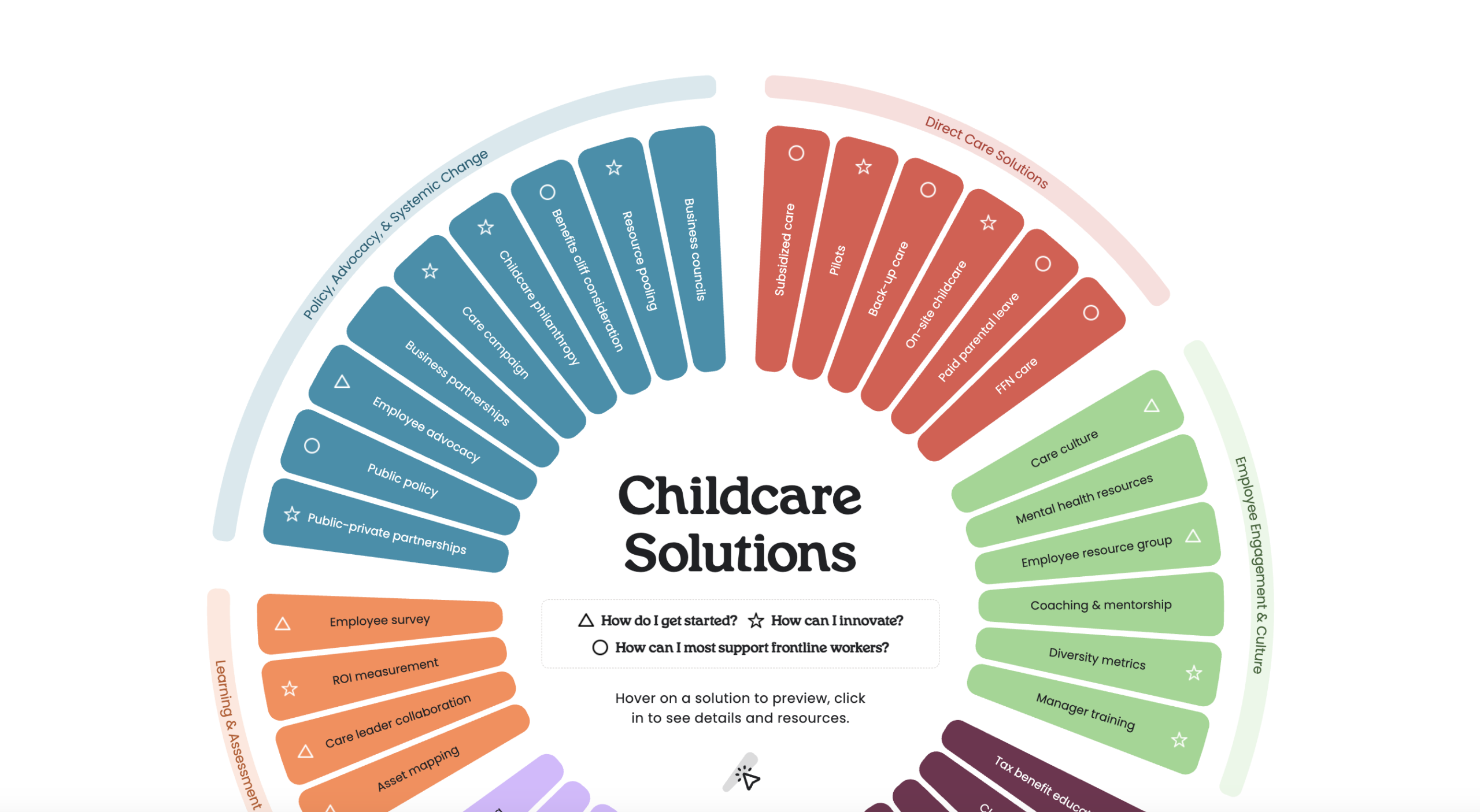
The site serves as a resource for employers to better support employees who are caregivers, highlighting 35+ actionable strategies through an interactive solutions visualization. Packed with resources, firsthand stories, insights, and examples, the site empowers businesses and individuals to advocate for and implement impactful caregiving solutions. This launch reinforces the call to action for systemic change and collective responsibility in addressing the childcare crisis. Visit the Case for Childcare Collaborative’s site to publicly commit to implementing solutions and find downloadable resources to share with your team and network. Help us forge a world where childcare is no longer a barrier for workers to remain and thrive in the workforce. 


To learn more about the Case for Childcare Collaborative, click here