Five Minutes with Alix Guerrier, CEO of DonorsChoose

For this installment of 5 Minutes With, NationSwell sat down with Alix Guerrier, CEO of DonorsChoose — a nonprofit donation platform that helps connect teachers with the resources and materials they need to create the inspiring classrooms and projects that ensure a great education.

Ahead of Teacher Appreciation Week (May 5 – 9, 2025), we asked Guerrier about how DonorsChoose is helping to address racial and socioeconomic inequities in school funding; the impact milestones he’s most excited about; and how the platform is helping to support teachers who come from HBCUs. 

Here’s what he had to say:


NationSwell: Tell us about your personal connection to education — is there anything about your background that gives you a unique perspective or emotional connection to this space?

Alix Guerrier, CEO of DonorsChoose: I became a math teacher after I did investment banking, and I found teaching to be by far the more challenging profession! It remains the toughest job I’ve had. But the thing that I loved most about teaching was witnessing students as they understood new concepts. I would feel so fortunate to be able to observe kids as they were starting to do things that, before, they were not able to do. It’s an incredible privilege to be part of a kid’s journey as they learn and develop new skills.

NationSwell: Where are the existing gaps in school funding models, and how is DonorsChoose helping to close those gaps?

Guerrier, DonorsChoose: Public schools aren’t created equal. Schools that serve mostly students of color receive $23 billion less in state and local funding each school year – a funding gap of $2,266 per student. This inequity is reflected in teacher out-of-pocket spending. Teachers working at schools in lower income communities and with more students of color reach into their own wallet more to buy classroom materials. Our DonorsChoose platform gives members of the public a transparent, accountable way to bridge that inequity.

Every time a teacher submits a project to DonorsChoose, we receive a collection of data points on that classroom: number of students, subject area, items requested, teacher demographics, and more. We integrate this national data into our platform to help donors and institutional partners target their support where it will make the biggest impact. By highlighting schools that have been historically underfunded due to racial and economic inequity, we’ve made it easy for anyone to help us move the needle towards equity — whether they have $5 or $5 million to give.

NationSwell: Are there any anecdotes or moments that stand out to you in terms of the tangible impact you’ve seen DonorsChoose create for teachers?

Guerrier, DonorsChoose: What immediately comes to mind is the preschool classroom of Dominique Foster at Friendship Blow Pierce in Washington, DC, where the majority of students are Black or Latino and qualify for free or reduced-price lunch. You won’t find a better equipped or more engaging preschool classroom, and that’s because of Dominique. In December 2024, she used DonorsChoose to fund costumes for her students to dress up as veterinarians, doctors and dentists, skeleton models, weighted stuffed animals to serve as the patients, toothbrushes, and Band-aids – among so many other resources. 

Since posting her first DonorsChoose project in 2019, Dominique has raised $120,000 for her classroom through our platform. Along the way, her colleagues, too, have discovered DonorsChoose. More than 300 projects, posted by 78 teachers, have been funded at Friendship-Blow Pierce – totaling more than $300,000 in resources. Through DonorsChoose, educators like those at Friendship-Blow Pierce are accessing materials that their students uniquely need for an enriching education.

NationSwell: What has your experience at DonorsChoose taught you about the role technology has to play in the education system — what is the potential that you’re seeing?

Guerrier, DonorsChoose: DonorsChoose has always embraced technology as a fuel for social good. In fact, crowdfunding wasn’t even a word when we launched 25 years ago. Teachers have similarly embraced tech advancements, and their resource requests over the years on DonorsChoose show that progress within education.

Right now, there are a lot of conversations about the potential benefits and harms of artificial intelligence (AI) for both education and technology overall. Wherever you stand, it’s clear that AI is a remarkably powerful tool that isn’t going away — teachers and students are already engaging with it on a daily basis. We need to listen to the educators on the frontlines of this progress and make sure they’re a part of our national conversation about AI so that we can create a just and equitable future for our children.

NationSwell: Are there any new initiatives in the works that you’re particularly excited about and would like to lift up?

Guerrier, DonorsChoose: DonorsChoose is gearing up for Teacher Appreciation Week (May 5-9, 2025), and we’re planning even more support for public school teachers across the U.S. Teachers should stay tuned that week for more opportunities to get funding for their classrooms.

A new initiative this school year that I’m very proud of is Quad to Classroom. Studies show that the graduation rate among Black students increases by 33% if they have at least one Black teacher between third and fifth grade. In 2021, DonorsChoose conducted the largest survey of male teachers of color, and the survey shows that Black male graduates of Historically Black Colleges and Universities (HBCUs) spend the most time engaging with students. The DonorsChoose Quad to Classroom program is inspired by these findings. The program helps to boost the pipeline of teachers who come from HBCUs and to provide them with funding on DonorsChoose.

NationSwell: Finally, what are some of the challenges you’re currently facing, and how can NationSwell’s community of changemakers help you with those challenges?

Guerrier, DonorsChoose: According to our annual DonorsChoose survey of our teacher community, teachers spend between $600 and $700 out of pocket on classroom supplies in a school year. We know that it’s often much higher than that. In fact, teachers on DonorsChoose told us that if it weren’t for our website, they’d be spending more than double out of pocket on classroom supplies. 

At the same time, teachers’ salaries have decreased as much as 15% between 2000 and 2017 and are decreasing much faster than those of comparable workers, yet they’re still reaching into their own pockets to get what their students need to learn. 

Anyone, from an individual to a corporation, can go to DonorsChoose to help a teacher avoid reaching into their own pockets again. DonorsChoose will not stop until every single student and teacher has the resources they need to thrive, and we’re doing everything we can to ensure that and to rally others to join us in empowering educators.

Goldman Sachs 10,000 Small Businesses

Goldman Sachs 10,000 Small Businesses

Entrepreneurship is a powerful driver of economic opportunity, yet many small business owners face systemic barriers to growth, including limited access to capital, business education, and professional networks. To address these challenges, the Goldman Sachs Foundation launched 10,000 Small Businesses – a nationwide initiative designed to provide practical business education, peer support, and access to funding to help small enterprises scale and succeed. The program has supported over 16,600 graduates across all 50 states, Washington, D.C., and Puerto Rico. This case study outlines the core components that make this initiative effective and replicable.


Key components of the model:

  • Selective yet accessible participation
  • Durable and practical curriculum
  • Strategic partnerships for scale
  • Adaptive delivery model
  • Lifelong learning and alumni support
  • Goldman Sachs employee engagement

Notable results and impact:

  • 66% of participants see increased revenue within six months
  • Nearly 50% create new jobs shortly after completing the program
  • 85% of alumni continue doing business with each other, demonstrating the program’s networking value
  • Participants report greater confidence in financial decision-making, fueling long-term sustainability

Share this report

The Power of Place-based Strategies

Place-based approaches have become a cornerstone for fostering long-lasting, meaningful change, by connecting organizations, cities, and communities across the United States. Through focusing on local needs and opportunities, place-based strategies have proven essential for building community resilience and driving positive, tailored outcomes.

During the final event in the Building Thriving Futures series hosted in partnership with FUSE, leaders dove into actionable strategies to strengthen partnerships across sectors and address critical challenges in supporting small businesses, advancing housing equity, and expanding workforce opportunities. 

Some of the key takeaways from the event appear below:


Insights:

Impact leaders need to support and work closely with local decision makers. City and state leaders are the largest social services providers for communities. As the federal government pulls away funding and infrastructure, it won’t change the community needs and people will look to their local and city governments to do more. The current destruction is huge — some populations like in Kansas have/had a large proportion of federal workforce — and philanthropists and private sector leaders need to help local public sector leaders expand their capacity to navigate the change. 

Learn from existing models that bring disparate people together for local change. For example, JobsFirst and FresnoDRIVE are initiatives funded by public, philanthropic, and private dollars aimed at boosting workforce, education, and inclusivity, and are high-aspiration, long-term plans.  

Diversification of funds is key — understanding who in your community is reliant on federal funding and helping them diversify to de-risk and change keeps occurring. Consider how you can help track the dollars being cut in your region, predict the ripple effects that will impact your grantees and community, and stem the loss. 

Balance listening and surviving, with planning for the future. Many organizations are navigating changing infrastructure, adopting a defensive posture, and doing the important work of helping grantees and community partners survive this turbulence e.g. by providing more unrestricted funding to plug gaps. However, also make time to think about those things that will help you “swing for the fences” and plan for a new future e.g. investing in the capacity and social capital of local talent who can rise into transformational leaders. 

Consider how we can fall in love with the problem and use it as a spark for innovation? Turbulence allows us to consider what we should double down on, what can we pivot away from because it is not an immediate priority, and what can we think differently about? In this time where national actions are impacting hyper local communities, it could be a useful exercise to borrow from entrepreneurs and figure out how you find the hardest, stickiest pain point and build energy around addressing it.

Drive investments to data and make sure you have secure data infrastructure locally, as it may not always be there federally. There may be opportunities for new investments and new partnerships that hinge on this data. 

Philanthropies have the power to bring place-based peers together to support each other. Information and strategy help us adapt more rapidly. By bringing together members, partners, or organizations you work with, across states and cities, who are working to combat the same barriers and issues, you scale insights and learning and help prevent a constant reinventing the wheel and repeating the same growing pains.

Invest in telling the story of place-based impact. With so many programs and initiatives at risk due to their reliance on federal funding, telling the story of their impact is more essential than ever. The role of communications and communications teams is often an afterthought, but the importance of language and framing has never been more crucial. Storytelling matters — even if it means we need to pivot or look at it a different way, we keep the story going.

Q1 2025 Social Impact Trends

Q1 2025 Social Impact Trends

Q1 2025 marked one of the most turbulent periods for the social impact sector since the COVID-19 pandemic. What emerged was a mix of reactive, proactive, and strategic responses: creating shared value, evolving DEI approaches, strengthening supports and deepening engagement, and advancing collective action.


Share this report

Impact Imperative: Innovative and Effective Partnership Models

Partnerships and collective action are essential for advancing transformational impact. But what are the most effective and boundary-setting approaches to collaboration today? What perspective, strategies, and frameworks are unlocking deep value between organizations and across sectors?

On February 20, NationSwell hosted a virtual roundtable discussion on the Impact Imperative: Innovative and Effective Partnership Models.

Here are some of the key takeaways from the event:


Insights:

Invest in trust-building as a load-bearing feature of your partnerships. Successful collaborations are rooted in trust and relationship-building. Establishing trust requires ongoing engagement, transparency, and alignment on shared goals. Whether between funders and grantees or across coalitions, investing time in in-person collaboration and candid conversations strengthens long-term commitment and impact.

Create a backbone to facilitate cross-sector collaboration. Organizations that take on the role of a backbone entity can drive more effective cross-sector partnerships – coordinating efforts, providing structural support, and creating alignment among stakeholders. As a backbone organization, tap into real-time, data-driven insights, and third-party expertise. 

Identify the intersection of organizational self-interest and things that you absolutely can’t do alone. As a general rule, a strong understanding of your own opportunities for partnership starts here.

Engage third-party perspectives to spark new ideas and collaborations. Organizations often miss opportunities for innovation by staying within their own networks. External experts, intermediaries, and third-party organizations can help identify new collaboration opportunities, provide fresh perspectives, and facilitate partnerships that might not naturally emerge. 

Break down silos among funders to enhance collective impact. Many funders support the same nonprofits but fail to coordinate efforts, leading to inefficiencies and missed opportunities. Organizations should pool resources, align funding strategies, and pursue collaborative grant-making to maximize impact and reduce burdens on nonprofit partners. Independent conveners can play a key role in brokering connections and facilitating shared funding models.

Hire staff with cross-sector experience to strengthen partnership design and relationships. Having team members with firsthand experience in relevant sectors improves collaboration and bridges power dynamics between funders and grantees. For instance, staff with NGO backgrounds bring emotional intelligence and valuable insight into nonprofit challenges, making them better positioned to create more equitable, flexible, and responsive funding strategies at grantmaking organizations.

Support nonprofit sustainability during economic uncertainty. Given financial uncertainty and funding contractions, funders should explore operating support, flexible grant structures, and bridge funding to help nonprofits sustain their work. Small grants can provide immediate relief, while long-term investment strategies ensure stability in an evolving landscape.

The social sector is being broken down and upheaved in dramatic ways right now; therein lies opportunity to consider what a better model looks like. With many traditional funding and partnership models being challenged, this moment presents an opportunity to rebuild a more effective and sustainable system. Organizations should use this period of uncertainty to innovate, create new frameworks, and rethink how funders, nonprofits, and businesses collaborate to drive long-term impact.

Place-based Impact Funders Guide

Place-based Impact Funders Guide

Place-Based Impact in Practice is an interactive guide designed to help funders and changemakers better understand, assess, and implement place-based strategies that create long-term community impact. Through practical frameworks, real-world case studies, interactive assessments, and a national action map, the platform explores how community-centered investment can help address challenges ranging from economic mobility to housing, workforce development, and climate resilience.

Built for philanthropy leaders, nonprofits, and cross-sector partners, the resource helps organizations move from theory to action by highlighting what effective place-based work looks like in practice and what it takes to build lasting, locally driven change


Share this report

NationSwell Launches the ‘Childcare for All’ Site from the Case for Childcare Collaborative

The Business Case for Childcare Benefits for Every Employee

Today NationSwell is proud to announce the launch of our expanded Case for Childcare Collaborative site advocating  for childcare for all workers. Employees—especially gig, hourly, part-time and frontline workers— across the country continue to face an uphill battle, punctuated by the ongoing childcare crisis in the United States. Frontline workers represent about 70% of the workforce with 90% of companies relying on these workers (BCG, Fortune). And yet, while only 14% of full-time workers have access to employer-sponsored childcare support, that number falls to 8% for part-time workers (U.S. Bureau of Labor Statistics). This demonstrates a childcare benefits gap, revealing those with the most to gain from these benefits are traditionally excluded from qualifying. The detrimental effects of a broken childcare system are glaringly apparent, with parents forced to leave careers in order to take care of children, and businesses suffering huge workforce losses. 

This was the instigation for NationSwell to launch the Case for Childcare site in February 2024, showcasing two years of research making the case for employer-supported childcare benefits, revealing the business opportunity of supporting employee childcare needs. 

Why focus on frontline workers?

But–a gap in our research remained—frontline workers have the most to gain from childcare support yet are traditionally excluded from benefits packages that are reserved for full-time, salaried employees. So we set our sights on an expansion of this site to build the case for employers to provide childcare benefits for all workers. Over the last year, we’ve focused our research on frontline workers, speaking with workers, advocates, and employers alike. This research highlighted the importance of these workers for businesses and the overall economy—leaving this demographic out of conversations around employer-based childcare support is a missed opportunity for companies to improve their retention, attraction, loyalty, and engagement of workers, ultimately boosting their bottom line. Today, we’re exposing the data that employers should support their worker’s childcare needs because it is both the right thing to do for people and the company.

Educate

With this launch, our Collaborative aims to put the spotlight on the research-backed value of supporting employer-sponsored childcare benefits for frontline workers so that more leaders can educate their colleagues and advocate for change.  If you need to make the case for childcare at your company, you can find easily downloadable materials that can serve as a pitch to leadership on why childcare benefits should be implemented or expanded for your workforce. Visit our site and request the synthesized research and solutions that you can use to pitch leaders and HR managers on the expansion of your childcare support for all workers.

Commit

You might be asking, “After I get buy-in, how can we get started? What can we offer as an employer to support caregivers?” The newly launched site includes a visualization of childcare solutions that range to fit any business, no matter where you’re starting from, whether it’s just starting to think about childcare support for the first time or adding cutting-edge policies to your already comprehensive benefits package. Explore each solution with resources and organizations to help you get started and examples of other companies who are implementing these kinds of support. Then commit to change, perhaps making a plan to reevaluate your care policies each quarter with executive leadership or starting to pilot one solution over the next six months. No matter where you start, start somewhere. Join others by committing publicly on our site—submit your story or commitment to be uploaded on our wall of examples. Together we can build a community of care. 

Share

Finally, we encourage you to share this site with your networks. Caregiving is undervalued in the United States and we’re on a mission to showcase the value of care for businesses and our economy. This site not only portrays the data on the clear business value in providing employer-supported care benefits for every employee, but it also features firsthand stories from business owners and workers who are parents. Listen to employers share how to accommodate childcare needs in the workplace for all workers—it’s not only possible, but practical. Hear from advocates on the unique barriers these workers face in regards to care. And listen to parents share their stories on the impact of employers who support the care movement. Post the site on your LinkedIn, text the link to a friend or family member, or reshare NationSwell’s social posts. Help us reframe the narrative to value care.

Conclusion

This site is a go-to hub for businesses and leaders to find information they need to not only build awareness of the business case for employer-supported childcare, but also, to provide tactical solutions that more employers can implement to grow the support for all workers to  have access to affordable, quality childcare that fits the needs of their family.

Visit the Case for Childcare Collaborative’s childcare for all expanded site to learn about the case for care for all workers, commit to implementing solutions, and share the information with your team and network. Help us forge a world where childcare is no longer a barrier for workers to remain and thrive in the workforce. Thank you to our partners at the Annie E. Casey Foundation, American Family Insurance Dreams Foundation and Pivotal Ventures for supporting this important work.


Read more about the Case for Childcare Collaborative

Hope in Action at NationSwell Summit 2024

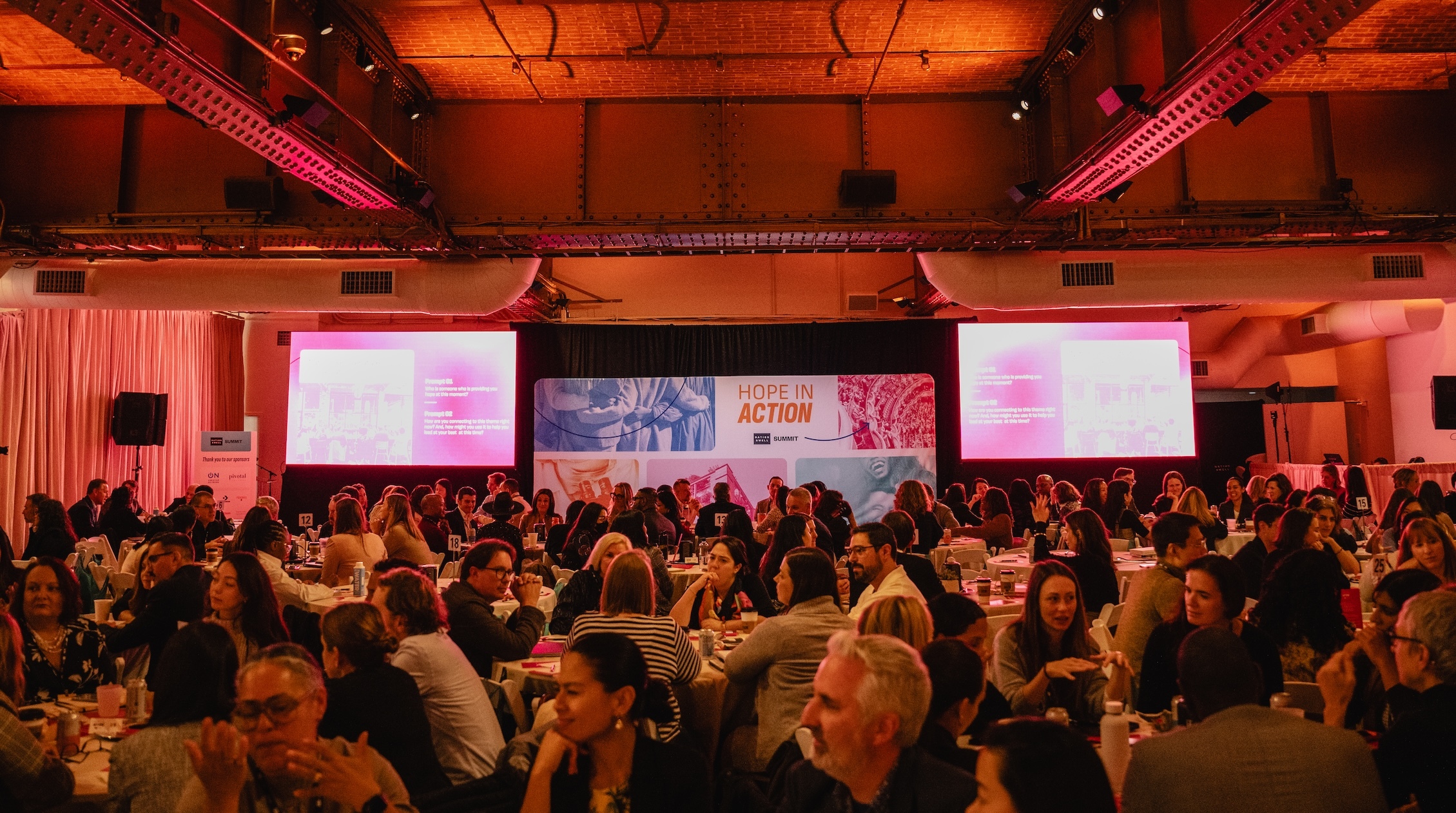
On November 20 and 21, NationSwell convened changemakers, innovators, and thought leaders in New York City for our Summit 2024. This year’s theme was Hope in Action — a nod to both the radical optimism this moment requires and the intentionality needed to create a more equitable and prosperous world.

Throughout the event, we heard from some of the nation’s leading social impact, sustainability, and philanthropic leaders on the innovative solutions and game-changing partnerships they’re pioneering. Below are a few of the moments that left us feeling hopeful and inspired to be standing shoulder to shoulder with this community of changemakers for all the work still to come:


Fireside Chat with Julián Castro

“We have an opportunity in this moment to model what we want the world to look like and to do that as leaders in our own organizations; to recommit ourselves to that vision and to breathe more energy into the values that we want to prevail.” – Julián Castro, CEO of the Latino Community Foundation and former United States Secretary of Housing and Urban Development

Impact Spotlight by Maria Kim

“What I’ve learned through my work and my life over the years is that lived experience is not what you’ve done or what’s been done with you; it’s sometimes this catalyst that makes you most beautifully, gloriously, affirmatively who you are.  So in a way, my lived experience is more aptly described as my lived expertise.” – Maria Kim, President and CEO, REDF

“I know we can do this if we put our back into it. And if we do it, we end up shifting from a generational transfer of poverty to a generational transfer of joy.” – Maria Kim, President and CEO, REDF

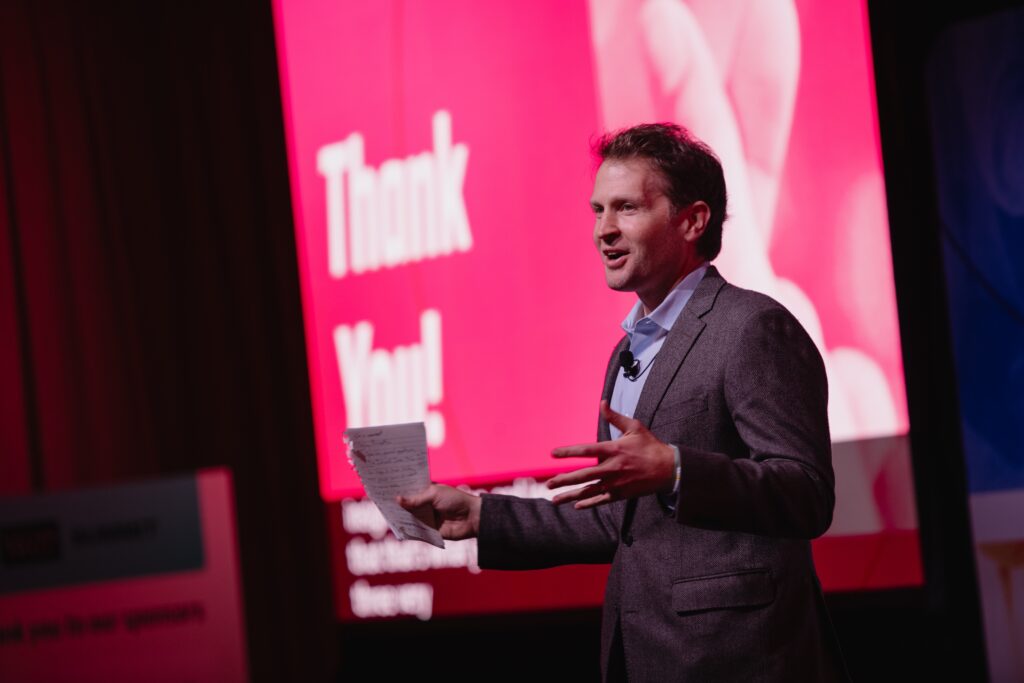
NationSwell founder and CEO Greg Behrman

Impact Spotlight by Scott Pulsipher

“To me, Hope in Action is about changing one life for the better and doing that hundreds of thousands of times, if not millions of times.  And it’s incredible to actually imagine a different world in which we rethink education, we imagine how it can actually operate. Not just for the good of the few, but for the good of the many.” – Scott Pulsipher, President, Western Governors University

“The U.S. higher education system is, in fact, failing those that it was designed to serve.”  – Scott Pulsipher, President, Western Governors University

NationSwell’s Books of the Year panel, moderated by Alesha Washington and featuring Nicholas Kristof and Dr. Ayana Elizabeth Johnson

NationSwell’s Books of the Year

“Hope is a muscle.” – Nicholas Kristof, Journalist, The New York Times

“Find the way to connect the dots to your work. I offer a simple diagram: what are you good at, what needs doing, and what brings you joy? The joy part is what keeps you going and will welcome other people into the work. Pick one and roll up your sleeves and see how far we can get.” – Dr. Ayana Elizabeth Johnson, Co-founder, Urban Ocean Lab

Impact Spotlight by Vilas Dhar

“Leadership in this moment is no longer about just individual courage; it’s no longer about many conversations that happen across society, but a world where we make decisions together.” – Vilas Dhar, President, Patrick J. McGovern Foundation

“We can be architects, we can build blueprints for tools and technologies in the future that incorporate our morals, our values, our norms, our beliefs, and the voices of the people around us.” – Vilas Dhar, President, Patrick J. McGovern Foundation

Impact Spotlight by Aly Richards

“[Affordable and accessible childcare] is a market failure – it is a broken business model. Early educators can’t afford to make less, parents can’t afford to pay more. The sooner we can understand that we need help from local, state, and federal, the sooner we can fix it.” – Aly Richards, CEO, Let’s Grow Kids

The Stonewall Chorale Chamber Choir

The Case for Care: The Business Imperative of Investing in Care

“In many ways, motherhood is the unfinished business of gender equality.” – Reshma Saujani, Founder and CEO, Moms First; Founder, Girls Who Code

“You can make a very strong business case for [child care], to do the right thing to help your people.” – Stephan Dolling, AVP, Global Benefits and Well-Being, Merck

“Let’s talk about the challenges more. Talk to me, or talk to your employers, about the caregiving challenges that we’re all experiencing.” – Lindsay Jurist-Rosner, Founder and CEO of Wellthy

The Lounge featured an interactive hopscotch with facts around childcare, a pamphlet with more information on the Collaborative, and signs highlighting childcare solutions
The Care Lounge, presented by the Case for Childcare Collaborative

Creative Forces for Social Change: The Power of Art in Action

“There’s a war on the storytelling of our authentic selves and truth and history.” – Renée Elise Goldsberry, Tony- and Grammy Award-Winning Actress and Singer

“I put all my hope in art. For one, art never cared who was in power.”  – Rahsaan Thomas, Documentary Filmmaker, Podcaster, and Producer

“There’s a lot of misunderstandings going on in our country right now, so we need art more than ever to translate the truth.” – Rahsaan Thomas, Documentary Filmmaker, Podcaster, and Producer

“I think my greatest resource as an artist is my most authentic self.” –  Renée Elise Goldsberry, Tony- and Grammy Award-Winning Actress and Singer

Impact Spotlight by Dr. Carmen Rojas and Tara Raghuveer

“Our country faces an unprecedented housing crisis. Not only are more than 3 million people homeless, housing insecure, or living in shelters, but rents have gone up more than 30% since 2020. This is in a context in which we have 16 million vacant homes in the United States. So this means that we have made a choice not to house our brothers and sisters, our cousins, people that we might fall in love with, slow dance with, sing karaoke with – it’s a decision that our political leaders have made.” – Dr. Carmen Rojas, President and CEO, Marguerite Casey Foundation 

“The rent is the biggest bill in most working people’s budgets. When people need to cut back on living expenses, making cuts to housing is not an option – the alternative is homelessness. The rent is too damn high.” – Tara Raghuveer, Founding Director of Kansas City Tenants

“Derek is one of the tenants who will strike another month. He said, ‘My rent is my power. And I will use my power with my neighbors until we win what we’re owed.’” – Tara Raghuveer, Founding Director of Kansas City Tenants

Impact Spotlight by Jay Bailey

“You want to talk about innovation? Show me someone more innovative than a single mother with two kids making $17,000 a year. She problem-solves, she makes sure there are gifts under the Christmas tree – send her to business school and she’ll run circles around everybody.” – Jay Bailey, President and CEO, Russell Innovation Center for Entrepreneurs (RICE)

“Hope in action is black prosperity through ownership.” – Jay Bailey, President and CEO, Russell Innovation Center for Entrepreneurs (RICE)

The Augment and Involve panel, featuring Molly Kinder, Nicole Johnson, and Carri Twigg

Augment and Involve: Empowering Workers in an AI-driven World

“We look at the AI development and economy that’s happening as an opportunity space. How can we ensure – unlike the internet – that there’s intentionality to the workforce that’s behind this technology?” – Nicole Johnson, Global Director of Social Impact & Inclusion, Cadence Design Systems

“Tech is all of us – each of us has the ability to engage and change for the tech future we want.” – Michele Jawando, Senior Vice President, Omidyar Network

“The human spirit is indomitable, and art is a fundamental part of that. We will figure out how to fulfill the promise of increasing representation, increasing stories using AI, and we will see more people fight for the art that gives their lives texture.” – Carri Twigg, Founding Partner, Culture House Media

“What gives me hope is that when workers are at the heart of our design of this technology and the decisions around deployment, this is not only good for society and workers, but there’s a lot of evidence that it’s good for employers, too. Workers are assets. They’re experts. They often know their space the best. AI is not something that’s top-down.” – Molly Kinder, David M. Rubenstein Fellow, The Brookings Institution

“Just as we celebrate innovation and we’re awed by it, it creates opportunities for creation and destruction. We need innovation in our policies, badly – we’re at an intersection of technology where it impacts workers, and there’s a role for the government in all of this.” – Ambassador Katherine Tai, United States Trade Representative

Impact Spotlight by Dreama Gentry

“The hope I’m holding – the hope that I’d ask you to join me in – is hope that this great nation can be a place where all of our children and young people are supported and have a choice-filled life.” – Dreama Gentry, President and CEO, Partners for Rural Impact

“We know what will create upward mobility from cradle to career – we just need to invest in that, and we can’t do this work alone.” – Dreama Gentry, President and CEO, Partners for Rural Impact

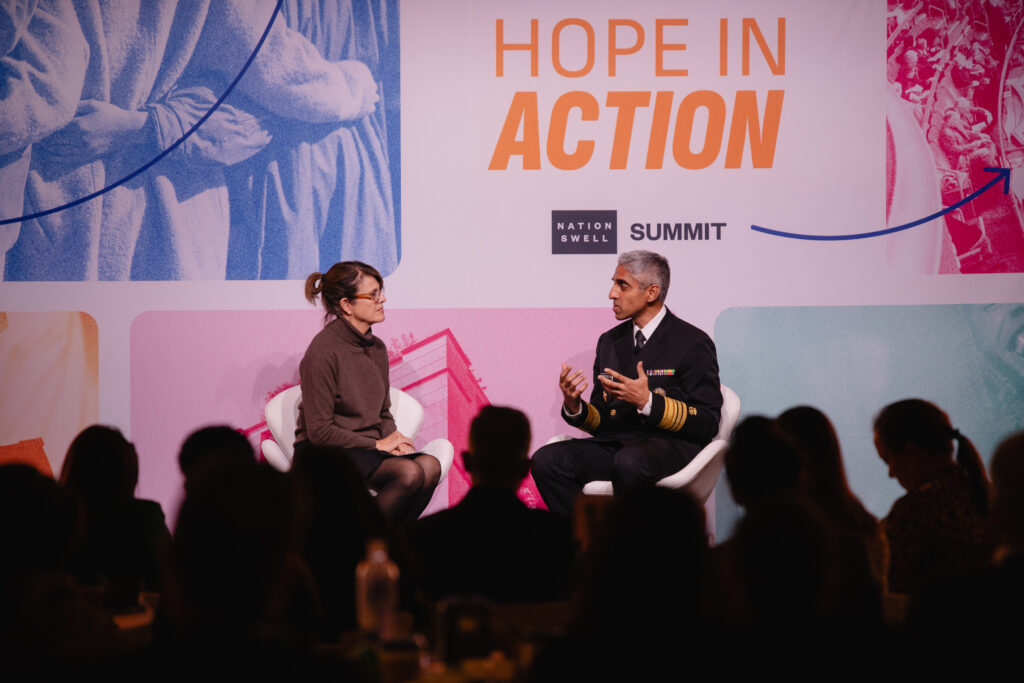
A fireside chat with Surgeon General Dr. Vivek Murthy

Impact Spotlight with Surgeon General Dr. Vivek Murthy

“When your friend is in a crisis, showing up doesn’t mean coming up with a ten-point plan to solve all problems. The truth is, people derive tremendous comfort from knowing that they’re not alone.” – Surgeon General Dr. Vivek Murthy


Place-Based Impact in Practice: 36 hours in Tulsa with NationSwell and George Kaiser Family Foundation

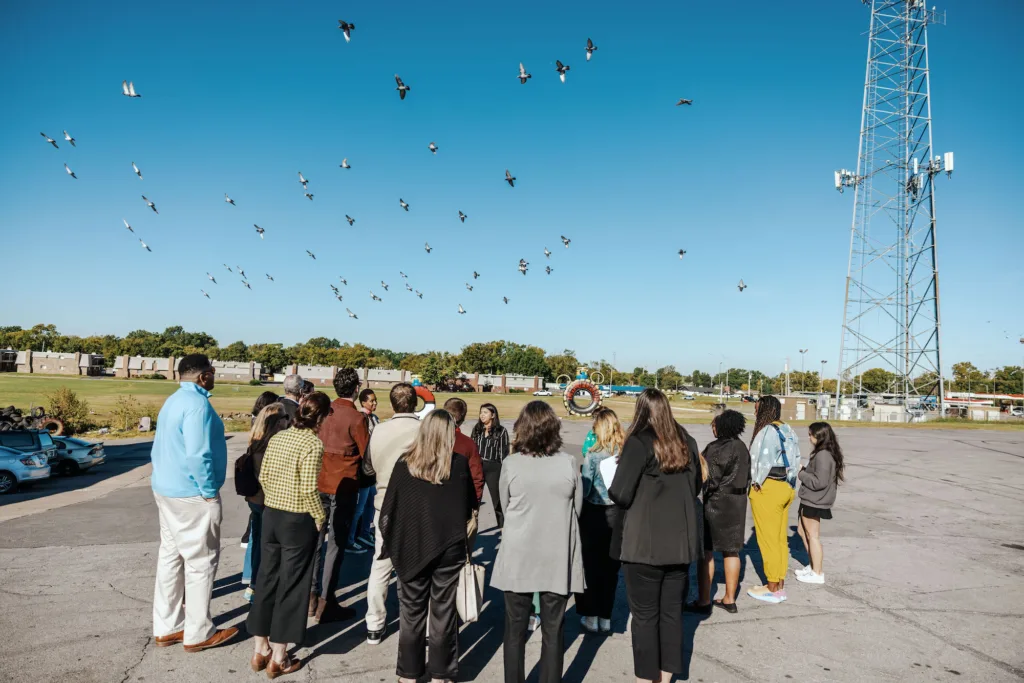
On the evening of October 18th, black clouds of starlings wheeled overhead as the NationSwell team made its way to meet a group of partners and leaders in downtown Tulsa. The group had gathered as part of our Place-Based Impact Collaborative for an immersive, 1.5-day experience designed to explore how community-centered investment and strategic partnerships are working in concert to give new strength to Tulsa. 

The insights and best practices we gathered from GKFF’s approach — and from the experts in attendance — were many, and can better enable communities nationwide to thrive. Although it’s impossible to accurately capture and convey the profound experience of being on the ground in Tulsa, our hope is that this piece can shed some light on what it was like to come together and learn with an incredible group of leaders and inspire you as you strengthen your own community-centered, place-based work.

Day One

The day began with a tour at Greenwood Rising to hear the vital stories at the core of Tulsa’s history and identity: the impact the Trail of Tears, the systems of anti-Blackness that fomented the Race Massacre of 1921, and the cultural reverberations of both eras that are still being felt throughout the city. Despite the violence dotting its past, Tulsa and its residents have persisted — deepening their sense of community and establishing a rich sense of place and culture that makes the city vibrant and unique.

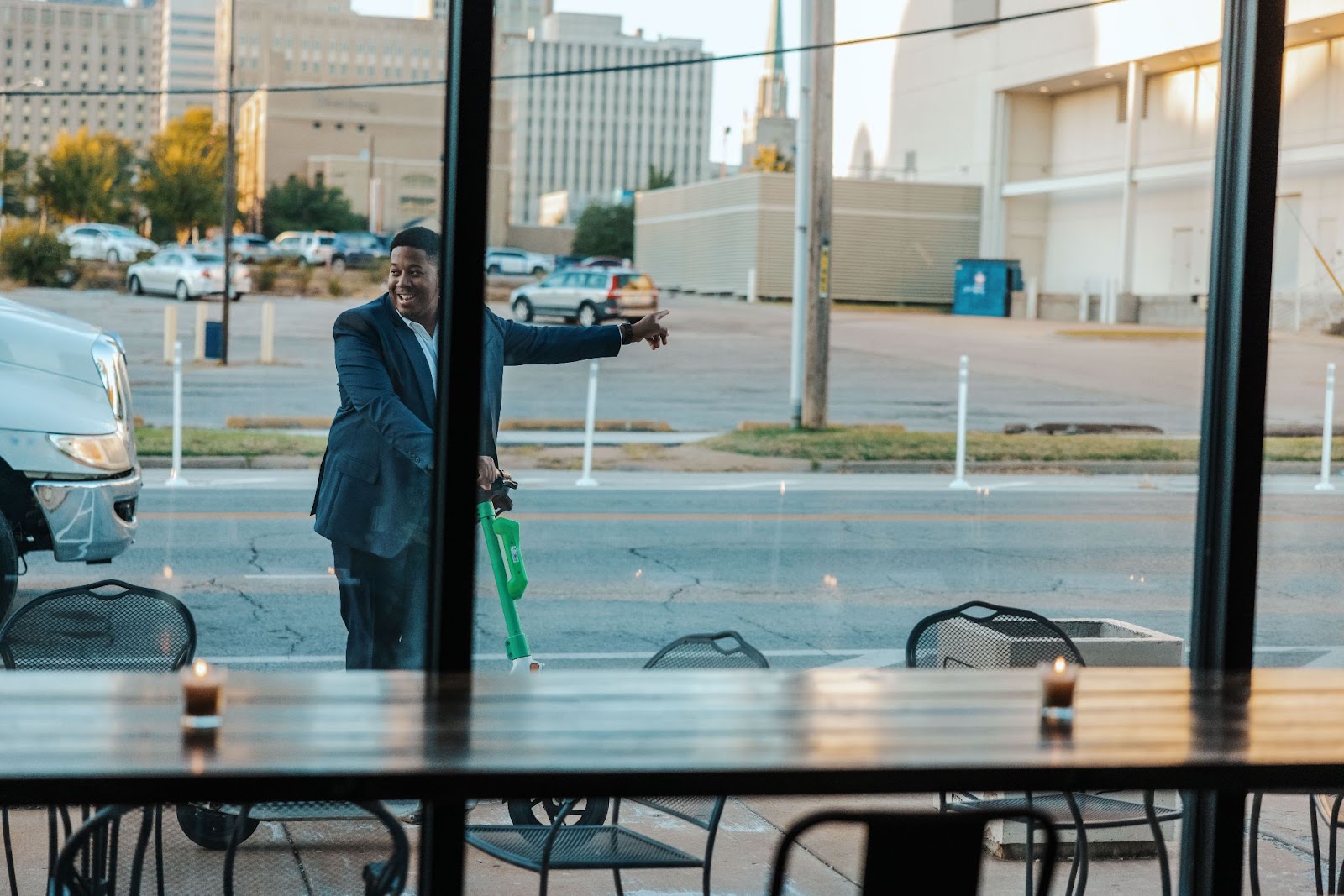
That night, we joined our hosts from George Kaiser Family Foundation for a welcome reception at a speakeasy in the city’s Deco District. After an evening of warm conversation, introductions, and getting to know one another better as we prepared for the next day, Aaron Miller — head of partnerships at inTulsa — announced that he would lead a group by bus to celebrate the city’s popular Oktoberfest, currently in its 44th year. Jonathan Pride, executive director at NPower, announced that he planned to lead a competing group to the same location via the city’s widely-available Lime scooters.

Day Two

East Tulsa


After a quick pit stop for breakfast on Thursday morning, our group set out by bus for East Tulsa, where white flight and the attendant infrastructural divestment have created unlikely opportunities for the city’s growing immigrant population. 

Cynthia Jasso — a program officer on the Vibrant and Inclusive Tulsa team — explained that East Tulsa has become a community hub, learning center, and worker community for newly-arrived immigrants, more than 1,100 of whom arrive at the Plaza Santa Cecilia from Mexico by bus each week. While organizations like Growing Together have done grassroots outreach to meet residents where they are — helping to expand access to vaccines and make PPP loan applications easier for local businesses owners — they ultimately found that there was an overwhelming need for a centralized community hub where people could get the help that they needed. Plaza Santa Cecilia has become that epicenter — a place for the community to gather, relax, take classes, shop, or even acquire permits.


The plaza features beautiful murals, restaurants, and a nightclub, and has become a major source of community pride and belonging — a critical metric of success for place-based investment. 

North Tulsa


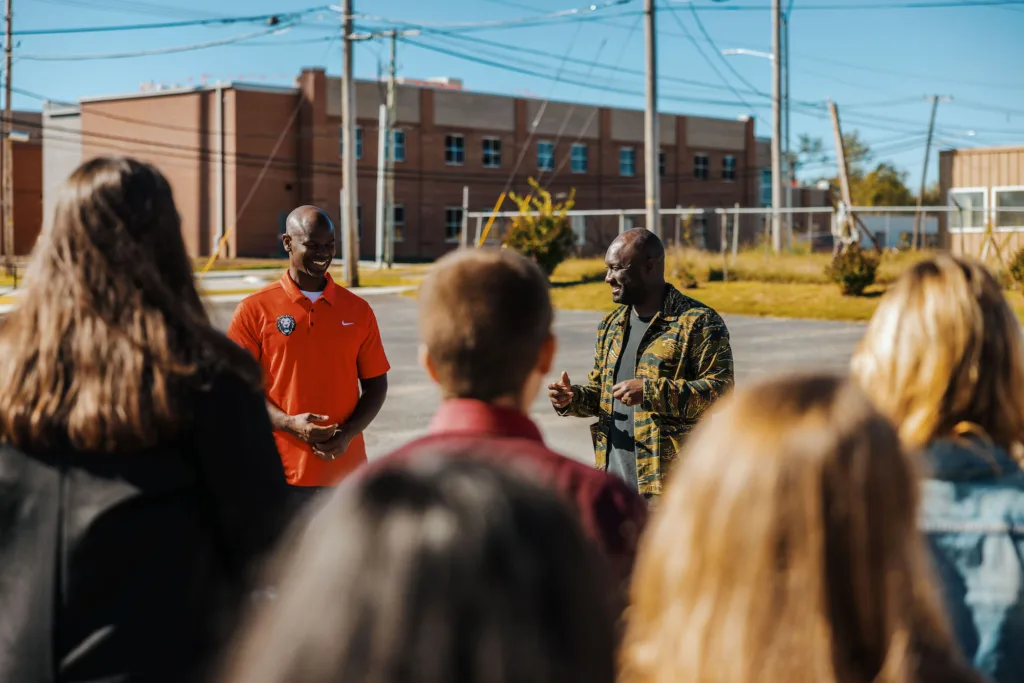
Our next stop was in North Tulsa, where attendees heard from Pastor Philip Abode of Crossover Community Impact and Crossover Bible Church. A former University of Tulsa football player and current high school football coach, Abode’s passion for coaching youth eventually catalyzed an even deeper relationship to mentorship in the city: he now serves as executive director of Crossover Preparatory Academy, which oversees several private middle schools throughout the city.

A majority-Black neighborhood, Tulsa’s north corridor is currently the site of major community development efforts, including a planned 500-unit, mixed-income housing project and new contracts with high-quality, high-paying manufacturing jobs at companies that agree to recruit from within the neighborhood (and nearby Tulsa Technology Center). 

Kendall Whittier


As the bright sun continued to warm up the day, we visited Kendall Whittier Park — located in Tulsa’s historic Kendall Whittier neighborhood — where we learned more about how a mixed-income neighborhood trust has helped  provide stable, affordable housing, and how partners like Growing Together and Tulsa Educare have created educational opportunities and green spaces where children and families can grow and thrive. 

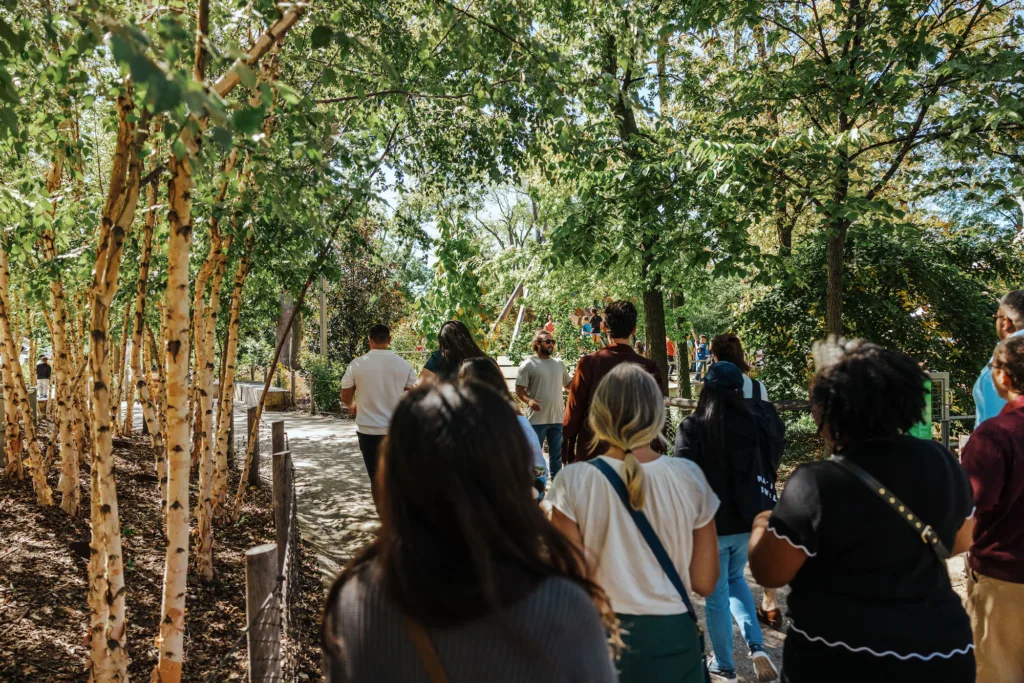
We also had the opportunity to tour The Gathering Place, which words alone don’t really do justice. A sprawling 66.5-acre green space nestled against the Arkansas River, The Gathering Place’s pathways were dotted with pumpkins and its playgrounds had names like “Land of the River Giants,” “Fairyland Forest,” and “Volcanoville.” All park activities are free, and guests can help themselves to kayaks and paddle boats, attend concerts on the lawn, and engage with the park’s many educational programs. 


After lunch, we reconvened at Greenwood Cultural Center for a series of panel discussions — first on how to leverage the power of storytelling, and then on how new models of collaboration across the public, private, and philanthropic sectors can help to foster opportunity from the ground up.

During the first panel, Jasmine Dellafosse — Director of Organizing and Community Engagement at EPIC — spoke about the value of telling the stories that run counter to our assumptions. 

“What are the stories we don’t know, and in whose interest is it that we don’t know them?” she asked. 

Panelist Vanessa Garrison — Co-founder and COO of GirlTrek — further emphasized the power storytelling holds in developing a community: deconstructing myths, challenging assumptions and enabling community members to lead change. 

In the second panel, a key insight that surfaced was the recognition that change doesn’t just take a longer grant cycle but can take generations to actualize. The question that emerges, then, is how do we integrate intergenerational change as a metric when measuring impact? 

At the intersection of both of these panels is the emerging understanding that how we measure impact in place-based philanthropy needs to evolve to incorporate more qualitative data, compelling us to reimagine what a thriving community really means.


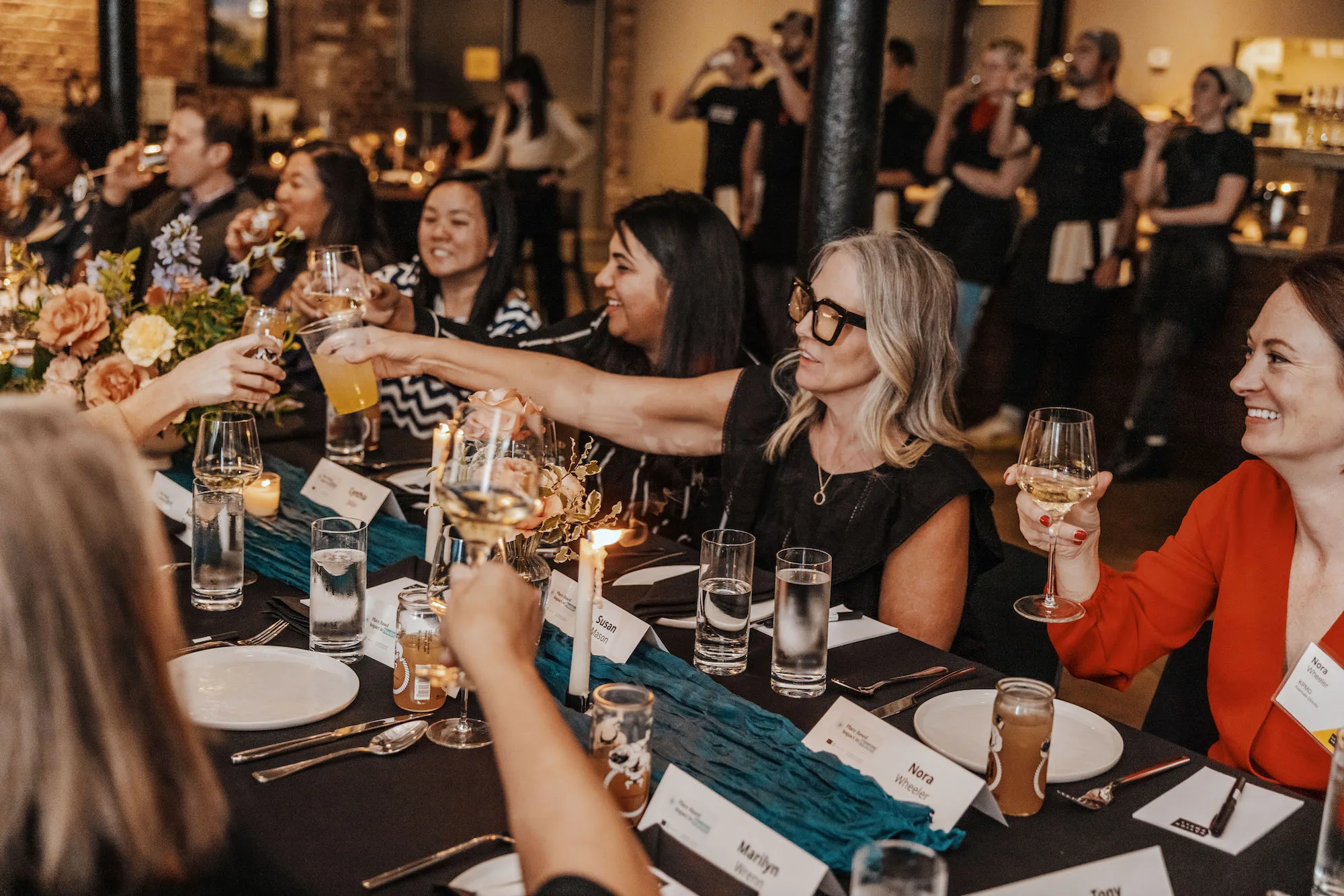
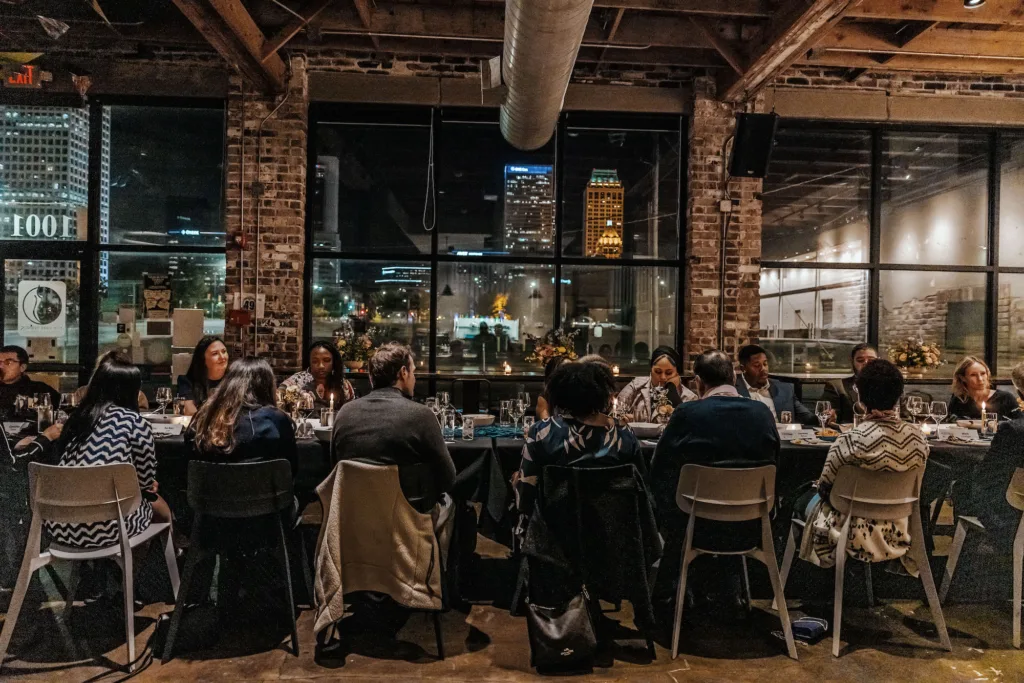
After a visit to Archer Studios to learn about the Tulsa Artist Fellowship — and a ceramics activity with fellow Raphael Corzo — participants had a few minutes to rest and recharge before coming together for a NationSwell Signature Dinner to reflect on the events and learnings of the day. 

Hosting us for the evening was the team at et al., a collective of chefs working collaboratively to “build a more delicious and equitable future for the food and beverage industry in Tulsa.” Aptly named to reflect the important but often overlooked or unknown people who help to make an ambitious vision into a reality, the symbolism behind et al.’s name and mission had a beautiful symmetry with the focus of our visit to Tulsa — and the patchwork of organizations and solutions we’d witnessed firsthand on the ground there. 


Attendees dove deep into what had inspired and moved them during the course of the meal, which was themed around the idea of breaking bread (as chef Colin Sato explained, “You have now broken bread with Tulsa, and now it’s a part of you”). There was a discussion of some of the central challenges to their own place-based work, with members laying out the approaches, tools, and new opportunities for partnership they were excited to bring back to their own communities. 

Like the chefs in et al.’s culinary collective, our time in Tulsa was distinguished by the patchwork of seemingly disparate, often undersung voices we heard from joining together to create a beautiful and undeniable chorus of solutions. While partners on the ground maintain different focuses in the work that they do and the neighborhoods they serve, everything in Tulsa has a certain harmony to it; the work comes together to hum like a well-oiled machine. As we packed up to leave on Friday, we couldn’t help but think about how this model of community impact — where every voice, program, and initiative happening on the ground is truly greater than the sum of its parts — has the potential to transform not only communities, but the world.

We’re so excited to have plans for more in-person, immersive experiences in the works for the near future. This incredible experience was part of our Place-Based Impact Collaborative. Our Collaborative model is based on the idea that the challenges we face call for collaboration and shared action to achieve the impact we seek on a variety of issue areas. Together, with cross-sector leaders, we illuminate challenges and opportunities in the space and align on action to advance each other’s work, and the field as a whole.

We encourage you to read more about our different Collaboratives and to contact us to get involved if you see one that resonates with you and your work. 


NationSwell Collaboratives are a new initiative convening cross-sector leaders to work in new ways on major issues affecting our lives, our nation, and our world. Learn more about our current offerings here.

ESG Next: An Interview With Levi’s Anna Walker

At a moment of unprecedented attention, investment, and opportunity for the emerging field of Environmental, Social, and Governance (ESG), leaders are asking: Who is best preparing their organization for the society of the future? Who is innovating today to meet decades-long environmental and social goals? Who is setting standards that catalyze their industry’s change for the better? Who is defining what bold and aspirational look like — and how best to advance that work in practice?

Enter NationSwell’s ESG Next, an exemplary group of investors, executives, authors, philanthropists, social sector leaders, academics, and field builders who are helping to shape business as a force for social and environmental progress, advancing — and even pioneering — the most forward-thinking and effective programs, initiatives, technologies, methodologies, practices, and approaches.

For this installment, NationSwell interviewed Anna Walker, Vice President of Impact and Issues at Levi Strauss & Co., on the unique strengths of an organization’s employees to inform corporate action, the undersung value of employee resource groups, and why coalition building is as much about the “where” as the “who.”

Greg Behrman, CEO + Founder, NationSwell: Can you tell us about your professional and personal journey to this field?

Anna Walker, Vice President of Impact and Issues, Levi Strauss & Co.: I went to graduate school for international economics with a focus on developing economies because I thought — very idealistically — that my path was leading me to work at a United Nations agency, that I’d make my contribution to the world through my work there. So while I was in graduate school, I got my opportunity to intern with the UN through the High Commissioner for Refugees, and it showed me that UN agencies are, by necessity, large, slow-moving, bureaucratic, and probably not a fit for me and my long-term goals. 

That’s why I made my way to the apparel industry: it aligned perfectly with my interests in development economics, and in helping countries moving up the development ladder, because it’s an industry that countries pursue when they’re moving forward on their economic development trajectory, transitioning from subsistence agriculture to labor-intensive industries. And Levi’s was the perfect fit within the apparel industry because it was so committed to supporting responsible practices in the supply chain and supporting workers there. 

Now, Levi’s is 170 years old this year. For most of its history, it owned its manufacturing. But in the 1980s, it transitioned from owned factories to overseas facilities. Employees asked the company, “How are we going to take care of the workers, and ensure the same level of care that they have as our own employees when the factories are owned by others and we’re just sourcing the production?” Because our employees asked our leadership that question, Levi’s was one of the first organizations to have a code of conduct for a global supply chain. Listening and responding to employee is a big part of Levi’s organizational DNA, and a big part of how I knew I’d found the right organization for me. 

Behrman, NationSwell: How do you define this moment in ESG? 

Walker, Levi Strauss + Co: This question is so fresh on my mind because we’ve been analyzing the challenges to ESG and so-called “woke capitalism” following the reaction to Bud Light and Target during Pride month — high profile cases of intense backlash that are such a part of this ESG moment. 

Levi’s is a fairly outspoken progressive company that really believes in using our voice to support the issues that our employees care about and that intersect with our business, and we used the backlash as an inflection point to brief leadership. We told them that we’re very cognizant of this changing environment, we assured them that we’ve taken some time to really stare down how it went for these other companies and why it went the way it did, and informed them of what we were going to do moving forward: remain consistent. Companies stumble when they try to change direction or appease a certain audience in a manner inconsistent with what they’ve said or done in the past. Consistency will be the key: it helps us adhere to what we can control and show up in the places where we can show up authentically.

Another big learning we’ve taken from the moment is that often, if you’ve already been outspoken on something, neutrality or silence isn’t going to be acceptable. Silence can be deafening, and stakeholders have come to count on you to be out there, to be supportive, and to be engaged. And sitting one out can often look like the wrong kind of engagement to them.

Behrman, NationSwell: What’s unique about the work you’re leading at Levi’s?

Walker, Levi Strauss + Co: I’m proud to say that through our long history, most of what we’ve been outspoken advocates on and built our social impact programs around — it’s all been rooted in our employees, rooted in what they’ve come to us and said matters to them, because it’s keeping them up at night or because they’re excited to take part in it.  

In the ’80s, we came out in support of employees dealing with HIV/AIDS, even before the disease had a name. We did that because employees came to us concerned about friends and family, and asked the company’s leadership to do something. They’ve held us accountable, and they keep us engaged. Because it’s real for them, it keeps our engagements from being one-and-done; they’re the reason why whatever we do will be far more authentic, genuine, and enduring. 

That’s what happened with our efforts around gun violence prevention. Our employees asked us how we’re going to support a safer America, which sparked us to create a threefold plan: first, we created the Safer Tomorrow Fund to give to organizations addressing community-based violence; second, we advocated to support efforts for common sense gun safety legislation at the federal level; and third, we engaged and informed employees to give them opportunities to volunteer and give, if they were interested.

When we started to build a broad coalition of companies working with us and supporting similar ends, it was slow-going at first. We sent a letter to the House of Representatives supporting the bipartisan background checks bill. And we only had three CEOs on it when we went to the House. But then, come fall of that same year, we had over a hundred CEOs on the letter when it went to the Senate. And last summer, when the Bipartisan Safer Communities Act passed, we had over 300 CEOs on the letter supporting Congressional action.  

We’re really proud to be a first mover, to be a bold mover that leverages its globally recognized brand name to build a big tent and create the safe space for other companies to join us in the advocacy. We’re going to be most effective when we’re using our brand to build coalitions and bring others along. 

Behrman, NationSwell: In the case of gun violence prevention, what helped you build such an effective coalition?

Walker, Levi Strauss + Co: It’s all about finding good partners. In the case of gun violence, we worked with Everytown and Giffords, and they’ve been really willing to roll up their sleeves and help to make it happen, to help to build the materials, and to engage and be there as experts when companies have questions. We’re not experts in gun violence prevention the way these groups are, so finding those partners that get the value of bringing the business case to advocacy is key.

As we’ve built coalitions, we’ve learned that it’s not only about who your partner is, but about where your partner is — especially when it comes to congressional advocacy. You know what members of Congress will support a bill, you know who is going to oppose it, and in the middle of all of that is the potential gettables you’ll actually need to make something happen. If you can find the companies that are their constituents in their home states, they’re the best advocates  to those members of Congress to make the case.

Behrman, NationSwell: How does Levi’s decide when to speak out or take action as an organization?

Walker, Levi Strauss + Co: Those actions all come to be through different channels. When the Dobbs decision on reproductive rights leaked, we were ready to issue a statement immediately because employees from our women’s Employee Resource Group (ERG), two years before the draft ruling leaked, asked for a meeting with our CEO and sat down with him to have a conversation on the landscape of women’s rights. 

Traditionally, ERGs allow employees from diverse backgrounds to find each other and deepen their bonds to one another, but they’re also an effective tool for surfacing to leadership those early signs of what’s on the horizon, and what your organization can do about it. Because that conversation happened years prior, we’d already had a lot of internal conversations and got our internal policies and programs in place to be able to move quickly. 

Levi’s CEO is Chip Bergh, and we do a monthly “Chip(s) and Beer” that’s sort of an ask me anything-style town hall with the CEO. That’s where a few of our advocacy and philanthropy actions have started from questions and concerns voiced by employees. Not only is it a powerful forum for directly learning what’s on employees’ minds, it helps you to create and maintain a culture of openness. 

Behrman, NationSwell: To which of your leadership practices do you attribute your efficacy?

Walker, Levi Strauss + Co: I have a smart, creative team that’s willing to try new things, take risks. I try to be the wind beneath their wings, I try to ask a lot of good questions, poke around corners, and support them to test, scale, and find what works and what fits. I encourage speed and smart risk-taking so that we always have time to course correct if we get it wrong. 

Really good leadership comes from finding really good people who are motivated, care, who are purpose and mission aligned with the organization and have a lot of energy about what they do.

Behrman, NationSwell: Who are the leaders who inspire your leadership?

Walker, Levi Strauss + Co: I’m inspired by Vicki Shabo, Senior Fellow, Better Life Lab, New America. Vicki is always advocating and innovating to make paid family leave universally available. I think of Michael Kobori, Chief Sustainability Officer at Starbucks Coffee Company, because he’s always willing to try new things, and he’s unceasingly supportive of his team. Worked along side him at LS&Co. And Hilary Dessouky, General Counsel at Patagonia, as well as Corley Kenna, Head of Communications and Policy at Patagonia, because they’ve been part of making some of the most sustainable business practices and best policies for Patagonia employees happen, and made sure to share those best practices with the rest of the business community.