
What we can learn from George Kaiser Family Foundation’s place-based work in Tulsa, Oklahoma

This fall, NationSwell launches its first immersive experience on October 18 and 19 in Tulsa, Oklahoma for Place-Based Impact in Practice: An Immersive Experience to Explore Community-Centered Funding and Action. Hosted by George Kaiser Family Foundation (GKFF) as part of our recently launched Place-Based Impact Collaborative, this hands-on event will take place over the course of one and a half days and will allow attendees to explore on-the-ground examples and innovative strategies to foster thriving and inclusive communities, particularly in fast-growing cities and rural areas. We’d love for you to join us.

But, you may be thinking, why Tulsa?

Since its establishment in 1999, George Kaiser Family Foundation has held, as its primary philanthropic goal, cementing Tulsa, Oklahoma, as a vibrant, inclusive, and prosperous environment where children and families can flourish. 

As the primary supporting organization of the Tulsa Community Foundation, GKFF funds organizations and efforts that directly service the greater Tulsa area, all while adhering to its guiding principle, “no child is responsible for the circumstances of [their] own birth.” Foundation investments include robust early childhood education initiatives that serve approximately 2,000 children in year-round education and care; over $100 million earmarked for the arts; economic development initiatives to attract and retain local businesses and talent as well as transform 100 acres of Tulsa’s iconic riverfront into a dynamic and world-class centralized park; neighborhood programs to foster a strong sense of community; and a work stipend program that has welcomed more than 2,500 diverse professionals to the city. 

GKFF harnesses a nimble, entrepreneurial spirit, which has helped to adeptly address community needs. Their approach is holistic and community-centered and driven–designed to lead with the community’s needs so that children and families in Tulsa can thrive. What sets their investment strategy apart from other philanthropic models is that it’s not only nuanced, but multi-pronged–touching almost every part of the Tulsa ecosystem. Parent engagement and early childhood education, health and family well-being, civic enhancement, and breaking the cycle of intergenerational poverty are all vital pillars of community prosperity.

George Kaiser Family Foundation’s holistic approach

In order to create and maintain the conditions for a thriving local community, GKFF has taken a holistic, all-encompassing approach to funding that sees early childhood education; health and wellbeing; neighborhood development; thriving public spaces; criminal justice; housing; and arts & culture as vital pillars of economic prosperity. During an onsite visit in March 2023, NationSwell got a firsthand look at how these key initiatives operate on the ground in Tulsa; below are some of the highlights we observed.

  • Parent Engagement and Early Childhood Education

GKFF provides support and resources to young Tulsa families to encourage parent‐child engagement and interaction. Through initiatives like Tulsa Educare and Early Learning Works, families and children are encouraged to pursue skill-building opportunities and early learning workshops, and are given the chance to connect with community and faith-based organizations that help to promote literacy and learning.

  • Civic Enhancement

Robust public spaces provide abundant natural spaces for residents to relax, convene and unplug. Tulsa’s 100-acre riverfront park, Gathering Place, now boasts a skate park, a picnic grove, cultural events and festivals for all ages, and free educational programming to support early childhood development. A $465 million transformation of more than 66 acres in central Tulsa, the park is one of the largest and most ambitious public parks ever created with private funds. The Foundation undertook a similarly ambitious project with Guthrie Green — a former truck loading facility that has now been converted into a 2.6-acre urban park, located in the heart of the Tulsa Arts District and a true living room for cultural programming in downtown Tulsa. 

Investments in a thriving arts scene and strong cultural values are integral to GKFF’s community approach. Both the Bob Dylan Center and the Woody Guthrie Center operate under auspices of the American Song Archives, a project of George Kaiser Family Foundation, and dedicated artist residencies, fellowships, and programming helps to further stimulate Tulsa’s growing arts community. 

In the same Tulsa Arts District as Guthrie Green sits the GKFF-funded Holberton School–a credentialing school for software developers. In addition to training career-ready developers, Holberton provides living stipends to students and tuition incentives to stay in Tulsa both pre- and post-graduation. 

Partnership is at GKFF’s core. GKFF takes a program-forward approach — meaning the Foundation serves as co- or sole owner of many of the LLCs that operate the aforementioned initiatives in Tulsa. When visiting the city, you can explore parks, cafes, bakeries, restaurants, food trucks, and programming initiatives that provide Tulsa residents with meaningful ways to stay engaged in their communities. 

  • Workforce Development

GKFF’s dedication to developing Tulsa’s tech-led inclusive economy is something to aspire to. Tulsa Innovation Labs (TIL) was founded with support from GKFF to establish a city-wide strategy for inclusive, tech-led growth. TIL designs and launches economic and workforce development initiatives in Tulsa’s four emerging tech clusters: virtual health, energy tech, advanced air mobility and cyber, and aims to support the growth of startups, train diverse talent, expand job opportunities, and spur academic innovation. And through the network of local workforce programs in Tulsa, businesses can more easily connect with key hires and launch operations in Tulsa via inTulsa’s talent, relocation, and growth solutions.

36 Degrees North — Tulsa’s basecamp for entrepreneurs, innovators, and startups — works to provide the high-quality workspace, resources, and spirited community that entrepreneurs need to build growing companies and drive economic impact in Tulsa. Workforce development programs like Tulsa Remote — which offers participants a $10,000 grant in addition to a membership at a local co-working space, support in identifying housing, and regular community-building opportunities — have helped draw new workers into Tulsa and boost retention rates for local populations.

  • Health and Family Well-Being

To address the longstanding problem of high recidivism rates in Tulsa County, GKFF has partnered with the Justice and Mobility Fund to launch JusticeLink — a compendium of resources designed to help those navigating the criminal legal system in Tulsa to access a full spectrum of community-based services. JusticeLink primarily focuses on providing court and resource navigation, while also helping individuals to access wraparound supports like phones, IDs, or benefits enrollment services.

And through neighborhood development initiatives like ElevateEast — which works collaboratively with residents, community-based organizations, and public and private entities to invest and support immigrant families living in East Tulsa — residents can further access the wraparound support they need to thrive.

Affordable housing also has a huge role to play in ensuring family wellbeing, and neighborhood development initiatives like Growing Together and Kendall Whittier West Park have been intentionally designed to create vibrant, mixed-income communities and an intense focus on the birth-to-college-to-career pipeline.

  • The Tulsa Artist Fellowship
    Dedicated artist residencies, fellowships, and programming helps to further stimulate Tulsa’s growing arts community. Established in 2015, Tulsa Artist Fellowship was created to address and mitigate the challenges facing artists and arts workers living in and joining the city. Through intentionally crafted programming, the Fellowship celebrates and supports artists across all mediums by providing them with $150,000 over three years in addition to a $12,000 yearly housing stipend. 

Stronger together

GKFF’s approach has necessitated a rethinking of scale and impact as being simultaneously micro and macro. Seemingly hyperlocal initiatives — like the neighborhood development in Kendall Whittier, or the transformation of public spaces into vibrant parks — can scale to an overall transformation that impacts community members’ wellbeing and livelihood. For GKFF, scale is ultimately not about reaching hundreds of millions of people to solve for one issue; it’s about making meaningful and impactful investments that tackle root causes, identify and address social determinants, and take into account the specific moments that come together to make up a well-lived life.

All of us invested in place-based work can learn from GKFF’s approach, bring insights back to our communities, and integrate them into our own strategies — all uniquely tailored to each place. Place-based strategies are inherently collaborative and rely on strong partnerships: together, we can learn from each other, lean on each other’s strengths, and propel strategies that have a community’s best interest at its core.  

This is why we can’t wait to share in the Tulsa experience and the work of GKFF with the broader NationSwell Community this Fall! If you are interested in joining us you can register here or learn more about GKFF’s work or the Immersive Experience on October 18-19 by emailing Joy Gregory at [email protected].
Key learnings on the theme of business for good

Key learnings on the theme of business for good


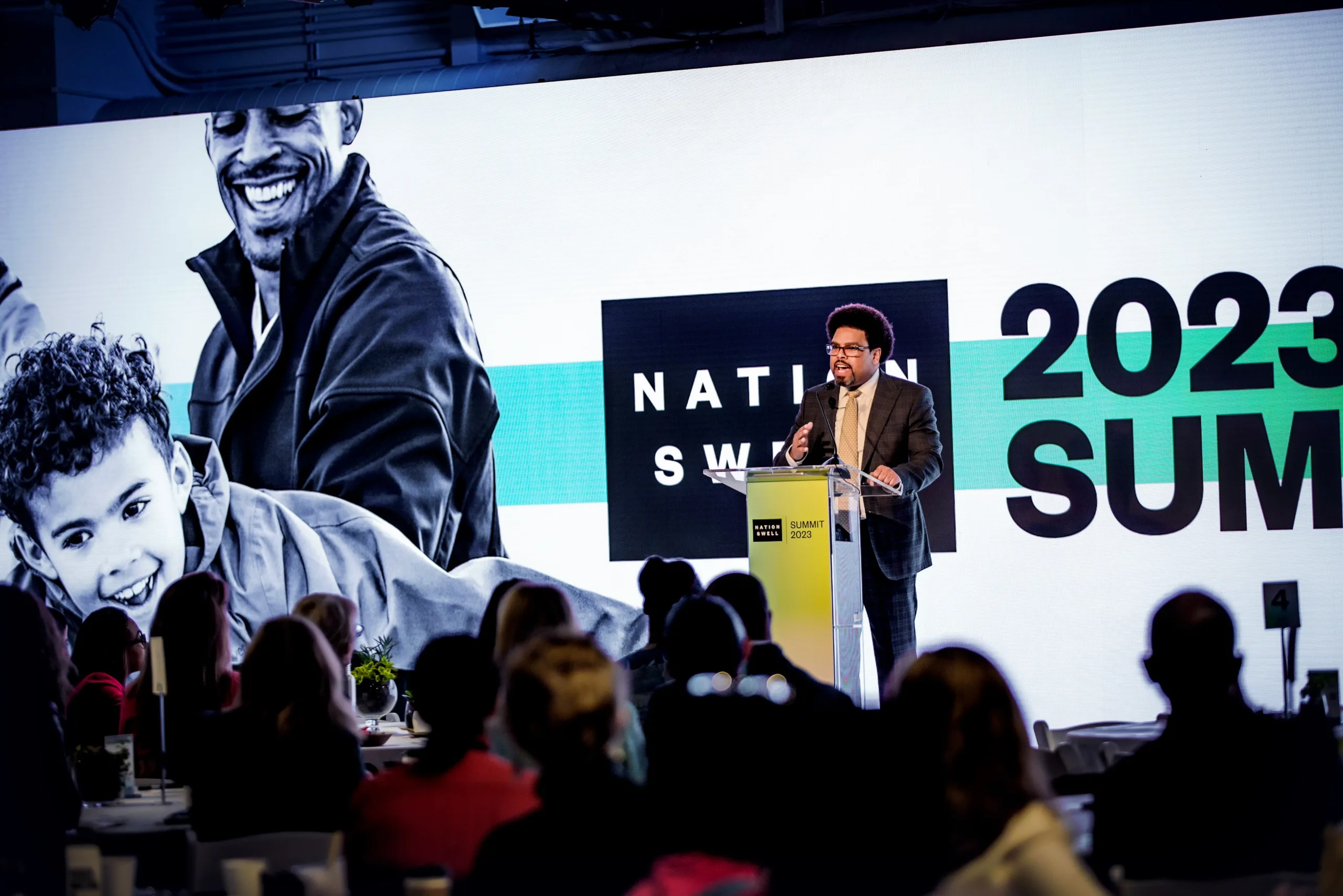
NationSwell’s 2023 Summit brought together the most cutting-edge and committed leaders in ESG, social impact, philanthropy, and other select fields. Across a full day of programming, participants elevated exciting and promising ideas and initiatives, reflected and revitalized, and gleaned actionable insights, practices, and collaboration opportunities to propel their leadership forward.

One of the main themes of the day was business for good, through which presenters and guests explored how to better center their values, prioritize human connection, and bring forward a “Better + Bolder” version of themselves.

Below are key learnings from the NationSwell Summit on the theme of business for good.

Note: Key learnings are also available on the Summit themes of purpose-driven leadership and economic mobility. A panel discussion on the fourth theme of sustainability was off the record.

Key Learnings

Individuals most affected by social issues are often those closest to solutions.

Identity is core to the impact that individuals and organizations drive, and often has an outsized impact on sociopolitical progress. Often, those most affected by societal inequalities are instrumental in deeply understanding and responding to pivotal issues. For example, as Thea Gay (NationSwell Fellow) noted, current efforts toward mitigating climate change are often driven by those who are most vulnerable to environmental injustice, such as youth and LGBTQ+ communities. Relatedly, as a Black woman, T. Morgan Dixon (Founder and CEO, GirlTrek) is closely aligned to her organizational mission of healing and transforming the lives of Black women through walking and self-care. Leaders must embrace the aspects of their own identity that prepare them to identify and adopt solutions to societal challenges, while also acknowledging when it is most appropriate to seek out and invest in others.

The intersection of business, leadership, and advocacy requires continual self-reflection.

Whether a business leader or social activist, it is vital to think deeply about who you are and how your identity shows up in the work you do. As your work evolves, your own self discovery will take new forms, and you may realize that working toward social impact for other communities is tied to advocacy for yourself. Bringing humility and self-reflection to your day-to-day work can create trust within your organization and create a narrative of meaning behind the work you do. During past inflection points, Hamdi Ulukaya (Founder and CEO, Chobani) has embodied self-reflection by asking for direct feedback from his entire staff on his leadership. He notes that success is a powerful influence and that course correction from your community is vital to staying true to your vision.

The social impact field is ripe for harnessing the collective power of technology and talent.

The potent social power of technological advancement, particularly around AI, is illustrated by the White House’s recent request that technology CEOs limit the risks of AI. But AI carries significant opportunities alongside its risks. As more talent enters the technology field, there are opportunities to mobilize platforms and employees for social good. For example, Sid Espinosa (Head of Social Impact, GitHub) notes that GitHub has created a huge network of passionate new developers that are eager to play a role in using technology for impact. Given the immense and growing power of technology and AI, organizations should anticipate headwinds and tailwinds relating to their own operations and consider how they can connect dots between their work, the evolution of the technology field, and social good. At GitHub, this perspective resulted in a partnership with the Norwegian Refugee Council, through which the company used its AI capabilities to deliver cash transfers to Ukrainians during conflict.


  1. Doing business for good often means seamlessly integrating – and responding to – information about the social and economic environment in which a company carries out its operations.

  2. Contributing financial resources toward advancing social impact is important, but can only go so far. To achieve organic and sustained impact, business leaders must assess the context in which they operate – often including characteristics outside of their control – and use that awareness to advance their goals. For example, in 2016, Hamdi Ulukaya (Founder and CEO, Chobani), identified refugee rights as a pivotal issue in the U.S. As such, there was a significant number of refugees in close proximity to Chobani’s manufacturing facility in upstate New York. Hamdi was able to increase their hiring of refugees to 30% of their total workforce, achieving a win-win for the company’s social impact agenda and the community within which it operates.
  1. Making a business case for investing in social impact is effective at generating buy-in, but doing it “meaningfully” creates sustainable change.

  2. According to Hamdi Ulukaya (Founder and CEO, Chobani), business is the most powerful platform for creating meaningful, sustainable change. Through the Tent Partnership for Refugees, he has found that CEOs often respond positively to understanding a clear business case for investing in an area of social good. For example, he cited that hiring refugees leads to high retention rates and demonstrable return on investment within two years. However, sustainable investment and long-term impact is escalated by business leaders who are dedicated to the meaning behind an issue. For some, this may be found through personal motivation, while others can look to their consumers and employees to lead the way.
More from Summit
Explore

NationSwell Summit 2023: The Moments on Our Minds

Once a year, the most cutting-edge and committed leaders in ESG, social impact, philanthropy and other select fields gather at the NationSwell Summit to foster invaluable cross-sector connections, to hear about the most exciting and promising ideas and initiatives, to reflect and revitalize, and to glean actionable insights, practices and collaboration opportunities to propel their leadership forward.

NationSwell held its Summit on Thursday in New York; the theme for 2023 was “Better + Bolder.”

Here are the better and bolder quotes and moments throughout the day that will be on our minds, in our hearts, and close to the core of our personal and professional practices of impact.

“The challenges we are working on are difficult, multi-layered and urgent. There is no time to waste, and none of us will be at our best if we’re doing it alone. At a moment that needs our best, how might we stretch further in the direction of the impact we seek?” — Greg Behrman, NationSwell CEO + Founder

“My call to action is a call to arms: Commit to justice as a matter of faith simply because it is the right thing to do.” — Darrick Hamilton, economist, Henry Cohen Professor of Economics and Urban Policy, and the founding director of the Institute on Race, Power and Political Economy at The New School.

“On every single barometer we know what works — yet, it’s not being done. It’s not that people don’t know how to manage their money, it’s that people don’t have money to manage. One’s income is not correlated to one’s intelligence. Your kids & their kids deserve just as much as my kids.” — former Stockton Mayor Michael Tubbs, special advisor on economic mobility to California Governor Gavin Newsom.

“Broad-based employee ownership and engagement, while difficult to execute, is wildly promising — it can lead to a radical increase in economic mobility, financial fluency, workforce stability and productivity.” — Pete Stavros, co-head of Global Private Equity, KKR; Founder and Chairman, Ownership Works  

“Regarding social media, it’s important to remember that 80% of tweets come from 10% of users. And that 10% tends to be much more extreme than the average American.  We naturally interpret these frequent, loud voices as being mainstream but if you look at surveys of what matters most to Americans across political lines, you actually find broad agreement.  So let’s take the time to talk to each other, particularly folks you wouldn’t normally talk to, because that’s the only way we’re going to understand each other and make progress.” — Pete Stavros,

“We’re in a burning building. We all have to get out. I might hit the ground before you, but you are right behind me. It’s not about being an ally because it affects you too… that’s why the term ‘allyship’ doesn’t quite capture it. You’re not doing this to help me. Your own life is at stake. Injustice makes everyone sick. If your proverbial boot is on my neck, your humanity is at stake too.” — Ruha Benjamin, author of “Viral Justice,” Princeton Professor of African-American Studies, NationSwell Book of the Year Award recipient.

“Be better and bolder by investing in the microscopic. People may not see it, but they will feel it.” — Ruha Benjamin

“Better and Bolder means not limiting ourselves in any way possible. It means constantly innovating, exploring, and creating new radical solutions by incorporating diverse perspectives. In this moment, we have to take that first step into the unknown. We have to ask ourselves “What would a world without a climate crisis look like?” And then we also have to consider these three questions: what does that mean to me? what does that mean for those most impacted by the crisis? And how can we make that future a reality?” — Thea Gay, NationSwell Fellow, youth climate activist

“Social impact at scale rarely happens overnight. Years of everyday decisions made by organizational leaders operating incrementally and independently reach a certain threshold — and can get stuck, often due to lack of capacity and broader insight. Our Collaboratives take the baton at that point of impasse, help identify shared opportunities and create the space for collective action to break through.” — Amy Lee, Chief Strategy Officer, NationSwell

“Refugees aren’t looking for a handout. These are the people fighting to stay alive, fighting for the futures of their families… these are the people you want working at your organizations.” — Hamdi Ulukaya, CEO + Founder, Chobani; Founder, the Tent Partnership for Refugees

“We all remember where we were when we heard something, watched something, or experienced something that changed our lives. The arts — and the extraordinary artists behind them — are the beating heart of our culture. They make us better, and they make us bolder. The catalytic inspiration and perspective they provide are essential for any leader.” — Anjali Ramasunder, NationSwell Vice President of Programming and Events


In the days to come, we will share more insights, reflections, photographs, and video from the NationSwell Summit. For more information, visit our digital hub.

ESG Next: An Interview With Target’s Amanda Nusz

At a moment of unprecedented attention, investment and opportunity for the emerging field of ESG, leaders are asking: Who is best preparing their organization for the society of the future? Who is innovating today to meet decades-long environmental and social goals? Who is setting standards that catalyze their industry’s change for the better? Who is defining what bold and aspirational look like — and how best to advance that work in practice?

Enter NationSwell’s ESG Next, an exemplary group of investors, executives, authors, philanthropists, social sector leaders, academics, and field builders who are helping to shape business as a force for social and environmental progress, advancing — and even pioneering — the most forward-thinking and effective programs, initiatives, technologies, methodologies, practices, and approaches.

For this installment, Greg Behrman, CEO + Founder of NationSwell, sat down with Amanda Nusz, Target Senior Vice President of Corporate Responsibility, to talk about the connectivity between ESG and business growth, and the importance of co-creating within your business and across your stakeholders.

Behrman, NationSwell: What is some of the work you’re leading that you’d hold up as a real exemplar of unique and effective approaches to the field of ESG?

Nusz, Target: We have undertaken several initiatives that are advancing our Target Forward sustainability ambitions. One that I’m particularly proud of is our work with Bridgeforth Farms, a fifth-generation, Black-owned family farm. By using cotton sustainably sourced from Bridgeforth Farms, we developed a selection of exclusive tee-shirts sold during Black History Month.

This alliance is unlocking growth opportunities for both of our businesses. It also inspired us to pursue new ways of working across our teams and the ways we operate with all of our external partners to enhance traceability and transparency throughout the sourcing journey.  

Our partnership and work with Bridgeforth Farms illustrates how important it is to not treat environmental and social issues as silos. They can and should work hand in hand to drive progress on all facets of sustainability and sustainable business practices. 

Behrman, NationSwell: Internally, it sounds like there’s an effort to socialize folks around some of these best practices. How do you do that in practice ?

Nusz, Target: The idea of co-creation is the central component to our process and our progress at Target. It’s a principle to which we’ve anchored our new sustainability strategy, Target Forward, which sets a vision to co-create an equitable and regenerative future with our guests, partners and communities. This means it’s a strategy built for collaboration across our business and with our partners, and for upskilling in sustainability for every member of the Target team. At every step, our principles of listening and collaboration shape our decisions and our ability to execute on our ambitions to design and elevate sustainable brands, innovate to eliminate waste, and accelerate opportunity and equity.

We know the work will be better if we do it together.

And that’s not just true of our work at Target headquarters — it’s true in our stores. For the majority of the stores we open, we’re in the community for months, if not years, before the store opening to build community relationships and understand how our stores can have meaningful presence and create meaningful impact for the community. 

It’s just one example of how we are enabling sustainable practices, decision making, and co-creation in every corner of our business, recognizing that impact and progress will be driven from every part of our organization. 

Greg Behrman, CEO + Founder, NationSwell: What’s driving you to carry out this work?

Amanda Nusz, Target: The bold sustainability ambitions being set in the business community are truly remarkable, as is the growing recognition that sustainability strategies are business strategies. The potential to drive positive impact and growth has never been more apparent, and demand for action has never been higher.

It’s energizing to see so many working to meaningfully answer that call, and it’s energizing for me personally as I reflect on the opportunity in front of us to accelerate growth through sustainable practices. 

Behrman, NationSwell: As you look at the field of sustainability and ESG and its growing prominence in the business dialogue, how do you make sense of the current moment?

Nusz, Target: I can’t help but always think about this moment — and what it means for business — in terms of growth. If you look at everything a business is trying to do, and you ask yourself, “Out of all of these goals, what really matters? What’s the role of business?” I strongly believe the role of business is to show sustainable growth — a phrase that has two meanings. 

At Target, we are mindful of the fact that business growth must be grounded in environmental and social sustainability practices; and, that the decisions we make and direction we take as a business must be built to last. Understanding the critical issues in your business model, and then relentlessly focusing on what happens in your model, can really unlock what it means to grow, and to have a brand that people love, need, and celebrate.

Behrman, NationSwell: Who are some leaders in the space who you really admire?

Nusz, Target: With co-creation at the core of our sustainability commitments, we have the opportunity to work alongside so many organizations that are advancing and accelerating sustainable growth.

Partners like the United Negro College Fund with which we’ve created the Target Scholars program to provide 1,000 students at HBCUs with scholarships, mentoring, internship and networking opportunities. And the PENSOLE Lewis College of Business & Design in Detroit, which offers free tuition to aspiring Black designers, engineers and leaders. 

Closed Loop Partners is activating meaningful work to advance circularity across the business community — and we’re grateful for our partnership with them and other retailers in The Consortium to Reinvent the Retail Bag. 

And we continue to be energized by the innovation we’re seeing across brand partners to advance sustainability with our guests. Our Target Zero initiative has seen brand partners like Burt’s Bees, PLUS, Grove Co. and more developing products and packaging designed to be refillable, reusable or compostable, made from recycled content, or made from materials that reduce the use of plastic.

Behrman, NationSwell: And what are some books or resources that have been really formative or influential for you in this space?

Nusz, Target: I’m always on the lookout for books that help me inspire our team to uncover their strengths and ideas that can advance our sustainability strategy — in particular our longstanding commitments to diversity, equity and inclusion. 

The Overstory by Richard Powers is a book that opened up a great sense of connection and understanding of the complex relationship between nature and humans as well as the importance of family, bio- and cultural diversity. And I found James D White and Krista White’s Anti-Racist Leadership to be an important resource for leaders working on designing and creating great places and cultures for all. 

I also find many podcasts a source of inspiration, including How to Save a Planet, especially the 2021 episodes with Dr. Ayana Elizabeth Johnson.


To learn more about how our ESG Next honorees are shaping business as a force for social and environmental good, visit the series hub. To learn more about NationSwell’s community of our country’s leading social impact and sustainability practitioners, visit our site.

ESG Next: An Interview With Rose Stuckey Kirk, Verizon Chief Corporate Social Responsibility Officer

At a moment of unprecedented attention, investment, and opportunity for the emerging field of ESG, leaders are asking: Who is best preparing their organization for the society of the future? Who is innovating today to meet decades-long environmental and social goals? Who is setting standards that catalyze their industry’s change for the better? Who is defining what bold and aspirational work looks like — and how best to advance that work in practice?

Enter NationSwell’s ESG Next, an exemplary group of social impact and sustainability leaders who are shaping business as a force for social and environmental progress, advancing — and even pioneering — the most forward-thinking and effective programs, initiatives, technologies, methodologies, practices, and approaches.

To kick off the series, Greg Behrman, NationSwell’s CEO + founder, interviewed Rose Stuckey Kirk, Chief Corporate Social Responsibility Officer at Verizon, who talked to us about the importance of professionalizing the field of ESG, the false premise that leaders have to choose between business opportunity and social good, and the art of “walking the halls” of your company to achieve internal buy-in on your impact initiatives. 

Greg Behrman, CEO + Founder, NationSwell: Is there a defining life experience or circumstance that drew you to social impact and sustainability work?

Rose Stuckey Kirk, Chief of Corporate Social Responsibility, Verizon: I grew up in a small, somewhat rural community in Arkansas, about 60,000 people at the time. My neighborhood was comprised of people who looked out for each other. If I was on my front porch when I was a little girl, I could hear the neighbors next door on their front porch. And I could hear the adults having very interesting conversations as they discussed ways to solve the issues of the city. At the same time, they were also keeping an eye out for the kids playing outside. I remember many times when an adult would pause mid-sentence and yell at someone else’s kid to course-correct their behavior.

So I grew up with this sense of the porch as a place where interesting conversations happen, where people were looking not inward, but outward; and looking outward meant sharing big ideas about the community and the world.  

All of that shaped my approach to what I do, and how I think about the world at large and communities in particular.  At a basic level, I believe we all have a responsibility to each other and a responsibility to lift up our communities.

Despite this belief, when I was building my corporate career, I had my hard hat on. It was all about P&L, and taking on really big challenges, and driving revenue, and managing sales forces, and managing union employees.  

And so when I ended up with the opportunity to focus on corporate social responsibility, it wasn’t called ESG — it was more like your company had a philanthropic arm — I was asked to take that on and make it more central and core to the strategy of Verizon.

I came into it with an agreement that it was just going to be a two-year gig, and I could go do something else afterward. But I ended up really falling in love with it because I saw so much opportunity, and so much of a space where we could think through where the world is going, where society is going, and what has to undergird decisions that we make in the business space that drive revenue — decisions that we need to make to connect our societal arm to that same space.  I remember so many conversations with one of our former CEOs encouraging me to move back into the P&L function of the business, but I honestly had no interest. I had found my happy place. 

Behrman, NationSwell:  You’ve been a leader and practitioner of ESG for some time now, and you’ve seen interesting ebbs and flows in the field. What is your assessment of this moment? How do you make sense of where we are? What are the biggest opportunities? What are the biggest watch outs or challenges about the current moment?

Kirk, Verizon: I think for anyone who has been in this field for a while, it is probably the dream that we all wanted — for this space to be viewed as important and central to a company and its strategy. But how we professionalize this space at this moment is really important:  When we hire an attorney or a lawyer, we expect a level of education or schooling, and that they have been a practitioner; when we hire an accountant, we have the same expectation. I believe that the space needs that same level of qualifications, that we are clear about how we build these ESG strategies, and that all of it is aligned with our business strategy.

It means not putting people in these roles whose qualification is their passion for purpose-driven work, but putting people in who are really capable of building qualified, scalable, measurable, authentic work. 

The big watch out of the current moment is that we’re being held accountable. Regulators are asking, “What are these targets? What are you guys talking about? What is really real here?” The sustainability space is under attack and many companies are beginning to do green-hushing. The amount of shareholder proposals and challenges to the work is mounting at a fast rate. But from my vantage point, all that is saying is that companies need to see this work and category as a professional aspect of their business. 

Collectively, this space and this scrutiny is about holding companies accountable. Authenticity matters. And that means not touting how great you are for the planet if your business and operations aren’t aligned with that; don’t jump on the racial justice bandwagon if you’re not willing to hold your leadership accountable for execution throughout the organization. I love how disciplined Verizon is about these things. We’re not fans of moonshot targets. We’re all about doing what we say and holding ourselves accountable.  

I think I drive people crazy in my ecosystem by asking, “What’s the target? What are we solving for? Was this good? Was it not? Is this a good use of time and money?” Because you can’t say after the fact it was good. You have to have everybody aligned on what we’re achieving, and then demonstrate that it was good against that set of objectives. And I’m really disciplined around that approach.

Behrman, NationSwell: How is your work at Verizon helping to professionalize the field? 

Kirk, Verizon: The first thing is the staff that I have hired. My team is comprised of experts from the education, environmental, social innovation, marketing, and finance space. It’s really interesting watching them do their jobs. They approach the work from a real customer-centric, insight-driven space. Then, those insights are used to actually create programs that align with our overarching business strategy at Verizon. 

The second thing is the manner in which Verizon investigates our work and holds us accountable for understanding issues across the spectrum, aligning the work with the priorities of the business, driving real outcomes, and demonstrating the true impact of the work. There is a strong emphasis on auditing the work and the outcomes that we communicate. Our disciplined approach to managing cost-per-program, evaluating the outcomes from our partners, and moving partners along a delivery continuum is truly best-in-class. 

The third approach is the need to really understand how Verizon makes money and the role that our work plays in contributing to that.  The work that we do requires a level of discipline across our entire ecosystem. As a result, the partners who work with us are finding that they are leveling up as well. Take for example our work in education: If you are one of our partner schools, the level of technology integration we require to be incorporated into our schools — everything from 5G labs to new 5G applications — requires our partners to aggressively enhance their understanding of edtech and the school districts to enhance their IT and other technology departments. I think this latter point shows how you can extend and expand the professional development space because of your work. The majority of my education team comes from the sector. They have spent time in classrooms in vulnerable school districts. They understand the need, they get the pedagogy.

Behrman, NationSwell: How do you think about the relationship between business opportunity and social good? Do you start with one, and then think about the other?

Kirk, Verizon: I don’t know that you have to think about one before the other. You first should consider the company you work for, the assets you have, and how you can leverage them to drive societal good and potentially drive revenue. Honestly, this is easier to do when your offerings are tangible — think consumer goods. But, if you do the right level of insight work and partner well with the business, you’ll find your social innovation opportunities. 

I don’t want my team to ever be in a situation where they’re not valued. I don’t want them to be in a situation where they’re viewed as just fluff. I want really smart people that can inform the business, that are called into meetings because of their expertise, and that’s what I love. 

You must have a good strategy, the right staff, and then you’ve got to “walk the halls” to get buy-in to your strategy at the top of the house, and then be hyper-focused on outcomes. I work out of a big building with 3,000 people in it with really, really long hallways. And I used to tell my team, “I’ve got to go walk the halls, and I’ve got to get the CFO to buy into this, or, “I’ve got to get the marketing person to buy into it,” or, “I have to get IT to be willing to support it.”

When you build programs that have demonstrative measurable outcomes, you can show people the connective tissue.  Bear in mind that you might not be able to add the big, big value that you’re trying to add immediately, and it’s going to be a space where you need the business to buy into the time that it will take. But when you look at that, you’ve got to sit down and get inside of people’s heads with what they think about what you’re doing. 

I think often, people walk the hall and say, “Here’s my idea. Do you support it?” I tend to say,  “Here’s what I’m thinking of — tell me where there are holes and issues.” And I say that because one of the things I have found is that most people really like to build with you. They like to be collaborative if you give them the chance. In doing that, you get the watch outs.  When you do it up and down the value chain,  you are creating a space where people can engage and help you tie it more closely to the business.

If there’s an art to walking the halls; it’s making sure that you set a vision, you set a strategy, you know where you’re going, but you don’t sell it without getting the buy-in and without people being able to edit it. And what I love about doing that is by the time I get into the big room and the big meeting, everyone says, “Yeah. Yeah. I’m aligned. Yeah, Rose came and talked to me. She spent an hour with me on it. I’m aligned.” 

Behrman, NationSwell: What are some of the habits you practice that make you an effective leader?

Kirk, Verizon: I try to pay attention to the details. I know how this business makes money. I know where I can lean in and who I can go poke to get engaged. I’ve developed great relationships with the entire leadership table, and those are the direct reports of the CEO. I have a great relationship with the CEO. I know how to ask for help, and I know how to apply that help. And then I also know how to set a strategy, how to enable my team with the right tools, and then get the heck out of their way and let them be able to implement.

And I love it when they say, “Yeah, I hear you, but,” or, “You asked for this, but,” or, “Okay, you asked for this, but you couldn’t see these other 10 things, so I’m giving you something that’s even better than what you asked for.” And I love that. 

It’s about getting to a comfortable level in life where you can confidently get out of the way of your team, but not become disengaged, and not shrug off your responsibility so you’re still there to fight the good fight when it’s necessary. And so I think that that’s a little bit about the leadership style, and I’m so glad that it resonates across the business, and that people see that leadership, and that passion —  and my badassery when I have to be a badass.

I  also love challenging people to go places that make them feel uncomfortable and turn projects and initiatives upside down. Everyone grows as a result. 

Behrman, NationSwell: Who and what is inspiring your leadership right now?

Kirk, Verizon: I have stacks and stacks of books next to me, but I prefer to turn to my people for inspiration and insight. My team lets me know when my leadership style needs to be tweaked or fixed. It’s that learning and feedback I get from my peers: They will tell me when I need to hold back or rethink. And listening to my team and my peers, and watching the creativity that comes from them, to me is the best business lesson there is because it is real, and it is authentic, and it is helpful, and it is aligned with the world in which I live. 

And in terms of who I admire, when I first took over this role, I called Laysha Ward. Laysha is an executive vice president at Target.  I called Laysha because I had such respect for what Target was doing years ago. They set the standard for how to bring consumers into the work and to see value in it. Laysha did not know me. But, she took my call and was so generous with her time and advice. I’ll never forget that.  I have incredible respect for her and the legacy work that she did and that she continues to do. For me, your value is that you can leave a legacy; so much so that the next person who comes in behind you sees such an impact that they don’t drop your work and turn to something else, and others who once worked for you take your blueprint to other companies and duplicate your activity. That is real leadership. 


To learn more about how our ESG Next honorees are shaping business as a force for social and environmental good, visit the series hub. Verizon is a NationSwell Institutional Member. To learn more about membership in NationSwell’s community of leading social impact and sustainability practitioners, visit our site.

Eight actions for creating catalytic cross-sector partnerships

Eight actions for creating catalytic cross-sector partnerships

EXECUTIVE BRIEFING

Many of the limitations and challenges associated with cross-sector social impact partnerships are rooted in their points of origin. More intentionality, responsibility, and creativity are necessary to unlock a greater number of truly catalytic opportunities. 

As the field of corporate social impact matures, organizations are embracing cross-sector partnerships as a means to advancing social and environmental goals. With ample institutional resources and access to wide-ranging capabilities, corporations are able to envision and invest in big ideas. Increasing attention from the private sector is altering the architecture of cross-sector collaboration, creating new opportunities for ambitious projects and deepening value alignment. 

At the same time, exciting examples of partnership activity are often flanked by examples in which opportunities go unmet. Given asymmetries in resourcing and capabilities, partnerships are too often rooted in matching dependencies between organizations. When that’s the case, partners satiate certain needs while overlooking more powerful approaches to collaboration, leaving behind big, creative, and sustainable ideas. Partners also lower their ceiling for impact when they proceed with too narrow an understanding of their own assets within an ecosystem, stunting potential unlocks that bloom from outside – and occasionally unlikely – perspectives. And, when organizations neglect to systematically embed trust and accountability, underlying relationships risk failure – in turn jeopardizing catalytic opportunities. 

These barriers to a catalytic result are best addressed at or before the point of partnership inception. Anchored in interviews with social impact leaders representing large corporations, NGOs, and philanthropies, this report presents eight actions that organizations and their leaders can take to raise their ceiling for impact. 

The eight actions:

  • Bring on cross-sector expertise and perspective 
  • Place a premium on emotional intelligence (EQ) 
  • Mine ideas from business units and individuals beyond your social impact team 
  • Embrace third-party views of your capabilities and liabilities 
  • Open dialogue with partners-to-be about your asymmetrical advantages 
  • Interlock organizational incentives 
  • Engage outside facilitators during (and after) ideation 
  • Hardwire feedback loops

Share this report