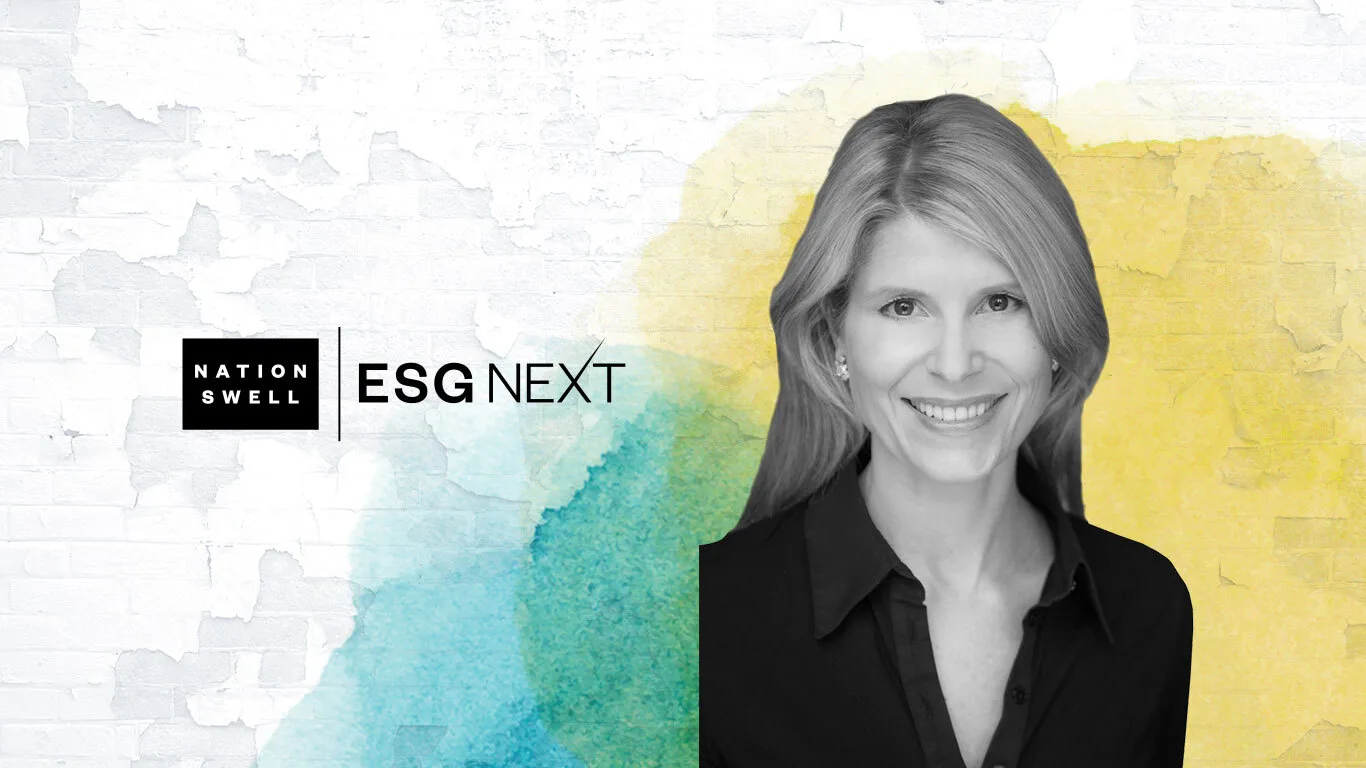
ESG Next: An Interview With PwC’s Shannon Schuyler

At a moment of unprecedented attention, investment, and opportunity for the emerging field of ESG, leaders are asking: Who is best preparing their organization for the society of the future? Who is innovating today to meet decades-long environmental and social goals? Who is setting standards that catalyze their industry’s change for the better? Who is defining what bold and aspirational look like — and how best to advance that work in practice?

Enter NationSwell’s ESG Next, an exemplary group of investors, executives, authors, philanthropists, social sector leaders, academics, and field builders who are helping to shape business as a force for social and environmental progress, advancing — and even pioneering — the most forward-thinking and effective programs, initiatives, technologies, methodologies, practices, and approaches.

For this installment, NationSwell interviewed Shannon Schuyler, Chief Purpose and Inclusion Officer at PwC, about the importance of an organizational North Star, why there’s no more safe zone for having difficult discussions about society at work, building coalitions with unlikely allies, and why going deep is sometimes better than going wide.

Greg Behrman, CEO + Founder, NationSwell: Can you tell us how your professional and personal journey led you to the work you’re leading?

Shannon Schuyler, Chief Purpose and Inclusion Officer, PwC: As our organization’s Chief Purpose and Inclusion Officer, my team and I are responsible for PwC’s purpose initiatives, which include corporate social responsibility, philanthropy, and ESG-related considerations. We’ve always been purpose-driven as an organization, but what someone means when they use the word “purpose” has been in a state of flux, which can make it a challenge to maintain understanding and alignment around it. 

When my team began 26 years ago, we had a traditional definition of what we meant by purpose: Our purpose was to protect the capital markets. And while that’s an accurate summary of what we do, to me, it begs an even more profound question: Why do we do it? What is our North Star — our guiding principle — that encourages us to make the investments we make and take the actions we take? 

PwC’s North Star is building trust in society and solving important problems by advancing real progress on some of our communities’ most urgent challenges. And it’s my task to align that traditional sense of purpose with our North Star through the ways we approach ESG to solve these problems. And although ESG issues aren’t traditionally seen on the same level as protecting capital markets, they’ve now gained equal importance — and the urgency around them continues to evolve. 

That may not sound to you like your typical professional services firm, but that’s the difference that distinguishes and defines us: our need to be more innovative and creative. Because if we’re not actually solving the important problems, really, why do we do what we do at all?

Behrman, NationSwell: How would you make sense of this moment in ESG? How has the field evolved, and where is it going?

Schuyler, PwC: 20 years ago, leaders who cared about environmental and social problems were frustrated with the little action we saw. We all wondered when more people — more leaders of more organizations — were going to recognize the importance of these issues, and the profound longevity of these challenges. We all asked ourselves why more people weren’t taking action to solve problems that our children, and their children, will face one day. We all hoped more would join us in taking action, because that was the only way we’d ever stand a chance in actually driving progress. 

This is a textbook example of being careful what you wish for, because today, with ESG, we now find ourselves in the exact place we all envisioned. And now that we’ve arrived, we realize that things aren’t as clear as they look in the rearview mirror. Back then, we thought it was as simple as contributing to a philanthropy and that’s it — job done. However, we now understand that these issues are pivotal to the sustainability of our planet and society; they concern our collective ability to ensure the continuity of life, our economy, and our progress. The stakes are high and the path uncertain. People are eager for definitive answers, but the reality is we’re creating solutions as we go, with our work on full display for all to see.

It’s a daunting challenge, made even more daunting by the rapid pace of change. Consider this: It took more than a century to develop our current systems of financial statements and planning, but we’ve only had 15 years to learn how to account for carbon. The speed of these developments is remarkable, and the margin for error is slim. It’s a monumental task, but it’s exactly where we wanted — and needed — to be if there was any hope of making an actual difference for future generations.

Behrman, NationSwell: What are the pitfalls and concerns of where ESG is going — and what’s the promise of what can come next?

Schuyler, PwC: It’s really fascinating how our professional environment — not just at PwC, but really the modern workplace — has changed over time. I’ve been with the firm long enough that I remember when subjects like politics and race relations were just not discussed within the workplace. These were topics reserved for personal time — like maybe a heated Thanksgiving debate — but certainly not something addressed daily at work.

That’s all changed. Today, these issues confront us every day, and we absolutely must address them. These issues are literally at our doorsteps and within our buildings. The sidelines have disappeared; there’s no safe zone to relegate these discussions. We’ve never done this before, but we can’t avoid it now. 

But the challenge lies in figuring out how to, in the workplace, discuss societal issues like horrific racial incidents in a way that’s respectful, appropriate, and capable of driving change; and alongside those issues, we can’t avoid talking about the reality of climate change when storms are devastating Midwest towns overnight, leaving people homeless due to insufficient resilience in these smaller cities – because the equity piece of the equation is present in both. 

It’s difficult to know how to react because these situations stir up a lot of anxiety and emotion. Trying to make decisions amid this emotional upheaval has made the task more challenging. But if there’s an upside, it’s that the urgency of these issues has become more apparent. People can’t ignore what they see on the news or what’s happening in their cities. They may not like it, but they can’t pretend it’s not happening. The issues are too glaringly apparent.

Some practitioners say, “ESG is really a nascent field, we’re just beginning, we’ll get it right down the line.” But we don’t have the luxury of saying that we’re at the starting line anymore. We’re in the game, and now we’re forced to run plays. And the people watching us are chanting, “When are you going to score?” And they’re waiting for that score because if we don’t deliver, then they’re going to say that this isn’t valuable, and you actually can’t make a change.

People don’t want to hear, “Give me 10 years to get this run and then I can get it!” We have to get it right now. We have to be able to show that we can actually make change happen sooner than what has occurred in other industries because this has to be validated, so we can prove it shouldn’t go back to being something that only a handful of companies focus on. And if we don’t realize that, we could lose — we could go back to where we were 20 years ago.

Behrman, NationSwell: What’s unique about the work you’re leading? What are some approaches, strategies, or practices you’re deploying that other field builders should have visibility into?

Schuyler, PwC: A decade ago, the focus was on who could pledge the largest sum or reach the most people. Now, the focus has shifted towards making a deeper impact on a smaller number, rather than just reaching a mass scale with something less substantive. 

Our progression with Access Your Potential reflects this change. The focus is now on employment, on preparing people to start their careers. We’re not just providing tools for personal upskilling, which is important, but we’re also creating pathways for people to join companies like ours and others.

With Access Your Potential, we’re saying it’s not just about providing the right connections, curriculum, and visibility. We want to ensure there’s a tangible outcome — a place where you can be successful on your own terms, and find a career path for the future support through newly developed skills and network.

We’ve moved from reaching 12 million K-12 grade students and helping them to sharpen their financial literacy skills to providing deeper support to 25,000 Black and Hispanix/Latinx college students. The depth of that support includes providing them with the tools, mentorship, and financial understanding they need to find jobs that allow them to sustain their lives. We’re committed to bringing them into our firm or, if their interests lie elsewhere, helping them find other opportunities.

Another significant development is the way we approach coalition building with our competitors to drive industry-wide change. 

Our leadership with CEO Action for Diversity & Inclusion is an example of this. We’re bringing industries together, like retail or private equity, to discuss and solve common issues – with over 2,400 signatories to date. We’re collectively addressing DEI issues impacting the workplace, sharing successes and failures, and holding ourselves accountable. Now in its sixth year, this effort began with companies that had already made significant internal strides and were ready to extend their efforts beyond their own walls. By changing society, participants believe we can further advance our internal efforts.

We also have around a hundred companies ready to be part of policy change who are working together as part of CEO Action for Racial Equity. Their policy teams are  engaging in state-by-state dialogues about potential changes specifically affecting the Black community in education, healthcare, economic empowerment, and public safety. They’re spending time in the most challenging cities, working with governors and mayors, and discussing what businesses want.

Eight different topic areas are being explored by these companies. We’re not shying away from discussing politicized or controversial issues like cash bail — we’re looking at them collectively, asserting that business wants to be part of these discussions and should have a say in large bills being passed.

Behrman, NationSwell: What leadership practices have helped you operate effectively?

Schuyler, PwC: First off, I’m immensely curious by nature. A lot of what I know wasn’t taught to me in a conventional sense. I’ve gained most of my knowledge because people are now writing books and sharing information on these topics, which fascinates me. There’s always something new to learn in this ever-changing field, and I’m genuinely interested in uncovering what I don’t know and learning more about it.

Secondly, I’ve developed an incredibly thick skin over time — and that’s something I didn’t have at the start of my career. Whenever we share something with the public, I know the reaction will be split. Half the people will appreciate it, and half will criticize it. Sometimes, people even send me scathing feedback. But you know what, that’s okay. I always appreciate the input, and I can only say, “I did my best.”

The key is to not shy away from criticism. We, as a firm, have decided what we stand for and what we’re going to do. Not everyone is going to like it, but we’re open to having conversations because we want people to understand our stance. But it’s crucial that leaders remain firm in their position. It requires courage and unwavering commitment, especially since these matters are often emotionally charged. It might be tempting to hide away from the backlash, but that’s not an option if we want to make continued progress.

Behrman, NationSwell: What inspires your leadership?

Schuyler, PwC: Coalition building inspires me. I’ve always been a proponent of unity and collaboration, and it’s heartening to see people with shared interests come together, even if they don’t agree on everything. The power of these coalitions of seemingly unlikely allies is what I admire the most.

On a personal level, Adam Grant has been such a source of inspiration. The way he communicates ideas has been instrumental in shaping my understanding of the world, and helping me slow down for a bit.

With business leaders putting a stake in the ground, they become catalysts that reassure us we’re not  alone in what we were doing, in caring about what we care about.

NationSwell Collaboratives: Making the Case for Childcare

NationSwell Collaboratives are a vehicle for bringing together committed actors to push towards collective action on a specific issue. Anthony Smith, NationSwell V.P. of Editorial, spoke to Uyen Tieu, NationSwell President, Amy Lee, NationSwell Chief Strategy Officer, Allie Mahler, NationSwell Senior Strategy Director, and Austen Zoutewelle, NationSwell Associate Director of Strategy, about the Case for Childcare Collaborative, a cross-sector coalition working to solve our nation’s crisis of childcare and help 1.1 million women return to a better workplace than the one they left at the outset of the pandemic.

Anthony Smith, NationSwell V.P. of Editorial: Why should leaders make the case for childcare?

Uyen Tieu, NationSwell President: The moment for leaders to make the case for childcare has been such a long time coming. This isn’t a new conversation in America, but it’s one that till this point had been led largely by women, experts, and activists. It took the wide scale disruption of the pandemic to get us to where we are now, where it’s now as clear for men — especially fathers — as it has been for us. We have to take advantage of this moment.

NationSwell: How did the work begin?

Amy Lee, NationSwell Chief Strategy Officer: Our first step was to recognize the mass exodus of women that left the workplace during the pandemic. At the beginning of the Covid era, 2 million women left the workforce; 1.1 million still have not returned. Their reasons aren’t just because of the tangible realities of school shutdowns and the lack of childcare — they’re about societal norms around which parent is chiefly responsible for caregiving.

One of our Studio partners told us, “We really want to work with you to tackle the problems that working womxn* and caregiving womxn are facing,” and that’s really how our Collaborative was born — out of the idea that we didn’t just want to help these women get back to work, we want to build the structures that allow women to actually thrive at work once they return.

Allie Mahler, NationSwell Senior Strategy Director: Collaboratives are all about building coalitions of committed actors for scaled, collective action. We have an incredible group of partners that have coalesced around this Collaborative initiative: American Family Insurance, Annie E. Casey Foundation, Caring Across Generations, National Domestic Workers Alliance, Working for Women, and others. It’s a powerhouse group who each bring unique expertise, funding, programming, organizing capabilities, and community to the table. I have no doubt this group will move mountains when it comes to helping businesses support low wage workers and the caregiving economy.

NationSwell: What are some of the challenges facing working caregivers in this country?

Austen Zoutewelle, NationSwell Associate Director, Strategy: Given what we know about economic disruption, it’s unsurprising that the women who are most affected by the lack of childcare in this country are women without a college degree, women of color, and small business owners. 

But one big learning for us is that the care industry — not only for early childhood education, but also for eldercare — is predominantly run by women. So not only are working mothers being affected by this disruption, but working mothers within the industry of care are also affected — even as we expect them to be at the frontlines of this crisis. Not only does that lead to fewer workers, it leads to fewer options for daycare and childcare. 

NationSwell: What advantages does the Collaborative model provide in tackling this challenge?

Lee: Philanthropy and corporate social responsibility functions are evolving at a rapid pace. Legacy models have been focused on a personal or organization-specific mission, but the new generation of leaders in this space have embraced the idea that these issues — whether it’s climate change or childcare — are too large to be solved by one person, or one family foundation, or one organization alone. We have to work together. And at the same time, we need to provide funders with a way to see what their peers are doing so that we don’t support redundant work.  

Collaboratives allow us to do exactly that — we bring funders and committed actors together to deepen and broaden their impact. We allow them to look across the space and really identify where there are unmet needs. And it also allows them to work together with partners that may not organically be at the same table without our support. 

Tieu: One of our partners said it the best: This time can be different because the table is different. NationSwell approaches this work with the nuanced understanding that the players need to work towards something that can last.

NationSwell: How is the case for childcare personal to you?

Tieu:  I’m a mom, I’m a daughter, I’m a woman, and I’m a business leader. If we’re to compete without actually addressing the urgent need for childcare, there’s going to be a knock-on effect across every aspect of society. The problem is too urgent to rely only on federal policy change. If committed actors come together now to co-create the roadmap, we can turn the case for childcare into a reality.

Zoutewelle: I watched my mom balance raising three kids and working full-time when I was in high school. She still manages caring for my brother with Down syndrome while working full-time. I’ve seen first hand the urgency of this issue, the importance of flexible working arrangements, the necessity of public policy to support parents, and the need for collaborative, systemic strategies for making an impact. The urgency is even greater for women of color in low-wage industries. It’s important to me to elevate this work so that more women can participate in the economy and feel supported as a parent. It’s critical for our moms and the future generations.

Mahler: This work is incredibly personal to me. I just returned back to work at NationSwell as a mom of two young babies under two years old while also leading our Strategy team. I love what I get to do at work, and I love my daughters, but it is not only mentally and physically taxing on a daily basis but also financially taxing to coordinate care for my children. During my maternity leave, I thought daily about how fortunate I was to have the time to connect with my daughters, and how so many women and their families are taken too soon from their babies as they go back to work at 6 or 8 weeks post-delivery. That’s why this work inspires me and lights a fire for me.

Lee: I am a privileged white woman, but nonetheless the pandemic showed me how hard it is to be a working parent. My children were one and three years old when the pandemic started, and my husband and I were suddenly thrust into full-time childcare and a full-time job at a time of huge uncertainty and fear. We were only just able to make it work and that was with the benefit of being able to work remotely and having a flexible, empathetic employer. I can’t even imagine how hard it must have been for people working shifts, or people from single parent families.


For more information on Collaboratives, visit our site.

Editor’s Note: To exercise intersectionality and inclusion, one member of our collaborative uses the spelling “womxn” whereas other members use the traditional spelling, “women.” You can learn more about “womxn” and other forms of intentional, lexical inclusion at the Womxn’s Center for Success. 

Diversity, equity, inclusion, and belonging: U.S. certifications and recognitions 

Diversity, equity, inclusion, and belonging: U.S. certifications and recognitions 

CURATED COLLECTION

From the Great Resignation to the Great Reshuffle, one thing is clear: workers want good workplaces alongside good jobs. For employers, however, it can be a challenge to signal their value to prospective employees or retain current talent in a tight labor market. Although external validation can never capture the true experience of what it is like to work at any one place, certifications, awards, or other public recognitions can offer employers the opportunity to pursue and promote excellence across a variety of DEIB dimensions.

This Curated Collection provides social impact leaders in the private sector with a roundup of United States-based certifications and “best of” recognitions related to different aspects of diversity, equity, inclusion, and belonging (DEIB). 

The collection includes the following: 

  • Certifications achieved based on company-submitted applications 
  • Recognitions achieved without needing to apply

Share this report

The Takeaway | Inclusive Leadership: How We Lead Online and Offline

The pandemic ushered in a wave of fresh challenges for companies and leaders, but it also served as a much-needed pause for leaders to reflect, retool, and reset. Now, nearly three years on, we’ve inherited a radically transformed workplace environment — and we’re tasked with implementing some of the carefully considered changes that will better serve our teams and help us to create the workplace of the future.

In a conversation hosted by the NationSwell Council community on Wednesday, we came together to parse exactly what leaders are doing to address DEIB goals, team attrition rates, competing needs amid a newly hybrid working world, and more.

Here are some of the key learnings from the event.


  1. We often think of how we create value for customers — now it’s time to start thinking about how we create value for our teams. New, remote work challenges have prompted a slew of new questions about how to keep teams engaged and how much “in-person” time is actually needed. Some leaders who are used to thinking about how to create value that makes customers want to show up are now flipping that question on its head, asking what they can do to incentivize team members to work from the office. Creating a hybrid schedule where employees are only expected to come into the office on certain days of the week — and then offering special perks, like free lunches and special affinity group meetings on those days — can be a helpful system for making team members feel like their time in the office is valuable and worth it.
  2. Building out effective listening engines will be critical to accurately assessing employees’ needs. With so much shared wisdom on how to respond to team members’ post-pandemic needs flying around, it can be tempting to impulsively deploy some of those solutions and policies, especially given that the underlying assumption is that they will make employees’ lives easier. But as one member pointed out, not every team member’s needs look the same — and it’s important to build out an infrastructure for feedback that ensures that you’re capturing your specific team’s needs as accurately as possible.
  3. Pay as much attention to why people are staying as you do to why they’re leaving. When it comes to high turnover rates, the intuitive response is to get to the bottom of why people are leaving and what can be done to mitigate the departures. But it’s equally important to figure out why people are staying — and which policies are actually working — so that you can be sure-footed in creating an environment that people genuinely want to be in, and not just one that they’re not ready to leave.
  4. If you value DEIB, put a premium on mental health. Team members’ mental health and well-being naturally dovetails with DEIB concerns: conversations about compensation, job security, hybrid work schedules, pipelines for advancement, and more are inherently stressful, and play a huge role in employees’ livelihoods and psychological safety both inside and outside the workplace. Investing in wraparound support structures can help to ensure team members’ happiness and well-being in the long run, and can set your organization up to more sustainably foster a workplace that is diverse, equitable, and inclusive.
  5. Work with team members to build hybrid schedules that suit their lives and needs. Rather than mandating that employees be in the office at certain times on certain days, create flexible mechanisms by which team members can choose to work from home when needed, as long as they let team members know well in advance. 

The NationSwell Council community brings together a diverse, curated community of bold individuals and organizations leading the way in social, economic, and environmental problem-solving. Learn more about the Council here.

The state of play: DEIB

The state of play: DEIB

Organizations have taken a larger interest in the practice of Diversity, Equity, Inclusion, and Belonging since COVID-19, the murder of George Floyd, and other pivotal events brought long-entrenched societal inequities into the spotlight. While their arc of progress is uneven, the simple fact remains: injustice occurs as prominently in workplaces as anywhere else, affording companies the opportunity – perhaps the responsibility – to model solutions that could ultimately yield a wider societal benefit. This trend report describes five key trends for DEIB in 2022:

The trends: 

  • With high expectations from current and prospective employees, companies are revamping recruitment to meet diversity goals; they are struggling to employ complete strategies.
  • To advance equity and inclusion, companies are leaning into stronger benefits, policy updates, and employee resource groups; data on efficacy is scarce, but makes clear that the work is just beginning.
  • Employee perspectives on DEIB effectiveness vary in ways that are unsurprising; company leadership has a responsibility for more open and reciprocal communications to better respond to these differences.
  • Reporting and disclosures around DEIB are improving, but the data is inconsistent and incomplete.
  • DEIB executives are turning over at an increasingly high rate; lack of resourcing, insufficient company-wide engagement, and burnout are major contributors.

Share this report

Expanding access to quality higher education for the incarcerated: An interview with Mount Tamalpais College’s Jody Lewen

In January 2022, after an arduous 18-month application and review process, Mount Tamalpais College was granted Initial Accreditation by the Accrediting Commission for Junior and Community Colleges, making it the first accredited independent liberal arts college dedicated specifically to serving incarcerated students.

Operating out of San Quentin State Prison — the oldest operating correctional facility in California, tucked away on a peninsula just outside of San Francisco — the staff at Mount Tamalpais has long been dedicated to ensuring that students on the inside receive a high-quality education at least comparable to what they might receive at a quality educational institution on the outside. 

Along with providing “an intellectually rigorous, inclusive Associate of Arts degree program and College Preparatory Program, free of charge, to people at San Quentin State Prison,” Mount Tamalpais also seeks to “expand access to quality higher education for incarcerated people, and to foster the values of equity, civic engagement, independence of thought, and freedom of expression,” according to its website.

NationSwell Council member Jody Lewen, the founder and president of Mount Tamalpais College, recently sat down with us to talk about advocating for academic quality and inclusivity and the process of building Mount Tamalpais’s programs into what they are today — a process, she said, that “really strained my atheism.”

Read our full interview with Jody below:

NationSwell: Tell us a little bit about how you ended up working in prison education.

Jody Lewen, founder and president of Mount Tamalpais College: I grew up in Manhattan and went to Wesleyan in Middletown, Connecticut, for undergrad, and then a short time later moved to Berlin and ended up doing my Master’s in comparative literature and philosophy. I came to California in 1994 to do my doctorate at Berkeley, but while I was about halfway through working on my dissertation, I very coincidentally learned about this college program at San Quentin that was run entirely by volunteers and became very interested.

I knew nothing about prison, it was not a field I had read about or studied. I had done a lot of political work and read a lot of history and literature as an undergrad and was very aware, in a mostly abstract sense, of suffering in the world, but I really hadn’t found a way to integrate my political interests with my academic career path. But I thought the program sounded really interesting, so I ended up going into San Quentin in the spring of 1999 and teaching a public speaking class and really loving it.

NS: What were some of the early challenges or surprises you faced in doing this work?

Mount Tamalpais College’s Jody Lewen: It was a lot of my own demons about education — there were so many very humbling ironies. I had never interacted with adults who were as talented and intelligent whose basic skills in reading and writing were as poor, and it made me realize that I had a lot of ignorant assumptions about the correlation between basic skills and intellect.

When I got that first batch of papers back, I didn’t even know how to grade them, because there were so many problems. So I eventually went back and had a conversation with the students where I said look, guys, I’m realizing there’s all this stuff you haven’t been taught about college writing and I’m not sure how to handle this but I don’t really feel comfortable letting this stuff slide. They just overwhelmingly were like, ‘Please don’t patronize us, people have been underestimating us our entire lives.’ They didn’t want to be in a prison college program; they wanted to be in college, and they wanted to learn what they really needed to know to be successful in the outside academic and professional worlds. 

NationSwell: How did you go from working as a volunteer at San Quentin to becoming the founder and president of Mount Tamalpais?

Lewen: I had gotten very interested in the recruitment and training of faculty, because very early on I had become aware that they were not acquiring the basic skills they were going to need to be successful in a rigorous academic environment. It became a question of, should the standards we’re holding our students to on the inside be the same ones we’re holding our students to on the outside? And if not, why not?

I’m the most unreligious person to walk the face of the earth, and yet a series of things began happening that really strained my atheism. It was like an intervention: We started to realize that the problem was not just that they were so underprepared academically; the problem was us, it was that we didn’t have the resources or the time to build a program that really met their needs. And then the fellow who was running the program left, and the whole thing collapsed on me like a house. I began to tear out walls and floors and ceilings; our courses weren’t in compliance with the minimum number of contact hours, so I extended the semester from 10 weeks to 13 weeks, increased the class meetings to twice a week from once a week, and began to recruit teachers who knew how to teach developmental writing and math. And we basically overhauled the whole pre-college writing and math program.

NationSwell: What are some of the things you think about in trying to recruit new educators to meet these challenges?

Lewen: To be frank, most people assume that prison is a scary place to be, understandably. We’ve all been taught to imagine incarcerated people as ugly, predatory, not very bright. So getting people to overcome their physical fear of prison is huge. It helps a lot, as the program has grown, we have so many current and former faculty members who can’t stop talking about what it’s like to teach there, and they’re really our recruitment army. 

And then the other thing I’ve noticed is that the universe of people who are interested in prisons and serving the incarcerated are often relatively politically similar to each other. The Bay Area is obviously quite progressive, so cultivating intellectual diversity among the faculty can be quite challenging. I take really seriously the fact that our students are really diverse in every way — not just racially or ethnically but also culturally, ideologically, politically, they’re from all corners of the universe. So diversity is also an important value in our recruitment processes.

NationSwell: What can interested members do to help support the work that you do, or prison education more broadly?

Lewen: For the fall semester our instructors are mostly lined up already, but in general we’re always looking for volunteers. For the credit classes the lead instructor has to have at least a master’s degree in the field, but for the developmental education classes and also any tutoring roles, the requirements are a little bit more flexible. [Anyone interested in volunteering can get in touch through Mount Tamailpais’s website here.]

We’re  always looking to connect with individual and institutional funders who are excited about the idea of providing high quality educational opportunities to currently incarcerated people. Unlike traditional colleges, we charge no tuition and receive no state or federal funding. This is fantastic for preserving our autonomy and our capacity to innovate, but it’s also real work to raise $5 million a year. People can always reach out to us, or directly support our work at mttamcollege.org/donate. 

There are also other nonprofit organizations that support reentry and other ancillary fields that can always use volunteers.A number of excellent organizations in the Bay Area have been founded by our alumni, either while they were still inside or once they got out. Some of those organizations are:

  • Bonafide (bonafidelife.org), an amazing reentry organization that works with people from the moment they’re released and then stays with them throughout their lifetime helping them adjust and thrive. 
  • The San Quentin News, the prison newspaper that’s in a period of tremendous growth right now.
  • Mend Collaborative, a restorative justice organization that was recently co-founded by an alumnus of ours.
  • Veterans Healing Veterans, founded by a former student, which supports currently or formerly incarcerated veterans.
  • Ear Hustle, a podcast that was co-founded by a former MTC faculty member.