Patagonia CEO Ryan Gellert: “Our biggest impact has been modeling a different way of doing business”

In the fall of 2022, Patagonia founder Yvon Chouinard announced a bold new experiment in for-profit business: the voting stock of his company would immediately transfer to the Patagonia Purpose Trust, with the remaining non-voting stock diverted to the Holdfast Collective, a 501c4 nonprofit, to ensure that all money not reinvested back into the company is dedicated to addressing the climate and ecological crisis. “Earth,” he proclaimed in a now-viral open letter, “is now our only shareholder.”

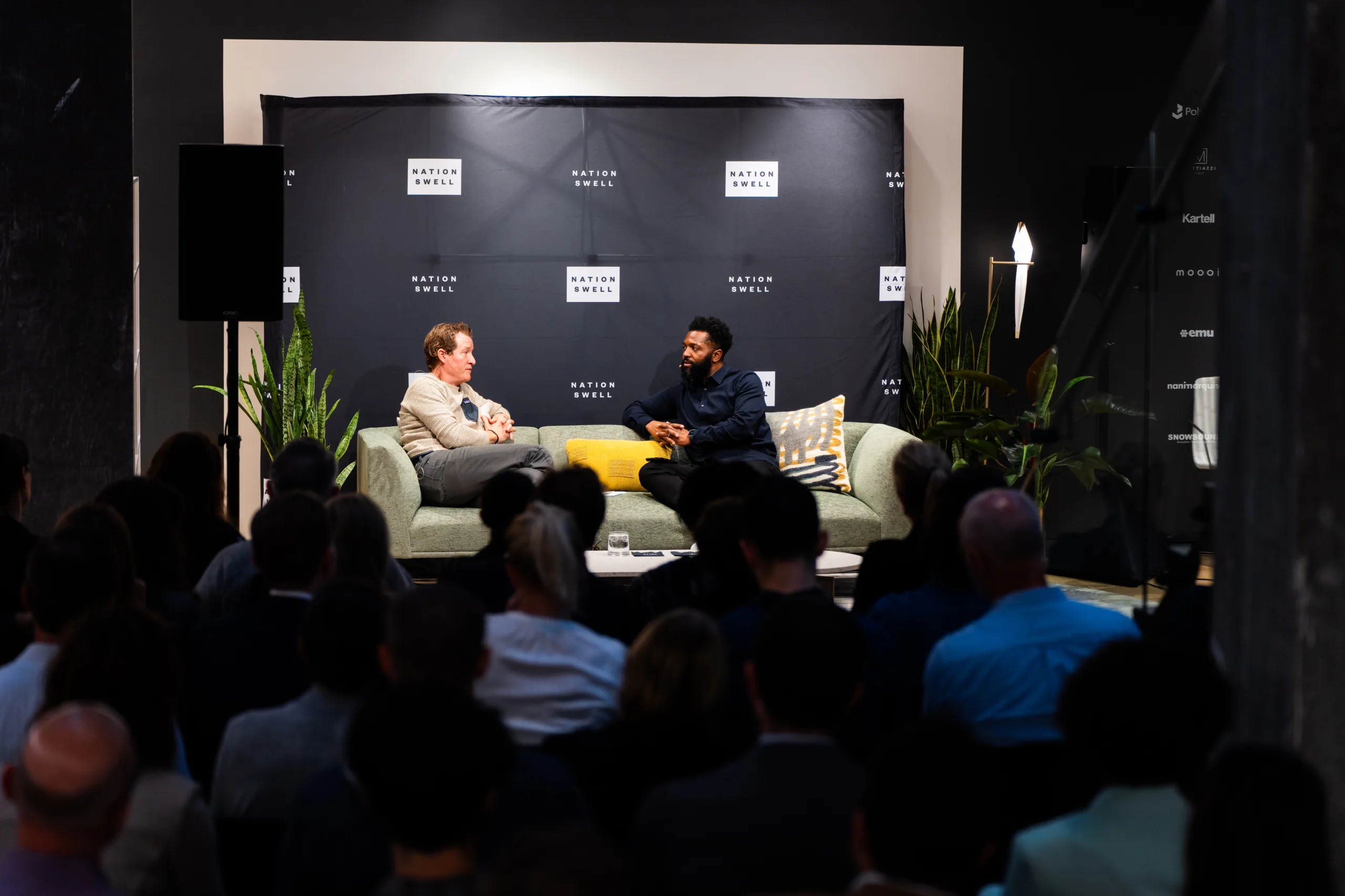
On September 18, 2023, as leaders from across sectors descended upon New York City for Climate Week, Patagonia CEO Ryan Gellert joined NationSwell for an in-person fireside chat to unpack how the company is maintaining its commitment to being a purpose-driven business. Moderated by best-selling writer, podcaster, and NationSwell Council member Baratunde Thurston, the conversation explored how for-profit companies can pave the way forward on catalyzing bold climate action and what leaders can do to ensure that their personal and corporate values are in sync. 

Here are several highlights from the discussion:

Climate work is a lifelong commitment, and protecting the planet is our shared responsibility.

According to Gellert, too many CEOs would respond to climate conversations five years ago with the common refrain: “That’s not my problem.” Today, he says the tone of those conversations has shifted encouragingly, and those same leaders are now more likely to acknowledge their place in finding shared solutions — even when they aren’t sure of the best way forward. 

The future of climate will necessarily depend on more people — those in positions of power in particular — acknowledging their role in moving the ball down the field and making sure that climate work is “a 52-week thing,” and not just something to focus on one week out of the year.

Business sector leaders have an obligation to be the catalysts of change — but they can’t do it alone.

Since Patagonia shifted its ownership structure, Gellert shared that there have been many conversations with other companies interested in investing in purpose in a similar way — and that it feels like the guardrails have meaningfully shifted in terms of what’s possible in rethinking a business’s relationship to its employees, its community, and the planet.

“I believe the biggest impact Patagnoia has had has been modeling a different way of business,” he said.

And while catalyzing businesses to drive change will be of critical importance to the larger climate movement, the business sector won’t succeed on its own.

“I’d like to create a world where everybody understands it absolutely is our shared problem… and we’re all leaning in the same direction, from the business sector, with the government, with NGOs, with citizens, to clean up the mess we’ve created,” Gellert said.

For purpose-driven businesses to succeed, purpose and profits cannot be treated as distinct aims.

The days of businesses setting up a corporate social responsibility department and making impact work solely that group’s jurisdiction are over. In order for businesses to fully realize their role in creating a more sustainable, equitable future, Gellert said, they must necessarily make it their responsibility to create a culture where every person in every area feels incentivized to show up and do the work.

“I don’t think you can separate purpose and profits, period,” he said. “Under pressure, every single business gravitates toward profits. So the two have to be entirely connected, or you have to call it what it is.”

Acknowledging that it had created an “incomplete culture” was instrumental in helping Patagonia to hone its approach to social issues.

In the weeks after George Floyd’s murder, Patagonia, like many other companies, took a hard look at its internal culture and where it fell short of its values. What Gellert and other leaders leaned into during that moment was a commitment to “transformational change even where there’s no end in sight” — and on improving systems and processes in ways that relied more on common sense than external optics and politics.  

“Listen, show up, and do the work,” Gellert said. “And I think slowly and steadily, that’s given us the momentum to do the work internally and externally.”

Consumerism and “business-as-usual” have created many of the problems we currently face, and need to be interrogated. 

According to Gellert, we’ve outgrown the Milton Friedman-backed idea of shareholder primacy — it’s precisely business as usual that has created the environmental crisis we currently find ourselves mired in. 

Universities and business schools have a vital role to play in helping to build thinking, morals, practices, and systems that address how consumerism contributes to natural resource depletion, pollution, and other deleterious climate impacts. Businesses, meanwhile, must interrogate how circular business models can help shrink their environmental impact and deliver value to a new set of stakeholders — including customers, employees, and the planet.

Sometimes the best way into climate awareness isn’t doom forecasting or even direct action — it’s connection.

In response to an audience question about the best way to help children connect with the complicated and dire implications of the climate crisis, moderator Baratunde Thurston said that sometimes, the best way into climate awareness, “…isn’t always direct work and action, (but) climate connection — to highlight our relationship to nature in a beautiful, local way.” 

“Kids are naturally curious, they play with bugs, they splash in the water… we don’t need forecasts of doom and gloom, we can achieve the same purpose through a celebration or an exploration of that connection,” he said. “When we become more interconnected, saving the planet becomes the most selfish thing we can do — it becomes about saving ourselves. And if we can plant that seed early with kids without being heavy-handed with it, then that could do something amazing.”


The state of play: Corporate sustainability

The state of play: Corporate sustainability

TREND REPORT

As climate change creates a growing risk to companies’ financial stability, sustainability programs offer a competitive advantage for businesses across size and sector. Those who are ahead of the curve are making bold commitments, deepening expertise, collaborating effectively, and greening their workforces. The most resolute business leaders will continue to push forward their strategies against political backlash. For them, it is a moment of opportunity not hesitancy. 

In this report, we help leaders get up to speed and check their progress against the latest macro trends, policy and regulatory developments (U.S. and E.U.), and pace-setting organizations.

The trends: 

  • Corporate climate commitments and leadership accountability are on the rise. But the rate of progress remains well behind what’s needed to achieve 2050 goals. 
  • Political and legislative activity are creating cross-pressures on sustainability work. But stakeholder activism remains a strong tailwind. 
  • New innovations and collaborations reflect a growing supply chain playbook. Companies know that Scope 3 impact cannot be ignored. 
  • Jobs–both existing and new–are becoming greener. Employers and workers are both driving the transition. 
  • Water and biodiversity are making big moves toward the center of corporate interest. Pending emissions disclosure rules remain top of mind.

Share this report

Five Minutes With Jonathan Stott, Executive Director at EcoRise

The NationSwell Council is made up of social impact-oriented leaders and changemakers who are committed to pioneering solutions in order to better their communities — and the world around them. In NationSwell’s latest series, “Five Minutes With…,” we sit down with members of our community whose exemplary leadership deserves a deeper dive. Here’s what Jonathan Stott, Executive Director at EcoRise, had to share with us on biomimicry, youth leadership on climate, and community-based environmental alliances:

NationSwell: What does the future of nature-inspired innovation look like, and what can we do to ensure that that future is as equitable and inclusive as possible?

Jonathan Stott, EcoRise: There are so many different ways to answer this one, but for today, I’ll focus on organizational culture. Nature-inspired innovation invites all of us to critically examine our workplace cultures and consider how we might look to nature to reimagine what a healthy and inclusive organization can look like. It’s taking principles of biomimicry, for example, to reimagine decision-making as at the periphery of an organization, where decisions are informed by the stakeholders/customers/users/etc, rather than having centralized control and command structures, which concentrate power in ways that inhibit innovation and contribute to inequity.

NationSwell: How does the work you’re driving today help to build that future?

Jonathan Stott, EcoRise: We’re doing a lot of work at EcoRise to put this concept into practice, with one example being our new partnership screening process. Historically, like many non-profits, we didn’t have a tool or process to truly vet potential partners and evaluate the degree to which they are aligned with our organizational values, like equity. After many conversations with board and team, we created a rubric to guide us through this review and a new working group that uses the rubric to review — and, importantly, make decisions — on partnerships. As a result of this work, we’re being super intentional about who we work with and, in some cases, where we need to respectfully decline funding. I’m looking forward to sharing our rubric and approach with other non-profits in the months ahead.

NationSwell: What inspires or motivates you — personally and professionally — to do this work?

Jonathan Stott, EcoRise: At EcoRise, we engage K-12 youth as climate justice and sustainability leaders through a variety of educational programs. I’ve had the opportunity to see our students in action this spring in communities across the country. Recently, I was in San Antonio for our Youth Council for Climate Initiatives showcase, where students shared their policy proposals and projects to advance climate and resiliency goals in the region. One student group examined how the city could streamline its website and better target support services as part of the residential weatherization assistance program to reduce San Antonio’s climate footprint and promote housing equity. All of the student groups were amazing — I could have sworn I was listening to a team of consultants or graduate students. I left feeling hopeful and inspired — and eager to do more to support youth leadership on climate.

NationSwell: What are some promising signs from the impact you’re driving?

Jonathan Stott, EcoRise: We face an existential threat with climate change, and so it’s easy for me to go negative. But there are so many promising signs in the work we’re doing at EcoRise with the support of our partners. One project I’m particularly excited about is our systems change efforts, whereby EcoRise is working with local, regional, and national partners to advance the environmental education movement through large-scale data collection and visualizations. This project is called Gen:Thrive, and is publicly available here: https://www.genthrive.org/

NationSwell: Finally, what are some of the challenges you’re facing? How can NationSwell’s social impact community of practice help you with those challenges?

Jonathan Stott, EcoRise: We’re not a huge non-profit, but we’re not tiny either. As a result of being somewhere in the middle, there are times when we need support in specific areas we are working in, where we don’t have the internal expertise (e.g. technical support for our GIS mapping work, human resources and legal expertise). We’re also seeking board members who can play the role of Community Connectors and Champions, helping advance our impact and build program alliances with community based non-profits in key regions including New York, Washington D.C, and Atlanta.


Jonathan Stott is the Executive Director at EcoRise, a nonprofit working to mobilize a new generation of leaders to design healthy, just, and thriving communities for all by elevating youth voices and advancing student-led solutions to real-world challenges. If you’re interested in learning more, please get in touch.

Five Minutes With Kristy Drutman, Founder of Browngirl Green

In “5 Minutes With…,” NationSwell’s Editorial Team sits down with practitioners in our community whose work advances social, economic, and environmental progress. As part of our focus on Meeting Our Climate Moment, and with mindfulness around the overlapping celebration of AAPI Heritage Month and recognition of Mental Health Awareness Month, NationSwell sat down with Kristy Drutman, founder of Browngirl Green, about the work she’s leading (and inspiring) on climate justice, why the climate crisis is a mental health crisis, and how her Philippine heritage informs her sense of urgency and intersectionality.

This is what she had to say.

NationSwell’s Anthony Smith: Tell us about your professional and personal journey.

Kristy Drutman, Browgirl Green: I’m a Jewish and Filipina environmentalist and online educator. I run a platform called Browngirl Green that centers diversity, equity, and inclusion in climate solutions, and I’m the co-founder of the Green Jobs Board, which is a social media-powered platform that strives to build a bigger and more inclusive green workforce.

NationSwell: In the climate space, we’ve heard for a few years that climate justice and racial justice are intertwined. What’s unique about your approach to the intersections between the two?

Drutman, Browngirl Green: My work is unique because it draws its power from storytelling. Leaders may have access to the tools, and they may also have access to the information systems, but it’s really storytelling that empowers us to tell a new narrative about climate solutions — and empowers people who have been traditionally sidelined to see ourselves as leading the charge. The mainstream media has failed to tell these stories well; it’s one of many mainstream institutions that young people who care about their futures are fed up with. They’re turning to one another in their frustration, and the platform I’m building seeks to not only support those connections, but give them education and resources so that they can be more than just frustrated. I start by representing them — and I use that to galvanize them to take action, and educate them on the steps they can take.

NationSwell: You mention frustration with media, with legacy institutions, with status quo. What are people — even people who care about climate — getting wrong about climate action?

Drutman, Browngirl Green: There’s a lot of excitement right now about geoengineering, but quick technological fixes aren’t going to get us out of this mess. It’s more than just investing in new technology; we still have to address that the reasons for resource degradation, extraction, and inequity is not a technological issue. It’s a human issue. 

That’s what we mean by climate justice. It’s more than just moving away from big oil and focusing on renewables — which, of course, we need, along with other scalable technologies; but it doesn’t matter if we never answer the human question at the heart of all of this: How do we make sure that these transitions aren’t at the expense of marginalized communities — how can we make sure they actually benefit? 

And if we don’t ask these questions, if we don’t center these communities and the humans in them in this transition, how is that any different from how the fossil fuel industry operates? 

NationSwell: I can imagine that part of how we think more comprehensively about the humans at the center of the climate crisis is in thinking about how this impacts our health: from the food we eat, to the air we breathe, to even our mental health. How do you think about this?

Drutman, Browngirl Green: The climate crisis is a mental health crisis. I feel like our society today is just constantly in a state of dissociation from what’s happening. That happens to me all the time where I’m just trying to be in my twenties, living a life that young people want to live, that other generations got to live, and we’re both trying to do that and we don’t get to do that. 

Meanwhile, there’s all this chaos happening and it’s almost like one of those things where you have to either become numb to it or you feel it so deeply — and it can be so overwhelming to where you just don’t even know how to function. And I would say that the climate crisis is leading a lot of people to feeling like there’s not much left you, because there’s no hope.

But there is hope, and there is so much you can do. Young people always have to question their hopelessness, because we need to build systems of emotional support alongside the climate work that we’re doing, where we can talk about how scary it feels to live at this time, knowing that science shows it will get worse if we don’t do anything.

NationSwell: We both share a Philippine heritage; I’m curious about how your heritage might inspire the work you’re leading.

Drutman, Browngirl Green: My culture and heritage… they’re really what’s at stake, and they instill in me a sense of accountability and responsibility. The Philippines is on the front lines of the climate crisis, and knowing that definitely drives a lot of my work. I think a lot about people who look like me, the communities I come from, the diaspora I come from, and I do feel a responsibility to the people in the Philippines because I have the privilege of being in rooms in America where I’m connected to people with power, and many of them do not have access to those spaces. 

NationSwell: Can you share a little bit about the impact you’ve had?

Drutman, Browngirl Green: I get young people hired in climate jobs, so they can do this work full time and get paid for it. When people tell me, “You’re the reason I got my first job,” it’s so exciting to me. I am directly creating avenues of employment and accessibility through storytelling, through the platforms that I’m building to make people’s lives better. 

That’s what it’s all about for me. I can’t do it all; I’m only one person. My work is about making sure there are more of me. Because this movement needs more of us, and more people bringing more people like them into it. That’s how we build more conduits for change.

NationSwell: What’s your call to action to people who read this?

Drutman, Browngirl Green: We need more intergenerational support. We need folks that are from older generations that do have resources and access to networks to open up doors, especially for young people of color.

A recent report showed that a very small percentage of environmental justice organizations are getting any funding in the climate space. Young people are likely an even smaller percentage of that; to say nothing of the disparities in funding for issues that disproportionately impact and marginalized BIPOC people. There’s a huge opportunity for people with wealth resources and access to understand that redistribution needs to happen in a very active and intentional way to make sure that that leadership is being nourished and that they are getting into those rooms.

There have been people that I met through NationSwell that did that for me. And I’m really grateful for the NationSwell community because a lot of those connections that NationSwell made for me really benefited me. And I made this call to action at NationSwell two years ago, where I asked the community to reach out and help me, and some of my most important relationships in this space came out of that  — people I’m still in touch with.

I just wanted to take this moment to shout out NationSwell,  because I think you all do really try to bring youth representation into those circles. And those round tables really have made a difference on the kind of people I got to connect with. 


Learn more about Kristy Drutman’s work here. Learn more about the NationSwell Community here.

Commercial products deployed for social good

Commercial products deployed for social good

CURATED COLLECTION

This Curated Collection explores a range of ways that companies are creating or repurposing products in service to their social impact strategies. It includes a non-exhaustive selection of representative and innovative examples of impact-oriented products, organized in categories based on how they are used.

The collection includes the following categories: 

  • Products used for fundraising 
  • Product grant programs 
  • Sustainable product; 
  • Special initiative products

Share this report

ESG Next: An Interview With Seventh Generation’s Alison Whritenour

At a moment of unprecedented attention, investment, and opportunity for the emerging field of ESG, leaders are asking: Who is best preparing their organization for the society of the future? Who is innovating today to meet decades-long environmental and social goals? Who is setting standards that catalyze their industry’s change for the better? Who is defining what bold and aspirational look like — and how best to advance that work in practice?

Enter NationSwell’s ESG Next, an exemplary group of investors, executives, authors, philanthropists, social sector leaders, academics, and field builders who are helping to shape business as a force for social and environmental progress, advancing — and even pioneering — the most forward-thinking and effective programs, initiatives, technologies, methodologies, practices, and approaches.

For this installment, NationSwell interviewed Alison Whritenour, Chief Executive Officer at Seventh Generation, about her journey from traditional marketing to corporate social responsibility, her concerns about this moment in ESG, and how her hope that Seventh Generation’s new approach to CSR reporting will provide the blueprint for its future.

Greg Behrman, CEO + Founder, NationSwell: How did your personal and professional journey to the field of ESG begin?

Alison Whritenour, CEO, Seventh Generation: My career kicked off in traditional consumer packaged goods fashion at Colgate-Palmolive. It’s a wonderful company, and I learned tremendously, but during that time, I realized that many of the things I was interested in weren’t being addressed from a brand and product perspective. At the time, sustainability wasn’t really a hot topic yet, but it was undeniably where all my passions lay. I was thinking about things like non-toxicity, having fewer chemicals, how a product’s ingredients interact with human health. 

Following those interests gave me my way in: I started exploring how I could apply my passion for brand management to companies I personally believed in and used in my own life. On a whim, I applied through a LinkedIn post to Seventh Generation, which I hadn’t heard much about. They were in Vermont — far from home.

Seventh Generation invited me to come up for an interview, so I went. I spent a day at the office I now work in, and I met incredible people who are, at their core, genuinely interested in changing the world and in thinking about doing business differently.

I was applying for a junior level in the organization, so it was a significant decision to take the job considering I’d be moving my whole family to Vermont. But I was inspired by the idea that business could be done differently from what I’d learned in school — from even what I’d seen at a large company. So I thought, “Why not take this chance? I can always go back.”

People often talk about gut instinct, and I tend to rely on it. That’s how I entered this field. It’s funny because people now ask how I got into ESG or CSR. I tell them, “I didn’t!” And that’s the truth. I just loved the company and what it stood for. Along the way, I’ve learned a lot about what those concepts actually mean and the impact they can have, but a lot of it wasn’t formalized when I started in this space more than 10 years ago. It was genuine interest that led me to this work, and it’s really been what’s driving me ever since.

Behrman, NationSwell: How do you define this moment in ESG?

Whritenour, Seventh Generation: This stage concerns me. We’ve seen many companies adopt ambitious goals, and communicate them to the world. But then what happens to those amazing goals? They shift, they get scaled back, or they just don’t materialize. I’m not seeing the accountability that we need to make sure that business is going to be a driving force in solving the environmental challenges of our time. This is the most urgent moment for our environment, and the combination of big goals not materializing and very real challenges facing business leaders and consumers is a collision that’s really getting in the way of impact and action.

I hope that a company like Seventh Generation can continue to be a great proof point that sustainable practices are possible despite various circumstances. We aren’t a huge company, but what we can do is really influence and punch above our weight class. And that’s really where we see the magic is helping move the big guys along who are going to have the most impact.

Behrman, NationSwell: What are some initiatives you and your team are driving at Seventh Generation that you think are noteworthy or that show promising signs of advancing the field?

Whritenour, Seventh Generation: There’s often a misconception that sustainability or corporate social responsibility (CSR) occurs in isolated environments. I have the privilege of running a company that was essentially founded on the idea of CSR. We have a genuine mission to transform the world into a healthier, more sustainable, and equitable place, and this guides all of our decisions. We have a rigorous set of product standards and practice radical transparency both internally and externally. 

We are a B Corp, and all of those things were here before I got here, before many of us got here. It’s in the DNA of the company to really serve as an example of what happens when CSR isn’t a standalone concept or an afterthought, but when the business itself is actually born from the idea of doing more than just delivering profit to shareholders, but truly standing for people, planet, and profitability. That’s how we run the company, that’s how my predecessors ran the company, and that’s how I’ve inherited the role. 

It’s a really important part of how this works because when I think about sustainability teams or CSR teams in bigger organizations, I think they’re often just considered around big decisions — you get their inputs, maybe you consider them, maybe you don’t, and then you just do what you were going to do already. 

But at Seventh Generation, our chief impact officer, the leader of our corporate consciousness — which represents advocacy and sustainability — sits on our leadership team. It’s a powerful reminder that you can’t make the easy decision. 

One key approach that sets us apart is the way we think about storytelling: We need everyone to understand the sustainability of our products the same way that they would understand the science of our products or what products claim to do. So for our marketers, your job is to innovate sustainability forward, all while finding a way to continue to hold our product standards as you do that. And that’s true across every function, but it really becomes the ethos for how these really hard decisions are made because there’s no shortcuts here. It’s all of our jobs.

In 2022, we came out with what we’re calling our Fingerprints report, which is truly the next generation of CSR reporting. We did our first CSR reporting in 2004, and we were one of the only companies to really do that at the time, so we’ve been in this for a while, and we’ve inspired a lot of Fortune 500 companies to do the same. But this year, we were really grappling with the question of what does the future of CSR reporting, of work like the work we’re leading, actually look like? 

It led our team down a path of not just looking at your carbon footprint, because this really is about everything we touch. The thesis around Fingerprints is that you really follow the impact of everything you touch, not just what you create. The most tangible examples being the investments you make, the services that you invest in, where you do your banking and where banks are investing your money.

Success for us looks like one other industry partner doing this, because if they do this, it can cement this approach as the reporting of the future.

Behrman, NationSwell: To which leadership practices do you most attribute your success?

Whritenour, Seventh Generation: A few things come to mind. First, I genuinely believe in what I do. I really give a shit, and am committed to leading this company to the next milestone. If we get there, we can be a successful business model that shows the whole world that this is possible. I am purposeful in making sure I show up every day with this ethos in mind.

Second, I take the role of being an empathetic leader very seriously, and there’s power in that. If you understand where you are, then you can understand where your team and where your consumers are, and you can address their needs and concerns as though they’re your own. This human connection is critical to the work we do.

Behrman, NationSwell: Who are some leaders in the field you admire, and who inspires you on a regular basis?

Whritenour, Seventh Generation: It’s funny you should ask me that question because I’ve been asking that question to others since I came into this job. To be honest with you, I don’t know how many people are out there doing roles exactly like mine. I’m someone who deeply values female leadership, and for me, other women doing this work and leading this work are where I find most of my inspiration. That’s been a sweet spot for me: Finding other women in the climate movement who are also willing to stand up and lead a company in that direction. 

Jenna Johnson, President of Patagonia, is one of these women. As a fellow leader in the space, she’s someone out there living the operational complexity of running incredible legacy businesses that stand for so much. She’s a true champion of not only the vision for driving sustainability forward, or in Patagonia’s case, raising the bar, but also what it takes from an operating model, financial delivery, and ensuring employee well-being. I take a lot of notes from her, especially regarding the challenges she’s wrangling these days.

Winona LaDuke joined one of our community conversations, and if you don’t know Winona, she is an Indigenous frontline community member and the executive director of Honor the Earth. She’s a total badass who doesn’t hesitate to tell people what they need to do to protect the sacred land she deeply believes in. I think the radical energy she brings to conversations is amazing, and she and her tribal partners represent a remarkable commitment to being true stewards of the environment and land around them. I’ve continued to watch her.

I always follow what The Sunrise Project is up to. I think the voices of the youth right now are crucial. I’m focused on what the next generation is calling for, and their willingness to take action gives me a lot of inspiration. I tend to follow their work and actions because they’re articulating what’s needed so well right now.

I’ve also been finding inspiration from podcasts — and one I’ve been following is Michael Gervais’s Finding Mastery. As a sports psychologist, he interviews people about how they become experts in their fields from a leadership perspective, physical perspective, and mental standpoint. Although I know nothing about sports, listening to this podcast has been enlightening and has provided me with some out-of-the-box applications for myself.


To learn more about how our ESG Next honorees are shaping business as a force for social and environmental good, visit the series hub. 

ESG Next: An Interview With Starbucks’ Michael Kobori

At a moment of unprecedented attention, investment, and opportunity for the emerging field of ESG, leaders are asking: Who is best preparing their organization for the society of the future? Who is innovating today to meet decades-long environmental and social goals? Who is setting standards that catalyze their industry’s change for the better? Who is defining what bold and aspirational look like — and how best to advance that work in practice?

Enter NationSwell’s ESG Next, an exemplary group of investors, executives, authors, philanthropists, social sector leaders, academics, and field builders who are helping to shape business as a force for social and environmental progress, advancing — and even pioneering — the most forward-thinking and effective programs, initiatives, technologies, methodologies, practices, and approaches.

For this installment, NationSwell interviewed Michael Kobori, Chief Sustainability Officer at Starbucks, about why this is the most crucial moment for ESG that the field has ever faced, the power of leadership companies to change whole industries, and why tapping into your employees is essential.

Greg Behrman, CEO + Founder, NationSwell: How did your personal and professional journey to the field of ESG begin?

Michael Kobori, Chief Sustainability Officer, Starbucks: When I was 17 years old, my father insisted that I apply for a scholarship offered by his company to spend the summer on a foreign exchange program. When you’re 17 years old, you want to spend the summer with your friends, not go to another country. But he made me apply, I got the scholarship, and spent the summer with a host family in Tokyo, Japan. 

Spending that time in my ancestral homeland, and even meeting some of my distant relatives, awakened in me a passion for thinking globally, and set me on a career that would lead to learning more about the world and working to understand and address the challenges facing humankind.  

As someone who has spent most of my life thinking globally, I think a lot about the Black Lives Matter protests of 2020 — it was incredible to see how these protests sparked movements all around the globe. They definitely helped me to reframe my views on social justice.

Another factor that has helped to frame my perspectives on social justice is my ethnicity. I’m a third-generation Japanese-American, and I never used to think about the fact that both of my parents, who were second-generation Americans, spent their youth in the internment camps during World War II. Growing up in the Japanese-American community, we just didn’t talk about it. But the powerful truth is that they were imprisoned by the United States government as enemy aliens.

Today, years later, my two daughters, who are much more conscious about ethnicity and diversity than I was, have awakened my personal history and sense of social justice. They and their generation are alive with discussions about justice and movements for reparations. I’m gratified to see that the Asian-American experience is part of the conversation. And it’s helped me to realize how my family’s history is such a big part of my desire for justice.

Behrman, NationSwell: How do you define this moment in ESG?

Kobori, Starbucks: I’ve been working in this field for nearly 30 years; well before we called it ESG. The work has evolved so much from those days of corporate social responsibility. And as the work evolves, the more we as a society recognize that the challenges of the capitalist system — like inequality and our environmental challenges — are reaching a head.

The current moment has been such an evolution from the early days. It has become so expansive — and as it expands, it keeps bringing more and more stakeholders to the table, including investors and regulators who are helping to change the system.  

Today, there is a clear recognition that the corporate sector is the most powerful and trusted institution in society — even more than nonprofits and governments. With this comes the urgent responsibility to address our global challenges and do our part to help build an equitable, sustainable future.

This is the most crucial moment ever for ESG. While we all try to address our companies’ footprints and the inequalities that may exist in our respective spaces, the real inflection point comes when more and more of us start realizing that we are part of a bigger system: We must ask ourselves what our responsibility is in enlisting others to help change the status quo. 

As practitioners, I think there are tremendous opportunities for us to contribute to society’s well-being and the planet. We need to think beyond our own companies and remind ourselves that the scale at which our business operates is societal and planetary. 

Currently, we are all individually addressing broader societal challenges. People ask if we are collaborating with other organizations and companies focused on the same ecosystem. It’s important to move from individual efforts to collective impact and find ways to capture this progress. When a company thinks on a wider scale, it unlocks opportunities to collaborate for the benefit of society. And collaboration is the only way we can enlist others to help restore ecosystems because, ultimately, success lies in contributing to the restoration of landscapes, which is what matters most to the planet.

Behrman, NationSwell: To which leadership practices do you most attribute your success? How do you approach getting buy-in on the work you’re driving?

Kobori, Starbucks: I’ve been fortunate to work for companies like Starbucks and Levi Strauss & Co., which have been recognized by others as leaders in sustainability. We know that the initiatives we pioneer can influence others in the industry. If Starbucks is successful in eliminating single-use cups and shifting to a reusable cup system, the industry will take notice. At Levi’s, the designers wanted to use less water in the manufacturing process. They came up with techniques to create the worn look on jeans using less water, which led to changes in the industry. Companies that manufactured washing machines began designing machines that used less water. Now, those machines are standard in every apparel factory worldwide.  

Leadership companies have the power to change entire industries. This is why I work for companies like these: We can have a broader influence on the system. 

If you find yourself at an organization that has the potential to lead and you’re facing headwinds because the organization does not have sustainability or responsibility as its ethos, you should focus on the business case for sustainability. It’s there, and it’s been demonstrated over the years — particularly for building resilience in your supply chain. 

It’s also essential to appeal to a company’s talent, especially the younger generation of employees and customers who expect sustainability and social justice from the brands they buy. When you appeal to a large swath of the workforce, that often means success is not dependent upon just one leader or executive. Tapping into your employees builds a movement for internal change that can actually have a societal impact as it starts to impact customers and communities outside of your business.

Behrman, NationSwell: What are some initiatives you and your team are driving at Starbucks that you think are noteworthy, or that show promising signs of advancing the field?

Kobori, Starbucks: Corporations are often nervous about environmental and climate justice and unsure of what to do. In addition to researching and engaging with stakeholders to assuage those anxieties, I prefer to take action. For example, we’ve invested $97 million in a community solar project in upstate New York, benefiting low- to middle-income communities. 

Because of that investment, Generate, our partners in the community solar project, received a deal with New York State and identified a subsidy so that those 24,000 households actually ended up paying less for renewable energy than they were for fossil fuel-based energy — and we also provided renewable energy to all of our stores in those neighborhoods. And now that criteria is being applied as we look at all of the other renewable energy investments that our company is making. 

This investment started with Starbucks’ balance sheet cash, and it allowed us to use our profits to address social and environmental issues, which also allows us to continue to generate income from that investment.

Another notable effort is our work on reusable cups, with more than 20 pilots last year in the U.S. and internationally. We aim to phase out single-use cups and move towards more sustainable options, which will not only help us lead with our employees and customers, but across the industry.

Behrman, NationSwell: To which leadership practices do you most attribute your success?

Kobori, Starbucks: I believe in being a servant leader, supporting my team, and helping them obtain the resources they need. I set a clear vision and empower my team to develop strategies for achieving our goals, and then I support them by influencing key stakeholders, connecting the dots, and connecting people who are doing like-minded work. Being a leader means embedding the work of sustainability and social equity in the business and supporting those teams to own it. It means being a great cheerleader and a supporter of their work. 

Behrman, NationSwell: What are some peer leaders and some books that inspire your work?

Kobori, Starbucks: I greatly admire Erin Meezan, CSO at JLL, who was formerly CSO at Interface. I still think Interface does this better than anyone else, because their approach to social impact is totally embedded in what they do as a company. Janine Benyus, founder of Biomimicry Institute, also comes to mind. Janine is one of the most brilliant people I know when it comes to thinking about ecosystems, biology, and sustainability. Every time I speak with her and I think I have the answer to something, she kicks my intellectual butt and makes me realize that I’m only part of the way there.

Finally, there’s Heather McTeer Toney, who leads climate justice work at the Environmental Defense Fund. She is one of the writers profiled in one of the books I’d recommend: All We Can Save, an anthology of poems and essays by female, largely BIPOC, climate justice leaders edited by Dr. Ayana Elizabeth Johnson and Dr. Katharine K. Wilkinson.

Reimagining Capitalism in a World on Fire by Harvard professor Dr. Rebecca Henderson is also an immensely powerful book, as is The Ministry for the Future by Kim Stanley Robinson, who has been called our greatest living science fiction writer. The Ministry for the Future describes a not-too-distant future where a U.N. Ministry has been created to implement the Paris Climate Agreement. And lastly, The Culture Code by Daniel Coyle is so helpful — it will always be my go-to for understanding organizational dynamics and building successful teams. 


To learn more about how our ESG Next honorees are shaping business as a force for social and environmental good, visit the series hub. Starbucks is a NationSwell Institutional Member. To learn more about membership in NationSwell’s community of leading social impact and sustainability practitioners, visit our site.

ESG Next: An Interview with Goldman Sachs’ Letitia Webster

At a moment of unprecedented attention, investment and opportunity for the emerging field of ESG, leaders are asking: Who is best preparing their organization for the society of the future? Who is innovating today to meet decades-long environmental and social goals? Who is setting standards that catalyze their industry’s change for the better? Who is defining what bold and aspirational look like — and how best to advance that work in practice?

Enter NationSwell’s ESG Next, an exemplary group of investors, executives, authors, philanthropists, social sector leaders, academics, and field builders who are helping to shape business as a force for social and environmental progress, advancing — and even pioneering — the most forward-thinking and effective programs, initiatives, technologies, methodologies, practices, and approaches.

For this installment, NationSwell interviewed Letitia Webster, Managing Director + Chief Sustainability Officer, Merchant Banking Division, Goldman Sachs, about what the precipice of this moment in ESG means for sustainability leaders, the importance of integrating corporate social responsibility across your entire business, and the leaders that inspire her. 

Greg Behrman, CEO + Founder, NationSwell: How did your professional and personal journey lead you to the field of ESG, social impact, and sustainability?

Letitia Webster, Managing Director + Chief Sustainability Officer, Merchant Banking Division, Goldman Sachs: When I lived in Telluride, there was a film festival they held called the Telluride Mountainfilm that celebrates important stories that need to be told within mountain communities — by and large, stories that celebrate a vibrant mountain culture with a focus on the environment and and on how it affects our most vulnerable populations. 

It helped to open my eyes to global injustice. I was very young — just out of college, and it informed my perspective. I was running a small non-profit in the region focused on the environment, and it became clear to me that I needed to make this more of my career path. I moved to the Bay Area, worked at The North Face, and while that was fun, I realized that what we were marketing — these big, pristine, wild places — was actually not what was happening in our supply chain, not just at The North Face, but in general across all products and sectors outsourcing to Asia. So I started the sustainability program at The North Face and it’s been my journey ever since.

Honestly, I’ve been passionate about this work since I was a child. It’s in my blood, and it’s so intuitive to me. It always pained me when I saw trees being chopped down for developments — I’d always wonder who was speaking up on behalf of the environment? Where are the birds going to go, the deer, everything that depends on them being there? 

But as I became more sophisticated and understanding of all of the unintended consequences and the ramifications of this work, it became crystal clear to me that there actually was no one speaking up, there was no voice in so many places for communities and the environment that were being impacted by decisions like that.

Behrman, NationSwell: How do you make sense of what this moment means for ESG and its field builders?

Webster, Goldman Sachs: We’ve made a remarkable amount of progress in 25 years,  but there’s highs and lows through all of this. Obviously, the publishing of Silent Spring was a significant milestone in turning the tide and raising awareness on these issues, and designating Earth Day was a big high. But there are big lows that come out of it as people lose focus and competing interests take over.

Sustainability has always been based in the science of what is actually happening to human and environmental health. Unfortunately, the science argument was not always understood from an economic perspective — but the science does impact the economy. And so it’s only been a recent development that we’ve started to see the sustainability argument become rooted in the business argument. You start to understand the cost of these externalities, how they impact your business, and how you approach embedding those material risks in your financial considerations.

When Covid hit, people were worried sustainability would take a backseat, and in fact it only heightened awareness of it. As our country has grown more divided in recent years, sustainability leaders have had to navigate an even more complex environment. Despite this, the reality of the increasing intensity of the impacts taking place are actually motivating investors and businesses to go even faster.

Behrman, NationSwell: What are some other factors driving movement in the field?

Webster, Goldman Sachs: Organizations like SASB have helped to evolve this work, making it more sophisticated, accountable, and transparent; while social media and NGOs helped amplify a broader sense of what’s happening in the world, from who makes our clothes to the carbon intensity of our beef, and now there’s a groundswell of consumer support for sustainability — and pressure on organizations to be more sustainable as their awareness grows more heightened.

ESG is maturing as a practice.  Companies have come along with it as have consumers.  Investors are at this precipice where they now understand the issue and their role in it. This heightened focus from investors is creating a tsunami of effort and impact as firms organize around this to integrate it into their investment approach and practices.

Behrman, NationSwell: What are some of the challenges?

Webster, Goldman Sachs: Sustainability work and the knowledge around it were very isolated at first. Now, it’s opened wide up and there is a deep desire to understand it, integrate it, and do something about it.  However there is a proliferation of frameworks, reporting requirements, and regulations. These are not always aligned; they can cause a great deal of inefficiency and be unproductive, which is causing a bit of chaos in the system.  

We need a more focused and targeted approach globally. We need clarity on expectations and reporting, just as there is guidance on general accounting principles and SEC reporting. Otherwise we fill out spreadsheets and questionnaires all day long, and don’t have time to do the real work to improve on our impact.

We have to get to that point because we’ll be able to consolidate the most material issues, and we just have to be able to focus. Really clear, crisp policy is the most important thing, and I think that includes a carbon tax.

In this moment, we are seeing these macro forces underscore the importance of integrating even deeper. We just need to stay focused on the task at hand. 

Behrman, NationSwell: What is it about your approach that differentiates you from your peers in sustainability?

Webster, Goldman Sachs: My approach, which has been refined over years of coaching and mentorship, tries to bring people to make this work inclusive and welcoming. I think that’s a really important piece of success in this field.  At the end of the day, sustainability has to be embedded into every single business function. It cannot be a standalone, isolated leadership activity where we are taking ownership or control of all of the work. It has to be dispersed, and it has to come from servant leadership — a leadership that is humbled by everything that must be done, a leadership that is visionary about where we need to go and how we get there, and a leadership that understands the goals of all key stakeholders and how this work benefits the business.

And so, it has to play this careful balance of bringing people in to that shared vision that we have and inviting people in to join us and then supporting those people in that journey and making sure everyone is part of it and understands their role in doing so.

My passion and commitment have been my fuel — this is really hard work, there’s no doubt about it. Especially 15 years ago, when doors were slammed in your face and no one wanted to hear from you. We had to literally kick the door down, but now people are more prepared. The challenge is making sure they’re listening to it in a way that they can absorb, in a way that they can engage with. You can’t lecture them, you can’t shame them, you can’t fear them.

For me, it’s all about letting your personal purpose guide your approach to your work. And personal purpose is all about three concentric circles. One is, what are you best at in the world? The second is, what are you passionate about — for me, that’s sustainability and giving people a voice. And then the third is, what does the world need from you?

Behrman, NationSwell: Who are some leaders whose work inspires you?

Webster, Goldman Sachs: I had the opportunity to see David Brower, the founder of the Sierra Club, speak right before he passed away. Listening to his stories — and the perseverance and grit that he had — it was just phenomenal.  For those earliest of environmental leaders to have that level of vision and commitment, is something I am in awe of and so grateful for.

Bill McDonough is a profound thinker whose work, specifically Cradle to cradle when it came out in 2004, transformed the way I thought about Sustainability and  how we can approach the opportunity for systemic change.  It was pretty revolutionary of him to go back to these ancient concepts of turning waste streams into nutrients for new products- he modernized the concept of a circular economy.  And, what he did to completely green the Ford River Rouge Truck Plant was fairly revolutionary  – it set the new standard.  He’s fantastic.

And a bit closer to home, I’d also have to say Hannah Jones. When she became the chief sustainability officer at Nike, it showed me that  I could do this work as my full time career, it didn’t have to something I pursued on the side.


To learn more about how our ESG Next honorees are shaping business as a force for social and environmental good, visit the series hub. Goldman Sachs is a NationSwell Institutional Member. To learn more about membership in NationSwell’s community of leading social impact and sustainability practitioners, visit our site.

ESG Next: An Interview With Nili Gilbert, Vice Chairwoman of Carbon Direct

At a moment of unprecedented attention, investment, and opportunity for the emerging field of ESG, leaders are asking: Who is best preparing their organization for the society of the future? Who is innovating today to meet decades-long environmental and social goals? Who is setting standards that catalyze their industry’s change for the better? Who is defining what bold and aspirational work looks like — and how best to advance that work in practice?

Enter NationSwell’s ESG Next, an exemplary group of social impact and sustainability leaders who are shaping business as a force for social and environmental progress, advancing — and even pioneering — the most forward-thinking and effective programs, initiatives, technologies, methodologies, practices, and approaches.

For this installment, Greg Behrman, CEO + Founder of NationSwell, sat down with Nili Gilbert, Vice Chairwoman of Carbon Direct, to talk about her personal journey to sustainable finance, why equitable solutions are only possible with cross-sector collaboration, and why she thinks ESG won’t be enough to get us to where we need to be.

Greg Behrman, CEO + Founder, NationSwell: How did your personal journey lead you to ESG? Is there a defining life experience or circumstance that drew you to social impact work?

Nili Gilbert, Vice Chairwoman, Carbon Direct: When I was in college at Harvard, I had the opportunity to design my own major, and studied the interplay between social movements and economic progress over time — of course, economics and finance also affect society and culture, creating a kind of cycle where neither ultimately exists in a vacuum.

After I graduated, I went to work for an international development organization, which was guided by the belief that if we could build strong local financing vehicles in low-income countries, we could beneficially support communities’ visions for social progress as well.

A lot of what we were helping to create was intangible value, societal value, which it’s hard to put a price on. I eventually became obsessed with the question of how we put prices on the things that we care about in the world. I thought about it all the time; I started a dedicated journal so I could write through it. And what I realized is that, somewhere out there, there are certain people who have an outsized voice in shaping the conversation of what we value as a society.

And around the time that I turned 22 years old, I said to myself, “I’m going to become one of those people.”

Behrman, NationSwell: How do you make sense of this moment in ESG? What is promising, and what are the pitfalls?

Gilbert, Carbon Direct: I think we’re actually in a moment where we’re advancing ESG. When I first started in this field, the phrase was “mission-driven investing.” That phrase grew out of the centuries-old “socially responsible investing.” In about 2005, this all evolved into ESG.

I don’t consider myself a leader just in the ESG space anymore. After years of working hard on ESG, I came to feel that it’s not going to be enough to really get us all the way to where we need to be. Because when you look at ESG, it’s a way of taking traditional business models and reframing them. Reframing isn’t going to get us to net zero. Reframing hasn’t proven successful in addressing social inequity. As a matter of fact, we’re reaching peak global inequity, and peak greenhouse gas emissions — all after almost two decades of ESG.

Behrman, NationSwell: Does this mean you’ve started to reject ESG?

Gilbert, Carbon Direct: I’m definitely not speaking from the point of view of the anti-woke capitalism movement, and I wouldn’t say this is a rejection of ESG — although there are some strategies which are classified as ESG, which could merit more scrutiny. But if you look at many ESG factors and approaches, it’s often about the measuring and the metrics of inputs. And now, I think we’re moving towards thinking more about the outputs from the process: the implementation and the impact.

I believe this is one of the reasons the net zero movement took on so much momentum before COP26: it’s measurable against a targeted outcome on the ground — reducing carbon emissions. We can ask: Have we limited global warming to one and a half degrees or not? This is the carbon budget, how much emissions are we putting out, and how do we get that number down to zero? And I hope that we’re starting to ask clear, direct questions about social goals and outcomes as well. I would say that we just need a more goal-oriented way of thinking about actual impact instead of just counting up inputs like whether there’s a sustainability report, or how many are on the board of a company.

Behrman, NationSwell: What caused this shift in thinking?

Gilbert, Carbon Direct: It happened back during the deepest part of the pandemic, before we had a vaccine. We were all sitting at home. We didn’t know what the future held for us. The social inequities that we’ve always faced were laid so bare in how different people were affected by the COVID crisis. We had people protesting in the streets after the murder of George Floyd. The climate community was originally worried that we would fall behind on our environmental ambitions because the social concerns became so overwhelming. But that didn’t end up happening. The opposite happened.

I was sitting there thinking, how are we going to get out of this? I’d felt like I’d been doing something good and useful for the world, but had this helped? Is this helping? Where is this going? How are we going to get to where we need to go?

The Rockefeller Family institutions where I chair the Investment Committees made our net zero pledges simultaneously during the pandemic. At the David Rockefeller Fund, we were more than 90% ESG aligned, and we “took the temperature” of our portfolio, as if our investments were the whole global economy, and found that we were still in line for global warming by 2050 of nearly 4 degrees — when we know that we need to limit this to 1.5 degrees. And I was like all this ESG, all this counting up the inputs, it hasn’t resulted in the outcomes that we need.

Last month, we just reached peak greenhouse gas emissions again. We reached peak coal use. That’s what I mean when I talk about this march of progress from SRI to ESG, and how I hope we’re moving more into a focus on outcomes and impact. We have to, because the idea of what happens if we don’t get this right is unimaginable.

Behrman, NationSwell: And what’s changed for you since this shift in your thinking on ESG?

Gilbert, Carbon Direct: I took the tough decision to resign from the firm that I had co-founded a decade prior because I was so worried about the world being off course. It was so very hard to say goodbye to my team, to put down something that we built. But I thought that what would be even harder is if we all end up living in a “four degree world” with extreme inequality. And so I said, “I have to try.”

That journey brought me to Carbon Direct, a company that has two separate businesses under one umbrella. One of the businesses is Carbon Direct Capital Management, which is focused on climate solutions and investing in technologies to decarbonize industry and build the new green economy. The other business, Carbon Direct Inc., supports clients on their decarbonization journeys — from carbon reductions to carbon removals.

The way I see it is, we have this high-emitting old economy, and we know that we need to get to zero emissions by 2050 in a way that also meets our longstanding social goals. We need to rebalance out of the old economy into the new one, on time. But one thing that we don’t talk about enough is that in order to get to that new portfolio, it’s not just that we need to stop doing a lot of things, we also need to build up a whole bunch of new things which will underpin the economy of the future.

So at COP26, it was amazing to be able to represent the leadership of the Glasgow Financial Alliance for Net Zero (GFANZ), in which the finance sector had come forward with over 400 net zero pledges. GFANZ now represents over $150 trillion in capital, and almost 50% of all private finance capital in the world. The private sector, in general, came forward with thousands of net zero pledges in Glasgow, and since then we have been marching from pledges to implementation. What this looks like is moving from the top-down frameworks that we have — for example, we know we need to get global emissions to net zero, which is very top down — into real bottom-up work. It’s understanding each sector’s transition plan, which is unique based upon business models, and the technical solutions that are available to them. It’s also about understanding what regional pathways and contributions will be, which is unique based upon their starting points and natural attributes.

And at the end of the day, it’s bottom-up work, asset by asset, ton by ton of greenhouse gas emissions, that will take us down to zero.

Behrman, NationSwell: What’s something about your work at Carbon Direct that other social impact leaders should know?

Gilbert: Beyond my passion for implementation and impact, I have a strong appreciation for the fact that we can’t solve big problems like climate change in isolation. We really need to emphasize a just transition, which appreciates the deep connection between our social goals and the environmental ones. It’s not really possible to separate them, partially because of the way that the fossil economy has been built on the backs of specific communities here at home and around the world.

And so, if we want to be able to solve the climate problem, we have to go to where the emissions are, which means place-based solutions and justice. We need to understand the labor transition for workers in high emitting sectors. We need to understand the intersection of climate with gender and race.

We need to think about global justice across the north and south, where two-thirds of the remaining investments that need to be made to limit global warming to 1.5 degrees need to be made outside of North America and Europe. The Justice 40 provisions in the U.S. climate bill, the Inflation Reduction Act, call for 40% of the benefits to accrue to previously underinvested communities, and to those which will be most affected by the transition. These groups are, of course, overlapping.

One of the things that I’m most proud of in 2022 is that Carbon Direct has hired Dr. Christian Braneon as our full-time Head of Climate Justice to lead us in this work.

Behrman: Who are some leaders that you admire, and whose work and accomplishments inspire your leadership?

Gilbert, Carbon Direct: I admire Christiana Figueres, the Costa Rican diplomat and former Executive Secretary of the United Nations Framework Convention on Climate Change, for her leadership in negotiating the Paris Agreement and well beyond.

Frederick Douglass is also deeply inspiring to me. He’s known for his work in abolition here in the US and was also a leader in foreign affairs. He reminds me of what it means to “make a way out of no way.”

Lastly, the mentorship of Peggy Dulany, Chair of Synergos, and the leadership lessons of her late father, David Rockefeller, are very moving and impactful to me.

Behrman, NationSwell: What works are you reading that are inspiring you right now?

Gilbert, Carbon Direct: There’s a book of poems by Aja Monet called “My Mother Was a Freedom Fighter” that immediately comes to mind. I would also mention “The Alchemy of Finance” by George Soros and “The Structure of Scientific Revolutions” by Thomas S. Kuhn as directly informing and inspiring my perspectives on transformative leadership.


To learn more about how our ESG Next honorees are shaping business as a force for social and environmental good, visit the series hub. To learn more about NationSwell’s community of our country’s leading social impact and sustainability practitioners, visit our site.