The Green Seat Guide, Chapter 1

The Green Seat Guide, Chapter 1

As corporate sustainability challenges grow more complex, chief sustainability officers (CSOs) are being hired at record rates. They come from diverse professional backgrounds, underscoring the multidisciplinary nature of the role, and often find themselves navigating uncharted waters, tasked with steering an entire enterprise toward ambitious goals. This mandate demands more than just technical knowledge, it demands leadership, vision, and the ability to inspire change at all levels.

While technical guidance on sustainability is widely available through consultants, vendors, and the scientific community, there remains a significant gap in the transfer of practical wisdom. The Green Seat Guide bridges that gap with insights, strategies, and lessons learned from experienced sustainability executives. The aim of the guide is to accelerate the impact of sustainability leaders, new and experienced, by offering practical guidance and learned wisdom from those who have pioneered the role.

Each chapter focuses on an essential component of the sustainability journey and includes a selection of ready-to-use tools to support the adoption of key ideas and tactics.

Chapter 1 – Developing a sustainability strategy

Crafting a sustainability strategy is a foundational, if daunting, part of a sustainability leader’s mandate. Success requires rapid, comprehensive learning about a complex enterprise and a nuanced grasp of the forces that motivate your key stakeholders.

Chapter 1 of The Green Seat Guide explores the art of crafting a sustainability strategy, drawing on the rich insights of those who have navigated this process before.

It is comprised of seven sections: 

  1. Getting to know your business inside and out 
  2. Roughing out a draft strategy
  3. Conducting a materiality assessment
  4. Defining top strategic priorities
  5. Setting targets
  6. Roadmapping and resourcing your sustainability strategy
  7. Engaging with external coalitions, pledges, and third-party validation

The chapter also offers tools to support the adoption of key ideas and tactics, including: 

  • Tool A: Sustainability landscape assessment checklist
  • Tool B: Preferred consulting and technology solutions
  • Tool C: Sustainability accountability map components
  • Tool D: Overview of commonly used sustainability reporting frameworks
  • Tool E: Materiality assessment preparation checklist
  • Tool F: Essential elements of a sustainability roadmap
  • Tool G: Common product sustainability certifications

Share this report

Mapping the LER Ecosystem to Drive Equity

Mapping the LER Ecosystem to Drive Equity

CASE STUDIES

Learning and employment records (LERs) are a vital solution to accelerating the uptake of skills-based hiring while empowering learners and earners to be recognized for their full set of skills from work, education, credentialing, service and life experiences. However, widespread use of LERs is often hindered by a lack of clarity and collaboration amongst the many necessary stakeholders, including employers, credential providers, learners and earners, and policy makers.

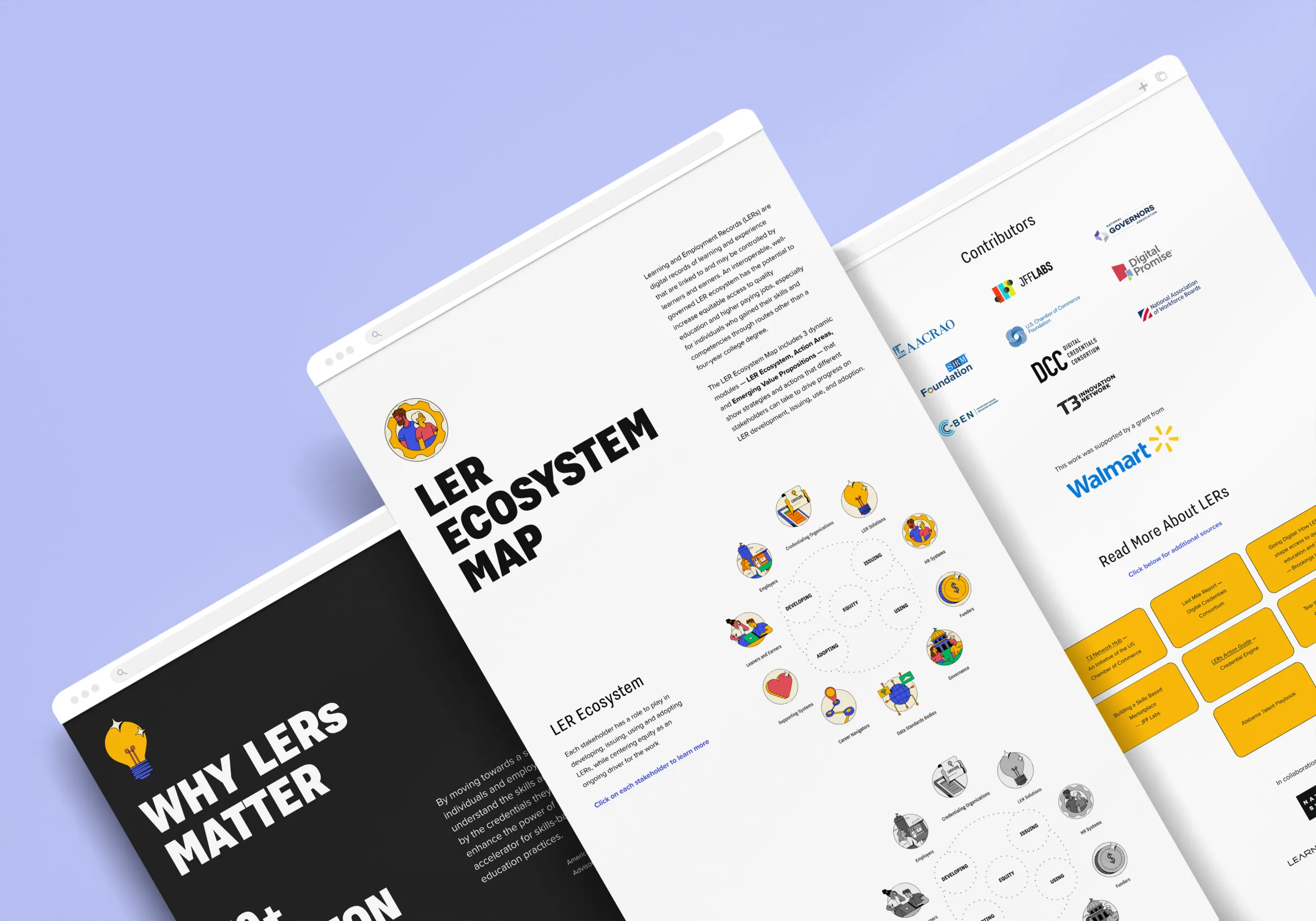
Therefore, Walmart brought NationSwell on to work with a Steering Committee of experts in the education, credentialing, equity and hiring space, to create an LER Ecosystem Map that would help people connect the dots across the ecosystem and more easily see how they can take action to drive equity through LERs.

Organizations in the LER Ecosystem Map Steering Committee:

  • AACRAO
  • Competency-Based Education Network
  • Digital Credentials Consortium
  • Digital Promise
  • JFFLabs
  • National Association of Workforce Boards
  • National Governors Association
  • SHRM Foundation
  • T3 Innovation Network
  • U.S. Chamber of Commerce Foundation

NationSwell worked closely with the Steering Committee to undertake thorough research to establish the goals and needs for the LER Ecosystem Map.

Through desk research, in-depth interviews, a diverse focus group, workshops, and months of cross-team collaboration, content drafting, design work and data visualization, our teams engaged 50+ individuals to help develop an interactive digital experience, accessible to stakeholders across the ecosystem, that clearly demonstrates opportunities for engagement, collaboration and action.

Through our three workstreams — establishing a hypothesis, research and development — the team discovered learnings, opportunities to drive adoption, and insights gaps that informed how the LER Ecosystem Map should come to life. The map launched at a pivotal point in LER development, providing many large and small players in the space with vital clarity on how to take action.


Share this report

Making the case for investment in corporate social impact and sustainability

Making the case for investment in corporate social impact and sustainability

This resource is intended to support corporate social impact and sustainability leaders in securing and growing their organization’s investment in their work.

The guidance contained herein is based on an online survey of 74 private sector social impact leaders conducted during July 2023, phone interviews with 8 private sector social impact leaders conducted during July and August 2023, and a literature review.

Skip to PDF content