
At a moment of inequality and division, who is advancing the vanguard of economic and social progress to bolster under-served communities? Whose work is fostering the inclusive growth that ensures every individual thrives? Who will set the ambitious standards that mobilize whole industries, challenging their peers to reach new altitudes of social impact?
In 2025, Impact Next — an editorial flagship series from NationSwell — is spotlighting the standard-bearing corporate social responsibility and impact leaders, entrepreneurs, experts, and philanthropists whose catalytic work has the potential to shape the landscape of progress amid urgent need for social and economic action.
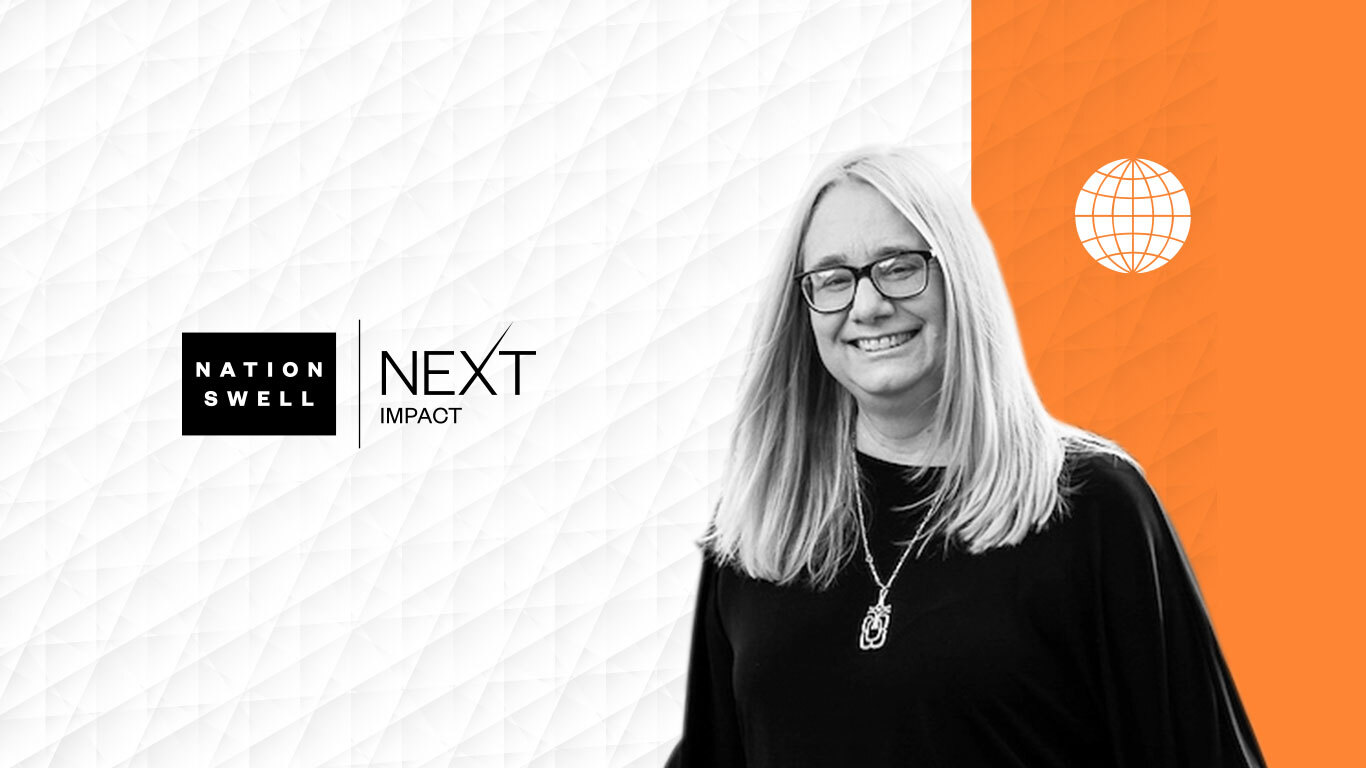
For this installment, NationSwell interviewed Lina Klebanov — Head of Corporate Social Responsibility for Tata Consultancy Services, North America.
Greg Behrman, CEO and founder, NationSwell: Tell us a little bit about your leadership journey — was there an early moment, a relationship, or an experience that galvanized your commitment to driving bold action?
Lina Klebanov, Head of Corporate Social Responsibility, Tata Consultancy Services: More than any other influence, my career path was inspired by my parents. They immigrated to the U.S. from Ukraine when it was still part of the Soviet Union and left behind everything and everyone, they loved to build a new life in America. Suddenly in a country where they didn’t speak the language or understand the culture, and had few, if any friends, they relied on the kindness of strangers and charitable organizations to get started. Their deep gratitude for their new-immigrant experience became a lifelong family value of giving back, and that spirit of service has always been part of me.
I carried that value and interest into my career planning, always intending to serve, but, when I was young, corporate social responsibility, or CSR, was an occasional activity of some companies. It was neither a defined career path nor a fully integrated strategy for business, so my search led me in other directions.
My original plan was to become a social worker, but, once I started shadowing cases, it occurred to me that I could be even more powerful helping create systemic change around the causes of so much of the personal and family crises I witnessed. That became my goal and, once concepts like corporate citizenship, community engagement and social responsibility emerged in my grad school experience, I saw my path clearly.
My first real exposure to the power of CSR occurred during grad school. As a student in the NYU Robert F. Wagner Graduate School of Public Service, I had the opportunity to intern with the Morgan Stanley Foundation. Working in its Community Affairs department, I saw how its efforts bridged business, community impact, and social good. From that moment on, there was no turning back. After a short time working at a nonprofit, I returned to Morgan Stanley and eventually led the company to the launch of its largest global volunteer initiative in the company’s history.
Behrman, NationSwell: What is the “North Star” of your leadership style? What is it about the way that you lead in the space that makes you an effective leader?
Klebanov, TCS: My leadership style is centered on empathy, humility, and a commitment to nurturing my team. It’s important to me to support each member’s potential growth and professional development. I make sure to always prioritize my reports’ well-being and work hard to ensure that, no matter how busy I may get, I am always actively listening and supporting both individual team members and collaborating teams.
I believe that effective leaders serve the needs of others first, but that might also be the mom in me. I do have three children, and I like to think that I separate the family and business nurturing that I do, but, at the end of the day, I’m not entirely sure they’re all that different.
Behrman, NationSwell: Is there a particular program, signature initiative, or some facet of the work that you would like to spotlight for us that is driving outcomes for the work?
Klebanov, TCS: One thing that’s really encouraged me lately is the growing emphasis on collaboration. Across every network and association, we’re part of, people are coming together to tackle big challenges at the local, national, and global levels. It’s been a through-line in our thought-leadership work and in our K–12 STEM programs.
Our Digital Empowers initiative in particular focuses on addressing digital inequity — the root barrier that keeps many people from accessing education, civic engagement, opportunity, and economic mobility. Through TCS Digital Empowers, we’ve built a large, cross-sector network of partners poised to work together to advance opportunities by addressing digital inclusion, STEM education, and workforce preparedness.
Early on, the bulk of our CSR work centered on raising awareness of the need for high-quality STEM education — back when most people didn’t even know what “STEM” stood for. Over the years, our leadership expanded into include corporate volunteering, diversity and inclusion in leadership, and women’s representation in STEM. We were part of the Million Women Mentors Initiative and have continued evolving as technological transformation accelerates and disparities widen. Today, our focus is on leveling the digital playing field. Through Digital Empowers, we’re bringing together private, public, and nonprofit partners to ask: How can we collaborate to build transformational opportunities for the current and future workforce and for Society, in general?
On the K–12 education side — which I’m particularly passionate about — the inequities tied to ZIP codes and other social influencers are heartbreaking and still too often overlooked. The pandemic exposed these gaps, but many under-resourced students and schools still haven’t recovered. At TCS, we believe that if you can’t see it, you can’t be it — and you often need to experience it to understand what’s possible. Our two flagship STEM programs give young people a chance to envision themselves in roles they never dreamed of before — as effective problem solvers, STEM prodigies and global changemakers. In those moments, they have the potential to positively impact students’ academic and professional trajectories.
Go Innovate Together, known as goIT, launched in 2009, gives K–12 students hands-on opportunities to consider how technology can solve real-world problems. Supported by former teachers, TCS volunteer mentors, public school systems and more, the program has expanded from its U.S.-based origin to a recognized global initiative that has reached more than 330,000 students and counting, something I am incredibly proud of.
As technology evolved faster than classroom instruction, we launched Ignite My Future, a professional-development program that approaches kids’ technology awareness and skills from another angle. It helps educators integrate computational thinking into core subjects, from math and science to social studies and even PE. Professional development programming for teachers helps them be more effective in teaching computational thinking and Ignite My Future classroom resources bring learning to life in an innovative way. It closes the gap for teachers who might lack access to up-to-date training and resources or those who just want to rise above.
We intentionally focus on school districts with the greatest need, and weave mentorship into everything we do — it’s our secret sauce. Combined with Digital Empowers, these programs create a holistic, systemic approach to closing the digital gap.
Behrman, NationSwell: Is there a particular facet of the work that you are leading that you think is particularly noteworthy or exemplary?
Klebanov, TCS: For me, what is exemplary is that, across all of this work, our goal remains the same: helping students — regardless of background or ZIP code — gain the confidence and digital fluency they need to succeed in any career, in any industry, in a world where every company is now, in some way, a tech company. If you’re asking about my favorite things, I have to tell you: it’s the sports connection!
We are constantly looking for creative ways to bring technology to life for students and have found a wonderful and exciting avenue for that through our sports partnerships. As the Title Sponsor of the TCS New York City Marathon and a major partner in Formula E, with Jaguar TCS Racing, we’ve created hands-on experiential moments for students associated with both of these high-visibility sports experiences.
A few months ago, in Miami, we partnered with a local nonprofit to bring middle school girls to a Formula E race, where they explored the technology—and computational thinking—behind Jaguar TCS Racing. They met an all-women panel of professionals working in the racing world—another field where female representation is limited—and had the chance to interview them and discuss what these role models love about their careers and just what it took to get there. Our GoIT TCS NYC Marathon Student Challenge, another example of how we merge STEM learning with real-world excitement, gave area students a chance to innovate for social good and compete with one another from the Marathon’s Expo pavilion. Winners of the digital innovation competition got to hold the finish line tapes and welcome race winners and finishers to the final steps in their achievement. The excitement of these K-12 students at those moments is palpable and I love being a part of that.
Behrman, NationSwell: Of the socially motivated leaders you consider your peers, are there any whose work inspires you and whom you hold in high esteem?
Klebanov, TCS: I have so much respect for people in the social sector who do this work every day. They’ve devoted their careers to purpose — not just for the communities they serve, but for their colleagues through employee engagement efforts. And honestly, employee volunteer engagement doesn’t get nearly the attention it deserves. There’s so much pressure in this field to deliver, to maintain integrity, to prioritize quality over quantity. It’s hard work, and so many people do it with such heart.
There are too many leaders, colleagues, and friends I admire to name them all — but as a fun fact, I will just mention that our Tata Group founder, Jamsetji N. Tata, was named Top Philanthropist of the last century, with donations worth $102 billion — ahead of Bill and Melinda Gates and many others!
Behrman, NationSwell: Are there any resources you’d recommend — books, podcasts, Ted talks — that have influenced your thinking that might influence others as well?
Klebanov, TCS:
Generally, I follow the sources that align with my values, but I also push myself to take in a diverse range of viewpoints. It’s not because I’m uncertain about what I believe in. I’m very grounded in that — but because empathy and humility matter. Trying to understand where others are coming from helps me see the fuller picture, continue learning and navigate this very chaotic world a little more gracefully.