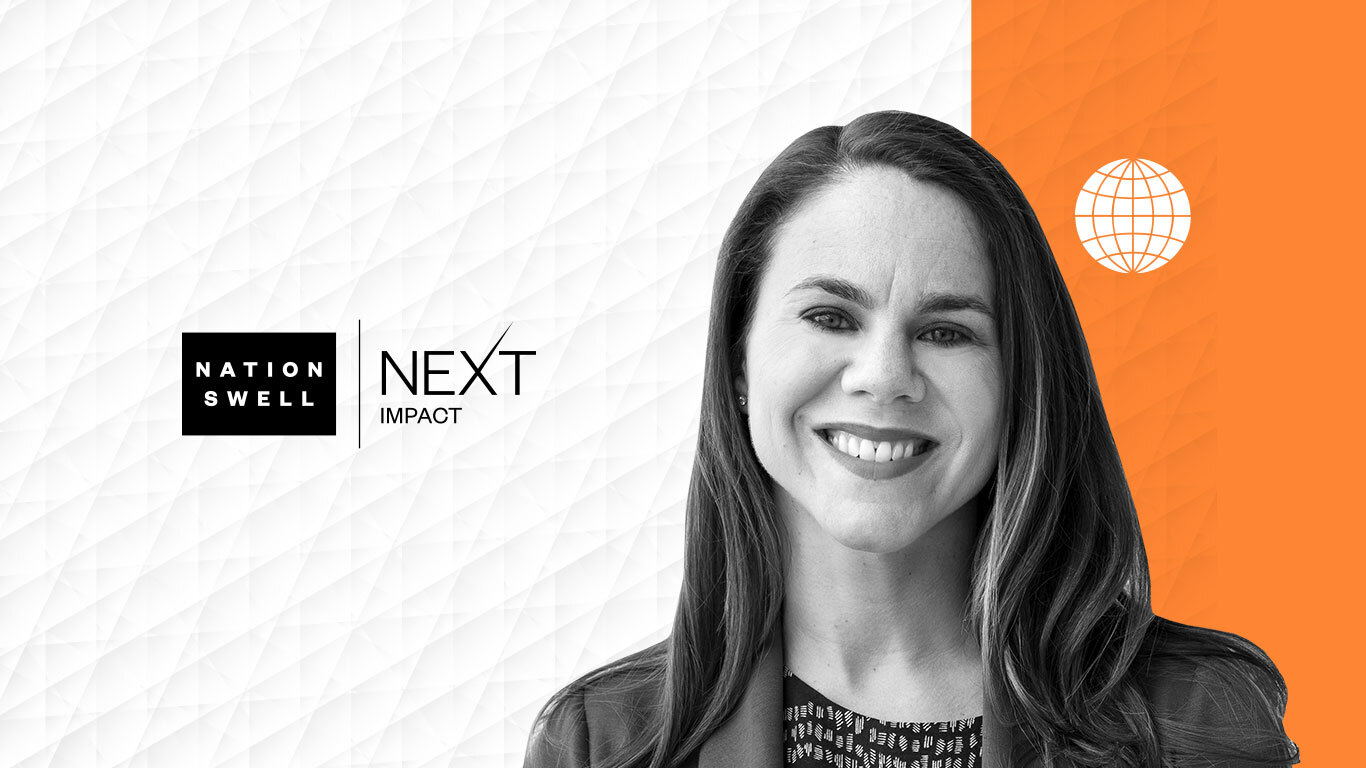
Five Minutes with… The Greater Tacoma Community Foundation’s Kathi Littmann

What does it look like for a community foundation to meet the moment not just as a funder, but as a convener, translator, and catalyst for long-term change? As a longtime steward of community resilience across Pierce County, Washington, the Greater Tacoma Community Foundation is embracing that challenge by connecting unlikely partners across the region and creating the conditions for communities to influence and shape the systems that affect them.

For this installment of Five Minutes With…, NationSwell spoke with Kathi Littmann, president and CEO of The Greater Tacoma Community Foundation, about the evolving role of community philanthropy, the importance of building resilience alongside capacity, and what other foundations can learn from Pierce County’s collaborative model.

Here’s what she had to say:


NationSwell: How would you describe the role The Greater Tacoma Community Foundation plays in the region, and what makes your approach to community philanthropy distinct?

Kathi Littman, President and CEO, The Greater Tacoma Community Foundation: We serve Pierce County, which is in the Puget Sound region between Seattle and the state capital. It’s a gritty, deeply collaborative community that has always known how to do a lot with limited resources, and that really shapes who we are as a foundation.

GTCF has been here since 1981, and we’ve grown from about $10,000 to more than $200 million in assets, so today we’re a mid-sized community foundation. At our core, our prime directive is honoring donor intent: what do our fund advisors love about Pierce County, and what kind of legacy do they want to leave here?

At the same time, when we’re working with discretionary resources, we’re very focused on systems change. We’re always asking how we can help meet urgent needs today, but we’re thinking in parallel about how we can address those problems long-term so that we’re not responding to them forever. For us, that means removing barriers to generational wealth and well-being across Pierce County.

Our strategic framework is built around four interconnected pillars: housing, youth, civic voice and power, and access to capital and wealth. Those issues all intersect, but right now we’re especially focused on civic voice and power in that we’ve been shifting our thinking from helping nonprofits build capacity to helping communities build resilience. Capacity is about doing what you already do, better; resilience is about being able to adapt, lead, and meet a changing moment.

And while we do a lot of grantmaking, our real superpower is not just the money, but the relationships. It’s convening across sectors, connecting people, catalyzing ideas, and helping communities use their lived experience to influence the systems shaping their lives. That’s really GTCF’s sweet spot, and it’s what makes us uniquely suited to this moment.

NationSwell: What would you say GTCF’s secret sauce is as a convener? What lessons have you learned that are transferable for others hoping to build community trust

Littmann, GTCF: Pretty consistently, whether we’re working with a government agency, a national funder, or one of our own donor-advised fundholders, people come to us because they know we’ll connect them to others who care about the same issues and help them make smarter decisions about how they invest in the community. They see us as thought partners, and just as importantly, as connectors to other thought partners.

That’s why I often say some of the highest-value things we offer go well beyond the grants themselves. A good example of this is the intermediary work we’ve done with the Washington State Department of Commerce, where we’ve helped move state dollars into communities faster by serving as the contract holder and intermediary so that nonprofits receive those funds as grants rather than taking on the administrative burden and risk of a government contract.

That work led to another important role: Last fall, the state Speaker of the House and the Pierce County Executive asked us to convene nonprofits around the impact of federal budget cuts on county services. We brought in service sector and network leaders, grounded the conversation in data, and created an ongoing space to understand the ripple effects across housing, food access, Medicaid, employment, and more.

That’s really our model: community-centered philanthropy. The people closest to the issue understand the barriers, and our role is to convene them, amplify their voices, bring in research and examples, and help translate lived experience into action.

NationSwell: How are you thinking about what it means to be a community foundation in this moment? What are the unique challenges that you’re facing, and how does your work go beyond traditional grantmaking? 

Littmann, GTCF: Being a community foundation is both inspiring and a little daunting, because in theory we’re built to be here in perpetuity. That means we have to lead with hope — not just for what Pierce County needs right now, but for what we want this community to look like seven generations from now. That’s a beautiful mission, but it’s also a heavy one, especially in a moment when so many systems feel misaligned with that long view. What we’ve learned is that even when there’s trauma and scarcity, there is real power in bringing people together around possibility and helping communities imagine solutions that reduce the need for crisis response over time.

A few lessons consistently guide how we do that work. First, we’re always asking: are we in the right role? If someone else should own it, we’re not trying to hold it. One reason communities trust us is that they know we can incubate and convene, but also that we’re not trying to keep control. Second, we’re constantly asking who’s not at the table; we don’t need to convene everyone, but we do need the right voices in the room. Third, one of our unique roles is helping the community see the bigger picture — surfacing patterns, gaps, and ripple effects that individual organizations may not be able to see on their own. And finally, we believe deeply in passing the mic. Our role is not to speak for communities, but to create the conditions for people to speak for themselves through our platform and relationships.

We’re also very intentional about building relationships beyond Pierce County, because some of our best learning comes from statewide and national partnerships. Pierce County is a strong testing ground: it’s diverse, collaborative, and in many ways a microcosm of the country. That makes it a powerful place not just to serve community needs, but to learn what kinds of philanthropic approaches actually work.

NationSwell: Can you share an example of a partnership, initiative, or investment that reflects how you’re trying to meet this moment differently?

Littmann, GTCF: I’ll start with our Department of Commerce work around the Community Reinvestment Project, which was a $200 million state initiative designed to address harms caused by the war on drugs and which we stepped into as an intermediary for Pierce County. We signed the contract, negotiated the terms, provided upfront funding, and convened a local advisory team made up of leaders from the sectors most impacted. We also trained them in community-centered philanthropy, because many had been conditioned to navigate contracts and compete for funding rather than help shape how resources move. Then they helped decide how the money went out.

We were able to move funds quickly and get grant dollars into the hands of local organizations, but what became most interesting was what happened beyond Pierce County. The Department of Commerce wanted to serve the whole state, and we stayed in our lane while helping foundations in the other priority counties replicate the model. We shared our contract, encouraged them to step into the same intermediary role, and built a coalition across the state. We were asking: what does this look like in a rural county? In a place with a huge geographic footprint? In a community with fewer people but different needs? We eventually brought in a third-party evaluator, captured what we learned, and shared it back with the Department of Commerce. That’s the kind of role we can play as connectors, conveners, and catalysts: helping partners scale while learning in real time.

Another example is our work with the Pierce County Resiliency Hub, which feels especially relevant right now. As federal funding started to shrink, we heard from two longtime community leaders — the Washington State Speaker of the House and the Pierce County Executive — both of whom came up through grassroots and agency leadership. They reached out and essentially said: Pierce County has done this before; when resources get tight, the community has to come together and get ahead of it, and GTCF is in a unique position to help make that happen.

That really speaks to our role beyond grantmaking. We can convene, yes, but we also serve as a knowledge facilitator. One of the hardest questions right now is simply: how much federal money has actually been flowing into Pierce County, and where is it going? That’s incredibly difficult to answer. Funding reaches municipalities, the county, the state, and individual organizations in different ways. So one of the first things we did was secure a researcher to help us build what we’re calling reliable data. With so much federal data becoming harder to access or disappearing altogether, we wanted a shared source of truth the community could trust.

NationSwell: As you look ahead, what feels most important for community foundations to get right in the next few years if they want to build long-term resilience and opportunity?

Littmann, GTCF: First, we have to be truly client-centered in how we make philanthropy accessible. The products themselves can be confusing: donor-advised funds, designated funds, changing tax laws, qualified minimum distributions. For someone simply trying to figure out how to do good with what they have, it can be overwhelming, and our role is to make that process feel human, clear, and usable.

Second, we have to get our financial model right. Like many organizations, our organic revenue doesn’t fully cover the catalyst and convening work we know has the highest impact. So it’s our responsibility to sustain GTCF in a way that reflects a theory of abundance, not scarcity. That means being able to clearly articulate the return on investment: if you support GTCF, you’re helping ensure we can meet the moment not just now, but 10, 20, or 50 years from now. That kind of long-term stewardship matters, and so does making sure we can retain the staff who make that work possible.

Third, we need to create the time and bandwidth to influence the field. We do our best work when we’re running alongside like-minded foundations, businesses, agencies, and partners. But that kind of collaboration takes time. It requires real relationship-building and a willingness to understand not just what someone is doing, but how they’re doing it and, most importantly, why.

And that leads to the last piece: narrative. If we’re truly thinking seven generations ahead, we can’t just document what we did or how we did it; the most important thing to preserve is why. If future leaders understand the values and reasoning underneath a decision, they can adapt the tactics to meet their own moment without losing the thread.

Five Minutes with… Walton Family Foundation’s Tina Fletcher

The Arkansas-Mississippi Delta is a case study in what community-rooted investment can make possible. Too often framed through deficit and disinvestment, the Delta is also a place of deep resilience, cultural richness, and local leadership; a region where people have been building and adapting solutions for generations, often without the level of sustained support they deserve. 

Tina Fletcher, who helps lead the Walton Family Foundation’s work in the Delta, is focused on helping shift that narrative by pairing long-term commitment with a community-centered approach to partnership. Across education, economic mobility, and leadership development, Fletcher’s work centers on strengthening what’s already working in the region and connecting the people and institutions best positioned to carry that momentum forward.

For this installment of Five Minutes With…, NationSwell spoke with Tina about what makes the Delta such a distinctive and inspiring place to work and why the greatest opportunity may be less about reinventing the Delta than investing in the talent and leadership that’s already there.

Here’s what she had to say:


NationSwell: For those less familiar, how would you describe the Delta — and what makes this region both unique and inspiring to you?

Tina Fletcher, Senior Program Officer, Walton Family Foundation: When it comes to the Delta, what stands out to me is just how much determination and resilience already exists. The Delta is a region rich in culture, community, and getting things done, with deep relationships and a strong sense of place that you can feel immediately. What makes it especially inspiring is that, despite being under-funded, the Delta has never lacked the capability to thrive. The Delta is full of people who have been leading and building for generations, people who aren’t waiting for solutions; they’re generating them in real time and in and meaningful ways. What’s needed now is investment that recognizes and accelerates that momentum because when you shift from “What’s wrong?” to “What’s working?”, the Delta looks entirely different.

NationSwell: How would you describe the Walton Family Foundation’s strategy on building trust and momentum in the Delta region over time?

Fletcher, WFF: At the Walton Family Foundation, our Delta Region strategy is simple, but not easy: show up, listen, be a good partner, and stay committed. Building trust in the Delta means investing in relationships just as much as we invest in results. In my role, I focus on strengthening what’s already working across education, economic mobility, and leadership, while finding creative ways to connect the individuals driving progress. I also bring a learning mindset to every table and conversation  I join, using data to inform the work without losing sight of community voice. That combination-commitment, consistency, humility, and rigor—is what turns trust into real momentum.

NationSwell: Can you share a moment or partnership in the Delta that changed how you think about community-centered philanthropy?

Fletcher, WFF: The biggest shift for me has been seeing what happens when communities aren’t just included—they’re in the lead. Across the Delta, I’ve seen young people, educators, and local leaders design solutions that are more relevant, effective, and sustainable than anything we could prescribe from the outside. I saw this firsthand in Jonestown, Mississippi, during a conversation with Mayor Columbus Russell, Jr., the youngest mayor in the state, and again in Helena-West Helena, Arkansas, led by Mayor Joseph Whitfield. Both are young, energetic leaders working in step with residents, partners, and funders to move their communities forward. Those moments reinforced that proximity matters. Community-centered philanthropy isn’t just about engagement, it’s about shared ownership. When communities lead together, the results aren’t just impactful, they’re sustainable. And that’s when the work doesn’t just land, it takes root.

NationSwell: For funders looking to invest in the Delta, what guidance would you offer to ensure their approach is both effective and community-centered? What are some common mistakes you’d recommend they avoid?

Fletcher, WFF: First, start by listening and plan to stay longer than you initially imagined. The Delta doesn’t need more one-off investments; it needs partners willing to build over time. Fund what’s already working, invest in capacity, and trust local leaders to guide the way. A common mistake is chasing quick wins without understanding the broader system or underestimating how long trust takes to build. In the Delta, philanthropy must focus on building trust and staying committed, because that’s what ultimately drives results. Opportunities for impact are real and plentiful, but they require patience, partnership, and a deep belief in the people closest to the work.

NationSwell: As a leader, how has working in the Delta shaped your personal leadership style, or clarified what kind of leadership this work requires?

Fletcher, WFF: This work has taught me that leadership isn’t about having all the answers, it’s about creating the conditions for the right answers to emerge. In the Delta, that means listening deeply, sharing power, and being intentional about whose voices shape your decision-making around the work. It’s also reinforced the importance of staying grounded in both data and humanity, balancing the desire for accountability and rigor with the realistic challenges Delta communities face. As a result, I am much more focused on connecting dots amongst stakeholders, leverage my organizations connections to benefit the communities we serve, funding what has proven to work, and making space for others to learn and lead. The kind of leadership this work requires is steady, collaborative, and deeply rooted in trust.

NationSwell: What gives you the most optimism about the future of the Delta, and where do you see the greatest opportunities for impact in the years ahead?

Fletcher, WFF: What gives me optimism is the talent and leadership already present, especially young leaders who are stepping up to shape what comes next, alongside seasoned leaders supporting them along the way. There’s a growing ecosystem of organizations doing powerful work, and the opportunity now is to connect and scale those efforts. I see real potential in more intentionally linking education to economic mobility, creating clear, local pathways from learning to earning and investing. The Delta doesn’t need to be reinvented; it needs to be invested in. And for funders willing to lean in, this is a moment with real momentum.

Impact Next: An interview with the Caterpillar Foundation’s Asha Varghese

At a moment of unevenness and division, who is advancing the vanguard of economic and social progress to bolster under-served communities? Whose work is fostering the shared growth that ensures every individual thrives? Who will set the ambitious standards that mobilize whole industries, challenging their peers to reach new altitudes of social impact? 

In 2025, Impact Next — an editorial flagship series from NationSwell — will spotlight the standard-bearing corporate social responsibility and impact leaders, entrepreneurs, experts, and philanthropists whose catalytic work has the potential to shape the landscape of progress amid urgent need for social and economic action.

For this installment, NationSwell interviewed Asha Varghese, Head of Corporate Social Responsibility at Caterpillar and President of the Caterpillar Foundation.


Greg Behrman, founder and CEO, NationSwell: What brought you to the field that you’re in right now? Was there an early moment, a relationship, or an experience that galvanized your commitment to driving bold action?

Asha Varghese, Head of Corporate Social Responsibility at Caterpillar and President of the Caterpillar Foundation: What brought me into this work wasn’t a single defining moment but really a series of experiences that shaped how I see opportunity, equity, and the role the private sector can play in expanding both.

A big part of that goes back to growing up between two very different worlds. I spent my early childhood in Kerala, India, and my family didn’t move to rural Kentucky until I was 12. On the surface, those places couldn’t have looked more different, but what connected them for me was how deeply access to opportunity shaped people’s lives. I was fortunate to grow up in a family that believed fiercely in education and pushed us toward careers, especially in STEM. But many people in both of those communities didn’t have the same access. Living between those two worlds taught me resilience, but also a lasting awareness of how much opportunity — or the lack of it — can define a person’s path.

The other set of worlds I’ve learned to navigate is more professional: I’m a computer engineer by training, and I now work in corporate philanthropy and social impact. Those fields may seem far apart, but for me they’re deeply connected: Engineering taught me how to break down complex problems, innovate with limited resources, and build thoughtful, durable solutions, and I bring that same mindset to social impact work.

That’s really how I think about this role: bridging the discipline and problem-solving orientation of the private sector with the urgency and complexity of social development. It’s the combination of those personal and professional experiences that led me here.

Behrman, NationSwell: What is the “North Star” of your leadership style? What are some of the attributes that make you an effective leader in the space?

Varghese, Caterpillar: I’d say my North Star as a leader is creating stable pathways for people to thrive, no matter where they’re starting from. That’s true for how I lead as an individual, and also for how I show up representing our brand.

I actually got a lot of clarity on that through the Presidential Leadership Scholars program, which brings together leaders to study the leadership styles of past U.S. presidents. One of the most powerful exercises they put us through was identifying your single core value — the one you’d choose if you could only pick one. For me, that value was stability.

That really clicked for me because it ties so directly to my own journey. Stable environments created opportunity in my life, and that’s shaped how I think about leadership ever since. Any solution I’m building, any initiative I’m helping lead, I want to make sure I’m leaving behind something that outlasts me: a system that is durable, intentional, and built to support people over time.

The other value that has become increasingly important to me over the last decade is empathy. And I don’t think of empathy as a soft skill but as strategic clarity. It’s about listening deeply to communities, to teams, to emerging leaders, and making sure their voices shape the systems we’re building. At the core of all of it, I believe in expanding access to opportunity. That’s what guides the work I do.

Behrman, NationSwell: What is helping you or anchoring you to a sense of stability in the current moment?

Varghese, Caterpillar: A good example of that is the work we’ve been doing at Caterpillar around the future of work. Last year, as we celebrated the company’s centennial, we used that milestone not just to reflect on our legacy, but to sharpen our focus on people.

In a moment defined by AI and rapid technological change, the question for us is not whether technology matters; of course it does. The question is: how do we make sure people and technology can coexist and thrive together? That’s where a lot of my work is centered right now.

It connects directly to our broader commitment around workforce development and the future of work. For the next generation entering the workforce, the path forward can feel increasingly unclear. At the same time, there are many workers, especially in manufacturing and adjacent sectors, who understandably worry about being left behind. So the challenge for us is how to help create stable pathways for both groups: pathways that help young people navigate what’s next, and pathways that help current workers adapt with confidence.

That’s the work in front of us right now: taking a massive, complex problem and breaking it down into scalable solutions that help people feel more prepared, more included, and more secure in the future.

Behrman, NationSwell: What is unique or differentiated about the approach that you’re taking? Can you walk us through what excites you most about the work that you’re leading?

Varghese, Caterpillar: It’s hard to pick a single initiative, but the work I’m most energized by right now is our growing enterprise-wide commitment to workforce development. We’ve supported that work in different ways for years, but this deeper focus across the company gives me a lot of optimism because it’s so clearly centered on people.

More broadly, one approach I’m especially proud of is how we think about shared-value philanthropy: designing strategies that create real social impact while also aligning with the unique role a company like Caterpillar can play. Over the last six years, through a pandemic, humanitarian crises, and all kinds of global volatility, we’ve stayed committed to showing up consistently in communities. And what I’m proudest of is that we’ve done it by keeping community at the center — not by assuming we know the answers, but by listening, collaborating, and building solutions that can outlast us.

A good example in the U.S. is the Caterpillar Foundation’s work with Learning Undefeated, which uses game-based experiences to get K–12 students, especially middle schoolers, excited about STEM and modern manufacturing. It’s a creative way to tackle perception and interest early, and it brings in not just students, but teachers and other adults who influence their choices.

Globally, the Foundation is also focused on partnerships that treat jobs as the outcome, not just training. That’s what I appreciate about partners like IYF and Generation: the goal isn’t simply to hand someone a certification. It’s to ask, did this person get a job, and are they still in it six months later? That’s the kind of economic progress that matters. 

Behrman, NationSwell: Are there any particularly cool or illustrative examples of how Caterpillar is showing up in communities?

Varghese, Caterpillar: One longstanding area of work I’d point to is our disaster relief and humanitarian response portfolio through the Foundation. What I find especially meaningful about it is that we don’t think about disaster response as just the immediate relief effort (though that’s obviously critical). We also focus on how communities can be better prepared before disaster strikes, so local organizations are ready to respond quickly rather than starting from scratch in the middle of a crisis.

And just as importantly, we stay engaged after the headlines fade. Once the cameras are gone and the community is still recovering, we look at long-term mitigation and resilience, which is where this work connects directly to our sustainable infrastructure portfolio. That means asking: what kinds of nature-based or infrastructure solutions can actually reduce the impact of future floods, fires, droughts, and other climate-related events?

To me, that portfolio really reflects the consistency of how we try to show up as a company. Whether it was COVID, wildfires in California, or flooding in parts of Africa, the goal is the same: respond in the moment, but also invest in the systems that help communities recover and withstand what comes next. That’s a strong example of what shared-value philanthropy looks like for us.

Behrman, NationSwell: Are there any resources you’d recommend — books, podcasts, Ted talks — that have influenced your thinking that might influence others as well?

Varghese, Caterpillar:  On the resource side, a couple of things come to mind right away. Podcast-wise, I really like the TED Radio Hour episode on “Networks.” It resonates deeply with how I think about leadership and impact — that solutions grow at the speed of trust, and that ecosystems and relationships really matter.

I also really enjoy Fortune’s Leadership Next. It’s a great look at how CEOs and corporate leaders are thinking about leadership today, especially when it comes to integrating social responsibility into business strategy. That intersection feels very relevant to the work I do, so I always find something useful there.

Book-wise, one that has really stayed with me is Atomic Habits by James Clear. It’s helped me stay disciplined and intentional about how I want to show up, both personally and professionally. I also subscribe to his weekly newsletter, which I find grounding and consistently useful.

Behrman, NationSwell: Of the socially motivated leaders you consider your peers, who are 2-3 whose work inspired you and whom you hold in high esteem?

Varghese, Caterpillar: The person who most inspires me is my father, Dr. Roy Varghese. He came to the U.S. in the 1970s and ultimately chose to spend more than 30 years of his career in rural Kentucky, helping revive a struggling hospital in a small town where he was, for a long time, the only physician. He could have chosen to practice anywhere, but he chose to stay there; that says so much to me about resilience, purpose, and intentionality. The way he showed up in medicine, and the way he stayed rooted in service, has had a profound impact on how I think about leadership.

Beyond that, I’m inspired by so many leaders across the social development space — especially those who lead with steadiness, creativity, and a commitment to building systems that outlast them. It’s a tough and often chaotic world, and I have a lot of admiration for the way so many nonprofit and corporate leaders continue to show up with consistency and conviction for the greater good.

Impact Next: An interview with the International Youth Foundation’s Christina Sass

At a moment of inequality and division, who is advancing the vanguard of economic and social progress to bolster under-served communities? Whose work is fostering the inclusive growth that ensures every individual thrives? Who will set the ambitious standards that mobilize whole industries, challenging their peers to reach new altitudes of social impact? 

In 2026, Impact Next — an editorial flagship series from NationSwell — will spotlight the standard-bearing corporate social responsibility and impact leaders, entrepreneurs, experts, and philanthropists whose catalytic work has the potential to shape the landscape of progress amid urgent need for social and economic action.

For this installment, NationSwell interviewed Christina Sass, President & CEO of the International Youth Foundation.


Greg Behrman, founder and CEO, NationSwell: What brought you to the field that you’re in right now? Was there an early moment, a relationship, or an experience that galvanized your commitment to driving bold action?

Christina Sass, President & CEO, International Youth Foundation: The short version is that I’m obsessed with youth employment. I genuinely believe it’s one of the most sustainable ways to get and keep people out of poverty. That’s why I focus on jobs for young people — I don’t want them to need things they can’t afford for themselves. When we help young people build skills they can take anywhere, we create change that lasts across generations.

That’s why this is my issue area, and why I tell people all the time: if you have a dollar or an hour to give, give a young person a chance who wouldn’t otherwise get one. Yes, you can do that through a charity like IYF, but honestly, if you have a job to offer in your own organization, that may be the most powerful thing you can do.

The reason this is so deeply personal is that it tracks closely with my father’s story: He immigrated to the U.S. from Germany at 22 with a suitcase and a couple hundred dollars to join his older brother. He was born in 1942, so you can imagine that his childhood was characterized by World War II, a devastated society, a family separated for years. His father was a prisoner of war for the first six years of his life; their family was internally displaced. His brother, my uncle, found a path forward through the brick masons, then volunteered for the U.S. Army as a way to stay in the country. My dad got a chance to build his career by coming over to live with his older brother. They were both hungry for opportunities.

His first job in the U.S. was picking up trash in a park while he barely spoke English. His second was moving boxes in an IBM warehouse — back when IBM was probably building typewriters, long before computers. But my dad was a true lifelong learner. He noticed that the most expensive machine parts were going missing, and he spent all night practicing enough English to ask his boss a question: why not keep the most valuable parts in one place and require people to check them out? His boss said, “Why don’t you build it?” And he did.

My dad retired after 32 years at IBM. Along the way, he kept leaving to get more education, kept pushing for opportunities, and was also lucky enough to have people take a chance on him — on someone who barely spoke English. That changed everything for our family. My dad is the reason my brother and I had the life we had; somebody gave him a chance. He passed away when I was a sophomore in college, and it was devastating for all of us, but his story still looms large for me.

So yes, this work is deeply personal, and it also happens to align with something I genuinely love. I stay so focused on youth employment because I’ve seen what it can unlock: in my own family, in my brother’s life, and in so many other young people’s lives.

I’ve taken multiple swings at the same question: How do we get young people into jobs at scale? Because I think we’ve failed badly at this. Educators say young people are ready for work; employers say they need two to three years of experience. And for the most at-risk young people, that gap is rarely merit-based. We can do so much better at opening doors early — and giving young people the chance to realize their full potential.

Behrman, NationSwell: Tell us a little bit about your current role and how you came to it.

Sass, IYF: International Youth Foundation is currently in its 35th year of operation, and I am the fourth CEO. All of the CEOs are around and super supportive of the work, which is a really cool legacy to have. IYF was founded by Rick Little, who was really ahead of his time in recognizing that young people face a distinct set of challenges in the transition from school to work, especially when there isn’t a clear path into employment.

I came to IYF in 2024, after spending 10 years building Andela, a platform connecting global companies with developer talent, especially in Africa. Bill Reese, IYF’s longtime second CEO, had been a mentor of mine for years, so when he reached out and said, “This is your issue area, would you consider it?”, it was a pretty extraordinary invitation.

What drew me in was the chance to work at a different order of scale. At Andela, we were intentionally building outside the system. At IYF, we’re working inside it — which comes with more constraints, but also a much bigger opportunity to create lasting change.

At its core, IYF focuses on youth economic opportunity, especially through training and job placement. We think broadly about who we serve: young people, of course, but also employers, school system leaders, and the funders who make this work possible. Our programs are strong, our outcomes are strong, and the work now is about growing awareness, expanding our reach, and continuing to evolve to meet young people where they are in a very complicated moment.

Behrman, NationSwell: Is there a particular program, signature initiative, or some facet of the work that you would like to spotlight for us that is driving outcomes for the work?

Sass, IYF: One great example is a program we run with FedEx in Mexico and Colombia called Jóvenes con Entrega, which roughly translates to “youth who deliver,” both literally and in life.

The idea is simple: we look at where there are real hiring gaps, then work backward with employers to build training directly into the school day. In this case, FedEx had a huge need for entry-level logistics workers, especially as nearshoring accelerated across the region. So we worked directly with their HR and logistics teams to map the skills they needed, build a curriculum around those requirements, connect Fedex mentors to program participants, and integrate into technical high schools. We initially trained teachers ourselves, then transitioned that ownership to the school systems.

Since 2018, that program has served more than 50,000 young people, with job placement rates more than double what they would be otherwise. Nearly half of participants are young women, which is especially meaningful because many were initially being steered toward “safe” roles like secretarial work. We had to make the case that logistics was not only viable, but safe, respected, and far better paying, and once families saw the first graduates succeed, the momentum really took off.

Another example I love is our work with the banking sector in Mexico. For years, you needed a four-year economics degree to become an entry-level bank teller, which made no sense for the role and excluded a huge amount of talent. We worked with banks to rethink the job around skills instead of credentials, and helped create a pathway for technical high school graduates to move directly into those roles. We’re now on our third cohort, and it’s been transformative for the young people involved (and a much better talent match for the banks, too).

Behrman, NationSwell: What is unique or differentiated about the approach that you’re taking? Can you walk us through a couple different facets of the work you’re leading that are particularly exciting to you right now?

Sass, IYF: We work with about 50,000 young people a year in what I’d call a high-touch way, meaning they’re getting the full curriculum in a classroom setting, often through technical high schools or school systems. The number is actually higher if you include lighter-touch engagement, like online learning, but 50,000 is the number we use when we’re talking about deeper transformation.

In 2025, 90% of young people who started an IYF program completed it, and 75% went on to a better economic outcome, whether that was job placement, enrolling in higher education, advancing in their current path, or starting something entrepreneurial. Overall, about 87% are connected to work in some meaningful way: employed, in education that leads to employment, or in training that improves their economic prospects. We also have very high net promoter scores with young people, and our partners tend to stay with us for the long term — on average about seven years, with some partnerships lasting 14 years or more. That matters, because systems change is almost always a multi-year effort.

I think the reason young people rate our programs so highly is simple: we design them with young people, not just for them. That “nothing about us without us” mindset is core to how we work. Our life skills curriculum, Passport to Success, is a great example: it’s active, relevant, and grounded in the real pressures young people are navigating, from anger management to gender norms to workplace expectations. Then we build the technical training on top of that. So the real secret sauce is strong systems-level partnerships combined with program design that is genuinely responsive to young people and accountable to them.

Behrman, NationSwell: Of the socially motivated leaders you consider your peers, are there any whom you hold in particularly high esteem, and how has their approach shaped your own leadership?

Sass, IYF: I think my superpower as a leader is that I’m wired to empower other people. My instinct is not to hold power tightly, it’s to give it away. I’m pretty vulnerable as a leader, and I talk openly about what I’ve learned about myself and how I work. I want to build a true team of rivals: extraordinary people with different strengths, fully unlocked to do their best work.

At the center of my leadership is not power or control, but the opposite: If we’re going to scale, we have to align people around the mission, bring in incredible talent, and then trust them.

That mindset was also shaped by an extraordinary executive coach I’ve worked with since my second year at Andela, Jeff Hunter of Talentism. His core methodology is based on the idea that leaders, particularly founders and entrepreneurs, have to see themselves clearly and design around what they actually are best in class at, and that framework has had a huge impact on me. To use myself as an example, I am a great individual contributor, but I am not a good day-to-day clarity manager. That tells me that I need to hire those people, and they need to manage those facets of the work. So I relentlessly try to see myself clearly and design well around myself, and then I hire people with high mission-alignment in mind. I believe that the best teams out there have a lot of psychological safety, so I try to start with vulnerability, lead with vulnerability, and really mean it when I say that I’m handing the reins over.

Impact Next: An interview with One Mind’s Kathy Pike

At a moment of inequality and division, who is advancing the vanguard of economic and social progress to bolster under-served communities? Whose work is fostering the inclusive growth that ensures every individual thrives? Who will set the ambitious standards that mobilize whole industries, challenging their peers to reach new altitudes of social impact?

In 2026, Impact Next — an editorial flagship series from NationSwell — will spotlight the standard-bearing corporate social responsibility and impact leaders, entrepreneurs, experts, and philanthropists whose catalytic work has the potential to shape the landscape of progress amid urgent need for social and economic action.

For this installment, NationSwell interviewed Kathy Pike, President and CEO of One Mind. Here’s what she had to say:


Ray Hutchison, Vice President of Community Engagement, NationSwell: What brought you to the field that you’re in now? Was there an early moment or a formative experience that helped shape how you arrived at this role, or your leadership?

Dr. Kathy Pike, President and CEO of One Mind: Before I became CEO of One Mind, I spent 35 years as an academic, as a professor at Columbia University in the Department of Psychiatry and the School of Public Health. Academia is a kind of priesthood, and moving from a full-time faculty role into leading a nonprofit is not a transition most academics make. So something had to shift for me, and it really came down to a couple of moments.

About ten years ago, I was invited by a large multinational company in New York to give a talk on mental health and well-being. I went in for an in-person prep meeting, and they told me there was one condition: I couldn’t say “mental health” or “mental illness.” Those terms were considered too alienating, too stigmatizing. They wanted the talk framed entirely around stress, coping, and resilience.

That stayed with me. The discomfort around even naming mental health felt incredibly restrictive, and I remember giving those kinds of talks and feeling like progress was painfully slow.

Then, a few years ago, after COVID, I was invited back to that same company to give a similar talk. When I walked in, there was a large sign on the door that read something like: “Feeling anxious? Depressed? Want to talk? I’m a mental health ambassador.”

That was a crystallizing moment for me. It was clear we had entered a genuinely new era, one where people were paying real attention to mental health and well-being. And with that shift came a huge opportunity to bridge what we know from rigorous science with what is actually happening in workplaces and communities.

I have always been deeply committed to translational science, to the question of how we take what we know and get it into the hands of people who can use it. That moment made it clear to me that the bridge between science and practice needed to be stronger, and that I wanted to lean fully into building it. When the opportunity came to join One Mind, it felt like exactly the right place to focus that work, to help ensure that what reaches people is grounded in strong science and actually makes a difference in their lives.

Hutchison, NationSwell: What is the “North Star” of your leadership style, and how has it changed over time? What is it about the way that you lead in the space that makes you an effective leader?

Pike, OneMind: Early in my leadership career, I was very focused on building a team that could deliver the work with excellence. I approached leadership in a very task-oriented way. When I thought about hiring or bringing people onto a team, it was largely about finding the right people to get the job done.

And that’s still essential. The work does need to get done, and it needs to be done well. But over time, my thinking about leadership has evolved, and I now see leadership as much more about leading with people. It’s about understanding who individuals are so that they can do the work they’re best suited for. The work they approach with energy and passion, and that allows them to operate at their highest level.

So the question becomes: How do you create the right match between the work that needs to be done and the person who’s doing it? Because when someone is working in an area where they feel alive, engaged, and capable of excellence, they’re simply going to do better work. It’s a subtle shift; the goal of delivering the work doesn’t change, but it changes how I think about leadership, especially when something isn’t working. It changes the questions I ask and the adjustments I consider.

More recently, when we think about building teams, I’ve come to see it less like assembling pieces of a pre-made puzzle and more like building with Legos. You may have an idea of what you’re trying to build, but people bring different strengths and perspectives, and the organization becomes stronger when you build around those differences. When people feel fulfilled and are working in areas they care about and feel strong in, the quality of the work improves as well.

Hutchison, NationSwell: What are some of the programs, signature initiatives, or some facets of the work that you’re doing at One Mind that feel particularly cut-through?

Pike, OneMind: I knew I wanted to lead an organization focused on translating science into practice, and One Mind felt like the right fit for a couple of reasons. For one thing, there’s a deep commitment to grounding the organization in science, which aligns closely with how I believe the mental health field needs to move forward. But there’s also a more personal reason: My paternal uncle was diagnosed with schizophrenia when he was around 20 years old, before I was born. As a child, I used to visit him with my father on Sundays at Rockland State Psychiatric Hospital, where he lived as a ward of the state for most of his adult life. But more than living there, he languished there. It wasn’t because people didn’t care. There were many deeply committed professionals working at the hospital, but the treatments and the understanding of serious mental illness at the time were very limited. I remember riding home after those visits thinking, we have to be able to do better than this. I’m sure that experience shaped my path toward becoming a clinical psychologist, and ultimately joining One Mind.

One Mind was founded by Shari and Garen Staglin after their son, Brandon, was diagnosed with schizophrenia. In contrast to my uncle’s experience, Brandon is thriving today. He serves as our Chief Advocacy and Engagement Officer, and the opportunity to work alongside him was an important part of my decision to join the organization. In a certain poetic way, it feels like being able to say, we’re doing better now, Uncle Henry. 

Of course, a diagnosis like schizophrenia is not unlike other serious health conditions where you can do everything right and still face difficult outcomes, but we can do far more now than we once could to help people thrive. One Mind’s commitment to integrating people with lived experience in all our programming under Brandon’s leadership, is enormously valuable and meaningful and ensures that the priorities and perspectives of those we aim to serve shape what we do.

What excites me every day is the way our work pushes the field forward across three core pillars: The One Mind Rising Star Academy supports researchers pursuing bold, breakthrough ideas in neuroscience to better understand the brain and develop new interventions; the One Mind Accelerator brings investment, technology, and innovation into mental health to build scalable, sustainable solutions; and One Mind at Work takes those insights into workplaces, helping organizations rethink how work itself supports mental health and well-being.

Across all three, the goal is the same: to demonstrate that better is possible, and to help make that future real.

Hutchison, NationSwell: What are the trends that you’re currently seeing that are giving you hope?

Pike, One Mind: Mental health is definitely having a moment. For a long time, nobody wanted to talk about it. Now everyone does. The advances in science and technology, the innovation, and the level of investment coming into this space fill me with genuine hope and make me deeply optimistic about what lies ahead.

But I’ll be honest about what keeps me up at night. All of this attention may not translate into real impact. There’s a real risk that good intentions don’t actually achieve their aims, and if that happens, the naysayers will say: we invested in mental health, we funded research, we built workplace programs, and nothing changed. They’ll throw up their hands and walk away. That concerns me deeply, because I believe we have a genuine opportunity right now, and I don’t want to see us squander it.

Here’s the challenge: too much of the work in mental health is underdosed. Think about strep throat. A doctor prescribes a very specific antibiotic at a very specific dose for a very specific number of days, because that is what produces results. In mental health, we have evidence-based strategies that similarly require a certain level of frequency and intensity to work. But too often we are asked to make do with less. It’s like telling a doctor to cut the prescription in half and then wondering why the patient isn’t getting better.

At One Mind, we think about this constantly. Good intentions are not enough. We are committed to translating science into programs that are designed and scaled for real impact.

And here is what I keep coming back to: we are living in a moment of extraordinary possibility. The science is stronger than it has ever been. The cultural openness is wider than it has ever been. The investment is growing. If we do this right, if we stay grounded in evidence and committed to reaching the people who need it most, I believe mental health will lead the way to a broader and more expansive understanding of what it means to be healthy. Not just mentally healthy, but fully, wholly healthy. That future is within reach, and that is what drives me every single day.

Hutchison, NationSwell: How are you thinking about AI in this moment? Is there a future where it’s a force for good? And if so, what does that look like? How do we get there?

Pike, One Mind: It’s not a future where AI becomes a force for good; it’s already here. AI is power, and it is potential. In many ways, it’s like water or money: what matters is how you use it.

In mental health and well-being, AI offers tremendous opportunity. Population-level data show that the burden of untreated mental health conditions is enormous, one of the leading causes of disability worldwide. And the vast majority of people with these conditions, whether in high-income countries like the United States or in lower-income countries and communities in the US, are not receiving treatment.

There are many reasons for that. Stigma remains a barrier, access to care is limited, and AI can help address both. It can expand access to information and support in ways that feel more private for people who are hesitant to seek care openly; it can help standardize aspects of care and reduce administrative burdens, like documentation and record-keeping, that take time away from clinicians. In those ways, AI has the potential to dramatically increase access and improve how mental health care is delivered.

But there is also real risk. We’ve already seen cases where people turn to tools like ChatGPT or other AI systems for mental health support, even though those systems aren’t trained to manage clinical risk. There have been tragic outcomes, which underscores how important it is to approach this thoughtfully.

We are addressing the issue of AI and mental health across all our programs. What is ethical use of AI for our One Mind Rising Star Award researchers? How can we responsibly support companies that are creating AI-enabled interventions in our One Mind Accelerator? How do we bring best practices to this new world of work for the companies we work with through One Mind at Work. Workplaces are all grappling with what AI means for their industries and their workforces. Jobs will change. Some roles may disappear, and new ones will emerge. All of us will be working differently in the years ahead.

So from my perspective, AI brings enormous opportunity and enormous risk. Our future will be shaped by the choices we make now. We need to be intentional about building AI in ways that advance our shared aspirations: improving the human condition and strengthening people’s health and well-being. And if we see risks emerging, we have a responsibility to act in ways that reduce harm and optimize good outcomes.

When there is choice, there is risk. But there is also the possibility of getting it right.

Hutchison, NationSwell: What are some peer leaders out there that you admire, particularly leaders in roles at other organizations, or companies, or nonprofits whose work you hold in high esteem? Is there anybody else out there that we should be pointing a finger in the direction of as another great example of a human being or an organization?

Pike, OneMind:  One organization that serves as a North Star for me is the Kennedy Forum, founded by Patrick J. Kennedy. I believe Patrick is the most important and effective national spokesperson on mental health today when it comes to advocacy, parity, and advancing solutions that matter for society as a whole. The organization’s CEO, Rebecca Bagley, is also an incredibly thoughtful, strategic, and compassionate leader who is helping carry that mission forward.

Patrick’s leadership was especially top of mind for me recently. This past Monday, he convened a major gathering at the National Press Club that brought together mental health leaders and policymakers. The event opened with an interview featuring his cousin, Secretary Robert F. Kennedy Jr.

Patrick and Secretary Kennedy have very little in common politically, and Patrick acknowledged that directly. As he closed his opening remarks, he said many people were probably wondering how he could stand on that stage and introduce someone whose political views he often disagrees with. But he explained that he was there because the Secretary will help shape the national agenda on mental health and addiction. And those issues matter to everyone. Patrick spoke about how both of them understand, through their own family experiences, what mental illness and addiction can do to individuals and families. He said, essentially, that they may sit in different political camps, but on this issue they share a mission.

For me, that moment captured something powerful. Patrick doesn’t just say that mental health is bipartisan, he treats it as a universal issue and leads accordingly. He’s willing to partner with people he may disagree with in other arenas because the mission matters more. One of my mentors used to say, “Keep your eye on the prize.” That’s exactly what Patrick is doing.

Because of that leadership, he and Rebecca and their team have helped drive real progress, including the Action for Progress on Mental Health and Substance Use — a framework that, if fully implemented, could have tremendous benefits for people across the country. I have enormous respect and admiration for Patrick’s ability to lead with that kind of focus and commitment.

Hutchison, NationSwell: What is the North Star of your leadership?

Pike, OneMind: I think about the North Star of my leadership as a three-legged stool of values: dignity, purpose, and joy.

As I make decisions about where to spend my energy, whether in my leadership, my social life, or my philanthropic work, those three values are the ones that guide me. I want to feel a sense of dignity, purpose, and joy in the way I engage in the world. If something lacks those things, if it doesn’t feel purposeful, if it doesn’t bring joy, or if there’s an indignity in it for myself or for others, then I know it’s not where I belong.

We live in a world with a frenetic energy that can pull people away from what they care about most. It’s easy to become disconnected, to drift from your center without even noticing it’s happened. But when we are intentional about keeping our values close, we actually have tremendous power to shape the world around us. It shows up in the decisions we make every single day, the small ones as much as the large ones.

So for me, dignity, purpose, and joy are not abstract ideals. They are the stars I use to navigate my leadership and to choose the work that is worthy of my time and energy.

Five Minutes with… IBM’s Sara Link

As artificial intelligence reshapes how institutions operate, many nonprofits and public-sector leaders are grappling with a pressing question: How can AI be deployed responsibly and equitably in service of the public good? 

At IBM, that question isn’t theoretical — it’s central to how the company designs, governs, and advances its AI strategy across sectors. In a new resource developed in collaboration with NationSwell, Responsible Use of AI for Social Impact, IBM outlines a practical roadmap for responsible AI adoption that moves beyond high-level principles and into actionable guidance for organizations navigating capacity constraints, ethical considerations, and rapidly evolving technology. The report emphasizes AI literacy; governance as an enabler instead of a blocker; and a clear focus on augmenting, rather than replacing, human capability. 

For this installment of Five Minutes with…., NationSwell spoke with Sara Link — IBM’s Global Head of Employee Impact — about what it takes to operationalize trustworthy AI at scale and why government and social sector leaders must be equipped not just with tools, but with the systems and confidence to use them well.

We asked Sara how IBM is reframing responsible AI from a compliance exercise into a performance advantage, what meaningful AI literacy actually looks like inside an organization, and what wild success for ethical AI adoption could look like five years from now. 

Here’s what she had to say:


NationSwell: What do you see as most distinctive about IBM’s approach to responsible AI, particularly for nonprofits and social impact organizations that face capacity constraints?

Sara Link, Global Head of Impact at IBM: It’s encouraging to see so many responsible AI principles circulating right now; that level of focus and intentionality is important. At IBM, our approach centers on making AI practical, understandable, and genuinely useful in everyday work. Our belief is that AI should help people do their jobs better — not replace them, overwhelm them, or create confusion.

One of the key insights in the report is that responsible AI has to be realistic for organizations with limited time, staff, and capacity. Nonprofits don’t have extra resources or margin for error, and in many cases they don’t have deep technical expertise in-house. So responsible AI can’t just live in a policy document — it has to be built in a way that reflects those constraints. That means designing tools and governance structures that are usable, accessible, and practical from the start, so organizations can adopt them confidently and integrate them into their daily work.

NationSwell: Augmenting rather than replacing human capability is central to IBM’s view of AI. Can you share an example of what that looks like in practice, either at IBM or with partners?

Link, IBM: In practice, we think about AI as something that helps bring work to life — whether that’s surfacing information, spotting patterns, or saving time on repetitive tasks. But at the end of the day, people still make the final decisions, especially when judgment, fairness, or context matter.

At IBM, for example, internal tools like AskHR or AskCSR help employees find answers more quickly and efficiently. They streamline the process, but they don’t replace accountability. People are still responsible for what happens next. The goal is to enable better, more informed decisions — not to obscure or complicate them.

NationSwell: The report emphasizes foundational AI literacy. What does “good” AI literacy look like inside an organization, and how does that translate into better outcomes?

Link, IBM: Good AI literacy means people aren’t afraid of the tools, but they also don’t blindly trust them. It shows up when leaders and staff understand what AI can support and where human judgment still needs to step in.

You can hear it in the kinds of questions people feel comfortable asking: Does this actually make sense? Should we double-check this before acting on it? For example, in a nonprofit using AI to screen applications or triage services, literacy shows up when staff know how to review AI recommendations, recognize when something doesn’t feel right, and understand that the final decision rests with them.

That kind of literacy leads to better mission outcomes. It reduces errors, helps guard against bias, and builds trust with the communities being served rather than simply automating decisions without oversight.

NationSwell: How does the report reframe responsible AI governance as an enabler rather than a blocker? What is one practical first step an organization can take?

Link, IBM: When you lay out clear rules, it actually becomes easier to move forward. Clarity helps people understand what’s acceptable and what’s not. Without that clarity, uncertainty can cause hesitation or lead organizations to avoid using AI altogether. One of the strongest findings in the report is that governance doesn’t slow adoption; it accelerates it by removing ambiguity.

A practical first step is to build a simple pause point into an existing workflow — a moment where a human reviews and signs off before an AI-driven decision affects someone. It doesn’t have to be complicated. It can be as straightforward as asking: Does this outcome make sense? Would I be comfortable explaining this decision to the person it impacts?

Over time, those small, repeatable checks turn responsible AI from a written policy into a daily habit. And that’s what enables organizations to scale AI safely and confidently.

NationSwell: If you could change one thing about how funders currently approach AI in the social sector, what would it be?

Link, IBM: First, it’s critical for funders to recognize the importance of investing in organizational capacity; that’s the foundation. I would encourage funders to focus not just on funding AI tools, but on supporting people’s ability to use AI well over time.

Investing in technology alone doesn’t create impact if organizations aren’t prepared to work with it. Right now, many nonprofits are expected to figure this out on their own. They may receive funding to pilot AI, but not necessarily the support for training, governance, or long-term learning that makes those tools effective and safe.

Through IBM’s AI for Impact program, which we launched in late 2024, we’ve brought nonprofits together to share how they’re using AI, what questions they have, and where they see opportunity. A recurring theme has been the need for funding that supports both the right tools and the training required to use them responsibly. And research from the IBM Institute for Business Value shows that skills are evolving rapidly — 57% of executives surveyed expect today’s skills to become outdated by 2030. That pressure is even more acute in the social sector, where resources are already stretched.

The funders making the biggest difference are supporting AI readiness, not just adoption — investing in training, shared standards, and giving teams time to learn and adapt, not just deliver. I’d also encourage funders to make their grantees aware of programs like AI for Impact. Many of these resources are free and can help organizations and their leaders build the knowledge and confidence they need to prepare for what’s ahead.

NationSwell: If responsible AI adoption truly takes root, what might wild success look like for the sector five years from now?

Link, IBM: The vision of success, to me, is that AI makes work easier and fairer — not more stressful or confusing. If we can eliminate that sense of overwhelm and instead empower people to use their skills more fully, that would be a meaningful outcome.

In that future, people would understand the tools they’re using and feel confident explaining the decisions those tools inform. AI would help nonprofits do more good without eroding trust or weakening human connection. Most importantly, technology would support organizations in serving communities better — not get in the way.

That’s what wild success looks like: better outcomes for communities, more efficient pathways to get there, and trust and connection preserved throughout the process.

NationSwell: What have you personally learned or found inspiring as you’ve helped lead this work around AI? How has this journey informed your broader leadership in the corporate impact space?

Link, IBM: For a long time, I’ve focused on capacity building for nonprofits and on how the corporate sector and funders can partner more closely with them, providing the right level of support so they can better serve their communities.

What’s been most inspiring lately is the openness I’ve seen when nonprofits come together — the willingness to share ideas, build relationships, and solve challenges collaboratively. There’s a real energy in the room when leaders from across sectors are learning from one another and exploring what’s possible.

I saw that firsthand at a recent conference after speaking on this topic: A healthcare employee approached me and shared that she and her colleagues had been experimenting with AI tools to solve internal challenges, and they were eager to bring leadership into the conversation to explore the potential more formally. She ended up connecting with another healthcare system that was further along, helping to broker a conversation between them.

That kind of openness — being curious about what’s out there and willing to imagine what could be possible — is what excites me most. It’s that spirit of shared learning and forward momentum that will ultimately drive meaningful change.

NationSwell: Is there anything else from the report — or from your leadership perspective — that you’d like to share?

Link, IBM: As someone who doesn’t necessarily have an engineering or a technical background, what’s been especially inspiring to me is realizing that you don’t need deep technical expertise to ask the right questions or to begin this journey of continuous learning. You don’t have to be an engineer to engage meaningfully with AI.

Personally, this experience has shown me how much further we can take our work by building our skills, staying curious, and asking thoughtful questions. When we approach AI as a tool for strengthening connections and building stronger partnerships — rather than something intimidating or purely technical — it becomes incredibly energizing. That mindset has been one of the most exciting parts of this journey for me.

Five Minutes with… Goodstack’s Aylin Oncel

As corporate impact programs grow more ambitious, they’re also becoming more complex. Employee engagement, grants, foundations, and product-led giving often evolve in parallel — built by different teams, on different systems, at different moments in time. The intent is strong — but without shared infrastructure, friction sets in: fragmented data, inconsistent governance, duplicated nonprofit relationships, and rising operational costs.

Enter Goodstack, which was built to address that disconnect. As expectations around transparency, compliance, and measurable impact continue to rise, the need for connective infrastructure has become more important than ever. Rather than layering new initiatives onto old systems, Goodstack helps organizations unify nonprofit verification, donation rails, governance, and reporting into a cohesive impact operating system — allowing distinct programs to remain purposeful while connected in execution.

For this installment of Five Minutes with…, NationSwell spoke with Aylin Oncel — VP of Social Impact at Goodstack — about what breaks down when social impact efforts remain siloed, why infrastructure is emerging as the next frontier of corporate impact, and what becomes possible when programs evolve from ad hoc initiatives into a connected, compounding strategy.

Here’s what she had to say:


NationSwell: How would you describe the core problem Goodstack is trying to solve for in corporate social impact — what tends to break down inside companies when CSR programs, employee engagement, and product-led giving aren’t connected to each other?

Aylin Oncel, VP of Social Impact, Goodstack: In my role as VP of Social Impact at Goodstack, I spend a lot of time talking with companies that are deeply committed to doing good, but are navigating increasingly complex impact ecosystems. What I see consistently is not a lack of intent, but a lack of connective infrastructure.

Many impact efforts across an organization start off siloed. Employee engagement, grants, and product-led giving are usually built at different moments, by different teams, in response to different needs. That’s a realistic and often effective starting point. The challenge emerges as those programs scale.

As organizations grow, disconnected systems begin to create friction. Impact data fragments, experiences become inconsistent, and strategic alignment becomes harder to sustain, both internally and for the nonprofits on the receiving end. We often see the same nonprofit relationships managed across multiple tools, different verification standards applied across programs, and teams spending significant time reconciling data rather than learning from it. Operational costs increase, global rollouts slow down, and risk rises when governance and tracking are inconsistent.

Goodstack helps by providing shared infrastructure that allows these efforts to remain distinct in purpose, but connected in execution. By standardizing nonprofit verification, donation flows, governance, and reporting across programs, we help company impact evolve from standalone initiatives into a coherent, resilient impact operating system.

NationSwell: How do you define the role Goodstack is actually seeking to play for companies, and why does that distinction matter in the current CSR landscape?

Oncel, Goodstack: We think of Goodstack as infrastructure for corporate impact, and also as a strategic partner helping companies bring their impact efforts together in a way that’s sustainable over time.

Our role is to provide the core systems companies and nonprofits can rely on, including nonprofit verification, donation rails, governance frameworks, and shared visibility across employee programs, customer experiences, foundations, and grants. Our partnership shows up in helping teams see and operate those efforts as part of a single impact strategy, rather than as separate initiatives competing for attention or resources.

That distinction matters because impact work today is inherently cross-functional, while expectations around trust, compliance, and measurement continue to rise. Companies need flexibility in how they activate and scale giving, but they also need a partner who understands the full ecosystem and can help connect programs into a cohesive strategy. When that foundation is in place, teams spend less time rebuilding systems and more time focusing on outcomes, engagement, and long-term impact.

NationSwell: You’ve identified a gap between different internal CSR stakeholders — HR, foundations, product, sales — who often aren’t talking to each other. What’s lost when that fragmentation persists, and what becomes possible when those efforts are connected?

Oncel, Goodstack: When CSR efforts stay fragmented, the biggest thing that’s lost is momentum.

Each team may be doing meaningful work in isolation, but those efforts rarely reinforce one another. Employees don’t always see how their time or giving fits into a broader narrative. Impact data lives in disconnected spreadsheets. Leaders miss opportunities to understand what’s resonating, what’s scaling, and where real outcomes are being created.

When efforts are connected through shared infrastructure and standards, participation tends to increase because experiences are simpler and more transparent. Insights improve because impact is measured consistently. Companies move from one-off campaigns to an always-on strategy that scales across teams and geographies. Impact shifts from episodic to compounding.

NationSwell: Without getting into proprietary details, can you share an example of a moment when things really clicked — when a company started to see its impact efforts as one connected system, and changed how they worked or thought about CSR?

Oncel, Goodstack: One of the clearest “click” moments I’ve seen is when a company realizes it no longer needs separate systems for nonprofit programs, employee giving, and grants. Once the underlying infrastructure is standardized across nonprofit verification, donation flows, and shared reporting, impact stops feeling like a collection of disconnected initiatives and starts functioning as part of the company’s operating system.

Teams spend less time managing logistics and more time thinking strategically. Reporting cycles that once took weeks begin to happen in near real time, and moments like GivingTuesday shift from one-off obligations into genuine opportunities to accelerate engagement. Volunteer initiatives spark interest in giving, giving data surfaces the causes employees care about, and those insights inform grantmaking nominations and company-wide campaigns. Product-led programs reveal new opportunities to engage customers more meaningfully. Instead of running ad hoc initiatives, teams learn from patterns, adapt faster, and move forward with a shared sense of purpose.

NationSwell: How would you describe the next evolution of CSR, and what signals tell you whether or not we’re already moving in that direction?

Oncel, Goodstack: I see the next evolution of CSR unfolding across three dimensions.

First, expanding stakeholder engagement by embedding giving into products and everyday experiences. Thoughtful design makes participation intuitive and expands who gets to be part of impact.

Second, meet employees where they already are. Atlassian, a Goodstack partner, exemplifies this approach in its employee engagement program. As Atlassian employees volunteer and donate, they earn rewards for themselves and nonprofits they care about directly on the platform – with high-impact activities unlocking bigger rewards. It recognizes a wide range of giving behaviors and gives people a clear, flexible path to increasing their impact.

Third, connecting efforts across teams so impact isn’t experienced as a series of disconnected programs, but as a cohesive narrative that demonstrates compounding progress over time.

The signals are already here. More leaders are asking not just how much was given, but who it reached, what changed, and how programs influence behavior and outcomes. That shift in questioning reflects a maturing field.

NationSwell: Goodstack sits at a unique intersection of data, infrastructure, and ecosystem visibility. How do you think about using that vantage point to not just report on impact, but to help shape better decisions?

Oncel, Goodstack: We’re thoughtful about how we use data and AI, because visibility alone doesn’t drive better decisions. It has to be paired with strong infrastructure, clear standards, and human judgment.

Where AI becomes powerful for us is in reducing friction and surfacing patterns that are difficult to see across large, complex impact programs. That can include revealing where engagement drops off, where interest clusters around specific causes, or where programs unintentionally overlap. These insights help teams act with greater confidence and intention.

Importantly, AI isn’t replacing decision-making. It’s supporting it. By pairing intelligent systems with verified nonprofit data, consistent governance, and transparent reporting, we help leaders spend less time reconciling information and more time designing impact strategies that are intentional, equitable, and resilient over time.

NationSwell: For CSR leaders who feel stuck repeating the same campaigns year after year, what’s one question they should be asking themselves if they want to unlock a more integrated, strategic approach to impact?

I’d encourage leaders to step back and ask, what problem are we actually trying to solve?

It’s easy to default to familiar formats and moments on the calendar without reassessing whether they’re still aligned with today’s challenges. Instead of starting with what you’ve always done, it can be more powerful to focus on how you might unlock new impact in service of your goals and overall mission.

That might mean pulling different levers, such as engaging customers in giving, designing employee programs that drive meaningful behavior change, or increasing access to funding and visibility for nonprofits that are often overlooked. When infrastructure is stable, leaders have the freedom to think creatively, test new approaches thoughtfully, and learn from what works.

The shift isn’t about reinventing the wheel. It’s about being clearer on the outcomes you want and more strategic in how you get there.

Five Minutes with… the Center for Audit Quality

At a moment when the accounting profession faces both a shrinking talent pipeline and an urgent need to diversify who enters the field, the Center for Audit Quality’s Accounting+ program is reshaping perceptions of what a career in accounting could look like. 

Launched as a profession-wide response to longstanding recruiting challenges, Accounting+ meets students where they are to spotlight the dynamic, impactful opportunities that exist within the accounting profession. Now in its fifth year, CAQ’s 2025 Annual Report shows that Accounting+ has strengthened awareness and engagement with accounting careers through data-driven content, strategic partnerships, and sustained outreach that reflects real student interests and aspirations. 

For this installment of 5 Minutes With, NationSwell sat down with Liz Barentzen — Vice President of Operations and Talent Initiatives at the Center for Audit Quality — to talk about how, against a backdrop of declining accounting graduates and broader enrollment pressures, Accounting+ is not just raising visibility for the profession but also helping to rewrite its narrative for the next generation of talent.

Here’s what she had to say:


NationSwell: What specific gap have you identified in the types of applicants the accounting profession typically attracts that made a broad, student-facing awareness campaign feel necessary? How has the Accounting+ program sought to address that gap?

Liz Barentzen, CAQ: The accounting profession was facing a dual challenge: a shrinking talent pipeline overall and persistent underrepresentation of Black, Latino, and other students of color. But what made a broad, student-facing campaign feel necessary — rather than just more targeted recruitment — was the data on awareness. Many students, particularly those without family connections to business or professional services, simply didn’t have accounting on their radar as a viable, appealing career path. They associated it with tax prep or number-crunching, not with the strategic advisory work, global mobility, or earning potential the profession actually offers.

So Accounting+ was designed to intervene earlier and more broadly — to shift perceptions before students make decisions about majors or career tracks. We’re working to widen who even considers accounting, not just compete for students already headed toward business fields.

NationSwell: You’ve described Accounting+ as working in two major buckets: large-scale brand awareness and in-classroom activation. How do those two strategies reinforce each other in practice, and where have you seen the strongest shifts in student perception?

Liz Barentzen, CAQ: The large-scale brand awareness work — think digital campaigns, influencer partnerships, broad-reach content — creates cultural receptivity. It plants the seed that accounting is something worth paying attention to. But awareness alone doesn’t give students the information or confidence to actually pursue it.

That’s where the in-classroom activation comes in, primarily through our partnership with EVERFI. We’ve reached nearly 260,000 students across thousands of high schools with a curriculum that goes deeper — explaining what accountants actually do, the variety of career paths, the earning potential and stability.

And critically, it doesn’t stop at awareness. When these previously primed students come to the Accounting+ website, they’re offered concrete next steps — internships, scholarships, programs that help them continue the journey. So we’re not just inspiring interest and then leaving students to figure it out on their own. We’re building a pathway from “I didn’t know this was an option” to “here’s how I actually get there.”

Some of the strongest perception shifts we’ve seen are around long-term earning potential and career stability. Students are starting to see accounting as a path to financial security — not just a boring desk job that requires advanced mathematics.

NationSwell: What has your research revealed about how students’ priorities are changing over time, and how has Accounting+ — and your messaging strategy — adapted in response?

Liz Barentzen, CAQ: Our longitudinal research has tracked a real shift. When we first launched the campaign, the messages that resonated most were about accounting as a pathway to starting your own business or giving back to your community. Students were drawn to the autonomy and purpose narratives.

Now, what’s landing is stability and long-term security. When we ask high school students what matters most in a career, long-term earning potential outranks starting salary — 68.5% prioritize it. They’re thinking about financial trajectory, not just what they’d make in year one.

That shift likely reflects the broader environment these students are coming of age in — economic uncertainty, headlines about layoffs and AI disruption, watching their families navigate instability.

So, our messaging has adapted accordingly. We’re still telling the full story of what accounting offers, but we’re leading with the durability of the career path, the flexibility it provides, and the financial foundation it builds. We’re meeting students where their priorities actually are, not where we assumed they’d be.

NationSwell: Accounting+ has been explicit about reaching students with the least exposure to accounting; what are the mechanics you employ to ensure that the campaign is widening the funnel rather than simply reaching students already on a professional track?

Liz Barentzen, CAQ: This is something we’re deliberate about. The mechanics include: partnering with 38+ state CPA societies to reach schools in communities with less exposure to professional services; working through EVERFI to deploy curriculum in Title I schools and districts we wouldn’t otherwise access; and ensuring our digital content doesn’t just target business-oriented students but reaches broader interest categories.

We also track who we’re reaching. If our data showed we were just preaching to the choir—students already in AP Economics or DECA — we’d know something was off. What we’re seeing instead is engagement from students who didn’t have accounting anywhere in their consideration set before encountering our content. The goal is exposure equity: giving students the same information about this career that kids with accountant parents or professional networks get at the dinner table.

NationSwell: As AI reshapes the accounting profession and companies rethink entry-level hiring, how are you reframing the value proposition of accounting for students today?

Liz Barentzen, CAQ: This is the live tension right now. Students are hearing headlines about AI replacing jobs and firms pulling back on entry-level hiring. If we’re not careful, the narrative becomes “why would I pursue a profession that’s automating itself out of existence?”

Our reframe is this: accounting skills are foundational to understanding how any organization works—financially, operationally, strategically. AI will change how accountants work, but it increases the need for people who can interpret, advise, and exercise judgment. The profession is shifting from compliance and data processing toward analysis and strategy.

We’re also honest with students that the entry-level landscape is evolving, and we’re working with firms and educators to ensure there are clear pathways in. But the core value proposition — financial literacy, career stability, multiple exit options, strong earning trajectory — remains sound. We just have to tell that story with more nuance now.

NationSwell: Your annual report shows accounting enrollments growing significantly faster than overall college enrollment, driven largely by Black and Latino students. What does that data tell you about what’s working — and what still needs to change to sustain this momentum long-term?

Liz Barentzen, CAQ: The headline is striking: accounting enrollments grew 13.9% while overall undergraduate enrollment grew just 5.2% — and that growth was driven disproportionately by Black and Latino students. Accounting programs are outperforming national trends across all demographic groups.

What does that tell us? First, that the awareness investment is working. When students know about a career path and see people like them succeeding in it, they pursue it. Second, that the profession’s efforts on diversity and inclusion — however imperfect — are registering with students. They’re voting with their enrollment decisions.

But to sustain this? We need to ensure students don’t just enroll — they persist, they pass the CPA exam, they get hired, they advance. That’s where the ecosystem needs to keep evolving. The pipeline is widening, but the profession has to be ready to receive and develop this talent. That’s the next chapter.

Liz Barentzen, CAQ: Is there anything else that feels important to mention?

First, Accounting+ is a coalition effort — major firms, state societies, educators, NABA Inc., AICPA, and more. That’s unusual in professional pipeline work, and it’s been essential to our scale and credibility. When students see the whole profession showing up, not just one firm recruiting for itself, it signals something different.

Second, we’re at the five-year mark, and we’ve seen meaningful movement. But this isn’t a problem you solve in five years. The question now is how we sustain momentum, continue adapting to a changing landscape, and ensure this generation of students has the support they need all the way through — from awareness to enrollment to career success.

Impact Next: An interview with Deloitte’s Dana O’Donovan

In moments of challenge and opportunity, who is advancing the vanguard of economic and social progress? Whose work is fostering growth that helps to ensure individuals thrive? Who will set the ambitious standards that mobilize whole industries, challenging their peers to reach new altitudes of social impact? 

In 2026, Impact Next — an editorial flagship series from NationSwell — will spotlight the standard-bearing impact leaders, entrepreneurs, experts, and philanthropists whose catalytic work has the potential to shape the landscape of progress.

For this installment, NationSwell interviewed Dana O’Donovan, US Purpose leader at Deloitte.


NationSwell: What brought you to the field that you’re in right now? Was there an early moment, a relationship, or an experience that galvanized your commitment to driving bold action?

Dana O’Donovan, Deloitte: I didn’t realize it at the time, but the genesis of my work really began when I was adopted at three weeks old, which completely changed the trajectory of my life. I was adopted by wonderful parents and given every opportunity to fulfill my potential and succeed.

As I got older, that personal experience became deeply formative; it drove a passion in me around the belief that every child deserves the opportunity to thrive, regardless of their background or the circumstances of their birth. I’m very aware that my life could have turned out very differently — that I could just as easily have been someone the nonprofit sector exists to serve; that awareness has stayed with me.

When I first started my career, I was focused almost entirely on client service. I came from corporate and business unit strategy, worked in strategy consulting, and then shifted into client service work for nonprofits and foundations (I used to joke that my two jobs were horse camp counselor and consultant).

About 18 years ago, I took an in-house role at a nonprofit, and that experience fundamentally changed my perspective. It gave me a deep appreciation for how hard day-to-day operations are, especially in the nonprofit space. Strategy, I realized, is often the easy part — implementation and operations are where the real challenges live.

When I returned to client service after that, it changed how I worked. Strategy still mattered, but I became much more focused on how it connected to what teams actually do every day, and that mindset has guided me ever since. I’ve held hybrid roles since then, never fully leaving client service but adding management and leadership responsibilities over time.

That blend of experiences ultimately led me to my current role, and it’s what energizes me most today: drawing on that full arc of experience to lead with both vision and practicality.

NationSwell: What are some touchstones that you have for yourself from that past experience that you’re bringing into how you’re leading now?

O’Donovan, Deloitte: I think one of the core roles of any leader is shaping vision and strategy — but it’s just as important to understand the operational reality your team is living in. You have to stay close enough to the day-to-day to help remove obstacles, spot opportunities, and keep the work moving as effectively and efficiently as possible. We often underestimate how much time and energy it takes just to keep the trains running on time; that’s something I learned very clearly during my nonprofit experience, and it’s stayed with me.

I also believe deeply in the power of communication. It’s almost impossible to over-communicate with your team — about what’s exciting you, what you’re seeing in the broader landscape, and where you think things are headed, both externally and inside the organization. We actually have a standing agenda item in our team meetings called “Dana’s downloads,” where I share those reflections. It’s a good reminder for me to keep doing that consistently.

There’s no denying how much is happening in the world right now, but I also see this moment as one of extraordinary opportunity. New technologies and capabilities are opening up possibilities we couldn’t imagine before, and I’m seeing a growing willingness to engage in bolder, more meaningful collaboration to drive impact.

On the corporate side, purpose is increasingly a market driver — it’s no longer something adjacent or optional; it’s core. At Deloitte, we see growth and purpose as deeply linked, and that connection helps us stay relevant in a world that’s moving incredibly fast.

I feel fortunate to have a front-row seat to this moment — through my role at Deloitte, through our client work across industries, and through conversations with leaders across the NationSwell community. I’m encouraged by how many organizations are finding new ways to make purpose central to their strategies and to collaborate beyond what any one organization could do alone. That kind of creativity and collaboration is really the only way we’re going to meet this moment — and it’s where I see real possibility for lasting impact.

NationSwell: Is there a particular lever you’re pulling or an approach that you have to that work that you think sets it up for success? 

O’Donovan, Deloitte: I do think we’re seeing more meaningful multi-sector collaboration than in the past. We’ve talked about collaboration for years, but it hasn’t always been as common or as effective as it needs to be. The reality is that the challenges trying to be solved are far too complex for any single organization — even one as large as Deloitte — to tackle alone.

That’s why focus matters. Organizations need clarity on the issue areas they’re committed to. But the real power of corporate purpose lies in how we show up. It’s not funding alone, which will always be modest compared to large foundations; it’s not talent engagement, pro bono work, or skills-based volunteering on their own. Impact comes from intentionally combining those assets.

At Deloitte, that “how” is grounded in place-based, issue-driven ecosystems. A strong example is the Yes San Francisco urban sustainability challenge, launched in 2023 as a collaboration among Deloitte, Salesforce, the World Economic Forum, and the San Francisco Chamber of Commerce. The aim was to support local urban sustainability innovators in developing solutions to help revitalize the city post-COVID, and in doing so build a more resilient economy.

That work has since evolved into a broader blueprint called Yes/Cities, focused on using cross-sector collaboration to drive sustainable change in cities globally. We’re not creating the solutions — we’re creating the conditions to help local innovators succeed.

One key lesson from San Francisco: Strong ecosystems require collaborators across sectors, each bringing distinct skills, resources, and networks. Place-based work also has to be community-centered — designed by, for, and with the people closest to the challenges. That means leading with questions, listening deeply, and building alongside communities rather than arriving with answers.

NationSwell: What’s defining the current social and economic environment that we’re in — what are the trends that you’re currently seeing, and what’s giving you hope?

O’Donovan, Deloitte: I think we still need to push ourselves to think about innovation not just for what’s required right now, but for what nonprofits will need five or ten years down the road. That’s especially true as we think about the commitments we’re making to help the social sector meet this moment from a technology perspective.

We’ve spoken with dozens of nonprofit leaders about their technology challenges and opportunities, and what’s clear is that they’re not naïve about the potential of tools like AI or integrated systems to help transform their work. The challenge isn’t awareness — it’s capacity. It’s not just about access to a platform; it’s about having the technical talent and resources to customize, maintain, and continually adapt those systems to their specific models.

As a result, technology takes up an enormous amount of nonprofit leaders’ mindshare — often at the expense of their core mission. I would love to help lower that burden so leaders can spend more time focused on impact. This is where Deloitte can play a valuable role. We bring deep experience in the social impact space alongside the scale and sophistication of our broader technology capabilities — the same kinds of platforms and support we provide to corporate clients.

Talking about innovation and potential isn’t enough if we can’t translate it into something usable and practical. The real opportunity is connecting technology to day-to-day operations in a way that helps organizations work more effectively, more efficiently, and stay deeply mission-focused. That’s the gap I’m most excited to help close.

NationSwell: What advice do you have for others about how they can lean in and use their superpowers to help the nonprofit sector?

O’Donovan, Deloitte: One thing I believe very deeply — and anyone on my team will tell you I say this all the time — is that Deloitte can do almost anything. But the real question isn’t what we can do — it’s what we should uniquely do to be most helpful.

I think we’re past the era of check-the-box corporate philanthropy: writing a check, running employee giving campaigns, and calling it a day. That work mattered, but we’ve learned so much more about the real superpowers corporations can bring to the table. When you do deep listening — when you talk to communities, engage people on the ground, and really understand what’s needed — you get fundamentally different answers.

That’s when you’re able to focus on what your organization is uniquely positioned to contribute. Because while you can do a lot of things, not all of them add up to the kind of change this moment actually demands.

NationSwell: How do you cultivate purpose within your team? How do you help people understand their purpose and feel guided by that?

O’Donovan, Deloitte: I think the good news about Deloitte is that we’ve cared about impact for more than 180 years. We’re starting from a place of real strength. For me, my role is about continuing to evolve that purpose in line with the moment we’re in.

A big part of that is making sure there’s as little daylight as possible between our ambitions and how we actually show up. When I think about our investments, commitments, and social impact work, we’re focused on sustainability, opportunity, and trust — areas aimed at creating positive impact in our organization and in our communities genuinely make sense for us. My work has been about sharpening that focus: aligning our portfolio with those priorities and doing the work with communities, not for them, and never alone.

Our senior leaders share this commitment and believe deeply in strengthening local efforts, convening decision-makers, and facilitating collaboration across sectors. That’s really shaped our approach — not just what we focus on, but how we show up. It’s about working alongside organizations closest to the issues, supporting strategic initiatives, and driving collective action. We started from a strong place; the work now is about raising our game and focusing on what we can uniquely do to create long-term impact — building access to opportunity, family-sustaining jobs, and more resilient communities.

I also want to be clear that leading with purpose isn’t limited to my role. I get to focus on this every day, and we empower our people to lead with purpose in how they show up with their teams and respond to opportunities including our client service professionals that can help think through the impact of their work on people and communities.

Part of my role is making that easier — helping our professionals and leaders embed purpose into their team and client engagements. Many of our clients care deeply about this too, which creates real opportunity. Whether it’s co-investing in communities, showing up together on Impact Day, our annual day of collective service, or building purpose into long-term client relationships, there are so many ways we can demonstrate what it looks like to lead with purpose as an organization.

NationSwell: Of the socially motivated leaders you consider your peers, are there any whose work inspired you and whom you hold in high esteem?

O’Donovan, Deloitte: First, I get a lot of energy from people and community — meeting new people, reconnecting with trusted peers, and talking through how we’re seeing the world. Those conversations often spark new or unexpected ideas. That’s why I value spaces like NationSwell so much. There’s real power in community building, especially when it’s a group you trust. I’ve always had what I call a “kitchen cabinet” — a personal board of directors. They’re not all in similar roles, but they’ve known me at different stages of my life, and when I’m facing a big decision, their perspectives are invaluable.

Second, I’m very intentional about continuing to invest in my own leadership. I love a good podcast or audiobook — especially thinkers who combine data with practical, human-centered insights. That blend of rigor and applicability really resonates with me and helps shape how I think about leading in complex environments.

And finally, I’ve been incredibly fortunate to learn from some exceptional mentors over the course of my career. A few former managers are still part of my kitchen cabinet today. One mentor, in particular, taught me so much about leadership—especially how to support people through different seasons of their careers. She helped me see possibilities for myself long before I could see them on my own. Watching her do that shaped how I lead today and how I think about developing others on my team.

Seeing people grow over time — and helping them prepare for what’s next — is one of the most fulfilling parts of leadership for me.

NationSwell: Are there any resources you’d recommend — books, podcasts, Ted talks — that have influenced your thinking that might influence others as well?

O’Donovan, Deloitte: I just finished the audiobook of Strong Ground, Brené Brown’s new book, and I found it incredibly insightful — especially in how it talks about leadership, transformation, and what’s actually required of leaders in this moment. I don’t think I’ve fully processed all of it yet, but it’s already prompting me to reflect on where some of my default settings might need an upgrade. It’s the kind of book that stays with you, and I know I’ll be carrying those questions with me as I think about 2026.

For people who want to come into this space, one thing I’ve found to be profoundly important is the combination of two kinds of experience and knowledge. First, deep industry knowledge in the social impact space — really understanding what it takes to create change, which for me and my team has come from decades of working closely with nonprofits, foundations, and communities. And second, a strong understanding of how change actually happens inside a corporate environment.

You need both. If you only have industry knowledge, your options can be limited if you don’t know how to galvanize people and move work forward in your organization. And if you only understand corporate systems without the depth of issue-area knowledge, the impact may not be meaningful. I certainly had to build that second muscle when I came to Deloitte 13 years ago — learning how things get done here to match my external experience.

When you bring those two together, the opportunity set expands exponentially. It’s incredibly energizing, because you start to see what’s actually possible. But it’s also complex work. This space can look appealing from the outside — and it is rewarding — but it requires a lot of reps, learning, and humility. That’s why I often tell junior professionals: go deep on one side first, build real experience, and then start layering in the other. Purpose alone isn’t enough — you need the skills and capabilities to turn it into lasting impact.

Impact Next: An interview with Results for America’s Michele Jolin

At a moment of inequality and division, who is advancing the vanguard of economic and social progress to bolster under-served communities? Whose work is fostering the inclusive growth that ensures every individual thrives? Who will set the ambitious standards that mobilize whole industries, challenging their peers to reach new altitudes of social impact? 

In 2025, Impact Next — an editorial flagship series from NationSwell — will spotlight the standard-bearing corporate social responsibility and impact leaders, entrepreneurs, experts, and philanthropists whose catalytic work has the potential to shape the landscape of progress amid urgent need for social and economic action.

For this installment, NationSwell interviewed Michele Jolin, CEO and Co-Founder of Results for America


NationSwell: What brought you to the field that you’re in right now? Was there an early moment, a relationship, or an experience that galvanized your commitment to driving bold action?

Michele Jolin, CEO and Co-Founder of Results for America: I grew up in a small town in Wisconsin that was really battered in the 1980s by the decline of manufacturing. A lot of people were losing their jobs, families were out of work — it was a hard time. At the same time, I came from a family of Irish immigrants who deeply loved America, and that shaped me just as much.

There was this incredible optimism in my upbringing about the promise of the American dream. My grandmother met my grandfather on the Fourth of July, married him a year later on the Fourth of July, and even had a ring with a red, white, and blue stone, which I still wear. It sounds a little hokey, but that sense of pride and belief in this country was real and deeply ingrained.

That optimism was paired with a clear-eyed understanding that we could — and should — do better. My mother was always an activist, involved in civil rights and anti-war movements, so there was this constant tension between believing in America’s potential and needing to push America to constantly improve itself to reach its potential, including supporting workers like those in my hometown transition to new jobs. I was growing up in a place where the government wasn’t stepping in the way it needed to — retraining workers, improving education, or creating pathways to new jobs. Seeing that gap early on really shaped how I think about economic mobility and the role systems can play in helping people move forward.

NationSwell: What would you say is the North Star of your current leadership?

Jolin, Results for America: One of our core organizational values is empathy, and that’s very much my North Star. By empathy, I mean truly understanding people’s lived experiences and what motivates them. When you’re trying to drive social change, especially within government, that understanding matters more than anything else. People act for complex reasons, and meaningful change only happens when you design solutions with those realities in mind.

At Results for America, our work is focused on helping government deliver better results and improve economic mobility. We know more than ever about what works — clear pathways that help children born into poverty reach the middle class — yet government hasn’t consistently funded or implemented those solutions. The issue isn’t a lack of intention; most public leaders are deeply mission-driven. It’s the complexity of systems, information overload, and structural barriers that make action difficult.

Our role is to simplify that landscape and remove those barriers. We help governments access proven solutions, learn from peers, and implement change more effectively, then recognize and celebrate progress when it happens. That combination of clarity, peer learning, and recognition is powerful. It reflects our values and how I think about leadership: understand what motivates people, meet them where they are, and create the conditions for sustained impact.

NationSwell: Is there a particular program, signature initiative, or some facet of the work that you would like to spotlight for us that is driving outcomes for the work?

Jolin, Results for America: When we first started Results for America, our focus was at the federal level, shaped by my experience in the Obama administration helping launch the Social Innovation Fund and the White House Office of Social Innovation. The idea was simple: Governments should invest in solutions that work, using evidence and data to guide funding. But when I took that idea to Congress, the response was often resistance. Even though the Social Innovation Fund was small relative to the trillions spent on economic mobility, it was meant to model a better way, and the pushback was deeply frustrating.

That frustration ultimately led me to start Results for America. The goal wasn’t just to fund a program, but to create the conditions where investing in what works became the norm. It’s common sense — and bipartisan — to say government dollars should go toward proven solutions that help kids and families move up. So we set out to remove the barriers that prevented governments from acting that way.

We began at the federal level, then expanded to cities with support from Bloomberg Philanthropies through What Works Cities, and later to states. Across all levels, we focus on the funding lever — budgets, grants, and procurement — because that’s where real change happens. By embedding evidence and outcome requirements into those processes, we help dollars flow to what works. Over time, we also realized governments needed help finding and implementing proven solutions, so we built tools like our Economic Mobility Catalog and Solution Sprints to pair funding with action. That combination — funding, solutions, and peer learning — is what now drives our impact.

NationSwell: What’s defining the current social and economic environment that we’re in — what are the trends that you’re currently seeing, and what’s giving you hope?

Jolin, Results for America: One of the most notable dynamics right now is the renewed focus on government efficiency, effectiveness, and state capacity. This isn’t new or partisan — spending public dollars more effectively has always resonated across red, blue, and purple states — but recent attention, including the DOGE moment, has put a sharper spotlight on the question of how government actually improves performance. Even as that moment fades, the underlying question remains: what truly works to fix government?

We’re part of a broader field tackling that challenge, alongside organizations like Code for America, the Government Performance Lab, and Work for America. What’s exciting is the growing momentum across this ecosystem. Where we play a distinct role is by starting with results and outcomes first, and then working backward to the “plumbing” of government — budgets, grants, procurement, and systems. That results-first approach is critical. Some leaders are motivated by efficiency alone, but many, especially elected officials, are driven by outcomes like cutting child poverty or improving economic mobility. We meet them there and then help translate those goals into smarter funding and proven solutions.

That focus feels especially important at this moment, as local governments face tightening budgets and growing pressure from affordability crises, workforce disruption, and rapid technological change. Resources will be more constrained, not less. Our role is to help governments do better with what they have — to become stronger problem-solvers, more adaptive, and more capable of delivering results despite volatility. The next decade will demand that kind of capacity, and that’s where we’re focused.

NationSwell: What is unique or differentiated about the approach that you’re taking? Can you walk us through what excites you most about the work that you’re leading?

Jolin, Results for America: I think it’s worth reiterating that funding is a powerful lever — something governments can actually shape — but it works best when it’s paired with information about solutions that’s easier to access and stronger support for implementation. That’s something we’ve learned over time through testing and piloting, and our reach is big: we work with 350 local governments, in 48 states, at the federal level, and with both Republicans and Democrats.

Another learning is that partnering with community organizations — especially place-based partnerships — can speed government delivery and results. Over the last five years, we’ve worked much more closely with networks like StriveTogether, the William Julius Wilson Institute, Purpose Built Communities, Partners for Rural Impact, and others. When a community is already aligned around outcomes, it can help drive faster uptake of solutions and faster results for residents. That’s something I see us leaning into even more over the next decade.

One example is in Dallas, where we worked with the city alongside the Commit Partnership (part of the Strive network) and CPAL (Children’s Poverty Action Lab). We identified an agency that funds many of the social service programs tied to key outcomes, but it wasn’t transparent what was being funded or how much of it was evidence-based. So we helped create an inventory of what they’re funding, what has evidence behind it, and where the gaps are — so leaders can make better decisions. We also worked to incorporate language into city processes that encourages funding programs with an evidence base. It’s a two-part approach: transparency about what’s happening, and incentives to fund what works.

NationSwell: Of the socially motivated leaders you consider your peers, who are 2-3 whose work inspired you and whom you hold in high esteem?

Jolin, Results for America: The first is Janet Yellen. I was her chief of staff at the Council of Economic Advisers during the Clinton administration, and I’ve worked closely with her over the years, including helping her stand up the Treasury Department when she became Secretary. She leads with a deep commitment to excellence, rigor, and evidence. The CEA is essentially the White House’s internal think tank, and that experience — grounding policy decisions in what actually works, whether on climate, welfare reform, or economic policy — was incredibly formative for me. She’s also been a pathbreaking woman in a deeply male-dominated field, and her courage, discipline, and integrity have inspired generations of leaders.

Another major influence is Bill Drayton, the founder of Ashoka. After leaving the Clinton administration, I worked there and saw firsthand how he built a global network of social entrepreneurs — people applying entrepreneurial thinking to social problems with extraordinary impact. What struck me was how universal that spirit is: you see it in India, Kenya, Germany, Colombia. Working with Bill helped crystallize the idea that innovation and entrepreneurship are just as powerful in the social sector as they are in the private sector, and that locally rooted solutions can drive change at scale.

The third is Rosanne Haggerty, who leads Community Solutions. Her work on homelessness — especially the concept of “functional zero,” where communities know exactly who is unhoused and can move people quickly into housing — has deeply influenced my thinking. It gets to the root of what results-driven government looks like: building the systems, habits, and problem-solving capacity to respond effectively to whatever challenge comes next. That mindset — helping governments build durable capacity to solve problems again and again — is exactly what excites me about the work we do today.

NationSwell: Are there any resources you’d recommend — books, podcasts, Ted talks — that have influenced your thinking that might influence others as well?

Jolin, Results for America: My go-to podcasts are Masters of Scale and Possible. I love how optimistic they are, and how practical they are about building organizations, shaping culture, and making big things happen at scale. There’s always something in there that sparks a new way of thinking.

Books are a huge part of my life — I read constantly. The Color of Law by Richard Rothstein and The Warmth of Other Suns by Isabel Wilkerson were especially formative for me. Both trace how government policies — sometimes intentionally, sometimes not — have created and reinforced racial disparities. They make clear that reducing inequality requires changing the “plumbing” of government: how laws are written, applied, and administered.

Another book that really stayed with me is Evicted by Matthew Desmond. Set in Wisconsin, it powerfully shows how housing policy and government systems leave families — especially children — extraordinarily vulnerable to displacement. That book deeply influenced how I think about fairness in government processes, and it makes me especially proud that Results for America is actively working with governments to adopt solutions that prevent displacement and improve housing stability.