 "
"
At a moment of inequality and division, who is advancing the vanguard of economic and social progress to bolster under-served communities? Whose work is fostering the inclusive growth that ensures every individual thrives? Who will set the ambitious standards that mobilize whole industries, challenging their peers to reach new altitudes of social impact?
In 2026, Impact Next — an editorial flagship series from NationSwell — will spotlight the standard-bearing corporate social responsibility and impact leaders, entrepreneurs, experts, and philanthropists whose catalytic work has the potential to shape the landscape of progress amid urgent need for social and economic action.
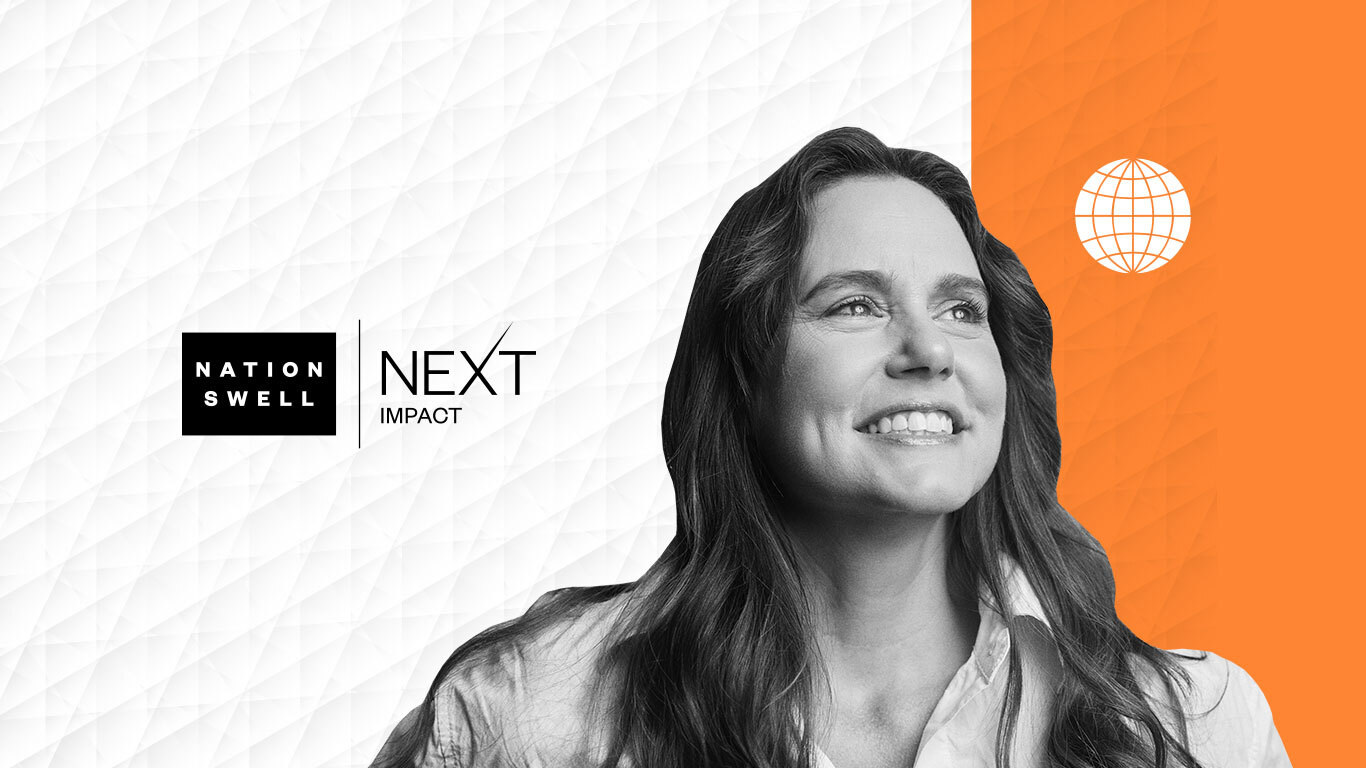
For this installment, NationSwell interviewed Christina Sass, President & CEO of the International Youth Foundation.
Greg Behrman, founder and CEO, NationSwell: What brought you to the field that you’re in right now? Was there an early moment, a relationship, or an experience that galvanized your commitment to driving bold action?
Christina Sass, President & CEO, International Youth Foundation: The short version is that I’m obsessed with youth employment. I genuinely believe it’s one of the most sustainable ways to get and keep people out of poverty. That’s why I focus on jobs for young people — I don’t want them to need things they can’t afford for themselves. When we help young people build skills they can take anywhere, we create change that lasts across generations.
That’s why this is my issue area, and why I tell people all the time: if you have a dollar or an hour to give, give a young person a chance who wouldn’t otherwise get one. Yes, you can do that through a charity like IYF, but honestly, if you have a job to offer in your own organization, that may be the most powerful thing you can do.
The reason this is so deeply personal is that it tracks closely with my father’s story: He immigrated to the U.S. from Germany at 22 with a suitcase and a couple hundred dollars to join his older brother. He was born in 1942, so you can imagine that his childhood was characterized by World War II, a devastated society, a family separated for years. His father was a prisoner of war for the first six years of his life; their family was internally displaced. Like his brother, my dad found a path forward through the brick masons, then volunteered for the U.S. Army as a way to stay in the country. I think he was just hungry for a shot.
His first job in the U.S. was picking up trash in a park while he barely spoke English. His second was moving boxes in an IBM warehouse — back when IBM was probably building typewriters, long before computers. But my dad was a true lifelong learner. He noticed that the most expensive machine parts were going missing, and he spent all night practicing enough English to ask his boss a question: why not keep the most valuable parts in one place and require people to check them out? His boss said, “Why don’t you build it?” And he did.
My dad retired after 32 years at IBM. Along the way, he kept leaving to get more education, kept pushing for opportunities, and was also lucky enough to have people take a chance on him — on someone who barely spoke English. That changed everything for our family. My dad is the reason my brother and I had the life we had; somebody gave him a chance. He passed away when I was a sophomore in college, and it was devastating for all of us, but his story still looms large for me.
So yes, this work is deeply personal, and it also happens to align with something I genuinely love. I stay so focused on youth employment because I’ve seen what it can unlock: in my own family, in my brother’s life, and in so many other young people’s lives.
I’ve taken multiple swings at the same question: How do we get young people into jobs at scale? Because I think we’ve failed badly at this. Educators say young people are ready for work; employers say they need two to three years of experience. And for the most at-risk young people, that gap is rarely merit-based. We can do so much better at opening doors early — and giving young people the chance to realize their full potential.
Behrman, NationSwell: Tell us a little bit about your current role and how you came to it.
Sass, IYF: International Youth Foundation is currently in its 35th year of operation, and I am the fourth CEO. All of the CEOs are around and super supportive of the work, which is a really cool legacy to have. IYF was founded by Rick Little, who was really ahead of his time in recognizing that young people face a distinct set of challenges in the transition from school to work, especially when there isn’t a clear path into employment.
I came to IYF in 2024, after spending 10 years building Andela, a platform connecting global companies with developer talent, especially in Africa. Bill Reese, IYF’s longtime second CEO, had been a mentor of mine for years, so when he reached out and said, “This is your issue area, would you consider it?”, it was a pretty extraordinary invitation.
What drew me in was the chance to work at a different order of scale. At Andela, we were intentionally building outside the system. At IYF, we’re working inside it — which comes with more constraints, but also a much bigger opportunity to create lasting change.
At its core, IYF focuses on youth economic opportunity, especially through training and job placement. We think broadly about who we serve: young people, of course, but also employers, school system leaders, and the funders who make this work possible. Our programs are strong, our outcomes are strong, and the work now is about growing awareness, expanding our reach, and continuing to evolve to meet young people where they are in a very complicated moment.
Behrman, NationSwell: Is there a particular program, signature initiative, or some facet of the work that you would like to spotlight for us that is driving outcomes for the work?
Sass, IYF: One great example is a program we run with FedEx in Mexico and Colombia called Jóvenes con Entrega, which roughly translates to “youth who deliver,” both literally and in life.
The idea is simple: we look at where there are real hiring gaps, then work backward with employers to build training directly into the school day. In this case, FedEx had a huge need for entry-level logistics workers, especially as nearshoring accelerated across the region. So we worked directly with their HR and logistics teams to map the skills they needed, build a curriculum around those requirements, connect Fedex mentors to program participants, and integrate into technical high schools. We initially trained teachers ourselves, then transitioned that ownership to the school systems.
Since 2018, that program has served more than 50,000 young people, with job placement rates more than double what they would be otherwise. Nearly half of participants are young women, which is especially meaningful because many were initially being steered toward “safe” roles like secretarial work. We had to make the case that logistics was not only viable, but safe, respected, and far better paying, and once families saw the first graduates succeed, the momentum really took off.
Another example I love is our work with the banking sector in Mexico. For years, you needed a four-year economics degree to become an entry-level bank teller, which made no sense for the role and excluded a huge amount of talent. We worked with banks to rethink the job around skills instead of credentials, and helped create a pathway for technical high school graduates to move directly into those roles. We’re now on our third cohort, and it’s been transformative for the young people involved (and a much better talent match for the banks, too).
Behrman, NationSwell: What is unique or differentiated about the approach that you’re taking? Can you walk us through a couple different facets of the work you’re leading that are particularly exciting to you right now?
Sass, IYF: We work with about 50,000 young people a year in what I’d call a high-touch way, meaning they’re getting the full curriculum in a classroom setting, often through technical high schools or school systems. The number is actually higher if you include lighter-touch engagement, like online learning, but 50,000 is the number we use when we’re talking about deeper transformation.
In 2025, 90% of young people who started an IYF program completed it, and 75% went on to a better economic outcome, whether that was job placement, enrolling in higher education, advancing in their current path, or starting something entrepreneurial. Overall, about 87% are connected to work in some meaningful way: employed, in education that leads to employment, or in training that improves their economic prospects. We also have very high net promoter scores with young people, and our partners tend to stay with us for the long term — on average about seven years, with some partnerships lasting 14 years or more. That matters, because systems change is almost always a multi-year effort.
I think the reason young people rate our programs so highly is simple: we design them with young people, not just for them. That “nothing about us without us” mindset is core to how we work. Our life skills curriculum, Passport to Success, is a great example: it’s active, relevant, and grounded in the real pressures young people are navigating, from anger management to gender norms to workplace expectations. Then we build the technical training on top of that. So the real secret sauce is strong systems-level partnerships combined with program design that is genuinely responsive to young people and accountable to them.
Behrman, NationSwell: Of the socially motivated leaders you consider your peers, are there any whom you hold in particularly high esteem, and how has their approach shaped your own leadership?
Sass, IYF: I think my superpower as a leader is that I’m wired to empower other people. My instinct is not to hold power tightly, it’s to give it away. I’m pretty vulnerable as a leader, and I talk openly about what I’ve learned about myself and how I work. I want to build a true team of rivals: extraordinary people with different strengths, fully unlocked to do their best work.
At the center of my leadership is not power or control, but the opposite: If we’re going to scale, we have to align people around the mission, bring in incredible talent, and then trust them.
That mindset was also shaped by an extraordinary executive coach I’ve worked with since my second year at Andela, Jeff Hunter of Talentism. His core methodology is based on the idea that leaders, particularly founders and entrepreneurs, have to see themselves clearly and design around what they actually are best in class at, and that framework has had a huge impact on me. To use myself as an example, I am a great individual contributor, but I am not a good day-to-day clarity manager. That tells me that I need to hire those people, and they need to manage those facets of the work. So I relentlessly try to see myself clearly and design well around myself, and then I hire people with high mission-alignment in mind. I believe that the best teams out there have a lot of psychological safety, so I try to start with vulnerability, lead with vulnerability, and really mean it when I say that I’m handing the reins over.