 "
"
At a moment of inequality and division, who is advancing the vanguard of economic and social progress to bolster under-served communities? Whose work is fostering the inclusive growth that ensures every individual thrives? Who will set the ambitious standards that mobilize whole industries, challenging their peers to reach new altitudes of social impact?
In 2026, Impact Next — an editorial flagship series from NationSwell — spotlights the standard-bearing corporate social responsibility and impact leaders, entrepreneurs, experts, and philanthropists whose catalytic work has the potential to shape the landscape of progress amid urgent need for social and economic action.
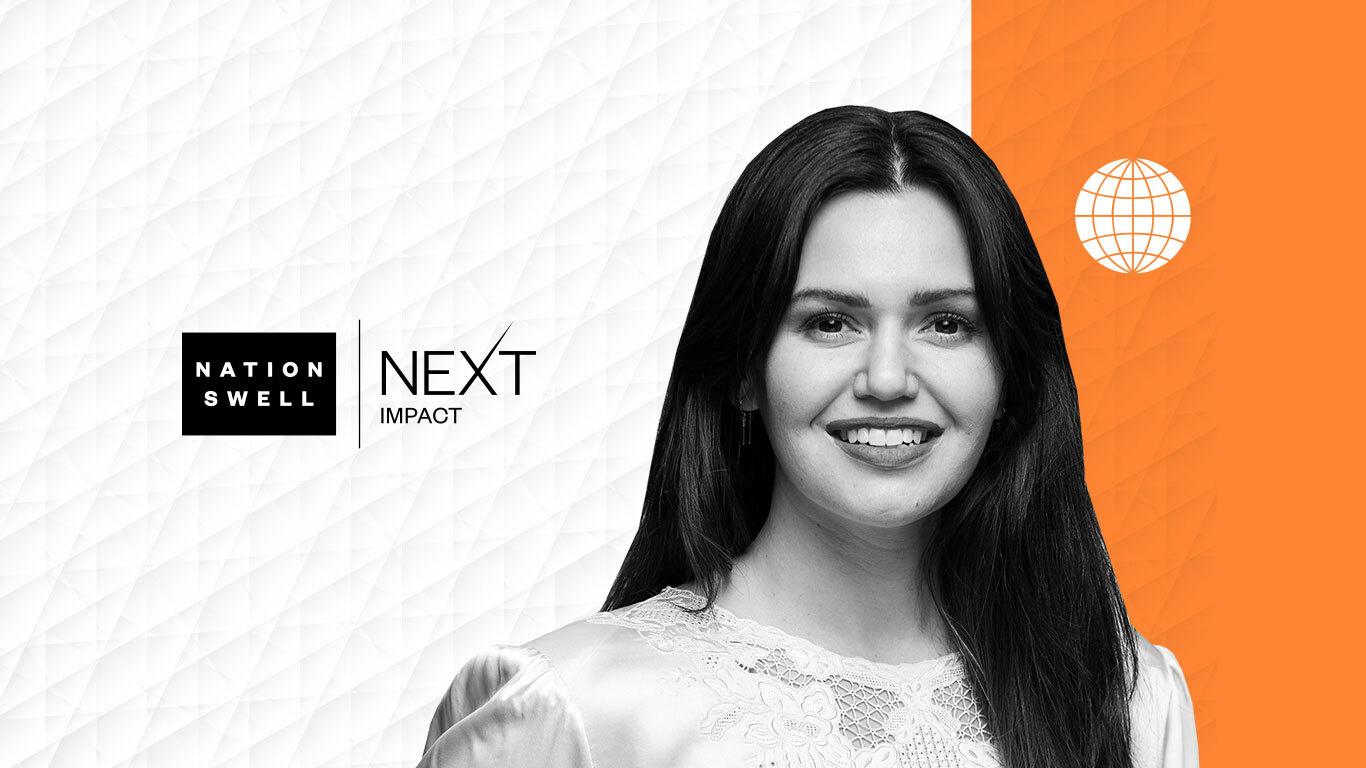
For this installment, NationSwell interviewed Lyndsay Harris-Kyei, Vice President of Global Impact and Sustainability at ServiceNow. Here’s what she had to say:
Greg Behrman, CEO and founder, NationSwell: What brought you to the field that you’re in right now? Was there an early moment, a relationship, or an experience that galvanized your commitment to driving bold action?
Lyndsay Harris-Kyei, Vice President of Global Impact and Sustainability, ServiceNow: My journey really started long before my career did. I grew up on a dairy farm in Western New York — which a lot of people don’t expect, especially if they meet me now in my very tall heels. But I grew up on 100 acres, I can drive a tractor, fix heavy equipment, and milk cows. My dad still insists that I jump on a piece of equipment, from time to time and now he likes me to show off for my son. My upbringing gave me an early and deep appreciation for what it means to live in harmony with nature and that understanding has shaped everything I do.
I always knew I wanted to move to NYC and I’ve been here since grad school. In college, I was at a liberal arts school, trying to figure out what I wanted to do and jumping around different majors. Then I took a World Affairs class, and something clicked: my interest in the world and in impact could translate into a role. I switched to political science halfway through my junior year, and later went on to get my master’s in international affairs at The New School.
But the defining moment came during my senior-year internship in refugee resettlement. I remember realizing how powerful it is to reach across borders and boundaries, and how universal the desire is to have the resources you need so your family can live a happy, safe, healthy life. There were moments that really caught me off guard — taking people to doctor’s appointments, being the only person in the room who spoke English, trying to make sure everyone felt at ease during complicated situations. These were things I had taken for granted, and that experience helped define what I wanted to do.
Later, while pursuing my master’s and interning in Senator Gillibrand’s office, someone said to me, “Great, you have a political science degree and a master’s in international affairs — now you know a lot of facts. What skills have you developed?” That question stayed with me, and I started thinking about the trail of capital: where it comes from, where it goes, and what it makes possible. That’s when I began leaning into the corporate side of impact.
Throughout my career, I’ve stayed close to that intersection of business, philanthropy, and community. I started at IAC, working on philanthropic initiatives, including the Little Island project. From there, I went to Medidata, where I had the opportunity to take over CSR and build it from the ground up.
That has been a theme in my leadership journey: asking the questions, seeing what’s possible, and not being afraid of hearing “no.” Then I got a call, somewhat randomly, from a senior leader at ServiceNow who wanted to talk about my philosophy on impact. That conversation eventually turned into a role that was designed around this work, and once again, I had the opportunity to build something from the ground up.
I once got advice from a senior leader who said, “Always take the call.” You just never know. Even if it turns into nothing, you’ve made a connection. I’ve tried to follow that throughout my career: take the call, ask to be in the room, ask the question, and push the boundaries of what’s possible.
Behrman, NationSwell: What is the “North Star” of your leadership style? Is there anything in particular that’s motivating or driving you now?
Harris-Kyei, ServiceNow: I think over time, you hear the same stories and have the same conversations. We’ve been talking about coalition building and collaboration for years. And I think about the bright-eyed 22-year-old version of myself who really believed we could change the world. Even now, when I’m in rooms with young people, I get so excited because they believe their solution is going to change the world.
What inspires me today is that even in the most challenging of times the work doesn’t stop — you just get smarter about how you approach it. When you’re young, you tend to think at the macro level: How is this one solution going to solve all the world’s problems? The more seasoned you get, the more you understand the nuance. These challenges repeat themselves across geographies, places, spaces, and people, but they’re also deeply unique to each community.
That’s what keeps me inspired: realizing how much you can do locally. You can change one person’s life, and that person could go on to become president, or lead change in ways you would never expect. You start to understand that the one-to-one connection is so much more important than you may have realized.
And then, as you get older — especially when you have kids — these conversations take on a different meaning. It becomes less theoretical; we have a responsibility to create the world we envision, not just accept the one we have. But I think that responsibility starts at the micro level, because the macro will come.
Behrman, NationSwell: As you’ve grown as a leader, what are some of your insights or perspectives that have sharpened that you would offer to peers or emerging leaders?
Harris-Kyei, ServiceNow: I started in the social impact space, and over time I have leaned further into environmental sustainability and corporate sustainability reporting. What’s interesting to me is how often we think about these things in silos, as if they’re fundamentally different from one another.
The more I’ve leaned into environmental sustainability, the more I’ve seen how closely connected these worlds really are. We just talk about them differently — and of course there are differences, I’m not denying that. However, when it comes down to it regardless of what you are purchasing, how it is measured, and why you are doing it…it comes down to the fact that you are trying to make the world a better place.. The more we break down the definitions, parameters, and guardrails we’ve created for ourselves, the more we can start to see these worlds merge.
That’s a huge part of the philosophy we’ve built at ServiceNow: environmental sustainability and social impact don’t sit on opposite sides of the fence. They’re completely intertwined. What happens if your social impact strategy mirrors your carbon market strategy? Suddenly, you’re investing in solutions in the same communities and spaces. That gives you an opportunity to double your impact.
The more time I spend in this space, the more I realize that in many of these rooms, we’re using different terminology, but we’re often working toward the same outcome. Together, we can have a much stronger impact. That’s a lot of the philosophy behind our program at ServiceNow.
Behrman, NationSwell: What principles guide your leadership, and how are you helping your team adapt the way they talk about impact and sustainability in today’s business environment?
Harris-Kyei, ServiceNow: I think there are a few requirements on my team, and honesty and authenticity are always at the top. I try really hard to create an environment where we can openly and respectfully challenge one another. We all have different backgrounds and experiences and that means we have to be open to changing our own ways of thinking.
That feels especially important in a world that is constantly shifting. ESG might be the number one topic one day and the second topic the next. The pendulum is always swinging, so we have to be agile, open, and willing to push ourselves. I tell my team all the time: challenge our thinking. And as a team, it is healthy to have open, sometimes difficult discussions and debates. I think that’s how you get to the most innovative ideas.
The other thing I’ll say is that now more than ever, as an industry, we have to think differently about how we influence this work and lead with a business mindset. We need to connect the work back to customers and business outcomes.
For example, we know the market is decarbonizing. So instead of only talking about sustainability as a values-led issue, how do we connect it back to the business? What percentage of our customers are in the green economy? How many of our customers are already moving in this direction?
That’s something my team and I have been talking a lot about. Even with sustainability, take the word “sustainability” out and focus on what we know: good business is efficient business, and efficient business is good for the planet. If we can talk about it that way, I think we’ll get more people engaged, because it’s no longer just values-led; it’s a business imperative.
Behrman, NationSwell: So many of your peer leaders are thinking hard about how best to make the business case for resourcing on impact right now. How do you think about ROI at a moment like this?
Harris-Kyei, ServiceNow: As we looked at our portfolio, one of the things we started doing was mapping customers and partners against every impact relationship we have. For every partnership, we ask: Who are we partnering with — not just from the nonprofit perspective, but from the customer or partner perspective? Who is already doing this work, and who could we bring in to support it?
That helps the nonprofit, because it reduces the burden of every company coming in separately and saying, “Let’s build something new.” It forces us to come together across industries. But it also helps our own leadership connect the dots. I can sit down with an executive and say, “You’re meeting with this company — you should know we’ve been working with them on a social impact initiative.” It creates a more organic business conversation.
For every partnership, I want to understand how it connects back to a customer, a partner, a brand opportunity, or a local market where we’re growing. There is real ROI in investing in the places and spaces where the business is expanding. The question is always: Where does impact overlap with business opportunity?
When I worked in clinical trials, we were asking ourselves how we could increase equity in trials, strengthen patient advocacy, and help more people feel comfortable participating. At ServiceNow, it means thinking about our role in the AI economy. If hundreds of millions of people don’t have access to connectivity, that’s untapped potential. And for a technology company, those are future customers who can’t even plug in a laptop.
So we have to think about infrastructure, skilling, and reskilling together. It always comes back to who you are as a business and where impact can help the business scale.
Behrman, NationSwell: Is there a particular program, signature initiative, or some facet of the work that you would like to spotlight for us that is driving outcomes for the work?
Harris-Kyei, ServiceNow: I think what’s unique at ServiceNow is that social impact and environmental sustainability don’t sit on opposite sides of the fence. Because my team is responsible for corporate sustainability reporting, environmental sustainability, social impact and investments, and employee volunteering, we’re able to step back and ask: What happens if we think about all of these resources holistically?
On the environmental side, we’re focused on things like renewable electricity and nature-based solutions. On the social impact side, we’re also investing in organizations like GivePower, which builds solar-powered desalination water farms in Kenya.
In a place like Kenya, some of the strongest investments happening right now are in the carbon market, so the question becomes: Are we looking at those investments holistically? Are we thinking about our handprint across both environmental sustainability and social impact?
India is another good example. Our environmental sustainability team is investing in renewable electricity, while our social impact team is supporting rural village adoption and solar energy access. Suddenly, the story becomes about solar energy and community resilience — we’re just approaching it through different forms of capital.
To me, it all has to tie back to your business. That’s why I love bringing the environmental side, the business side, and the social impact side together. It forces us to think more creatively about the resources we have available.
NationSwell: Of the socially motivated leaders you consider your peers, who are 2-3 whose work inspired you and whom you hold in high esteem?
Harris-Kyei, ServiceNow: A few leaders come to mind, but Melanie Nakagawa, Chief Sustainability Officer at Microsoft, is always at the top of my list. I think she’s brilliant in the way she has helped shape the space.
I’ve also had the opportunity to work with Suzanne Kennedy (Director, Office of the Chairman & President) at IAC Foundation, who was a huge mentor to me and really helped frame my career. What I admire about Suzanne is how locally grounded her approach to impact has always been — whether through IAC, Little Island, or the way she thinks about bringing in community and the people who actually live nearby.
While so many of us are trying to figure out how many countries we can reach or how many people we can serve, Suzanne has always had a much more grassroots lens, which I really love and admire.
Behrman, NationSwell: Are there any resources you’d recommend — books, podcasts, Ted talks — that have influenced your thinking that might influence others as well?
Harris-Kyei, ServiceNow: Every morning, I listen to BBC News, NPR, The New York Times highlights, and Al Jazeera. I don’t know if that’s inspirational or just helpful, but it gives me a more global perspective on what’s happening in the world.
That feels incredibly important to me, because I think we can get very tied to what’s happening in our own country or our own immediate world. Listening more globally grounds me. It reminds me that the problems and headlines we’re seeing here are not the only things happening.
When I have time and need more of a moment of inspiration, I’ll also listen to Ayana Elizabeth Johnson’s podcast, “WHAT IF WE GET IT RIGHT?”. I really appreciate how direct and honest she is about what’s happening in the world.