 "
"
At a moment of inequality and division, who is advancing the vanguard of economic and social progress to bolster under-served communities? Whose work is fostering the inclusive growth that ensures every individual thrives? Who will set the ambitious standards that mobilize whole industries, challenging their peers to reach new altitudes of social impact?
In 2026, Impact Next — an editorial flagship series from NationSwell — will spotlight the standard-bearing corporate social responsibility and impact leaders, entrepreneurs, experts, and philanthropists whose catalytic work has the potential to shape the landscape of progress amid urgent need for social and economic action.
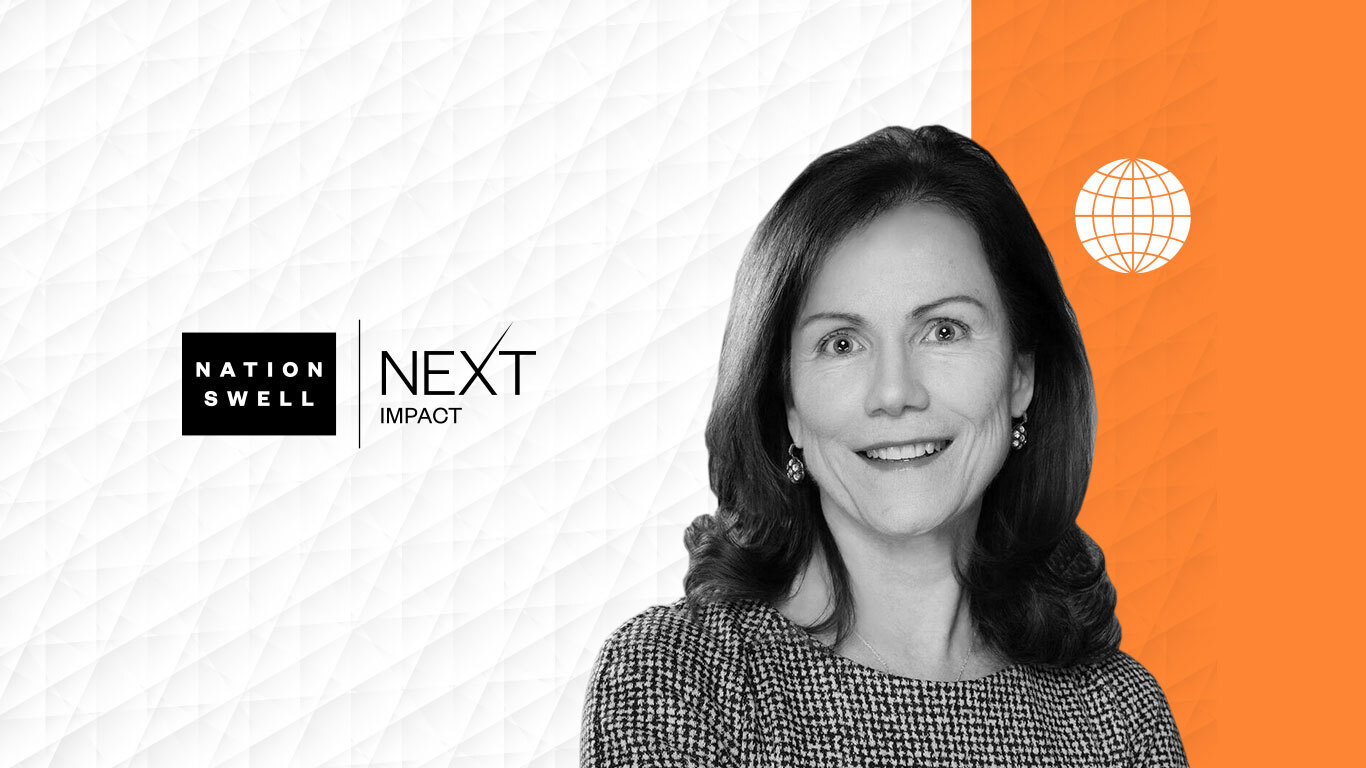
For this installment, NationSwell interviewed Kathy Pike, President and CEO of One Mind. Here’s what she had to say:
Ray Hutchison, Vice President of Community Engagement, NationSwell: What brought you to the field that you’re in now? Was there an early moment or a formative experience that helped shape how you arrived at this role, or your leadership?
Dr. Kathy Pike, President and CEO of One Mind: Before I became CEO of One Mind, I spent 35 years as an academic, as a professor at Columbia University in the Department of Psychiatry and the School of Public Health. Academia is a kind of priesthood, and moving from a full-time faculty role into leading a nonprofit is not a transition most academics make. So something had to shift for me, and it really came down to a couple of moments.
About ten years ago, I was invited by a large multinational company in New York to give a talk on mental health and well-being. I went in for an in-person prep meeting, and they told me there was one condition: I couldn’t say “mental health” or “mental illness.” Those terms were considered too alienating, too stigmatizing. They wanted the talk framed entirely around stress, coping, and resilience.
That stayed with me. The discomfort around even naming mental health felt incredibly restrictive, and I remember giving those kinds of talks and feeling like progress was painfully slow.
Then, a few years ago, after COVID, I was invited back to that same company to give a similar talk. When I walked in, there was a large sign on the door that read something like: “Feeling anxious? Depressed? Want to talk? I’m a mental health ambassador.”
That was a crystallizing moment for me. It was clear we had entered a genuinely new era, one where people were paying real attention to mental health and well-being. And with that shift came a huge opportunity to bridge what we know from rigorous science with what is actually happening in workplaces and communities.
I have always been deeply committed to translational science, to the question of how we take what we know and get it into the hands of people who can use it. That moment made it clear to me that the bridge between science and practice needed to be stronger, and that I wanted to lean fully into building it. When the opportunity came to join One Mind, it felt like exactly the right place to focus that work, to help ensure that what reaches people is grounded in strong science and actually makes a difference in their lives.
Hutchison, NationSwell: What is the “North Star” of your leadership style, and how has it changed over time? What is it about the way that you lead in the space that makes you an effective leader?
Pike, OneMind: Early in my leadership career, I was very focused on building a team that could deliver the work with excellence. I approached leadership in a very task-oriented way. When I thought about hiring or bringing people onto a team, it was largely about finding the right people to get the job done.
And that’s still essential. The work does need to get done, and it needs to be done well. But over time, my thinking about leadership has evolved, and I now see leadership as much more about leading with people. It’s about understanding who individuals are so that they can do the work they’re best suited for. The work they approach with energy and passion, and that allows them to operate at their highest level.
So the question becomes: How do you create the right match between the work that needs to be done and the person who’s doing it? Because when someone is working in an area where they feel alive, engaged, and capable of excellence, they’re simply going to do better work. It’s a subtle shift; the goal of delivering the work doesn’t change, but it changes how I think about leadership, especially when something isn’t working. It changes the questions I ask and the adjustments I consider.
More recently, when we think about building teams, I’ve come to see it less like assembling pieces of a pre-made puzzle and more like building with Legos. You may have an idea of what you’re trying to build, but people bring different strengths and perspectives, and the organization becomes stronger when you build around those differences. When people feel fulfilled and are working in areas they care about and feel strong in, the quality of the work improves as well.
Hutchison, NationSwell: What are some of the programs, signature initiatives, or some facets of the work that you’re doing at One Mind that feel particularly cut-through?
Pike, OneMind: I knew I wanted to lead an organization focused on translating science into practice, and One Mind felt like the right fit for a couple of reasons. For one thing, there’s a deep commitment to grounding the organization in science, which aligns closely with how I believe the mental health field needs to move forward. But there’s also a more personal reason: My paternal uncle was diagnosed with schizophrenia when he was around 20 years old, before I was born. As a child, I used to visit him with my father on Sundays at Rockland State Psychiatric Hospital, where he lived as a ward of the state for most of his adult life. But more than living there, he languished there. It wasn’t because people didn’t care. There were many deeply committed professionals working at the hospital, but the treatments and the understanding of serious mental illness at the time were very limited. I remember riding home after those visits thinking, we have to be able to do better than this. I’m sure that experience shaped my path toward becoming a clinical psychologist, and ultimately joining One Mind.
One Mind was founded by Shari and Garen Staglin after their son, Brandon, was diagnosed with schizophrenia. In contrast to my uncle’s experience, Brandon is thriving today. He serves as our Chief Advocacy and Engagement Officer, and the opportunity to work alongside him was an important part of my decision to join the organization. In a certain poetic way, it feels like being able to say, we’re doing better now, Uncle Henry.
Of course, a diagnosis like schizophrenia is not unlike other serious health conditions where you can do everything right and still face difficult outcomes, but we can do far more now than we once could to help people thrive. One Mind’s commitment to integrating people with lived experience in all our programming under Brandon’s leadership, is enormously valuable and meaningful and ensures that the priorities and perspectives of those we aim to serve shape what we do.
What excites me every day is the way our work pushes the field forward across three core pillars: The One Mind Rising Star Academy supports researchers pursuing bold, breakthrough ideas in neuroscience to better understand the brain and develop new interventions; the One Mind Accelerator brings investment, technology, and innovation into mental health to build scalable, sustainable solutions; and One Mind at Work takes those insights into workplaces, helping organizations rethink how work itself supports mental health and well-being.
Across all three, the goal is the same: to demonstrate that better is possible, and to help make that future real.
Hutchison, NationSwell: What are the trends that you’re currently seeing that are giving you hope?
Pike, One Mind: Mental health is definitely having a moment. For a long time, nobody wanted to talk about it. Now everyone does. The advances in science and technology, the innovation, and the level of investment coming into this space fill me with genuine hope and make me deeply optimistic about what lies ahead.
But I’ll be honest about what keeps me up at night. All of this attention may not translate into real impact. There’s a real risk that good intentions don’t actually achieve their aims, and if that happens, the naysayers will say: we invested in mental health, we funded research, we built workplace programs, and nothing changed. They’ll throw up their hands and walk away. That concerns me deeply, because I believe we have a genuine opportunity right now, and I don’t want to see us squander it.
Here’s the challenge: too much of the work in mental health is underdosed. Think about strep throat. A doctor prescribes a very specific antibiotic at a very specific dose for a very specific number of days, because that is what produces results. In mental health, we have evidence-based strategies that similarly require a certain level of frequency and intensity to work. But too often we are asked to make do with less. It’s like telling a doctor to cut the prescription in half and then wondering why the patient isn’t getting better.
At One Mind, we think about this constantly. Good intentions are not enough. We are committed to translating science into programs that are designed and scaled for real impact.
And here is what I keep coming back to: we are living in a moment of extraordinary possibility. The science is stronger than it has ever been. The cultural openness is wider than it has ever been. The investment is growing. If we do this right, if we stay grounded in evidence and committed to reaching the people who need it most, I believe mental health will lead the way to a broader and more expansive understanding of what it means to be healthy. Not just mentally healthy, but fully, wholly healthy. That future is within reach, and that is what drives me every single day.
Hutchison, NationSwell: How are you thinking about AI in this moment? Is there a future where it’s a force for good? And if so, what does that look like? How do we get there?
Pike, One Mind: It’s not a future where AI becomes a force for good; it’s already here. AI is power, and it is potential. In many ways, it’s like water or money: what matters is how you use it.
In mental health and well-being, AI offers tremendous opportunity. Population-level data show that the burden of untreated mental health conditions is enormous, one of the leading causes of disability worldwide. And the vast majority of people with these conditions, whether in high-income countries like the United States or in lower-income countries and communities in the US, are not receiving treatment.
There are many reasons for that. Stigma remains a barrier, access to care is limited, and AI can help address both. It can expand access to information and support in ways that feel more private for people who are hesitant to seek care openly; it can help standardize aspects of care and reduce administrative burdens, like documentation and record-keeping, that take time away from clinicians. In those ways, AI has the potential to dramatically increase access and improve how mental health care is delivered.
But there is also real risk. We’ve already seen cases where people turn to tools like ChatGPT or other AI systems for mental health support, even though those systems aren’t trained to manage clinical risk. There have been tragic outcomes, which underscores how important it is to approach this thoughtfully.
We are addressing the issue of AI and mental health across all our programs. What is ethical use of AI for our One Mind Rising Star Award researchers? How can we responsibly support companies that are creating AI-enabled interventions in our One Mind Accelerator? How do we bring best practices to this new world of work for the companies we work with through One Mind at Work. Workplaces are all grappling with what AI means for their industries and their workforces. Jobs will change. Some roles may disappear, and new ones will emerge. All of us will be working differently in the years ahead.
So from my perspective, AI brings enormous opportunity and enormous risk. Our future will be shaped by the choices we make now. We need to be intentional about building AI in ways that advance our shared aspirations: improving the human condition and strengthening people’s health and well-being. And if we see risks emerging, we have a responsibility to act in ways that reduce harm and optimize good outcomes.
When there is choice, there is risk. But there is also the possibility of getting it right.
Hutchison, NationSwell: What are some peer leaders out there that you admire, particularly leaders in roles at other organizations, or companies, or nonprofits whose work you hold in high esteem? Is there anybody else out there that we should be pointing a finger in the direction of as another great example of a human being or an organization?
Pike, OneMind: One organization that serves as a North Star for me is the Kennedy Forum, founded by Patrick J. Kennedy. I believe Patrick is the most important and effective national spokesperson on mental health today when it comes to advocacy, parity, and advancing solutions that matter for society as a whole. The organization’s CEO, Rebecca Bagley, is also an incredibly thoughtful, strategic, and compassionate leader who is helping carry that mission forward.
Patrick’s leadership was especially top of mind for me recently. This past Monday, he convened a major gathering at the National Press Club that brought together mental health leaders and policymakers. The event opened with an interview featuring his cousin, Secretary Robert F. Kennedy Jr.
Patrick and Secretary Kennedy have very little in common politically, and Patrick acknowledged that directly. As he closed his opening remarks, he said many people were probably wondering how he could stand on that stage and introduce someone whose political views he often disagrees with. But he explained that he was there because the Secretary will help shape the national agenda on mental health and addiction. And those issues matter to everyone. Patrick spoke about how both of them understand, through their own family experiences, what mental illness and addiction can do to individuals and families. He said, essentially, that they may sit in different political camps, but on this issue they share a mission.
For me, that moment captured something powerful. Patrick doesn’t just say that mental health is bipartisan, he treats it as a universal issue and leads accordingly. He’s willing to partner with people he may disagree with in other arenas because the mission matters more. One of my mentors used to say, “Keep your eye on the prize.” That’s exactly what Patrick is doing.
Because of that leadership, he and Rebecca and their team have helped drive real progress, including the Action for Progress on Mental Health and Substance Use — a framework that, if fully implemented, could have tremendous benefits for people across the country. I have enormous respect and admiration for Patrick’s ability to lead with that kind of focus and commitment.
Hutchison, NationSwell: What is the North Star of your leadership?
Pike, OneMind: I think about the North Star of my leadership as a three-legged stool of values: dignity, purpose, and joy.
As I make decisions about where to spend my energy, whether in my leadership, my social life, or my philanthropic work, those three values are the ones that guide me. I want to feel a sense of dignity, purpose, and joy in the way I engage in the world. If something lacks those things, if it doesn’t feel purposeful, if it doesn’t bring joy, or if there’s an indignity in it for myself or for others, then I know it’s not where I belong.
We live in a world with a frenetic energy that can pull people away from what they care about most. It’s easy to become disconnected, to drift from your center without even noticing it’s happened. But when we are intentional about keeping our values close, we actually have tremendous power to shape the world around us. It shows up in the decisions we make every single day, the small ones as much as the large ones.
So for me, dignity, purpose, and joy are not abstract ideals. They are the stars I use to navigate my leadership and to choose the work that is worthy of my time and energy.