 "
"
In moments of challenge and opportunity, who is advancing the vanguard of economic and social progress? Whose work is fostering growth that helps to ensure individuals thrive? Who will set the ambitious standards that mobilize whole industries, challenging their peers to reach new altitudes of social impact?
In 2026, Impact Next — an editorial flagship series from NationSwell — will spotlight the standard-bearing impact leaders, entrepreneurs, experts, and philanthropists whose catalytic work has the potential to shape the landscape of progress.
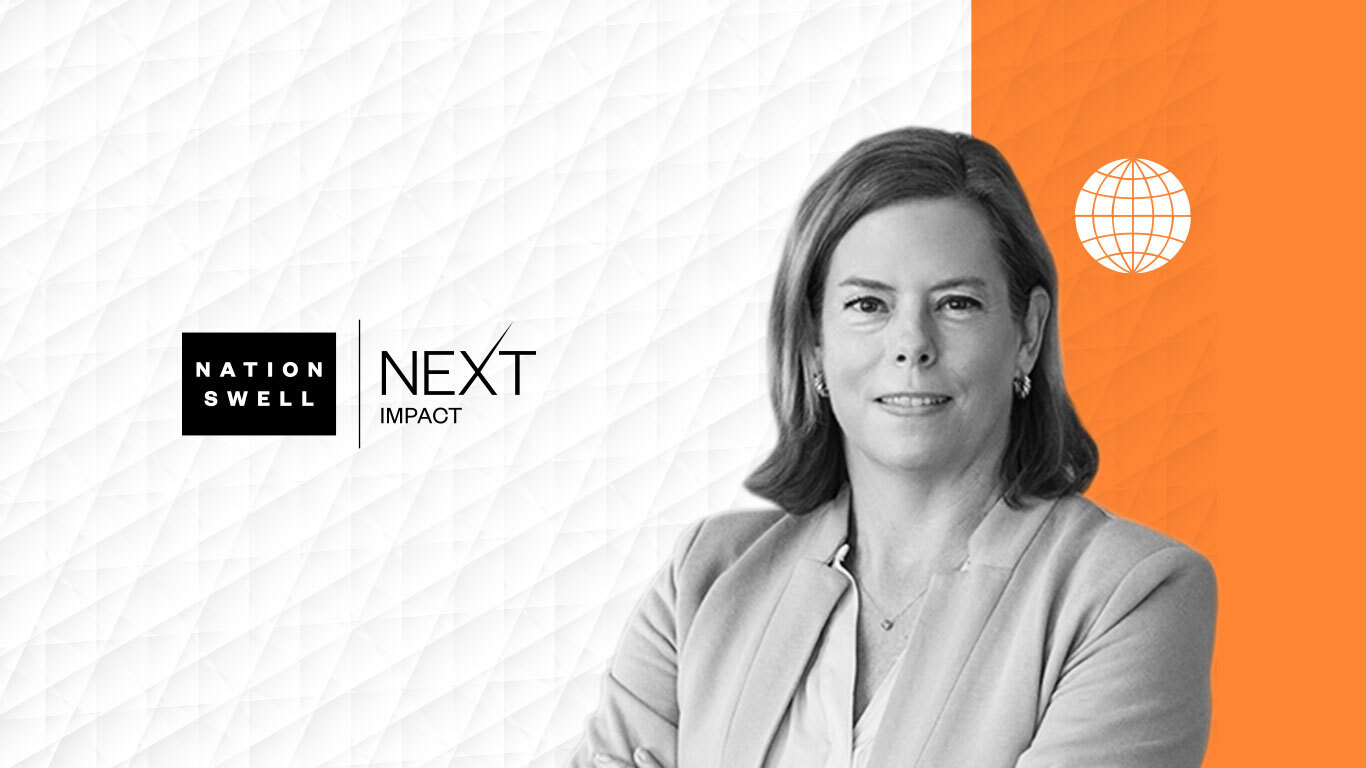
For this installment, NationSwell interviewed Dana O’Donovan, US Purpose leader at Deloitte.
NationSwell: What brought you to the field that you’re in right now? Was there an early moment, a relationship, or an experience that galvanized your commitment to driving bold action?
Dana O’Donovan, Deloitte: I didn’t realize it at the time, but the genesis of my work really began when I was adopted at three weeks old, which completely changed the trajectory of my life. I was adopted by wonderful parents and given every opportunity to fulfill my potential and succeed.
As I got older, that personal experience became deeply formative; it drove a passion in me around the belief that every child deserves the opportunity to thrive, regardless of their background or the circumstances of their birth. I’m very aware that my life could have turned out very differently — that I could just as easily have been someone the nonprofit sector exists to serve; that awareness has stayed with me.
When I first started my career, I was focused almost entirely on client service. I came from corporate and business unit strategy, worked in strategy consulting, and then shifted into client service work for nonprofits and foundations (I used to joke that my two jobs were horse camp counselor and consultant).
About 18 years ago, I took an in-house role at a nonprofit, and that experience fundamentally changed my perspective. It gave me a deep appreciation for how hard day-to-day operations are, especially in the nonprofit space. Strategy, I realized, is often the easy part — implementation and operations are where the real challenges live.
When I returned to client service after that, it changed how I worked. Strategy still mattered, but I became much more focused on how it connected to what teams actually do every day, and that mindset has guided me ever since. I’ve held hybrid roles since then, never fully leaving client service but adding management and leadership responsibilities over time.
That blend of experiences ultimately led me to my current role, and it’s what energizes me most today: drawing on that full arc of experience to lead with both vision and practicality.
NationSwell: What are some touchstones that you have for yourself from that past experience that you’re bringing into how you’re leading now?
O’Donovan, Deloitte: I think one of the core roles of any leader is shaping vision and strategy — but it’s just as important to understand the operational reality your team is living in. You have to stay close enough to the day-to-day to help remove obstacles, spot opportunities, and keep the work moving as effectively and efficiently as possible. We often underestimate how much time and energy it takes just to keep the trains running on time; that’s something I learned very clearly during my nonprofit experience, and it’s stayed with me.
I also believe deeply in the power of communication. It’s almost impossible to over-communicate with your team — about what’s exciting you, what you’re seeing in the broader landscape, and where you think things are headed, both externally and inside the organization. We actually have a standing agenda item in our team meetings called “Dana’s downloads,” where I share those reflections. It’s a good reminder for me to keep doing that consistently.
There’s no denying how much is happening in the world right now, but I also see this moment as one of extraordinary opportunity. New technologies and capabilities are opening up possibilities we couldn’t imagine before, and I’m seeing a growing willingness to engage in bolder, more meaningful collaboration to drive impact.
On the corporate side, purpose is increasingly a market driver — it’s no longer something adjacent or optional; it’s core. At Deloitte, we see growth and purpose as deeply linked, and that connection helps us stay relevant in a world that’s moving incredibly fast.
I feel fortunate to have a front-row seat to this moment — through my role at Deloitte, through our client work across industries, and through conversations with leaders across the NationSwell community. I’m encouraged by how many organizations are finding new ways to make purpose central to their strategies and to collaborate beyond what any one organization could do alone. That kind of creativity and collaboration is really the only way we’re going to meet this moment — and it’s where I see real possibility for lasting impact.
NationSwell: Is there a particular lever you’re pulling or an approach that you have to that work that you think sets it up for success?
O’Donovan, Deloitte: I do think we’re seeing more meaningful multi-sector collaboration than in the past. We’ve talked about collaboration for years, but it hasn’t always been as common or as effective as it needs to be. The reality is that the challenges trying to be solved are far too complex for any single organization — even one as large as Deloitte — to tackle alone.
That’s why focus matters. Organizations need clarity on the issue areas they’re committed to. But the real power of corporate purpose lies in how we show up. It’s not funding alone, which will always be modest compared to large foundations; it’s not talent engagement, pro bono work, or skills-based volunteering on their own. Impact comes from intentionally combining those assets.
At Deloitte, that “how” is grounded in place-based, issue-driven ecosystems. A strong example is the Yes San Francisco urban sustainability challenge, launched in 2023 as a collaboration among Deloitte, Salesforce, the World Economic Forum, and the San Francisco Chamber of Commerce. The aim was to support local urban sustainability innovators in developing solutions to help revitalize the city post-COVID, and in doing so build a more resilient economy.
That work has since evolved into a broader blueprint called Yes/Cities, focused on using cross-sector collaboration to drive sustainable change in cities globally. We’re not creating the solutions — we’re creating the conditions to help local innovators succeed.
One key lesson from San Francisco: Strong ecosystems require collaborators across sectors, each bringing distinct skills, resources, and networks. Place-based work also has to be community-centered — designed by, for, and with the people closest to the challenges. That means leading with questions, listening deeply, and building alongside communities rather than arriving with answers.
NationSwell: What’s defining the current social and economic environment that we’re in — what are the trends that you’re currently seeing, and what’s giving you hope?
O’Donovan, Deloitte: I think we still need to push ourselves to think about innovation not just for what’s required right now, but for what nonprofits will need five or ten years down the road. That’s especially true as we think about the commitments we’re making to help the social sector meet this moment from a technology perspective.
We’ve spoken with dozens of nonprofit leaders about their technology challenges and opportunities, and what’s clear is that they’re not naïve about the potential of tools like AI or integrated systems to help transform their work. The challenge isn’t awareness — it’s capacity. It’s not just about access to a platform; it’s about having the technical talent and resources to customize, maintain, and continually adapt those systems to their specific models.
As a result, technology takes up an enormous amount of nonprofit leaders’ mindshare — often at the expense of their core mission. I would love to help lower that burden so leaders can spend more time focused on impact. This is where Deloitte can play a valuable role. We bring deep experience in the social impact space alongside the scale and sophistication of our broader technology capabilities — the same kinds of platforms and support we provide to corporate clients.
Talking about innovation and potential isn’t enough if we can’t translate it into something usable and practical. The real opportunity is connecting technology to day-to-day operations in a way that helps organizations work more effectively, more efficiently, and stay deeply mission-focused. That’s the gap I’m most excited to help close.
NationSwell: What advice do you have for others about how they can lean in and use their superpowers to help the nonprofit sector?
O’Donovan, Deloitte: One thing I believe very deeply — and anyone on my team will tell you I say this all the time — is that Deloitte can do almost anything. But the real question isn’t what we can do — it’s what we should uniquely do to be most helpful.
I think we’re past the era of check-the-box corporate philanthropy: writing a check, running employee giving campaigns, and calling it a day. That work mattered, but we’ve learned so much more about the real superpowers corporations can bring to the table. When you do deep listening — when you talk to communities, engage people on the ground, and really understand what’s needed — you get fundamentally different answers.
That’s when you’re able to focus on what your organization is uniquely positioned to contribute. Because while you can do a lot of things, not all of them add up to the kind of change this moment actually demands.
NationSwell: How do you cultivate purpose within your team? How do you help people understand their purpose and feel guided by that?
O’Donovan, Deloitte: I think the good news about Deloitte is that we’ve cared about impact for more than 180 years. We’re starting from a place of real strength. For me, my role is about continuing to evolve that purpose in line with the moment we’re in.
A big part of that is making sure there’s as little daylight as possible between our ambitions and how we actually show up. When I think about our investments, commitments, and social impact work, we’re focused on sustainability, opportunity, and trust — areas aimed at creating positive impact in our organization and in our communities genuinely make sense for us. My work has been about sharpening that focus: aligning our portfolio with those priorities and doing the work with communities, not for them, and never alone.
Our senior leaders share this commitment and believe deeply in strengthening local efforts, convening decision-makers, and facilitating collaboration across sectors. That’s really shaped our approach — not just what we focus on, but how we show up. It’s about working alongside organizations closest to the issues, supporting strategic initiatives, and driving collective action. We started from a strong place; the work now is about raising our game and focusing on what we can uniquely do to create long-term impact — building access to opportunity, family-sustaining jobs, and more resilient communities.
I also want to be clear that leading with purpose isn’t limited to my role. I get to focus on this every day, and we empower our people to lead with purpose in how they show up with their teams and respond to opportunities including our client service professionals that can help think through the impact of their work on people and communities.
Part of my role is making that easier — helping our professionals and leaders embed purpose into their team and client engagements. Many of our clients care deeply about this too, which creates real opportunity. Whether it’s co-investing in communities, showing up together on Impact Day, our annual day of collective service, or building purpose into long-term client relationships, there are so many ways we can demonstrate what it looks like to lead with purpose as an organization.
NationSwell: Of the socially motivated leaders you consider your peers, are there any whose work inspired you and whom you hold in high esteem?
O’Donovan, Deloitte: First, I get a lot of energy from people and community — meeting new people, reconnecting with trusted peers, and talking through how we’re seeing the world. Those conversations often spark new or unexpected ideas. That’s why I value spaces like NationSwell so much. There’s real power in community building, especially when it’s a group you trust. I’ve always had what I call a “kitchen cabinet” — a personal board of directors. They’re not all in similar roles, but they’ve known me at different stages of my life, and when I’m facing a big decision, their perspectives are invaluable.
Second, I’m very intentional about continuing to invest in my own leadership. I love a good podcast or audiobook — especially thinkers who combine data with practical, human-centered insights. That blend of rigor and applicability really resonates with me and helps shape how I think about leading in complex environments.
And finally, I’ve been incredibly fortunate to learn from some exceptional mentors over the course of my career. A few former managers are still part of my kitchen cabinet today. One mentor, in particular, taught me so much about leadership—especially how to support people through different seasons of their careers. She helped me see possibilities for myself long before I could see them on my own. Watching her do that shaped how I lead today and how I think about developing others on my team.
Seeing people grow over time — and helping them prepare for what’s next — is one of the most fulfilling parts of leadership for me.
NationSwell: Are there any resources you’d recommend — books, podcasts, Ted talks — that have influenced your thinking that might influence others as well?
O’Donovan, Deloitte: I just finished the audiobook of Strong Ground, Brené Brown’s new book, and I found it incredibly insightful — especially in how it talks about leadership, transformation, and what’s actually required of leaders in this moment. I don’t think I’ve fully processed all of it yet, but it’s already prompting me to reflect on where some of my default settings might need an upgrade. It’s the kind of book that stays with you, and I know I’ll be carrying those questions with me as I think about 2026.
For people who want to come into this space, one thing I’ve found to be profoundly important is the combination of two kinds of experience and knowledge. First, deep industry knowledge in the social impact space — really understanding what it takes to create change, which for me and my team has come from decades of working closely with nonprofits, foundations, and communities. And second, a strong understanding of how change actually happens inside a corporate environment.
You need both. If you only have industry knowledge, your options can be limited if you don’t know how to galvanize people and move work forward in your organization. And if you only understand corporate systems without the depth of issue-area knowledge, the impact may not be meaningful. I certainly had to build that second muscle when I came to Deloitte 13 years ago — learning how things get done here to match my external experience.
When you bring those two together, the opportunity set expands exponentially. It’s incredibly energizing, because you start to see what’s actually possible. But it’s also complex work. This space can look appealing from the outside — and it is rewarding — but it requires a lot of reps, learning, and humility. That’s why I often tell junior professionals: go deep on one side first, build real experience, and then start layering in the other. Purpose alone isn’t enough — you need the skills and capabilities to turn it into lasting impact.