 "
"
What does it look like for a community foundation to meet the moment not just as a funder, but as a convener, translator, and catalyst for long-term change? As a longtime steward of community resilience across Pierce County, Washington, the Greater Tacoma Community Foundation is embracing that challenge by connecting unlikely partners across the region and creating the conditions for communities to influence and shape the systems that affect them.
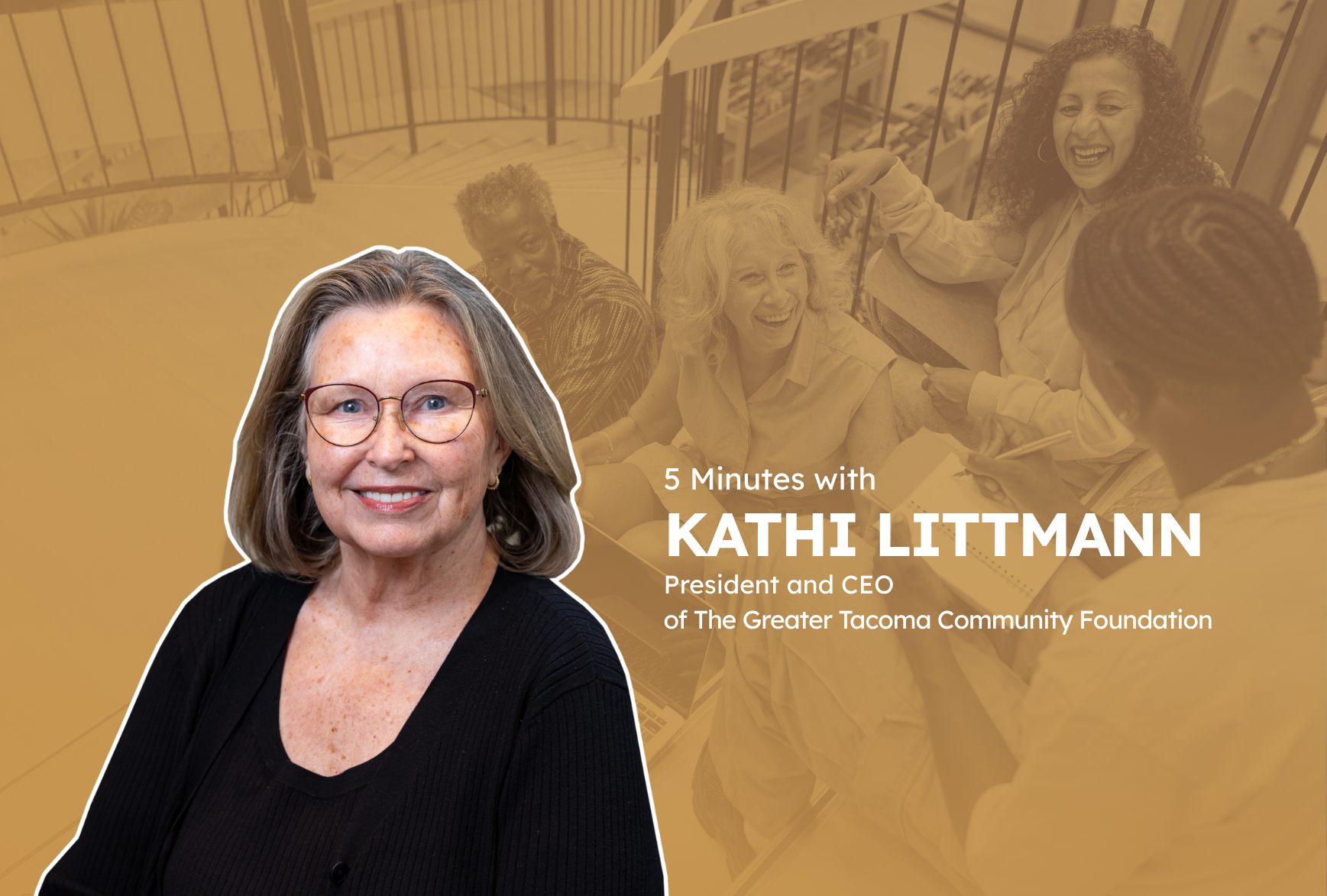
For this installment of Five Minutes With…, NationSwell spoke with Kathi Littmann, president and CEO of The Greater Tacoma Community Foundation, about the evolving role of community philanthropy, the importance of building resilience alongside capacity, and what other foundations can learn from Pierce County’s collaborative model.
Here’s what she had to say:
NationSwell: How would you describe the role The Greater Tacoma Community Foundation plays in the region, and what makes your approach to community philanthropy distinct?
Kathi Littman, President and CEO, The Greater Tacoma Community Foundation: We serve Pierce County, which is in the Puget Sound region between Seattle and the state capital. It’s a gritty, deeply collaborative community that has always known how to do a lot with limited resources, and that really shapes who we are as a foundation.
GTCF has been here since 1981, and we’ve grown from about $10,000 to more than $200 million in assets, so today we’re a mid-sized community foundation. At our core, our prime directive is honoring donor intent: what do our fund advisors love about Pierce County, and what kind of legacy do they want to leave here?
At the same time, when we’re working with discretionary resources, we’re very focused on systems change. We’re always asking how we can help meet urgent needs today, but we’re thinking in parallel about how we can address those problems long-term so that we’re not responding to them forever. For us, that means removing barriers to generational wealth and well-being across Pierce County.
Our strategic framework is built around four interconnected pillars: housing, youth, civic voice and power, and access to capital and wealth. Those issues all intersect, but right now we’re especially focused on civic voice and power in that we’ve been shifting our thinking from helping nonprofits build capacity to helping communities build resilience. Capacity is about doing what you already do, better; resilience is about being able to adapt, lead, and meet a changing moment.
And while we do a lot of grantmaking, our real superpower is not just the money, but the relationships. It’s convening across sectors, connecting people, catalyzing ideas, and helping communities use their lived experience to influence the systems shaping their lives. That’s really GTCF’s sweet spot, and it’s what makes us uniquely suited to this moment.
NationSwell: What would you say GTCF’s secret sauce is as a convener? What lessons have you learned that are transferable for others hoping to build community trust?
Littmann, GTCF: Pretty consistently, whether we’re working with a government agency, a national funder, or one of our own donor-advised fundholders, people come to us because they know we’ll connect them to others who care about the same issues and help them make smarter decisions about how they invest in the community. They see us as thought partners, and just as importantly, as connectors to other thought partners.
That’s why I often say some of the highest-value things we offer go well beyond the grants themselves. A good example of this is the intermediary work we’ve done with the Washington State Department of Commerce, where we’ve helped move state dollars into communities faster by serving as the contract holder and intermediary so that nonprofits receive those funds as grants rather than taking on the administrative burden and risk of a government contract.
That work led to another important role: Last fall, the state Speaker of the House and the Pierce County Executive asked us to convene nonprofits around the impact of federal budget cuts on county services. We brought in service sector and network leaders, grounded the conversation in data, and created an ongoing space to understand the ripple effects across housing, food access, Medicaid, employment, and more.
That’s really our model: community-centered philanthropy. The people closest to the issue understand the barriers, and our role is to convene them, amplify their voices, bring in research and examples, and help translate lived experience into action.
NationSwell: How are you thinking about what it means to be a community foundation in this moment? What are the unique challenges that you’re facing, and how does your work go beyond traditional grantmaking?
Littmann, GTCF: Being a community foundation is both inspiring and a little daunting, because in theory we’re built to be here in perpetuity. That means we have to lead with hope — not just for what Pierce County needs right now, but for what we want this community to look like seven generations from now. That’s a beautiful mission, but it’s also a heavy one, especially in a moment when so many systems feel misaligned with that long view. What we’ve learned is that even when there’s trauma and scarcity, there is real power in bringing people together around possibility and helping communities imagine solutions that reduce the need for crisis response over time.
A few lessons consistently guide how we do that work. First, we’re always asking: are we in the right role? If someone else should own it, we’re not trying to hold it. One reason communities trust us is that they know we can incubate and convene, but also that we’re not trying to keep control. Second, we’re constantly asking who’s not at the table; we don’t need to convene everyone, but we do need the right voices in the room. Third, one of our unique roles is helping the community see the bigger picture — surfacing patterns, gaps, and ripple effects that individual organizations may not be able to see on their own. And finally, we believe deeply in passing the mic. Our role is not to speak for communities, but to create the conditions for people to speak for themselves through our platform and relationships.
We’re also very intentional about building relationships beyond Pierce County, because some of our best learning comes from statewide and national partnerships. Pierce County is a strong testing ground: it’s diverse, collaborative, and in many ways a microcosm of the country. That makes it a powerful place not just to serve community needs, but to learn what kinds of philanthropic approaches actually work.
NationSwell: Can you share an example of a partnership, initiative, or investment that reflects how you’re trying to meet this moment differently?
Littmann, GTCF: I’ll start with our Department of Commerce work around the Community Reinvestment Project, which was a $200 million state initiative designed to address harms caused by the war on drugs and which we stepped into as an intermediary for Pierce County. We signed the contract, negotiated the terms, provided upfront funding, and convened a local advisory team made up of leaders from the sectors most impacted. We also trained them in community-centered philanthropy, because many had been conditioned to navigate contracts and compete for funding rather than help shape how resources move. Then they helped decide how the money went out.
We were able to move funds quickly and get grant dollars into the hands of local organizations, but what became most interesting was what happened beyond Pierce County. The Department of Commerce wanted to serve the whole state, and we stayed in our lane while helping foundations in the other priority counties replicate the model. We shared our contract, encouraged them to step into the same intermediary role, and built a coalition across the state. We were asking: what does this look like in a rural county? In a place with a huge geographic footprint? In a community with fewer people but different needs? We eventually brought in a third-party evaluator, captured what we learned, and shared it back with the Department of Commerce. That’s the kind of role we can play as connectors, conveners, and catalysts: helping partners scale while learning in real time.
Another example is our work with the Pierce County Resiliency Hub, which feels especially relevant right now. As federal funding started to shrink, we heard from two longtime community leaders — the Washington State Speaker of the House and the Pierce County Executive — both of whom came up through grassroots and agency leadership. They reached out and essentially said: Pierce County has done this before; when resources get tight, the community has to come together and get ahead of it, and GTCF is in a unique position to help make that happen.
That really speaks to our role beyond grantmaking. We can convene, yes, but we also serve as a knowledge facilitator. One of the hardest questions right now is simply: how much federal money has actually been flowing into Pierce County, and where is it going? That’s incredibly difficult to answer. Funding reaches municipalities, the county, the state, and individual organizations in different ways. So one of the first things we did was secure a researcher to help us build what we’re calling reliable data. With so much federal data becoming harder to access or disappearing altogether, we wanted a shared source of truth the community could trust.
NationSwell: As you look ahead, what feels most important for community foundations to get right in the next few years if they want to build long-term resilience and opportunity?
Littmann, GTCF: First, we have to be truly client-centered in how we make philanthropy accessible. The products themselves can be confusing: donor-advised funds, designated funds, changing tax laws, qualified minimum distributions. For someone simply trying to figure out how to do good with what they have, it can be overwhelming, and our role is to make that process feel human, clear, and usable.
Second, we have to get our financial model right. Like many organizations, our organic revenue doesn’t fully cover the catalyst and convening work we know has the highest impact. So it’s our responsibility to sustain GTCF in a way that reflects a theory of abundance, not scarcity. That means being able to clearly articulate the return on investment: if you support GTCF, you’re helping ensure we can meet the moment not just now, but 10, 20, or 50 years from now. That kind of long-term stewardship matters, and so does making sure we can retain the staff who make that work possible.
Third, we need to create the time and bandwidth to influence the field. We do our best work when we’re running alongside like-minded foundations, businesses, agencies, and partners. But that kind of collaboration takes time. It requires real relationship-building and a willingness to understand not just what someone is doing, but how they’re doing it and, most importantly, why.
And that leads to the last piece: narrative. If we’re truly thinking seven generations ahead, we can’t just document what we did or how we did it; the most important thing to preserve is why. If future leaders understand the values and reasoning underneath a decision, they can adapt the tactics to meet their own moment without losing the thread.