 "
"
At a moment of inequality and division, who is advancing the vanguard of economic and social progress to bolster under-served communities? Whose work is fostering the inclusive growth that ensures every individual thrives? Who will set the ambitious standards that mobilize whole industries, challenging their peers to reach new altitudes of social impact?
In 2025, Impact Next — an editorial flagship series from NationSwell — will spotlight the standard-bearing corporate social responsibility and impact leaders, entrepreneurs, experts, and philanthropists whose catalytic work has the potential to shape the landscape of progress amid urgent need for social and economic action.
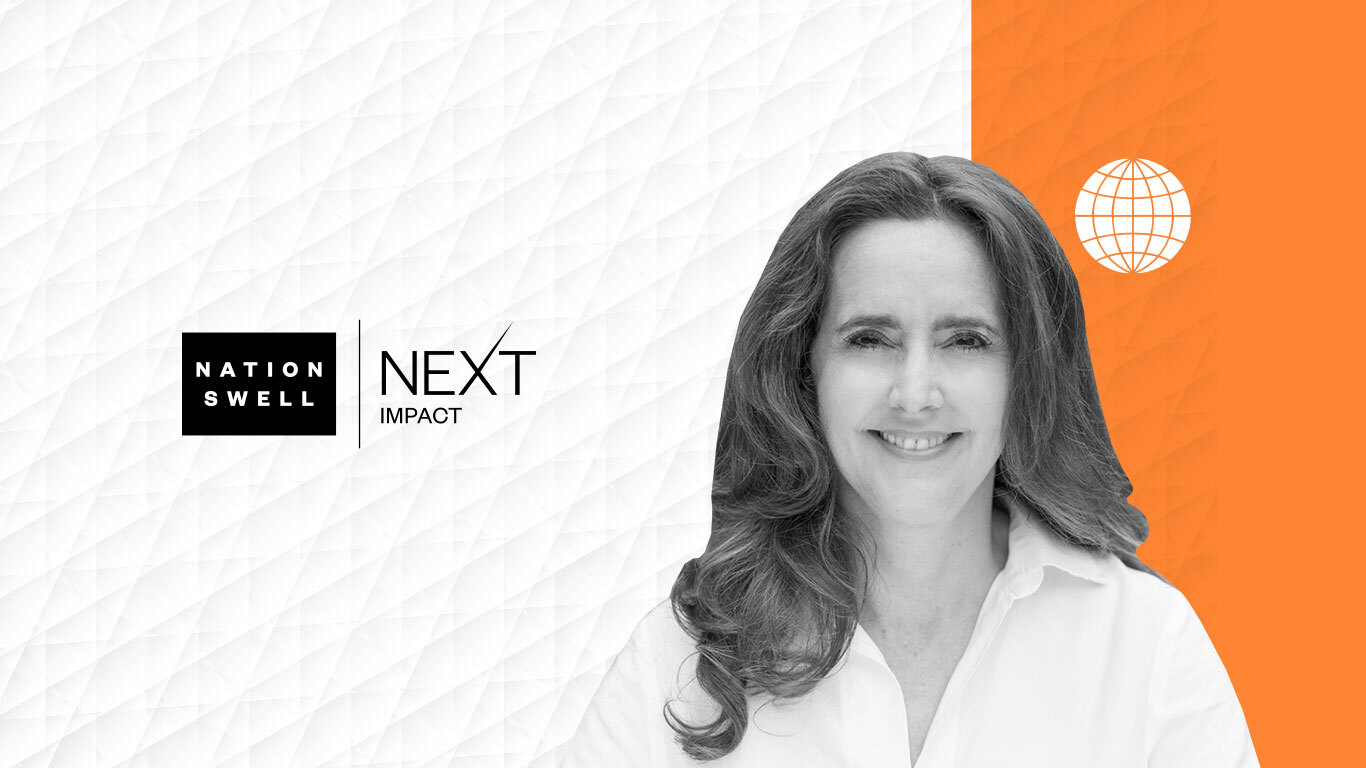
For this installment, NationSwell interviewed Michele Jolin, CEO and Co-Founder of Results for America.
NationSwell: What brought you to the field that you’re in right now? Was there an early moment, a relationship, or an experience that galvanized your commitment to driving bold action?
Michele Jolin, CEO and Co-Founder of Results for America: I grew up in a small town in Wisconsin that was really battered in the 1980s by the decline of manufacturing. A lot of people were losing their jobs, families were out of work — it was a hard time. At the same time, I came from a family of Irish immigrants who deeply loved America, and that shaped me just as much.
There was this incredible optimism in my upbringing about the promise of the American dream. My grandmother met my grandfather on the Fourth of July, married him a year later on the Fourth of July, and even had a ring with a red, white, and blue stone, which I still wear. It sounds a little hokey, but that sense of pride and belief in this country was real and deeply ingrained.
That optimism was paired with a clear-eyed understanding that we could — and should — do better. My mother was always an activist, involved in civil rights and anti-war movements, so there was this constant tension between believing in America’s potential and needing to push America to constantly improve itself to reach its potential, including supporting workers like those in my hometown transition to new jobs. I was growing up in a place where the government wasn’t stepping in the way it needed to — retraining workers, improving education, or creating pathways to new jobs. Seeing that gap early on really shaped how I think about economic mobility and the role systems can play in helping people move forward.
NationSwell: What would you say is the North Star of your current leadership?
Jolin, Results for America: One of our core organizational values is empathy, and that’s very much my North Star. By empathy, I mean truly understanding people’s lived experiences and what motivates them. When you’re trying to drive social change, especially within government, that understanding matters more than anything else. People act for complex reasons, and meaningful change only happens when you design solutions with those realities in mind.
At Results for America, our work is focused on helping government deliver better results and improve economic mobility. We know more than ever about what works — clear pathways that help children born into poverty reach the middle class — yet government hasn’t consistently funded or implemented those solutions. The issue isn’t a lack of intention; most public leaders are deeply mission-driven. It’s the complexity of systems, information overload, and structural barriers that make action difficult.
Our role is to simplify that landscape and remove those barriers. We help governments access proven solutions, learn from peers, and implement change more effectively, then recognize and celebrate progress when it happens. That combination of clarity, peer learning, and recognition is powerful. It reflects our values and how I think about leadership: understand what motivates people, meet them where they are, and create the conditions for sustained impact.
NationSwell: Is there a particular program, signature initiative, or some facet of the work that you would like to spotlight for us that is driving outcomes for the work?
Jolin, Results for America: When we first started Results for America, our focus was at the federal level, shaped by my experience in the Obama administration helping launch the Social Innovation Fund and the White House Office of Social Innovation. The idea was simple: Governments should invest in solutions that work, using evidence and data to guide funding. But when I took that idea to Congress, the response was often resistance. Even though the Social Innovation Fund was small relative to the trillions spent on economic mobility, it was meant to model a better way, and the pushback was deeply frustrating.
That frustration ultimately led me to start Results for America. The goal wasn’t just to fund a program, but to create the conditions where investing in what works became the norm. It’s common sense — and bipartisan — to say government dollars should go toward proven solutions that help kids and families move up. So we set out to remove the barriers that prevented governments from acting that way.
We began at the federal level, then expanded to cities with support from Bloomberg Philanthropies through What Works Cities, and later to states. Across all levels, we focus on the funding lever — budgets, grants, and procurement — because that’s where real change happens. By embedding evidence and outcome requirements into those processes, we help dollars flow to what works. Over time, we also realized governments needed help finding and implementing proven solutions, so we built tools like our Economic Mobility Catalog and Solution Sprints to pair funding with action. That combination — funding, solutions, and peer learning — is what now drives our impact.
NationSwell: What’s defining the current social and economic environment that we’re in — what are the trends that you’re currently seeing, and what’s giving you hope?
Jolin, Results for America: One of the most notable dynamics right now is the renewed focus on government efficiency, effectiveness, and state capacity. This isn’t new or partisan — spending public dollars more effectively has always resonated across red, blue, and purple states — but recent attention, including the DOGE moment, has put a sharper spotlight on the question of how government actually improves performance. Even as that moment fades, the underlying question remains: what truly works to fix government?
We’re part of a broader field tackling that challenge, alongside organizations like Code for America, the Government Performance Lab, and Work for America. What’s exciting is the growing momentum across this ecosystem. Where we play a distinct role is by starting with results and outcomes first, and then working backward to the “plumbing” of government — budgets, grants, procurement, and systems. That results-first approach is critical. Some leaders are motivated by efficiency alone, but many, especially elected officials, are driven by outcomes like cutting child poverty or improving economic mobility. We meet them there and then help translate those goals into smarter funding and proven solutions.
That focus feels especially important at this moment, as local governments face tightening budgets and growing pressure from affordability crises, workforce disruption, and rapid technological change. Resources will be more constrained, not less. Our role is to help governments do better with what they have — to become stronger problem-solvers, more adaptive, and more capable of delivering results despite volatility. The next decade will demand that kind of capacity, and that’s where we’re focused.
NationSwell: What is unique or differentiated about the approach that you’re taking? Can you walk us through what excites you most about the work that you’re leading?
Jolin, Results for America: I think it’s worth reiterating that funding is a powerful lever — something governments can actually shape — but it works best when it’s paired with information about solutions that’s easier to access and stronger support for implementation. That’s something we’ve learned over time through testing and piloting, and our reach is big: we work with 350 local governments, in 48 states, at the federal level, and with both Republicans and Democrats.
Another learning is that partnering with community organizations — especially place-based partnerships — can speed government delivery and results. Over the last five years, we’ve worked much more closely with networks like StriveTogether, the William Julius Wilson Institute, Purpose Built Communities, Partners for Rural Impact, and others. When a community is already aligned around outcomes, it can help drive faster uptake of solutions and faster results for residents. That’s something I see us leaning into even more over the next decade.
One example is in Dallas, where we worked with the city alongside the Commit Partnership (part of the Strive network) and CPAL (Children’s Poverty Action Lab). We identified an agency that funds many of the social service programs tied to key outcomes, but it wasn’t transparent what was being funded or how much of it was evidence-based. So we helped create an inventory of what they’re funding, what has evidence behind it, and where the gaps are — so leaders can make better decisions. We also worked to incorporate language into city processes that encourages funding programs with an evidence base. It’s a two-part approach: transparency about what’s happening, and incentives to fund what works.
NationSwell: Of the socially motivated leaders you consider your peers, who are 2-3 whose work inspired you and whom you hold in high esteem?
Jolin, Results for America: The first is Janet Yellen. I was her chief of staff at the Council of Economic Advisers during the Clinton administration, and I’ve worked closely with her over the years, including helping her stand up the Treasury Department when she became Secretary. She leads with a deep commitment to excellence, rigor, and evidence. The CEA is essentially the White House’s internal think tank, and that experience — grounding policy decisions in what actually works, whether on climate, welfare reform, or economic policy — was incredibly formative for me. She’s also been a pathbreaking woman in a deeply male-dominated field, and her courage, discipline, and integrity have inspired generations of leaders.
Another major influence is Bill Drayton, the founder of Ashoka. After leaving the Clinton administration, I worked there and saw firsthand how he built a global network of social entrepreneurs — people applying entrepreneurial thinking to social problems with extraordinary impact. What struck me was how universal that spirit is: you see it in India, Kenya, Germany, Colombia. Working with Bill helped crystallize the idea that innovation and entrepreneurship are just as powerful in the social sector as they are in the private sector, and that locally rooted solutions can drive change at scale.
The third is Rosanne Haggerty, who leads Community Solutions. Her work on homelessness — especially the concept of “functional zero,” where communities know exactly who is unhoused and can move people quickly into housing — has deeply influenced my thinking. It gets to the root of what results-driven government looks like: building the systems, habits, and problem-solving capacity to respond effectively to whatever challenge comes next. That mindset — helping governments build durable capacity to solve problems again and again — is exactly what excites me about the work we do today.
NationSwell: Are there any resources you’d recommend — books, podcasts, Ted talks — that have influenced your thinking that might influence others as well?
Jolin, Results for America: My go-to podcasts are Masters of Scale and Possible. I love how optimistic they are, and how practical they are about building organizations, shaping culture, and making big things happen at scale. There’s always something in there that sparks a new way of thinking.
Books are a huge part of my life — I read constantly. The Color of Law by Richard Rothstein and The Warmth of Other Suns by Isabel Wilkerson were especially formative for me. Both trace how government policies — sometimes intentionally, sometimes not — have created and reinforced racial disparities. They make clear that reducing inequality requires changing the “plumbing” of government: how laws are written, applied, and administered.
Another book that really stayed with me is Evicted by Matthew Desmond. Set in Wisconsin, it powerfully shows how housing policy and government systems leave families — especially children — extraordinarily vulnerable to displacement. That book deeply influenced how I think about fairness in government processes, and it makes me especially proud that Results for America is actively working with governments to adopt solutions that prevent displacement and improve housing stability.