 "
"
At a moment of turmoil, who is advancing the vanguard of economic and social progress to bolster under-served communities? Whose work is fostering growth that ensures every individual thrives? Who will set the ambitious standards that mobilize whole industries, challenging their peers to reach new altitudes of social impact?
In 2025, Impact Next — an editorial flagship series from NationSwell — will spotlight the standard-bearing corporate social responsibility and impact leaders, entrepreneurs, experts, and philanthropists whose catalytic work has the potential to shape the landscape of progress amid urgent need for social and economic action.
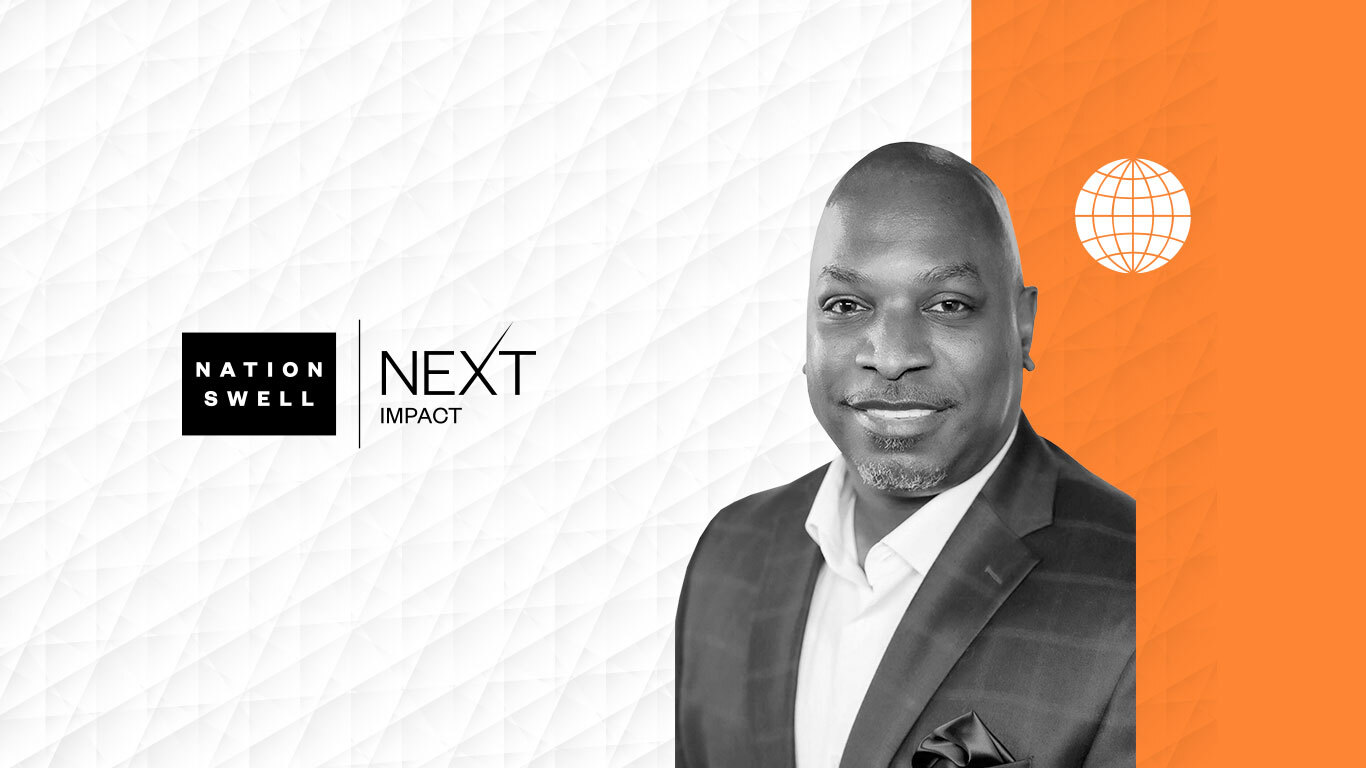
For this installment, NationSwell interviewed C.D. Glin, President of the PepsiCo Foundation and Global Head of Social Impact for PepsiCo.
NationSwell: What brought you to the role that you’re in right now? Was there a moment, a relationship, or an experience that galvanized your commitment to driving bold action?
C. D. Glin, President, PepsiCo Foundation: My journey really began in service. My dad spent nearly 30 years in the Air Force, my mom had a degree in social work, and I grew up with five siblings on military bases around the world — England, Italy, the Azores, Portugal. Service to family, community, and country was in our DNA.
The true inflection point for me came as a member of the first group of Peace Corps volunteers in South Africa. This was during the historic Presidency of Nelson Mandela. That experience shaped my worldview, teaching me humility, the power of proximity, and the importance of community-led solutions. Since then, whether in philanthropy, government, or now leading social impact and philanthropy at PepsiCo, I’ve been guided by the belief that everyone deserves the opportunity to thrive and that giving your time, talent, and resources is essential.
Achievement of goals big or small, most often occurs through participation — being a part of the change — through partnership, collaborating with others, and through purpose-driven leadership. These are principles I first learned not in a classroom or from a book, but while living in a South African village as a Peace Corps volunteer nearly 30 years ago.
NationSwell: What makes you a successful impact leader? What approaches, beliefs, and practices would you say are the hallmark of your leadership style?
Glin, PepsiCo Foundation: Looking back on my career, my leadership has evolved from direct service — being on the ground, listening, observing, learning and responding — to focusing on systems change and root-cause solutions. Today, I lead with a mindset of collective action for collective impact, wherein philanthropy, business, policy and community participation are aligned to help drive scalable, sustainable change. My style has become more collaborative, data-informed, and always rooted in empathy, equity and inclusion of those with lived experiences.
For me, empathy plus action is caring, and true caring means putting yourself in someone else’s situation and then doing something about it. That philosophy of “don’t just talk about it, be about it” has been central to how I lead and how I serve. Combined with collaboration and data, it has shaped my ability to contribute to durable, positive, lasting change.
This emphasis on collective impact is also front of mind for our Social Impact team at Pepsico. At this year’s Summit, themed Together and Advance, we released an insights report highlighting models, case studies, and best practices for building stronger partnerships. The field is full of enthusiasm for collaboration, but there’s still a gap between intention and effective execution. Our goal is to equip and inspire others with actionable tools to close that gap and to reinforce the idea that we are stronger together.
NationSwell: Are there any facets of your work or leadership that you feel are particularly differentiated that you’d like to lift up?
Glin, PepsiCo Foundation: At PepsiCo, we’ve honed in on our approach to social impact. As the largest U.S. food and beverage company, we believe we have a responsibility and an opportunity to help our communities thrive and be a force for good. Our strategy, PepsiCo Positive, positions social impact — the totality of the positive contributions we make with and for people and communities — not as a side initiative but as an enterprise-wide commitment embedded across our brands, supply chains, and global workforce.
Our framework focuses on access and advancement: helping ensure greater access to essentials like food and safe water, and then seeking to leverage that access to catalyze social and economic advancement, creating opportunities for education, jobs and increased income. As a food and beverage company rooted in agriculture, we’re especially focused on food access solutions and farming. Programs like our Food for Good social enterprise, which sources, packs, and delivers meals to children and families in need after school, on weekends, and during the summer, address hunger locally. Separately, the She Feeds the World program, in partnership with CARE, invests in smallholder farmers who make up the backbone of global food systems. These initiatives allow us to meet people where they are, rather than suggest solutions from afar.
What makes this work powerful is its integration with PepsiCo’s core capabilities: how we grow, source, manufacture, transport, distribute, market and sell food and beverages; how our brands show up in the world; how we engage over 300,000 associates globally; and how we drive supply chain decisions, from regenerative agriculture to diverse sourcing. For me, leading social impact at PepsiCo is both pressure and privilege. The needs of communities where we live, operate and serve are immense, but the opportunity to align business growth with meaningful, scalable change — and to prove that business can be a positive force in creating thriving communities — is what drives me every day.
NationSwell: How are you making sense of this moment — what are the challenges and opportunities you’re seeing?
Glin, PepsiCo Foundation: Right now, I find myself doing a lot more listening. I’m trying to lean into curiosity and appreciative inquiry — being a guide on the side rather than a sage on the stage. The past five years have demanded constant response, whether to the pandemic, economic shocks, or injustice.
Part of that reflection is recognizing that the challenges we face are deeply interconnected, and fatigue from being “always on” is real. I don’t believe today’s problems can be solved with yesterday’s approaches. We’ve long talked about the importance of local leadership, but now it’s a necessity. Too often, solutions are designed far from the communities they aim to serve. At PepsiCo and the PepsiCo Foundation, we’ve emphasized community-rooted partnerships, and I’m centering my own listening on local voices — whether that’s farmers in Egypt, food-insecure families in the U.S., or communities needing access to safe water in Mexico.
The noise at the top can be distracting. Real impact happens closest to the challenges, so I’m choosing to listen, learn, and to be led by those at the local level. That’s where meaningful change must begin.
NationSwell: Of the socially motivated leaders you consider your peers, who are 2-3 whose work has inspired you and whom you hold in high esteem?
Glin, PepsiCo Foundation: Three leaders come to mind, and the first is Darren Walker. I’ve looked to his example at nearly every stage of my career, from his time at Abyssinian Development Corporation and the Rockefeller Foundation, where I first met him, to his bold, transformational leadership at the Ford Foundation. What I admire most is his unapologetic stance on equity, systems change, and social justice, paired with the humility of leading in service to others. Over the past few years, I’ve also had the opportunity to engage with him in new ways as he served on PepsiCo’s board, bringing a philanthropic mindset that resonates deeply in corporate spaces.
The second is Helene Gayle. Helene’s career spans medicine, global health, development, philanthropy, corporate boards, and most recently higher education leadership. What she embodies for me is multi-disciplinary leadership — the ability to connect gender, health, business, philanthropy, and education in ways that are both rigorous and inclusive. Where Darren’s example has been about passion and boldness, Helene’s has been about perspective and breadth, showing how multiple disciplines can come together in service of lasting change.
And finally, Graham Macmillan, now at the Visa Foundation. Our career paths have overlapped in private philanthropy and corporate social impact, and I admire the thoughtfulness and generosity he brings to this moment. Graham consistently pushes corporate foundations and those who support the sector toward collaboration rather than competition, encouraging leaders and organizations to focus on collective impact. He brings expertise, intellect and humility to every conversation, and his journey has been a personal reminder of what it means to carry your values across institutions while helping the field grow stronger together.
NationSwell: Are there any resources you’d recommend — books, podcasts, Ted talks — that have influenced your thinking that might influence others as well?
Glin, PepsiCo Foundation: Three books come to mind right away. The first is The Alchemist. I don’t think you can reread it enough, especially in moments of transition. For me, it’s a reminder that life is purpose-driven — that even when things feel tough, the universe is conspiring to put me in situations where I can grow and do more. It grounds me whenever I need perspective.
The second is Keith Ferrazzi’s Never Eat Alone. This book reframed my entire approach to relationships. Ferrazzi’s philosophy — that generosity, consistency, and meaningful connection are the true engines of success — has stayed with me. It taught me that none of us advances alone, that leadership is as much about investing in others as it is about delivering results. Whenever I get buried in work or am slow to respond, I remind myself of that core truth: relationships require attention, presence, and the humility to let others support you as much as you support them.
And the last one is The Autobiography of Malcolm X. To me, it’s one of the greatest stories of transformation ever told. Malcolm’s journey — from Malcolm Little to Malcolm X to El-Hajj Malik El Shabazz — reveals that reinvention isn’t just possible; it’s essential. His life story shows what it’s like to expand your thinking, deepen your convictions, and evolve your purpose. In my career, I’ve crossed industries, sectors and roles many times, and his story reminds me that what got me here won’t necessarily get me there. Growth demands courage, curiosity, and a willingness to become something new. That’s a lesson I carry with me every day.