
2023 Private Sector Social Impact and Sustainability Leadership Survey

2023 Private Sector Social Impact and Sustainability Leadership Survey

SURVEY FINDINGS

2023 brought social impact and sustainability work further into the social, political, and organizational spotlight, and presented leaders with distinct, long-term considerations for their work. Leaders encountered large-scale, composite challenges: the escalation of the anti-ESG movement; the Supreme Court’s ruling against affirmative action and its subsequent implications for diversity, equity, inclusion, and belonging (DEIB); the effects of an increasingly restrictive macroeconomic environment on teams and priorities; and the intensification of regulatory requirements. At the same time, social impact work has matured and deepened, with leaders investing heavily in employee engagement, leaning in on sustainability strategies, cautiously adopting AI, and empowering communities through trust-based and place-based work.

Against this backdrop, NationSwell set out to investigate what forces were most significant in changing the way leaders approached their priorities and decision-making over the past year, and what leaders anticipate about the environment, their organizations, and their jobs in the year to come. Between July and August 2023 we surveyed 74 corporate social impact and sustainability leaders across NationSwell’s membership community and beyond. The resulting report explores the direct opinions and experiences of those leaders, in service to advancing collective knowledge about their essential roles.

Below is a summary of the key findings discussed in greater detail in the report:

Theme 1: Leaders’ confidence takes a hit among a difficult year for impact work

  • Leaders’ satisfaction with their organizations’ social impact is waning marginally amid an increasingly challenging environment.
  • With trepidation about the year ahead, leaders’ confidence in their own work is also dwindling.

Theme 2: Economic and regulatory activity assert their dominance above other forces 

  • Two of 2023’s trending issues – the politicization of ESG and the emergence of generative AI – have not transformed social impact and sustainability strategies. 
  • Instead, macroeconomic conditions had widespread and deep impacts highlighted by layoffs, budget cuts, and new barriers to collaboration.
  • Over the next year, leaders predict that economic conditions and regulatory/legislative activity will be key factors in their prioritization and decision-making.
  • In recognition of their growing need, and in spite of economic uncertainty, leaders will advocate for more funding for social impact and sustainability work in the year ahead.

Theme 3: Influence is leaders’ most sought-after and valued currency 

  • Leaders respond most to the influence of their executive team, and want to wield their own influence in return.
  • Leaders are intent on improving their strategies and capabilities to engage with internal stakeholders.

Share this report

How Johnson & Johnson is Accelerating a Health Equity Mindset: the Business Match Fund

How Johnson & Johnson is Accelerating a Health Equity Mindset: the Business Match Fund

In the U.S., health disparities for people of color relative to White individuals include higher rates of illness and death and less access to quality care. In response to longstanding and systemic healthcare inequities, Johnson & Johnson (“J&J”) launched its “Our Race to Health Equity” initiative (“ORTHE”) in November 2020. The bold under-taking “aspires to help eradicate racial and social injustice as a public health threat by eliminating health inequities for people of color” with a $100 million commitment over five years.

The company will invest half of ORTHE’s $100 million through external grants, programs, and initiatives by 2025. To embed a health equity mindset into J&J’s everyday business practice and strategy, J&J has also committed to driving change from within their large enterprise, allocating $50 million over five years to a Business Match Fund (“BMF”). The BMF is an incubator and catalyst for alignment at all levels of J&J by providing dollar-for-dollar co-investment alongside business units seeking to advance a health equity-oriented initiative in the United States. 

This case study details how Johnson & Johnson designed and executed the Business Match Fund to accelerate the adoption of a health equity focus across its divisions and, consequently, to seed large-scale organizational change. Their approach includes five core elements, explored further in the report:

  1. Design a funding approach that promotes innovation, long-term thinking, and engagement
  2. Use a varied toolkit to invite applications from across the enterprise
  3. Administer a layered and inclusive review process to select fund recipients
  4. Track impact centrally and regularly, leaving room for flexibility
  5. Tell the story of catalyzed impact internally and externally

Share this report

Mapping the LER Ecosystem to Drive Equity

Mapping the LER Ecosystem to Drive Equity

CASE STUDIES

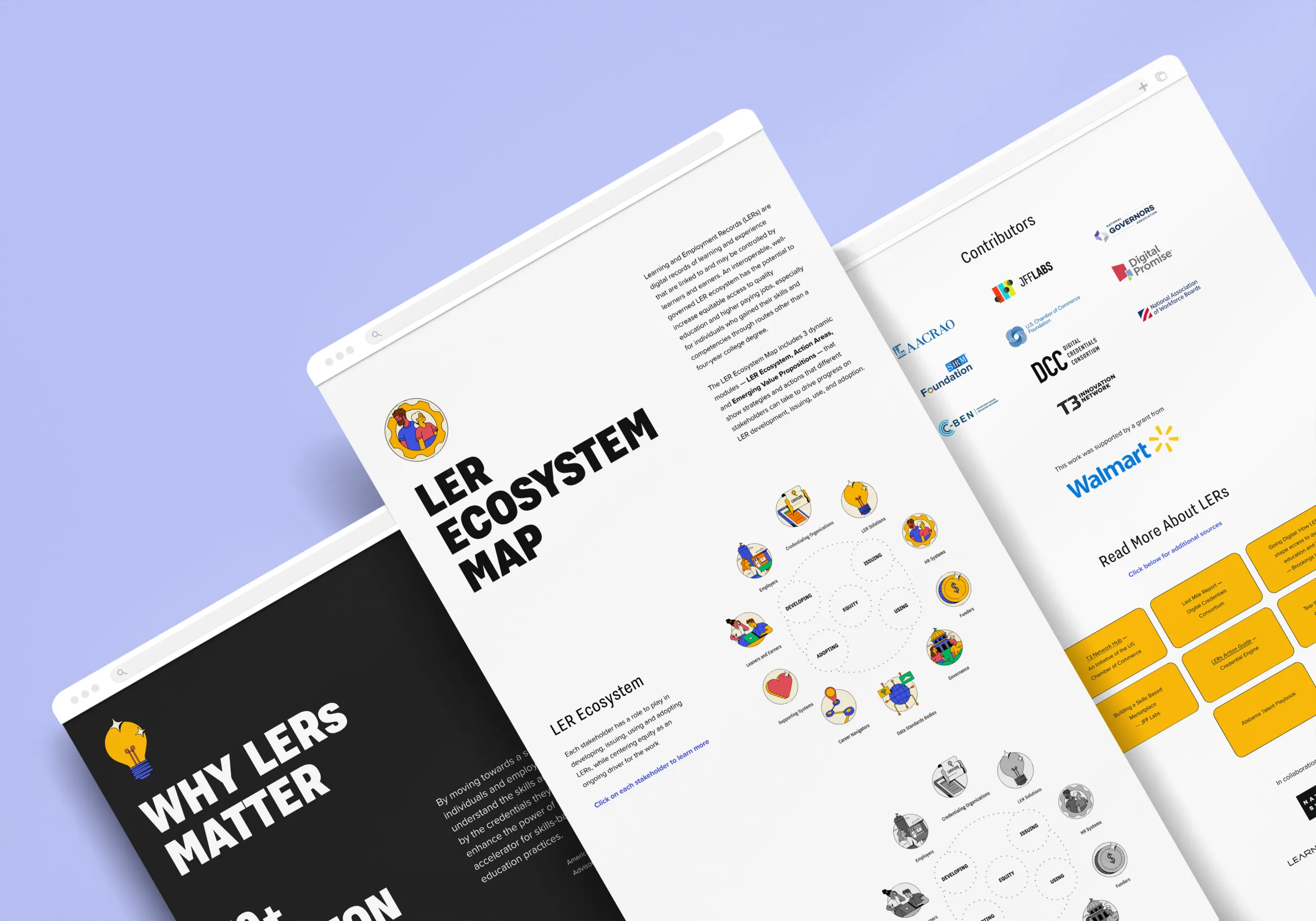
Learning and employment records (LERs) are a vital solution to accelerating the uptake of skills-based hiring while empowering learners and earners to be recognized for their full set of skills from work, education, credentialing, service and life experiences. However, widespread use of LERs is often hindered by a lack of clarity and collaboration amongst the many necessary stakeholders, including employers, credential providers, learners and earners, and policy makers.

Therefore, Walmart brought NationSwell on to work with a Steering Committee of experts in the education, credentialing, equity and hiring space, to create an LER Ecosystem Map that would help people connect the dots across the ecosystem and more easily see how they can take action to drive equity through LERs.

Organizations in the LER Ecosystem Map Steering Committee:

  • AACRAO
  • Competency-Based Education Network
  • Digital Credentials Consortium
  • Digital Promise
  • JFFLabs
  • National Association of Workforce Boards
  • National Governors Association
  • SHRM Foundation
  • T3 Innovation Network
  • U.S. Chamber of Commerce Foundation

NationSwell worked closely with the Steering Committee to undertake thorough research to establish the goals and needs for the LER Ecosystem Map.

Through desk research, in-depth interviews, a diverse focus group, workshops, and months of cross-team collaboration, content drafting, design work and data visualization, our teams engaged 50+ individuals to help develop an interactive digital experience, accessible to stakeholders across the ecosystem, that clearly demonstrates opportunities for engagement, collaboration and action.

Through our three workstreams — establishing a hypothesis, research and development — the team discovered learnings, opportunities to drive adoption, and insights gaps that informed how the LER Ecosystem Map should come to life. The map launched at a pivotal point in LER development, providing many large and small players in the space with vital clarity on how to take action.


Share this report

Corporate engagement with HBCUs

Corporate engagement with HBCUs

The Supreme Court’s 2023 decision to strike down affirmative action in higher education may result in decreased racial diversity at public and private colleges, making the role of historically Black colleges and universities (HBCUs) even more vital in advancing opportunities for students of color. Their impact today is essential, and applications for enrollment are increasing, yet HBCU funding is lacking in comparison with other higher education institutions. 

In response to member interest, NationSwell reviewed the available data on HBCU funding levels (historical and current), their benefits to individuals and communities, and the most common forms of partnership between companies and schools. We’re pleased to share a summary of what we learned in the hopes that it helps our member organizations better understand their opportunity to support HBCUs.


Share this report

Skilling the future workforce: 8 recs for corporate leaders

Skilling the future workforce: 8 recs for corporate leaders

EXECUTIVE BRIEFING

Private sector engagement with skills-based hiring is increasing in response to employment gaps and escalating economic precarity. Between 2017 and 2019, 46% of middle-skill and 31% of high-skill occupations experienced material degree resets. And in 2022, 79% of HR professionals reported that scores on skills assessments are just as or more important than traditional criteria in hiring decisions.

These are positive trends from an economic and a social perspective. Skills-based hiring is critical to increasing equity and diversity in the workplace, as traditional credential-based hiring tends to screen out, disqualify, or exclude applicants without a four year degree.

While increased commitment to skills-based hiring is an important step toward a more prepared and more inclusive workforce, many companies are learning that in-demand skills do not exist in adequate supply. Some of those businesses are taking it upon themselves to develop the skill-based talent pipeline that will be necessary to power their organizations, industries, and broader market into the future.

To better understand how companies are investing in the skills-based training ecosystem, before hiring even comes into frame, we dug deep with nine organizations on the cutting edge of workforce development.

Through our conversations with leaders and practitioners, we uncovered a depth of contributions to changing and scaling the learning systems that are preparing workers for quality jobs. Our report compiles eight recommendations to provide guidance for private sector employers who are committed to skilling the future workforce and ultimately contributing meaningfully to a more just and equitable workplace. 

The eight recommendations:


  • Decide if you aim to be influential at a systems, sector, or company level
  • Position your strategy correctly within your company’s infrastructure
  • Lean into (and use) your company’s strengths
  • Build a well-balanced partner portfolio
  • Design for replicability and scalability
  • Mind the non-skills gap between learner and earner
  • Engage in pre-competitive transparency and collaboration
  • Bring rigor and patience to impact measurement

Share this report

The state of play: Corporate sustainability

The state of play: Corporate sustainability

TREND REPORT

As climate change creates a growing risk to companies’ financial stability, sustainability programs offer a competitive advantage for businesses across size and sector. Those who are ahead of the curve are making bold commitments, deepening expertise, collaborating effectively, and greening their workforces. The most resolute business leaders will continue to push forward their strategies against political backlash. For them, it is a moment of opportunity not hesitancy. 

In this report, we help leaders get up to speed and check their progress against the latest macro trends, policy and regulatory developments (U.S. and E.U.), and pace-setting organizations.

The trends: 

  • Corporate climate commitments and leadership accountability are on the rise. But the rate of progress remains well behind what’s needed to achieve 2050 goals. 
  • Political and legislative activity are creating cross-pressures on sustainability work. But stakeholder activism remains a strong tailwind. 
  • New innovations and collaborations reflect a growing supply chain playbook. Companies know that Scope 3 impact cannot be ignored. 
  • Jobs–both existing and new–are becoming greener. Employers and workers are both driving the transition. 
  • Water and biodiversity are making big moves toward the center of corporate interest. Pending emissions disclosure rules remain top of mind.

Share this report

Seven critical design choices for corporate impact investors

Seven critical design choices for corporate impact investors

EXECUTIVE BRIEFING

As the global impact investing market surpasses $1 trillion USD, a small yet growing number of companies are adopting the strategy.

Corporate impact investors are motivated by the limitations of traditional philanthropy to fundamentally alter the structural disadvantages of capital markets, the desire to diversify their social impact strategies, the proven possibility of competitive financial returns, and intensifying pressure on the private sector to help finance the UN Sustainable Development Goals (SDGs).

Regardless of their motivation, what these enterprising companies are discovering is a world of opportunity and constraint, one that requires intentionality and conviction when designing an impact investing approach that best serves the organization and its goals.

To support the aspirations of would-be and nascent corporate impact investors, NationSwell went behind the curtain with four successful and well-established leaders in the space. We dug deep into their investment philosophies, models, and mechanics with the intent to pinpoint the most fundamental design choices that determine a program’s shape and direction.

This report summarizes our learnings from these four investors, organized around a short but load-bearing list of questions that any new corporate impact investor will need to resolve with clarity. Each question is followed by further explanation of its significance, illustrations of how the four model organizations answered it for their own purposes, and additional guidance from NationSwell on how to approach the choices at hand.

The seven fundamental design choices:

  • What is your impact investment thesis and how does it align with company priorities?
  • Where do your investments originate within the enterprise?
  • Are you investing directly in companies or indirectly through funds and intermediaries?
  • How are you reaching beyond traditional networks to source investment leads?
  • Who should be at the table when making investment decisions in order to optimize for efficacy and efficiency?
  • What will be your level of involvement with investments after cutting a check?
  • How will you measure and report the impact made through your investments?

Share this report

Commercial products deployed for social good

Commercial products deployed for social good

CURATED COLLECTION

This Curated Collection explores a range of ways that companies are creating or repurposing products in service to their social impact strategies. It includes a non-exhaustive selection of representative and innovative examples of impact-oriented products, organized in categories based on how they are used.

The collection includes the following categories: 

  • Products used for fundraising 
  • Product grant programs 
  • Sustainable product; 
  • Special initiative products

Share this report