At a moment of unprecedented attention, investment and opportunity for the emerging field of ESG, leaders are asking: Who is best preparing their organization for the society of the future? Who is innovating today to meet decades-long environmental and social goals? Who is setting standards that catalyze their industry’s change for the better? Who is defining what bold and aspirational look like — and how best to advance that work in practice?
Enter NationSwell’s ESG Next, an exemplary group of investors, executives, authors, philanthropists, social sector leaders, academics, and field builders who are helping to shape business as a force for social and environmental progress, advancing — and even pioneering — the most forward-thinking and effective programs, initiatives, technologies, methodologies, practices, and approaches.
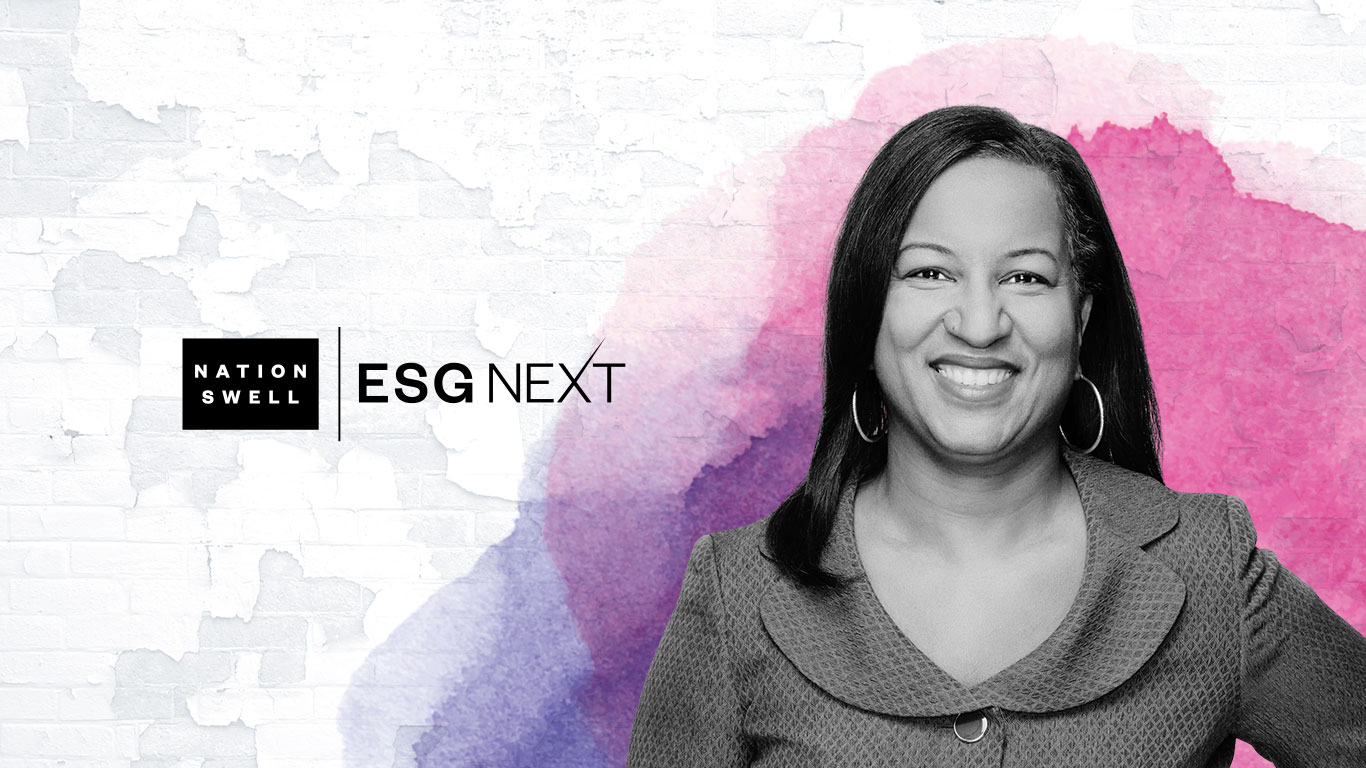
For this installment, NationSwell interviewed Justina Nixon-Saintil, Vice President and Chief Impact Officer at IBM, about why passion and partnership are paramount to an ESG leader’s success, why engineering and corporate social responsibility work go hand-in-hand, and why the future of ESG might just be its “S.”
Greg Behrman, NationSwell CEO + Founder: Tell us about your personal and professional journey, and how it led you to ESG work.
Justina Nixon-Saintil, Vice President and Chief Impact Officer, IBM: If you told me 30 years ago when I was studying to be an engineer that I would be working on corporate social responsibility and ESG, I would not have connected the dots to see how that could be possible. My focus then was on getting a job in engineering that would let me take care of myself. I’m an immigrant from Dominica who came to the South Bronx, an area that has been challenged by its high crime rate. My mom is an educator, and she really pushed the idea that education is the way out of poverty — how we become successful, here and anywhere.
But when you think about it, what engineers actually do is solve some of the biggest problems in the world. I always loved taking things apart and putting them back together just to see how different pieces could fit, and how things worked on the inside. And in that sense, my education in engineering is directly connected to where I am and what I do today.
Behrman, NationSwell: How do you think about this moment in ESG?
Nixon-Saintil, IBM: There’s such a sense of urgency right now. When you think about how quickly technology is advancing, when you think about climate change and the urgency around it, when you think about the pandemic and its global impact, you realize this unprecedented urgency is driving everyone to figure out how you move from theory to scaling, and reaching the masses — because these pressures are impacting so many people.
You have marginalized populations who are being left behind. You have vulnerable communities who are being impacted by climate change. You have diverse subsets of the population who are still underrepresented in tech and other well-paying fields. And everyone is coming together now to say, this is not something any one company or any one entity can do alone.
I remember going to meetings a long time ago where we would always start by identifying the problem we were trying to solve, and I would sit there and think, “We already know the problem.” It would frustrate me. What’s different about this current moment is you don’t have conversations like that anymore. It’s not a discussion about what the problem might be, it’s a move to determine how we scale and invest and actually solve the problems that we know exist.
Behrman, NationSwell: Where do you see the field going next, and what’s driving that shift?
Nixon-Saintil, IBM: I just read that almost half of Fortune 500 companies have made an aggressive commitment to reach carbon neutrality in the near future. And it made me think, what does a commitment like that look like for the S in ESG?
I think you’re going to start seeing a lot more excitement and focus on social factors like human capital management. We’ll still talk about the E and the G, but when we do, we’ll approach it from a way that always straddles the S — like the just transition, or how companies are thinking about the vulnerable communities they impact as part of their net zero commitments.
But along with this excitement, there’s anxiety. So many business leaders are waiting to know more about how we’ll be regulated. A lot of ESG reporting up until this point has been voluntary — ours at IBM has. But we know mandatories are coming, and more will come, and everyone is waiting to see what will be expected of us. I don’t think anything will come as a surprise — especially if you’ve been doing work like this for a while — but I do think we all want to know more about the shape of the landscape.
And where there’s anxiety and excitement, there’s opportunity. Companies and organizations that are thinking through this are looking to us to help solve challenges with them, and we’re excited to partner.
Behrman, NationSwell: Can you tell us about some initiatives at IBM that are exemplars of your approach?
Nixon-Saintil, IBM: When I started at IBM, there was so much goodness across the company. There were so many things we were doing in the environmental space, in the social space, in the governance space, but at the time, there wasn’t a comprehensive way of communicating this work and making sure that we brought even more awareness to it.
In 2022, we launched our ESG strategy, a framework called IBM Impact. And that was a new initiative for us as a business. I’ve been really proud of this because when you just talk — whether it’s external to investors, internal to your team or to clients — it’s really easy to talk about our framework, our ten commitments that are exemplars that we are going to continue to demonstrate progress against, and it really leads to further conversations, because it’s so much easier to understand how it all fits together.
I also lead our IBM Sustainability Accelerator, a new initiative my team launched in 2022 that leverages the solutions, software, and expertise of our business around data, and the environmental intelligence suite around our hybrid cloud, and how we bring those solutions and software to non-profit organizations in order to support vulnerable communities that are most impacted by climate change. So we are really excited about the work that we’re doing in the sustainability space.
The last initiative I want to highlight is the IBM SkillsBuild. Last year, we made a commitment to skill 30 million people by 2030, a huge and ambitious commitment. I felt we needed a north star as a company, because we’ve been a leader in the work that we’ve done around education, skills, badging, and credentials — 50% of our job postings do not require applicants to have a four year degree requirement, a barrier that has left so many populations struggling to find employment opportunities.
When we looked at all of the work we’re doing across the board, I felt like we could make a significant commitment to skill 30 million people globally. And in fact, last year we we reached around 3.5 million people. It’s just something we can do only with partnerships on the ground, with non-profit organizations, with academic institutions that are closest to the people that we want to impact. So I’m just really excited about those three things.
Behrman, NationSwell: How do you approach social impact and sustainability work? What distinguishes or differentiates you from some of your peers?
Nixon-Saintil, IBM: First, there’s my passion; it’s a must in a role like mine. The most successful people who drive this work are those who are passionate about how business can solve issues like these. The second thing is, I approach this from the point of view that these problems are solvable through your strategy, which means you have to understand how your company makes money and does business.
Behrman, NationSwell: Can you tell us about some leaders whose work you really admire?
Nixon-Saintil, IBM: I came to IBM under CEO Arvind Krishna’s leadership, and I’ve been impressed with his focused and thoughtful leadership. And that way of thinking has permeated through the whole company. I would say another person is Rose Stuckey Kirk, Chief Corporate Responsibility Officer at Verizon. I learned so much from her about how to “walk the halls” to get the alignment on the things you want to create and move forward, and how to communicate impact so people can understand what you’re doing in a clear and transparent way.
To learn more about how our ESG Next honorees are shaping business as a force for social and environmental good, visit the series hub. IBM is a NationSwell Institutional Member. To learn more about membership in NationSwell’s community of leading social impact and sustainability practitioners, visit our site.