This fall, NationSwell launches its first immersive experience on October 18 and 19 in Tulsa, Oklahoma for Place-Based Impact in Practice: An Immersive Experience to Explore Community-Centered Funding and Action. Hosted by George Kaiser Family Foundation (GKFF) as part of our recently launched Place-Based Impact Collaborative, this hands-on event will take place over the course of one and a half days and will allow attendees to explore on-the-ground examples and innovative strategies to foster thriving and inclusive communities, particularly in fast-growing cities and rural areas. We’d love for you to join us.
But, you may be thinking, why Tulsa?
Since its establishment in 1999, George Kaiser Family Foundation has held, as its primary philanthropic goal, cementing Tulsa, Oklahoma, as a vibrant, inclusive, and prosperous environment where children and families can flourish.
As the primary supporting organization of the Tulsa Community Foundation, GKFF funds organizations and efforts that directly service the greater Tulsa area, all while adhering to its guiding principle, “no child is responsible for the circumstances of [their] own birth.” Foundation investments include robust early childhood education initiatives that serve approximately 2,000 children in year-round education and care; over $100 million earmarked for the arts; economic development initiatives to attract and retain local businesses and talent as well as transform 100 acres of Tulsa’s iconic riverfront into a dynamic and world-class centralized park; neighborhood programs to foster a strong sense of community; and a work stipend program that has welcomed more than 2,500 diverse professionals to the city.
GKFF harnesses a nimble, entrepreneurial spirit, which has helped to adeptly address community needs. Their approach is holistic and community-centered and driven–designed to lead with the community’s needs so that children and families in Tulsa can thrive. What sets their investment strategy apart from other philanthropic models is that it’s not only nuanced, but multi-pronged–touching almost every part of the Tulsa ecosystem. Parent engagement and early childhood education, health and family well-being, civic enhancement, and breaking the cycle of intergenerational poverty are all vital pillars of community prosperity.
George Kaiser Family Foundation’s holistic approach
In order to create and maintain the conditions for a thriving local community, GKFF has taken a holistic, all-encompassing approach to funding that sees early childhood education; health and wellbeing; neighborhood development; thriving public spaces; criminal justice; housing; and arts & culture as vital pillars of economic prosperity. During an onsite visit in March 2023, NationSwell got a firsthand look at how these key initiatives operate on the ground in Tulsa; below are some of the highlights we observed.
- Parent Engagement and Early Childhood Education
GKFF provides support and resources to young Tulsa families to encourage parent‐child engagement and interaction. Through initiatives like Tulsa Educare and Early Learning Works, families and children are encouraged to pursue skill-building opportunities and early learning workshops, and are given the chance to connect with community and faith-based organizations that help to promote literacy and learning.
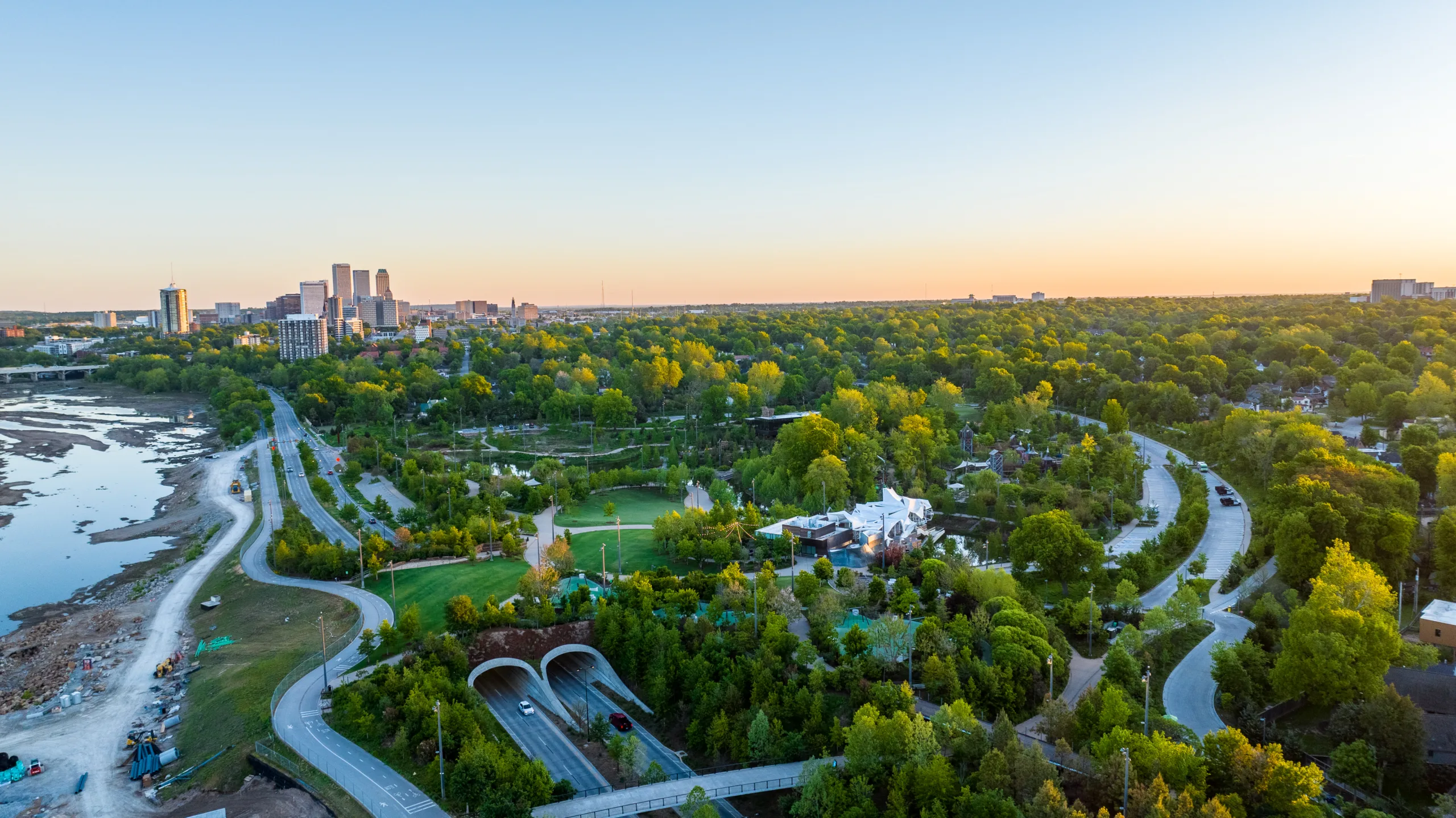
Robust public spaces provide abundant natural spaces for residents to relax, convene and unplug. Tulsa’s 100-acre riverfront park, Gathering Place, now boasts a skate park, a picnic grove, cultural events and festivals for all ages, and free educational programming to support early childhood development. A $465 million transformation of more than 66 acres in central Tulsa, the park is one of the largest and most ambitious public parks ever created with private funds. The Foundation undertook a similarly ambitious project with Guthrie Green — a former truck loading facility that has now been converted into a 2.6-acre urban park, located in the heart of the Tulsa Arts District and a true living room for cultural programming in downtown Tulsa.
Investments in a thriving arts scene and strong cultural values are integral to GKFF’s community approach. Both the Bob Dylan Center and the Woody Guthrie Center operate under auspices of the American Song Archives, a project of George Kaiser Family Foundation, and dedicated artist residencies, fellowships, and programming helps to further stimulate Tulsa’s growing arts community.
In the same Tulsa Arts District as Guthrie Green sits the GKFF-funded Holberton School–a credentialing school for software developers. In addition to training career-ready developers, Holberton provides living stipends to students and tuition incentives to stay in Tulsa both pre- and post-graduation.
Partnership is at GKFF’s core. GKFF takes a program-forward approach — meaning the Foundation serves as co- or sole owner of many of the LLCs that operate the aforementioned initiatives in Tulsa. When visiting the city, you can explore parks, cafes, bakeries, restaurants, food trucks, and programming initiatives that provide Tulsa residents with meaningful ways to stay engaged in their communities.
GKFF’s dedication to developing Tulsa’s tech-led inclusive economy is something to aspire to. Tulsa Innovation Labs (TIL) was founded with support from GKFF to establish a city-wide strategy for inclusive, tech-led growth. TIL designs and launches economic and workforce development initiatives in Tulsa’s four emerging tech clusters: virtual health, energy tech, advanced air mobility and cyber, and aims to support the growth of startups, train diverse talent, expand job opportunities, and spur academic innovation. And through the network of local workforce programs in Tulsa, businesses can more easily connect with key hires and launch operations in Tulsa via inTulsa’s talent, relocation, and growth solutions.
36 Degrees North — Tulsa’s basecamp for entrepreneurs, innovators, and startups — works to provide the high-quality workspace, resources, and spirited community that entrepreneurs need to build growing companies and drive economic impact in Tulsa. Workforce development programs like Tulsa Remote — which offers participants a $10,000 grant in addition to a membership at a local co-working space, support in identifying housing, and regular community-building opportunities — have helped draw new workers into Tulsa and boost retention rates for local populations.
- Health and Family Well-Being
To address the longstanding problem of high recidivism rates in Tulsa County, GKFF has partnered with the Justice and Mobility Fund to launch JusticeLink — a compendium of resources designed to help those navigating the criminal legal system in Tulsa to access a full spectrum of community-based services. JusticeLink primarily focuses on providing court and resource navigation, while also helping individuals to access wraparound supports like phones, IDs, or benefits enrollment services.
And through neighborhood development initiatives like ElevateEast — which works collaboratively with residents, community-based organizations, and public and private entities to invest and support immigrant families living in East Tulsa — residents can further access the wraparound support they need to thrive.
Affordable housing also has a huge role to play in ensuring family wellbeing, and neighborhood development initiatives like Growing Together and Kendall Whittier West Park have been intentionally designed to create vibrant, mixed-income communities and an intense focus on the birth-to-college-to-career pipeline.
- The Tulsa Artist Fellowship
Dedicated artist residencies, fellowships, and programming helps to further stimulate Tulsa’s growing arts community. Established in 2015, Tulsa Artist Fellowship was created to address and mitigate the challenges facing artists and arts workers living in and joining the city. Through intentionally crafted programming, the Fellowship celebrates and supports artists across all mediums by providing them with $150,000 over three years in addition to a $12,000 yearly housing stipend.
Stronger together
GKFF’s approach has necessitated a rethinking of scale and impact as being simultaneously micro and macro. Seemingly hyperlocal initiatives — like the neighborhood development in Kendall Whittier, or the transformation of public spaces into vibrant parks — can scale to an overall transformation that impacts community members’ wellbeing and livelihood. For GKFF, scale is ultimately not about reaching hundreds of millions of people to solve for one issue; it’s about making meaningful and impactful investments that tackle root causes, identify and address social determinants, and take into account the specific moments that come together to make up a well-lived life.
All of us invested in place-based work can learn from GKFF’s approach, bring insights back to our communities, and integrate them into our own strategies — all uniquely tailored to each place. Place-based strategies are inherently collaborative and rely on strong partnerships: together, we can learn from each other, lean on each other’s strengths, and propel strategies that have a community’s best interest at its core.
This is why we can’t wait to share in the Tulsa experience and the work of GKFF with the broader NationSwell Community this Fall! If you are interested in joining us you can register here or learn more about GKFF’s work or the Immersive Experience on October 18-19 by emailing Joy Gregory at [email protected].