 "
"
At a moment of inequality and division, who is advancing the vanguard of economic and social progress to bolster under-served communities? Whose work is fostering the inclusive growth that ensures every individual thrives? Who will set the ambitious standards that mobilize whole industries, challenging their peers to reach new altitudes of social impact?
In 2026, Impact Next — an editorial flagship series from NationSwell — will spotlight the standard-bearing corporate social responsibility and impact leaders, entrepreneurs, experts, and philanthropists whose catalytic work has the potential to shape the landscape of progress amid urgent need for social and economic action.
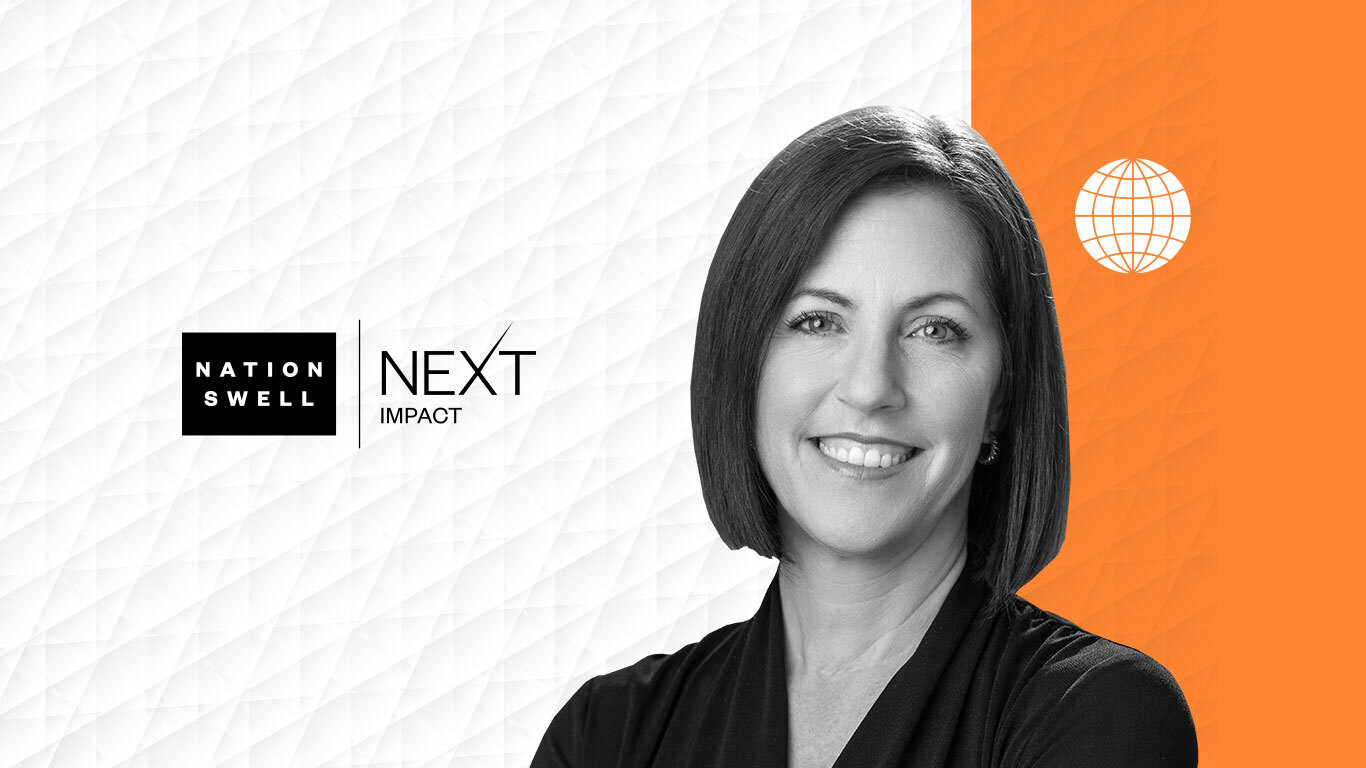
For this installment, NationSwell interviewed Lara Littlefield, Executive Director of Allen Family Philanthropies. Here’s what she had to say:
Chloe Lew, Senior Vice President of Strategic Partnerships and Innovation, NationSwell: What brought you to the field that you’re in right now? Was there an early moment, a relationship, or an experience that galvanized your commitment to driving bold action?
Lara Littlefield, Executive Director, Allen Family Philanthropies: I grew up in a family where community service was embedded in who we were: My mom was an active volunteer in the local children’s community theater, my dad served on the school board, and I grew up watching them both give back to our community.
As a teenager, politically active friends pulled me into volunteering on campaigns around issues like raising the minimum wage. At the same time, I was a dancer and choreographer, and in the arts, every time you want to showcase your work you’re also fundraising, so I had early exposure to both organizing and fundraising.
I loved the arts, but I was also becoming more politically aware. I studied community organizing and political economy, interned with the AFL-CIO, and explored labor organizing. I knew I wanted to work in the nonprofit sector because service and supporting community were core to my motivations. I also needed a job, so I thought about what would make me valuable to a nonprofit and landed on securing capital, which led me into fundraising.
Eventually, I joined the Collins Group, a fundraising consulting firm, where we helped nonprofits build capacity through volunteer-led, staff-supported capital, program and endowment campaigns. I worked on dozens of campaigns across the Pacific Northwest, and it was one of the most inspiring periods of my career — watching people who wanted to do something meaningful jump in and make it happen with a little support.
From there, I went deeper into fundraising at the University of Washington, working at the intersection of research, innovation and impact. That partner-development work eventually led me to what is now Allen Family Philanthropies – founded by Microsoft co-founder Paul G. Allen and his sister Jody Allyen – an organization I had worked with throughout my career as a fundraiser, a consultant and now as its leader.
Lew, NationSwell: How do you think about leading a foundation that has real influence in Seattle, the community that you’re from and continue to live in? What is that like?
Littlefield, Allen Family Philanthropies: It was serendipitous in the best way. You never quite know where your career will lead, but I think if you stay connected to your values, they’ll guide you where you want to be. I didn’t seek this role out; it was a wonderful opportunity that evolved over time and felt deeply aligned with what matters to me.
The Allen family has roots here in Seattle. They grew up here, their parents were a librarian and a school teacher, and they remain committed to this place and the topics I believe can be transformational for the region.
When I attended Evergreen State College, my first interdisciplinary cohort was called “Sense of Place.” We brought together biology, English, writing, and art to understand our connection to place and what those ties mean. Looking back, it all feels connected, even though I couldn’t have known that at the time.
This region has undergone a lot of transformation, but its roots and identity are still here. It’s a place of natural beauty, art, and creativity, and a place that continues to push the envelope in technology and business. A lot of places might say that, but for me, it feels authentic because I’ve seen it and grown up with it. It feels very tangible.
Lew, NationSwell: How do you look at the role of community in your work? Is there something else that you see as being really key to a part of your leadership and management with the Foundation?
Littlefield, Allen Family Philanthropies: It’s a really interesting blend. The foundation has evolved over time, alongside the broader practice of philanthropy, and as a field we’re constantly learning what works, what doesn’t, and which new approaches are worth trying.
There was an era when the foundation’s approach was very much, “move quickly, identify what doesn’t exist but should, and build it.” Innovation is still part of our DNA, and there’s absolutely a place for that. But we’ve also learned that you can develop the most powerful tool in the world, and if it isn’t grounded in an understanding of who it serves, what problem it solves and what adoption will require, it won’t have the impact you intended.
We have three program areas — Arts & Culture, Youth, and Environment — each with its own strategies and goals. But the golden thread connecting all of them is community. We believe that creating a thriving, healthy community requires everyone to play a part.
That means engaging the people closest to the problems, because they often have the strongest solutions. It means responding to what we hear, co-developing approaches, and creating a sense of ownership. Particularly in the environmental sector, we’ve learned that this is what makes a solution sustainable and helps it gain traction. Over the past six years, we’ve really worked to evolve our practices around that belief.
At the same time, we could listen forever, but we also have a point of view. We’re able to look across an entire landscape and identify patterns, associations, and connections that may be harder to see when you’re immersed in the details.
That’s where research and research-to-practice come in. Someone may have a great idea, but it may already have been tested — or there may be evidence showing that a different approach will produce a stronger result. Our role is to bring those perspectives together: to combine the high-altitude view and the experience on the ground.
Lew, NationSwell: How would you describe your leadership style? What is it about the way that you lead in the space that makes you an effective leader?
Littlefield, Allen Family Philanthropies: I first try to create a culture of psychological safety — one where everyone knows we’re in this together to make the work stronger — and that requires leaving ego at the door. None of us is the smartest person in the room, and once you accept that, you become much more open to possibility and to developing better ideas.
People should feel comfortable challenging one another, asking questions, saying something doesn’t resonate or explaining why they disagree. That means building trust, fostering collegiality, and not reacting defensively when something feels uncomfortable. To me, discomfort is part of growth. I don’t want us to become intellectually comfortable, because everything is dynamic. As soon as you think you have the answer, something changes.
There also has to be rigor. I want us drawing connections across fields and disciplines, because that’s often where innovation comes from. And I want us to feel comfortable taking risks, both personally and in what we bring to the board. If everything we propose is immediately accepted, I don’t think we’re pushing hard enough.
And it should be fun, because what an honor and a privilege it is to do this work. We’re engaging with difficult problems every day, and that can wear us down, but we also get to translate those problems into potential solutions and investments, and I try to keep the team focused on that.
Lew, NationSwell: How do you see Allen Family Philanthropies within the broader philanthropy field? How do you see philanthropy situated within the world?
Littlefield, Allen Family Philanthropies: I don’t see philanthropy in a singular way. My perspective changes depending on the altitude from which we’re looking at the question.
At one level, we can ask why philanthropy is necessary at all; that raises legitimate questions about the economic model and the accumulation of wealth that makes large-scale philanthropy possible. Those critiques matter.
But there’s also philanthropy on the ground, which isn’t exclusive to major funders. We practice it in our communities every day, often in ways that research doesn’t capture: helping a neighbor, bringing food to someone who is sick, contributing to a crowdfunding campaign or volunteering at your child’s school.
At its core, philanthropy is about acting on your values and beliefs to help people and the world around you. Whatever critiques we bring to the field, people should have opportunities to act on what matters to them, and that requires understanding what their values actually are.
That’s why fundraising, to me, isn’t really about money. Money is the final transaction, but the work is listening to understand someone’s values, the kind of world they want to live in and where they hope to make a difference. It’s about building enough trust that they believe you understand them and can connect them to a meaningful way to act.
Grantmaking is similar. We’re interpreting proposals and conversations through the values of our founders and the foundation. We’re asking whether the work aligns with our vision for impact and whether we can build a relationship grounded in trust, learning and a shared journey.
For us, that relationship shouldn’t be transactional. We want to learn alongside our grantees, and when something doesn’t work, understand why and figure out together whether to adapt or pivot. That becomes difficult with large portfolios, but to me, it’s the heart of philanthropy — just practiced at different scales.
Lew, NationSwell: What’s currently defining the current social and economic environment that we’re in? What are the trends that you’re seeing, and what’s giving you hope right now?
Littlefield, Allen Family Philanthropies: One thing COVID showed us is that crisis can create opportunity, even in the midst of something terrible. We saw people come together in new ways, and we saw capital move quickly. So we know it’s possible, and we shouldn’t have to wait for a crisis to make that happen.
When I entered this role, I also started seeing more foundations create partner-development functions — people focused on connecting with other funders, aligning strategies, sharing resources and building a stronger understanding of the landscape. None of us is going to solve these problems alone, so the question is how we create greater leverage together.
Pooled funds and collaboratives aren’t new, but I’m seeing much more conversation and partnership among funders, which is encouraging. I’m also seeing trust-based philanthropy grow in scale. That raises important questions about what kind of funder you want to be. Are you simply distributing capital, or are you trying to learn and build relationships as you go?
At the same time, I’m concerned about preserving the philanthropic sector and its ability to make those choices, particularly in moments when attention and funding are pulling inward.
That concern feels especially immediate because of the Ebola outbreak we’re watching now. When Paul was alive, he committed $100 million to the 2014 outbreak, and we funded work across the spectrum — from vaccine development to last-mile community services.
Now, we’re seeing another outbreak accelerate, and we’re trying to understand who is responding and where the gaps are. There’s less U.S. presence, and many funders have shifted toward local giving for very good reasons. But outbreaks don’t respect borders. There’s a risk in pulling inward and assuming that because something isn’t affecting us here right now, it won’t affect us at all.
That’s one of my biggest concerns in this moment: how we maintain a local commitment while still recognizing our global interdependence.
Lew, NationSwell: What issue do you think philanthropy should be paying more attention to right now?
Littlefield, Allen Family Philanthropies: I’m not sure loneliness is lacking attention — people are talking about it — but I do think we need to do more about it. The disconnection people feel from one another is a real concern.
That’s where work like the Chamber of Connection comes in, along with our investments in arts & culture. How do we create third spaces where people can gather, engage face-to-face, and build relationships? How do we leverage cultural experiences to help people see themsevles and each other in new ways? We know people are hungry for connection, so how do we make it as easy and inviting to step outside and walk into your neighborhood as it is to pick up your phone?
We need more opportunities that bring people in and make them feel welcome. The challenge can seem enormous, especially alongside conversations about AI and what accelerating technology might mean for humanity, but a community-based approach makes it feel more tangible.
Rather than trying to solve for what the entire world will look like in 20 years, we can ask what connection looks like just outside our doors: in our neighborhoods, storefronts, walkable spaces, churches, or other gathering places.
I’m grateful that so many people are leaning into this work. That’s where I feel both the concern and the excitement — they’re two sides of the same coin.
Lew, NationSwell: Is there a particular program, signature initiative, or some facet of the work that you would like to spotlight for us that is driving outcomes for the work?
Littlefield: Each project has a different flavor, and often what resonates personally has to do with the people leading it. That’s also why I believe we need to be out in the field. If my team is spending too much time in the office, I get nervous. We should be talking to people and spending time in the communities we serve. I’m constantly trying to balance that myself.
One project I was closely involved in developing was the Community Accelerator Grant with ArtsFund. During COVID, we wanted to move capital quickly and help arts organizations keep their doors open, and we also wanted the community to help determine where that funding went.
We’re now in the fourth year of the partnership, which has distributed about $10 million each year through a low-barrier process, and every eligible applicant has received funding. We’ve supported more than a thousand arts and culture organizations across all 39 counties in Washington state.
One of the most interesting things we’ve learned is how many small organizations operate below the thresholds captured by traditional reporting systems, yet play critical roles in their communities. This year, we limited eligibility to organizations with budgets under $1 million so that more funding could reach that grassroots level. It’s exciting to discover organizations I had never heard of and to learn more about the ecosystem through their work.
And then there’s the Slingshot Challenge with the National Geographic Society, which supports young people developing environmental solutions and presenting their ideas in a video format. They’ve received applications from around 80 countries, far beyond what we imagined when the program began. Watching those videos is incredibly inspiring and humbling. I’m always thinking, “What was I doing at that age? Can I have a do-over?” These young people are already changemakers
Lew, NationSwell: Are there any resources you’d recommend — books, podcasts, Ted talks — that have influenced your thinking or shaped your perspective?
Littlefield, Allen Family Philanthropies: In these roles, we’re already reading constantly — journals, articles, papers and research — so when I have time to read for myself, I want to get out of my own brain a little.
I really like science fiction because it creates associations I might never have made otherwise. It pushes you to imagine different possibilities and think about the future in a new way. I also listen to podcasts, and one I especially enjoy is Hidden Brain. I like the combination of human stories and the science behind them; that probably speaks to my nerdier side.
I’m also drawn to futurism because in philanthropy, we have to keep thinking about the world we want to create. A colleague and I once explored how we might gather a group of science fiction authors and ask them what we ought to be funding.
More and more, the world can feel like a science fiction story. But I do think there’s something valuable in looking to those writers and thinkers to help us imagine what might come next.