 "
"
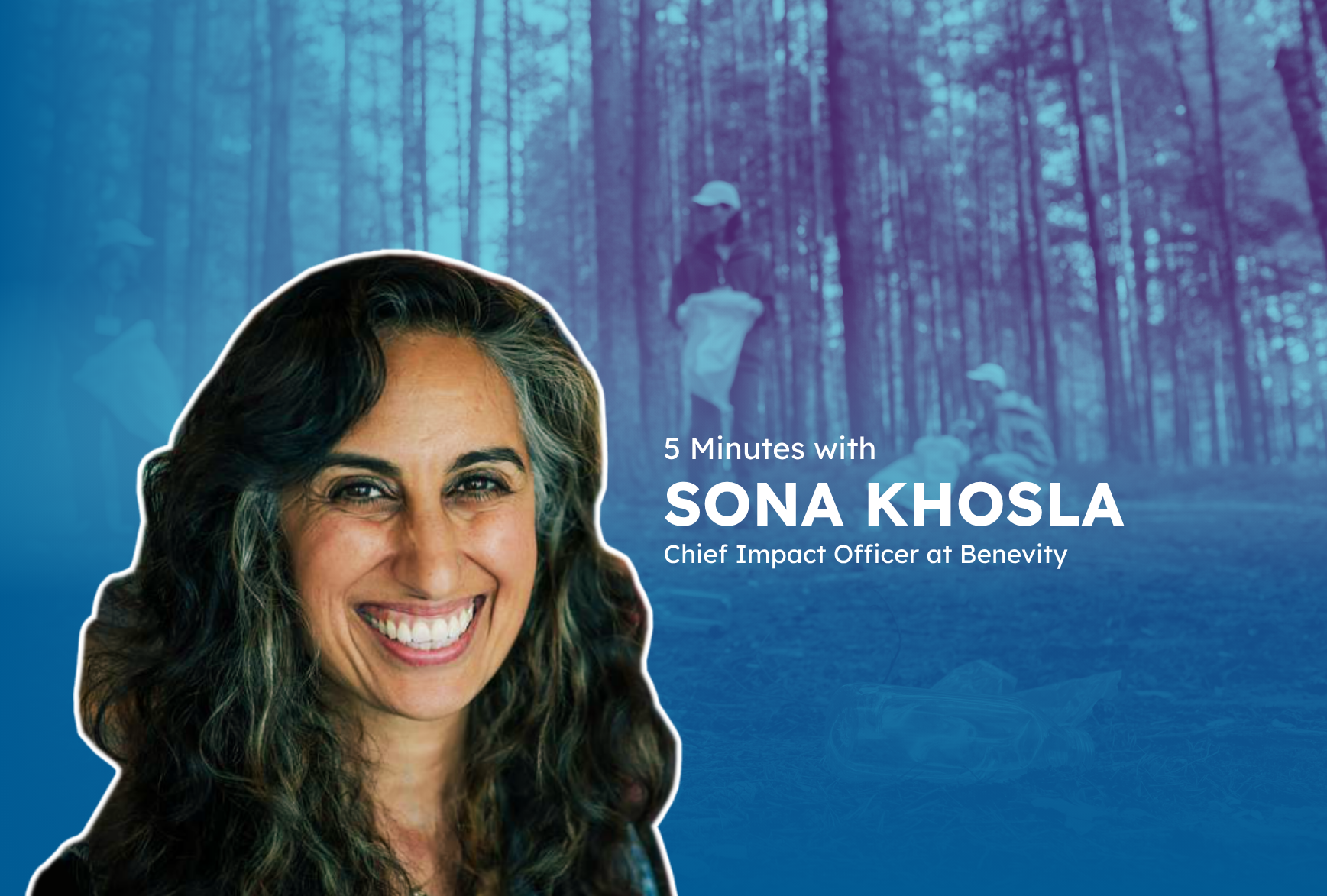
Corporate purpose leaders have spent the last several years navigating an increasingly complex mix of political pressure, regulatory scrutiny, business demands, and rising expectations from shareholders, employees and communities. For Sona Khosla — Chief Impact Officer at Benevity — that complexity has not diminished the importance of the work, but it has changed what strong leadership looks like.
NationSwell spoke with Khosla about her unlikely path from marketing to impact, the growing need for purpose leaders to pair moral clarity with business fluency, and why adaptability should be understood as a necessary condition for enduring impact.
Here’s what she had to say:
NationSwell: Take us into your world a bit — what brought you to this field? Was there a single moment that catalyzed your interest in social impact?
Sona Khosla, Chief Impact Officer, Benevity: I would honestly say that most of my career has been accidental. I accidentally ended up in marketing, and spent about 15 years there before I discovered Benevity. I had heard a lot about Benevity and its founder, Bryan de Lottinville, as a rising tech startup in Calgary, but I had no idea what CSR was — I thought it meant customer service representative – so I was clearly walking into new territory when I interviewed for a role at the company.
But I sat across the table from Bryan and felt an instant kinship; after an hour and a half, he offered me the job on the spot. One of his closing questions was, “What is one of your top values?” and I realized I had never been asked that in an interview before. My answer was fairness. I hadn’t realized how much fairness in your personal life is akin to justice at a bigger scale. Bryan lit up and said, “Me too.” It was a meeting of minds. I remember thinking, this is a person I want to work for and a company I want to work for — even though I still have no idea what they do.
Later, while hosting one of our conferences, I heard La Shanda Hurst from Microsoft say, “We may all be competitors in business, but we’re all collaborators in goodness.” In that moment, I thought to myself that impact was a pretty unique place to be and wanted more of it.
A few years later, I moved from marketing into the Chief Impact Officer role and began leading Benevity Impact Labs, whose mission it is to accelerate impact and inclusion through innovation, data insights and community. I found that the collaborative spirit really suits my nature. Working at the ecosystem level is a privilege because you become more than a product to your clients. You become a platform that can fuel impact with greater efficiency for nonprofits and companies. That suits me so much more than being a commercial engine for software.
Ten years in, I’ve realized that this is soul work. This is not just a job, it is a calling. At some level, you have to answer the call — and I did. Now I feel like I’ve found my people.
NationSwell: You came to this work as an outsider. How did you navigate that transition?
Khosla, Benevity: Luckily, I spent my first five or six years at Benevity in marketing, so I had time to learn the field before stepping into the impact role. Even so, I definitely had imposter syndrome. I was suddenly in rooms with people who had master’s degrees in international policy and deep expertise in systems thinking and cross-sector mobilization. I thought, I’m just a marketer — what do I know?
Then I realized the skills I had as a marketer were exactly the skills required to drive behavior change. On the marketing side, you are driving behavior change. In this work, you are driving behavior change for social good. It is still about audience insight, motivation, reward, storytelling, connecting people to something bigger and showing them how they can find belonging. I realized I could bridge those worlds. Those skills were highly transferable—and now they could be used for a greater good.
The other big transition was moving from brand marketing into a lab where data and research are foundational. That has actually been incredibly helpful. I can immerse myself in the data and understand what is happening across the industry without having held every practitioner role myself. I can see what is happening at the ecosystem level, and I’ve learned how to ask good questions of the people in the roles about why it is happening, how it is happening and what dynamics are underneath it.
And as Chief Impact Officer, I’ve also had to do this work for Benevity itself. The standard people hold Benevity to is high because we are literally selling enterprise impact. People expect us to live our values and contribute positively. I have appreciated that high bar, and I’ve learned a lot through it.
NationSwell: How have your strategies or leadership style evolved over time throughout your career?
Khosla, Benevity: I moved from marketing into this role in 2021, after the pandemic and the racial justice movement, when many people still had not returned to the office. I realized how much this work was not merely about running good programs; it was about equity and justice, and that suited me. I had always been an avid reader of Nelson Mandela, Mahatma Gandhi and Malcolm X.
Then the conflict in the Middle East escalated in 2023, and many organizations were forced to recalibrate their focus on equity and justice because they recognized how difficult it was to establish a single “right” position. What had been treated as a source of unification was suddenly perceived as a source of risk and division. I was pulled into conversations about discrimination, hate speech and hate groups, and ultimately into policy and ethics.
I don’t think that shift was uncommon. Many people in roles like mine had been running programs and suddenly had to engage with policy, ethics, legal questions and regulatory risk. That only intensified through 2025.
My thinking has rounded out. It began with social impact, then expanded to risk mitigation. Now it is about embedding purpose across the enterprise with a full-spectrum lens: How does it create business value and social impact? How does it support regulatory permission and brand trust? How do you thread those things together so the work delivers maximum value while also managing unexpected risks?
I never imagined I would be in these moral, ethical, policy and legal discussions, but I have found a strange affinity for it. It is challenging, but it requires whole-minded, wholehearted engagement.
NationSwell: What are some of the trends or the evolutions that you are seeing today in 2026, and what should other leaders be preparing for over the next five years?
Khosla, Benevity: We publish an annual trends report called the State of Corporate Purpose. In this year’s research, three-quarters of companies said political and regulatory compliance influenced their strategy. So I know I’m not alone in this—not exactly a pivot, but a real rounding out of how you develop a strategy with those factors in view.
Communications used to be quite broad, but now people in roles like mine are becoming much more discerning and strategic about how they invest and communicate. Last year, 69% of companies changed the way they described their programs publicly, much of that because of legal and regulatory risk.
But the data also showed that corporate giving rose eight points and volunteering reached record levels. In a year when this work was perceived as one of the greatest corporate risks, people in these roles still largely won very difficult internal conversations and continued the work in ways that stand up to scrutiny. To us, purpose prevailed.
Not every conversation was won. Some teams got smaller; some resources were reduced; sixty-five percent of companies changed the programs or nonprofits they funded, and that has real downstream consequences. What we are seeing now is much more thoughtfulness and strategic discernment around communications, nonprofit partnership, and impact storytelling and measurement. Those are the three areas surfacing most strongly in the data.
NationSwell: As leaders navigate uncertainty and scrutiny, what distinguishes the strongest among them?
Khosla, Benevity: Looks can be deceiving. From the outside, it can appear that a company is retreating, but we get exposure to the very difficult decisions these leaders are making and the actual impact they are having in their communities and companies.
The real question is: How does a company make decisions based on its values, and how is it able to live authentically into this work? Looking back, we can now see that some of the work that came out of 2020 was responsive. It was no less important because of that, but there has been a recalibration around how authentic it is to a company’s values and how aligned to its goals going forward.
I have a tremendous amount of empathy for the people making those decisions. More than 80% of the people in our research said they were proud of the decisions their companies made, and I don’t think that is because the decisions were easy. I think it is because of how hard they were.
There is no perfection in this work. If you were able to hold the line on the foundation of the work, that is success. If it gets expressed through different partnerships, slightly different cause categories or different program investments, that is a shift, but it is not necessarily a withdrawal.
We need to allow organizations to adapt without harsh judgment. If we judge every adjustment too aggressively, this work will be undermined. No matter how strong the business case is, purpose is still being weighed against pay, flexibility and other very tangible employee expectations. When companies are held to an impossible standard of perfection, it makes it difficult for them to continue to do the work and adapt as needed. We need some forgiveness in the system for people to continue to do the right thing.
NationSwell: Which trends are giving you optimism now, and which are giving you pause?
Khosla, Benevity: There is actually a lot giving me optimism. Corporate giving rose. Volunteering reached record levels. If that was our hardest year and we still grew our impact, then hell yeah, we can do this!
The level of strategic discernment and adaptability I have seen from leaders in the past few years is phenomenal — the ability to know when and how to hold the line and when and how to adjust. People in this field have basically received a crash course in the skills future business leaders will need. This group of professionals has gone through the test. I have a lot of optimism that they are ready for what comes next and are going to become some of the best business leaders across the enterprise over the next decade.
Our research showed that the number-one reason companies invest in purpose is corporate reputation and trust. So CMOs, chief communications officers and chief brand officers are leaning in. Legal cares. Finance cares. The CHRO cares. Some people see that as dilution. I see it as the work becoming embedded across the organization.
I’m also optimistic about our willingness to surface tensions. In our State of Corporate Volunteering report, we called out that companies are seeing record participation while nonprofits are struggling on the funding side — and many nonprofits do not see value in the employee volunteering they are currently receiving. Once we saw that gap in the data, we felt a responsibility to publish it. The response from both sides was: Thank you. Now help us figure out how to do it better. That is exactly the conversation the sector needs to have.
What gives me pause is the need for stronger internal advocacy. Many people in this work come from nonprofits, policy or impact. We are phenomenal at selling the value of the work to people who already believe in it. Then the challenge is: Now sell it to people who don’t. That is harder.
We need stronger impact-storytelling skills, more business acumen and greater fluency in the language of the business. And I do not mean only making a financial case. A CHRO may care more about culture and connectedness, or about using purpose to unify a company through an acquisition or merger. We need to speak very specifically to every stakeholder in their language. We are getting better at that, but there is still more to be learned and practiced.
NationSwell: What is your North Star when it comes to making difficult decisions?
Khosla, Benevity: Our former CFO and I spent a lot of time together because he was responsible for legal, compliance and risk, while I was working on the policy and ethics side. One day he said to me, “Sona, in your capacity as Chief Impact Officer, I see you as the conscience of the company.” That articulation of the role has stayed with me.
My North Star is to ask: Can I live with the decisions we are making? And are these decisions enduring? Are we going to regret this in 24 months? If so, I cannot live with it now.
My job is to be the conscience at the executive table. That means speaking on behalf of the nonprofits in our ecosystem, our clients, our people and their people. And then asking again: Can we live with these decisions over time? Is this enduring? At the end of my career, I want to leave with a sense that we did the best we could – not as a rationalization but with pride. That is what fulfillment looks like to me.
The other mindset I’m bringing to the work is that we are always going to be in draft mode. We are not going to write the next purpose playbook for the next five years, create a giant tome and simply apply it. We have to become very comfortable constantly writing, rewriting and rewriting again.
That is not failure. That level of adaptability and resilience is success. If you are rewriting, you are successful. That is the mindset this moment of hyperchange requires.