 "
"
At a moment of inequality and division, who is advancing the vanguard of economic and social progress to bolster under-served communities? Whose work is fostering the inclusive growth that ensures every individual thrives? Who will set the ambitious standards that mobilize whole industries, challenging their peers to reach new altitudes of social impact?
In 2026, Impact Next — an editorial flagship series from NationSwell — will spotlight the standard-bearing corporate social responsibility and impact leaders, entrepreneurs, experts, and philanthropists whose catalytic work has the potential to shape the landscape of progress amid urgent need for social and economic action.
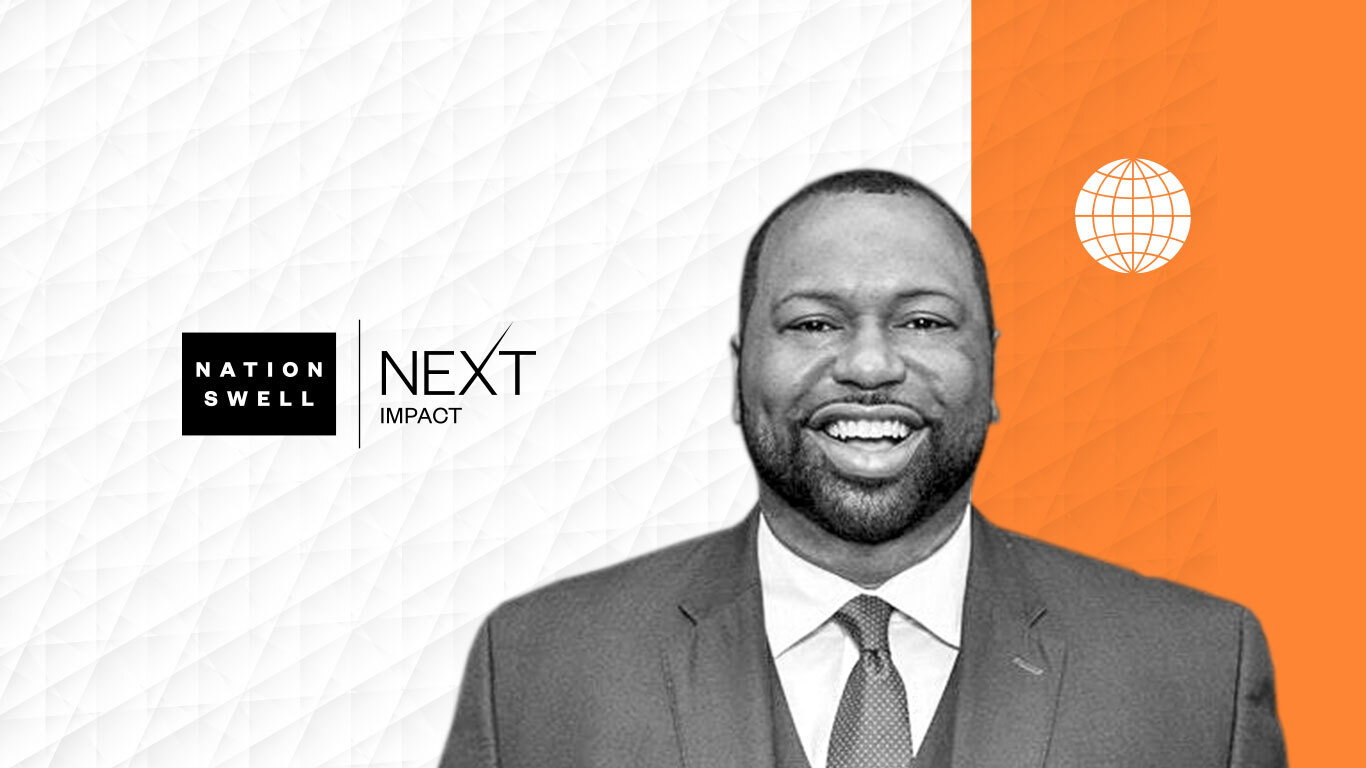
For this installment, NationSwell interviewed James “Jay” Bailey, President and CEO of the Russell Innovation Center for Entrepreneurs (RICE). Here’s what he had to say:
Greg Behrman, founder and CEO, NationSwell: What brought you to the field that you’re in right now? Was there an early moment, a relationship, or an experience that galvanized your commitment to driving bold action?
James Bailey, President and CEO, RICE: Part of my story is I’ve always been entrepreneurial: I started my first business at 12, bought my first house at 19, and made my first million by 23, but I didn’t have the right role models, and by 28, I’d lost everything. I went from a 10,000-square-foot house to living in a nine-by-nine storage unit. And that’s where I had to confront the truth: by the world’s standards, I had been successful, but I had zero significance. I hadn’t done anything to put a dent in this world.
A big part of that story goes back to losing my mother, Millie L. Bailey, when I was 19. She never made more than $40,000 a year, but she was one of the greatest philanthropists I’ve ever known. She worked with young people in the juvenile justice system, brought kids home for Christmas, made sure they felt seen, valued, and loved. When she died, all of that left my life, and money became my hiding place. Big houses, nice cars — all of it covered up a kid who was grieving.
I remember thumbing through a photo album and seeing pictures of all these kids throughout my life that my mother would make a part of our lives, ensuring that they had exposure to something different. Slowly I found my way back to my core, and to her example, and that’s when I stopped chasing success and started dedicating my life to significance.
Behrman, NationSwell: Is there a particular program, signature initiative, or some facet of the work that you would like to spotlight for us that is driving outcomes for the work?
Bailey, RICE: I love Atlanta. I was born and raised here, and I believe Atlanta has the chance to be the most consequential city of the next 100 years: the collision of corporations, culture, and community — if we get our act together — could create something few cities can match. But I love my city enough to be honest: we’re the worst city in the country for income inequality and economic immobility. And if you’re not willing to talk about race, I think you’re being intellectually disingenuous about solving it.
There are no poor white neighborhoods in Atlanta. There are no failing Latino schools in APS. Ninety-nine percent of the demographic drivers behind those statistics look like me. So when I chose to focus on Black entrepreneurs, it wasn’t just a social cause — I was thinking like an economist. If we’re 52% of the population but our companies account for just 8% of economic growth, there’s a disconnect keeping Atlanta from becoming everything it could be.
That’s why we chose entrepreneurship. Not because it solves everything, but because it can move the needle. I’ve long believed we lose GDP every year because brilliant ideas on the south side of the tracks never reach the marketplace — because people don’t believe they belong. And that’s why we rejected the traditional, episodic model of programming alone. Programming matters, but our goal was transformation.
You can’t ignore the loneliness, the depression, the isolation, the generational poverty and trauma. Before someone can grow a business, they have to see value in their own reflection. They have to feel belonging. Then you build the scaffolding — the infrastructure, the support, the pathways to actually start and scale. Both are necessary for the people we serve.
That’s built into the DNA of the Russell Center. It’s one of the few places in the country where the place that serves the people is built, run, and supported by the people it serves. Our architect, our contractor, the products on my shelf, even the snacks — they all come from our entrepreneurs. That circular economy creates allegiance, covenant, and community. And at the heart of it all, more than access to capital, is culture: a community of collaboration, support, and belief. That mindset shift is everything.
NationSwell: What makes this model different — what you have learned from the outcomes you’re generating?
Bailey, RICE: My core inspiration was the HBCU model — historically Black colleges and universities — which have been one of the greatest economic mobility engines in our community for the past 100 years. I wanted to build the entrepreneurial equivalent of that experience; I didn’t want a model where you come for four weeks or 18 weeks, graduate, and that’s it. What’s unique about what we do is that it’s a continuum of engagement across the life cycle of a business; you don’t graduate out.
That ties back to the circular economy we’ve built: companies that are thriving pour into the ones coming behind them. It creates the same kind of culture you see on a college campus — seniors tutoring freshmen, freshmen aspiring to be seniors. Every day, even outside the curriculum, people are being inspired, exposed to new pathways, and changed by proximity, and so much of that transformation has nothing to do with what’s on the transcript.
That model pushed us to think about serving the whole entrepreneur beyond just what we can teach. How deeply can we understand what makes a person himself, what he is trying to do, and what actually works for him? That’s why I value business experts at the same level as therapists and psychologists in our curriculum: That whole-person approach — our ability to grow, retain, and build real community as we grow — is something I haven’t really seen anywhere else.
Behrman, NationSwell: Can you walk us through a couple different facets of the work you’re leading that are particularly exciting to you right now?
Bailey, RICE: One of my biggest learnings in this work is that, yes, access to capital will always matter for entrepreneurs; you plan for that. But what I’ve found is that community is a deep need, in many cases even more urgent than capital.
Where I come from, I didn’t grow up seeing a lot of Black billionaires or people running multinational companies. And when 98% of Black-owned businesses have just one employee, there’s a reason for that. So much of it comes down to how we see ourselves as entrepreneurs. I bought into the narrative that success meant hustling, grinding, doing everything yourself. What I want at the forefront of our work is breaking through that mindset — giving people the exposure, access, and belief to say, ‘Why couldn’t my idea become the next great company?’ That kind of exposure creates belief.
The second thing we’ve identified is a huge donut hole in the ecosystem: the growth-stage entrepreneur who isn’t a venture-backed tech unicorn, but a bedrock, missing-middle business. If you’re a startup with an idea, there’s support. If you’re a high-growth tech founder chasing a massive exit, there’s support. But if you’ve got 15, 20, 30, even 150 employees and you’ve plateaued, there’s almost nobody built to help you break through. That’s why we’re building out the Scale Studio to surround those companies with the accountants, attorneys, consultants, and capital they need to grow. The businesses stabilizing our economy are the ones getting the least support.
And the third is campus expansion. Early on, when we mapped the barriers to starting and growing a business, things like housing, childcare, and healthcare were at the top of the list. So one of our big ideas is: how do we go from a 70,000-square-foot campus to something bigger — adding housing, medical care, affordable office space, and other supports around the entrepreneur? How do we fully build out that whole-entrepreneur model and make sure Atlanta stays affordable enough to dream? Because if the city becomes so expensive that people with ideas have to leave, then dreams can’t live here. We want to be a speed bump against that.
So those are the three big areas for us: mindset as part of the theory of change, support for the missing middle that no one is really serving, and expanding beyond our current footprint to truly meet the needs of the people we support.
Behrman, NationSwell: Of the socially motivated leaders you consider your peers, are there any whom you hold in particularly high esteem, and how has their approach shaped your own leadership?
Bailey, RICE: There’s one in Atlanta who absolutely needs to be on people’s radar: Dr. Lakeysha “Key” Hallmon, the founder of The Village Market. I remember meeting Key when she was just a teacher with a big idea, and now she’s built real spaces for entrepreneurs, business owners, and creatives.
In Detroit, Alexa and Johnnie Turnage, the husband-and-wife team behind Black Tech Saturdays, are two of the most inspirational people I know; they make technology sexy and fun. I’ve been to Detroit to speak with them, they’ve brought their team down to Atlanta, and the passion they have for moving the community forward is infectious.
And then, when I think about my core motivation, I have to name someone who’s no longer with us: Maynard Jackson, Atlanta’s first Black mayor. I draw endless inspiration from him. His courage helped change the direction of Atlanta and, in many ways, the South. He paid a real price for it, but he made that sacrifice to create opportunity. He’s responsible for creating more Black millionaires than any other mayor in American history, and he did it with grace, style, humility, and empathy. His legacy is still shaping all of us.
Behrman, NationSwell: Are there any resources you’d recommend — books, podcasts, Ted talks — that have influenced your thinking that might influence others as well?
Bailey, RICE: I quote Rudyard Kipling’s poem “If” constantly, and then there’s “Invictus” by William Ernest Henley — Out of the night that covers me / black as the pit from pole to pole … I am the master of my fate / I am the captain of my soul. Those are two I come back to. And honestly, another quote that I return to all the time is simpler: “don’t quit.”
In terms of other things that influence my thinking, I’m a city boy with country leanings. My wife and I are landowners here in Georgia, and nothing clears my mind like getting out of the city, getting into the country, and hopping on my four-wheeler. For some people it’s a massage, a round of golf, whatever people do to unwind — for me, nothing compares to being on that ATV and just riding.
There’s something about it that brings me real joy, release, and freedom. The engine is so loud you can’t hear your phone, can’t feel it vibrate, can’t hear it ring. And that means, for a little while, you’re free — free to just be, without any connectivity to the device or the world. It’s how I get away from everything, and it’s one of the things I cherish most.