 "
At a moment of inequality and division, who is advancing the vanguard of economic and social progress to bolster under-served communities? Whose work is fostering the inclusive growth that ensures every individual thrives? Who will set the ambitious standards that mobilize whole industries, challenging their peers to reach new altitudes of social impact?
In 2026, Impact Next — an editorial flagship series from NationSwell — will spotlight the standard-bearing corporate social responsibility and impact leaders, entrepreneurs, experts, and philanthropists whose catalytic work has the potential to shape the landscape of progress amid urgent need for social and economic action.
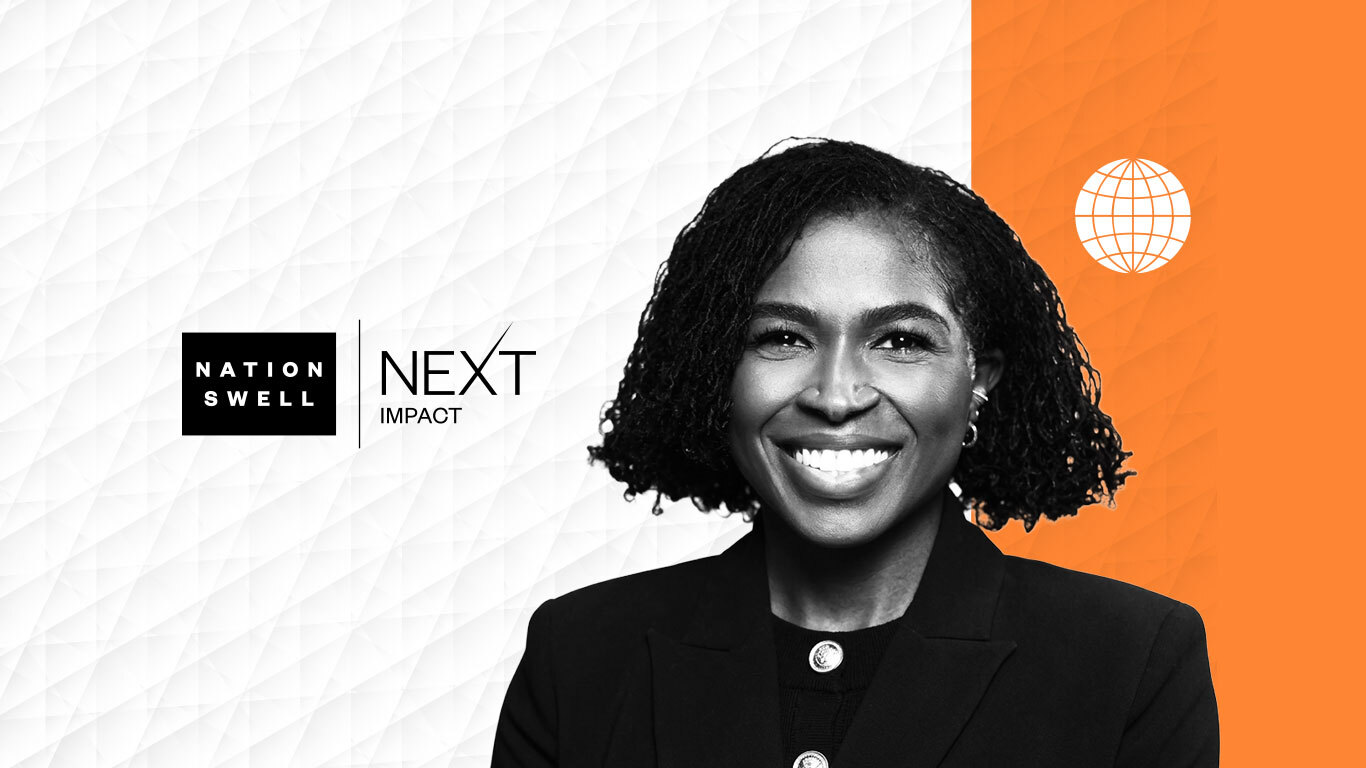
For this installment, NationSwell interviewed Olivia Jefferson — the Vice President of Social Impact at Best Buy and Executive Director of the Best Buy Foundation. Our conversation focused on creating skills-first pathways into tech-enabled careers for young people and what it takes for corporate leaders to move from presence to power.
Here’s what she had to say:
Greg Behrman, founder and CEO, NationSwell: What brought you to the field that you’re in right now? Was there an early moment, a relationship, or an experience that galvanized your commitment to driving bold action?
Olivia Jefferson, Vice President of Social Impact at Best Buy: A year and a half ago, this wouldn’t have been my answer, but while preparing for the Best Buy Foundation’s annual Charity Classic, I worked with a speech coach. The process became almost like therapy: He asked about how I grew up and helped me recognize an experience I had never connected to my career.
On my fifth birthday, my birth mother was in a car accident that left her paralyzed from the neck down. Growing up, I watched her navigate systems that, particularly in the 1980s, were not designed for people with disabilities. When I was a college freshman, she told me she was applying for a Habitat for Humanity grant to build an accessible home, and I remember thinking, “This lady is something else — who does this?” Sure enough, she secured the grant, and Habitat built her a fully accessible home.
That was when I first understood the power of standing in the gap between resources and changing someone’s life. I didn’t yet know to call it philanthropy, but I knew I wanted to be part of it. For years, I saw that period only as a difficult part of my childhood; my speech coach helped me understand that it was also my introduction to this field — and that it had been guiding me throughout my career, even before I had the words for it.
Behrman, NationSwell: What is your approach to leadership or leadership philosophy? What makes you an effective leader in the space?
Jefferson, Best Buy: I was fortunate to see leadership done well very early in my career. At 22, fresh out of college and trying to break into public health, I was hired by Audrey Smith, general manager of the Detroit Department of Health and Wellness Promotion. She gave me the opportunity to lead two school-based health clinics, where I managed a physician, a nurse practitioner, and a health educator — all of whom were old enough to be my parents.
I quickly began to feel like an imposter, but Audrey pulled me into her office and said, “Don’t let your youth keep you from leaning into your potential. Draw on their wisdom, but recognize that you also have something to give.” She reminded me that my energy and excitement were exactly what the young people in those clinics needed to see in a professional who felt more like a peer.
Audrey gave me direct feedback without sugarcoating it, but it always came from a place of care and a desire to see me grow. She taught me that clear, critical feedback is something we give to people we believe in. Throughout my career, I’ve learned from strong women leaders and from people willing to challenge me; if everyone tells you you’re the best thing since sliced bread, you cannot see where you need to grow. My own leadership style is deeply empathetic: I listen, ask thoughtful questions, champion people, and seek to understand, but I also believe clarity helps us become better versions of ourselves. Those are the cornerstones of how I lead.
Behrman, NationSwell: Can you tell us a little about what you’re trying to do by bringing folks together? What are some of the things that are helping you to get traction?
Jefferson, Best Buy: At Best Buy social impact, we’ve partnered with America Achieves, which brings together government leaders focused on skills and creating good-paying jobs that offer real opportunity, not dead ends. That vision closely aligns with what we want for young people, and we joined in part to ensure r the voices of young people were represented.
Through our network of Best Buy Teen Tech Centers across four regions, we have direct relationships with young people and trusted local partners in those communities. We recently held an informal focus group about AI because so many people are telling us what young people think when in reality, we should really just be asking them. Hearing their fears, their excitement, and where they want organizations like ours to play a role has been incredibly valuable.
America Achieves also serves as a bipartisan, neutral convener, bringing government, business, and philanthropy together. Through the partnership, we’ve been able to engage organizations including JPMorgan Chase and Salesforce in conversations that might not otherwise have happened. The work is still in its early stages, but we see tremendous potential. Companies that may be competitors elsewhere are not competing here; this is a space where we need to work together.
Behrman, NationSwell: With all the dynamics at play as the backdrop for doing impact work right now, how are you sense-making this moment? How do you anchor and ground yourself amidst it all?
Jefferson, Best Buy: Something Tonya Allen said recently has stayed with me: “We need to act more like a constellation, and less like a North Star.” There is a role for everyone to play in shaping a world being transformed by AI and economic change, but we have to work in concert. We also have to accept some risk and be vulnerable enough to say, “This will be difficult, but we’re willing to step forward.”
At Best Buy, one part we can play is advocating for skills-first hiring. Young people are telling us they don’t necessarily see college as the right next step, and they aren’t convinced it will prepare them for jobs that are still being defined. If employers don’t begin valuing skills alongside credentials, we risk becoming irrelevant to the very people we will need as our future workforce.
What excites me is that Best Buy isn’t waiting for every answer before taking meaningful action. We’re willing to say, “We may not get it right every time, but we’re going to step forward now and invite others to join us.” Tonya’s language helped me see that more clearly: Do your part, do it well, and be willing to take a risk. That is how we begin linking the constellation.
Behrman, NationSwell: Is there a particular program, signature initiative, or some facet of the work that you would like to spotlight for us that is driving outcomes for the work?
Jefferson, Best Buy: Our Teen Tech Centers have built a strong foundation by giving young people access to technology, helping them develop skills, and listening to what they need, but what excites me now is the Best Buy Foundation’s commitment to create even more pathways to economic opportunity. Through hub networks in the Twin Cities, New York, Los Angeles, and Atlanta, we’re braiding together partnerships that can move young people beyond a physical tech center and toward tech-enabled careers.
Technology underpins nearly every industry. A young person may want to be a singer or songwriter, but they could also become an engineer in the music industry or work in technology for the Grammys and still be close to what they love. We want to help young people see those possibilities and gain real-world experience through internships and apprenticeships. Skills like critical thinking, defending an idea, and navigating disagreement are often learned in a first job, not a classroom. Our goal is to create a connected ecosystem that builds both skills and confidence so young people can chart their own paths from education to employment.
Another important part of the strategy is connecting Best Buy employees to this work. One way we’ve done that is through Geek Squad Academy. Best Buy employee volunteers from across the company to teach young people coding, Photoshop, digital design, and other technical skills. We’ve also created a portable version called Geek Squad Academy in a Box that our stores can tailor to the needs of their own communities. Young people develop both technical and interpersonal skills, while employees engage directly in places where they live and work. It has been powerful to take something we already had, scale it differently, and help employees feel that their company truly understands what they care about.
Behrman, NationSwell: Are there any resources you’d recommend — books, podcasts, Ted talks — that have influenced your thinking that might influence others as well?
Jefferson, Best Buy: I recently heard Rashad Robinson discuss his book, From Presence to Power, and his central argument is that we often mistake presence for power. You can be highly visible — invited to speak everywhere and asked to comment on every issue — without actually moving the needle in a meaningful way. That distinction stayed with me.
Corporate spaces can sometimes feel lonely because companies often believe they have a great deal to lose by taking a clear position. At this moment, we see many people doing a lot of talking without a long record of impact behind their names or their work. I never want to be that person. I want to understand the power I have, wield it responsibly, help shape the narrative, and use it to create real change.
I admire Rashad’s willingness to be brutally honest about that distinction. It is also meaningful to see a Black author writing explicitly about power and strategy — an area where far too few Black voices have been elevated.