 "
Long before foundations and formal grantmaking institutions became synonymous with philanthropy, Black communities were building their own systems of care. Mutual aid networks, church-based giving, civic organizations, and families pooling their own resources together have helped communities meet their needs and pursue their dreams across generations.
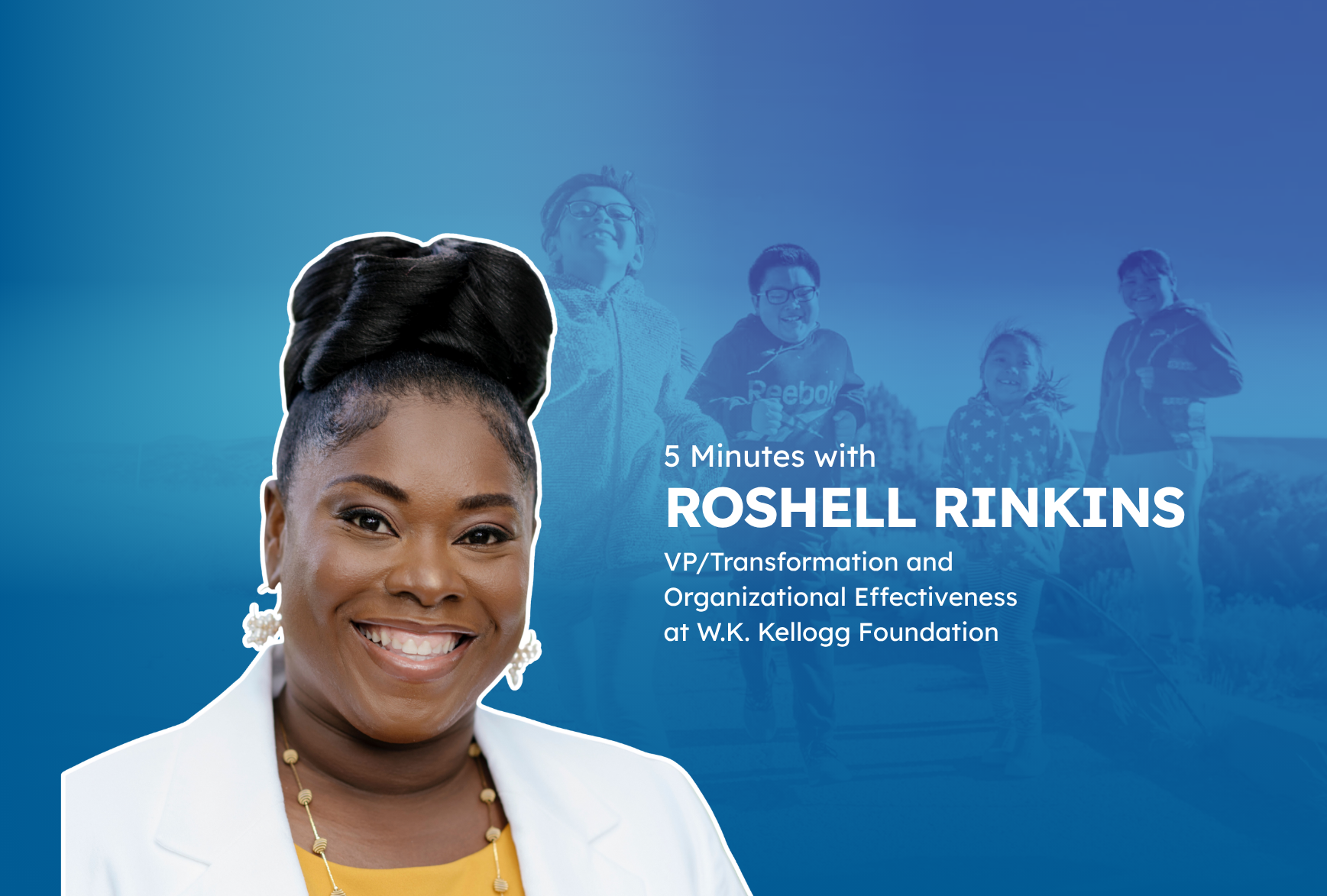
In celebration of Black Philanthropy Month this year, Roshell Rinkins — vice president for transformation and organizational effectiveness at the W.K. Kellogg Foundation — brought that expansive view to her moderation of a conversation on “Rewriting History: The Promise and Power of Narrative Equity” at the Martha’s Vineyard African American Film Festival. The discussion explored an idea with significant implications for philanthropy: The stories institutions tell about communities can shape whose expertise they value, which problems they see, and ultimately where resources flow.
NationSwell spoke with Rinkins about what the panel surfaced, the state of Black philanthropy, the relationship between narrative and systems change, and what it means to shift power toward communities themselves.
Here’s what she said:
NationSwell: When we talk about “the state of Black philanthropy,” what are we actually referring to — traditions of giving? Institutional investment in Black communities? The influence Black philanthropic leaders have? Some combination of these? What tends to get overlooked in the way the field usually frames the conversation?
Roshell Rinkins, vice president for transformation and organizational effectiveness, WKKF: Our understanding of Black philanthropy has to include all of the above — and that breadth and depth is itself often overlooked.
Black communities have long had to look beyond institutions to survive, meet our needs, advance our priorities, and have created traditions that help sustain us across shifting political landscapes. These include mutual aid, church-based giving, civic organizations, and families simply pooling resources and taking care of one another. I also think about the traditional practice of susu, or giving circles, which help communities flourish even without formalized support. All of these traditions have evolved with the times, as Black communities face new political challenges, new means of organizing, and new ways to expand their reach.
And so casting philanthropy as solely about institutional generosity — or implying that big-dollar giving is the only way to meaningfully improve lives — leaves out important context. And that’s at our own peril. Understanding the rich history of community care, and celebrating the grassroots traditions that inform and complement our current practices, can also help us navigate this political moment. I am so proud that one of the areas we support in our racial equity and community engagement grantmaking is around catalyzing community giving
Another important point, often overlooked, is that supporting Black philanthropy helps us address other systemic issues. Essentially, it’s the curb cut effect: The first curb ramps, which were introduced in California in the 1970s, were intended to support people with accessibility needs. But it turned out that not only wheelchair users benefited from curb cutting — people on crutches, pregnant mothers, parents pushing strollers, and pedestrians generally all enjoyed a better experience thanks to the curb cuts. We see the same effect today with closed captioning. Originally developed for people who are deaf or hard of hearing, captions are now widely used by people who simply have difficulty following dialogue, particularly as sound mixing in movies and television has changed. That’s how I think about Black philanthropy: By focusing on the issues affecting the Black community, you can create systems improvements that affect everyone.
NationSwell: Tell us a bit about the conversation you recently moderated on Martha’s Vineyard. What surfaced, and what changed or sharpened your own understanding of what Black philanthropy needs from the broader sector right now?
Rinkins, WKKF: During this year’s Black Philanthropy Week on Martha’s Vineyard, I moderated a discussion called “Rewriting History: The Promise and Power of Narrative Equity” at the 24th annual Martha’s Vineyard African American Film Festival. We had an incredible panel of speakers: the legendary actor Glynn Turman, producer and strategist Keisha Senter, and Brookings Senior Fellow Dr. Andre Perry.
Glynn, who’s part of the cast of A Different World, and Keisha, who leads social impact at Jordan Peele’s Monkeypaw Productions, presented their work on the recent documentary High Horse: The Black Cowboy. The miniseries examines the Black contributions to Western culture, which have long been overlooked. For most of us, if we close our eyes and picture a cowboy, the image that comes to mind is that of a white, cisgender man—when in reality, one in four cowboys were Black. The film broadens the aperture and expands our minds, with Glynn, a rancher and rodeo cowboy, speaking from his lived experience.
Stories like this — narratives of joy and adventure — aren’t the stories we usually hear about Black communities. And for me, the conversation reinforced that philanthropy can’t treat narrative as tangential to systems change — a kind of PR exercise that comes after the so-called real work. Philanthropy can help us change what we can see, and the stories we tell shape the future we can imagine.
NationSwell: How do the stories philanthropy tells us about Black communities influence what gets funded? How does narrative in general continue to shape whose expertise is valued and which forms of progress are considered possible?
Rinkins, WKKF: Long before funding decisions are made, familiar stories about communities inform our interactions with them. If the dominant narrative focuses on deficiency—poverty, violence, educational gaps, poor health outcomes—then philanthropy can easily design its response around fixing people rather than addressing the systems around them.
But when we engage with narratives of Black success and joy, we create a more complete picture, one that highlights our communities as stewards of knowledge and creators of solutions. It’s the difference between raising the floor and raising the ceiling and broadening our horizon of the possible. I’ve seen how narrative transformation can reshape institutions, expanding our understanding of what kinds of people and communities are valuable, investable, and capable of creating sustained change.
A key part of that is also challenging the stories we tell when Black philanthropy falls short, or doesn’t immediately produce transformation. Failures are analyzed in dozens of post-mortems, but successes are rarely awarded similar scrutiny. This can spark a cycle of negativity and fear: People say, “We did that once and it didn’t work as well as we hoped, so we can’t do it again.” That shapes the funding future efforts receive. We see it in the numbers. Black-led nonprofits are less likely to receive foundation funding, and when they do, they are more likely to receive funding that is restricted rather than flexible. That matters because flexibility gives organizations the ability to respond to what their communities need, invest in their infrastructure, and sustain the work over time.
The successes happening in Black philanthropic spaces deserve far more attention, both to celebrate the great work so many folks are doing, and to inform future grantmaking.
NationSwell: WKKF emphasizes community leadership and the importance of people closest to inequity shaping solutions. Where do you still see a gap between that principle and how philanthropy actually distributes money and decision-making power?
Rinkins, WKKF: Philanthropy has certainly come a long way in embracing community voice and community leadership. The turn towards trust-based philanthropy, with its focus on openness and mutual accountability, is particularly indicative of the field going in the right direction.
I worked at Procter & Gamble and Apple, so I come from very consumer-driven industries. Those businesses don’t stay in business unless the consumer is happy. And I think “Big-P” Philanthropy sometimes loses sight of the fact that our position isn’t entirely different: We don’t have a business without our grantee partners. They are the reason we exist.
That’s why I love the Kellogg Foundation’s approach, which holds that those closest to the problem are best equipped to solve it. It dates back to our founder, Will Keith Kellogg, who sought to provide communities with “practical assistance in solving their own problems,” as one of our earliest foundation reports put it.
Empowering people to address the issues closest to home requires collaboration, trust, and respect, and we take every opportunity to reduce the power imbalances that can exist in our field. For example, as we plan investments with our grantees, we ask them which KPIs they think will matter, rather than imposing our own. Yes, we have a board, and yes, there are metrics we need to collect from a governance perspective, but it’s important to acknowledge that grantees are on the ground, they’re the experts, and their knowledge drives the work.
There’s also the fact that over 90% of our grantmaking is done in 60 business days or less, which is another way we build trust with our grant seekers and respect the urgency of their efforts. That timeline is a top-down commitment, and we monitor ourselves against it — a weekly dashboard is shared across the organization, including with our CEO, La June Montgomery Tabron. This timeline is critically important to us, because a “yes” that arrives nine months or a year after the ask may very well come too late: organizations shutter, people move on.
NationSwell: WKKF oversees both racial equity grantmaking and organizational transformation, which means you have a unique insight into how external commitments intersect with internal practice. What systems or habits should philanthropic institutions examine if they want equity to shape how decisions are made, vs. simply what they say or fund?
Rinkins, WKKF: At the Kellogg Foundation, I sit at a very interesting intersection, because few roles in philanthropy that bring operations and programs together as much as mine does. I manage the operational side, with grants and contracts and org effectiveness, and I also have the racial equity and community engagement side, too.
This role has taught me that you can’t separate external strategy from internal practice, because an organization can have a strong public commitment to equity and still operate through systems steeped in hierarchy that hamper collaboration.
One example of an investment we’ve made to ensure our operations reflect our values is creating our Concierge Desk. It’s an omnichannel service designed to meet grantseekers and grantees where they are, whether by phone, email, or other forms of direct support. And importantly, we still maintain a public phone number where someone can speak directly with a live person—which is increasingly rare today.
We track the concierge desk’s performance and are always exploring new ways to help people access the information they need, whether they’re existing grantees or grant seekers. And that’s notable, as many foundations only hear the voices of those they’ve funded. But we want to create a transparent and accessible experience for everyone we touch, whether or not we end up working with them.
We also held a convening for our Racial Equity and Community Engagement team this spring, and one of the things that was really important to me and our team was making sure we included grantee voices. So we created a grantee advisory council, and we’re used this community to help co-create the grantee convening experience. What emerged went beyond a traditional advisory body. It existed as a strategy for impact and a model for how insight sharing, when practiced with intention, can accelerate strategy, build a culture that deepens reciprocal trust and through amplification can elevate learning across an organization and its partners.
NationSwell: What is one lesson from this conversation on Martha’s Vineyard that you hope fellow philanthropic leaders will carry into their own work, and what would acting on it look like in practice?
Rinkins, WKKF: As we closed the conversation in Martha’s Vineyard, I told the audience that we tell stories because they help identify what has hurt our communities and what needs to change. But both harms and solutions look very different depending on your vantage point — and transformation is only possible when we take a 360-degree perspective.
One illustration of this broader point of view came through the work of Dr. Andre Perry, who was among the panelists that day, and who’s also a Kellogg Foundation grantee partner. He’s producing the upcoming documentary The Most Equal Place in America. It’s about Paulding County, Georgia, where the quality-of-life gap between Black and white people is smaller than almost anywhere else in the nation.
This asset-first framing is so often left out of conversations about marginalized communities. We usually talk about underrepresented groups as lagging behind, but the film instead spotlights a community that’s proving that equity is attainable, even given all of the challenges our nation currently faces.
That’s the lesson I’ll carry forward: Your story and your strategy are one and the same. Sharing the “who” and the “why” behind the “what” and the “how” is how we prove that better worlds are possible.
Acting on that lesson requires investment — funding Black storytellers and Black-owned media, and supporting the platforms, researchers, and archives that help stories reach audiences. And it also requires us to examine the stories embedded in existing grantmaking strategies. Imagine the opportunities we can unlock if we shift our perspective toward communities’ strengths rather than their deficits.