 "
"
Although grief touches nearly every family at some point, the systems people rely on most — schools, workplaces, healthcare settings — often remain unprepared to offer meaningful support. This year, the New York Life Foundation is hitting a major milestone in its effort to change that: $100 million invested in bereavement support since it began funding the field nearly two decades ago.
The Foundation’s 2025 State of Grief Report zeroes in on three places where support gaps run deepest: the youngest grievers under age five, who are often the most overlooked; schools, where most parents want grief education and better systems for identifying bereaved students; and workplaces, where two in three employees say they’ve experienced the death of a loved one while on the job. Taken together, the findings are clear: people want grief acknowledged and supported, not sidestepped, and most institutions still don’t know how.
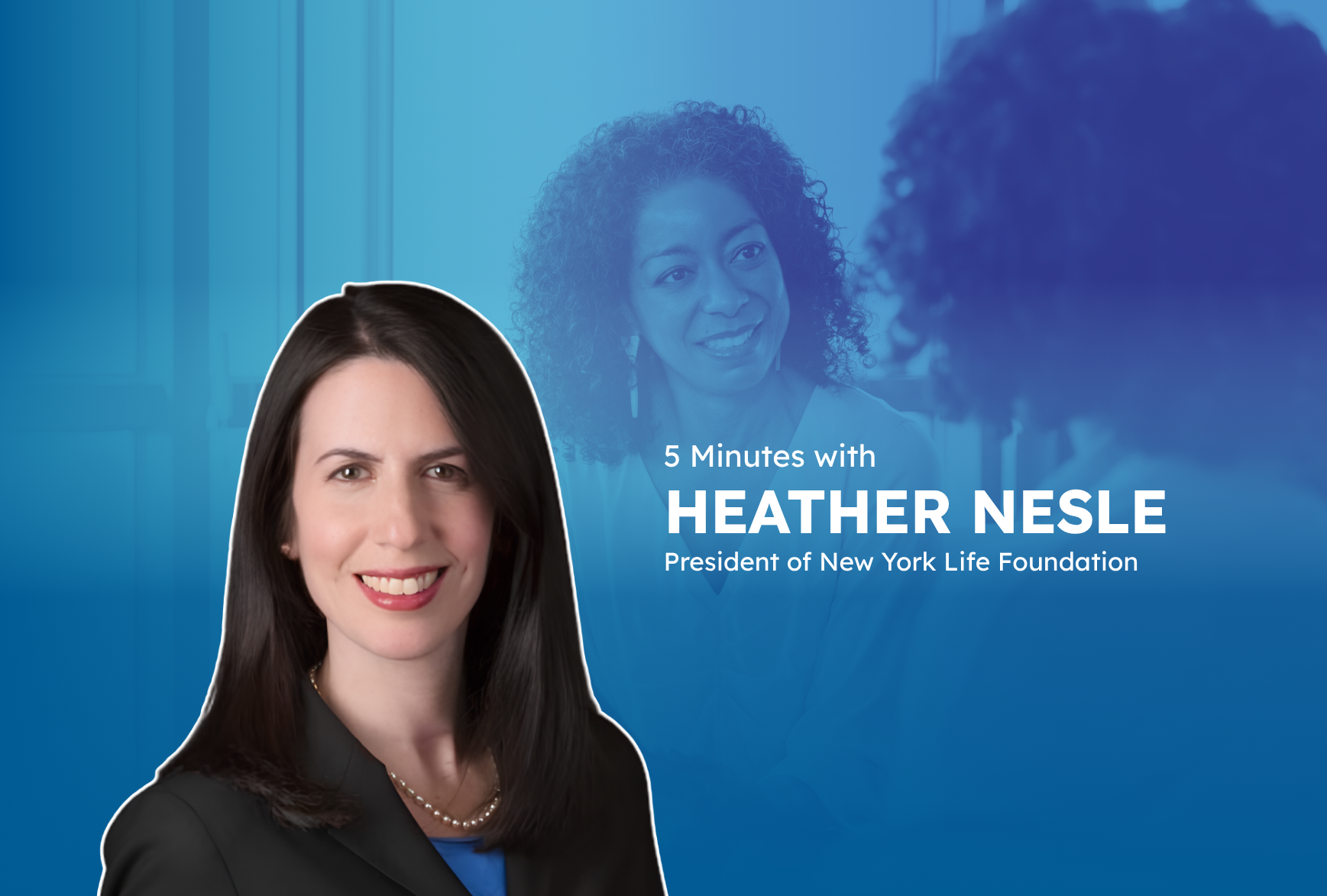
For this installment of Five Minutes With…, NationSwell spoke with Heather Nesle, President of the New York Life Foundation, about the $100 million milestone, what the report reveals, and where the Foundation’s work goes next.
NationSwell: Congratulations on New York Life Foundation reaching $100 million invested in bereavement support. What does that milestone mean to you? What story does it tell about the role philanthropy can play in building a more grief-literate society?
Heather Nesle, President, New York Life Foundation: I think $100 million is very significant in the history of our foundation. Since we started in 1979, we’ve given roughly half a billion dollars total, so 20% of that in just the last 17 to 18 years, all focused on this one issue.
We started with a few grants for camps and bereavement centers. But once we understood the depth of the need, it became clear this was a place where we could really have an impact — the kind of niche every funder hopes to find.
Early on, we realized we couldn’t even answer a basic question: How many children are actually affected? Grief is universal, yet in the U.S. it’s swept under the rug; there’s a stigma around even bringing it up. So we helped fund the Childhood Bereavement Estimation Model out of Judi’s House, which let bereavement organizations back up their work with real numbers instead of just stories. Today we know 1 in 11 children will lose a parent or sibling before age 18 in the U.S., and that’s an undercount of the pervasiveness of grief, since it doesn’t include grandparents, friends or other significant relationships. Nearly every grant application we receive now cites that statistic.
We’ve also focused on schools. Over a decade ago, our survey with the American Federation of Teachers found that roughly 93% of teachers had a grieving student in their classroom, but only 7% had ever received training on how to help. So, we built the Coalition to Support Grieving Students and launched our own Grief-Sensitive Schools Initiative, training our employees and agents to run presentations about bereavement resources at local schools, each of which gets a $500 grant and joins a support network now nearly 8,000 strong. When we redid the survey years later, teacher training had risen to 15% — still lower than we’d like, but marking real progress.
This work is deeply mission-driven for us. Our company’s mission is financial security and peace of mind, and this is the peace-of-mind half of that, because our agents and claims staff are often among the first people bereaved families talk to. It’s genuinely a labor of love: our Grief-Sensitive Schools program is our most popular volunteer effort, with over 3,600 agents and employees trained to lead it. As a corporate funder, it’s rare to find an issue that resonates so deeply that you never have to convince your people to engage — and this work makes us better as an organization, too.
NationSwell: The latest State of Grief report does a good job highlighting that while grief is universal, support for grief is still pretty uneven. Where do you see the biggest gaps right now, especially for children, families, schools, and workplaces?
Nesle, New York Life Foundation: I think one of the biggest gaps — and it’s not just about schools, though schools play a big part — is identifying bereaved youth. Right now, there’s no real way to know where a grieving child is or who they’ve lost.
In our State of Grief Report, we’ve asked about this the past few years, and parents are clear: 83% believe grief education has a place in school, and around 75% believe a death in the family should be documented on a child’s school record. We can train teachers and administrators all we want, but if they don’t know which children are grieving, it’s much harder to help. We see the effects of this: children acting out because of a loss and being treated punitively because no one at school knows what’s actually going on.
Identification also matters because of the benefits many of these children are owed. Most children in the U.S. who lose a parent or guardian qualify for Social Security survivor benefits, but less than half actually receive them, largely due to lack of awareness. Schools, as the hub of social support for most families, could play a huge role here: if they could identify and understand what a child is going through, they’d be positioned to offer real support, not just academically.
Government has a major role to play as well. We’re already seeing what’s possible through our partnership with the Children’s Collaborative, where we worked with state agencies in Utah to match death records with school enrollment data. That work has surfaced more than 3,000 children so far who are eligible for support but have never been identified by any system. That’s a proof of concept for what proactive, government-enabled identification can look like at scale.
So that’s an issue very much on our radar, and one we’re working on from multiple angles.
NationSwell: The latest report spends meaningful time on very young children. Why was it important to focus on the youngest grievers, and what do adults often get wrong about how young children experience loss?
Nesle, New York Life Foundation: We want to focus on everybody, not just children — our interest is in supporting all people as they grieve. That said, we’re putting particular attention on the youngest grievers right now, because very few people pay attention to that cohort. There’s a general belief that if you’re very young, you don’t really understand these concepts, so you’re not affected in the same way. But we like to say: if you’re old enough to love, you’re old enough to grieve. Young children need attention, too.
Our findings back that up. Nearly 90% of people wanted more resources to help them talk to young children about grief. Most parents and caregivers want to do the right thing, but often aren’t sure what that is, so they end up doing nothing, which is actually the wrong approach.
We’ve worked with several partners to address this age group appropriately, Sesame Street being one great example. While a three-year-old can’t have the same conversation as a 12-year-old, that doesn’t mean they aren’t feeling things or don’t need ways to express themselves. We’ve also worked with children’s museums across the country to find the right ways, often through play, to engage the youngest grievers.
NationSwell: So much of this work seems to come down to helping people know what to do in moments when they might otherwise freeze, avoid the topic, or say nothing. What have you learned about what actually helps people show up well for someone who is grieving?
Nesle, New York Life Foundation: A few things stick with me from conversations with many colleagues and bereavement experts over the years.
Saying nothing is the worst thing you can do. People, children and adults alike, need to feel supported and safe, and able to communicate in whatever way feels comfortable to them. Even something as simple as “I’m here for you, talk to me” can be enough.
Our most popular resource is a tip card on what to say and what not to say. People worry a lot about saying the wrong thing. Those tips help, but I’d also say there isn’t really a wrong thing to say. Someone might take it the wrong way, but I think it comes down to intent. If you’re authentic, honest, and willing to listen on the other person’s terms, that’s the best thing you can do.
We also tell people not to put the burden on the grieving person. Instead of asking “What can I do for you?”, be specific: “Can I bring you dinner tonight?” or “Can I help with your laundry?” That way it’s not one more thing they have to figure out.
But beyond the ideal conversations and tips, I think it’s really about showing up and checking in, not just the first week or month, but three months in, six months in. People often respond right away and then disappear. Grief doesn’t follow a linear timetable, especially when you lose someone close, and the first year can get harder, not easier, as it goes on. Just letting someone know you’re still thinking of them can be enough.
NationSwell: How has having proprietary data benefitted the initiative holistically?
Nesle, New York Life Foundation: Data is so important. Many funders, governments included, won’t grant money to an organization unless there’s data to back up its claims. Storytelling can bring out emotion and help convey what you’re trying to say, but hard data can do the same thing.
I don’t like comparing one cause to another, but when you look at the fact that 1 in 11 children in the U.S. will lose a parent or sibling before age 18, that prevalence rate is far higher than many other issues receiving attention. Having that contrast, that benchmark against other causes, helps push this to the forefront as something that needs to be addressed. And that 1-in-11 figure is a national average. Some states are at 1 in 7, and some cities are even higher. Being able to point to real numbers like that, to show this is a genuine issue area, gets people’s attention.
Data also matters for us in benchmarking our own impact. We want to understand where we’re starting from and where we want to get to. With the American Federation of Teachers survey, starting from such a low percentage was tough to see, but it also motivated us to find real interventions, ones that would actually move that number and have a measurable effect. The work is cut out for you, but at least you know where you stand.
NationSwell: New York Life Foundation has invested in a wide ecosystem of grief supports, from schools and employers to public awareness campaigns and partnerships with organizations like Sesame Workshop, Judi’s House, and the National Alliance for Children’s Grief. How do you think about knitting those efforts together so they add up to something bigger than a set of individual programs?
Nesle, New York Life Foundation: We’re focused on the ecosystem. Schools were a good example: we found the gap and tackled it from multiple angles. Our workplace grief initiative follows the same model. School makes sense for children since that’s where they spend most of their time; for adults, it’s the workplace.
So we built a free, voluntary program for companies, starting with training, but expanding to policy templates, manager guidance and resources for HR teams. The first goal is just getting companies to acknowledge that grief affects productivity, emotional health, and culture. From there, we want them to build that acknowledgment into how their support model is structured — not just a one-time training, but policies and practices that reflect the reality of how grief actually works.
We’re taking the same approach elsewhere: a healthcare initiative with Yale training frontline workers on how to talk about death, deeper school partnerships through the PTA, and work with children’s museums, another place parents learn how to support their kids. We want to meet people where they are and raise awareness.
One way I explain this: I recently spoke at SHRM, a major HR conference, and asked the room how many had gotten married while working. Most hands went up, and I reminded them how colleagues threw showers, asked about the honeymoon, remembered anniversaries. Then I asked who’d had kids while working. Same story: gifts, excitement, people still asking years later.
Then I asked them to think about losing someone while working. People give condolences at first, maybe come to the funeral. But very quickly, no one asks about it anymore. Few check in on the anniversary of a loss, or know you’re buried in probate paperwork months later.
The point is simple: having a child changes your life and how you show up at work, and so does losing someone close to you. Yet the workplace does almost nothing to acknowledge it. It doesn’t take much: a word, a note, a casserole. In our workplace research, we hear it constantly: people who felt supported at work say they’ll never leave; people who didn’t say they couldn’t imagine staying.
That’s the goal: look at the whole ecosystem, fill the gaps, and get more people thinking about how to be more sensitive to this.
NationSwell: For other social impact leaders who may see grief as important but hard to act on, what would you say is the first step? Where can institutions begin?
Nesle, New York Life Foundation: There’s been a lot of talk about mental health, wellness, and culture in companies, and this is a huge part of that. All these moments in the life cycle matter. We talk a lot about bringing your whole self to work: that can’t just mean the fun parts, it has to mean all of it.
On the flip side, talking about death and about those we’ve lost doesn’t have to be sad. Grief is love, and that means you likely have great memories of the people you’ve lost. They’re still with you in many ways, still motivating you. About a decade ago, we ran the Shared Grief Project, asking athletes and other prominent people who’d lost parents young about how it affected them. Almost all talked about how it built resilience, how that adversity fueled them and made them better at what they do. None of them would have chosen it, but they found strength and resiliency.
This November, to mark the $100 million milestone, we’re launching an initiative we’re excited about, centered on hope and positivity, the brightness that comes from talking about the people we’ve loved and doing it in community. I always tell people considering an investment in this space: spend a night at a bereavement camp with kids. People assume it’ll be sad. It’s the opposite. It’s camp, it’s fun, and these kids relax because they realize they’re not the only one carrying this. For a weekend, that burden is shared, and they can just enjoy being together. There are tears, yes, but it can also be joyous: celebrating those people and everything you carry forward from them.
Launching in mid-November, our new initiative, the Golden Sweater Project, will be about raising a national conversation and bringing out positivity where society typically limits us to sadness. We want to bring in everyday people and public figures alike to show the humanity in grief. It affects all of us. Nobody’s immune.